Home Blog Page 177

Agricultural output grows by 2.8% in Q3

THE PHILIPPINES’ agricultural production grew by 2.8% in the third quarter, as strong crops and poultry output offset the decline in livestock and fisheries, the Philippine Statistics Authority (PSA) said. Read the full story.

Agricultural output grows by 2.8% in Q3

Clark Water earmarks P17.3B for upgrades

CLARK WATER CORP., a subsidiary of east zone concessionaire Manila Water Co., Inc., plans to invest P17.3 billion through 2040 to enhance its services.

In a statement on Thursday, the company said the investment will be directed toward planned infrastructure upgrades and system enhancements.

“By upgrading our facilities and introducing innovative solutions, we ensure that locators and communities have access to reliable, high-quality, and sustainable services. These improvements not only support economic development but also reinforce our commitment to environmental stewardship and long-term resilience,” Clark Water General Manager Lyn Zamora said.

Clark Water is a subsidiary of Manila Water Philippine Venture, itself a wholly owned subsidiary of Manila Water.

Since 2011, the company has invested roughly P6.6 billion in upgrading water and wastewater systems across the Clark Freeport Zone, which currently has 1,894 total water service connections.

The company said it has delivered “100% coverage of water and wastewater services, continuous service, full regulatory compliance, and industry-leading performance.”

“As we celebrate 25 years of service, we reaffirm our commitment to world-class water and wastewater solutions for the Clark Freeport Zone,” Manila Water Non-East Zone Operations Chief Operating Officer Melvin John M. Tan said.

“With the investment, we will continue supporting growth while protecting our environment and communities. Thank you to our partners and stakeholders for your trust as we build a stronger, more resilient Clark,” he added.

Manila Water serves the east zone of Metro Manila, covering parts of Marikina, Pasig, Makati, Taguig, Pateros, Mandaluyong, San Juan, portions of Quezon City and Manila, as well as several towns in Rizal province. — Sheldeen Joy Talavera

Spain’s exiled former king feels abandoned by son, according to memoir

PARIS/MADRID — Spain’s disgraced former king, Juan Carlos, feels abandoned and misunderstood, including by his son and heir, King Felipe VI, and by other close family members, according to his memoir that went on sale in France on Wednesday.

In Reconciliation, Juan Carlos, 87, said he understood why Felipe needed to be “firm as king” in public, keeping his father at a distance, but said it was painful that “as a son he should be insensitive.”

Juan Carlos, who played a key role in Spain’s transition to democracy after the death of dictator Francisco Franco, said he bitterly regretted an affair with Danish-German socialite Corinna zu Sayn-Wittgenstein-Sayn, saying it had harmed his reputation among his compatriots and led to his downfall and self-imposed exile in Abu Dhabi.

“I gave freedom to the Spanish people by establishing democracy but I was never able to enjoy that freedom for myself,” he wrote.

“Now that my son has turned his back on me out of duty, now that those who call themselves my friends have turned their backs on me, I realize that I have never been free.”

Juan Carlos said he wanted to return to Spain, enjoy a quiet retirement and a harmonious relationship with Felipe, and be buried with state honors.

The 512-page memoir, written in collaboration with French journalist and author Laurence Debray, is an attempt to reclaim his legacy after decades of scandal, Juan Carlos said.

“My father always advised me not to write my memoirs,” he wrote. “(Kings’) secrets remain buried in the shadows of their palaces. Why am I disobeying him today? I feel as though my story is being stolen from me.”

EX-KING SAYS HE GREATLY RESPECTED FRANCO
Born in exile in Italy in 1938 during the Spanish Civil War, he was separated from his parents at the age of 10 after being summoned to Spain by Franco, who groomed him to be his successor.

Juan Carlos said he grew to admire Franco, who ruled Spain for 36 years.

“I respected him enormously, appreciated his intelligence and political sense,” wrote Juan Carlos, who was crowned king two days after Franco’s death in 1975.

He also wrote about the death in 1956 of his 14-year-old brother Alfonso in Portugal as the pair cleaned a pistol — the first time he said he had spoken of the traumatic episode.

“I lost a friend, a confidant. He left a huge void,” Juan Carlos wrote. “Without his death, my life would have been less bleak, less unhappy.”

As king, Juan Carlos quickly implemented reforms that led to democratic elections in 1977. For much of his reign he was a popular figure because of the role he played in steering Spain’s transition to democracy.

However, public opinion turned against him at the height of Spain’s financial crisis in 2012, when many Spaniards lost their jobs, after details emerged of a lavish elephant-hunting trip in Botswana with Ms. Sayn-Wittgenstein-Sayn.

He abdicated in 2014 and moved to the United Arab Emirates in 2020. Felipe canceled his stipend when it became known that he was the subject of money-laundering investigations in Spain and Switzerland. Both cases were eventually dropped.

“I am accused of numerous offences, of having enriched myself through alleged commissions, without any proof or basis,” he wrote.

He said the extra-marital relations ascribed to him by the media, including an alleged tryst with the late Princess Diana, were “mostly entirely fictitious.”

He found Diana “cold, taciturn, distant, except in the presence of the paparazzi,” he wrote.

Reconciliation was published in France on Wednesday by Editions Stock and will be published in Spain on Dec. 3 by Planeta. Reuters

How narcissism ruins teamwork — and why it matters in the workplace

STOCK PHOTO | Image from Freepik

Teamwork can bring out both the best and the worst in people. Working together means sharing ideas and coordinating actions. But sometimes, it can also involve swallowing pride, particularly when people with strong personalities, such as those with narcissism, take charge.

In our new study, we explored how grandiose narcissism — the inflated belief that you’re brighter, bolder, and more capable than everyone else — affects cooperation in a team.

Instead of running surveys in a lab, we took narcissism into the wild: with more than 100 people locked in commercial escape rooms, racing the clock to solve puzzles together.

Personality psychologists distinguish between two sides of grandiose narcissism. Narcissistic admiration is the charming, confident, magnetic side that wins people over. Narcissistic rivalry, by contrast, is the defensive, combative side — quick to take offence when its status feels threatened.

Both protect a grandiose self-image, but in different ways: admiration draws people in, rivalry pushes them away. We wanted to see which side helps or harms teamwork when the pressure’s on.

THE ESCAPE-ROOM EXPERIMENT
Participants were split into small teams of four or five, most meeting for the first time. After a quick icebreaker, they entered a jungle-themed escape room with 60 minutes to find clues and escape. Success depended on communication, trust, and problem-solving: exactly what makes real-world teams thrive.

Before and after the escape-room challenge, players rated themselves and one another on traits like likeability, empathy, and confidence. This let us see how first impressions held up when the pressure kicked in.

We also measured the two sides of narcissism — admiration (charm, confidence, leadership) and rivalry (defensiveness, competitiveness). Finally, we tracked how well the teams gelled together, how much conflict emerged and how successful they were — not just how successful they felt, but how many rooms they actually escaped.

This was what’s called a round-robin design: every team member rated both themselves and each of their teammates. This let us capture not just how narcissistic people see themselves, but how they’re actually seen by others — giving a rare glimpse into real-time reputation and perception within teams.

RIVALRY WRECKS PERFORMANCE
The findings were striking. Teams high in narcissistic rivalry performed worse than others, making around one-third less progress in the escape challenge. They solved fewer puzzles, reported less unity, and generally found the experience more frustrating.

Why? Rivalry undermined team cohesion: the sense of unity that keeps people working towards a shared goal. Under pressure, rivalrous people tended to withdraw, dismiss others’ suggestions or hold back information. They didn’t always start arguments, but their defensiveness quietly slowed the group down.

The takeaway is simple: ego doesn’t just make teammates annoying, it breaks the collective bond that gets the job done.

The admiration side of narcissism told a more seductive story. Those high in admiration looked confident, likeable, and ready to lead. Early on, they seemed to boost morale. But by the end of the task, teammates saw them as more arrogant and less empathic.

In other words, the charisma that first impressed others soon wore thin once teamwork required genuine give and take. It’s the office classic: the confident self-promoter who dazzles in the meeting, but frustrates everyone by the project’s end.

Modern workplaces run on collaboration: hybrid meetings, agile teams, constant “visibility.” Yet confidence and self-promotion are still too often mistaken for competence.

Our research shows that the wrong kind of confidence can quietly undermine trust, creativity and performance. As organizations rethink leadership and teamwork in the wake of the pandemic and remote work, it’s worth asking: are we rewarding charisma over collaboration? Are our “team players” actually playing for themselves?

The fix isn’t to sideline confident people. But it’s to value good listeners as much as good talkers. Leaders who prize only assertiveness risk breeding rivalry instead of cooperation.

Building psychologically safe teams, where members can speak up without fear of ridicule, helps counteract the corrosive effects of ego.

Even team-building games reveal this dynamic. Escape rooms, often sold as fun bonding exercises, also expose who dominates, who supports and who quietly gives up when they’re not center stage. Those moments tell you far more about teamwork than any personality test.

The escape-room setting gave us a rare window into narcissism in motion. Participants couldn’t hide behind screens or polish their image: every decision, glance and interruption played out in real time.

What we saw was clear: rivalry isolates, admiration impresses but fades. The most successful teams weren’t the loudest, but the ones that stayed cohesive, communicative, and generous — even when the clock was ticking.

THE CONVERSATION VIA REUTERS CONNECT


Claire Hart is an associate professor of Psychology at the University of Southampton. Reece Bush-Evans is a senior lecturer in Psychology at Bournemouth University.

Dearth of teacher expertise seen hindering push for media literacy

PHILSTAR FILE PHOTO

THE Department of Education (DepEd) said the revamped basic education curriculum that includes courses in media and information literacy (MIL) is running into obstacles due to the shortage of trained teachers.

“One of the hard things of integrating topics into various learning areas is that you have a much larger group of teachers who need to be trained on particular skills,” DepEd Director for the Bureau of Learning Delivery Gerson Marvin M. Abesamis said in a panel discussion at the Philippine Media and Information Literacy Conference 2025 (MILCon 2025) this week.

“There used to be a small number of teachers who would only deliver media and information literacy, and you’d have a small number of teachers to train to build their capacity,” he added.

For the March 2025 Licensure Examination for Professional Teachers, 16,282 elementary teachers and 38,747 secondary teachers passed. As more professionals join the education industry, teacher training in MIL is emerging as a challenge, he said.

“On the other hand, it does create an opportunity to ensure that MIL is not just treated as a subject for compliance,” Mr. Abesamis said.

In the revised K to 10 and strengthened senior high school (SHS) curriculum, MIL has evolved from a core subject in SHS to an integral topic discussed across various subjects.

The realignment of the DepEd curriculum also tracks the UNESCO Media and Information Literacy Framework recommendation, which highlights it as an “emerging framework” that should not be isolated in SHS alone.

“Media and information literacy as a separate subject in senior high school is still possible. There are ways that school can still propose it as an elective, so it’s not necessarily gone,” Mr. Abesamis said.

Philippine Association for Media and Information Literacy President Carlo T. Concepcion noted that teacher education must include MIL-related skills across specializations. “We’re not only selecting if it’s English, if it’s only the languages, we also want to have this to be integrated regardless whether you are taking physical education or social sciences.”

Finnish Ambassador Saija Nurminen underscored the importance of teacher training fostering trust between the student and educator.

“The evidence shows that when the teachers are trusted, students learn to trust themselves, and trust is the basis for critical thinking,” she said.

Teaching MIL at an early age is as essential as teaching age-appropriate topics that foster critical thinking skills, the Ambassador said.

“The way we inject MIL is different from four-year-olds, seven-year-olds, and when the abstract thinking develops in junior high, it’s already different,” Ms. Nurminen said.

“Every age group needs to start learning in order to become active citizens when the 15 years of schooling is at the end,” she added.

In the Philippines, MIL is included in the curriculum for students at Grade 3.  “Even Grade 3 in the Makabansa course, there are certain competencies there that talk about the role of technology in society,” Mr. Abesamis said.

“Media and information literacy is the perfect spot or entry point for learners, as early as Grade 3, to understand the ecosystem that they’re currently in, the real world that they have,” he added.

The Makabansa subject, under the Matatag curriculum, was rolled out in Grades 1 to 3 to develop “healthy, resilient and patriotic” students. Makabansa covers competencies in Araling Panlipunan, and Music, Arts, Physical Education, and Health. — Almira Louise S. Martinez

Allianz PNB Life launches plan, benefits for single parents

ALLIANZ PNB Life Insurance, Inc. has launched a product suite for single parents that includes a life and health protection plan and exclusive benefits.

Allianz PNB Life Chief Marketing Officer Gino Riola said the MaPanatag initiative is part of the company’s push to boost insurance penetration.

“Our purpose is to secure the future of Filipinos, which we’re constantly reminded is below 2% in the Philippines, in a country of 117 million people,” he said at the launch event on Thursday.

“So, the proposition is actually composed of three main components. All of these components are meant to address the worries and anxieties of single moms,” Allianz PNB Life Sustainability Head Aileen C. Dionisio said at the event.

Ms. Dionisio said the plan is available for as low as P970 a month.

“We wanted it to be a starter for them to get them into the habit of getting protection and security for themselves and their families. And we wanted to make sure also that it’s something they can afford,” she added.

The initiative includes eAZy Health, a renewable life and health protection plan that covers critical illness, accidental health, disability, dismemberment, and total permanent disability.

Meanwhile, HerBox is a set of exclusive benefits for single moms, including a wellness benefit of P2,000 in the first year and P1,000 annually from years two to five, as well as discounts and perks from partner clinics, pharmacies, wellness services, and mom-and-baby essentials.

“Herbox is an ecosystem that we built that’s enabled by Healthbox, which is something that we already have, but we reinforced it with other partners that will really specifically cater to single parents and their kids,” Ms. Dionisio said.

The initiative also gives single parents access to join the Allianz distribution team, allowing them to gain additional income.

“We of course understand that financial independence or financial worries are something that’s big for single moms, and that’s what we wanted to address by opening our doors to them. So, if they are interested and they qualify, they can join our distribution force. So that’s something that we would like to offer them also as an option because this is something that will help them become more confident with their finances,” Ms. Dionisio said.

Allianz PNB Life booked a gross premium income of P19.01 billion in the first half, rising by 14% year on year from P16.64 billion in the same period last year.

Its net premium income, which is net of reinsurance, likewise rose by 14% to P18.91 billion in the period from P16.55 billion.

Meanwhile, its net income dropped by 29% to P412.91 million in the first half from P578.03 million. — A.M.C. Sy

Jobless rate at 3.8% in September

THE PHILIPPINES’ unemployment rate rose to 3.8% in September from a year earlier, signaling a fragile labor recovery as natural disasters disrupted hiring ahead of the holiday season, data from the Philippine Statistics Authority (PSA) showed on Thursday. Read the full story.

Jobless rate at 3.8% in September

Vivant’s COREnergy eyes 5% market share by 2030

Vivant-COREnergy-logo

CORENERGY, Inc., a subsidiary of Vivant Energy Corp., aims to capture a larger share of the retail electricity market over the next five years, especially following the government’s move to lower the consumption threshold for consumers to switch suppliers.

“By next year, we should be around 2% and by 2030, our goal is 5%,” COREnergy Head of Sales Jose Marko Anton G. Sarmiento said during a press briefing on Thursday.

While the target may seem modest, Mr. Sarmiento noted that the company already holds a 1.3% share of the market.

Established in 2016, COREnergy is a licensed retail electricity supplier that delivers retail electricity, engineering, and rooftop solar services to commercial and industrial customers.

Mr. Sarmiento said the company aims to set the benchmark in customer experience.

“Our aim is not to be the biggest. Our aim is to be the best. So best in many areas: the best partner, the best strategic advisor to be able to help companies improve their profitability,” COREnergy President Francis S. Del Val said.

Earlier this week, the Energy Regulatory Commission (ERC) approved lowering the threshold to join the Retail Competition and Open Access (RCOA) and the Retail Aggregation Program (RAP) to 100 kilowatts (kW) of average monthly peak demand, down from 500 kW previously. The new threshold will take effect on June 26, 2026.

RCOA is a customer-choice program that allows qualified consumers to select their energy supplier, while RAP enables multiple electricity users to combine their demand to meet the required threshold.

“The threshold will be reduced to 100 kW by next year. We feel that this is a major shift in the industry. Currently, it’s at 500 kW, so bringing it down to 100 kW opens up the space dramatically,” Mr. Sarmiento said.

With the lower consumption threshold, the company expects more contestable customers to enter the market and exercise their option to select a preferred electricity supplier.

Mr. Del Val said the company has helped clients save nearly P300 million over the past three years.

He added that COREnergy can offer 10-15% savings on electricity bills compared with distribution utilities.

“Our role is to make energy work for businesses. Whether it’s helping clients unlock savings, simplifying their transition to open access, or using data to guide better energy decisions, COREnergy gives customers real control over their energy consumption,” Mr. Del Val said.

Vivant Energy holds the electric power generation interests of publicly listed Cebu-based energy and water conglomerate Vivant Corp. — Sheldeen Joy Talavera

Stuff to Do (11/07/25)


Listen to carols at The Pen

The Peninsula Manila begins celebrating Christmas in November with carols as some of Manila’s finest choirs are set to grace The Lobby. Performing on Nov. 7 are the Battig Chamber Singers of St. Scholastica’s College, Manila. Next up on Nov. 14 are the Centro Escolar University Singers Manila, and on Nov. 21, it is the turn of the Servus Dei Vocal Ensemble. The carol-filled month will end with the MAPUA Cardinal Singers on Nov. 28. The performances will take place from 7 to 7:45 p.m. on those dates, with P1,500 as the minimum consumption amount for each guest who dines at The Lobby.


Enjoy Spanish guitar at Ayala Museum

NAMCYA winner Carlo Antonio B. Juan will perform a soulful and expressive Spanish guitar interlude in a busking series at Ayala Museum as part of the ongoing exhibition MEZCLA: Interwoven Cultures and the Mantón de Manila. His music, shaped by his training under world-renowned guitar masters and immersion in flamenco culture, is made possible with the support of the Embassy of Spain in the Philippines, AECID, and Instituto Cervantes. The performance dates are Nov. 8 and 22, Dec. 6, and Feb. 7, 2026. Those interested may pay for 3rd floor access to the museum priced at a regular rate of P350.


Observe ritual and pageantry at the CCP

The Cultural Center of the Philippines, in cooperation with the Goethe-Institut Philippinen, presents Magic Maids by Eisa Jocson and Venuri Perera, on Nov. 7 to 9, at the Tanghalang Ignacio Gimenez (CCP Black Box Theater). Magic Maids interweaves ritual performance, pageantry and  possession, a feral incantation that demystifies the connection of the history of European witch-hunts to the enduring extraction and exploitation of women’s labor in today’s global chain of migrant care work. Tickets to the performance cost P300 and P600.


Attend an first album experience tour

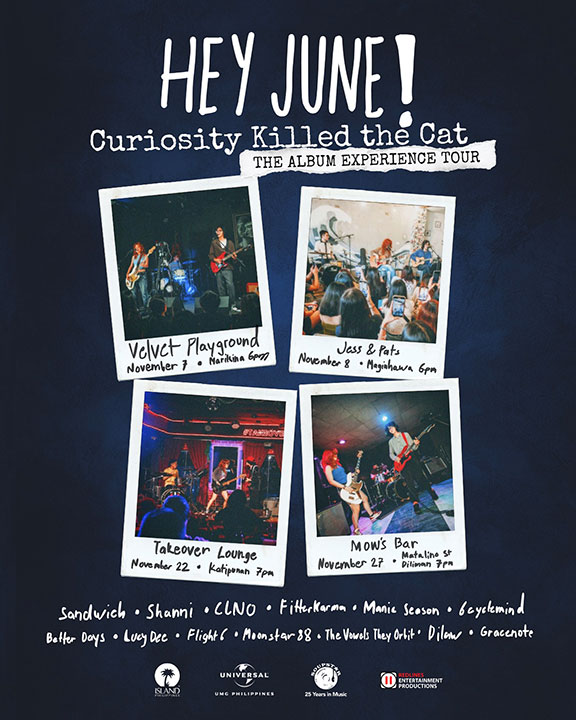
FILIPINO alternative pop band HEY JUNE! has announced their first-ever headlining concert series, Curiosity Killed The Cat: The Album Experience Tour. Named after their debut album, the tour follows the success of their single “LASIK,” which trended online after being featured on Pinoy Big Brother: Collab Edition. The shows will take place on Nov. 7, 6 p.m., at Velvet Playground in Marikina, with guest artists Dilaw and Gracenote; Nov. 8, 6 p.m., at Jess & Pat’s in Maginhawa, Quezon City, with guest artists Moonstar88 and The Vowels They Orbit; Nov. 22 at Takeover Lounge in Katipunan, Quezon City, with guest artists 6cyclemind and Better Days; and Nov. 27, 7 p.m., at Mow’s Bar in Matalino, Quezon City, with guest artists Sandwich and Shanni.


Catch ABS-CBN’s The Alibi on Prime Video

A brand-new TV series, The Alibi, produced by Dreamscape Entertainment and ABS-CBN Studios, is a Filipino psychological thriller that explores the thin line between truth and deception. With themes of love, betrayal, and survival, it stars Kim Chiu as a sex worker and Paulo Avelino as a privileged journalist, who find themselves entangled in a dark mystery. It is out now on Prime Video.


Listen to Nicole Laurel Asensio’s new single

NICOLE Laurel Asensio is back in the Philippines after a holding a successful series of shows abroad. Her latest offering, “Let Our Love,” released under Warner Music Philippines, is a team-up with producer and multi-instrumentalist Gabe Dandan. The track is subtle, sensual, and full of soul. It also draws from R‘n’B and jazz influences, with a touch of 1990s pop. “Let Our Love” is a teaser track for an upcoming EP, to be released early next year.


Watch women-led Filipino films on Netflix

TWO of CreaZion Studios’ woman-led films, Isang Himala and Flower Girl, will stream on Netflix this November. Now on the platform is Isang Himala, which won the Special Jury Prize at last year’s Metro Manila Film Festival. A reimagining of the 1982 film classic Himala in a movie musical format, it stars Aicelle Santos, Kakki Teodoro, and Bituin Escalante, under the direction of Pepe Diokno. After that, Flower Girl will join Netflix on Nov. 20. The closing film of the New York Asian Film Festival, it stars Sue Ramirez as a woman who is one day cursed to have no vagina and must go on a journey of self-discovery to get it back.

Vanke is reigniting the debate China wants to bury

VANKE.COM

By Shuli Ren

CHINA seems to find solutions to the world’s thorniest economic problems. Its exports juggernaut is marching on despite President Donald Trump’s tariffs. The domestic AI industry is booming without Nvidia Corp.’s high-end chips.

But once in a while, a dormant zombie comes back to haunt it, serving as a reminder to global investors that the government hasn’t dealt with its most pressing economic issues even as the stock market rallies.

Shenzhen-based China Vanke Co., one of the nation’s biggest developers, is this zombie. Shenzhen Metro Group Co., a state-owned enterprise that is its largest shareholder with a 27% stake, seems to have had a change of heart lately on how much financial support it’s willing to give.

The urban rail operator, owned by the city government, is asking Vanke to retroactively pledge collateral for existing unsecured loans worth 20.4 billion yuan ($2.9 billion). It’s also setting a cap on the loan facilities it will provide.

This came as a shock. Throughout the year, Shenzhen Metro has been seen as the entity the city government will use to rescue Vanke. As of Oct. 30, roughly 70% of its loans were unsecured, in what investors perceive as the most concrete sign of an informal bailout.

The burning question now is who will be responsible for Vanke’s bills. The company needs to repay 5.7 billion yuan of public bonds in December, and another 7.7 billion yuan in the first half of 2026. As of June, the developer’s cash pile was only able to cover 44% of its short-term debt, the lowest since data became available in 1992.

It’s understandable why Shenzhen Metro is balking. Vanke is growing into an ever-expanding black hole. Contracted sales are at risk of falling by 40% this year, creating a cash shortfall north of 100 billion yuan, according to Bloomberg Intelligence. Without the Shenzhen government’s support, Vanke may not be able to survive, and its bondholders could be staring at debt restructuring — or even worse, default.

Five years into a property downturn, Beijing has been using partial, unofficial bailouts to diffuse potential financial crisis caused by developer blowups. Shenzhen Metro, for instance, is widely seen as the lender of last resort to Vanke, even though its stake could classify the SOE as a passive investor.

Until recently, this half-baked effort has worked reasonably well. The pace of corporate delinquencies has slowed. Meanwhile, the biggest developers that defaulted have largely hobbled toward the end of their restructuring, as creditors accept more onerous terms.

Beijing, in turn, is more than happy to declare mission accomplished. In recent policy meetings, the property recovery was put on the back burner, while technology and innovation took the center stage. Unlike last year, the government no longer pledges to “halt the real estate market decline.”

But this big headache won’t go away on its own. New-home sales extended a slump in October, falling 42% from a year earlier, according to data compiled by Bloomberg. In other words, Vanke is the norm, not an exception.

Meanwhile, the latest kerfuffle is reigniting a debate over how Beijing plans to diffuse the developer time bomb. Some believe there’s no too-big-to-fail in China, and that the likes of Vanke will eventually ask to extend their borrowings or spiral into a default. Others have more political stability in mind. In their view, the government doesn’t want to rock the boat any further and will find another SOE to come in as a liquidity provider.

Either way, Shenzhen’s reluctance to give unconditional love to Vanke shows that China’s real estate woes are deepening. Beijing can’t just turn the page yet.

BLOOMBERG OPINION 

Soliciting donations for a grieving colleague

This is my first time to work as a human resources (HR) manager for a company managed by foreign nationals. Yesterday, the spouse of one worker died, and some workers initiated an abuloy collection drive. I am worried how this cultural practice might come across to some of the foreign managers. — Drama Mama.

In many Filipino private and public organizations, extending financial help to a bereaved colleague is almost automatic. It’s not about the money but showing that you and other employees’ care.

It’s common to see an envelope quietly being passed around to collect abuloy. It’s not compulsory, but serves as a demonstration of pakikisama (camaraderie). At any rate, colleagues are not expected to give a large amount of money.

In many foreign-managed work environments, however, especially those influenced by Western management practices, the workplace is expected to be free of any form of solicitation, regardless of its purpose and the amount of money involved.

What’s understood as pakikisama may, in some foreign culture, be seen as a policy violation, an ethical gray area, or even an HR compliance risk. That’s because what feels like generosity for Filipinos can feel like pressure to foreigners, regardless of the collection’s voluntary nature.

Western ethics are guided by fairness and neutrality. No one should feel coerced, even subtly, to contribute to a cause they might not personally support. This difference in mindset often creates an awkward tension: employees want to show sympathy, but foreign managers may not like it.

Should they allow the donation drive, or risk appearing cold-hearted by saying no?

Welcome to the globalized workplace, where good intentions need management approval.

GLOBAL RULES, LOCAL HEARTS
No company policy manual can capture the full spectrum of human emotion. When a colleague’s family member dies, the corporate playbook rarely tells us what to do beyond granting bereavement leave. Yet, in human terms, the question isn’t just about policy — it’s about decency.

In some cases, multinational firms operating in the Philippines eventually learn to adapt. They recognize that local culture values community support. Therefore, HR should take a proactive approach by doing the following:

One, review precedents and previous cases. Since you’re new to the organization, it’s best to check with people who know better. If solicitation was allowed before, review the reasons and under what conditions. It’s best to be prepared for any eventuality if you decide not to perpetuate such precedents.

Two, allow voluntary participation. There should be no pressure, no guilt trips. However, this is more difficult than it seems. People would rather give something not out of compassion, but to address the invisible pressure they feel. Imagine a situation where an abuloy collector waits in front of your work station for your share.

Three, require discreet coordination. Use personal channels instead of official company platforms. That means, people may not be able to use company e-mails, even company time or similar approaches to carry out a solicitation campaign. Rather, encourage them to give their abuloy directly to the bereaved worker.

Four, prepare an official management expression of sympathy. The organization could send flowers, a mass card, and a token amount. It’s the right balance between empathy and professionalism that should not weigh on the workers’ shoulders.

Five, lead by example. Sometimes, a personal note or visit from management and its representatives means more than any amount of money. The real goal isn’t to raise funds, but to raise morale.

LEADING WITH EMPATHY
Compassion doesn’t have to clash with compliance. In fact, culturally intelligent HR departments can use these moments to strengthen the organization’s emotional intelligence. That means showing genuine concern through culturally attuned actions.

When leaders acknowledge grief and allow space for compassion, they’re not just being kind; they’re reinforcing trust and engagement.

I once talked to a Japanese executive who had been living in the Philippines for more than 35 years, who proposed to manage the situation by taking the best of both cultures: “In Japan, we follow rules. In the Philippines, we follow relationships. The best leaders learn to do both.”

COMPASSION AS A KPI
In management terms, kindness doesn’t appear on the balance sheet, but it does reflect in employee retention, morale, and engagement. A company that balances rules with respect for human emotions earns something more valuable than compliance — loyalty.

So, is it appropriate to solicit donations for a grieving employee’s family in a foreign-owned company? Yes, but only if done with discretion, sensitivity, and consent. Compassion is universal, but it must pass through the right HR channel. There’s nothing wrong with passing the hat — as long as you’re not passing the buck.

In a globalized workplace, empathy must come with etiquette. The most admired leaders know that policy keeps order, but compassion keeps people. The best organizations don’t just manage resources — they manage relationships.


Have a free consultation of your workplace issues with Rey Elbo. E-mail elbonomics@gmail.com or DM Facebook, X, LinkedIn or via https://reyelbo.com. Anonymity is guaranteed.


How PSEi member stocks performed — November 6, 2025

Here’s a quick glance at how PSEi stocks fared on Thursday, November 6, 2025.