Home Blog Page 1747

How CloudCFO aims to simplify accounting process for F&B companies

PCH.VECTOR-FREEPIK

ACCOUNTING and advisory firm CloudCFO seeks to streamline traditional bookkeeping processes to make it easier for food & beverage (F&B) companies to track their finances.

“Now more than ever, with rising costs due to inflation, maintaining profitability through rigorous control over margins is key to not only staying competitive in the F&B industry, but also to setting restaurants up for the future,” it said in a statement on Wednesday.

CloudCFO is a cloud accounting platform that seeks to deliver real-time financial data to help fast-track business operations. It focuses on payroll, tax compliance, and financial consultancy.

“As an outsourcing provider specializing in accounting, bookkeeping, and finance services, CloudCFO offers customized, technology-driven solutions, enhancing the financial operations and strategic decision-making of startups and SMEs (small and medium enterprises),” it said.

CloudCFO conducts an in-depth assessment of a company’s business model and its current practices to help tailor-fit its bookkeeping services.

“For restaurants, the review covers various internal controls such as POS systems, reconciliation of multi-channel payments, inventory management, and regulatory compliance.”

The company has developed “proprietary technology” specific to a company’s needs to help easily identify opportunities and challenges in the restaurant’s finances.

It also helps restaurants track costs and inventory, as well as customer transactions regardless of the payment channel. — Beatriz Marie D. Cruz

CCA embraces sustainability

Culinary school looks back at 28 years of highs and lows

THE Center for Culinary Arts Manila (CCA Manila) did not celebrate its 28th anniversary in a grand manner on Nov. 26 — it didn’t even hold it in its new BGC campus. Instead, a dinner was held for guests at the BGC Urban Farms (the community garden set up in a block between some of the development’s skyscrapers), featuring a plant-based menu done in collaboration with John Danao of Green Oasis, an agri-social enterprise based in Dupax, Nueva Vizcaya.

A short talk by Veritas F. Luna, CCA Manila’s chancellor, centered on culinary wellness, with points on cultural and personal enjoyment, skillful preparation, and overlooked moderation and hydration during eating. These points were put to the test with the menu, featuring dishes like pumpkin and moringa soup, mustasa (mustard greens) salad with passionfruit vinaigrette, papaya palabok, pinakbet burrito, and tomato and ginger sorbet.

We had expectations with the pumpkin soup, which tasted comforting; complimented by its heft, but we had a pleasant surprise with the papaya palabok, the noodles in the dish substituted with shredded green papaya. The usually heavy dish became a light repast, and despite our aversion to fruit, we might look forward to seeing this at someone else’s table.

The dinner highlighted CCA Manila’s commitment to sustainability, seen in a plant-based kitchen in Tagaytay in a partnership with Guang Ming College, and in a culinary agri-entrepreneurship program in collaboration with the University of the Philippines Los Baños.

“For us, it’s really part of our DNA since CCA started,” said Badjie Trinidad, president of CCA Manila in an interview.

The school was started 28 years ago by her mother Annie Guerrero. “My mom is a culinary environmentalist,” she said, recalling that her mother told her stories about growing up in Malabon. Back then, her mother and her sisters would receive a budget from their parents, but her mother would be the only one who could come up with change by the end of the week. She did this by sourcing everything from nearby markets and their own backyard — down to their toys.

“When we started the school, she would be very strict with our chefs,” Ms. Trinidad recalled, citing that students and even faculty members would get demerits and memos for waste and other environmental issues — all this before “sustainability” had become a buzzword.

“I think employers appreciate our graduates, when they work, because they’re very mindful of their resources,” said Ms. Trinidad.

She discussed the problems they faced to get to 28 years: “One, of course, is the sourcing of ingredients. We want to give the best training but not all of the ingredients are available,” she said. Another would be hiring faculty that “both have technical and practical experience.”

There was also the pandemic, but then, “We never thought we could teach culinary online. We were never closed — maybe just for a week. But we continued and we persevered.”

“I guess we just have to persevere,” she said about how they got to 28 years. This also comes with focus: “Just focus on what we (found) that we do best, which is really culinary training.” While she said that they didn’t expand into other programs, what they did was to form new courses that only served to complement the culinary training core, with paths in entrepreneurship and food technology.

Ms. Trinidad cited the difference in the profiles of their students now, versus then. Before, they used to cater to city-based students, but a lot of their new students are from the provinces or from overseas.

She talked about their plans for the future, namely, opening 10 campuses in five years. “Fulfilling 5,000 culinary dreams — that’s the target we set for ourselves,” she said. Part of this includes upcoming partnerships with University of the Philippines Diliman, and with Brittany Hotel in BGC.

“We never stopped innovating our programs,” she said. “Just like when we started CCA. No one thought that anyone would enroll for a two-year program. They thought of it just as a hobby; a short course. Now, it’s a career.” — Joseph L. Garcia

Business lessons from a global Filipina

FAMA FRANCISCO — US.PG.COM

Filipinos are making their mark all over the world. Of course, we have our pambansang bayani, our overseas Filipino workers who are shining examples of hard work, resilience, and the Filipino spirit. At the same time, we have Filipino businessmen and women who are making an impact at the highest levels of the corporate world.

In my years speaking to and working with Filipino entrepreneurs and professionals from various industries, I’ve come to the conclusion that Filipinos have much to offer to the world. Our mix of ingenuity for problem-solving, resilience in the face of hardship, and an unstoppable work ethic all contribute to world-class Filipinos in the workplace. I call them global Filipinos — our kababayans who can make it anywhere in the world.

I recently spoke to one such global Filipino, Fama Francisco. Fama began her career with Procter & Gamble (P&G) Philippines back in 1989 when she was just 21 years old. It was a different time, and right from the start she was already breaking the glass ceiling as the first female sales manager at P&G.

Many firsts followed. She was the youngest woman to be promoted to president in P&G. And then she became the highest-ranking Asian female executive in P&G, leading the company’s second-largest sector, overseeing 17,000 employees in 180 countries, and being responsible for $20 billion in sales as the CEO of Global Baby, Feminine and Family Care.

What can we learn from the example of Fama Francisco? And how can you too become a global Filipino? I’ve summarized four points from our all-too-brief conversation during our Fireside Chat at the P&G Philippines Grand Alumni Homecoming (Incidentally, I had the privilege of working with Fama in the same Advertising Department in the ’90s as a young brand manager. As they say among P&G Alumni — “Once a PGer, Always a P&Ger”).

1. “P” IS FOR “PERSISTENCE.”
In business, failure is part of the journey. What I’ve learned from speaking to the most successful entrepreneurs and business people is the way they react to setbacks or learn from failure. Oftentimes, they treat failure as a learning opportunity, or other times they move on quickly to the next thing. Or they try and try again until they get things right.

Fama met failure early on in her career. As a graduate of a marketing course, she applied to become a brand manager in P&G. And she was rejected. But that didn’t stop her.

“I learned my first lesson from P&G,” Fama says. “[It] starts with P: persistence. If one door is closed to you, you don’t give up, right? We find another way. We find another door. So, my other door was sales. I applied for sales.”

With great humility, Fama accepted the job in sales, knowing it wasn’t what she wanted. However, she knew that it was still the opportunity she needed to join P&G. And also, she knew that walking through this door would lead to other doors opening.

2. OVERCOME STEREOTYPES.
When Fama joined sales in P&G, it was a time when the workplace was dominated by men. In particular, they weren’t used to seeing women in sales.

Fama recalls, “The first time I would call on the accounts, they would always say, there’s the demo girl of P&G. There’s the demo girl who’s going to demo Tide. There’s the girl who’s going to demo Pampers.”

Faced with this situation, Fama had the courage and grace to stand her ground. She knew she belonged in her role in sales, and she demanded that people respect that.

“I had to learn how to introduce myself,” Fama tells us. “I would say, I’m not your demo girl. Good morning. I’m your sales manager from P&G. I’m here to build your business.”

Global Filipinos may face unfair stereotypes in a number of ways, from gender to race, to other biases. The lesson here is easy to learn but takes courage to execute. So, like Fama, be courageous. Remember, you belong where you are.

3. SET THE BAR.
Fama Francisco credits her early years in P&G for much of her success. Among the things she learned was from her time in sales: persistence, a growth mindset, and planning.

Another crucial lesson was learning how to be world-class.

Fama shares, “Growing up in P&G Philippines, we all knew P&G Philippines was world-class. Whether you were working on our brands, whether you were working on sales, whether you were working on R&D, whether you were working in our manufacturing plants — Tondo and Cabuyao — P&G Philippines was always world class. And that was another learning that I had.

“You have to set the bar to always be world-class.”

4. REMEMBER TO REFILL YOUR “OXYGEN TANK.”
Finally, being a global Filipino isn’t all about work. The most effective professionals are often very good at balancing work and life.

Fama acknowledges this truth by focusing on refilling what she calls “oxygen tanks.”

Lahat tayo (all of us), we have oxygen tanks,” she explains. It just differs how many oxygen tanks we have. One of your oxygen tanks could be your family, your faith, yourself, your work, or your friends who are like family.

“Some of you might have five oxygen tanks, six oxygen tanks,” she continues. “Now, at any point in life, hindi naman pwedeng (it can’t be that) all the levels of the oxygen tank are perfect. Di ba? They’re never perfect. They always go up and down. But it’s very important to know what levels your oxygen tanks are. And if something is really going down, you have to catch it and you have to top up your oxygen tank.”

Only when your oxygen tanks have enough air can you work to your fullest potential. So make sure to always fill up those tanks with care from the ones you love, or with time spent on the things you are passionate about.

How does Fama do it? She says, “So 5:30 in the morning, I’m already awake. But the first thing I do to start the day? Two minute hug with my husband. Because our philosophy is, life is always going to be so busy.”

From that point, there’s no stopping this global Filipina.

“And then I start the day,” she goes on. “I would say, more than half of the day, you can’t really anticipate. You cannot anticipate what work brings your way.” n

Are there other entrepreneurs or business leaders you want me to interview? Please let me know, send me an e-mail at ledesma.rj@gmail.com.


RJ Ledesma (www.rjledesma.com) is a Hall of Fame Awardee for Best Male Host at the Aliw Awards, a multi-awarded serial entrepreneur, motivational speaker and business mentor, podcaster, an Honorary Consul and editor-in-chief of The Business Manual. Connect with Mr. Ledesma on LinkedIn, Facebook and Instagram. The RJ Ledesma Podcast is available on Facebook, Spotify, Google and Apple Podcasts.


FMIC completes sale of FAMI stake

FIRST METRO Investment Corp. (FMIC), the investment banking arm of listed Metropolitan Bank & Trust Co. (Metrobank), has signed the deed of sale for its controlling stake in First Metro Asset Management, Inc. (FAMI) to the ATR Asset Management Group (ATRAM Group).

“Please be informed that First Metro executed today a Deed of Absolute Sale with ATR Financial Holdings, Inc., following MET Holdings, Inc.’s execution of an Accession Agreement transferring its rights to ATR Financial Holdings, Inc.,” the company said in a disclosure to the local bourse on Wednesday.

The accession agreement allows the entrance of a new party into an existing contract.

On Oct. 30, FMIC’s board of directors approved the sale and signed a share purchase agreement for its 70% stake in FAMI with MET Holdings of the ATRAM Group.

Before the transfer of rights, the transaction involved the sale of FMIC’s 1,050,000 common shares representing 70% of the issued and outstanding capital stock of FAMI to a consortium made up of the ATRAM Group, led by its parent firm ATRAM Investment Management Partners Corp., and MET Holdings.

FMIC has said the sale of its majority stake in its asset management arm is “part of its strategy to focus on the investment banking business.”

FAMI is the principal distributor, administrator and fund manager of First Metro Philippine Equity Exchange-Traded Fund, Inc. and FMIC’s mutual funds.

It was founded in 2005 by FMIC as a joint venture with the Catholic Educational Association of the Philippines and Marist Brothers Congregation Philippines, Inc.

Meanwhile, the ATRAM Group operates through ATRAM Trust and ATR Asset Management, Inc., managing portfolios made up of mutual funds, trust assets, insurance portfolios, and real estate for its clients. It had assets under management of over P385 billion at end-September.

Metrobank’s attributable net income rose by 11.35% to P12.124 billion in the third quarter, bringing its nine-month net profit to P35.729 billion, up by 12.4% year on year.

Its shares went up by P1.20 or 1.63% to close at P75 each on Wednesday. — A.M.C. Sy

‘Zero trust’ mindset to aid businesses in managing cyberthreats amid the holidays

FREEPIK

A “ZERO TRUST” approach amid the increase in online activities this holiday season can help businesses boost their security and defense against cyberthreats, according to industry experts.

The zero trust mindset emphasizes “strict verification for every user and device accessing their networks,” Palo Alto Networks said in a statement.

“By integrating comprehensive threat detection, response, and data protection into a Zero Trust framework, businesses can enhance visibility, streamline security operations, and enable real-time threat responses.”

International Business Machines Corp. (IBM) added that this type of security approach helps address risks brought by remote workers, hybrid cloud services, personal devices, and other elements of today’s corporate networks.

“Zero trust operates on the principle of “never trust, always verify” rather than granting implicit trust to all users inside a network,” IBM said.

According to the 2024 TechTarget Enterprise Strategy Group report, more than two-thirds of organizations revealed they are implementing zero trust policies across their enterprises.

Apart from businesses, consumers also face risks like online scams and fraud during the holidays, according to the Philippine National Police (PNP).

“Christmas is a season of joy and giving, but it is also a period when criminal elements may exploit public vulnerability,” PNP said in a statement.

“Our operations target the syndicates behind these scams, but the public’s awareness and caution are crucial in preventing victimization,” it added.

Palo Alto Networks reminds the public to verify the authenticity of e-mails and links, use two-factor authentication, shop only through official channels, beware of phishing scams, use strong and unique passwords, and never provide sensitive personal details to protect themselves from harmful acts online.

“With the holiday season and Christmas shopping in full swing, Filipinos may feel more inclined to act on attractive offers without verifying the source,” Palo Alto Networks Philippine Country Manager Oscar Visaya said in a statement.

“By fostering a culture of vigilance, we can protect ourselves and others in a landscape where threats are constant,” he added. — Almira Louise S. Martinez

Agoda: More Filipinos eyeing int’l travel for New Year’s Eve

PHILIPPINE STAR/WALTER BOLLOZOS

INTERNATIONAL and domestic flight-related searches are increasing as the holiday season approaches, digital travel platform Agoda said.

“It’s exciting to see more Filipinos looking to celebrate New Year’s Eve abroad,” Mike Hwang, Agoda country director, said in a statement on Tuesday.

According to Agoda, a 34% increase in accommodation searches for international trips has highlighted the influx of Filipinos traveling abroad to celebrate the beginning of 2025.

The digital travel platform added that Tokyo, Hong Kong, Taipei, Bangkok, and Singapore are the top five destinations among Filipinos.

Domestic travel searches also increased by 2%, while inbound searches grew by 10% compared to last year.

The company added that Manila, Cebu, and Boracay Islands are the most popular domestic destinations.

Meanwhile, international travelers, predominantly from South Korea, Japan, and the United States, prefer Manila, Cebu, and Bohol.

“More interest from international travelers consider starting 2025 here in the Philippines,” Mr. Hwang said.

In preparation for the passengers brought by the holiday season, flag carrier Philippine Airlines (PAL) will mount more flights to key domestic and international destinations.

“Our goal is to help people reunite with their loved ones, and we’re committed to expanding our services to meet the needs of our customers and make holiday travel as convenient as possible,” PAL said in a statement.

As of Dec. 15, international visitors to the Philippines reached 5.65 million, falling short of its 7.7-million goal for the year, according to the Department of Tourism. — Almira Louise S. Martinez

Dining In/Out (12/19/24)


Do good this Christmas at The Peninsula

THE PENINSULA MANILA once again welcomes guests with a sumptuous calendar of delicious experiences this Christmas as, the hotel’s culinary team unveils festive menus for guests to savor with family, friends, and loved ones at its restaurants. Since its founding, The Pen has extended support to underserved community members through outreach programs and charitable donations. This year, guests can join in contributing to the welfare of children with the Peninsula Festive Afternoon Tea that will feature finger sandwiches, pastries and cakes paired with homemade scones, and a choice of tea or champagne. For each Festive Afternoon Tea set sold at The Lobby, the hotel will donate a portion of the proceeds to the Make-A-Wish Foundation Philippines, an organization that grants the wishes of children with life-threatening illnesses. The afternoon tea is available daily from 2:30 to 5 p.m., for P3,170 (with tea of your choice) and P5,370 (with two flutes of champagne). The hotel’s various dining outlets will be offering special meals on Christmas Eve and Christmas Day. On Dec. 24, The Upper Lobby will be offering a merienda buffet and a dinner buffet. On Dec. 25, it will be serving la carte breakfast, lunch, and dinner merienda buffet. The hotel’s fine dining restaurant, Old Manila, will be serving a four-course set dinner, aside from à la carte lunch and dinner on Dec. 24 and 25. The hotel’s buffet restaurant, Escolta, will have a special Christmas Eve Dinner Buffet and Christmas Day lunch roast and dinner buffet. Spices, the hotel’s Asian restaurant, offers an array of exotic flavors that will bring an extra dash of warmth and joy to the festive season, with special lunch and dinner offerings on Dec. 24 and 25. Savor with family, friends, and loved ones at its restaurants. Visit the official hotel website at peninsula.com/manila/special-offers for more details.


Discovery Samal welcomes holiday with festive offerings

DISCOVERY SAMAL celebrates the Christmas season with dining experience and exclusive holiday packages. On Dec. 24, from 6 to 10 p.m., The Shoreline and Morning Catch restaurants will host a special Christmas Eve Dinner Buffet for P6,000 net per person. Guests can indulge in holiday favorites likeRoast Beef (P20,350 net for 6 kg), Roasted Turkey (P11,500 net for 8 kg), and Christmas Ham (P5,850 net). Festive pastries and treats are also available, including Signature Christmas Log Cakes (P900 net), French Macarons (P250 net), classic Fruit Cake (P850 net), Christmas cookies (P250 net), and the Gingerbread Castle centerpiece at P2,200 net. Discovery Samal offers holiday party packages tailored to groups of various sizes, starting at P300,000 net for 50 guests. These packages include venue use, buffet options, lechon, beer kegs, and other festive inclusions. Also, special room packages are available for those seeking a holiday getaway, starting at P27,385 net, with perks like roundtrip transfers, daily breakfast, and access to beach and pool facilities. For reservations, e-mail @discoverysamal.com or fb@discoverysamal.com.


7-Eleven brings Taiwan flavor to its stores

CONVENIENCE STORE 7-Eleven is taking Filipinos on a culinary journey to Taiwan with its new Taste of Taiwan lineup, available in select stores in Luzon. Partnering with its in-house brands — Big Time Meals, HottaRice, and 7-Fresh — it now offers an array of Taiwanese-inspired dishes including the Big Time Meals Chicken Chop Bento (P129), HottaRice Lu Rou Fan or Taiwanese Braised Pork (P99), and 7-Fresh Taiwanese Beef Noodles (P95). For snacks there are the 7-Fresh Pepper Pork Bun (P59) and the 7-Fresh Almond Jelly for dessert.


Jollibee opens eco-friendly branch in Tuguegarao

JOLLIBEE recently launched a branch at Enrile Blvd., Tuguegarao City, Cagayan, which is designed with sustainability in mind, incorporating advanced green technologies to reduce environmental impact while delivering the brand’s signature offerings to customers. The store utilizes solar panels to lower energy consumption by up to 30%, along with a solar water heater and solar window films that regulate indoor temperature. High-efficiency motors have also been installed to manage the exhaust system and air supply, optimizing energy use during off-peak hours — key for a store that operates 24/7.  Also, the store converted its pylon lights to LED, reducing energy use by 80%. Motion sensors in restrooms, automatic low-flow faucets, and a modern wastewater treatment facility further enhance the store’s eco-friendly operations by recycling clean water for toilet use and other maintenance activities, including rainwater collection.


Bounty Fresh introduces safer, healthier holiday chicken

BOUNTY FRESH CHICKEN is setting a new standard for holiday meals with its No Antibiotics Ever (NAE) farming approach, ensuring safer and healthier poultry options for consumers. By eliminating the use of antibiotics and steroids throughout the chickens’ lifecycle, the company adheres to strict biosecurity measures, promoting natural health and optimal living conditions. This approach supports global health initiatives to combat antibiotic resistance, reduces the risk of superbugs, and aligns with ethical and sustainable farming practices. Bounty Fresh offers a diverse selection of products, including Whole Chickens, Premium Chicken, Gourmet Chickens in various flavors, and NAE Chicken Cut-Ups for convenient meal preparation. With pre-marinated options such as Meals in Minutes, the brand caters to the needs of modern households during the busy holiday season. Bounty Fresh products are available at supermarkets.


Korea’s Eat Pizza offers different flavors

EAT PIZZA is bringing a fresh and innovative approach to the local dining scene with its Korean-inspired pizza slides. Since debut in October, the brand has captured the attention of both food enthusiasts and Hallyu fans with its distinctive 10-inch rectangular pizzas, offering unique, personal-sized portions with creative and bold flavors. The menu features 10 options, including Korean Sausage with honey mustard and relish, Beef Bulgogi with marinated beef, and Samgyeopsal with local meat and Korean cheese. Sweet options like Sweet Potato, Sweet Milk, and Sweet Corn are also available, alongside classic choices like cheese, pepperoni, and aloha. Popular Korean sides such as Sweet Potato Corn Cheese, Tteokbokki with Cheese, and Sweet & Spicy Corn Cheese complement the pizzas, along with Spaghetti and Carbonara for added variety. For more information, follow Eat Pizza on their social media pages.

Can everybody be a winner?

FREEPIK

SHOULD life always be a contest? If it is not (and it shouldn’t be), then there are really no winners and losers. Of course, in our culture, rankings are common, even when it comes to social status. In front page news on media, bar exams show the grades of the passers, and those in the Top 10. This top ranking is attached to the winners for the rest of their lives.

Still, some cultural forces avoid the tags of winners and losers. Ratings have now become more qualitative even for those who can’t catch up — needs improvement.

The report card, especially for primary school students, is now given the more positive spin of “progress report.” This avoids the traditional numerical grading based solely on exams and evaluation of reports. Ratings are no longer quantitative, favoring fewer qualitative classifications such as exceptional, good, and most friendly. Blurring performance levels can build self-confidence especially for those who “missed the bus.”

The message is a double negative: There are no losers. Everybody is a winner. This confidence-building approach promotes a rating system where nobody feels left behind. If a child is poor in math, she may get a stamped star anyway for joining the spelling contest and going three rounds out of five. (Get a math tutor.)

Contests that need to attract large numbers of participants give as many “awards” as possible. These are not even called “consolation” prizes. There may be an award just for showing up early.

To keep their ratings and broaden viewership, beauty contests have expanded their circle of winners. Prizes are handed out for talent, friendliness, and photogenic appeal. Sponsors give out minor prizes (Ms. Skin Whitener) where the winner serves as product endorser for one year. Finalists are designated as a “court of honor.” (Each one gets a sash too.)

What are online postings in social media, after all, but avenues for life’s consolation prize winners? While not as rich and powerful as the icons they are photographed with, these attendants to the rich and famous become part of the entourage.

However, in real life, not everybody is a winner. Being outside the circle at the top is indistinguishable from being a loser. It’s the podium position that attracts celebrity status, along with its prizes.

Nurtured as a child to always feel good after a contest, the adult may be unprepared for the competitive world that routinely classifies contestants as winners and losers. The sheltered child, now an adult, may have gifts previously recognized (most friendly). When a winner is declared, the nurtured child, now an adult, is apt to sulk and grudgingly accept a plaque of appreciation. The applause for the real winner is just too disheartening.

A student used to a soft grading system (or not being graded at all) discovers the perils of not understanding the difference between winning and losing. When job hunting, he realizes that he either gets the job or a letter saying, “We will keep your application on file should the need for a stoic philosopher come up.”

Corporate performance ratings have not followed the “feel good” bandwagon. There are even forced rankings that put the “bottom 10%” of the rates at risk — what have you done to increase market cap?

Sports contests too are binary. One either wins or loses the championship trophy. The result is straightforward. One team has a bonfire party and the other complains about the officiating. (That last shot shouldn’t have counted.)

The Olympic Games pronounce winners and losers, even if the difference in speeds is only a hundredth of a second. The second-place winner may complain about the accuracy of the clock, but such an attitude makes him the worst type of competitor — a sore loser. Even in defeat, a winning attitude of humility and good cheer is appreciated — I’ll try harder next season.

In any situation, it is our attitude that matters. Sure, it could be better, but it could also have been worse. As Epictetus, the stoic, puts it — we cannot control what happens to us, only how we react to it.

Winning or losing is not just about attitude, especially in the public arena. It is about what is at stake… when one ends up at the losing end.


Tony Samson is chairman and CEO of TOUCH xda

ar.samson@yahoo.com

2024 the ‘year of the bond’ as record inflows top $600 billion

LONDON — Investors have poured a record $600 billion into global bond funds this year, taking advantage of some of the highest yields in decades ahead of an uncertain 2025.

Dwindling inflation has finally allowed central banks to lower interest rates, pushing investors to lock in the relatively high yields available and finally delivering the “year of the bond” after $250 billion left fixed-income funds in 2022.

“The story is income,” said Vasiliki Pachatouridi, head of EMEA iShares fixed-income strategy at BlackRock. “We are seeing the income being put back into fixed income. We haven’t seen these levels of yields in almost 20 years.”

Bond yields tend to fall, and prices rise, as central banks reduce short-term borrowing costs.

Although returns on the ICE BofA global bond index have been middling at around 2% this year, the yield on offer topped 4.5% late last year, the most since 2008.

As of mid-December, $617 billion had flowed into developed and emerging market bond funds, according to financial data provider EPFR, topping 2021’s $500 billion and putting 2024 on track to be a record year.

Stocks, meanwhile, have drawn $670 billion of inflows as indexes in the US and Europe scale new heights. Cash equivalent money market funds, which boast high yields and little risk, have fared the best, pulling in more than $1 trillion.

CREDIT CRAZE
Corporate bonds, which offer higher yields than equivalent government debt, have proven particularly popular, rallying as companies weathered the rise in central bank interest rates.

The yield on the ICE BofA global corporate bond index has fallen to its lowest over risk-free government debt since before the financial crisis in 2007.

“Before interest rates started to drift up a few years ago, a lot of companies locked in their funding for a long time,” said Willem Sels, global chief investment officer at HSBC’s private bank.

“Therefore, the impact of rising borrowing costs on corporates was much less than people expected. At the same time, a lot of companies earned more on their cash holdings.”

PASSIVE AGGRESSIVE
Investors have shown a clear preference for passive exchange-traded funds (ETFs), which were on track for a record year with $350 billion of inflows by the end of November, according to Morningstar Direct data.

“ETFs give investors access to a number of assets that previously were harder to trade, including bonds,” said Martin Oehmke, professor of finance at the London School of Economics.

“Corporate bonds, for example, are notoriously illiquid and ETFs offer easy access to this market in a much more liquid form.”

The two biggest passive fund players — BlackRock and Vanguard — have reaped the benefits.

BlackRock’s iShares fixed-income ETF business alone attracted $111 billion of inflows between January and the end of October, according to estimates from Morningstar Direct. Vanguard’s bond funds took in an estimated $120 billion, the vast majority of which went to its index business which includes ETFs.

PIMCO, traditionally known for its active management, has also had a strong year. It has drawn around $46 billion into its bond funds, according to Morningstar, after shedding some $80 billion in 2022.

FLOWS COULD SLOW
A number of factors could cause inflows to slow in 2025. President-elect Donald J. Trump’s tax-cutting and deregulatory agenda has caused US stocks to jump and inflows into equities to surge, limiting the appeal of bonds.

Data from EPFR and TD Securities shows $117 billion flowed into US stock funds in the four weeks after Mr. Trump’s Nov. 5 victory, more than four times the $27 billion into global bonds.

Meanwhile, investors are skeptical that corporate bonds can rally much further after this year’s strong performance.

“It seems very hard to continue to expect spreads to tighten much more, and I don’t believe that bond yields will be much lower from where we are today,” said Carl Hammer, global head of asset allocation at Swedish bank SEB. — Reuters

Asia hedge funds eye Chinese tech leading AI charge in 2025

An artificial intelligence (AI) sign is seen in this illustration taken on June 23, 2023. — REUTERS/DADO RUVIC/ILLUSTRATION

HONG KONG — Some Asian hedge funds are betting on leading Chinese tech companies such as Xiaomi and Baidu, buoyed by their artificial intelligence (AI) innovations, despite the threat of further US curbs that could take effect next year.

A US ban imposed on advanced chip exports to China has kept many global investors on the sidelines. But those scouring China for potential winners said firms there are developing AI products for a massive home market as their self-developed large language models catch up, and valuations are lower than their US peers.

Fund managers say they are particularly upbeat about growing AI adoption in the lives of China’s 1.4 billion people, from mobile phones and smart wearables to social apps and games.

“Chinese innovations are reaching end-users rapidly,” said Nilesh Jasani, founder of GenInnov Funds and former vice-chairman for Asia at Jefferies.

“We have been extremely excited by China’s ascendancy in mobility and mobiles, benefiting names like Xiaomi and Baidu,” he said, noting his fund has been raising exposure to China.

China’s leading search engine company Baidu recently launched a text-to-image generation tool for its ad clients. It also plans to release AI glasses early next year and debut its robotaxi service outside mainland China.

Hong Kong hedge fund Monolith Management, which manages assets worth $300 million, has set its sights on smartphone maker Xiaomi and its suppliers.

“Xiaomi offers compelling edge AI user experience through its self-developed HyperOS, with a larger ecosystem of IoTs and cars to tap into, compared to its Western counterparts,” said Timothy Wang, chief investment officer at Monolith.

Chinese tech stocks have lagged behind their US counterparts in this year’s global AI frenzy.

The Hang Seng Tech Index and CSI AI sector have risen 19% and 21%, respectively, while the Nasdaq 100 has gained over 30%.

But Wang predicts growth opportunities for China’s homegrown AI-powered products and services in the coming year. The advances would be driven by the proliferation and commercialization of large language models, coupled with the country’s supply chain strengths and a wealth of skilled product managers, he said.

ByteDance’s AI chatbot Doubao became the world’s second most popular AI application in November with 60 million monthly active users, only behind ChatGPT, according to Aicpb.com.

“We are seeing breakthroughs in AI software, such as text-to-video generation and multimodal AI,” said Sean Ho, CIO of Triata Capital, which manages $770 million in assets.

“The high rankings of Chinese AI models on open-source platforms like Hugging Face reflect their ambition to lead globally, a trend that is unlikely to be derailed by ongoing tech conflicts,” he said in recent investor communications.

Not everyone is convinced, especially as US, Taiwan, and Japan semiconductor stocks dominate tech investors’ portfolios and deliver strong results.

Eventually, it comes down to whether AI can boost earnings growth, said Andy Maynard, head of equities at China Renaissance Securities.

“China is clearly lagging the US in terms of monetization at the listed company level,” he said. — Reuters

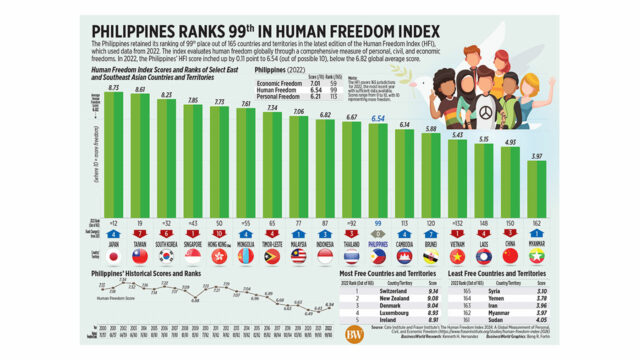
Philippines ranks 99th in Human Freedom Index

The Philippines retained its ranking of 99th place out of 165 countries and territories in the latest edition of the Human Freedom Index (HFI), which used data from 2022. The index evaluates human freedom globally through a comprehensive measure of personal, civil, and economic freedoms. In 2022, the Philippines’ HFI score inched up by 0.11 point to 6.54 (out of possible 10), below the 6.82 global average score.

Philippines ranks 99<sup>th</sup> in Human Freedom Index

How PSEi member stocks performed — December 18, 2024

Here’s a quick glance at how PSEi stocks fared on Wednesday, December 18, 2024.