ASEAN nations plan tariff talks with United States
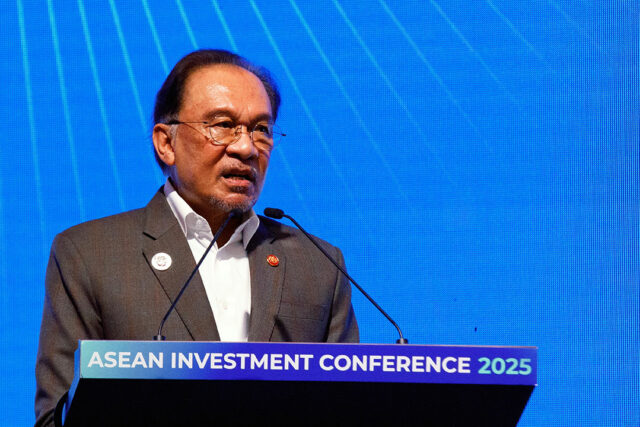
MALAYSIAN Prime Minister Anwar Ibrahim said his country and the Association of Southeast Asian Nations (ASEAN) partners will dispatch officials to Washington, D.C. for talks following President Donald J. Trump’s rollout of global tariffs.
“There may be limited room to revisit the underlying intent, but there is still scope for adjusting the policy’s implementation,” Anwar said in his opening speech at the ASEAN Investment Conference 2025 in Kuala Lumpur. “The global trading system is under intense strain, more so than at any point in recent memory.”
Southeast Asian nations were hard hit by the so-called reciprocal tariffs rolled out by Mr. Trump last week, though they vary depending on each country’s trade relationship with the US. Malaysia faces a 24% levy; US tariff on Indonesia was set at 32%; and Vietnam exports will be charged at 46%. The US tariff on Singapore was set at 10%, while the levy for the Philippines will be 17%.
In response, countries across the region are examining both policy responses to support their economies while seeking relief from the tariffs in talks with the US. Vietnam Deputy Prime Minister Ho Duc Phoc on Monday canceled afternoon meetings in New York to hurry to Washington, people with knowledge of the matter said earlier. Mr. Trump’s tariffs on Vietnam and other countries take effect at 12:01 a.m. in Washington on Wednesday.
Indonesia has announced plans to send a heavyweight delegation to Washington next week, including Finance Minister Sri Mulyani Indrawati and the economy and foreign ministers.
Thailand’s Deputy Prime Minister Pichai Chunhavajira will also visit the US, Prime Minister Paetongtarn Shinawatra said in a statement on Sunday, without specifying any timing. “What we will communicate to the US government is that Thailand is not just an exporter, but we are a reliable ally and economic partner,” Paetongtarn said.
Singapore will set up a taskforce to address economic uncertainties, Prime Minister Lawrence Wong told lawmakers on Tuesday, warning that the official growth forecast of 1%-3% for 2025 is likely to be revised lower.
Mr. Wong said a Special ASEAN Economic Ministers’ Meeting will be convened this week to discuss how the bloc can work together to boost trade and as a “strong signal of ASEAN’s commitment to regional economic integration.”
The Philippines on Monday said it may cut tariffs on US products, while also consider joining a potential collective response by ASEAN.
Malaysia is the current chair of the ASEAN group of 10 Southeast Asian countries. Anwar said over the weekend that Malaysia will lead efforts to coordinate a regional response by Southeast Asia toward US tariffs.
On Tuesday, he deviated slightly from a distributed written copy of the speech by specifically mentioning ASEAN’s role in US talks.
“As part of our soft diplomacy of quiet engagement — and I built this consensus among ASEAN leaders — we will be dispatching together with our colleagues in ASEAN, our officials to Washington to begin the process of dialogue,” Anwar said.
Noting that the bloc accounts for total trade in goods of $3.5 trillion, Anwar also called for more internal economic cooperation, including more regulatory alignment, cross-border logistical work and digital connectivity.
“With the barrage of tariffs sweeping across the world in fast and furious fashion, we are witnessing the fraying of the global order,” Anwar said. “Therefore, ASEAN must rely more on itself.”
Anwar, who was Malaysia’s finance minister during the 1997-1998 Asian financial crisis until he fell from grace with then-Prime Minister Mahathir Mohamad, said the “Trump tariffs” are not the first challenge to multilateralism and won’t be the last.
“If ASEAN can hold its nerve — staying open, pragmatic and cohesive — it may yet be among the last believers in a world that works better when it works together,” he said. — Bloomberg