Home Blog Page 1722

Prevention: Dog’s best defense against parasites

FREEPIK

DOGS are natural explorers, eager to socialize and engage in playful adventures. However, this love for freedom often exposes them to unseen threats such as parasites, which can harm their health and sometimes even be fatal. While it may sound cliché, prevention remains the best defense in protecting pet dogs, a veterinarian said.

Dr. Sixto Miguel Enrique Alimudin S. Carlos, veterinarian and general manager of the Makati Dog and Cat Hospital, said in a webinar led by Boehringer Ingelheim Pets that pet owners must understand the risks posed by both skin and internal parasites to effectively protect their pets’ health.

Heartworm is a prime example of a preventable parasite that remains the leading cause of fatalities from parasites among dogs, Mr. Carlos said.

“Five percent of dogs are infected. The sad thing is it is easy to prevent a heartworm infection,” Mr. Carlos said in a mix of English and Filipino.

Mr. Carlos added that heartworm infection can easily be prevented by taking dogs to the family veterinarian as early as six months old, with preventative options available either orally or through injection.

Other parasites are gut worms, commonly including roundworms and tapeworms. If not prevented and treated, gut worms can lead to serious health issues, such as injury of the digestive system, which may manifest as bleeding in the feces and result in weakness and lethargy in affected dogs.

“All worms are parasites. They absorb nutrients that are important for dogs,” Mr. Carlos explained.

Roundworms can be acquired if a dog consumes infected feces or has physical contact with other dogs, while tapeworms are typically acquired when a dog ingests a flea.

Gut worms can be prevented by scheduling regular check-ups with the family veterinarian or simply by maintaining cleanliness in the dog’s environment, such as regularly cleaning up feces.

The most common parasites found almost everywhere are ticks and fleas. The hot and humid weather of the Philippines creates an ideal environment for these crawling parasites, which can pose serious health risks to dogs, Mr. Carlo said. Ticks can transmit blood-borne parasites, which can be fatal if left untreated, while fleas can lead to tapeworm infections. Regular grooming and flea and tick prevention treatments should be done to protect dogs from these common parasites.

Mr. Carlos emphasized that owners must ensure their pets receive essential vaccines and other preventative treatments to avoid health complications and potential fatality. While it may involve costs, protecting their pets is ultimately the owner’s responsibility. — Edg Adrian A. Eva

On airports and attaining fiscal balance

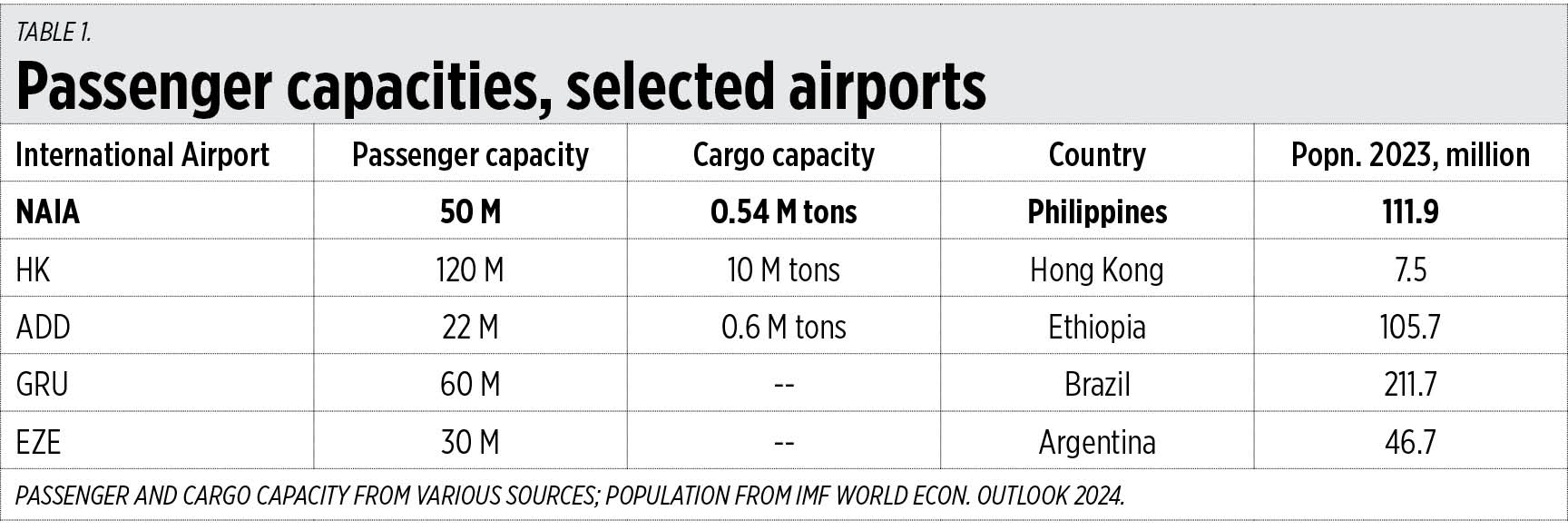
BUENOS AIRES — I just arrived here in the capital city of Argentina via Ethiopian Airlines. My route was: Ninoy Aquino International Airport (NAIA) to Hong Kong (HK), two hours; Hong Kong to Addis Ababa Bole airport (ADD), Ethiopia, 11 hours; Addis Ababa to Sau Paulo’s Guarulh (GRU) airport, Brazil, 12 hours with a stop to refuel; then Sau Paulo to Buenos Aires’ airport (EZE), three hours. Including the time spent waiting for flights at NAIA, HK, ADD, and GRU, the trip came to a total of about 36 hours.

This is a particularly long trip, but this is the first time that I set foot in Africa — at least the airport in Ethiopia — and my first time to set foot in South America. So, I welcome this trip with curiosity. I am here to attend meetings and lectures with leaders of free market think tanks and taxpayers’ associations from several countries around the world.

I came up with this short table to make a brief comparison of the airports I passed through over the past two days.

I arrived in the evening in HK, ADD in the early morning, GRU in the afternoon, and EZE in the evening. My quick observation of these airports is that the combined brightness at night of ADD, EZE, and possibly GRU — runways, passenger terminals, other structures — were perhaps just half as bright as the Hong Kong airport. The ADD runway is dark and not lighted enough. The same could be said perhaps for the size of passenger terminals.

About my fellow passengers, one thing I noticed was that from HK-ADD, there were plenty of African passengers. But from ADD-GRU and EZE, I think there was not a single African passenger. I hypothesize that perhaps Africans would rather do business with East Asians than South Americans. Especially now that China is now expanding its diplomatic and economic footprint in Africa, those Africans probably came from mainland China and Hong Kong.

From EZE to Buenos Aires city proper, three things surprised me when compared to Metro Manila.

One, their roads are much smoother — I did not see or feel a single pothole or bump on the road.

Two, the center island lights are much brighter than on EDSA or even the Skyway.

Three, there were very few motorcycles on the road.

The privatization of NAIA — the New NAIA Infra Corp. (NNIC) took over its operation last September — was a great development in Philippines airport modernization. The Department of Finance (DoF) got an upfront payment of P30 billion from NNIC plus P2 billion/year guaranteed payment, plus an estimated P120 billion from its 82.16% share on gross revenue excluding passenger service charges over the concession period.

NNIC will spend some P170.6 billion to modernize NAIA, increasing its airport capacity from the original 35 million passengers per annum (mppa) to 62 mppa, and increasing flight movements per hour.

LESSONS FROM ARGENTINA
On Dec. 11, Argentina’s President Javier Milei held a press conference tackling a very important issue — he said that Argentina has no budget deficit for the first time in 123 years. He explained that “The deficit was the root of all our evils — without it, there’s no debt, no emission, no inflation. Today, we have a sustained fiscal surplus, free of default, for the first time in 123 years. This historic achievement came from the greatest adjustment in history and reducing monetary emission to zero.”

It was indeed a big achievement. Many subsidies were cut and there was no major social and political backlash. President Milei’s policy is called “Unbreakable Fiscal Rule” — that the administration must cover debt interest payments before allocating further spending.

The Philippines can take some lessons from this new trend in Argentina. Since the National Government always has a budget deficit but the local government units (LGUs) always have budget surpluses, then certain national agencies and spending must be cut and the LGUs allowed to cover whatever they need to from their own revenues, both local and external like LGUs’ share from the National Tax Allotment or NTA (see Table 2).

Many LGUs, especially the rich cities, have their own expanded social welfare systems, have their own city-owned universities, science high schools, and city-owned hospitals.

So, candidate national agencies that can handle no increases in spending — with no need to decrease their budgets — in my opinion are the Department of Social Welfare and Development (DSWD), the state universities and colleges, the Department of Education (DepEd), and the Department of Health (DoH).

Attaining a fiscal balance (where revenues are equivalent to expenditures) by 2028 is a political and economic goal in itself for two reasons: it will free up huge resources away from high interest payments, projected to reach P800+ billion this year alone, and with the government borrowing less to cover old loans means lower interest payments and low inflation.


Bienvenido S. Oplas, Jr. is the president of Bienvenido S. Oplas, Jr. Research Consultancy Services, and Minimal Government Thinkers. He is an international fellow of the Tholos Foundation.

minimalgovernment@gmail.com

HelloMoney sees wider Japan acceptance with PayPay-Alipay+ deal

ASIA UNITED Bank Corp.’s (AUB) e-wallet HelloMoney is expected to have wider acceptance in Japan, supported by Alipay+’s expanded partnership with PayPay.

“We welcome the continued expansion of the Alipay+ network of partners as this enables AUB to bring HelloMoney closer to more users, making mobile banking easier as well as helping more merchants grow their business globally,” AUB Executive Vice-President and Head of Operations & Information Technology Wilfredo Rodriguez Jr. said in a statement on Monday.

Alipay+, through its recently expanded partnership with PayPay, one of Japan’s quick-response (QR) payment operators, will now connect over three million local merchants in Japan to global payment partners, including HelloMoney.

“HelloMoney users can enjoy seamless and secure payment and travel experiences at even more merchants in Japan this year-end travel season and beyond,” AUB said.

In Japan, HelloMoney users can now scan PayPay QR codes to make payments at merchant-presented mode stores, even if the merchants don’t have Alipay+ point of sale materials.

“Alipay+ will collaborate with PayPay merchants to launch a promotional campaign, which will run from Dec. 20, 2024 to Jan. 10, 2025,” AUB added.

AUB is currently the only Philippine bank that has a partnership with Alipay+, which also allowed it to become the first local lender with an e-wallet with cross-border mobile payments.

Besides Japan, HelloMoney can be used at all merchants that carry the Alipay+ logo in Singapore, South Korea, Malaysia, and Hong Kong SAR.

Launched in 2019, HelloMoney now has a customer base of more than six million. Besides cross-border payments, the app also has other features and product offerings such as prepaid load, remittance via PeraPadala, QR code payments, bills payment, and automated teller machine withdrawals, among others.

AUB’s net income jumped by 71.44% to P3.35 billion in the third quarter amid higher revenues. This brought its nine-month performance to P8.78 billion, up by 40.97% from a year ago.

Its shares closed unchanged at P62.70 apiece on Monday. — A.M.C. Sy

Ayala Corp. to redeem P10-B bonds next year

AYALALAND.COM.PH

AYALA CORP. has announced plans to fully redeem its P10 billion, 4.8200% bonds due 2025 on the maturity date, Feb. 10, 2025.

“The bonds shall be redeemed by payment in cash of the redemption price set at 100% of the issue price plus all accrued and unpaid interest based on the coupon date of 4.8200% per annum,” the company told the local bourse on Monday.

In its notice of bond redemption, Ayala Corp. said that the payment of the redemption amount will be made to bondholders recorded as such on Feb. 6, 2025 via electronic register of bondholders maintained by the Philippine Depository & Trust Corp. as registrar.

The company noted that there must be no secondary trading of the bonds or modifications in the accounts starting on the record date.

The listing of the bonds on the Philippine Dealing & Exchange Corp. will be terminated upon redemption on maturity date, it said.

On Monday, Ayala shares at the stock exchange went down 0.08% to close at P613.50. — Sheldeen Joy Talavera

2025 real estate outlook: What to watch for

PHILIPPINE STAR/MIGUEL DE GUZMAN

(First of two parts)

THE past twelve months have produced mixed results for the Philippine property. Office vacancies remain elevated while a sizable condominium inventory has yet to be absorbed by the Metro Manila market. Meanwhile, the retail sector has been recording sustained mall space take-up despite new supply while rebounding consumer spending has also been benefiting the leisure sector, resulting in occupancies more than tripling since the pandemic. Industrial parks continue to expand with greater prospects from sunshine segments such as electric vehicles and related components.

Meanwhile, the next 12 months provide vast opportunities for developers to reassess their strategies. They should identify growth opportunities and know how to recalibrate. 2025 is a year where we will likely see the full impacts of policy changes implemented in 2024 and the results of midterm elections likely to set the stage for 2028 national polls. Property firms should thoroughly evaluate headwinds in the market but should be quick in maximizing tailwinds. Only those who pivot will stay afloat.

OFFICE: OPTIMIZING NEW MARKET DYNAMICS POST-POGO
We see record high vacancies with the POGO exodus, but not all central business districts (CBDs) are the same, with Makati CBD, Fort Bonifacio and Ortigas CBD faring better.

Per submarket, Makati CBD will continue to record healthy occupancy rates as we only recorded limited vacated spaces. In our view, primary CBDs such as Fort Bonifacio, Ortigas CBD and Makati CBD are likely to recover faster compared to the Bay Area, Alabang and Makati Fringe. In 2024, we project overall vacancies to rise to 20.5%, a record high. In our latest briefing poll, Makati CBD emerged as the preferred destination for relocation and expansion. In fact, we believe that Makati CBD is up for redevelopment.

Tenants should take advantage of available fitted office space especially those implementing flight to cost and flight-to-quality measures. We see more occupants, including government agencies, taking advantage of high-quality office spaces being offered at a discount. Note that average lease rates in Metro Manila corrected by nearly 40% from 2020 to 2023.

We are likely to see sustained office space demand in Pampanga, Cebu, Davao, Bacolod, Iloilo, and Davao. We are getting queries from large BPO firms planning to either open their first facility or expand in these locations.

We see a more pronounced take-up for green and sustainable office space across the country.

In the first nine months of 2024, Colliers recorded 293,900 square meters (3.2 million square feet) of office space transacted in green buildings with Leadership in Energy and Environmental Design (LEED), Excellence in Design for Greater Efficiencies (EDGE), WELL Building Standard (WELL), and Building for Ecologically Responsive Design Excellence (BERDE) certifications or pre-certifications. This is nearly double the amount compared to the 151,900 sq.m. (1.6 million sq.ft.) transacted a year ago. Given the heightened importance of sustainability in occupiers’ office requirements, landlords are encouraged to infuse green features into their portfolio.

Major office developers are taking the lead in promoting sustainability in workspaces. We see a more pronounced promotion of healthy office space as developers and occupants work together to lure employees back to traditional office setup.

HOTEL: FOREIGN BRANDS BETTING BIG ON PHILIPPINE HOSPITALITY
Visitor arrivals are expected to be at more than seven million this year — that is up by more than 20% year on year (YoY). The Tourism department is targeting 12 million foreign tourists in 2028. This should entice developers to build more homegrown brands or form partnerships with foreign operators in constructing more accommodation facilities across the Philippines especially in emerging tourist destinations.

Colliers believes that now is an opportune time for foreign brands to expand their presence in the Philippines given the planned modernization of the country’s international airports and the projected rise in international arrivals. The government has also set a lofty goal of attracting 12 million international tourists in 2028. Other foreign branded hotels in the pipeline will come from Sheraton, InterContinental Hotels, Dusit Thani, Citadines, Tryp by Wyndham and AppleOne’s JW Marriott in Panglao, Bohol. Colliers recommends that developers be on the lookout for upcoming convention centers and soon-to-be modernized airports outside the capital region for their hotel expansion plans.

Colliers believes that the establishment of more meetings, incentives, conferences, and exhibitions (MICE) is a must especially now that the government is positioning the Philippines as a key MICE destination in the world. The integration of these facilities is of utmost importance especially in business hotels located in major business districts in Metro Manila, Pampanga, Cebu, and Davao.

(To be continued.)


Joey Roi Bondoc is the director and head of Research of Colliers Philippines.

joey.bondoc@colliers.com

Entertainment News (12/17/24)


DTI fair for last-minute Christmas shopping

THE THIRD edition of the Department of Trade and Industry’s (DTI) Bagong Pilipinas Christmas Village Fair has opened at the Filipino Village on the 2nd Level of Ayala Malls Manila Bay. Running until Dec. 22, this festive marketplace showcases the craftsmanship and creativity of Filipino micro, small, and medium enterprises (MSMEs). Visitors can seize the opportunity to shop for unique, locally made holiday gifts while supporting local businesses. This year’s fair features a wide array of handcrafted goods, including fashion accessories, home décor, artisanal crafts, and food products. The Christmas Village Fair is open daily with free admission.


KZ Tandingan, Dionela in Eastwood’s New Year Countdown

EASTWOOD CITY is set to welcome the new year with its annual New Year Countdown on Dec. 31, starting at 8 p.m., at the Eastwood Mall Open Park. Headlining the event are KZ Tandingan and her husband, TJ Monterde, joined by Janine Teñoso, Barbie Almalbis, the P-pop group Dione, and singer-songwriter Dionela. The celebration will feature live performances, a fireworks display, and the iconic star drop at midnight — an homage to New York City’s Times Square ball drop. For more information, visit megaworld-lifestylemalls.com.


MTRCB, GMA Network ink partnership

THE Movie and Television Review and Classification Board (MTRCB) and GMA Network Inc. have signed a partnership to advance the “Responsableng Panonood Tungo sa Bagong Pilipinas” campaign by promoting age-appropriate media choices among Filipino families. As part of the partnership, MTRCB’s infomercial will be shown on GMA Network’s channels to reach more families. MTRCB Chairperson and Chief Executive Officer Lala Sotto-Antonio expressed gratitude to GMA Network, highlighting that the partnership underscores the role of media as a force for good and their shared commitment to creating a more responsible media landscape. GMA Network Senior Vice-President Annette Gozon-Valdes also reaffirmed their support for informed and responsible media consumption.


Special edition whisky from Johnnie Walker, Squid Game

JOHNNIE WALKER has partnered with Netflix’s Squid Game to release a limited-edition Black Label bottle, celebrating the hit show’s return for Season 2. The special edition was launched on Dec. 13 and 14 at Forbestown BGC in Taguig City, featuring numbered labels from 001 to 456 as a tribute to the players in Squid Game. Designed with innovative digital and traditional printing technologies, the special edition offers a unique collectible experience with the iconic Johnnie Walker Striding Man logo wearing a green tracksuit inspired by the show’s signature style. Available to fans 21 and older, the special edition can be purchased online and in leading supermarkets nationwide. For updates on events and availability, follow Johnnie Walker on social media @johnniewalkerph.


Cebuana singer-songwriter Jolianne drops new single

CEBUANA singer-songwriter Jolianne has released her latest single, “Plain Girl,” a playful and honest anthem exploring the bittersweet realities of single life. Combining jazz-infused pop with Disney-like whimsical melodies, the track offers a fresh perspective on loneliness, missed connections, and the ups and downs of navigating relationships. Produced by Jonah Bru and RJ Pineda, “Plain Girl” is the second single from her debut EP, which will explore themes of love, heartbreak, and yearning. Plain Girl” is now available on all streaming platforms worldwide via Careless Music and Sony Music Entertainment, with its live performance video available on her official YouTube channel.

Where are all the women in the chip sector?

AT A MASSIVE semiconductor trade show in Tokyo last week, I watched robots shoot hoops and play table tennis and witnessed an impressive lineup of executives share their visions on everything from quantum computing to artificial intelligence.

More than 1,000 companies representing nearly every facet of the supply chain gathered to show off their latest technologies to an estimated 100,000 attendees. But as I walked over from the local train station amid a sea of men in suits, I wondered where all the women were.

It’s not unusual for the semiconductor industry, and tech sector in general, to feel like a man’s world. That’s why I was heartened to see that roughly 12% of the speakers this year were women. This representation sounds dismal, but it’s a lot better than some of the other panels and seminars I’ve attended recently in Tokyo.

This uneven reality is not a fault of the convention or unique to Asia. The lack of women in the chip sector is a global conundrum. A report last year found that the median of women representation in the workforce lies between 20% to 29%, and the percentage of women in technical roles was in the 10% to 19% range. These figures shrink even further with management roles.

Companies in the chip industry desperately need to overhaul efforts to recruit and retain women workers. There’s been some backlash against corporate diversity efforts in recent years, and one of its most vocal critics was recently elected US president. But there is no time for this exclusionary debate when it comes to this sector: It’s already in the throes of a massive labor shortage.

The global semiconductor business is projected to become a trillion-dollar industry by the end of the decade. It would be a shame for women to miss out on this economic boom, particularly given their participation is key to overcoming the biggest anticipated hurdle to unlocking this potential. Industry association Semi projects the need for 1 million additional workers by 2030.

At a time when governments around the globe are spending billions of dollars to get ahead, policymakers need to recognize that efforts to boost domestic production can’t afford to leave half the population behind. For private sector leaders, there’s also a mountain of data that suggests more women leaders make for better performing and more resilient businesses.

But in the tech sector, the stakes feel even higher. Diversity drives innovation, and the groupthink that arises from a lack of it can weaken firms trying to solve hard problems. Japan’s tech ecosystem, in particular, has faced criticism for not being innovative as it fell further and further behind Silicon Valley. At the same time, women have been left out of the nation’s tech sector. Japan had the smallest share among OECD nations of girls who expect to work in science or technology when they turn 30, and the lowest share of women graduates in science, technology, engineering, and math, known as STEM.

At a panel looking at some of the barriers companies face as they recruit and retain women, this smaller pool of STEM graduates emerged as a key issue. Solving this will take more than just company efforts. It will require systemic changes that encourage women to pursue career paths in tech at the university level and even earlier. Government mandates can help force corporate change, but they aren’t enough to support the front-end of this pipeline. Meanwhile, promoting women to leadership is critical to tackle a lack of role models and mentors in higher positions within the semiconductor industry.

As much as it can feel like a man’s world, there are glimmers of hope. Last week, Time Magazine unveiled Advanced Micro Devices, Inc. (AMD) Chief Executive Officer Lisa Su as its CEO of the Year. The Taiwanese-born immigrant to the US oversaw a 50-fold increase in AMD’s share price during her time at the helm. Her tenure is the subject of a Harvard Business School case study — showing women are more than capable of leading in this sector when given the opportunity. In a recent interview, Su said she’s passionate about her work with the Global Semiconductor Alliance’s women’s leadership initiative, touting the importance of bringing females in the industry together for support and mentorship.

I was thrilled to encounter swaths of women in some audiences at the convention. Amid the heated race for dominance in the tiny components that power our smartphones, computers, and cars and the booming demand for AI, those countries and companies that come out on top will be the ones that have as many women in their workforce as men — not to fill some diversity quota, but because their businesses need them.

BLOOMBERG OPINION

Central bank cancels registration of money service business

BW FILE PHOTO

THE BANGKO SENTRAL ng Pilipinas (BSP) has canceled the registration of a money service business, it said in a statement on Monday.

The BSP said the Monetary Board approved the cancellation of the registration of Fil-Express International Remittance & Delivery Services, Inc., in its resolution dated Oct. 16.

The business was found violating Section 901-N of the Manual of Regulations for Non-Bank Financial Institutions for a Money Service Business.

A money service business refers to financial services that involve the acceptance of cash, checks, other monetary instruments or other stores of value, and the payment of a corresponding sum in cash or other form to a beneficiary by means of a communication, message, transfer, or through a clearing network to which the service provider belongs, according to a BSP definition.

These include remittance and transfer companies; remittance service agents; and money changer/foreign exchange dealers, among others.

Latest data from the Anti-Money Laundering Council showed there are a total of 687 money service businesses registered with them as of March 27. — Luisa Maria Jacinta C. Jocson

MAP names Al Panlilio as 77th president

ALFREDO S. PANLILIO — BW FILE PHOTO

THE MANAGEMENT Association of the Philippines (MAP) announced on Monday the appointment of Alfredo “Al” S. Panlilio as its president for 2025.

Mr. Panlilio, who currently serves as chairman of Maya Bank, Inc. and director of PLDT Inc., will take over the role following the re-elections necessitated by the withdrawal of the former appointee, the organization said in a statement.

MAP had previously elected Emmanuel P. Bonoan as its 77th president, but he withdrew before taking office due to personal reasons.

Mr. Panlilio served as president and chief executive officer (CEO) of PLDT from June 2021 to December 2023, and Smart Communications, Inc. from August 2019 to December 2023.

“With PLDT as a long-time supporter of the Philippines’ digital transformation, Al is among the founding members under the Digital Infrastructure pillar of the Private Sector Advisory Council, which was formed in July 2022,” MAP said.

Mr. Panlilio had also held positions in Manila Electric Co. and its various subsidiaries.

“An advocate of the value of sports in maintaining a strong republic and international relations, he is a member of the International Basketball Federation (FIBA) Central Board and second vice-president of the FIBA Asia Board,” MAP added.

He currently holds positions in the MVP Sports Foundation, the National Golf Association of the Philippines, the Philippine Olympic Committee, and Samahang Basketbol ng Pilipinas.

Mr. Panlilio holds a Bachelor of Science in Business Administration in Computer Information Systems from San Francisco State University.

He also holds a Master of Business Administration (MBA) from both the Hong Kong University of Science and Technology and Northwestern University’s Kellogg School of Management.

MAP said that board members for 2025 include Metro Pacific Investment Corp.’s Michael T. Toledo as vice-president, SGV and Co.’s Wilson P. Tan as treasurer, Ayala Healthcare Holdings, Inc.’s Paolo F. Borromeo as assistant treasurer, and GT Capital Holdings, Inc.’s Gil B. Genio as secretary.

Other members include Ayala Corp.’s Jose Rene Gregory D. Almendras, Center for Excellence in Governance’s Rex C. Drilon II, CEO Advisors, Inc.’s Marianne B. Hontiveros, and KPMG’s Mr. Bonoan. — Adrian H. Halili

AI adoption fuels demand for data centers in PHL — Leechiu

EPLDT.COM

By Beatriz Marie D. Cruz, Reporter

THE INCREASING adoption of artificial intelligence (AI) is driving demand for data centers in the Philippines, which could, in turn, spur growth in the country’s property sector, according to Leechiu Property Consultants (LPC).

“Although we’re seeing a resurgence of the tourism (industry), because of the sluggishness of the office and residential sectors, (data centers are) one part of the property sector that can push for new development, new markets,” LPC Director for Research and Consultancy Roy Amado L. Golez, Jr. told BusinessWorld last week.

Data centers, which house IT infrastructure like networked computers and storage systems, are expected to grow with the adoption of AI.

The Philippines is hard-pressed to speed up its adoption of AI amid its potential to improve productivity in sectors like IT-BPM (information technology-business process management), manufacturing, and healthcare.

“There’s really a huge need to house the information and data that we will be needing as we move towards a more augmented AI,” Mr. Golez said during a briefing last week.

The Philippines, with 73.6% of its population (around 86.98 million) using the internet, is a potential major market for data centers, according to Datareportal, a platform that provides global digital insights and trends.

However, the Philippines lags behind its Southeast Asian peers in terms of the power capacity for its data centers.

The country’s current capacity is at 1.53 watts per capita, significantly lower compared to Singapore (187.67 watts/capita) and Malaysia (18.77 watts/capita).

“It’s (data centers) an industry that’s worthwhile to look at, and I hope that it’s an industry that will also fuel the office market in the next few years,” Mr. Golez said.

Meanwhile, the 2024 full-year office vacancy rate remained flat since the start of the year at 18%, according to LPC.

Vacated spaces jumped by 65% to 690,000 square meters (sq.m.) from 418,000 sq.m. last year, mainly driven by the ban on Philippine offshore gaming operators (POGO).

For 2025 and 2026, office vacancy is seen staying flat at 18%, before falling to 16% by 2027.

“Demand will continue to grow, but we will need time to be able to absorb the contractions and the new buildings that will be injected into the market next year,” LPC Director for Commercial Leasing Mikko Baranda told the briefing.

Leasing demand in the office market grew by 4% to 1.1 million sq.m. from 1.07 million sq.m. despite the POGO ban.

“Government demand for office spaces increased sixfold over the past year, marking a significant milestone in 2024,” Mr. Baranda said.

Demand from government offices was also the highest in seven years, accounting for 11% or 122,000 sq.m. of demand. Traditional offices had the biggest share at 44% or 492,000 sq.m., followed by the IT-BPM sector (38% or 422,000 sq.m.), and POGOs (7% or 76,000 sq.m.).

Within Metro Manila, the Bay Area recorded the largest demand for office space at 24% or 213,000 sq.m., with government accounting for 38%. This was followed by Makati City with 22% or 198,000 sq.m., and Ortigas/Mandaluyong/San Juan at 17% or 152,000 sq.m.

‘SLUGGISH’ RESIDENTIAL MARKET
For the residential sector, the number of Metro Manila condominiums sold dropped by 37% to 25,565 in the first eleven months of the year from 40,555 a year ago. This was the lowest recorded since the start of the pandemic, Mr. Golez said.

The number of new launches also plunged year on year by 46% to 13,226 units from 24,656 units in 2023.

Due to the slow selling pace, it would take around 34 months before the current supply of condominium units is sold, according to Mr. Golez.

“By early next year, we expect many developers to start offering new or novel or innovative schemes for the purchase of condominium units,” he said. “We’re already hearing more furnished units, more management, more involvement of the developers.”

In the hospitality sector, Leechiu expects around 7,500 pipeline keys scheduled to open next year, according to Alfred Lay, director for hotels, tourism, and leisure at LPC. This would be led by Metro Manila (2,882 keys), Panglao Island, Bohol (936 keys), and Mactan, Cebu (869 keys).

Other issues expected to affect the hospitality industry in 2025 include the privatization of the Ninoy Aquino International Airport, the turnover of some public-private partnerships, the value-added tax refund system for tourists, recovery in source markets, and the growing interest in branded residences.

Overseas Filipinos’ Cash Remittances

CASH REMITTANCES from overseas Filipino workers (OFW) rose by 2.7% in October, the slowest growth in four months, data from the Bangko Sentral ng Pilipinas (BSP) showed. Read the full story.

Overseas Filipinos’ Cash Remittances

How PSEi member stocks performed — December 16, 2024

Here’s a quick glance at how PSEi stocks fared on Monday, December 16, 2024.