Home Blog Page 1721

As economy stalls, Germany struggles to get consumers spending

The Brandenburg Gate is illuminated during the Festival of Lights, in Berlin, Germany Oct. 4, 2024. — REUTERS/LISI NIESNER/FILE PHOTO

BERLIN — With global trade deeply uncertain and a tariff war causing havoc on financial markets, Germany’s next government is hoping to unleash domestic consumption to revive stalled growth in an economy that has been driven for decades by exports.

Conservative chancellor-in-waiting Friedrich Merz, in a newly forged coalition with the center left Social Democrats (SPD), has announced policies such as tax cuts and raising the minimum wage.

He hopes these measures will increase purchasing power and support domestic demand. However, economists, retail groups and consumer behavior experts question whether they will be enough to persuade Germans — already among the world’s biggest savers — to break open their piggy banks and spend.

“I doubt that we will really see a sharp consumption revival this year,” Carsten Brzeski, global head of macro told Reuters.

Germany’s attempts to wean itself off its exports dependency predate the trade turmoil unleashed by the Trump administration, as it has long struggled to deal with declining competitiveness.

Since 2023, domestic consumption has been stagnant however, with the household savings rate reaching 20% last year due to political uncertainty, above the EU average of 15%.

To avoid a third year of contraction in 2025, economists agree that boosting consumption in Europe’s biggest economy is crucial.

“Looking at it in a very simple way you can say, okay, there is a fall in demand for our export goods, so we have to strive for more domestic demand, which is investment and consumption,” Cyrus de la Rubia, chief economist at Hamburg Commercial Bank AG, told Reuters.

Merz’s coalition has agreed to lower income taxes for middle and lower income households, which could help consumption, the German retail association HDE told Reuters. “However, we do not expect a significant upturn.”

The government will make overtime pay tax-free and offer tax benefits for those working beyond retirement age. The minimum wage is expected to rise to 15 euros ($17.10) per hour and the value-added tax (VAT) on food in restaurants will be lowered to 7% from a current 19%.

Deutsche Bank, however, said these “miscellaneous fiscal gifts” will provide only limited relief in the near term.

Since unveiling the measures, Mr. Merz’s coalition has started bickering about the contents of the agreement, with Mr. Merz warning that tax cuts would only happen if there was enough money in the budget.

Moreover, the measures would likely take time to change household habits, Salomon Fiedler, an economist at Berenberg, told Reuters.

“German consumers seem to need a more psychological kickstarter: a policy or political breakthrough,” Mr. Brzeski said.

Despite a borrowing bonanza announced by Mr. Merz after the election, consumer sentiment was broadly unchanged afterwards, with a cooling labour market also making households hold back.

SUSTAINABILITY TRENDS
Adding to their reluctance to spend, German consumers are increasingly conscious of their environmental impact.

In the heart of Berlin is Kleiderei, a labyrinth of aisles with clothing from virtually every decade and style imaginable that customers can borrow for a monthly fee, like “a clothing library.”

“Our model is about slowing down consumption and creating a real community,” Kleiderei director Lena Schroeder told Reuters, having now five physical stores in Germany. “When customers visit our stores, they can touch and feel the clothes, making more conscious decisions about what they borrow.”

Kleiderei only includes pre-owned clothes in its collection of 60,000 pieces, repairing them to maintain quality.

As fast fashion brands like Shein and Temu rise, social media influencers advocate more environmentally responsible consumption.

“These advertisements on TV or radio always want people to buy more… but we actually don’t need it,” said Lisa Monaco, founder of the blog Nachhaltig4Future. “We already have an excess of everything – it’s not good for anyone.”

The 34-year-old, who started her sustainability platform in 2020 during the pandemic, provides tips ranging from zero waste to-go kits to sustainable cleaning products.

“Influencers have become the new gatekeepers of consumer attention, especially for younger generations,” Barbara Engels, senior economist at the IW institute told Reuters. “Luxury is out, values are in.”

Such a trend may continue. Close to 60% of the Germans reported consuming sustainably in some way, while 71% said they would like to do more, a 2023 study from the Development Engagement Lab showed.

“The project ‘making German consumers spend again’ will not be an easy one and requires patience and stamina,” said Mr. Brzeski. — Reuters
Tariffs drag Asia growth outlook to weakest since COVID

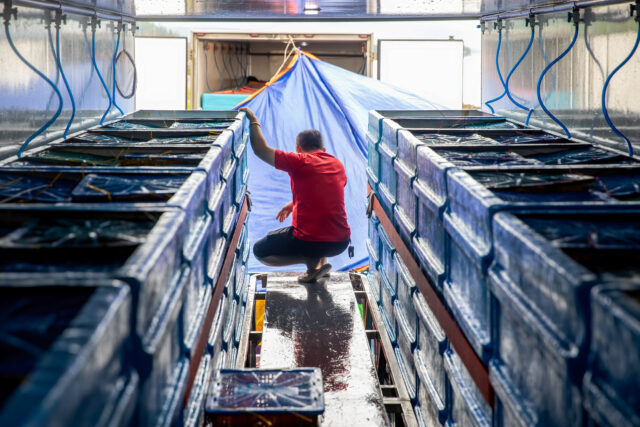
A worker arranges the plastic bins containing lobsters in the seawater tanks and oxygen generators inside a truck at a lobster collection point in Song Cau, Vietnam, on Friday, Dec. 20, 2024. — BLOOMBERG

US President Donald Trump’s global tariffs would cut Asia’s economic growth to the weakest since the COVID-19 pandemic, according to a regional research group.

If America’s so-called reciprocal levies are implemented, growth across Asia would slow to 3.8% this year and 3.4% next year, according to the ASEAN+3 Macroeconomic Research Office. The 2025 estimate includes Trump’s “Liberation Day” charges on all nations that he subsequently paused, but not the recently announced temporary exemption for certain products including smartphones and electronics.

That forecast compares to a 4.2% baseline without tariffs and would mark the slowest pace of growth since it slumped to 3.3% in 2022.

While some countries may be hit harder given how much they rely on exports to the US — such as Vietnam and Cambodia — the region can mitigate the impact by easing monetary policy and boosting fiscal spending, according to the Singapore-based group.

“They’ll take policy responses to mitigate it,” said AMRO chief economist Hoe Ee Khor. “The region is pretty resilient because they’ve accumulated reserves over the years and are more flexible in terms of the exchange rate,” he said, adding that inflation is tame, leaving space for central banks to cut policy rates.

Asia is set to be the hardest hit by Trump’s protectionist push, given the escalating charges on China and how integrated supply chains are across the region. Officials from Vietnam to Japan have been seeking exemptions and promising concessions across meetings with counterparts in the US.

Some central banks have already started cutting interest rates, flagging risks to the growth outlook, including the Reserve Bank of India last week, where members signaled additional easing in coming months.

Meanwhile, the 145% levies announced this year on China and retaliatory duties on the US mean trade is set to plummet between the two nations.

That impact is likewise “manageable” for China since the nation’s share of exports to the US makes up a shrinking share of domestic GDP, according to AMRO. The bigger risk, meanwhile— that the two economies will fully decouple — isn’t likely, Mr. Khor said. “Decoupling is basically all imports and exports” down to zero, he said. “That’s an extreme scenario that won’t happen.”

If implemented, US tariffs on Asia would rise to an average 26% excluding China, according to AMRO. About 15% of the region’s total exports currently head to the US, comprising about 4% of GDP. — Bloomberg

From ordinary jobs to extraordinary impact: How loan consultants are changing lives

By Ariel Dizon

What if the opportunity that could change your life has been right in front of you this whole time—quietly waiting to be noticed?

Today, more and more people are searching for careers that offer not just a paycheck, but purpose—roles where they can grow, make an impact, and find fulfillment. And while some paths are more celebrated than others, there are unsung careers that can lead to personal and financial milestones. One of those is being a Loan Consultant.

At first glance, it might seem like just another role. But in truth, loan consultants play a crucial part in people’s lives—helping them get one step closer to owning a home, building a business, purchasing a car, or simply getting back on their feet financially. It’s not just about numbers—it’s about guiding people through life’s defining moments.

And here’s the best part: you don’t need to have a finance degree or years of industry experience. Many of the most successful consultants today came from different walks of life—customer service, sales, education, and even careers unrelated to finance. What they had in common? A genuine desire to help others, a strong work ethic, and a willingness to learn.

At Global Dominion, we have over 10,000 active loan consultants nationwide—each one driven by the mission to help Filipinos achieve their dreams. “Before joining Global Dominion, I worked in retail. I had zero background in lending or finance. But the training and support helped me grow. Now, not only have I helped hundreds of clients buy cars and start businesses, I was also able to build my own home for my family.” — Loan Consultant, Iloilo

We’ve even seen inspiring success stories from individuals who started in their 40s and 50s—people who thought their window for change had passed. But through this career, they found a second wind, financial stability, and the chance to help others transform their lives. It proves one thing: it’s never too late to start something meaningful. Many of our loan consultants now own homes, drive their dream cars, and even run their own side businesses—all made possible by embracing the opportunity to grow in this field.

So, if you’re thinking of making a career move—one with purpose, growth, and real impact—this might be your sign. The best opportunities don’t always shout. Sometimes, they quietly wait—for someone ready to take a meaningful step forward.

Take that step today. Join Global Dominion as a Loan Consultant and start building a future with purpose. Visit gdfi.com.ph to apply.


Spotlight is BusinessWorld’s sponsored section that allows advertisers to amplify their brand and connect with BusinessWorld’s audience by publishing their stories on the BusinessWorld Web site. For more information, send an email to online@bworldonline.com.

Join us on Viber at https://bit.ly/3hv6bLA to get more updates and subscribe to BusinessWorld’s titles and get exclusive content through www.bworld-x.com.

Expect to be safe this Holy Week, says PCG

“Philippine Coast Guard (PCG) ensign Jesus S Mandi, deputy commander of CG Station Bataan, assures passengers that they are safe under the PCG’s watch this coming Holy Week.

Interview by Edg Adrian Eva
Video editing by Arjale Queral

[B-SIDE Podcast] Policy uncertainty: The ripple effects of sudden tariffs

Follow us on Spotify BusinessWorld B-Side

US President Donald Trump has given a 90-day pause on the reciprocal tariffs he imposed, and everything is still in flux.

In this B-Side episode, BusinessWorld speaks with former tariff commissioner George N. Manzano about the tariffs, their impact on the Philippines, the motivations behind them, and recommendations for how the country can navigate this trade environment.

Interview by Patricia Mirasol
Video editing by Jayson Mariñas

Follow us on Spotify BusinessWorld B-Side

How the PCG anchors up for the Holy Week rush

“Philippine Coast Guard (PCG) ensign Jesus S Mandi, deputy commander of CG Station Bataan, shares how the PCG is gearing up for the Holy Week rush.

Interview by Edg Adrian Eva
Video editing by Arjale Queral

TikTok encourages PHL users to report misinformation, harmful content amid elections

STOCK PHOTO | Image by antonbe from Pixabay

by Almira Louise S. Martinez, Reporter

TikTok, a short-form video social media platform, encourages its Filipino users to report misinformation and harmful content on the platform in line with the Philippines’ 2025 midterm elections. 

“In a global community, it’s natural for people to have different opinions but our goal is to operate on a shared set of facts and reality,” Peachy A. Paderna, Philippine Public Policy Manager at TikTok, told reporters on Thursday.

In January, the social media platform launched an in-app Philippine Elections Center site in partnership with the Commission on Elections (COMELEC), the National Citizens’ Movement for Free Elections (NAMFREL), and the Legal Network for Truthful Elections (LENTE) to avoid the spread of misinformation, and promote reliable and trustworthy election-related content.  

TikTok’s Philippine Election Center site houses verified “critical election resources” such as voting procedures, polling locations, key election dates, and other essential information regarding elections.

Peachy Paderna, Philippine Public Policy Manager at TikTok. | photo by Almira Louise S. Martinez, BusinessWorld

According to Ms. Paderna, the platform’s community guidelines are based on three key themes to ensure the safety of its users – balancing harm prevention and expression, embracing human dignity, and ensuring actions are fair.

“We also rely on the larger TikTok community to help us spot content that we may not have caught in the initial phase,” Ms. Paderna added.

Although the social media company has over 40,000 professionals and machine technology that handles content moderation, Ms. Paderna said users are still encouraged to report harmful content. 

Users can find the in-app report button under the share feature of the platform. Violence, hate and harassment, self-harm, nudity, and misinformation are some of the available reasons to file a report. 

“We want to make sure that our community of users stays safe even as we promote the diversity of ideas on the platform,” she said. “We do not allow misinformation that may cause significant harm to individuals or society regardless of intent.”  


Reported accounts and videos 

From July to September 2024, the video hosting site took down 4.5 million videos in the Philippines, of which 99.7% were removed proactively due to violations of the platform’s community guidelines. In addition, 98% of the reported videos were removed within 24 hours.  

“When content is taken down or acted on by our enforcement team, that doesn’t necessarily mean that the [content creator’s] account will be taken down all the time,” Ms. Paderna said. 

Getting banned on TikTok depends on the gravity of the violations. “Sometimes all it takes is one post, sometimes it takes multiple posts,” the TikTok executive added. 

The severity of violations can be categorized as significant and moderate harm. Content that leads to severe forms of physical harm, such as life-threatening injury or death, falls under ‘significant harm’. Meanwhile, moderate harm is false or misleading content regarding treatments or prevention of health-related issues that could not lead to life-threatening concerns.  

Ms. Paderna noted that mass reporting would not help the video or account be removed from the platform.  

“One thing that we want to remind everybody is that it’s not a matter of people reporting one account,” she said. “We don’t need multiple reports to take down or pay attention to a violation.”  

“We want to ensure that actions are fair so that when we take enforcement action, it’s always in fair way, it’s always just, it’s always rational,” Ms. Paderna said. 

US Treasury’s Bessent backs Argentina’s economic reforms with eye on China

Image by David from Pixabay

 – U.S. Treasury Secretary Scott Bessent said he met with Argentine President Javier Milei on Monday to underscore the Trump administration’s full support for economic reforms that were bringing the Latin American country “back from the precipice.”

Mr. Bessent also commended Mr. Milei for working to reduce barriers towards reciprocal trade with the United States, Treasury said in a statement about the visit.

In an interview with Bloomberg TV after his meeting with Mr. Milei, Mr. Bessent said the Trump administration was focused on helping Latin American countries avert what he called “rapacious” agreements made by China in Africa.

Argentina on Friday sealed a $20 billion, 48-month Extended Fund Facility deal with the International Monetary Fund after dismantling key parts of its years-long currency controls. It also announced a $12 billion loan program with the World Bank and a separate $10 billion deal with the Inter-American Development Bank.

“I wanted to come here today to show support for President Milei and his commitment … to what I think is historic in terms of bringing Argentina back from the precipice,” Mr. Bessent said in the interview.

The U.S. sought to prevent Latin American countries giving up mining rights to China in return for aid, he said.

“China has signed a number of these rapacious deals marked as aid, where … they’ve taken mineral rights. They’ve added huge amounts of debt onto these countries balance sheets,” he said. “They’re guaranteeing that future generations are going to be poor and without resources. And we don’t want that to happen any more than already has in Latin America.”

Chinese lenders provided a combined $182.28 billion to 49 African countries from 2000-2023, leaving many countries heavily in debt. Since 2005, Chinese lenders provided more than $120 billion in loans to Latin American and Caribbean countries, according to data from Boston University Global Development Policy Center.

China said it opposed Mr. Bessent’s remarks and criticized him for “maliciously slandering and smearing” China, and told the U.S. to refrain from “obstructing and deliberately sabotaging” developing countries.

“We advise the U.S. to adjust its mindset, instead of spending time repeatedly smearing and attacking China, meddling in the foreign cooperation of regional countries,” the Chinese embassy in Argentina said in a statement on Tuesday.

Mr. Bessent said the U.S. was not considering a credit line directly to Argentina like the one extended by China. He said Beijing had shown a “very good faith effort” in conjunction with the IMF deal, and would be rolling forward the $5 billion drawn down by the previous Argentine government.

He said Mr. Milei’s government should eventually have enough foreign exchange inflows to repay that amount as it stayed the course on economic reforms.

President Donald Trump has sought to expand ties with a handful of leaders in Latin America, including Salvadoran President Nayib Bukele, who visited the White House on Monday, and Ecuadorean President Daniel Noboa, who met with Trump in Florida last month.

Mr. Bessent did not say whether Argentina, which received the 10% base rate in Trump’s recent reciprocal tariff announcement, could achieve a zero tariff rate, saying he told Argentine officials to bring their “A game” for negotiations.

Asked if any country could negotiate a zero tariff rate, Mr. Bessent said the negotiations were focused on “a whole box of things we’ve got to overcome: tariffs, non-tariff barriers, trade barriers, currency manipulation and subsidization of labor and facilities.” – Reuters

Europe had most widespread floods for more than a decade in 2024, scientists say

STOCK PHOTO | Image by Hermann Traub from Pixabay

 – Europe faced its most widespread flooding last year since 2013, with 30% of the continent’s river network hit by significant floods, scientists said on Tuesday, as fossil fuel-driven climate change continued to prompt torrential rain and other extreme weather.

Flooding killed at least 335 people in Europe in 2024 and affected more than 410,000, the European Union’s Copernicus Climate Change Service and the World Meteorological Organization said in a joint report on Europe’s climate.

Western Europe was hit hardest, with 2024 ranking among the region’s ten wettest years in records going back to 1950. Storms and flooding are Europe’s costliest weather extremes, last year causing damage exceeding 18 billion euros.

Globally, 2024 was the world’s warmest year since records began, as well as the warmest for Europe – the planet’s fastest-warming continent. The planet is now around 1.3 degrees Celsius warmer than in pre-industrial times, mainly due to human-caused climate change.

“Every additional fraction of a degree of temperature rise matters because it accentuates the risks to our lives, to economies and to the planet,” said WMO Secretary-General Celeste Saulo.

The report noted bright spots, including that renewable energy sources produced a record-high 45% of Europe’s energy in 2024, while most European cities have plans in place to better adapt to climate change.

But weather extremes were recorded across the continent. Southeastern Europe had its longest heat wave on record, totaling 13 days, while Scandinavia’s glaciers shrank at the highest rates on record, and heat stress increased across the continent.

Much of Eastern Europe was hit by lack of rain and drought, while floods ravaged western Europe.

Nearly a third of Europe’s overall river network exceeded a “high” flood threshold, while 12% breached “severe” flood levels in 2024.

Devastating floods in Valencia in late October accounted for most of the lives lost and economic damage caused in Europe by floods, with 232 people killed in the disaster. Storm Boris in September dumped the heaviest rain ever recorded in Central Europe onto countries, including Austria, Czechia, Germany and Slovakia.

Scientists have confirmed climate change has made such downpours more likely, because a hotter atmosphere can hold more water, leading to intense rain. Atmospheric water vapor reached a record high in 2024.

Other factors that influence flooding include river management and urban planning that determines whether homes and infrastructure are built in flood-prone areas. – Reuters

The impact of robotic surgery in healthcare

Robotic surgery is transforming healthcare in the Philippines, according to medical doctors at a media roundtable organized by Makati Medical Center (MMC).

In this video, MMC doctors talk about the benefits of such a surgery, as well as the top concern of patients in relation to it.

Interview by Patricia Mirasol
Video editing by Arjale Queral

Taiwan to simulate impact of US tariffs on semiconductor sector

Semiconductor chips are seen on a circuit board of a computer in this illustration picture taken on Feb. 25, 2022. — REUTERS

TAIPEI – Taiwan will simulate the impact of any U.S. tariffs on the semiconductor industry and seek talks with Washington on the issue, the island’s economy minister said on Tuesday.

The Trump administration is probing the import of chips, along with pharmaceuticals, in a bid to impose tariffs on both on grounds that extensive reliance on foreign production of semiconductors and medicine is a national security threat.

The United States relies heavily on chips imported from Taiwan, a reliance former President Joe Biden sought to end during his term by granting billions of dollars in Chips Act awards to lure chipmakers to expand production in the country.

Speaking to reporters outside parliament, Taiwan Economy Minister Kuo Jyh-huei said he would seek to discuss the matter with the United States and ensure “fair competition” for Taiwanese industry.

The Taiwanese and U.S. chip sectors are complementary, he added.

“As to how much (the tariffs) could be, we will of course carry out simulations,” Kuo said. “On the tariffs issue, we will try as hard as possible to communicate with the U.S. side.”

The level of chip tariffs will be “the outcome of talks”, he added, without elaborating.

Taiwan is home to TSMC, the world’s largest contract chipmaker and a major supplier to companies including U.S. tech giants Apple and Nvidia.

On Monday, Nvidia said it is planning to build AI servers worth as much as $500 billion in the U.S. over the next four years with help from partners including TSMC. That followed Apple’s February promise of half a trillion dollars in U.S. investment over a similar time frame.

TSMC last month announced a $100 billion investment in the United States, on top of previous investment pledges.

Its Taiwan-listed shares traded 0.7% higher on Tuesday morning, largely in line with the broader market. — reuters

Trump administration sued over tariffs in US Court of International Trade

STOCK PHOTO | Image by Pexels from Pixabay

A legal advocacy group on Monday asked the U.S. Court of International Trade to block President Donald Trump’s sweeping tariffs on foreign trading partners, arguing the president overstepped his authority.

The lawsuit was filed by the nonpartisan Liberty Justice Center on behalf of five small U.S. businesses that import goods from countries targeted by the tariffs. The businesses range from a New York wine and spirits importer to a Virginia-based maker of educational kits and musical instruments.

The lawsuit challenges Mr. Trump’s April 2 “Liberation Day” tariffs, as well as duties he separately levied against China.

“No one person should have the power to impose taxes that have such vast global economic consequences,” Liberty Justice Center senior counsel Jeffrey Schwab said in a statement. “The Constitution gives the power to set tax rates — including tariffs — to Congress, not the President.”

White House spokesman Harrison Fields defended Mr. Trump’s tariffs in a statement.

“Never Trumpers will always oppose him, but President Trump is standing up for Main Street by putting an end to our trading partners — especially China — exploiting the U.S. His plan levels the playing field for businesses and workers to address our country’s national emergency of chronic trade deficits,” Mr. Fields said.

The Trump administration faces a similar lawsuit in Florida federal court, where a small business owner has asked a judge to block tariffs imposed on China.

Mr. Trump imposed 10% tariffs on goods from all countries and higher tariffs for countries the administration says have high barriers to U.S. imports, most of which he later paused for 90 days.

The president’s executive order invoked laws including the International Emergency Economic Powers Act, which gives presidents special powers to combat unusual or extraordinary threats to the U.S.

In Monday’s lawsuit, the Liberty Justice Center said the law does not give presidents the authority to impose tariffs.

“There is no precedent for using IEEPA to impose tariffs. No other President has ever done so or ever claimed the power to do so,” the lawsuit said.

The lawsuit asks the court to block enforcement of the tariffs and declare Mr. Trump lacked the authority to impose them.

The New York-based Court of International Trade is a U.S. federal court with broad jurisdiction over most trade-related matters. — Reuters