Home Blog Page 1702

BBM’s Infrastructure Complex

FREEPIK

Speaking at a Palace briefing last Tuesday, Transportation Secretary Jaime J. Bautista said the first full Cabinet meeting of the year tackled the 16 flagship infrastructure projects that need the government’s immediate attention, with the goal of achieving at least partial operations before the government steps down in 2028.

The 16 flagship projects include the North-South Commuter Railway, the Metro Manila Subway Project, the Metro Rail Transit (MRT) Line 4, MRT Line 7, Light Rail Transit Line 1 Extension, the New Cebu International Container Port, the Philippine National Railways South Long Haul, Mindanao Railway, and the New Dumaguete Airport.

President Ferdinand “Bongbong” Marcos, Jr. is focusing on rail projects, especially the proposed North-South Commuter Railway, a 147-kilometer line connecting Clark Airport to Calamba, Laguna.

The total cost of the Marcos administration’s Build Better More program is P9 trillion. He said this is crucial for improving standards of living and attracting more investments in the Philippines. Boosting infrastructure investments will likewise aid in accelerating economic recovery and resiliency while maintaining the country’s debt sustainability.

However, the national budget continues to be criticized for its deep cuts for social services, which include education, health, and social security. It is very likely that the 2025 budget would be challenged in the courts because of the alleged violation of the constitutional provision that the education sector should get the biggest share of the annual budget, and the brazen violation of Republic Act No. 11223 or the Universal Health Care Act that mandates subsidizing PhilHealth (Philippine Health Insurance Corp.) to provide healthcare benefits to the underprivileged.

It will be recalled that Bongbong Marcos’ campaign slogan during his run for the presidency in 2022 was “Babangon muli” (will rise again). It was intended to evoke a memory of the Golden Era of booming economy and golden infrastructure that was supposed to have been his father’s presidency.

It worked. He was elected president. As he said right after he was sworn in as president, “The campaigns have run, and have taken me here where I stand today.”

Addressing the Filipino people, he said, “My father built more and better roads. Much has been built and so well that the economic dogma of dispersing industry to develop the least likely places has been upturned. Development was brought to them. Investors are now setting up industries along the promising routes built. And yet, the potential of this country is not exhausted.

“Following these giants’ steps, we will continue to build on the success that’s already happening. We will be presenting the public with a comprehensive infrastructure plan, six years could be just about enough time. No part of our country will be neglected. Progress will be made wherever there are Filipinos so, no investment is wasted.”

In his first State of the Nation Address, he said the backbone of an economy is its infrastructure. “We shall confidently build on this firm foundation established by my predecessor. As it is in building an edifice. We must keep the momentum and aspire to build better more.

“It is clear in my mind that railways offer great potential as it continues to be the cheapest way of transporting goods and passengers. We can build upon already existing lines by modernizing these old railway systems. There are dozens of railway projects — on the ground, above the ground, below ground, not just in Manila, but in other regions — at various stages of implementation, and with a combined cost of P1.9 trillion.

“My order to the Department of Transportation is really very simple: FULL SPEED AHEAD!”

In his second State of the Nation Address, he said, “One of the keys to continuing economic growth is infrastructure development. So, we will build better, and more. Our P8.3-trillion ‘Build Better More’ Program is currently in progress and being vigorously implemented.

“The underlying logic to our infrastructure development is economic efficiency. We are opening up all gateways to mobilize goods and services at less cost and in less time, and ultimately, to drive the economy forward. Our road network plans must link not only our three major islands, but all prospective sites of economic development.

“The 1,200-kilometer Luzon Spine Expressway Network Program will effectively connect Ilocos to Bicol, from 20 hours to just nine hours of travel. Under the Mega-Bridge Program, 12 bridges totaling 90 kilometers will be constructed, connecting islands and areas separated by waters.

“To improve capacity for specialized medical treatment, specialty centers in various fields are being established and integrated into our government hospitals.”

In his third State of the Nation Address, he bannered two new specialty hospitals that aim to decongest public hospitals and galvanize the “nation’s fight against cancer.” These are the UP-PGH Cancer Center, the first Public-Private Partnership project to be approved under Marcos, and the Philippine Cancer Center of the Department of Health, which broke ground in March.

His defenders’ counter to the criticism that his infrastructure program had syphoned funds from the Health department is that the infrastructure program includes centers for specialized medical treatment.

But as I wrote in my Aug. 14, 2023 column in reaction to his second SONA, where he said that the estimated cost of the multi-specialty center being built in Clark is P10 billion, “There goes the budget for the universal healthcare (UHC) for the next five years. The full implementation of UHC will be set back by five more years. That huge sum of money can build thousands of 20- to 30-bed primary care hospitals in congressional districts with no healthcare facility. The Universal Health Care Act or Republic Act No. 11223, which was enacted in 2016, mandated that all Filipinos get the healthcare they need, when they need it.”

RA 11223 was meant for people whose lives can be saved or whose good health can be maintained if they receive timely medical attention without ruining them financially. Complications of the leading diseases in the Philippines like bronchitis, influenza, chicken pox, diarrhea, and respiratory tract infection can be prevented if the patient receives preventive, curative, rehabilitative, and palliative health services. But the rural and poor Filipinos cannot avail themselves of those services because there are no facilities that render those services in their area.

When the Philippine Heart Center was built under President Ferdinand Marcos, Sr.’s Decree No. 673, Senator Jose W. Diokno commented that the government can spend 50% of the health budget for the “designer hospital.” “While around the country, Filipinos were dying of curable illnesses like tuberculosis, whooping cough, and dysentery.”

The hospital, designed by architect Jorge Ramos, was finished reportedly to heed First Lady Imelda Romualdez Marcos’ request that the building be inaugurated on Valentine’s Day 1975, so that the First Lady could refer to it as “The Monument to the Heart.”

That “monument” was one of the many “monuments” built by Mrs. Marcos by which she is remembered. The others are the Cultural Center of the Philippines, the Manila Film Center, the Folk Arts Theater, the Coconut Palace, the Makiling Center for the Arts, the National Kidney and Transplant Institute, and the Lung Center of the Philippines. They are identified with what is referred to as the former First Lady’s “Edifice Complex,” for her obsession of building grandiose edifices with public funds.

Bongbong Marcos does not have an Edifice Complex. His obsession is with railways. As he said in his third SONA, “There are dozens of railway projects — on the ground, above the ground, below ground, not just in Manila, but in other regions — at various stages of implementation, and with a combined cost of P1.9 trillion.”

It should be noted that not one of the edifices identified with Imelda Marcos is named Imelda. But there were avenues re-named Imelda when she was First Lady — the major east-west route in Makati and Taguig now known as Kalayaan Avenue, and the four-lane major road in Cainta that connects Marcos Highway to Ortigas Avenue Extension that is now called F.P. Felix Avenue.

There were highways named after President Ferdinand Marcos, Sr.  that have been renamed after the People Power Revolution but still referred to as Marcos Highway, among them the one in Cainta and the road from Agoo, La Union to Baguio City.

There are Quezon Boulevard, Osmeña Highway, Roxas Boulevard, Quirino Avenue, Magsaysay Boulevard, Carlos P. Garcia Avenue, Diosdado Macapagal Boulevard, various Marcos roads and highways — all named after former presidents. Maybe Bongbong Marcos wants to be remembered by his railway system, or maybe even by the national road network as his 1,200-kilometer Luzon Spine Expressway will not only connect Ilocos to Bicol but his 90-kilometer Mega-Bridge Program, will connect Luzon to Mindanao via the major Visayan islands.


Oscar P. Lagman, Jr. has been a keen observer of Philippine politics since the late 1950s.

LANDBANK, DBP looking to issue bonds this year

By Luisa Maria Jacinta C. Jocson, Reporter

STATE-RUN Land Bank of the Philippines (LANDBANK) and Development Bank of the Philippines (DBP) are looking to conduct bond offerings this year to raise fresh funds, their top officials said.

LANDBANK President and Chief Executive Officer Lynette V. Ortiz said they could tap the domestic debt market by the second quarter.

“It depends, so we obviously have to see interest. At the minimum, we’re hoping we could go for P10 billion and hopefully, there will be some oversubscription for investors who really believe in the bank,” Ms. Ortiz told reporters on the sidelines of the Bangko Sentral ng Pilipinas’ annual reception for the banking community held on Friday.

“We were actually hoping it would be earlier, but I think reasonably, it would be the second quarter, just looking at all the approvals that will need to be secured.”

LANDBANK is looking to offer peso-denominated papers, Ms. Ortiz said.

“Our balance sheet is mostly a peso balance sheet and the projects — renewable, clean energy — they’re all peso-based, so we don’t want to take unnecessary FX (foreign exchange) risks,” she said.

She added that LANDBANK is looking to offer papers with a tenor of at least five years.

“That should be the sweet spot… We are trying to match it as well with the kind of projects,” Ms. Ortiz said. “If it’s solar, it can be a bit shorter. Depending on what those other projects are. Technically, we would want five to 10 years in terms of tenor.”

The official added that LANDBANK is looking into issuing sustainable bonds.

“We want to match it (projects) with bonds that are either green, blue, or sustainable, sustainability-linked. So, yes, we’re working on that, and it depends on all the approvals. We’re hoping it can be done this year.”

LANDBANK’s new charter, which is pending with Congress, would allow it to secure faster approvals for fundraising exercises, Ms. Ortiz noted. The state bank requires approvals from the Monetary Board, the National Economic and Development Authority and the Office of the President.

“The approval process for LANDBANK is a bit long. That’s in our charter. So hopefully, if we get our charter changed, we want our ability to go to market to be swifter so that all of these approvals and basically requisite steps can hopefully be shortened,” she said. “Because by the time we get all of those approvals, it’s very possible that the markets would have changed already.”

Meanwhile, the DBP said it is also eyeing to issue bonds towards the latter part of the year.

“It’s possible, maybe about P5 to P10 billion. It’s something to look at. We’re still studying it,” DBP President and Chief Executive Officer Michael O. de Jesus said separately at the same event.

The bank is also looking to issue peso bonds with a tenor of at least five years, he said.

“Just basically for liquidity purposes for our daily banking needs,” he added.

Mr. De Jesus likewise said the DBP’s proposed charter amendments will give it easier access to the capital markets.

The Finance department has pushed to amend the charters of both the LANDBANK and DBP to increase their capitalization, allow for their public listing and streamline the bond issuance process.

Proposals to revise LANDBANK’s charter are still pending at the House committee level. The LANDBANK bills seek to increase its capitalization to P1 trillion from the current P200 billion.

Meanwhile, the Senate bill seeking to amend the DBP’s charter was approved on final reading in September, while the House version is currently up for second reading.

Under the measure, the bank’s authorized capital stock will be raised to P300 billion from P35 billion.

LANDBANK saw its net profit decline by 21.07% to P25.14 billion as of end-September 2024 from P31.85 billion a year prior, based on its financial statement posted on its website.

Meanwhile, DBP booked a net profit of P4.68 billion at end-September 2024, down by 8.95% year on year.

Global box-office decline was even steeper than in US last year

TONI POMAR-UNSPLASH

HOLLYWOOD executives and theater owners have fretted loudly and often about the tough box-office in the US. Turns out it’s worse overseas.

Global ticket sales fell at a double-digit clip last year due to a sharp drop in China, the world’s second-largest market, along with contractions in Japan, South Korea, and Germany.

Worldwide revenue slumped 10% to $30.5 billion in 2024, according to data from researcher Gower Street Analytics, making the US and Canada a bright spot with a decline of just 3.3%. China’s box office shrank by 25%, while the rest of the international market was down 8.2%.

The numbers show that sluggish theater attendance was far more than just a domestic problem for Hollywood’s movie industry. Major releases, like last year’s box-office leader Inside Out 2, can generate more than 60% of their ticket revenue outside the US, making falling international receipts a big concern.

Results worldwide were hurt by the 2023 strikes by actors and writers. Their walkouts halted production and forced studios to postpone a number of potential 2024 blockbusters. Those include Paramount Global’s Mission Impossible: The Final Reckoning. Walt Disney Co. had to shelve Snow White, Pixar’s Elio, and two Marvel releases: Captain America: Brave New World and Fantastic Four: First Steps from its Marvel Studios.

The decline outside the US was exacerbated by the strong dollar, which reduced the revenue US studios receive from foreign box-office sales, according to Rob Mitchell, director of theatrical insights at Gower Street.

The strong dollar “impacts results from a huge number of markets,” Mr. Mitchell said.

But even in local currencies, the decline was steeper than in the US. In Japan, the No. 3 movie market, ticket sales measured in yen slumped 10% last year. In Germany, they fell 8.4%, and in South Korea they declined 6.9%, according to data tracker Comscore, Inc. Of the top 10 markets outside the US and Canada, only the UK and France matched their 2023 sales.

While strikes and currency fluctuations explain part of the international slump, other forces are at work as well.

Audience tastes in China, historically the most dependable international market for Hollywood fare, changed in favor of local films over US productions. That’s coincided with deteriorating relations between the two countries.

The number of government-approved US releases in China plunged from a peak of over 60 in 2018 to as little as 15 in 2022, according to industry data. They rebounded to 35 in 2023 and totaled 31 last year.

Local-language films in China have soared in quality over that period, possibly blunting demand for American fare. More than 80% of China’s box office is now generated by homegrown pictures. And the country’s deteriorating economy has curbed local spending on cinema tickets.

Like the US market, China’s theater industry is suffering from the growing popularity of streaming. The Chinese online video market — which is dominated by platforms such as Tencent’s WeTV and Baidu’s iQIYI — is now worth $31 billion, according to estimates from Media Partners Asia.

The so-called micro drama industry, which produces short television episodes that air on platforms such as Douyin, the Chinese version of ByteDance Ltd.’s TikTok, swelled to $6.9 billion in 2024, according to industry data, making the genre larger than the box office for the first time.

“Over the last 10 years, there are also more choices, streaming content, but also other out-of-home entertainment choices that compete for leisure time,” said Rance Pow, chief executive officer of the film industry advisory firm Artisan Gateway.

Mr. Mitchell is optimistic that the delayed films, and other titles such as Avatar: Fire and Ash on the 2025 calendar will see global ticket sales bounce back to $33 billion.

That’s still 22% below the global high mark of $42.3 billion set in 2019. — Bloomberg

BCDA signs 15-year lease with pizza chain, specialty cafe

CAMP JOHN HAY — BW FILE PHOTO

THE BASES Conversion and Development Authority (BCDA) has signed a 15-year commercial lease agreement with Amare La Cucina and Top Taste and Trading, Inc.

BCDA President and Chief Executive Officer Joshua M. Bingcang said the newly signed contract reflects a vote of confidence from investors after the change of management in Camp John Hay (CJH).

“Our vision for CJH is to provide enterprises of all sizes an environment where they can all thrive and empower the local community with more employment opportunities,” he said in a statement on Monday.

The BCDA signed the contracts with the homegrown pizzeria and specialty café and restaurant on Jan. 8 following the successful recovery of the CJH property.

The contract with Amare La Cucina covers the lease for a 1,500-square-meter lot, while the deal with Top Taste and Trading, Inc. is for the lease of an 800-square-meter property.

Aside from the commercial lease contracts, BCDA also signed its first long-term residential lease agreement with Victorino “Ricky” Vargas, a director at Metro Pacific Investment Corp.

The 25-year residential lease contract involves two Forest Cabin units that were previously leased with CJH Development Corp. (DevCo).

The BCDA regained control over the 247-hectare CJH property after a notice to vacate was served to CJH DevCo last week.

It followed the ruling of the Supreme Court on Dec. 12, which upheld an arbitral ruling that ordered CJH DevCo to vacate the property it leased from BCDA.

“While we are setting up a positive climate for enterprises and the people, we also want to assure the local community that we will preserve and protect the forest watershed of CJH, as the remaining lung of the city,” said Mr. Bingcang. — Justine Irish D. Tabile

Why PDIC, PhilHealth remittances and spending control are good

Among the recent fiscal issues that have come up after the sustained attack against the newly enacted budget or General Appropriations Act (GAA) 2025 is the clamor against the remittance of the Philippine Deposit Insurance Corp. (PDIC) to the Bureau of the Treasury (BTr) of P107.2 billion to help finance some unprogrammed appropriations.

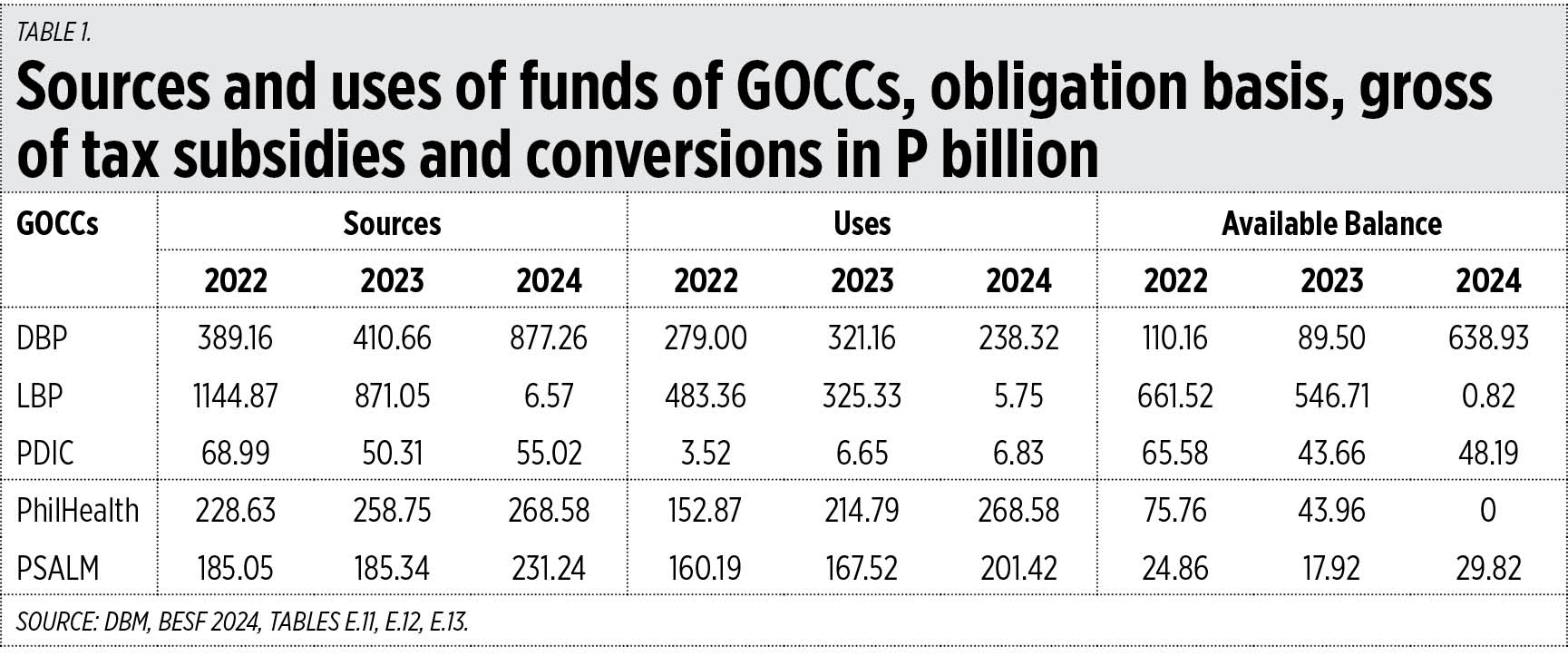
I checked some numbers of government-owned and -controlled corporations (GOCCs) at the Budget of Expenditures and Sources of Financing (BESF). Sources of funds of GOCCs are equity and subsidy from the National Government, corporate borrowings, and corporate funds. Uses of funds are general administration and support (GAS), support to operations, operations, and projects.

Those under the Department of Finance (DoF) with high available balances (sources minus uses) are the Development Bank of the Philippines (DBP), the Land Bank of the Philippines (LANDBANK), and the PDIC. Earlier, DBP and LANDBANK resources had been remitted for the initial funding of the Maharlika Investment Fund.

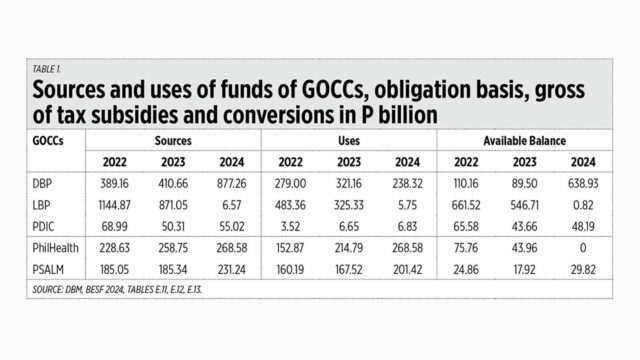
The Power Sector Assets and Liabilities Management Corp. (PSALM) under the Energy department also has a large available balance yearly, but only about half of PDIC’s. The Philippine Health Insurance Corp. (PhilHealth) had no available balance in 2024 (see Table 1).

Tapping PDIC’s excess funds for some government expenditures is a good move, for four reasons. One, the P107 billion is equivalent to its available balance for 2022 and 2023 alone. Two, it is less than the Deposit Insurance Fund (DIF) requirement in 2023 of P187 billion, derived as the DIF ratio 5.5% multiplied by total insured deposits of P3.4 trillion. Three, the assurance from PDIC President Roberto Tan that the DIF “remains adequate to cover risks in the banking system in case of insurance calls.” And, four, tapping excess funds of financially stable GOCCs is a lot better, far superior, to raising taxes or raising additional borrowing.

So, I support the DoF and the Department of Budget and Management (DBM) in tapping the PDIC excess funds. The same way that I supported their move to tap excess funds of PhilHealth (funds that came from taxes paid by smokers, vapers and drinkers of alcohol and sugary beverages, not from direct contribution of members).

If there is one thing that I wish the DoF and DBM would do, or that President Ferdinand Marcos, Jr. would push, is to have an across-the-board spending cut, targeting a budget balance, and significantly reducing the public debt stock, reducing interest payments.

I want to see spending cut from infrastructure, foreign aid-funded projects, and social services like the budgets of state universities and colleges (SUCs) including UP. The SUCs budget has been jumping up, from P67 billion in 2019 to P81 billion in 2021, P107 billion in 2023, and P133 billion in 2024 — which is double its budget just five years earlier.

Much of the infrastructure — roads, airports, seaports, power plants, etc. — are now financed and constructed by private corporations via public-private partnership (PPP). The user-pay principle is a lot superior to the all taxpayers-pay principle.

Education, healthcare, and household welfare should first and foremost be personal and parental responsibilities, not the government’s responsibility. Government should still help, but be limited to primary and secondary education, limited to infectious diseases and not compromised with non-infectious diseases because these result in bottomless health spending. Plus, local governments units (LGUs) are putting up their own hospitals, their own universities, their own social welfare programs, and they always have a budget surplus while the National Government (NG) always has a budget deficit.

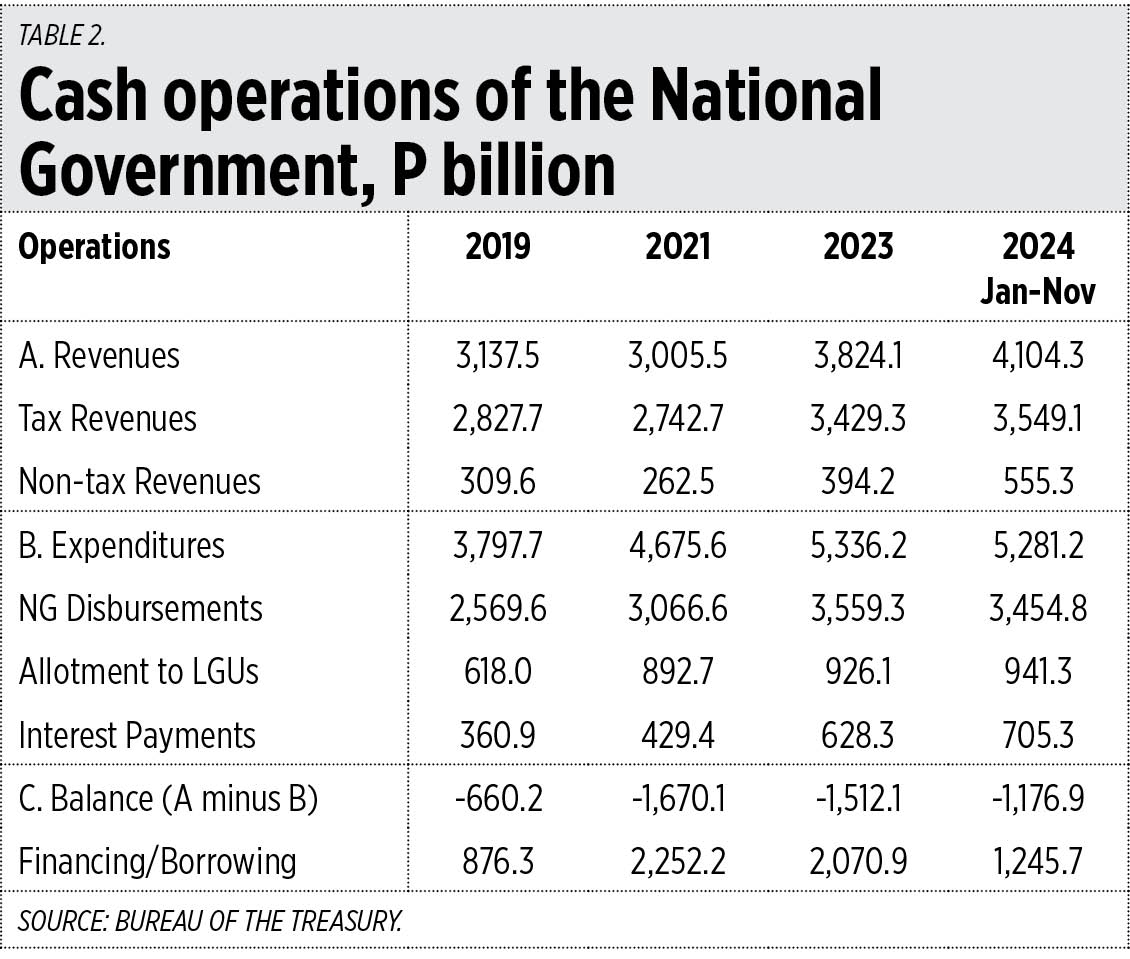
There was some good news in public finance in 2024: revenues in January-November were higher than in the full-year 2023 while expenditures were controlled. This led to a lower deficit, although it was still above P1 trillion, and borrowings are below P2 trillion (see Table 2).

We should sustain this momentum. A lot of the criticism made by various NGOs and pressure groups about the GAA 2025 is that their favored sectors — like healthcare and education — did not get more money than they wished. They wanted more health and education socialism and are not interested in fiscal balance, nor in asserting personal and parental responsibility in how people run their lives. They hate the legislators and want the endless dependence of the people on the government, which is run and fund-appropriated by the politicians they hate. There is irony and hypocrisy there.

To remove the irony, people should demand less public spending and borrowing, less taxation and regulations, and more money in their pockets to finance their household needs, to do more philanthropy for needy people.


Bienvenido S. Oplas, Jr. is the president of Bienvenido S. Oplas, Jr. Research Consultancy Services, and Minimal Government Thinkers. He is an international fellow of the Tholos Foundation.

minimalgovernment@gmail.com

BTr hikes T-bill award amid strong demand

STOCK PHOTO | Image by RJ Joquico from Unsplash

THE GOVERNMENT upsized its award of the Treasury bills (T-bills) it offered on Monday as rates dropped across the board amid strong demand for short-term papers, as the market expects the Bangko Sentral ng Pilipinas (BSP) to continue its easing cycle.

The Bureau of the Treasury (BTr) raised P27.6 billion from the T-bills it auctioned off on Monday, higher than the P22-billion plan, as total bids reached P93.776 billion, more than four times as much as the amount on offer. This was also higher than the P70.975 billion in tenders seen on Jan. 7.

The oversubscription prompted the Treasury to double the accepted non-competitive bids for the three- and six-month T-bills to P5.6 billion each, it said in a statement.

Broken down, the Treasury borrowed P9.8 billion from the 91-day T-bills, higher than the programmed P7 billion, as tenders for the tenor reached P37.863 billion. The three-month paper was quoted at an average rate of 5.588%, dropping by 19.4 basis points (bps) from the 5.782% seen at the previous auction, with the BTr only accepting bids with this yield.

The government likewise made a P9.8-billion award of the 182-day securities, above the P7-billion program, as bids reached P31.375 billion. The average rate of the six-month T-bill stood at 5.638%, falling by 27.3 bps from the 5.911% fetched previously, with the BTr only accepting tenders with this rate.

Lastly, the Treasury raised P8 billion as planned via the 364-day debt papers as demand for the tenor totaled P24.538 billion. The average rate of the one-year debt decreased by 4 bps to 5.891% from the 5.931% quoted at the last auction, with bids accepted carrying rates of 5.85% to 5.9%.

At the secondary market before the auction, the 91-, 182-, and 364-day T-bills were quoted at 5.7511%, 5.8199%, and 5.8562%, respectively, based on PHP Bloomberg Valuation Service Reference Rates data provided by the Treasury.

The government upsized its T-bill award as it took advantage of the strong demand for short tenors, a trader said via text message.

Market reference has shifted to short-term papers amid the global bond rout led by US Treasuries due to renewed inflation concerns in the United States.

T-bill yields declined for the second straight week as within-target Philippine inflation bolstered expectations of further BSP cuts this year, Rizal Commercial Banking Corp. Chief Economist Michael L. Ricafort said in a Viber message.

Headline inflation picked up to 2.9% in December from 2.5% in November, the government reported last week. Still, this was slower than the 3.9% print in the same month in 2023 and was within the 2.3%-3.1% forecast of the BSP.

The December rate brought the full-year 2024 inflation average to 3.2%, slower than 6% in 2023 and marking the first time since 2021 that the consumer price index settled within the BSP’s 2-4% annual target.

BSP Governor Eli M. Remolona, Jr. last week said the Philippine central bank still has room to continue cutting benchmark interest rates as inflation is well within its annual goal, adding that current borrowing costs remain “restrictive.”

The Monetary Board has slashed benchmark borrowing costs by a total of 75 bps since it began its easing cycle in August, bringing its policy rate to 5.75%.

It will hold its first policy meeting for this year on Feb. 20.

On Tuesday, the BTr will offer P30 billion in reissued 10-year Treasury bonds with a remaining life of seven years and eight months. — Aaron Michael C. Sy

RLC eyes full sellout of Le Pont Tower 2 this year

BW FILE PHOTO

RLC Residences, the residential arm of Robinsons Land Corp. (RLC), said 15% of units in the second tower of Le Pont Residences in Pasig City have been sold as of end-December and that it will now focus on selling the remaining inventory this year.

“Since its launch in July, 15% of units in Tower 2 have already been sold, reflecting strong market interest and buyer confidence,” Stephanie Ann Go, vice-president and business development and design head at RLC Residences, told BusinessWorld in an e-mail.

“For 2025, RLC Residences is focused on selling out existing inventory while preparing for the next wave of exciting project launches to cater to the evolving needs of our clients,” she said.

Le Pont Residences is a high-rise residential condominium project within Bridgetowne Destination Estate.

Located in Pasig City, Bridgetowne is a 31-hectare mixed-use township and business park that boasts proximity to key commercial areas, malls, hospitals, and major roads.

Le Pont Residences has two towers, both with 51 floors. The first tower houses 506 units, and the second tower has 644 units.

According to Ms. Go, the cost of a unit in the second tower ranges from P15.1 million to P134.7 million.

It features a one-bedroom unit (sized at 45-46 square meters or sq.m.), an executive one-bedroom unit (63 sq.m.), a two-bedroom unit (82.5-115 sq.m.), a three-bedroom unit (151 sq.m.), a four-bedroom unit (220 sq.m.), and a penthouse (269.5-431 sq.m.).

The units are designed with a modern architectural style, featuring loggias and engineered wood finishes.

Residents are treated with “hyper-sized” amenities like a podium clubhouse, infinity and wading pools, fitness deck, and meeting rooms. The second tower will also have a golf simulation room.

Tower 2 residents can also access amenities found in the first tower, including a podium, clubhouse, work lounge, fitness deck, meeting room, pet park, swimming pools, and the Altitude 51 for private events.

Both towers also have environment-friendly fixtures and systems, helping residents cut water usage by up to 34% and energy consumption by up to 45%. It is also the only condominium in Bridgetowne with an EDGE (Excellence in Design for Greater Efficiencies) certification.

Meanwhile, around 90% of units in the first tower have been sold, RLC Residences Senior Vice-President Chad Sotelo said in August.

The two-tower property has also seen an 8% value appreciation, outperforming traditional investment options, according to the company.

“Le Pont Residences Tower 1 is projected to be completed by the third quarter of 2029, while Tower 2 is expected to be finished by the first quarter of 2031,” according to the listed property developer. — Beatriz Marie D. Cruz

Hollywood celebrities clear their closets for fire aid

GABE—UNSPLASH

LOS ANGELES — When wildfires destroyed parts of Los Angeles this week, real estate agent Jenna Cooper started asking friends for clothing and other items to help people in need.

Her request spread quickly through a network of powerful women. Actors including Sharon Stone and Halle Berry responded, providing sweaters, shoes, clothing, handbags, belts, pajamas and more pulled from their own collections.

“I’m packing up my entire closet,” Ms. Berry wrote on Instagram. “If you live in the Southern California area, I urge you to do the same. This is something we can do right now.”

Ms. Cooper, who also runs a home goods store called +COOP, cleared half the space to create a pop-up shopping experience for displaced people to take what they need. Many Angelenos lost entire homes in the fires, which are still burning.

Ms. Stone circulated information about the donations on social media, which helped attract publicity. She and her sister, Kelly Stone, contributed clothing, bedding and more, and Kelly volunteered to assist shoppers.

“The first thing they need when they come in the store is a hug,” Kelly Stone said. She then said to shoppers, “Show me pictures of yourself, how do you dress?” so she could direct them to sweaters or trench coats that reflected their style.

At the store on Friday, a therapy dog named Jackie Robinson greeted people at the door. Inside, they looked through racks of dresses and coats, stacks of denim, shelves of shoes and baskets of handbags.

Offerings ranged from packages of fresh underwear from Target to new or lightly used Zara dresses and some Gucci and Ferragamo shoes in the mix.

Ms. Cooper said she received donations and volunteer support from power players across Los Angeles, including actors, executives, lawyers, restaurant owners, and moms. Her network of real estate agents in New York was sending gift cards, she said.

One Hollywood stylist came with two large bags of items from her closet and was enlisted to help organize the store for shoppers over the weekend.

“I know people who have lost everything, and even people I don’t know I’m devastated for,” said Lisa Cera, who has worked for celebrities including the Kardashians and Lenny Kravitz. “I decided I’m just going to bring whatever I can.”

Ellen Bennett was choosing items for her 72-year-old mother, who lost her home in the Eaton fire on the east side of Los Angeles. BMs. ennett said she selected “the basics,” including socks, sweaters, pants, a jacket, and a pair of running shoes.

“She left her house with her dog and a bag and just a few things. She thought she would come back,” Ms. Bennett said of her mother, adding, “It’s so special and beautiful that in this time of tragedy, people are rising up and helping each other.”

Store owner Ms. Cooper said she helped a man find a pair of sneakers so he could run on the beach, something he had not done since the fires erupted. She said she was overwhelmed by the response to her idea to help.

“This is a city of love, and everybody wants to support each other,” Ms. Cooper said. — Reuters

DoE seeks support to close financial gap in RE dev’t

PHILSTAR FILE PHOTO

THE DEPARTMENT of Energy (DoE) is seeking support to address the financial gap required for renewable energy (RE) development, an official said on Monday.

Speaking at the 15th session of the International Renewable Energy Agency Assembly, Energy Undersecretary Rowena Cristina L. Guevara said that reducing capital costs is critical for RE developers, paving the way for an affordable energy transition.

“At the end of the day, in order for the energy transition to be just, we need to afford the electricity generated from renewable energy,” she said. “But in order for that to happen, we hope our partners would be able to address the financing gap.”

The government and RE developers have faced challenges in permitting, consenting, and obtaining environmental compliance certificates for offshore wind (OSW), among other issues that cause delays in RE development, she said.

“While we are confident that RE developers will be able to get financial closure for their projects, the next hurdle would be the price of RE such as floating solar, OSW, and WTE (waste-to-energy),” Ms. Guevara said.

“We have requested the help of our central bank and multilateral development banks to figure out concession financing, and even longer loan periods for PSH (pumped-storage hydropower), geothermal, and the smart grid,” she said.

She added that the DoE is considering energy transition trading to connect coal plant retirement with replacement RE power at an affordable price.

“Developing countries are often the most vulnerable to the impacts of climate change, despite contributing the least to global emissions. It is essential that those who have historically benefited from fossil fuels now support those who are striving to achieve a sustainable future. Energy transition is a shared responsibility, and we must act with urgency, solidarity, and fairness,” Ms. Guevara said. — Sheldeen Joy Talavera

New year’s (re)solutions for housing and the urban poor

BEATRIZ BEATO

With the dawn of each new year, we become excited by the prospect of starting anew. New year’s resolutions are sprinkled all over social media — new projects to start, habits to change, and for the Philippines — a new set of officials this coming May.

While the official campaign period for the midterm elections will only start in February, candidates have already plastered images of themselves on billboards, television advertisements, and social media campaigns. With each year and election, we often hear the promise of change — but do things ever really change?

For the urban poor, their call for security of tenure is one that has rung unanswered for the longest time despite the “refresh” that a new year promises, and regardless of the promise of a new set of government officials.

CHALLENGES TO HOUSING FOR THE URBAN POOR
While legislation such as the Urban Development and Housing Act of 1992 (UDHA) supposedly frames the issue of housing and urban development as a collaborative and participatory process — socialized housing developed through public-private partnerships (PPPs) have produced housing that target beneficiaries refuse to occupy because of its subpar quality and distance from the center, resulting in limited access to social services, transportation, and livelihood opportunities.

The PPP model inadvertently prioritizes private interests — as private sector partners often have real estate driven interests and tend to prioritize land unattractive to real estate profits for housing. A 2013 Philippine Institute for Development Studies (PIDS) study found that developers for socialized housing are bound only to fulfilling environmental requirements in site selection rather than the socio-economic feasibility and potential of living in the resettlement area.

The urban poor, as well as their allies, have further criticized socialized housing for its lack of affordability — with previous National Housing Authority (NHA) housing projects costing P600 to P1,200 in monthly amortization, amounts which aren’t easily affordable for daily wage earners.

SAME OLD PROBLEMS?
While the Marcos Jr. administration’s flagship Pambansang Pabahay Para sa Pilipino (4PH) Housing Program is underway, issues of affordability remain. In fact, the current price ceiling for socialized housing was increased to incentivize private sector participation in socialized housing — highlighting how the housing program remains contingent on private sector cooperation.

Worse yet, Department of Human Settlements and Urban Development (DHSUD) Secretary Jerry Acuzar made headlines in 2023 as he was quoted as saying “iyon pong hindi nagtratrabaho, malamang hindi magkakabahay (those who really do not work, are not going to have houses),” calling those who cannot afford housing lazy — underscoring a glaring gap in how the government frames housing issues.

WHAT ABOUT THE VOICES OF THE URBAN POOR?
The historical challenges of socialized housing bring a key issue to the surface: that housing and urban development should not just be about addressing backlogs and providing houses unilaterally but consider the voices and realities of the people who will live in these communities.

Last December, the urban poor held their yearly Panunuluyan (a Christmas tradition) with the theme “Pista ng Pag-asa: Panunuluyan ng Nagkakaisang Himig para sa Maralita” (Feast of Hope: Shelter of the United Song for the Poor) and in coordination with the Urban Poor Action Committee (UPAC), Community Organizers Multiversity (COM), Urban Poor Associates (UPA), and the Philippine Educational Theater Association (PETA). Following the Filipino tradition of reenacting Joseph and Mary’s search for a place to give birth to Jesus, informal settlers from Metro Manila, Rizal, Laguna, and Bulacan staged the Panunuluyan to symbolize the urban poor’s struggle for basic services, affordable housing, and poverty alleviation.

The exercise was a reminder that in issues of urban development, a key factor often overlooked is people’s participation. The urban poor should not be treated as passive recipients of government programs but should be actively included in questions of their welfare. Discussions on housing programs often fail to highlight the agency and longstanding community organizing present in urban poor communities. The urban poor, usually organized into people’s organizations (POs), have continuously engaged government and non-government stakeholders in improving their access to basic services, upscaling their communities, and amplifying their issues for public knowledge.

One key advocacy of the urban poor is the integration of their people’s plan into the 4PH program. The people’s plan strategy (introduced in 2014 by the Aquino administration as part of Oplan LIKAS) highlighted a shift from “supply driven” to “demand driven” approaches to addressing homelessness and housing issues — highlighting people’s participation in choosing where they would like to be live, how they would like their houses to be designed, and assurances of accessible social services within their community. Such strategies emphasize the active role that the urban poor can play in determining their living conditions.

PARTICIPATION IS POSSIBLE
What can participation look like? The Alliance of People’s Organizations along the Manggahan Floodway (APOAMF) in Pasig City organized their people’s plan in 2010 for resettlement and housing to protect themselves from the threat of demolition post-Typhoon Ondoy. APOAMF, through organizing their people’s plan, was able to propose an alternative in-city resettlement site that satisfied government specifications while also fulfilling community needs like distance from schools and livelihood. After a series of dialogues within the community and with the government, APOAMF saw the inauguration and blessing of the Manggahan Residences in 2015. Their experience is a testament to the importance and power of shared responsibility and people’s participation in community development.

KAYO NA BA ANG AMING TALA?
Even with the dawn of the new year and even with the “promise” of a new set of government officials, these issues remain present. During Panunuluyan 2024, the urban poor actors engaged audience members in their search for true hope. As we reflect on the incoming year, this is a stark reminder that true hope and resolution to issues of poverty and housing does not originate in top-down solutions, but in standing in solidarity with the causes of the urban poor. The urban poor look to each other, and to the rest of society as their allies in calling for improved basic services, livable wages, and their people’s plan for their communities. The question is: are we willing to listen?

Key in the new year and in the coming elections is a change — not in the introduction of new programs, or even new leaders, but rather a renewed commitment to platforming urban poor advocacies and holding government officials accountable to their promises. With the midterm elections coming up, these issues of access, quality, and participation will remain at the forefront of the urban poor agenda.

The resolution for 2025 (not just for us, but especially for those in government) is perhaps to firstly listen as the call of the urban poor remains loud and clear — as articulated in the words of youth leader Aldrian Villacorta “na hindi lamang salita sa papel ang human rights at social justice” (that human rights and social justice not remain just words on paper).


Beatriz “Trixie” Beato lectures at the Department of Political Science, Ateneo de Manila University. She is also a research associate at the Institute of Philippine Culture at the same university.

Bitget to expand crypto payment options

BITGET Philippines Country Manager Jose Mendoza

CRYPTOCURRENCY exchange platform Bitget is introducing new applications this year to expand users’ payment options.

The newly unified Bitget Token (BGB) will power the Bitget ecosystem to allow users to use Bitget Pay and Bitget Card for payments at select partner merchants, it said in a statement on Monday.

“These developments align with the Philippines’ increasing adoption of digital payment solutions, providing an added choice for consumers who want to explore cryptocurrency as part of their financial habits. Bitget is working toward partnering with both local and international merchants to bring these services to a wide range of our consumers, blending the benefits of cryptocurrency with practical use cases,” Bitget Philippines Country Manager Jose Mendoza said.

Cardholders who have the required number of BGB tokens can enjoy benefits like rebates and lower transaction fees, among others.

“To enhance its PayFi ecosystem, Bitget is also collaborating with more financial technology companies to expand the utility of BGB,” the company said.

Bitget recently reduced the token’s total supply by burning or removing from circulation 800 million tokens worth nearly $5 billion to enhance the value of BGB. This brought the total supply to 1.2 billion tokens from 2 billion, causing the price of BGB to increase by 23% to $8.36 and increasing its market capitalization to $11.7 billion.

“Bitget has also committed to ongoing quarterly burns, destroying 20% of its profits from trading fees across its services. The repurchased tokens will be sent to a burn address, with details of each burn shared publicly to maintain transparency,” it said.

“The steps reflect Bitget’s commitment to supporting the value of BGB for its holders, including those in the Philippines who are looking to explore this growing ecosystem,” Bitget CEO Gracy Chen said.

The company is also committed to improving its platform’s security measures via a protection fund and regular reporting of reserves, it said. — B.M.D. Cruz

AppleOne Group sees demand for personalized guest experiences

MAHI CENTER, a business and lifestyle hub in Lapu-Lapu City, Cebu. — BW FILE PHOTO

PROPERTY developer AppleOne Group is working to incorporate sustainability and cultural heritage into its projects, aiming to offer personalized experiences for guests, according to a company official.

“I’m very much into sustainability, particularly the conservation of local culture. So, that’s what I really want to instill in every person in the company,” Samantha H. Manigsaca, assistant vice-president (AVP) for hospitality at AppleOne Group, said in an interview with BusinessWorld.

“I really like to go out and experience something different. For example, I love to travel and see for myself what I can bring back to the table here in Cebu.”

Ms. Manigsaca is the second-generation scion of AppleOne Group, founded in 2009 by her parents, Ray Go Manigsaca and Venus H. Manigsaca.

Prior to joining AppleOne in 2023, Ms. Manigsaca worked in different hotels like Sheraton Cebu Mactan Resort, JW Marriott Hong Kong, The Ritz-Carlton Hong Kong, The Westin Manila, and Marriott Hotel Manila.

As the AVP for hospitality, Ms. Manigsaca plays a key role in identifying locations for AppleOne Group’s property developments, banking on their accessibility to airports and major routes in Panglao and Cagayan de Oro.

“These emerging destinations, even if not traditionally preferred, are envisioned as growth hubs with AppleOne seeing the potential for their growth and beauty to be shown, offering unique opportunities for future hotel guests and residential unit owners,” according to Ms. Manigsaca.

These locations are also recognized for their untapped potential, particularly in their rich culture, heritage, and natural attractions, she added.

Under Ms. Manigsaca’s leadership, AppleOne seeks to provide more “experiential” and relaxation amenities in its hotels, citing tourist demand.

In the post-pandemic era, tourists prefer to stay within the hotel and utilize its amenities, compared to the pre-pandemic period, when they focused on visiting tourist spots.

“The difference now compared to the trends before is really more of people being into experiences, ‘experiential’ relaxation, and time with the family,” Ms. Manigsaca said.

For example, the company’s hotels feature local activities for kids like puso-making, Cebu’s famous hanging rice, while adults can enjoy physical activities like yoga and badminton.

AppleOne has been focusing on mixed-use developments to provide more options to customers, according to Ms. Manigsaca.

“We don’t usually do a standalone hotel. We always mix it with something else so that people get to enjoy this and to sustain the business of the hotel,” she said.

The developer’s upcoming Mahi Center in Mactan, Cebu, has a five-floor office building for business process outsourcing firms and features the city’s first boutique mall.

Its hotel, to be managed by the brand Fairfield by Marriott, has 196 rooms measuring around 25 square meters. Mahi Center will be launched by early 2025.

AppleOne is also bullish about the Cebu property market, particularly in Mactan, citing the increased international flights and other developments on the island.

“We see a lot of potential, especially in Mactan, because this area is right outside the airport and also nearby the [Mactan] economic zone,” she added.

Ms. Manigsaca also noted that the decline of Chinese tourists following the ban on Philippine offshore gaming operators (POGOs) presents opportunities to invite more local and other foreign tourists to Cebu.

The expected privatization of Cebu’s airports, as well as the recently approved value-added tax refund for foreigners, are also expected to drive more visitors from foreign markets.

Cebu has been an attractive destination for the Meetings, Incentives, Conferences, and Events segment, and for other tourist activities such as weddings, concerts, and marine activities like diving, Ms. Manigsaca said. — Beatriz Marie D. Cruz