Home Blog Page 1683

Global airlines in talks with Brazil’s Gol as part of bankruptcy exit, report says

STOCK PHOTO | Image from Pixabay

 – Major global airlines are in talks with Gol to invest in the Brazilian carrier, which is undergoing Chapter 11 bankruptcy proceedings in the U.S., local newspaper Valor Economico reported on Tuesday, citing sources.

The report mentions U.S.-based companies United Airlines and American Airlines, as well as European firms Air France-KLM, British Airways parent International Airlines Group ICAG.L and Germany’s Lufthansa Group among the carriers in talks with Gol.

Valor Economico said the investments from global airlines would be made as part of Gol’s exit from Chapter 11.

The Brazilian airline, which last week announced a memorandum of understanding to explore a merger with local rival Azul, has been in Chapter 11 bankruptcy proceedings since early 2024.

Gol’s potential merger with Azul would create a dominant airline in the Brazil domestic market, surpassing LATAM Airlines’ local unit.

The international airlines would be interested in a deal with Gol ahead of the proposed merger with Azul to strengthen their international presence at some of Brazil’s busiest airports, Valor Economico reported.

Gol and Air France-KLM declined to comment on the report. American Airlines said it was aware of Gol’s ongoing restructuring process, noting it already has a commercial agreement with the Brazilian airline.

United Airlines, International Airlines Group and Lufthansa did not immediately respond to requests for comment. – Reuters

2024 BoP surplus narrows sharply

US dollar banknotes are seen in this illustration taken July 17, 2022. — REUTERS

By Luisa Maria Jacinta C. Jocson, Reporter

THE PHILIPPINES’ balance of payment (BoP) surplus sharply narrowed in 2024, falling short of the central bank’s full-year projection.

Data from the Bangko Sentral ng Pilipinas (BSP) showed the full-year BoP position stood at a surplus of $609 million last year, plunging by 83.4% from the $3.672-billion surplus at end-2023.

This was also much lower than the BSP’s full-year projection of $3.5 billion.

Philippines: Balance of Payments (BoP) PositionThe BoP shows a glimpse of the country’s transactions with the rest of the world. A surplus shows that more funds came into the country, while a deficit means more money fled.

“Based on preliminary data, the decline in the cumulative BoP surplus was due to higher trade-in-goods deficit and lower net receipts from trade in services and net foreign borrowings by the National Government (NG),” the BSP said.

Data from the local statistics agency showed the trade deficit widened by 3.2% year on year to $49.96 billion in the January-November period.

Outstanding external debt rose to a record $139.64 billion as of end-September, data from the BSP showed.

“This decline was partly muted, however, by the continued net inflows from personal remittances as well as net foreign portfolio and direct investments,” the central bank added.

In December alone, the BoP swung to a deficit of $1.508 billion, a reversal of the $642-million surplus a year earlier.

“The BoP deficit in December 2024 reflected the BSP net foreign exchange operations and drawdown on the NG deposits with the BSP to pay off its foreign currency debt obligations.”

Last year, the government raised $2 billion from global bonds in May and another $2.5 billion from its dollar bond offer in August.

At its end-December position, the BoP reflects a gross international reserve (GIR) level of $106.3 billion, down by 2% from $108.5 billion as of end-November.

“Specifically, the latest GIR level ensures availability of foreign exchange to meet balance of payments financing needs, such as for payment of imports and debt service, in extreme conditions when there are no export earnings or foreign loans,” the central bank said.

The level of dollar reserves was enough to cover 7.5 months of imports and payments of services and primary income. It is also equivalent to about 3.7 times the country’s short-term external debt based on residual maturity.

Rizal Commercial Banking Corp. Chief Economist Michael L. Ricafort said the wider BoP deficit in December was partly due to the trade shortfall in recent months.

“There is persistent import growth, particularly in energy, food and capital goods that likely outpaced export performance,” said John Paolo R. Rivera, a senior research fellow at the Philippine Institute for Development Studies.

“The ongoing decline in exports due to weaker global demand particularly from major trading partners like China has exacerbated the trade deficit, a major component of the current account,” he added.

Mr. Ricafort said the peso volatility, especially from November to December, might have affected the BoP position.

“The strong US dollar also increased debt servicing costs for US dollar-denominated obligations,” Mr. Rivera added.

At end-2024, the peso closed at P57.845, declining by P2.475 or 4.28% from its end-2023 finish of P55.37 against the dollar.

The peso fell to a record-low P59 level thrice last year — twice in November and once in December.

Mr. Rivera said the recovery in tourism receipts and business process outsourcing revenues might not have been enough to “fully offset the drag from the trade imbalance.”

“Also, the government and private sector’s efforts to settle maturing foreign debt obligations may have contributed to outflows in the financial account, worsening the overall BoP position,” he added.

For the coming months, the BoP could improve if structural inflows continue to increase, Mr. Ricafort said.

“Any improvement in BoP data and in GIR data for the coming months could still help provide a greater cushion for the peso exchange rate versus the US dollar especially against any speculative attacks, as well as help strengthen the country’s external position,” he said.

Recent reforms would also help attract more investments into the country, Mr. Ricafort said.

In November, President Ferdinand R. Marcos, Jr. signed into law the Corporate Recovery and Tax Incentives for Enterprises to Maximize Opportunities for Reinvigorating the Economy.

The law expands fiscal incentives and lowers the corporate income tax on certain foreign enterprises.

The BSP projects a BoP surplus of $2.1 billion for 2025, equivalent to 0.4% of gross domestic product.

AMRO says Philippines likely to post 2nd fastest GDP expansion in region

A general view of the rush-hour traffic in Manila, Philippines, Dec. 20, 2024. — REUTERS

By Aubrey Rose A. Inosante, Reporter

THE PHILIPPINES is expected to be the second-fastest growing economy in Southeast Asia in 2025, as further monetary easing boosts domestic demand, the ASEAN+3 Macroeconomic Research Office (AMRO) said on Tuesday.

In its Regional Economic Outlook quarterly update, AMRO said Philippine gross domestic product (GDP) is projected to expand by 6.3% this year, unchanged from the forecast in December.

“We kept the growth forecast at 6.3%. That’s among the highest in the region and that’s partly because the Bangko Sentral ng Pilipinas (BSP) has started to also ease monetary policy.” AMRO Chief Economist Hoe Ee Khor said at a virtual news briefing on Tuesday.

This is within the Development Budget Coordination Committee’s 6-8% GDP growth target for 2025 until 2028.

The growth projection for the Philippines is the second-fastest among Association of Southeast Asian Nations (ASEAN) members, behind Vietnam (6.5%), but ahead of Cambodia (5.8%), Indonesia (5.1%), Malaysia (4.7%), Laos (4.6%), Thailand (3.1%), Brunei Darussalam (3%), Singapore (2.7%) and  Myanmar (1%).

In the ASEAN+3 region, the Philippines is also ahead of China (4.8%), Hong Kong (2.6%), South Korea (1.9%) and Japan (1.3%).

“The (central bank) governor has announced that there’s scope for them to continue to ease because the real interest rate is still pretty high. And we see signs that the economy is beginning to respond,” Mr. Khor said.

Since it began its easing cycle in August 2024, the BSP has lowered interest rates by 75 basis points (bps).

BSP Governor Eli M. Remolona, Jr. has signaled a rate cut at the Monetary Board’s first policy meeting on Feb. 13.

AMRO said stronger domestic demand and exports would support its growth outlook for the Philippines.

The think tank said tourism arrivals in the Philippines and Singapore remained below pre-pandemic levels, while the rest of the region recovered with the help of tourists from China.

Data from the Department of Tourism showed that international tourist arrivals increased by 9.15% to 5.95 million but missed its 7.7 million target in 2024.

For 2024, AMRO said the Philippine economy likely grew by 5.8%, falling short of the government’s 6-6.5% target.

“The Philippines is one of the stronger, faster-growing economies in the region. This year, we had shaved the growth down to 5.8%, but that’s because the third quarter was very weak,” Mr. Khor said.

In the third quarter, Philippine GDP expanded by a weaker-than-expected 5.2% due to bad weather affecting spending and agriculture.

This brought the average to 5.8% in the first nine months of the year. Fourth-quarter and full-year 2024 GDP data will be released on Jan. 30.

At the same time, AMRO kept its headline inflation forecast for the Philippines at 3.2% for 2025, slightly lower than the BSP’s 3.3% average forecast. In 2024, inflation averaged 3.2%.

RISKS TO OUTLOOK
Meanwhile, the ASEAN+3 region is projected to grow by 4.2% this year, same as the growth in 2024.

ASEAN is forecast to grow by 4.8% this year, slightly faster than 4.7% in 2024.

“Growth will be mainly driven by domestic demand, with firm external demand providing continued support. Nonetheless, regional growth has been revised downward from the 4.4% in the October 2024 update mainly to reflect the baseline assumption of the US increasing tariffs on imports from China in the second half of 2025,” AMRO said.

US President Donald J. Trump has vowed to impose tariffs of up to 60% on imported Chinese goods and 25% for Canadian and Mexican imports, as well as a 10% universal tariff.

“The higher tariffs are expected to increase prices in the US and constrain private sector spending. As a major export market for most ASEAN+3 economies, the resulting decline in demand from the US would weigh on regional exports,” AMRO said.

AMRO said regional growth could be lower by 0.1 percentage point in 2025.

“The impact would be considerably worse if affected economies were to retaliate, with growth being potentially 0.6 percentage point lower instead,” it added.

AMRO said the negative impact would likely build up in the next few years as demand weakens.

“Consequently, tariff retaliation could result in regional growth declining by 1-2 percentage points by 2026-2027 — marking the slowest regional growth since the Asian Financial Crisis (excluding the pandemic years of 2020-2022),” the think tank said.

Other risks to the regional outlook include a sharper growth slowdown in the US and Europe, tighter global financial conditions, a spike in global commodity prices and shipping costs and slower growth in China.

“Beyond the immediate risk of higher protectionism, the ongoing geoeconomic fragmentation and geopolitical tensions would weigh on the longer-term growth prospects of regional economies, particularly the trade-dependent ones,” AMRO said.

The region’s aging population and failure to address climate change could also impact economic growth, it added.

Philippine CEOs confident in economic growth in the next 12 months — survey

Top executives in the Philippines are optimistic about economic growth this year. — PHILIPPINE STAR/MIGUEL DE GUZMAN

MOST chief executive officers (CEO) based in the Philippines are optimistic about economic growth prospects despite worries over a shortage of skilled workers and technological disruption, a survey showed.

In the PwC 28th Global CEO Survey, 78% of Filipino CEO respondents said they expect domestic economic growth to improve in the next 12 months.

On the other hand, 9% of the Filipino executives said they expect gross domestic product growth to stay the same in the next 12 months, while 13% said they expect a decline.

PwC’s 28th Global CEO Survey gathered 4,701 responses from CEOs globally from October to November 2024. Of the total, 1,520 are from the Asia-Pacific region, including 32 from the Philippines.

For the next 12 months, 38% of the CEOs said that they are very confident about revenue growth, 38% are moderately confident, while 19% are only slightly confident.

Meanwhile, 44% of the CEOs said that they are optimistic about revenue growth in the next three years, 38% said they are moderately confident, and 13% said they are only slightly confident.

Filipino CEOs also expressed confidence in headcount expansion, with 59% saying they are planning to hire more workers in the next 12 months, higher than the global average of 42%.

“This commitment to human capital signals a long-term vision of strengthening capabilities to support business strategies,” PwC said.

However, 13% of Philippine CEOs said they would be decreasing headcount in the next 12 months, lower than  the 17% global average.

The survey showed Filipino executives cited shortage of skilled workers (28%) and technological disruption (28%) as their primary concerns, alongside macroeconomic volatility (19%) and inflation (16%).

PwC said the skill gap is especially prevalent in data analytics, digital transformation and emerging technologies.

“These immediate challenges are particularly critical because they directly impact business sustainability,” PwC said.

“These challenges emphasize the need for people and organizational reinvention, including more targeted investments in digital transformation and workforce development,” it added.

PwC said Filipino CEOs are making progress in addressing skill gaps and technological disruptions, with 75% having been able to develop innovative products and services and 65% forging partnerships with universities and managed service  providers.

The survey also showed Philippine-based executives’ confidence in the potential of artificial intelligence (AI), with 75% of Filipino CEOs personally trusting having AI, including generative AI, being embedded into key processes in their companies. This was higher than the global average of 67%.

The majority or 88% of the business leaders said they expect moderate to large AI integration in their business processes, workflows and technology platforms in the next three years.

Meanwhile, the CEOs also see moderate to large AI integration in workforce and skill development (75%), new product or service development (69%), and core business strategy (60%).

PwC Philippines Deals and Corporate Finance Managing Partner Mary Jade Roxas-Divinagracia said AI would not only help businesses in automating routine tasks but also uncover deeper insights into consumer behavior.

“Ultimately, the impact of AI depends on how it is used. Businesses that thoughtfully embed AI into their strategies will not only enhance operations but also uncover opportunities for transformative growth,” she said in a statement.

PwC Philippines Chairman and Senior Partner Roderick M. Danao said the rapid advancement of AI and digital technologies are reshaping how businesses operate today.

“While reinvention is essential for navigating these changes, it requires careful planning and measured implementation with a focus on skill development and workforce readiness to meet future demands,” he said in the statement.

“By strategically adopting new technologies, leaders can create meaningful opportunities for their organizations and work to ensure long-term viability,” he added.

According to the report, 69% of Filipino CEOs believe that their businesses will only remain economically viable as long as 10 years if they continue on their current path, which reflects concerns about changes in technology and consumer preferences, as well as increased competition. This was higher than the 42% global average.

Meanwhile, only 31% said their businesses would be viable even after 10 years on their current path, lower than the 55% global average.

“Without significant changes to their business models, operational processes and technological capabilities, organizations risk becoming obsolete in an increasingly dynamic market environment,” PwC said. “To keep up, CEOs must focus on fundamental transformation rather than incremental improvements.” — Justine Irish D. Tabile

High rice prices may affect BSP’s easing cycle

Government officials inspect prices and supply of rice at a market in Quezon City, Jan. 10, 2025. — PHILIPPINE STAR /MIGUEL DE GUZMAN

STILL-ELEVATED rice prices could stoke inflation and threaten the Bangko Sentral ng Pilipinas’ (BSP) pace of monetary easing, GlobalSource Partners said.

“Such a precarious rice situation does not promise bright prospects for domestic inflation,” GlobalSource Partners Country Analyst Diwa C. Guinigundo said in a report.

“Given the inflationary impact of an expected weakening of the peso-dollar exchange rate, the uptrend in rice prices coupled with creeping fuel price increases and the reported price hikes of 63 goods in February could generate more price pressures.”

Headline inflation averaged 3.2% last year, the first time that full-year inflation fell within the central bank’s 2-4% target since 2021. It was also the slowest since 2.4% in 2020.

“The BSP would have to be careful in issuing forward guidance that commits itself to more rate reductions in the next meetings of the Monetary Board,” Mr. Guinigundo said.

“The supply side does not appear to be supportive of its 2-4% target,” he said, noting that inflation risk-adjusted forecasts for 2025 and 2026 stand at 3.4% and 3.7%, respectively.

For this year, the BSP expects inflation to average 3.3%. Accounting for risks, inflation could average 3.4%.

The Monetary Board delivered a total of 75 basis points of rate cuts last year, bringing the benchmark to 5.75%.

“Since the weight of rice at 8.9% dominates the weight of food in the consumer price index and food weighs heaviest among all the other components, economists and inflation forecasters fear of another surge in inflation this year and the next,” Mr. Guinigundo said.

The Agriculture department has announced plans to declare a food security emergency for rice. This would allow the release of buffer stocks of local rice from the National Food Authority to be sold at subsidized prices.

Mr. Guinigundo said this activity could be a “potential source of corruption.”

“Many buffer stocks could be declared aging and discounted only to be resold with minimal polishing. Given the forthcoming election, local government units  could also use them to win votes,” he said adding that the impact of this move would be “minimal.”

Rice prices were supposed to start declining after the government slashed tariffs on rice imports, Mr. Guinigundo said.

“This did not happen because one, domestic rice production remained weak; and two, profiteering from reduced tariffs did not cease but only benefited importers, wholesalers and retailers who were reported to have engineered the artificial shortage of the food staple.”

President Ferdinand R. Marcos, Jr. issued an executive order that reduced tariffs on rice imports to 15% from 35% until 2028. This took effect in July.

“The problem remains because agricultural policy to stabilize prices of key commodities continues to focus on market dynamics rather than on production and agricultural productivity,” Mr. Guinigundo said.

RESCHEDULED MEETING
Meanwhile, the Monetary Board’s first policy meeting this year was rescheduled to Feb. 13 from Feb. 20, the central bank said on Tuesday.

This as BSP Governor Eli M. Remolona, Jr. is set to attend the Financial Action Task Force (FATF) plenary and meetings in France from Feb. 17-20.

The Philippines has been on the FATF’s gray list since June 2021. Government officials are hopeful that the country can exit the gray list this year. — Luisa Maria Jacinta C. Jocson

Meralco seeks P75-B loan for JV with AboitizPower

PHILSTAR FILE PHOTO

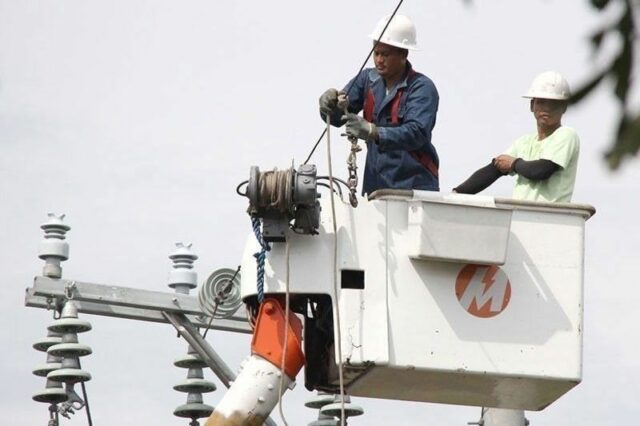
PANGILINAN-LED Manila Electric Co. (Meralco) said it will borrow P75 billion from three major local lenders to finance its planned joint venture (JV) with Aboitiz Power Corp. (AboitizPower).

Meralco hopes to secure P75 billion in loans, payable over 12 years, from BDO Unibank, Inc., Bank of the Philippine Islands, and Metropolitan Bank & Trust Co. within the week, the power distributor said in a stock exchange disclosure on Monday.

“The loan will be used to finance investments and other general corporate purposes of the company,” Meralco said.

Meralco Chief Finance Officer Betty C. Siy-Yap said via Viber that the credit facility is intended for the “acquisition of investments in Project Chromite” and will be drawn “within the week.”

In March last year, Meralco and AboitizPower announced that their subsidiaries had entered into an investment agreement to form Chromite Gas Holdings, Inc.

Chromite Gas will be 60% and 40% beneficially owned by Meralco PowerGen Corp. (MGen) and Therma Natgas Power, Inc. (Therma), respectively.

The joint venture is part of the $3.3-billion landmark deal between MGen, Therma, and San Miguel Global Power Holdings Corp. (SMGP) to launch an integrated liquefied natural gas (LNG) facility in Batangas.

Under the deal, MGen and Therma will jointly invest in two of SMGP’s gas-fired power plants: the 1,278-megawatt (MW) Ilijan power plant and the new 1,320-MW combined cycle power facility.

MGen and Therma, through Chromite Gas, along with SMGP, will also invest in the LNG import and regasification terminal owned by Linseed Field Corp. in Batangas.

Late last year, the Philippine Competition Commission (PCC) approved the mega deal, allowing the parties to proceed with their joint acquisition of power facilities and the LNG terminal, subject to certain conditions.

Monalisa C. Dimalanta, chairperson and chief executive officer of the Energy Regulatory Commission, earlier said that the commission needs to review the LNG deal to ensure that the companies comply with market share limitations and to review power supply deals.

Meralco’s majority owner, Beacon Electric Asset Holdings, Inc., is partly owned by PLDT Inc.

Hastings Holdings, Inc., a unit of PLDT Beneficial Trust Fund subsidiary MediaQuest Holdings, Inc., has an interest in BusinessWorld through the Philippine Star Group, which it controls. — Sheldeen Joy Talavera

ACMobility adding more EV charging points in Makati

ACMOBILITY

ACMOBILITY is putting up 27 more electric vehicle (EV) charging stations in Makati City within the first quarter, the mobility solutions provider announced on Tuesday.

Makati City is set to have 74 operational charging points across 18 locations, such as offices, malls, and condominiums, the end-to-end mobility solutions arm of the Ayala group said in a statement.

The plan to put up 27 more charging points, which will include 19 DC (direct-current) fast charge points, is in partnership with Ayala Land, Inc. and the Makati Central Estate Association.

“As a key city for our EV ecosystem expansion, Makati exemplifies the potential of electric mobility in urban centers, and we are dedicated to meeting its evolving needs toward a greener future,” ACMobility Chief Executive Officer Jaime Alfonso Zobel de Ayala said.

The expansion of ACMobility’s charging stations will help position the city as one of the most sustainable urban centers in the country, the company said.

“By boosting our EV infrastructure through ACMobility, we commit to the integration of cleaner technologies,” said Makati Mayor Marlen Abigail Binay-Campos.

To date, ACMobility has 47 charging points in Makati City, which are located in offices, transport terminals, residential areas, and commercial spaces. — Ashley Erika O. Jose

What Trump policies could bring for PHL

DONALD J. TRUMP wearing a traditional barong Tagalog during his visit to Manila on Nov. 12, 2017. — REUTERS

By Revin Mikhael D. Ochave, Reporter

UNITED STATES PRESIDENT Donald J. Trump’s recent policy announcements have mixed implications for the Philippines, with potential benefits from lower energy prices due to boosted US oil and gas production but concerns over US inflation and protectionist trade policies that could affect the Philippine economy and its trade relationship with the US, according to analysts.

“President Trump’s orders and announcements that impact US inflation are quite mixed. On the one hand, there are measures designed to ultimately reduce inflation. On the other hand, the proposed 25% tariffs on Canada and Mexico could drive up US inflation since the US imports nearly $900 billion of goods from those countries,” China Bank Capital Corp. Managing Director Juan Paolo E. Colet said in a Viber message.

“A sustained increase in US inflation would very likely push the Federal Reserve into a hawkish policy stance, which could in turn weaken the peso and limit the Bangko Sentral ng Pilipinas’ (BSP) room for interest rate cuts,” he added.

Following his inauguration on Tuesday, Mr. Trump signed a memorandum directing every federal agency to fight consumer inflation. He also hinted that 25% tariffs will be imposed on Canada and Mexico starting Feb. 1.

The local stock market was relatively flat following Mr. Trump’s inauguration.

The bellwether Philippine Stock Exchange index dropped by 0.15% or 9.68 points to 6,340.21, while the broader all shares index fell by 0.07% or 2.62 points to 3,700.24.

AP Securities, Inc. Research Head Alfred Benjamin R. Garcia said Mr. Trump’s focus on oil and gas could be beneficial to the Philippines.

“One thing that stands out is his mandate to boost oil production and lift the export ban on liquefied natural gas (LNG) exports, which should help lower energy prices and translate to lower inflation for us here in the Philippines,” Mr. Garcia said in a Viber message.

One of Mr. Trump’s first-day executive orders (EOs) resumes processing export permits for new LNG projects to boost US energy production.

“This first batch of EOs focused mostly on domestic issues, and we’re not yet seeing details on his planned executive actions that would have significant impacts on the global economy, such as tariffs,” Mr. Garcia said.

Philippine President Ferdinand R. Marcos, Jr. recently signed Republic Act No. 12120 or the Philippine Natural Gas Industry Development Act to develop the country’s natural gas industry.

The Philippines is seeking other sources of energy as the Malampaya gas field, which supplies a fifth of all power generated in the country, is expected to run out of easily recoverable gas by 2027.

Mr. Colet also noted that Mr. Trump’s move to direct federal agencies to investigate US trade practices could be a potential concern for the Philippines.

“He has ordered an investigation into trade practices and deficits, so that is something that should concern us because the Philippines is a net exporter to the US. Hopefully, our special relationship with the US and the relatively small trade deficit they have with us will spare our country from any major tariffs,” he said.

“Trump’s key pronouncements so far are generally in line with market expectations. There’s nothing there yet that is immediately and materially adverse to our country’s economy,” he added.

Meanwhile, COL Financial Group, Inc. Chief Equity Strategist April Lynn Lee-Tan said in a Viber message that the impact of Mr. Trump’s policies on the Philippines will depend on how it affects US bond rates and the dollar.

For his part, Rizal Commercial Banking Corp. Chief Economist Michael L. Ricafort said that Mr. Trump’s protectionist policies could lead to higher US inflation.

“More protectionist policies by Mr. Trump could lead to higher tariff rates on imports from China and other countries, while tighter immigration rules could increase US labor costs, all of which would lead to higher overall US inflation,” he said in a Viber message.

Next to Normal returns for a more informed audience

THE rock musical Next to Normal, written by Brian Yorkey with music by Tom Kitt, is often credited as launching the discussion of mental health in mainstream theater back when it premiered on Broadway in 2009.

Next to Normal follows an American family navigating grief. The mother, Diana Goodman, suffers from worsening bipolar disorder that was triggered by a loss in the family. Her illness also affects the lives of her husband Dan and her children, Natalie and Gabe.

The late theater director Bobby Garcia brought the musical to the Philippines in 2011, its Asian premiere. It starred Markki Stroem, Menchu Lauchengco-Yulo, Jett Pangan, Bea Garcia, Felix Rivera, and Jake Macapagal. It was very well received.

This year, 14 years later, it is The Sandbox Collective’s turn to produce the play. The director, Toff de Venecia, believes that as an exploration of love and resilience, the Tony and Pulitzer-winning Broadway drama will resonate with Filipinos audiences of today, who are now equipped with “the language and capacity to talk about mental health.”

“The last time this was staged here was a short Ateneo blueREP run in 2020 cut short by the pandemic. Before that was Atlantis Productions in 2011. I think it’s time to bring this piece back for new generations like Gen Z. It’s very timely, timeless, and important,” he said at a Jan. 14 press preview of the musical.

Sandbox has been staging mental health-themed plays these last few years — Every Brilliant Thing, Lungs, The 25th Annual Putnam Spelling Bee, Tiny Beautiful Things, and Dani Girl. “Mental health is the core advocacy of Sandbox. There’s always a need to have a platform to talk about it,” said Mr. De Venecia.

A NEW STAGING
Next to Normal stars big names in theater: Shiela Valderrama and Nikki Valdez will be alternating as Diana Goodman, OJ Mariano and Floyd Tena alternating as Dan, Sheena Belarmino and Jam Binay alternating as daughter Natalie, and Vino Mabalot and Benedix Ramos alternating as son Gabe. Omar Uddin and Davy Narciso will share the role of Henry, who falls in love with Natalie, while Jef Flores takes on the role of psychiatrist Dr. Madden.

“The main characters are a family, which is very Filipino. The themes in this musical are universal,” Mr. De Venecia said.

For Ms. Valderrama, the burden of the material was made less heavy by the support of the cast and crew, who were all easy to work with, she said.

“It was cathartic for me to release the darkness,” she explained. “It’s not so much absorbing it but releasing it.”

Making the music feel authentic and real was also key in making this staging Next to Normal different from others, according to musical director Ejay Yatco.

“We did it before with Ateneo blueREP for that one weekend before the pandemic hit. It felt like an unfinished battle for me. Now we have a completely live band, not a synthesized keyboard, so it’s all ‘real.’ I also wanted the music itself to have an arc,” he said.

The choreography will be just as “real,” with choreographer Stephen Viñas saying, “I wanted them to just breathe and create something without really dancing,” when speaking of the actors.

The goal for this staging, which is “radically different”  for “the emotions and performances to carry the show.”

REVISITING THEMES
Next to Normal is relevant for people who may want to overcome their personal mental struggles through the arts.

Mr. Mariano, who plays the steadfast husband who must support his wife while also navigating his own grief, said that it’s good to “always revisit the topic of mental health.”

“I actually lost my parents last year, seven months apart, and I have really bad days. I told Toff it might be too close to home and I might not be able to handle it, but I had the strength to go to the callbacks. I’m lucky to have a support system around me to be able to do this,” he explained.

Playing the enigmatic son Gabe is Mr. Mabalot, who revealed that he has his own struggle, with major depressive disorder. He talked about the importance of “sublimating,” to divert or modify an emotional impulse into something more productive.

“There are times we have to move past it that way, to get to a healthy standpoint so as to not trigger our own traumas,” he said.

In line with the topic of the musical, The Sandbox Collective got The Medical City to sponsor tickets for those with mental illness who would like to watch Next to Normal. They will also be a partner in spreading awareness and being the support that audiences can turn to regarding the mental health struggles depicted.

“In the process of putting things together, we openly talk about mental health issues,” said Mr. De Venecia. “Being transparent makes the result more grounded and real.”

Next to Normal will run from Feb. 1 to 23 at the Power Mac Center Spotlight, Circuit, Makati. Tickets are now available via ticket2me.net. — Brontë H. Lacsamana

The demographic dividend of the Philippines: The Catholic view of marriage

LYNDSEY MITCHELL-UNSPLASH

(Part 8)

We have seen that a widespread culture of materialism and consumerism is a counterforce in the efforts of the developed countries to increase the average fertility rate. The moment individuals get used to considering the cost of having children in terms of a Lexus car, an expensive apartment, a world tour or some other luxury item they have to forego, it would be very difficult to convince married couples to have two or more children or even to get married at all.

Getting married and having children cannot be reduced to a cost-benefit decision based on purely materialistic goods and human pleasures. For example, local governments in China today are cold-calling married women to ask about their plans to have babies and are handing out cash to parents to encourage them to have more than one child. Universities have been asked to introduce so-called love courses for single students. These efforts are all doomed to fail. Decisions about children are fundamentally human ones that necessarily involve the spiritual and moral dimensions of man.

Countries that are desperately trying to reverse the decline in their respective populations and the corollary rapid ageing of the same must turn to a non-materialist or spiritual interpretation of the role of marriage, the family and children in society.

Here, I present the Catholic view of marriage, the family, and children, a world view that includes a belief in God as the Creator of the universe and a Law giver who has issued very concrete decrees about marriage and everything related to this sacred institution. This Catholic view is shared by millions of Muslims and Jews because they are contained in the divine revelations found in the Old Testament which is accepted by the two other religions. Those from other faiths or of no religion alone can arrive at some of these truths by the light of reason alone, albeit with some difficulty.

In the Catechism of the Catholic Church, we read in Number 2331 that “God is love and in himself he lives a mystery of personal loving communion. Creating the human race in his own image…, God inscribed in the humanity of man and woman the vocation, and thus the responsibility of love and communion… God created man in his own image… male and female he created them; He blessed them and said, ‘Be fruitful and multiply’; When God created man, he made him in the likeness of God. Male and female he created them, and he blessed them and named them Man when they were created.”

St. John Paul II elaborated on these points of the Catechism in his famous Apostolic Exhortation entitled “The Family in the Modern World.” He emphasized that the human person was created out of love, and each is called to love within his or her vocation. Marriage and family life are special opportunities to live the vocation of love. The love between husband and wife mirrors the love between Christ and his Church — that is, this love is sacrificial and life-giving. A person’s freedom, far from being restricted by this fidelity, is secured against every form of subjectivism or relativism and is made a sharer in creative Wisdom. Married life is enriched and becomes a family with gift of children. It is clear from these teachings of the Catholic Church that marriage, and the marital act must be open to the possibility of children coming from this union of love. That fact that “love is sacrificial and life-giving” means that married couples must be ready to suffer the discomforts, inconveniences, privations, etc. that come with having children. Only when the majority of a population accept this philosophical (and theological) truth will efforts to arrest the decline in the fertility rate and the rapid ageing of the population succeed.

St. John Paul II elaborates further that the family is more than an economic, biological, and sociological entity. As mentioned repeatedly in the Catechism of the Catholic Church, the family is part of God’s plan for creation and salvation. It is within the family that the human person comes to be whom he or she is and comes to know the living God. Love within the family reveals in a special way the unbounded love of God for humanity. Family love involves four general callings: forming a community of persons; sharing a love which serves life; participating in the development of society; and sharing in the life and mission of the Church in the case of baptized Christians. The family, likewise, helps to morally renew the social order. To bear witness to the inestimable value of the indissolubility and fidelity of marriage is one of the most precious and most urgent tasks of Christian couples in our time. Fortunately, in the Philippines there are a good number of apostolic initiatives of married couples who are committed to these urgent tasks, such as the Couples for Christ, Marriage Encounter, Regnum Christi, Focolare, Education for the Upbringing of Children (Educhild), Parents for Education Foundation (Paref), and many others.

In a summary of the detailed ways of promoting an increase in the fertility rate, the following very concrete measures are suggested to concerned married couples, who should always be at the forefront in efforts of “serving life”: (cf. familylife@diolc.org)

• Spouses are to give themselves totally to each other in the conjugal act by honoring God’s inseparable union of love and life. The love between husband and wife must be fully human, exclusive, and open to new life.

• Serving life includes recognition that contraception and natural methods of family planning are very different. Natural methods invite spouses into dialogue, reciprocal respect, shared responsibility, and mutual self-control.

• Spouses are called to be generous to life.

• Husbands and wives are the first and foremost educators of their children. Parents must recognize that they are primarily responsible for the upbringing of their children. Their role is so decisive that scarcely anything (not even the best teachers, except in the few situations when, with God’s grace, teachers or other persons, for example, decide to adopt orphans or abandoned children) can compensate for their failure in it. This is the mission of the two Philippine NGOs mentioned above, i.e., Educhild and Paref.

• Parents are to create a family atmosphere that is animated with love and reverence for God and others.

• Parents are to teach their children to live a simple lifestyle and recognize that material goods are not as important as people. From a very early age, children must realize the fact that in giving birth to them, their parents had to deprive themselves of many material comforts and luxuries.

• It is the parents’ privilege and duty to share the details of sexuality education with their children in such a way that sex (and their sexuality: womanhood and manhood) is viewed as an enrichment of the whole person and an opportunity to give oneself in the gift of love.

• Parents are to work cooperatively with private and public institutions, maintaining cordial and active relationships with teachers and school authorities. Those in society who are in charge of schools must never forget that the parents have been appointed by God Himself as the first and principal educators of their children and that their right is completely inalienable.

• Serving life also includes caring for those outside the immediate family who are society’s outcasts. Also, from a very early age, children must learn from the example of their parents to care for the poor, the sick, and the abandoned.

It would be futile for public authorities in those countries that are going “extinct,” to use the expression of Elon Musk, to sponsor or promote all sorts of programs to arrest the decline in population without having resort to some religious or spiritual motives. Materialistic or consumerist motivations, as have already been tried in countries like Singapore, South Korea, and Japan (and are being desperately resorted to by Chinese authorities today), will not work. I suggest that these governments make as required reading for their public officials the Apostolic Exhortation of St. John Paul II so that they can be inspired to look for deeper human motivations based on religious or spiritual convictions that are the only ones that can inspire married couples to make the necessary sacrifices to “serve life.”

It may also help for the public authorities to seek some assistance from those Catholics in their respective populations who continue to be faithful to the Teaching Authority of the Church and have not been influenced by the so-called “woke” culture that promotes abortion, same-sex marriage, and other practices that are contrary to “service to life.”

(To be continued.)


Bernardo M. Villegas has a Ph.D. in Economics from Harvard, is professor emeritus at the University of Asia and the Pacific, and a visiting professor at the IESE Business School in Barcelona, Spain. He was a member of the 1986 Constitutional Commission.

bernardo.villegas@uap.asia

A Brown investing P2.5B in Misamis Oriental project

MISAMIS ORIENTAL PROVINCIAL INFORMATION OFFICE OFFICIAL FACEBOOK ACCOUNT

A BROWN Co., Inc. (ABCI) is investing P2.5 billion in the construction of a mixed-use complex under a joint venture agreement with the Misamis Oriental provincial government.

The project will be developed in four phases and is part of an integrated master development plan, the company said in a regulatory filing on Tuesday.

ABCI said the first phase of the project covers three components, which include the development and construction of office spaces, a commercial center, a park, and parking facilities.

The final phase of the project will consist of the development and construction of a multilevel mixed-use building with a dormitory.

The company said it will disclose more information on the final terms and conditions of the project once the joint venture agreement is signed.

ABCI is a Mindanao-based company with interests in sectors such as property, power generation, public utilities, and agribusiness.

For the first nine months, ABCI saw a 40% decline in its net income to P290.82 million from P484.50 million the previous year.

Revenue rose by 31% to P1.45 billion from P1.10 billion a year earlier, led by higher sales of real estate units and agricultural goods such as crude palm oil.

The total cost of sales and services likewise increased by 95% to P761.34 million from P390.23 million the previous year due to higher sales.

ABCI shares fell by 1.75% or one centavo to 56 centavos apiece on Tuesday. — Revin Mikhael D. Ochave

BTr fully awards reissued bonds as rates drop on strong demand

BW FILE PHOTO

THE GOVERNMENT made a full award of the reissued 10-year Treasury bonds (T-bonds) it offered on Tuesday at an average rate lower than secondary market levels on strong demand,  with traders also reacting to US President Donald J. Trump’s post-inauguration policy announcements.

The Bureau of the Treasury (BTr) raised P30 billion as planned via the reissued 10-year bonds it auctioned off on Tuesday as total bids reached P93.32 billion or more than thrice the amount on offer.

The bonds, which have a remaining life of nine years and 14 days, were awarded at an average rate of 6.251%. Accepted yields ranged from 6.22% to 6.27%.

The average rate of the reissued papers rose by 36.1 basis points (bps) from the 5.89% fetched for the series’ last award on Dec. 10. This was also 1 bp higher than the 6.25% coupon for the issue.

Still, the average rate was 6.7 bps below the 6.318% seen for the same bond series and 7.5 bps lower than the 6.326% quoted for the 10-year bond at the secondary market before Tuesday’s auction, based on PHP Bloomberg Valuation Service Reference Rates data provided by the BTr.

To accommodate the strong demand seen for Tuesday’s offer, the BTr opened its tap facility window to raise P10 billion more via the bonds at the same average rate.

The T-bonds auctioned off on Tuesday fetched yields lower than comparable benchmarks at the secondary market following Mr. Trump’s inauguration speech, Rizal Commercial Banking Corp. Chief Economist Michael L. Ricafort said in a Viber message.

T-bond rates were lower than market expectations as Mr. Trump’s speech caused markets to scale back their bets of a hawkish US Federal Reserve, the first trader said by phone.

The Treasury fully awarded its offer as it saw strong demand for the bonds on “improved risk sentiment,” a second trader said in a text message.

Global markets greeted Mr. Trump’s presidency with apprehension on Tuesday in moves that were highly sensitive to headlines over the newly sworn-in president’s plans for trade relations and tariffs in particular, Reuters reported.

US markets were closed for a holiday on Monday, so the first reactions to Mr. Trump’s return to the White House were felt during Asian trade on Tuesday, with European futures also pointing to a lower open.

Just as investors cheered the possibility of a delay in Mr. Trump’s implementation of tariffs following a brief mention of the topic in his inauguration speech, the US president said shortly after that he was mulling imposing 25% tariffs on Mexico and Canada as soon as Feb. 1.

Mr. Trump’s plans for hefty import tariffs have been a key area of focus for financial markets on the view that such policies will stoke inflation and run the US economy red hot again, which would boost the dollar and hurt bonds.

Some investors had expected a swift imposition of tariffs from the moment he took office, so the lack of any concrete moves initially sparked a brief relief rally across stocks and US Treasuries.

The benchmark 10-year US Treasury yield was last 7.1 basis points lower at 4.54%. Yields move inversely to bond prices.

Markets had expected that Mr. Trump would announce trade tariffs via executive orders, raising the prospects for higher-for-longer Federal Reserve policy rates.

The BTr plans to raise P213 billion from the domestic market this month, or P88 billion via Treasury bills and P125 billion through T-bonds.

The government borrows from local and foreign sources to help fund its budget deficit, which is capped at P1.54 trillion or 5.3% of gross domestic product this year. — A.M.C. Sy with Reuters