Home Blog Page 1680

Beyond paychecks: The dilemma of employee reimbursements

Employees sometimes incur business expenses during the course of their work, including travel, meals, lodging, and other business-related costs. While reimbursements seem straightforward, they carry tax implications that must be managed carefully. Businesses must be aware of these implications to mitigate potential tax risks and avoid reducing the net take home pay of their employees, who are merely performing their duties in the pursuit of their employer’s business.

As a rule, fixed or variable transportation, representation and other allowances which are received by an employee, in addition to the regular compensation fixed for his position, are generally treated as compensation subject to withholding taxes. However, certain amounts are not considered compensation (and therefore, not subject to withholding taxes). These are advances or reimbursements for traveling, representation and other bona fide ordinary and necessary expenses incurred or reasonably expected to be incurred by the employee in the performance of his duties. Specifically, the following conditions must be satisfied:

1. It is for ordinary and necessary expenses paid or incurred by the employee in the pursuit of the employer’s trade, business or profession; and

2. The employee is required to liquidate/account for the expenses in accordance with the requirements for substantiation under the Tax Code. Any excess advances made which are not properly liquidated constitute taxable income if such amount is not returned to the employer.

Hence, if a business provides monthly allowances or advances to its employees in cash, and they are not required to liquidate or account for the funds received, this may be viewed as compensation subject to withholding tax. It should be noted though that the rules provide an exception: reasonable amounts of reimbursements/advances for traveling and entertainment expenses which are pre-computed on a daily basis and are paid to an employee while he is on an assignment or duty are not required to be substantiated and are not subject to Withholding Tax on Compensation (WTC).

WHAT’S THE DILEMMA, THEN?
During a tax investigation, the BIR typically compares the taxpayer’s expense accounts on its books with its filed tax returns and review the sufficiency of supporting documents related to claimed expenses. Employers usually do not treat reimbursements to their employees as compensation subject to WTC. However, unless employers are able to prove with valid documentation that such reimbursements are valid business expenses, there may be a challenge in resolving this issue during an audit.

Even if the hurdle of WTC is cleared, the expenses may still be flagged as subject to Expanded Withholding Tax (EWT), particularly for employers which are classified as a top withholding agent. As most know, a top withholding agent is required to withhold 1% tax on goods or 2% tax on services purchased from regular domestic suppliers. However, in most cases, the employees are not in a position to withhold EWT when directly paying a supplier. Suppliers would not agree to the withholding unless a withholding tax certificate can be provided on the spot, which the employee may not be authorized or equipped to provide. To avoid incurring penalties (i.e., interest, compromise penalties) during an audit, in cases where there was failure to withhold the EWT, some employers opt to gross-up the transaction amounts to pay off the EWT supposedly due on the transactions, which results in additional costs.

As if the above is not enough, if the documentation requirement is not fully complied with, such as when the invoices are not in the name of the employer, these expenses may also be disallowed as expenses for income tax and as input VAT credits.

Clearly, there is a lot at stake, especially for businesses which heavily rely on employee reimbursements to account for expenses used in business.

WHAT SHOULD BE DONE?
For WTC purposes, employers must establish the business purpose of these reimbursements with the appropriate documents, i.e., supplier invoices that are issued to the company, to prove that these should not be subject to WTC. Putting up internal policies specifying the conditions to avail of such employee reimbursements and/or allowances would help during a tax audit and also help business managers who review the reimbursement reports to ensure that only valid reimbursements are granted.

As for EWT, employers may consider using company-issued credit cards for employee reimbursements. In line with the tax rules, the employers’ payments to suppliers are not subject to withholding tax if paid through a credit card. This is because the EWT obligation on the supplier income is shifted to the credit card companies who have control of the payment to the suppliers. Instead, the taxpayer/employer’s withholding tax obligation is limited to the 2% EWT due on the service fees and other charges imposed by the credit card company. This approach helps alleviate the burden on the employer of assessing the applicable EWT for each and every reimbursement transaction or grossing up the expenses to account for the additional EWT (which inevitably results in additional cash outlay).

Last, in terms of substantiation requirements for income tax and VAT purposes, employers may provide their employees with a handy reference guide that can be presented to suppliers whenever a purchase is made. The guide should include the following information of the employer which the supplier would then use to issue the invoice: (1) Full business name; (2) Complete address; and (3) Tax Identification Number (TIN). Employees should ensure that they receive BIR-registered invoices and that the VAT amount is specifically broken down to support the company’s tax/VAT reporting. 

Employee reimbursements can be tricky, to say the least. While reimbursements help facilitate business-related expenses, these can come with tax exposures if not managed properly. With the ever-changing tax rules and specific compliance requirements, it is crucial to stay informed and be meticulous with the documentation to avoid running into pitfalls. By doing so, businesses can mitigate risks, improve tax efficiency, and optimize cash flows, which can lead to a stronger financial position moving forward.

The views or opinions expressed in this article are solely those of the author and do not necessarily represent those of Isla Lipana & Co. The content is for general information purposes only and should not be used as a substitute for specific advice.


Steven Lloyd Co is a manager at the Tax Services department of Isla Lipana & Co., a Philippine member firm of the PricewaterhouseCoopers global network.

steven.lloyd.co@pwc.com

Peso jumps to P55 level as weak US data fuel Fed cut bets

BW FILE PHOTO

THE PESO on Wednesday closed at the P55-per-dollar level for the first time since September as weak US economic data bolstered US Federal Reserve rate-cut bets.

The local unit closed at P55.84 per dollar on Wednesday, surging by 30.5 centavos from its P56.145 finish on Tuesday, Bankers Association of the Philippines data showed.

This was the peso’s strongest finish in more than seven months or since its P55.69 close on Sept. 20, 2024. This was also the first time it ended at the P55 level since Sept. 26, 2024’s P55.965.

The peso opened Wednesday’s trading session stronger at P56.005 against the dollar. Its worst showing was at just P56.06, while its intraday best was at P55.833 versus the greenback.

Dollars exchanged went down to $1.68 billion on Wednesday from $1.78 billion on Tuesday.

Philippine financial markets are closed on May 1 (Thursday) for Labor Day.

The peso surged as the dollar remained fragile following weak US Job Openings and Labor Turnover Survey and consumer confidence data, a trader said in a phone interview.

The reports fueled expectations of rate cuts by the Fed amid recession fears, Rizal Commercial Banking Corp. Chief Economist Michael L. Ricafort added in a Viber message.

Tuesday’s data highlighted a gradually declining economy, Reuters reported. US job openings dropped sharply in March, but a decline in layoffs suggested that the labor market remained on solid footing despite an ever-shifting tariff policy casting a pall over the economy.

The Conference Board’s US consumer confidence index, on the other hand, sank to a nearly five-year low in April on tariff concerns.

Markets are now pricing in 97 basis points (bps) worth of rate cuts from the Fed by December, up from about 80 bps early last week.

The dollar is on track for its worst monthly performance since November 2022 with a 4.7% loss against a basket of peers. — Aaron Michael C. Sy with Reuters

PSEi climbs to 6,300 level on easing trade jitters

BW FILE PHOTO

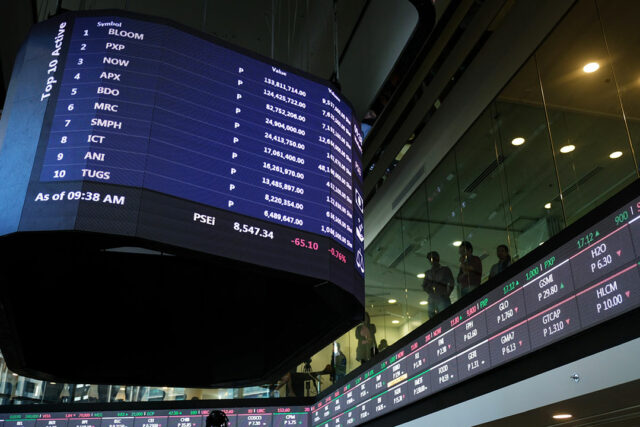
PHILIPPINE SHARES surged to the 6,300 level on Wednesday on easing trade tensions and after Fitch Ratings affirmed the country’s investment-grade rating.

The bellwether Philippine Stock Exchange index (PSEi) rose by 1.64% or 102.80 points to close at 6,354.99, while the broader all shares index increased by 1.11% or 41.07 points to end at 3,727.30.

This was the PSEi’s highest close in almost two months or since it ended at 6,360.77 on March 10.

Philippine financial markets are closed on May 1 (Thursday) for Labor Day.

“The local bourse jumped… following positive cues from Wall Street amid a major trade deal announced by the United States. Many investors also took the opportunity to buy stocks at bargain levels,” Philstocks Financial, Inc. Research Analyst Claire T. Alviar said in a Viber message. “Additionally, Fitch Ratings’ decision to affirm the Philippines’ investment-grade “BBB” rating with a stable outlook added to the positive sentiment.”

“The PSEi extended its gains today, supported by strong first quarter earnings from several index heavyweights and a backdrop of easing global trade tensions,” DragonFi Securities, Inc. Equity Research Analyst Jarrod Leighton M. Tin added in a Viber message.

US President Donald J. Trump signed a pair of orders to soften the blow of his auto tariffs on Tuesday with a mix of credits and relief from other levies on materials, and his trade team touted its first deal with a foreign trading partner, Reuters reported.

In his latest partial reversal of tariff policies, the Republican president agreed to give carmakers two years to boost the percentage of domestic components in vehicles assembled domestically.

Meanwhile, US Commerce Secretary Howard Lutnick told CNBC he had reached a deal with one foreign power that should permanently ease the “reciprocal” tariffs Mr. Trump plans to impose.

Majority of sectoral indices closed higher on Wednesday. Property climbed by 3.54% or 79.59 points to 2,323.42; financials rose by 2.67% or 64.32 points to 2,466.03; holding firms went up by 1.54% or 81.54 points to 5,347.01; and industrials increased by 0.57% or 50.91 points to 8,980.77.

Meanwhile, mining and oil fell by 1.25% or 125.65 points to 9,873.68 and services dropped by 1.13% or 22.28 points to 1,943.57.

Value turnover jumped to P8.28 billion on Wednesday with 727.49 million shares traded from the P4.88 billion with 622.80 million issues exchanged on Tuesday.

Advancers bested decliners, 100 versus 77, while 70 names were unchanged.

Net foreign buying increased to P986.27 million on Wednesday from P275.68 million on Tuesday.

“The PSEi is now approaching its key resistance level at 6,400. With this in mind, we may see some profit-taking or consolidation in the near term as the market gauges whether it has enough momentum to break above this level or retrace toward its 20-day moving average near 6,150,” Mr. Tin said. — Revin Mikhael D. Ochave with Reuters

DLSU blocks UST to secure No. 2 seed, Final Four bonus

DLSU LADY SPIKERS — UAAP/JOAQUI FLORES

Games on Saturday
(Araneta Coliseum)
10 a.m. – NU vs UST (men’s Final Four)
12 p.m. – FEU vs DLSU (men’s Final Four)
2 p.m. – NU vs FEU (women’s Final Four)
6 p.m. – UST vs DLSU (women’s Final Four)

DE LA Salle University (DLSU) turned back University of Santo Tomas (UST) in a gritty come-from-behind win, 23-25, 25-20, 30-28, 29-27, to secure the No. 2 seed and the last Final Four bonus in the UAAP Season 87 women’s volleyball playoff on Wednesday at the Mall of Asia Arena.

The Lady Spikers melted a 17-22 deficit in the extended fourth set, swatting a barrage of attacks from the usually fiery Golden Tigresses out to force a decider for a defensive masterclass in two hours and 30 minutes.

Overall, La Salle tallied 20 blocks — the most by any team this season — including three in the tail end of the fourth frame none bigger than setter Julyana Tolentino’s swat on Maribeth Hilongo followed by Shevana Laput’s down-the-line hammer for the gusty win.

La Salle’s net dominance complemented the 24 points of super spiker Angel Canino, who also contributed in blocking with four blocks plus an ace, entering the semis duel against the same squad on Saturday at the Smart Araneta Coliseum. Reigning champion and No. 1 seed National University (NU) battles the fourth-ranked Far Eastern University in the other bracket.

Ms. Laput added 22 points on 19 hits, two blocks and an ace while Amie Provido, Ms. Tolentino and Alleiah Malaluan, who had 11 points, joined the party with five, four and three blocks, respectively.

La Salle obliged, clawing back in the final two sets that both reached deuces to own the coveted win-once bonus this time after settling for the third seed last year. Then at a disadvantage, the Lady Spikers were eliminated by second-ranked and twice-to-beat-armed Golden Tigresses in one attempt to surrender their throne.

After splitting the first two sets, the Lady Spikers stared to a 20-22 deficit in the third but still pulled off a 30-28 win behind Ms. Canino’s explosion in the nick of time with back-to-back hits.

It’s the same story in the fourth, where the Golden Tigresses appeared headed into forcing a decider like their first two encounters this season only to be zapped by the Lady Spikers’ searing comeback behind a defensive clinic.

It’s the first four-setter win for either team after three-straight five-setters since the Final Four last year, including a split this season.

“We’ve been given this chance so we’re not just gonna throw away this shot. We fought for this. We know we needed this twice-to-beat advantage,” said Ms. Laput as La Salle made up for two crucial losses in their final three games of the eliminations to miss out on an outright bonus.

Angge Poyos (24), Regina Jurado (12) and Hilongo (8) stood their ground but Santo Tomas will still march into the Final Four at a disadvantage this time around for a harder route to a finale return.

The Golden Tigresses only had eight blocks compared to the Lady Spikers’ truckload, getting shut down in succession to absorb their second straight loss en route to the semis after also crucial five-setter defeat to the mighty NU Lady Bulldogs in the final game of the elims.

A win by Santo Tomas against NU then could have given it the coveted second spot right away without a playoff but to no avail. And with another shot against their archrivals, the Golden Tigresses stumbled anew. — John Bryan Ulanday

South Korean yellow jersey holder finishes second to Javiniar in Stage 7

FACEBOOK.COM/TOUROFLUZONCYCLING

LABRADOR, Pangasinan — South Korean Joo Dae Young of Gapyeong Cycling Team struck with a podium finish in the 15.2-kilometer Stage Seven individual time trial ahead of the dreaded Baguio ascent of the MPTC Tour of Luzon: Great Revival on Tuesday.

The 27-year-old two-time Korean national champion clocked 18 minutes and three seconds in finishing second behind eventual stage winner Joseph Javiniar of Excellent Noodles, who clocked an impressive 17:25.

“Tuesday, I’m getting more time. Wednesday, I don’t think so,” said Mr. Joo moments after his second podium finish in the short but sweet lap that started in Lingayen and ended in front of the municipal hall here.

Metro Pacific Tollways Drivehub’s Mervin Corpuz was third with an 18:17 time.

The effort earned Mr. Joo precious seconds to his lead and now owns a total aggregate time of 17:59:37, or 2.10 minutes ahead of his closest pursuer Mr. Corpuz (18:01:47).

Victoria Sports’ Nichol Pajera jumped from seventh to third after ending up fourth in Stage Seven and has 18:02:42 while Standard Insurance’s Jan Paul Morales (18:02:46) and Jeremy Lizardo (18:02:51), MPTD’s Jonel Carcueva (18:03:13), Go for Gold’s Jerico Jay Lucero (18:03:40), Exodus Army’s Mar Francis Sudario (18:03:57), 7-Eleven’s Rench Michael Bondoc (18:03:57) and Standard’s Ronald Oranza (18:04:35) rounded out the top 10.

After seven grueling but relatively flat stages in the MPTC Tour of Luzon: Great Revival, everything will now boil down to this one final stage that could make or break dreams.

And Mr. Joo, who will wear the yellow jersey again, knows the 177.54-kilometer Stage Eight from Lingayen to the feared mountain passes of Baguio would be far from easy.

Mr. Joo also has one dilemma entering Baguio — he will have to defend his lead with a lone teammate standing in Jang Jun Hyeok after the rest of his squad fell like dominoes due to various reasons.

“My team is just two, me and one person. But we’ll keep going,” he said.

Mr. Corpuz, a 27-year-old nephew of multi-awarded Santy Barnachea, for his part, said he’s ready to take on the challenge.

“I’m 100-percent ready,” he said.

But don’t mistake Stage Eight as a Joo-Corpuz show as practically everybody trailing by mere 10 minutes or less have a legitimate shot of claiming the one crown all cyclists crave — the Tour title.

“It’s still anybody’s race,” said Commissaire1 Jun Lomibao.

That’s the reason Mr. Barnachea, MPTD’s director a winner of two Tour crowns and two Ronda titles, gave Mr. Corpuz and his team one marching order — attack in the start of the ascent.

“I just told the boys to make the move and attack at will when they see the mountains,” he said.

Like the individual race, the over team race is far from settled as Standard Insurance continued to cling at No. 1 with a 71:01:14, or just 32 ticks ahead of MPTD (71:01:46).

So expect nothing less than an epic ending in this 1,074-kilometer, eight-stage race staking P1 million each to the individual and team champions. — Joey Villar

Stephon Castle named Rookie of the Year, second straight for San Antonio

San Antonio Spurs guard Stephon Castle was the runaway winner of the NBA Rookie of the Year award on Tuesday.

Castle is the second straight San Antonio player to win top rookie honors. Victor Wembanyama was the unanimous winner last season.

Castle received 92 of the 100 first-place votes and totaled 482 points in balloting conducted by a global media panel. The former UConn standout was the fourth overall pick of the 2024 draft.

Zaccharie Risacher of Atlanta Hawks was second with five first-place votes and 245 points. The Memphis Grizzlies’ Jaylen Wells (three first-place votes, 123 points) placed third.

Castle joins Wembanyama, and legends David Robinson (1989-90) and Tim Duncan (1997-98) as San Antonio players to win the award.

Said Wembanyama on social media: “Hustle, heart & just pure talent… all year long, you showed why you deserved this title !! So proud of you @StephonCastle.”

The Spurs are the first team with back-to-back winners since the Minnesota Timberwolves in the middle of last decade. Andrew Wiggins was the 2014-15 winner and Karl-Anthony Towns won the honor the following campaign.

Castle, 20, averaged a rookie-best 14.7 points and also led with 74 steals while playing in 81 games this season (47 starts). He also averaged 4.1 assists and 3.7 rebounds and made 95 3-point baskets. Reuters

China’s navy patrols South China Sea as Philippines, US hold own sea drills

FORMATION flight of the Philippine Air Force’s FA-50 aircraft and US B-1B bomber aircraft, F16 aircraft and F18 aircraft during a bilateral air patrol over the South China Sea on April 29. — PHILIPPINE AIR FORCE

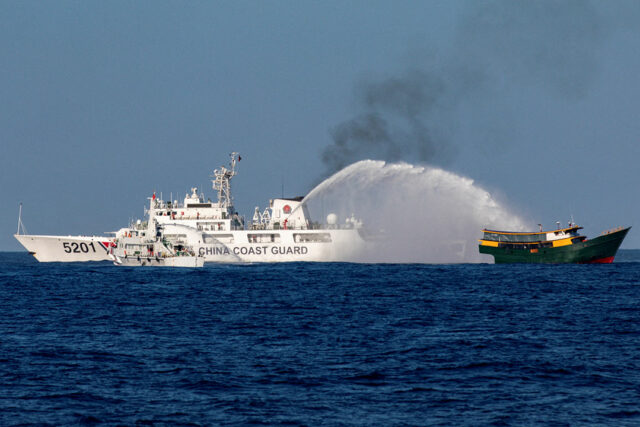
CHINA accused the Philippines of creating “disturbances” as its navy conducted a patrol in the South China Sea on Tuesday, as Philippine and US forces held their own drills in the disputed sea alongside the Australian Navy meant to improve their combat readiness.

In a statement late Tuesday, the Southern Theatre Command of China’s People’s Liberation Army said its forces had carried out routine patrols in the South China Sea, without giving an exact location.

“Recently, the Philippines has been frequently carrying out maritime infringement provocations, creating disturbances and pulling in countries from outside the region to organize so-called joint patrols,” it said.

The command’s naval and air forces have monitored the situation and maintained vigilance, it added.

“Troops in the theater of operations are maintaining a high level of alert, resolutely defending the country’s territorial sovereignty and maritime rights and interests, and resolutely safeguarding peace and stability in the South China Sea region,” it said.

The South China Sea has become a flashpoint in Southeast Asia as China continues to assert sovereignty over almost the entire sea, seen as a vital global trade route that is also believed to be rich in undersea gas and oil deposits.

Beijing has deployed an armada of coast guard vessels to protect what it considers its territory despite a 2016 arbitral tribunal ruling that voided its claim for being illegal.

More than 14,000 Filipino and American soldiers are participating in Balikatan (shoulder-to-shoulder) exercises that run from April 21 through May 9 in the face of shared regional security concerns. China has said the drills are provocative.

A Philippine missile frigate, an Australian destroyer ship and various military jets from the US participated in the April 29 military training, where a range of combat drills were performed to improve military communications, sea tactics and anti-submarine warfare capabilities, the Armed Forces of the Philippines (AFP) said in a statement on Wednesday.

Three FA-50 fighter jets of the Philippine Air Force performed a joint patrol as part of the drills in the hotly contested waters alongside the US Pacific Air Forces’ B-1 long-range bomber and two F-16 and F-18 jets.

“The exercise demonstrates the growing synergy among like-minded partners in maintaining peace and stability in the Indo-Pacific,” AFP Chief of Staff Romeo S. Brawner, Jr. said in the statement. “These exercises are vital in strengthening our collective defense posture and operational readiness.”

The military drills are being held in Philippine areas facing regional hotspots such as the South China Sea and Taiwan.

Started in 1991, the Balikatan exercise has evolved into Southeast Asia’s premier combat rehearsal as the Philippines and the US seek to strengthen security cooperation and enhance force interoperability in response to China’s growing assertiveness in the region.

Last week, the US deployed its Nimitz aircraft carrier group to the Philippine Sea, where it is practicing day and night flight operations and testing its ability to rapidly deploy military jets in various weather conditions, according to the US Indo-Pacific Command.

The Philippines and China have been entangled in a sea row over claims in the South China Sea, with clashes flaring around disputed maritime features such as the Spratly Islands and Scarborough Shoal.

Tensions between them were rekindled after Chinese media said Beijing had seized a disputed reef near a Philippine outpost last week, a claim Manila quickly shot down.

The joint combat drills jeopardize regional peace and could lead to further provocations, Chinese Defense Ministry spokesman Zhang Xiaogang said last week, according to a transcript published on the agency’s website.

“The South China Sea should be a sea of peace, cooperation and friendship,” he said. “However, the Philippines holds a candle to the devil by currying favor and colluding with the US and other outside countries to make provocations.”

Responding in a separate statement to the Chinese military’s comments, the Philippine military said the armed forces stand firm in exercising their sovereign rights and partnerships with allies like the US that reflect shared values.

“The conduct of joint exercises and maritime domain awareness operations within our territorial waters and exclusive economic zone is not a provocation; it is preparedness,” it said.

“To be clear: the Philippines is a sovereign state. No foreign power can dictate how we defend our home or with whom we stand in solidarity,” it added. — Kenneth Christiane L. Basilio

Filipinos think ICC should prioritize justice for victims, not Marcos-Duterte quarrel

By Chloe Mari A. Hufana, Reporter

MOST Filipinos think the International Criminal Court (ICC) should focus on delivering justice for victims of former President Rodrigo R. Duterte’s war on drugs rather than the Marcos-Duterte feud, according to a WR Numero’s latest poll.

About six of 10 Filipinos (59%) said the ICC should prioritize addressing the extrajudicial killings linked to Mr. Duterte’s drug war.  Just 12% disagreed, while 18% were undecided.

The survey, conducted on March 31 to April 7, followed Mr. Duterte’s arrest on March 12 under an ICC-issued warrant.

The public sentiment reflected strong regional and demographic support for ICC intervention, WR Numero said. In Metro Manila, 70% said the ICC should center its legal and investigative efforts on ensuring justice for drug war victims.

Similar views were held by majorities in Luzon (68%) and the Visayas (65%), while opinion in Mindanao — Mr. Duterte’s political base — was more divided, with 32% in agreement and 30% opposed.

Support was also highest among younger Filipinos, with 61% of those aged 30 and below backing the ICC’s focus on victims. Across income classes, upper and middle-class respondents (Class ABC) showed the strongest support at 70%.

Nearly half (47%) of Filipinos thought victims of the drug war should escalate their pursuit of justice to the international court if local remedies fail. This view was particularly strong in Metro Manila (66%) and among Filipinos with a higher income background.

Hansley A. Juliano, a political science lecturer at the Ateneo de Manila University, said the results show a shift in the political and moral values of Filipinos, noting that Filipinos might be tired of the Marcos-Duterte feud.

“Our younger audiences are a bit more cynical to clan or familial feuds, more so since increasingly, younger generations of Filipinos are developing attitudes away from or outside of traditional Filipino family ties,” he told BusinessWorld in a Facebook Messenger chat.

He added that this cynicism has affected how candidates in the May 12 midterm elections project themselves to voters.

“Beyond being clientelistic, they actively invest in developing an online personality/celebrity to get support,” he said. “This simultaneously makes it easier for audiences to explicitly say they’d rather focus on the merits of the case than continue casting the ICC case as a political maneuver, especially since this is blatant Duterte propaganda.”

The ICC probe into Mr. Duterte’s bloody war on drugs has become a political flashpoint in the Philippines, especially after the arrest of the tough-talking leader and the impeachment of his daughter, Vice-President Sara Duterte-Carpio.

Mr. Duterte, a maverick ex-mayor and former prosecutor who led the Philippines from 2016 to 2022, was flown to The Hague on March 11, hours after his arrest in Manila.

This marked the biggest step yet in the ICC’s probe into alleged crimes against humanity during an anti-drug crackdown that killed thousands and drew condemnation around the world.

His trial is set for September.

WR Numero interviewed 1,894 voters for the poll, which had an error margin of ±2 points. It was commissioned by political scientist Gary D. Ador Dionisio.

PHL, NZ sign visiting forces agreement for ‘more seamless’ defense

PHILIPPINE Defense Secretary Gilberto C. Teodoro, Jr. and New Zealand Defense Minister Judith Anne Collins sign a visiting forces agreement as President Ferdinand R. Marcos, Jr., New Zealand Ambassador to the Philippines Catherine McIntosh and Foreign Affairs Secretary Enrique A. Manalo look on. — NOEL B. PABALATE/ PPA POOL

By Kenneth Christiane L. Basilio, Reporter

THE Philippines and New Zealand on Wednesday signed a visiting forces agreement (VFA) that would bolster military cooperation and let their armed forces hold joint exercises in each other’s territories.

Philippine Defense Secretary Gilberto C. Teodoro, Jr. and New Zealand Defense Minister Judith Anne Collins signed the military pact at the presidential palace in Manila, making Wellington the fourth country with which Manila has a VFA.

Philippine President Ferdinand R. Marcos, Jr., New Zealand Ambassador to the Philippines Catherine McIntosh and Foreign Affairs Secretary Enrique A. Manalo, witnessed the signing.

The two nations held their first round of negotiations for the pact in January and reached a consensus a month later, paving the way for its finalization.

Senate ratification is required for the agreement to take effect in the Philippines, while treaties in New Zealand become binding without formal parliamentary approval.

“This agreement will create conditions for even more seamless cooperation in the defense space,” Ms. Collins told a news briefing. “It will ensure that we are prepared to work hand-in-hand when urgent responses are required.”

The Philippines, already bound by military agreements with the US, Japan and Australia, is pursuing closer security ties with allies amid tensions with China over disputed features in the South China Sea.

Tensions flared between the two nations again this week after Chinese state media reported that Beijing had seized a reef near a Philippine military outpost in the hotly contested region, a claim that prompted Philippine security officials to issue a denial.

Ms. Collins said the region’s strategic environment is “deteriorating,” leading New Zealand to establish defense links with other nations. “We have vowed to step up and play our part, working with others in our region.”

China has sought to expand its influence and project naval power beyond its region, with its navy making an unannounced voyage around Australia from February to March and conducting live-fire drills in the Tasman Sea — over 8,000 kilometers away from Hainan Island, China’s nearest major landmass — separating Australia and New Zealand.

“Peace is best backed with resilience and with deterrence,” Mr. Teodoro told the same briefing. “China, for example, is particularly aggressive in the way it makes its claims. We need to deter this kind of unwanted behavior from happening.”

The Chinese Embassy in Manila did not immediately reply to a Viber message seeking comment.

Manila is also exploring visiting forces agreements with France and Canada.

Mr. Teodoro said a visiting forces agreement with Canada would be signed “very soon,” while the Defense department has just received the authority to negotiate one with France.

Meanwhile, Mr. Teodoro said his agency is reviewing more than 50 military agreements spanning from memoranda of understanding to defense cooperation and exchanges that the Philippine government has with nations that don’t share Manila’s position on the South China Sea.

The Defense secretary did not identify which countries were being scrutinized by his agency, but said he was not “singling out” any nation.

“We are also in the process of reviewing the agreements with countries that do not support our claims and that do not have benefit to our defense and foreign policy position,” he told reporters on the sidelines of the media briefing.

The Defense department’s “options are open” when it comes to taking action on the agreements the Philippines has with what Mr. Teodoro described as “misaligned” countries, including revoking the military deals under review. “The review started on day one from my assumption.”

Gov’t told to reallocate defense budget to education, healthcare, climate action

REUTERS

THE Philippine government should prioritize funding critical sectors like education, healthcare, and climate adaptation instead of defense, Stop the War Coalition Philippines said.

“Divest from militarization, slash the defense budget and reallocate funds to education, healthcare, and climate resilience,” Merci Llarina-Angeles, secretariat for the Stop the War Coalition Philippines, said in a forum on Wednesday.

Ms. Angeles said that critical sectors remain “starved of resources,” while the defense sector ballooned to over P300 billion in 2025.

The country’s education sector faces a P50-billion shortfall that leaves students in overcrowded classrooms. The healthcare sector also continues to be underfunded, with one out of three Filipinos unable to afford medical care.

Moreover, the group said that climate adaptation programs received less than 1% of the national budget, despite the country ranking as among the most vulnerable to climate change.

“The reckless prioritization of war over welfare betrays the Filipino people.”

Ms. Angeles said that the Philippines should also oppose foreign military bases and close Enhanced Defense Cooperation Agreement (EDCA) sites, as these risk entangling the country to conflict.

“The Philippines has been fashioned into a forward tripwire state, which could transform the entire nation into a southern battlefront of impending war between the US and China over Taiwan,” Ms. Angeles added.

US troops currently have access to nine EDCA sites, including two military bases in Cagayan which are facing Taiwan.

“The stakes could not be higher. If we do not act now, the Philippines will be locked into a future of endless war, ecological collapse, and stolen sovereignty,” she said.

The Philippines has increase budgetary allocation on the defense sector amid efforts to counter Chinese aggression in the South China Sea, with about P35 billion for the modernization of the military over the next decade.

Philippine forces have repeatedly sparred with Chinese ships and aircraft in the South China Sea over competing claims on Spratly Islands and Scarborough Shoal, among other sea features.

A United Nations-backed tribunal based in the Hague in 2016 voided China’s claim to more than 80% of the South China Sea, where more than $3 trillion worth of trade passes through each year. — Adrian H. Halili

Palace alarmed over alleged Chinese spy arrest

STOCK IMAGE | Image by Dee from Pixabay

THE Presidential Palace is “alarmed” by the arrest of an alleged Chinese spy near the Commission on Elections (Comelec) main office in Manila amid concerns about China’s interference in the upcoming midterm elections in the Philippines.

“It’s quite alarming, and… President Ferdinand R. Marcos, Jr., has this trust in the intelligence agents who made the operation. So, we will just have to wait for the final investigation on that matter,” Presidential Communications Office Undersecretary Clarissa A. Castro said at a news briefing.

When asked if the Chinese Ambassador to the Philippines, Huang Xilian, has been ordered for questioning, Ms. Castro deferred the question to Defense Secretary Gilberto C. Teodoro, Jr.

The Chinese Embassy in Manila said it has taken note of the situation, in response to a Viber message seeking comment.

Also on Tuesday, Justice Secretary Jesus Crispin C. Remulla said if the person is a foreigner, then there is a violation of Immigration Law and that can become a non-bailable case.

Authorities on Sunday apprehended a Chinese national found with suspected surveillance equipment near the Comelec headquarters in Intramuros, Manila.

The National Bureau of Investigation (NBI) has not ruled out the possibility that any data gathered could potentially be used to influence the upcoming elections.

It monitored the suspects’ activities for five days before taking action on Tuesday, just as they were about to switch vehicles.

During the operation, authorities apprehended one of the suspects.

Comelec Chairman George Erwin M. Garcia assured the public there is no cause for concern, as no election data is stored at the Comelec headquarters.

He also stated that a system check was conducted, and no compromise was fowund. — Chloe Mari A. Hufana

Marcos to order probe of PrimeWater

BW FILE PHOTO

PRESIDENT Ferdinand R. Marcos, Jr. will order an investigation into the Villar-owned PrimeWater Infrastructure Corp. for alleged poor services and high cost, the presidential palace said on Wednesday.

“The people’s need for a clean and adequate water supply should not merely be treated as a business opportunity — it must be addressed with concern for the needs of the citizens. The President will order an investigation into this matter,” Presidential Communications Office Undersecretary Clarissa A. Castro said in Filipino at a news briefing.

When asked if this would affect the President’s confidence in admin-backed senatorial candidate Camille A. Villar, she said it would depend on how Ms. Villar would perform. She is eyeing replacing her mother, Cynthia, as a senator.

“If we have this trust in her, well, we have to give to her, but she should prove that she can perform as a leader,” Ms. Castro said.

“With this issue regarding PrimeWater, if there’s a need for them to resolve the issues raised by the consumers, I think we should… take immediate action on that,” she added.

Head of public relations at Prime Asset Ventures, Inc., Mavic Chavez Ching, said in a Viber message the company has yet to issue an official statement.

PrimeWater is a subsidiary of Prime Asset Ventures, Inc.

The private company oversees and operates water services for over 500,000 households across more than 100 districts nationwide. — Chloe Mari A. Hufana

ADVERTISEMENT
ADVERTISEMENT