Home Blog Page 1673

US judges block Trump’s ability to withhold school funds over DEI

Federal judges in Maryland, New Hampshire and Washington, D.C., on Thursday blocked Republican President Donald Trump’s administration from following through on threats to cut off funding to public schools that engage in diversity, equity and inclusion efforts.

The trio of rulings – two by judges whom Trump appointed during his first term in office – came in lawsuits by teachers unions and civil rights groups that sued to prevent the U.S. Department of Education from cutting funding to K-12 schools and universities that did not cease what it called “discriminatory” DEI initiatives.

The Education Department did not immediately respond to a request for comment, but the administration is likely to appeal the decisions.

The policy at issue was outlined in a February 14 “Dear Colleague” letter from the Education Department that the administration said was intended to remind schools that receive federal funding of their obligations to comply with existing civil rights law.

The letter said schools in recent years had embraced “pervasive and repugnant race-based preferences” and “toxically indoctrinated” students by teaching about the history of systemic racism.

The letter said DEI proponents had been “smuggling” such practices into everyday training, programming and discipline, and the department advised schools that it would take action if they did not ensure their practices followed the law.

But U.S. District Judge Landya McCafferty in Concord, New Hampshire, sided with the National Education Association, the largest teachers’ union, and two other groups in finding the policy was unconstitutionally vague and violated educators’ free speech rights under the U.S. Constitution’s First Amendment.

Ms. McCafferty, an appointee of Democratic President Barack Obama, said that while the letter made clear the department’s view that DEI programs violate Title VI of the Civil Rights Act of 1964, it never defined what a “DEI program” even was.

“DEI as a concept is broad: one can imagine a wide range of viewpoints on what the values of diversity, equity, and inclusion mean when describing a program or practice,” she wrote.

She said the policy infringed the First Amendment rights of university professors, also by targeting their speech based on viewpoint if they, for example, teach students about structural racism in America.

Shortly after Ms. McCafferty ruled, U.S. District Judge Stephanie Gallagher in Baltimore issued an order similarly halting the Education Department’s policy at the behest of the American Federation of Teachers, the American Sociological Association and others.

Ms. Gallagher, a Trump appointee, said the Education Department failed to follow proper rulemaking processes and lacked the authority to adopt the policy under the Department of Education Organization Act of 1979.

That law bars the Education Department from directing or supervising a school’s curriculum, instructional program, administration or personnel, or its selection of instructional materials like textbooks.

In the Washington, D.C., case, Trump-appointed U.S. District Judge Dabney Friedrich agreed with the National Association for the Advancement of Colored People, which brought the case, that the policy was too vague.

Her ruling blocked the department from enforcing a requirement it adopted on April 3 mandating that state educational agencies certify compliance with the February policy by Thursday or lose federal funding.

Skye Perryman, whose liberal-leaning legal group Democracy Forward represented the plaintiffs in the Maryland case, in a statement said the ruling “affirms what we have always known: this administration’s attempts to censor schools, teachers, educators, colleges, and universities is unlawful.” – Reuters
China tells G20 meeting world economic growth insufficient

STOCK IMAGE | Image by WikiImages from Pixabay

 – China’s finance minister told a G20 meeting that the current world economic growth momentum was insufficient, with tariff and trade wars further impacting economic and financial stability, according to a ministry readout on Friday.

Lan Foan called on all parties to further improve the international economic and financial system by strengthening multilateral cooperation.

China advocates the settlement of trade and tariff disputes through dialogue and consultation on an equal footing, he said in his speech at the meeting in Washington.

Lan also urged for better implementation of the debt treatment mechanism under the Common Framework, and said all parties should pool more resources for Africa’s development and strengthen Africa’s capacity-building.

Lan held bilateral meetings and exchanges with several representatives, including from South Africa, the European Commission, Pakistan, Germany, South Korea, Indonesia, Britain, Japan and World Bank,

The meetings were mainly to discuss views on the macroeconomic situation, key issues of the G20 fiscal channels and bilateral cooperation, the readout said. – Reuters

China military says it monitored US warship in Taiwan Strait

EN.WIKIPEDIA.ORG

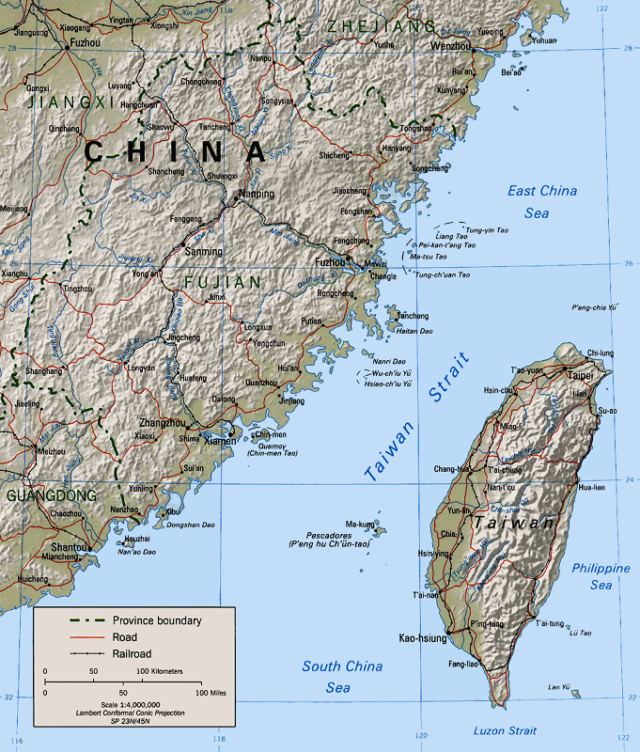
 – China’s military said on Thursday that it had dispatched naval and air forces to monitor and warn a U.S. guided missile destroyer that sailed through the sensitive Taiwan Strait, the second such mission since Donald Trump became U.S. president.

The U.S. Navy sends ships, occasionally accompanied by vessels from allied countries, through the Taiwan Strait about once a month. China, which claims Taiwan as its own territory, says the strategic waterway belongs to it.

China held its latest round of war games around Taiwan earlier this month, drawing condemnation from Taipei and concern from the United States and its allies.

The Eastern Theatre Command of China’s People’s Liberation Army named the ship as the guided-missile destroyer USS William P. Lawrence, and said it passed through the strait on Wednesday in an act of “public hyping”.

“Relevant remarks by the United States have inverted right and wrong, distorted legal principles, confused the public and misled international perception,” the command said in a statement, without specifying which comments it was referring to.

“We are telling the United States to stop their distortions and hyping and to work together to maintain peace and stability in the Taiwan Strait.”

The command also published a short video on its social media account of a Chinese navy sailor observing the U.S. warship with a pair of binoculars from a distance. It did not give an exact location for the encounter.

The U.S. Indo-Pacific Command said in an emailed statement that its ship had conducted a routine transit of the strait “through waters where freedoms of navigation and overflight apply in accordance with international law.”

The sailing demonstrates U.S. commitment to upholding freedom of navigation for all nations, it said.

“The international community’s navigational rights and freedoms in the Taiwan Strait should not be limited.”

The U.S. Navy’s last publicly announced sailing through the strait was in February, the month after Trump was inaugurated for a second term. – Reuters

Japan puts together economic package to help ease tariff pain, PM Ishiba says

WIKIMEDIA

 – Japan’s government has decided on an emergency economic package to help alleviate the pain on industries and households from sweeping U.S. tariffs, Prime Minister Shigeru Ishiba said on Friday.

The package includes stronger support for corporate financing, as well as subsidies to lower gasoline prices by 10 yen ($0.0700) per litre and partially compensate electricity bills for three months from July.

“I have instructed cabinet members to make the utmost efforts to aid firms and households that have been worried about tariff impacts,” Mr. Ishiba said, adding the tariff measures could

have a significant impact on industries such as automobiles and steel that support Japan’s economy.

The package will be financed by a reserve fund and a fund already earmarked for gasoline subsidies, according to Japanese media, having only a limited impact on the state budget for this financial year through March. – Reuters

Hongqi’s new EVs EH7, E-HS7 now available in the Philippines

The world of luxury electric vehicles is about to change with the EHS7, Hongqi’s All-New All-Electric SUV. -- Hongqi Philippines

IN THE electrifying realm of clean transportation, luxury automotive icon Hongqi, together with its exclusive distributor EVOxTerra, is confidently redefining all-electric vehicles with the arrival of its two new groundbreaking models into the Philippine market.

The EH7 and E-HS7 boldly showcase Hongqi’s mastery of sleek, minimalist design. This design language confidently signals Hongqi’s commitment to achieving the perfect harmony of sophistication and simplicity, tailor-made for trailblazing Filipinos ready to make a statement.

These new EH7 and E-HS7 models stand in stark contrast to their predecessors, featuring an all-new vehicular design language. With these vehicles, Hongqi firmly establishes itself as a leader in electric vehicle design, boasting clean exterior profiles, smooth, sharp lines, and an undeniable presence that commands attention with quiet authority, and a 5-star Euro NCAP safety rating on top of it all.

“Introducing the EH7 and E-HS7 in the Philippines is more than just a vehicle launch – it’s a declaration of a new design ethos,” stated Rashid Delgado, President of Hongqi Philippines. “These models embody Hongqi’s unwavering commitment to continuously push the boundaries of design, sophistication, and innovation.”

In addition to the striking exteriors, the interiors of both the EH7 and E-HS7 have been completely reimagined to amplify the luxurious comfort that the marque prides itself on, offering drivers the ultimate electric experience. With an infotainment system that flows seamlessly within the driver’s field of vision onto the dashboard, atmospheric ambient lighting, a heat & UV rejecting panoramic glass roof, and the finest premium materials, the EH7 and E-HS7 deliver a uniquely contemporary experience that is unmatched. These vehicles are guaranteed to shock the industry with an innovative overhaul of their design and features.

“We at Hongqi firmly believe that unparalleled comfort is the ultimate expression of luxury,” added Mr. Delgado. “Riding in a Hongqi transcends mere transportation; it’s an immersive experience. An experience we want you to indulge in, from the moment you step into the EH7 and E-HS7.”

Beyond their stunning aesthetics, the EH7 and E-HS7 are dynamic performers, boasting impressive specifications and functionality that rival any luxury electric vehicle on the market. The EH7 sedan, starting at P2,280,000, provides a remarkable 650 km range on a single charge, ensuring premium mobility for daily commutes and driving through the city with ease.

For those seeking greater versatility, the E-HS7 midsize SUV delivers up to 540 km of range per charge, eliminating any concerns about range during family trips or leisure getaways, perfect for the outdoors. The E-HS7 is competitively priced, starting at P2,580,000.

As Hongqi expands its footprint across the Philippines, the EH7 and E-HS7 are more than just additions to its lineup. They are definitive statements that establish the bold design direction Hongqi is confidently pursuing. For the discerning Filipino seeking to embrace clean driving while standing out from the crowd, Hongqi delivers an unmatched fusion of cutting-edge technology, superior performance, environmental consciousness, and breathtaking design, going beyond the confines of what it means to own one’s drive.

Hongqi is accepting reservations for the first limited batch of EH7 and E-HS7 units. Those interested may reserve and learn more through Hongqi’s official website at https://www.hongqi.ph or inquire through Hongqi’s showrooms nationwide in BGC, Manila Bay, Alabang and Quezon City. Visitors can also explore the marque’s other vehicles at any of the aforementioned dealerships. Additional information and updates are available through Hongqi’s official Facebook page at https://www.facebook.com/hongqi.philippines/ and Instagram at @hongqi.ph.

DBM sees faster spending after polls

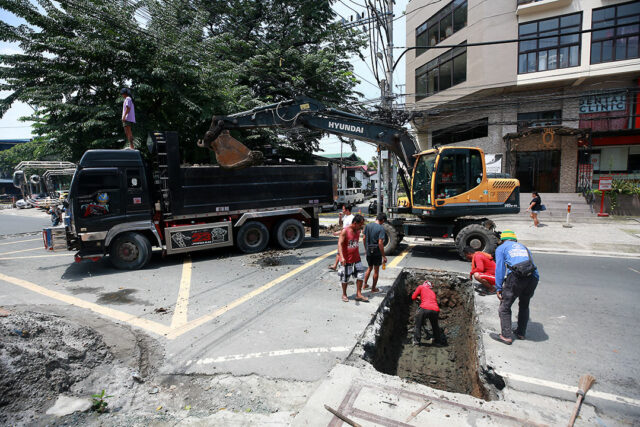
Workers excavate a portion of a street in Quezon City in this file photo taken on Sept. 7, 2024. — PHILIPPINE STAR/MIGUEL DE GUZMAN

By Aubrey Rose A. Inosante, Reporter

BUDGET SECRETARY Amenah F. Pangandaman anticipates a rebound in infrastructure spending in the next two months, following an expected dip in April due to the election ban.

In an e-mail interview with BusinessWorld, Ms. Pangandaman said disbursements “tend to pick up strongly” in May and June. 

“With regard to the election ban, based on historical government spending performance for similar national and local election periods, for example, in 2019 or in 2022 (presidential election), we see a bit of a temporary slowdown when the election ban is in effect in April,” she said on April 15.

The Commission on Elections’ ban on public works spending began on March 28 and will run for 45 days. The midterm elections are scheduled for May 12.

Latest data from the Department of Budget and Management (DBM) showed spending on infrastructure and other capital outlays declined by 19.8% to P146.7 billion in December 2024 from P183 billion in the same month in 2023.

For the full year, expenditures on infrastructure and other capital outlays jumped by 10.1% to P1.33 trillion from P1.2 trillion in 2023.

Infrastructure spending data for the first three months of 2025 is yet to be released.

Ms. Pangandaman, who chairs the Development Budget Coordination Committee, said there would be “a slowdown in project execution during the first half of 2025 on account of the upcoming midterm national and local elections.”

A similar slowdown in infrastructure spending was seen in the months leading up to the May 2022 national polls.

In 2022, infrastructure and other capital expenditures fell by 9.7% in April, but inched up 2.1% in May and jumped by 51.9% in June.

Despite the expected slowdown, Ms. Pangandaman remains optimistic that infrastructure disbursements will be “robust” in 2025.

“We are optimistic that infrastructure spending will remain robust and a significant growth driver for the year, particularly from the ongoing projects which were started and accelerated ahead of the election ban,” she said.

Ms. Pangandaman noted that in the first two months of 2025, state spending already showed a 13.76% increase to P822 billion.

“When we look at other data, for instance, using bank reports for the same period to check specific agency spending performance, the disbursements of at least the Department of Public Works and Highways and the Department of Transportationthe two main infrastructure departmentscombined for P83.9 billion, more than 50% of their equivalent disbursements for the comparable period in 2024 of P54.5 billion,” she said.

Ms. Pangandaman said this only factored the notices of cash allocation (NCA) disbursements and left out the non-NCA items.

The NCA is a cash authority issued by the DBM to central, regional and provincial offices and operating units through government banks to cover the cash requirements of the agencies.

“These numbers somehow indicate the relative strength of infrastructure spending that we expect for the year,” Ms. Pangandaman said.

Reinielle Matt M. Erece, an economist at Oikonomia Advisory and Research, Inc. said there may be an increase in infrastructure spending in 2025. 

“Apart from the election season, lower borrowing costs and fiscal spending to boost economic growth may also drive higher infra spending. I expect to see the increase in infra spending in the second half of the year,” Mr. Erece told BusinessWorld on Thursday. 

In addition, Mr. Erece expects public-private partnerships projects to “prosper” amid lower borrowing cost and fiscal spending.

Meanwhile, Rizal Commercial Banking Corp. Chief Economist Michael L. Ricafort said infrastructure spending has become a major contributor to economic growth and development.

He noted that infrastructure spending’s share in gross domestic product has gone up to 5-6% in recent years, sharply higher than the less than 2% share in the last 20-30 years.

Benign inflation gives BSP more space to keep cutting — Nomura

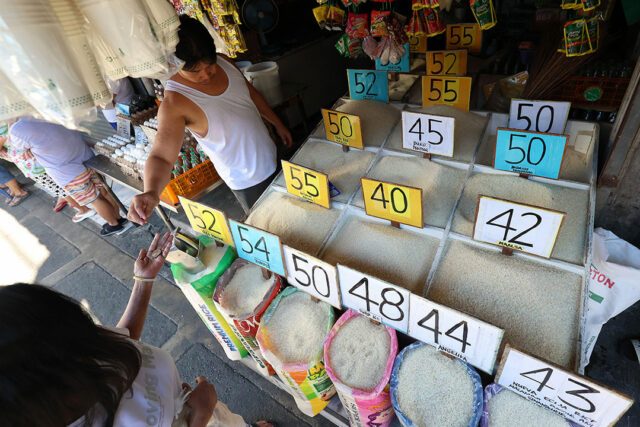
Vendors display different varieties of rice at a stall inside Mega Q-Mart in Quezon City, March 27. Inflation sharply slowed to 1.8% in March, the lowest print in nearly five years. — PHILIPPINE STAR/MIGUEL DE GUZMAN

THE BANGKO Sentral ng Pilipinas (BSP) has more than enough room to ease rates further as inflation is expected to settle near the lower end of the 2-4% target band this year.

“For as long as inflation remains benign, I think that would give the BSP a lot of scope to keep cutting,” Nomura Global Markets Research analyst Euben Paracuelles said on Money Talks with Cathy Yang on One News.

Nomura expects headline inflation to average 2.2% this year, near the lower end of the central bank’s 2-4% target range.

“To me, that really gives them a lot of flexibility to keep cutting, especially in this environment when there are some external headwinds that are putting some pressure on growth. They could focus on supporting that a little bit.”

Inflation sharply slowed to 1.8% in March, the lowest print in nearly five years. This brought average headline inflation to 2.2% in the first quarter.

The BSP sees inflation averaging 2.3% in 2025 and 3.3% in 2026, pricing in risks.

“I’ve always said that the BSP across the central banks that I follow in the region is among the more orthodox inflation targeters,” Mr. Paracuelles said. “What that means is they’re sticking to this inflation-targeting framework and not really too worried about other things like the currency.”

The Monetary Board earlier this month resumed its easing cycle with a 25-basis-point (bp) rate cut, bringing the key rate to 5.5%.

The central bank had lowered rates by a total of 75 bps in 2024. At its first rate-setting meeting this year, it opted for a pause as it waited to see how global trade uncertainties would unfold.

BSP Governor Eli M. Remolona, Jr. has signaled further rate reductions this year as the benchmark is still “slightly restrictive.” Rate cuts will likely be delivered in “baby steps” or in 25-bp increments, he said.

Mr. Paracuelles also noted the central bank’s other policy tools such as further cuts in the reserve requirement ratio (RRR).

On March 28, the RRR of universal and commercial banks and nonbank financial institutions with quasi-banking functions was reduced by 200 bps to 5% from the current 7%.

The RRR for digital banks was also lowered by 150 bps to 2.5%, while the ratio for thrift lenders was cut by 100 bps to 0%.

Rural and cooperative banks’ RRR has been at zero since October, the last time the BSP cut reserve requirements.

“What that (RRR cut) does is provide a lot of liquidity into the banking system. And as a result, the policy transmission of the rate cuts that are about to come or already have happened become a bit more effective than otherwise would have been the case in the past cycle.”

Meanwhile, Nomura is also sticking to its 5.9% gross domestic product (GDP) forecast this year but flagged heightened uncertainties. This is below the government’s 6-8% growth target for 2025.

“I’d say at the moment, that’s still a reasonable forecast. But of course, we’re noting that uncertainty remains very high, especially on the global trade tensions and US tariff policy,” Mr. Paracuelles said.

“Obviously, that would put the balance of risk to the downside in terms of our growth projections. But the Philippines, in terms of the exposure to external demand is relatively low,” he added.

The Philippines was slapped with a 17% reciprocal tariff, the second lowest in Southeast Asia, after Singapore’s baseline rate of 10%.

“The bigger factor there is really in terms of how much we think the domestic growth engines could fire up and provide some offset to a potential decline in exports… those things are still very much intact, regardless of what’s happened with the tariffs.”

Easing inflation will also provide support to household spending and purchasing power.

“I think domestic demand will become the bigger driver here from a growth standpoint this year,” he added.

First-quarter GDP data will be released on May 8.

In 2024, the economy grew by a revised 5.7% but still short of the government’s 6-6.5% target. — Luisa Maria Jacinta C. Jocson

Building material costs likely to remain steady

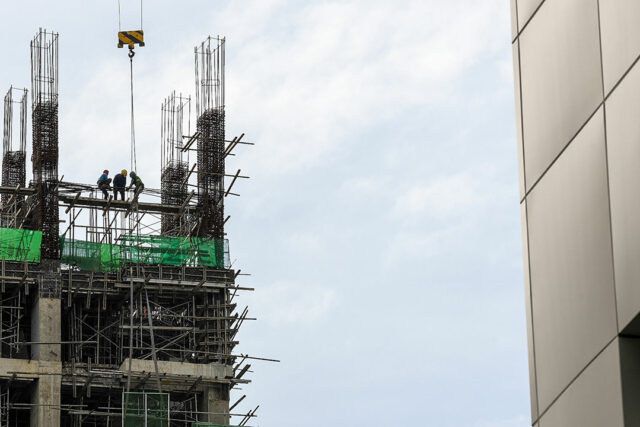
Workers were seen at a construction site in Manila. — PHILIPPINE STAR/EDD GUMBAN

By Beatriz Marie D. Cruz, Reporter

THE COST of building materials is likely to remain steady this year amid government demand and slowing inflation, although geopolitical uncertainties may cause price volatility, according to construction company executives.

“Based on the current market situation, we see a steady trend in prices, with partial bias for marginal increases due to demand coming from government infrastructure projects as well as the rollout of economic and socialized housing projects,” Megawide Construction Corp. said in an e-mail to BusinessWorld.

Jason C. Valderrama, president and chief executive officer  at construction firm JCV & Associates, said prices of construction materials are expected to remain stable amid cooling inflation and easing interest rates.

“The inflation rate has been the lowest in the last five years and the construction materials wholesale price index moves in lock step with it, so prices of construction materials will be stable this year,” he said in an e-mail.

In the first three months of the year, the wholesale price growth of construction materials in Metro Manila averaged 0.1%, lower than 1.1% a year ago, latest data from the Philippine Statistics Authority showed.

Headline inflation averaged 2.2% in the January-to-March period, within the central bank’s 2-4% target.

Mr. Valderrama said the resumption of the Bangko Sentral ng Pilipinas’ (BSP) easing cycle would further temper inflation and stabilize construction material prices.

The BSP on April 10 cut rates by 25 basis points, bringing its key policy rate to 5.5%. BSP Governor Eli M. Remolona, Jr. said further rate cuts will likely be delivered in “baby steps” or in 25-bp increments.

“The Philippines is always reliant on developments in the global commodity markets like oil, steel products and China’s economic situation/trends, and basic construction materials like cement, pipes and lumber may be very volatile,” Aboitiz Construction Vice-President for Strategic Asset and Supply Chain Management Eric King said in an e-mail to BusinessWorld.

However, the price and supply of raw steel are expected to remain steady through 2025, he said.

“We anticipate that this will result in a stable availability and unchanged base cost of our steel base materials, including steel fibers, dowel cradles, armor joints, gabions, and other double-twist items.”

The expected slowdown of global oil prices would also stabilize the cost of energy intensive materials like steel and cement, according to Megawide Construction.

“As of the latest forecasts, oil prices are expected to slow down on account of higher output coupled with reduced demand,” Megawide Construction said.

The Organization of the Petroleum Exporting Countries on April 14 reduced its 2025 global oil demand growth forecast as the United States’ tariff policy has dampened economic activity, Reuters reported.

“This scenario, however, can change depending on the intensity of the ongoing trade war triggered by US policy directions,” Megawide said.

IMPACT OF TRADE WAR
However, the US tariff policy as well as ongoing conflicts in the Middle East could still hurt global supply chains, affecting the cost of building materials.

“If the current state of tensions in Europe, the Middle East and Asia worsens, shipping routes may be affected and cause higher transport and landed costs. In addition, the trade war could disrupt traditional sourcing channels and impact pricing, which should also be reflected in prices,” the company said.

US President Donald J. Trump on April 9 announced a 90-day suspension of reciprocal tariffs with its trading partners except China, although the baseline 10% tariff on most US imports remained in effect.

Philippine exports were imposed a 17% reciprocal tariff by the US, the second- lowest among Southeast Asian countries.

Cebu Landmasters, Inc. Chief Operating Officer Jose Franco B. Soberano said the company is still seeing “very favorable” steel prices and stable cement prices amid tariff pressures.

“It might even be beneficial to us because there will be more supply coming to our region… We will get more competitive and aggressive pricing from Southeast Asia or Asian countries that supply construction materials to us. Costs have gone up in the last three years due to the supply chain disruptions and the pandemic, but it’s become more stable now,” Mr. Soberano said in an interview aired on Money Talks with Cathy Yang on One News last week.

However, Mr. Soberano said that while the company is taking advantage of pricing opportunities, it is “not locking in anything beyond three or six months.”

Mr. Valderrama said he expects muted US demand for construction materials from China and other countries due to the trade war. He noted these countries will look to send more of their products to other export markets such as the Philippines.

“There will be a lot of available supply from China when it comes to steel, so if there is nowhere to go because of the tariff issue, then the tendency is there will be supply available [for the Philippines],” PHINMA Corp. Director and Executive Vice-President for the Construction Materials Group Eduardo A. Sahagun said via telephone.

To navigate unexpected changes in the market, Mr. King said Philippine companies should foster strong relationships with its business partners and suppliers.

“In some advanced organizations and industries, they have started to use data and AI-powered tools to help them find better prices and manage their inventory more efficiently,” he said.

PSE IPO target unlikely amid uncertainties due to tariffs — analysts

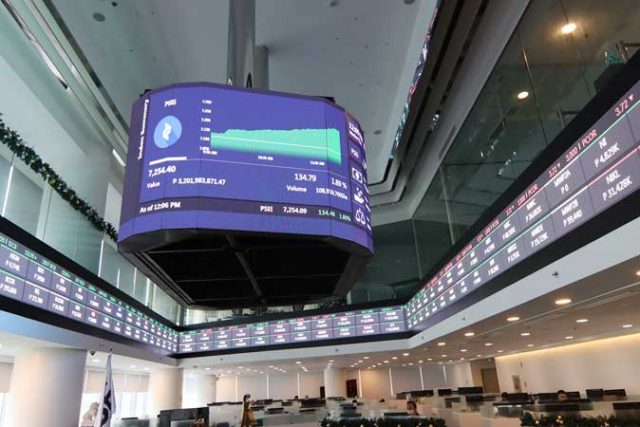
BW FILE PHOTO

By Revin Mikhael D. Ochave, Reporter

THE PHILIPPINE Stock Exchange’s (PSE) target of six initial public offerings (IPOs) this year may no longer be achievable due to uncertainties related to US tariffs, according to analysts.

“Until we see more consistency between President Donald J. Trump’s trade statements and actual policy direction, investor sentiment may remain cautious — making it more important for upcoming IPOs to be timed carefully and backed by strong fundamentals,” DragonFi Securities, Inc. Equity Research Analyst Jarrod Leighton M. Tin said in a Viber message on Wednesday.

“We’ve seen how market volatility can derail IPOs, with Mr. Trump’s unpredictable tariff policies shaking global equity markets… This kind of bearish sentiment makes it harder for IPOs to gain traction,” he added.

AP Securities, Inc. Research Head Alfred Benjamin R. Garcia said that the ongoing trade war has increased the likelihood of an economic slowdown, weakening investors’ risk appetite.

“With markets being as weak as they are, GCash is likely thinking that they won’t be able to get valuations acceptable to existing shareholders. Since they have no immediate need for funds, it would be better for them to wait for better conditions before going public,” he said.

“We thought that the six-IPO target was a long shot even before the trade war, so it’s even more unattainable now. Our most optimistic IPO estimate is four, and only Maynilad will be big,” he added.

Electronic wallet giant GCash recently hinted at possible delays in its planned public listing, citing the Trump administration’s tariffs.

Globe Chief Financial Officer Juan Carlo C. Puno said on Tuesday that the new US tariffs have added a lot of uncertainty. Despite this, he said that GCash’s market debut would likely happen either this year or next year.

“I think this uncertainty does not stop us from preparing. The goal is to get GCash to a point where we are push-button ready. So, when the market opens up, if we find the window where the valuations and interest we’re getting are appropriate and acceptable, we will push that button for the IPO,” Mr. Puno said.

Globe has a 36% stake in Globe Fintech Innovations, Inc. (Mynt), which owns GCash operator G-Xchange, Inc.

Mr. Trump recently announced his “Liberation Day” tariffs, which include a 10% duty on goods from all countries. The Philippines is subject to a 17% tariff on its exports to the US, though these, along with most reciprocal tariffs, have been suspended for 90 days.

The PSE saw its first public listing on April 8 with the P732.6-billion IPO of Cebu-based fuel retailer Top Line Business Development Corp.

Mr. Garcia said that the risk appetite among investors is not there yet despite positive local factors such as slower inflation and easing policy rates.

“Valuations are still at levels not seen since the Global Financial Crisis of 2008, so it’s unlikely that the market will have appetite for high valuations. Companies, on the other hand, are unlikely to accept low valuations for their IPO,” he said.

Philippine inflation eased to 1.8% in March from 2.1% in February, the lowest in 58 months or since the 1.6% logged in May 2020.

The local central bank recently reduced borrowing costs by 25 basis points despite a more challenging external environment.

China Bank Capital Corp. Managing Director Juan Paolo E. Colet said in a Viber message that the risk of economic slowdown caused by the Trump administration’s tariffs would have a negative impact on corporate earnings and valuations.

“Elevated uncertainty around US economic policy has also introduced significant volatility in global financial markets, so that has made some foreign investors more cautious about committing to IPOs in Southeast Asian emerging markets,” he said.

Despite uncertainties, Unicapital Securities, Inc. Equity Research Analyst Peter Louise D.C. Garnace said that the P49-billion IPO of Pangilinan-led water provider Maynilad Water Services, Inc. is still expected to proceed.

“We believe that the water sector is relatively insulated from global trade tensions as growth is domestically driven. On top of this, Maynilad’s IPO has a higher likelihood of pushing through, as the water concessionaire is legally required to list by 2027,” he said in a Viber message.

Mr. Colet said that Maynilad is still on track to have a “successful IPO” despite the uncertainties.

“They are a defensive stock and dividend play, so that would draw a lot of investor interest,” he said.

The offer period of Maynilad’s IPO will be from June 25 to July 2, with a July 10 listing date, based on its prospectus dated March 14.

Signed into law on Dec. 10, 2021, Republic Act No. 11600 granted Maynilad a 25-year legislative franchise until 2047 to establish, operate, and maintain a waterworks system and sewerage and sanitation services in the West Zone service area of Metro Manila and Cavite province.

The law also requires Maynilad to offer at least 30% of its outstanding capital stock within five years from the grant of the franchise.

ICTSI: Trump tariffs pose little risk, Mexico terminal vulnerable

ICTSI.COM

INTERNATIONAL Container Terminal Services, Inc. (ICTSI) said its operations are unlikely to be affected by new US tariffs, but its Mexico operations may face market impact.

“It is too early to tell the impact since Trump’s flip-flopping every day. It is also too early to tell how these tariffs will settle; our operations are very diverse,” ICTSI Chairman and President Enrique K. Razon, Jr. said during the company’s annual stockholders’ meeting on Thursday.

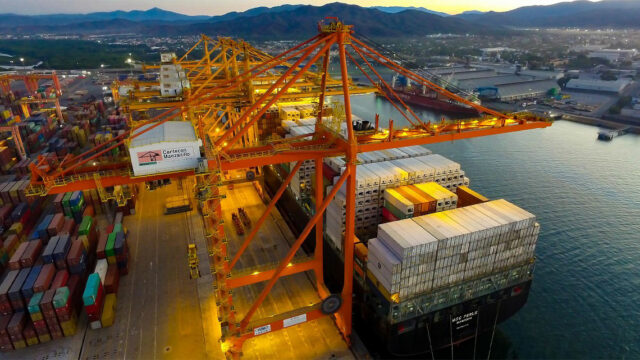
“The only major impact that could be possible would be at the Manzanillo terminal (in Mexico),” he added.

Mr. Trump has disrupted the global trade system with his “Liberation Day” tariffs, including a 10% duty on goods from all countries.

The Philippines has been hit with a 17% tariff on its exports to the US, but these, along with most reciprocal tariffs, have been suspended for 90 days.

ICTSI operates 33 terminals in 20 countries across six continents. The company has operations in Mexico through Contecon Manzanillo (CMSA).

“There could be an impact (on the Mexico terminal), but so far it is a wait-and-see. Out of our portfolio, trade with the US is only 3%,” he said, noting that if the company’s Mexico operations were affected, this could still be mitigated by other markets.

“Massive industrial installed capacity in China means they will be looking for other markets. So, one market offsets another.”

In 2024, the listed port operator saw its attributable net income surge by 66.1% to $849.8 million from $511.53 million a year earlier, driven mainly by its operations in Asia.

Gross revenues for the period rose by 14.6% to $2.74 billion from $2.39 billion in 2023.

Breaking down the company’s revenue growth, its operations in Asia accounted for the largest share, generating $1.14 billion in 2024, up by 9.6% from $1.04 billion in 2023.

Revenues from its operations in the Americas reached $1.08 billion, up by 26% from $855.62 million in 2023, while revenues from Europe, the Middle East, and Africa (EMEA) totaled $521.02 million, an increase of 6.3% from $490.28 million. — Ashley Erika O. Jose

Total EKlipse

NORMAN P. AQUINO

By Norman P. Aquino, Special Reports Editor

RELUCTANTLY, I stepped forward. The ride attendant secured our harnesses and gave us a thumbs-up. As the countdown began, I shut my eyes, my heart hammering in my chest. The ride lurched upward, slowly at first, but with each second, we went higher. My stomach twisted as the world blurred around me. Then, the EKlipse spun. 

The massive pendulums of Enchanted Kingdom’s (EK) newest ride swung high, revolving and tilting as it threw four riders fastened back-to-back to each gondola on both ends into the air.

I could hear the grunts from my nephew and grand-nephew behind me — their screams of terror echoing through the park and later turning into laughter. The thrill of weightlessness, the rush of the wind against my face — it was terrifying and exhilarating at the same time. Below, the park lights shimmered like stars.

Riding the EKlipse felt pretty much like riding the Octopus — a popular amusement park ride known for its rotating arms and suspended seats, resembling an octopus with multiple “tentacles” that swing in various directions — in peryas during my pre-teen years.

Like the Octopus, riders experience centrifugal force and weightlessness while on the EKlipse, except that guests stay upright throughout the experience. You also won’t feel like you are falling from your seat because your body is tightly secured by padded metal bars.

But the resemblance was striking, especially at night, when two rows of round white LED bulbs covering the EKlipse “tentacles” light up, resembling octopus suckers.

It never really felt like one of the four arms I was on would hit another, but after watching the EKlipse operate while not riding it, it definitely seemed like it might as the arms passed each other in synchronized motions.

As the ride slowed and finally stopped after about two minutes — the preparations took much longer — we stumbled off, breathless.

The EKlipse, designed and manufactured by Italian company Antonio Zamperla S.p.A., targets pre-teens and teenagers, and parents too, as long as they’re bold. It’s definitely not for the faint of heart — as you enter the gate, you are warned that the EKlipse is not for people with a weak heart.

EK launched the EKlipse on March 30 as one of their inaugural gifts for their 30th anniversary this year. It’s the first of its kind in Southeast Asia, and before its installation at Enchanted Kingdom, the EKlipse was recognized by the International Association of Amusement Parks and Attractions in 2019 as one of the best rides globally.

Enchanted Kingdom is open from 11 a.m. to 8 p.m. on Wednesdays through Sundays. It is located along RSBS Boulevard (San Lorenzo Road) in Santa Rosa, Laguna.

Pangilinan says Meralco ‘looking for ways’ to lower power prices

PHILSTAR FILE PHOTO

By Ashley Erika O. Jose, Reporter

MANILA ELECTRIC Co. (Meralco) remains focused on lowering power rates and ensuring supply reliability, its chairman said on Thursday, amid continued scrutiny following the renewal of its franchise.

“We are very mindful of that. I hope we are able to bring down power prices, at least on the distribution side. We don’t make money on the generation side, but we get the brunt of the criticisms. It is in our interest to bring power rates down — we are looking for ways to do that,” Meralco Chairman and Chief Executive Officer Manuel V. Pangilinan said at the Giga Summit 2025: The Fusion of Power and Intelligence, an industry forum held on Thursday.

President Ferdinand R. Marcos, Jr. on April 11 signed into law the measure extending Meralco’s franchise for another 25 years. Its current franchise is set to expire in 2028.

With the extension, the company will have the authority to distribute power to Metro Manila, Bulacan, Cavite, Rizal, and select areas in Batangas, Laguna, Quezon, and Pampanga until 2053.

It has around eight million customers in 39 cities and 72 municipalities.

“Beyond the traditional role of business, of supplying goods and services for profit, we are stewards of the money entrusted to us; that’s the basic role of business — providing goods and services for profit,” Mr. Pangilinan said.

Mr. Pangilinan said the company is focusing on helping advance the country’s energy transition, including the Philippines’ ambition to include nuclear power in the country’s power mix.

“Let me focus on the nuclear situation, the thrust of Meralco in nuclear. We’ve had several visits abroad; we’re looking at viable modular nuclear energy, but that’s still some years away,” Mr. Pangilinan said.

Energy Secretary Raphael P.M. Lotilla has also called on Meralco to ensure that it can fulfill its franchise obligations, noting that it is also responsible for the supply through its decisions on where to procure power.

“What Meralco chooses to contract also dictates what power supplies are left for all other distribution utilities, and electric cooperatives do not have the scale to backstop the construction of a large-generation facility,” Mr. Lotilla said during the same event.

Earlier this month, the Energy Department called on Meralco and Excellent Energy Resources Inc. (EERI), the operator of the 1,275-megawatt combined-cycle natural gas plant, for alleged undelivered capacity under their power supply agreement.

“Any delays in the implementation of a power supply agreement have results, not just within the Meralco franchise area, but particularly for the rest of Luzon. And in all this, as I’ve said, the question that we need to ask is, how can Meralco be the very best that it can be? It is a challenge that I impose on you, given that your performance affects the rest of the country,” Mr. Lotilla said

Meralco’s controlling stakeholder, Beacon Electric Asset Holdings, Inc., is partly owned by PLDT, Inc. Hastings Holdings, Inc., a unit of PLDT Beneficial Trust Fund subsidiary MediaQuest Holdings, Inc., has an interest in BusinessWorld through the Philippine Star Group, which it controls.