Home Blog Page 1637

Senatorial race: Perceptions of Metro Manila informal sector workers

PHILIPPINE STAR/RYAN BALDEMOR

By Maria Catalina M. Tolentino

WHAT do the Informal Sector (IS) workers think about the forthcoming senatorial race? Why did we choose them for the study? Because they comprise approximately half of the Philippine workforce. In the voting population, they comprise the majority of the electorate. Moreover, these workers can wait in long queues at voting precincts notwithstanding the heat and extended voting hours. It is difficult to give accurate numbers because many are in the underground economy, meaning they are not reflected in official accounts.

The International Labour Organization Philippine Office describes Informal Sector workers as the non-regularly employed, those who do seasonal or piece-rate jobs, for example carpentry, appliance repair, gardening, plumbing, and house cleaning. They often receive less than the mandated daily minimum wage rate or are paid at a negotiated price. “Kayo nang bahala” (It’s up to you), they answer when clients ask about their fees. Included in this category are what the Philippine Statistics Authority terms as self-employed — the market vendors, sari-sari (sundry) store operators, home-based food caterers, street hawkers, tricycle drivers, and independent contractors like the delivery riders or virtual assistants. In rural areas, we can include the farmers, fishermen and similar types. They cannot speak of benefits like social security, tenured work, health insurance. As to educational attainment, most are high school graduates, a few reached college levels.

In the months of January to March this year, my two classes in Research Methods conducted interviews among Informal Sector workers in a few cities in Metro Manila. We chose interviews and observations as data-gathering methods to delve deeper into the perceptions of voters about the senatorial election and the reasons why voters choose certain candidates. The students collected responses from a total of 105 workers aged 18 and above. Interviews and observations (unlike surveys) take longer to conduct and to process, even with a small sample size.

Approached for the interviews, many expressed bemused reactions such as: “Kelan ba ang election? Boboto ba tayo ng presidente? Matagal pa naman ’yan,” (When is the election? Will we vote for the president? That’s a long time away) or “Hindi ako boboto, wala namang mangyayari kahit sinong manalo.” (I will not vote, no change will happen anyway no matter who wins).

Do they know the job of a senator? Their reactions varied: silence or reluctance to respond but we were glad to hear one answer from a balut vendor: “Gumagawa ng batas” (They make laws), accompanied with laughter. What laws does he remember were authored by his senatorial bet? More laughter: “Hindi ko alam!” (I don’t know).

When asked whom they will vote for  the senate, none of them gave quick answers and returned with perplexed look “Sino ba ang tumatakbo?” (Who are running?) particularly in interviews done in January to February. One interviewee shot back “Personal na ’yan. Tanungin mo na lang ako ng iba, huwag na ’yan” (That’s personal. Ask me another question, not about that) and turned away.

The team intentionally did not provide a list nor mention any candidates’ names. We wanted to see natural reactions and hear names that were really in their minds. Pressed for answers, some names were mentioned but interviewees did not give a complete list of 12. Several times only three were given or an average of seven, in an effort to recall more candidates. Asked to explain their choices:

Kasi kilala na, dati nang nakaupo,” (They are known, they were already in the senate) validating the name recall factor.

Tumutulong sa mahihirap, pag may baha namimigay,” (They help the poor, during floods they distribute goods) explaining their notions about help for the poor being tangible concrete efforts even from politicians who should be writing and explaining laws.

A 3rd grade schooled taxi driver mentioned a name and when asked to explain his choice: “Wala lang” (No reason) he said with a sheepish smile, and when grilled further said, “Sabi dun sa amin, sabi ng nanay ko.” (I heard from my neighbors and my mother).

Their sources of information are social media, particularly TikTok, especially when they are bored at work, like the drivers waiting for passengers.

On the issue of political dynasties, most are not aware that a sibling is still sitting as senator and will be joined by other siblings. They only remember the family name, as if referring to just one person or is running for reelection.

A pleasant surprise was about the ayuda (assistance). They accept ayuda but it is not the deciding factor. With or without ayuda, they will vote for whom they want.

Vague ideas about the elections are further reflected in the answers about mentioning candidates who are not running; other names may be running but not as senators.

There were respondents who regretted choosing candidates who did not meet their expectations; who did not help improve the quality of their lives, including the celebrity senators of past elections.

We attempted to approach agency-hired employees at the malls — the security guards, cashiers, salesclerks, food servers, merchandisers, toilet cleaners, and porters. These are contractual employees who are often stuck in minimum wage level jobs, but they refused to accommodate interviewers because supervisors were roaming the premises, looking over their shoulders. Despite being lowly paid, these employees were attentive to their tasks and were evasive about interviews. The topic being political could be another reason. It’s a sensitive topic to them thinking they might be castigated for mentioning controversial candidates.

It is observable that many Informal Sector workers have no clear ideas about the senatorial election. Yet despite the reluctance to vote, and the dissatisfaction about outcomes of past elections, these workers feel obliged to go to the polls and patiently wait in long lines. House helpers beg their employers to allow them short vacations in their provinces because names are being listed by the barangay officials reportedly giving away cash or grocery bags.

In the interviews, what we sought to find out were the workers’ perceptions about the election. What names they actually mark in the ballots is a different story. At this point, it is sufficient to say that if these patterns of thinking and behaving about electing leaders continue, especially among the bigger population, we know where we are headed for in the next few years.


Maria Catalina M. Tolentino, PhD is an associate professor at the UP School of Labor and Industrial Relations. She teaches research methods and was a recipient of professorial chairs and centennial faculty grants.


URC posts 2% fall in Q1 net income

URC.COM.PH

GOKONGWEI-LED Universal Robina Corp. (URC) reported a 2% decline in first-quarter (Q1) net income to P4.3 billion, as last year’s figure was boosted by higher foreign exchange gains.

Despite the lower net income, core net income rose by 4% to P4.1 billion because of reduced costs, the company said in a disclosure to the stock exchange on Thursday. Operating income also grew by 1% to P5.5 billion.

First-quarter consolidated sales increased by 7% to P45.3 billion, driven by volume growth across most business segments.

“We are starting the year on a high note, delivering impressive volume growth across our key branded businesses in the first quarter of 2025,” URC President and Chief Executive Officer Irwin C. Lee said.

Sales from the branded consumer foods (BCF) segment rose by 6% to P29.7 billion. BCF Philippines registered a 4% increase in sales to P20.1 billion, led by double-digit volume growth in ready-to-drink beverages, snacks, and confectionery products.

BCF International sales expanded by 10% to P9.6 billion, as Vietnam posted double-digit growth, while Malaysia and Indonesia showed steady improvements.

“The international business continued to sustain its momentum and deliver above market growth, despite the weak ASEAN sentiment and tariff uncertainties in export-oriented economies,” URC said.

The agro-industrial and commodities segment posted an 8% increase in sales to P15.6 billion, with higher volumes in sugar and flour offsetting weaker demand for animal feeds.

“As overall consumer confidence and sentiment improve, we look forward to accelerating our forward momentum and continuously improving URC’s performance,” Mr. Lee said.

“We will continue to create and sell trusted products that people love, with the best innovations at the best prices, while staying true to our mission: to delight our customers and consumers with good food choices,” he added.

Shares in URC fell by 1.73% or P1.50 to close at P85.40 apiece on Thursday. — Revin Mikhael D. Ochave

New Attenborough film showcases both destruction and hope in planet’s oceans

Ocean with David Attenborough (2025)

LONDON — British naturalist David Attenborough says there is hope for the future of the planet’s oceans in a new film that sets out both the scale of damage caused by human activities and the oceans’ capacity for recovery.

In his latest work Ocean, Mr. Attenborough, one of the world’s best-known nature broadcasters and filmmakers whose work spans seven decades, charts the challenges faced by the seas over his lifetime, from destructive industrial fishing practices to mass coral reef bleaching.

“After almost 100 years on the planet, I now understand the most important place on Earth is not on land, but at sea,” he says in a trailer of the movie.

Its full release in cinemas on Thursday coincides with Mr. Attenborough’s 99th birthday.

“When David Attenborough started there were two TV channels and everybody knew him as the voice of nature. Now there are hundreds of channels, social media but yet he is still the voice for nature,” Enric Sala, an executive producer of the film and National Geographic Pristine Seas founder, said in an interview.

Tuesday’s premiere in London saw celebrities and dignitaries, including King Charles, walking a blue — not red — carpet in the evening, and a daytime screening for students and teachers which was also watched by Prince William, although he did not speak at the event.

Despite depicting the bleak current state of the health of the ocean, discoveries made during filming offer hope, Mr. Attenborough said.

“The ocean can recover faster than we had ever imagined, it can bounce back to life,” he said.

“If we save the sea we save our world. After a lifetime of filming our planet I’m sure nothing is more important.”

The film’s release comes ahead of the United Nations Ocean conference in Nice, France, in June where it is hoped more countries will ratify a 2023 agreement to protect ocean biodiversity.

So far only 21 countries have officially signed, falling well short of the 60 countries needed for the agreement to come into force. — Reuters

Gov’t urged to make TUPAD a public jobs program

CITYOFSANPEDROLAGUNA.GOV.PH

THE GOVERNMENT needs to convert its displaced-worker aid initiative, known as TUPAD (Tulong Panghanapbuhay sa Ating Disadvantaged/Displaced Workers) into a public jobs program, labor analysts said.

Benjamin B. Velasco, an assistant professor at the University of the Philippines Diliman School of Labor and Industrial Relations, said TUPAD needs to become a hiring program  providing paid work to the unemployed for at least 100 days per year.

“Instead of street sweeping, (the government should prioritize) green jobs such as tree planting, river and beach cleanups,” Mr. Velasco said via Facebook chat.

TUPAD was designed a community-based safety net scheme that provides temporary employment to the unemployed, the underemployed, and seasonal workers.

He added that relying on the so-called gig economy of virtual assistants, food delivery riders, and home-based work produces “different forms of underemployment with precarious incomes and little in labor standards and social protection. (It) does not provide a pathway out of underemployment.”

Mr. Velasco said the Philippines needs an industrial policy or state-led program to develop designated industries to improve job quality.

He added that another pathway to improving job quality is strengthening skills training through the Technical Education and Skills Development Authority.

The unemployment rate inched up to 3.9% in March, equivalent to 1.93 million jobless.

The government’s Trabaho Para sa Bayan (TPB) Plan is a 10-year roadmap that aims to increase the labor force participation rate to 68.2% by 2034.

Labor Secretary Bienvenido E. Laguesma said via Viber that the TPB Plan will address labor market inefficiencies like education-job mismatches, skills-job mismatches and geographical mismatches.

He added that an interagency council will oversee the implementation of the plan “which will also address the issue of underemployment and unemployment, among others.”

“The rise in the underemployment rate is likewise indicative that there are work or jobs available, but the challenge is to have quality jobs or jobs that are more permanent and full-time,” Mr. Laguesma said.

Federation of Free Workers President Jose G. Matula said job quality is deteriorating as “more workers are not earning enough or are in jobs that do not match their qualifications.”

“Underemployment and low wages are silent crises. The solution is not just creating jobs — but ensuring they are dignified, secure, and sufficient to sustain families,” Mr. Matula said in a Viber message.

He added that government must also allocate a P100 billion stimulus to fund micro, small, and medium enterprises giving access to capital, wage subsidies, and digitalization support. 

He said that the government should substantially raise wages nationwide, through the implementation of a P200 legislated wage hike.

“A P200 daily wage increase will not only address the gap between income and rising cost of living, but also serve as an economic stimulus by boosting consumer demand and circulation of money in the economy,” Mr. Matula said.

Last year, the Senate approved a bill for a P100 daily wage increase for all minimum wage earners in the private sector, regardless of region or industry.

On the other hand, the House of Representatives, last January, endorsed a consolidated bill proposing a P200 across-the-board daily wage increase for private sector workers. — Adrian H. Halili

How Asia can revolutionize its food systems — before it’s too late

TAWATCHAI07-FREEPIK

By Qingfeng Zhang

ASIA faces a paradox: home to over half the world’s undernourished, but also the most vibrant economies, where agrifood systems employ 40% of the workforce.

In 2021, 1.9 billion people lacked access to healthy diets, trapped between poverty and skyrocketing food prices. Resource degradation and economic shocks now threaten to unravel decades of progress.

Yet within this challenge lies an unprecedented chance to rewrite the rules of food production.

Global agrifood systems generate massive hidden costs — environmental, social, and health-related — estimated at $13 trillion in 2023, or 10% of global GDP, according to the Food System Economics Commission. These costs stem from greenhouse gas and nitrogen emissions, land-use changes, water depletion, poverty among agrifood workers, and dietary-driven health issues.

Productivity losses from poor diets rose 14% globally since 2016, with South Asia seeing a 20% increase. Without urgent reforms, these hidden costs will stifle future economic growth, requiring policymakers to rethink agrifood policies beyond traditional production-centered strategies.

There is great potential for private sector investment. Credit guarantees, first-loss facilities, and parametric insurance are bridging the gap for risk-averse investors. Paired with policy reforms, these instruments make smallholder lending viable — critical for a sector dominated by family farms.

There are also digital bridges to smallholders. In Asia, a significant portion of farmers are smallholders, with estimates suggesting that 80% of the food consumed in the region is grown on small farms.

Mobile platforms now aggregate farmers into “digital cooperatives,” linking them to buyers, fintech services, and real-time data. This cuts financial service delivery costs by 90% and builds credit histories for millions previously excluded.

To reimagine Asia’s food systems, we should pursue these strategies:

Pursue productivity through precision. Asia’s farms need a tech infusion. Drones monitoring pest outbreaks, sensors optimizing irrigation, and AI-driven advisories alerting farmers to weather shifts. But technology alone isn’t enough.

We need to invest in the entire value chain, from post-harvest innovation — such as solar-powered cold storage that reduces spoilage losses by 30% — to direct-to-consumer platforms that enable farmers to bypass exploitative middlemen through e-commerce apps, and skills training initiatives like women-led cooperatives in India, which have doubled incomes through digital literacy programs.

Decades of overexploitation have left 40% of Asia’s soils degraded, but the solution lies in treating nature as an ally rather than a sacrifice by paying farmers to heal ecosystems. In Vietnam, mangrove restoration projects reduce dyke maintenance costs by $7.3 million annually while protecting farms from storms. In the Philippines, rice terraces that use duck-and-fish integrated systems achieve 20% higher yields without synthetic inputs. Meanwhile, Indonesia’s hutan desa (village forests) program rewards communities with land ownership to help combat illegal logging.

Asia’s irrigation canals lose 50% of water to leakage, but modernizing them with sensor-based allocation could save 300 billion liters annually. Future-proof infrastructure priorities include smart water grids, such as solar pumps and drip systems in Bangladesh that have reduced water use by 30%; climate-resilient logistics like India’s Kisan Rail network, which transports perishables at half the cost and cuts waste; and digital safety nets, exemplified by Myanmar’s farmer apps that provide flood alerts 72 hours in advance, giving farmers enough time to salvage their crops.

Although Asia produces enough calories, 600 million people still suffer from micronutrient deficiencies. Making nutrition a policy cornerstone involves subsidizing diversity, as seen in Thailand’s school meals program, which sources 30% of its ingredients from local organic farms; fortifying staples, such as Indonesia’s iron-enriched rice that has reduced anemia rates by 24%; and establishing crisis buffers, like Vietnam’s national rice reserve, which helped stabilize prices during the 2022 global grain crunch.

Transformed agri-food systems can also help to provide decent jobs for the millions of young people in Asia’s developing economies who work in the informal sector, and for the one in four young workers who are moderately or extremely poor.

Agri-food can generate tech-driven jobs, such as drone operators and bioengineers, which require vocational training. It can create entrepreneurial ecosystems, like the Philippines’ AgriTech accelerators, that have launched over 200 startups since 2020; while urban-rural balance initiatives, exemplified by the People’s Republic of China and Thailand’s “digital village” programs, can attract tech talent to modernize farms.

Asia must embrace a food revolution that marries productivity with sustainability. The tools exist — finance, digital transformation, and collaborative models — to turn smallholders into stakeholders and hunger into history.

At stake is nothing less than the health of 4.7 billion people and the stability of the planet’s most dynamic economies.

The views expressed are those of the author and do not necessarily reflect the views of the Asian Development Bank, its management, its Board of Directors, or its members.


Qingfeng Zhang is senior director, Agriculture, Food, Nature, and Rural Development at the Asian Development Bank.

ATRAM Group, UnionBank ink strategic partnership for trust units’ merger

THE ATR Asset Management Group (ATRAM Group) and Union Bank of the Philippines, Inc. (UnionBank) have formalized their strategic partnership for the merger of their trust units, with combined assets amounting to about P470 billion.

This follows the Bangko Sentral ng Pilipinas’ (BSP) approval of the merger transactions last month, the companies said in a joint statement on Thursday.

Under the deal announced and finalized in November last year, UnionBank will acquire a 27.5% stake in the ATRAM Group’s ATR Asset Management, Inc. (AAMI) and sell 100% of its shares in its stand-alone trust subsidiary UnionBank Investment Management and Trust Corp. (UBIMTC) to AAMI. The ATRAM Group will keep its 72.5% majority stake in AAMI.

The transaction will result in the merger of UBIMTC with ATRAM Trust Corp. (ATC), with the latter as the surviving entity.

The partnership will form the fourth-largest private asset management firm in the Philippines, the companies said. ATC ended 2024 with trust assets worth P363.29 billion while UBIMTC had P108.75 billion, latest BSP data showed.

The companies said that the partnership will combine both firms’ strengths to offer more personalized and accessible wealth management solutions to their clients.

“This milestone marks a pivotal step for UnionBank as we combine our digital leadership with ATRAM’s investment expertise to create smarter, more accessible wealth solutions for Filipinos. Together, we’re redefining asset management through digital-first innovation,” UnionBank President and Chief Executive Officer Ana Maria Aboitiz-Delgado said.

“With UnionBank, we’re powering next-generation world-class digital investment solutions that grow client wealth. By leveraging digital innovations with our investment expertise, we are set to drive long-term financial growth and raise industry standards,” ATRAM Group Chief Executive Officer Michael V. Ferrer said.

Last year, the ATRAM Group finalized its acquisition of First Metro Investment Corp.’s (FMIC) controlling stake in First Metro Asset Management, Inc. FMIC is the investment banking arm of listed Metropolitan Bank & Trust Co.

UnionBank booked a net income of P1.43 billion in the first quarter, down from the year prior due to one-time tax-related write-offs from a subsidiary and front-loaded non-recurring costs.

Its shares closed unchanged at P32.25 each on Thursday. — BVR

First Gen tapped to energize PSE Tower with renewable power

PHILIPPINE STAR/KJ ROSALES

THE Philippine Stock Exchange, Inc. (PSE) has tapped Lopez-led energy firm First Gen Corp. to supply renewable energy (RE) for the PSE Tower in Bonifacio Global City.

In a media release on Thursday, First Gen announced that the Philippine Stock Exchange at One Bonifacio High Street Condominium Corp. (PSE-OBHS) had renewed its retail electricity supply contract, ensuring a direct supply of electricity for the tower.

Under the agreement, First Gen will supply up to 5.1 megawatts (MW) of electricity to the PSE Tower, with the power sourced from its geothermal plant in Leyte, operated by its renewable energy subsidiary, Energy Development Corp. (EDC).

PSE President and Chief Executive Officer Ramon S. Monzon said the renewal of the agreement reflects the exchange’s continued commitment to sustainability.

“Climate change is a very real risk to all of us, and we must do what we can to mitigate our impact on the environment… By making sure that our place of business utilizes 100% RE and through strict adoption of relevant sustainability efforts, the PSE can continue to reduce its carbon footprint,” Mr. Monzon said.

To date, First Gen’s total capacity stands at 3,668 MW, sourced from its geothermal, wind, hydro, solar, and natural gas plants.

The company’s renewable energy portfolio consists of 1,651 MW of installed capacity from geothermal, solar, wind, and hydro power plants.

At the stock exchange on Thursday, First Gen shares declined by 0.37%, closing at P16.16 per share. — Ashley Erika O. Jose

How each segment contributed to Q1 2025 GDP

THE PHILIPPINE ECONOMY grew by a weaker-than-expected 5.4% in the first quarter, reflecting heightened uncertainty arising from the Trump administration’s tariffs. Read the full story.

Disney earnings soar on resilient streaming, US parks revenue

LOS ANGELES — In an earnings quarter teeming with uncertainty around tariffs, Walt Disney’s quarterly results are looking like the happiest place on earth.

The media giant exceeded expectations in its most recent quarter, bolstered by an unexpected boost in its Disney+ streaming business and strong results from its theme parks that suggested consumer resilience despite a turbulent global economic environment.

“Despite questions around any macroeconomic uncertainty or the impact of competition, I’m encouraged by the strength and resilience of our business,” Disney CEO Bob Iger said.

The entertainment giant released its earnings report shortly before announcing plans for a new theme park in the United Arab Emirates capital Abu Dhabi. Shares of the company rose nearly 10% in early trading as it posted adjusted earnings per share of $1.45 for the January-to-March quarter, beating the $1.20 analysts’ consensus as polled by LSEG.

“At a time when so many businesses in the US are worried about the potential impact of tariffs on consumer spending, on household budgets, Disney is feeling confident,” said Danni Hewson, head of financial analysis at AJ Bell.

The company — unlike many other blue-chip companies — voiced a lofty outlook for the rest of the year. Disney is leaning on its streaming business to grow profits as traditional television declines and to expand its popular theme parks and cruise line in the midst of a shaky US economy.

Revenue rose 7% to $23.6 billion. Analysts had expected $23.14 billion. Operating income came in at $4.4 billion.

Disney forecast adjusted earnings per share of $5.75 for fiscal 2025, an increase of 16% from the prior fiscal year.

The company reiterated guidance for 6% to 8% operating income growth in the parks-led Experiences division during the fiscal year, and for double-digit percentage operating income growth during that time in the entertainment unit.

Disney Chief Financial Officer Hugh Johnston told investors that “the outlook is actually still quite strong” for the company’s Experiences unit, with bookings up in the fiscal third and fourth quarters. Theme park attendance “is actually still quite good.” The lone exception is at Shanghai Disney Resort and Hong Kong Disneyland, where attendance has dropped, which he attributed to the Chinese economy.

Mr. Iger said Disney’s newest cruise ship, Disney Treasure, has attracted “sky high” consumer ratings; and the new vessel to be ported in Singapore is already attracting interest. He predicted the cruise line would become a growth driver for the Experiences segment over the next three to four years.

Disney said it picked up 1.4 million customers for the Disney+ streaming service during the just-ended quarter. Three months ago, it had warned of a modest decline in Disney+ subscribers following a price increase.

Its Hulu service added 1.1 million customers during the quarter, and operating income at the streaming division rose to $336 million. A year earlier, operating income stood at $47 million.

Mr. Iger told investors Disney is optimistic it can turn its streaming business into a “true growth business,” as it adds ESPN’s flagship live sports streaming, improves technology to allow for greater personalization, and invests in content outside of the US.

The entertainment unit reported total operating income of $1.3 billion, a 61% increase from the prior year.

Mr. Johnston told investors Disney continues to see “robust demand” from advertisers, particularly from restaurants and healthcare.

Mr. Iger touted the box office performance of the latest Marvel movie, Thunderbolts*, and the strength of the coming film slate, which includes a new Pixar Animation movie, Elio, Walt Disney Animation’s Zootopia 2, and Avatar: Fire and Ash.

At the Experiences unit, operating income rose 9% to $2.5 billion. The company also saw an increase in cruise ship bookings with the launch of a new vessel, the Disney Treasure.

Disney stock has fallen 17% this year compared with a 4.7% decline in the S&P 500. The shares have fallen 6.6% since April. Reuters

Oscar-winner Paul Haggis cleared of sex charges in Italy, lawyers say

MILAN — An Italian judge has dismissed a case against Oscar-winning screenwriter and director Paul Haggis for alleged rape, his lawyers said on Wednesday.

Mr. Haggis, 72, was detained in June 2022 and spent 14 days under house arrest after a British woman accused him of raping her over a two-day period in the southern Italian town of Ostuni in the Puglia region, where he was teaching at a film event.

The court judge in the nearby city of Brindisi ruled no sexual act took place without consent, Mr. Haggis’ lawyers said.

“For Mr. Haggis, it is the end of a nightmare that has unfairly shattered the career of a film genius and 2006 Oscar winner,” lawyers Michele Laforgia and Daniele Romeo said in a statement.

Mr. Haggis co-wrote and directed Crash, a 2004 crime drama for which he won two Oscars, and also wrote Million Dollar Baby, a sports drama directed by and starring Clint Eastwood, which was released the same year.

The lawyer of the woman who filed the complaint against the screenwriter was not immediately available to comment.

In November 2022, a New York jury ordered Mr. Haggis to pay $10 million in damages for raping a publicist in his apartment nine years earlier. Reuters

New hire with Latin honors given clerical tasks

I’m a recent graduate with top honors from a prestigious university. When I was hired by a major corporation, our department head assigned me to work in the back office, encoding and filing documents. After one month, I realized that management was not doing justice to my academic achievements. I’m planning to resign and look for another job. Is that a wise decision? — Pink Lotus.

Of course, not! Resigning from a job due to unfulfilled expectations would not bring you any happiness or career success, from both a short-term and long-term perspective. Don’t confuse a slow start with a dead end. At the very least, you should talk to your management about your concerns to be properly enlightened about your current situation.

Having an impeccable academic record from a top university but with zero corporate experience often leads to expectations that success must be instant and dramatic. It’s not as simple as that.

First, you should prove your worth by doing menial tasks and excelling at them. Efficiency is one gauge, but so is improving the work process, among other things.

At that early stage, you should not expect to lead a project team, manage an irate customer, or make a difficult decision for the department. You need to start at the bottom even if you think you don’t deserve it.

You must prove your worth in entry-level jobs and gradually move up with the help of consistent wins, big and small, along the way.

Therefore, if you’re not sure, you need to clarify management’s intentions. I’m sure they have a road map for all new employees. If there’s none, then create one for yourself and seek management approval. Some major industries, have a Management Development Program (MDP), which is often a career map for people singled out as having potential.

MDPs are typically one-year structured training programs to help young people achieve their full potential while trying to work their way up. It is beneficial for employers as it creates a pool of management talent whose potential is validated. They’re soon assigned to different departments, say, after three months or as soon as opportunities come in.

BE STRATEGIC
What should you do? Think long and hard. Keep your arrogance in check. Be humble but strategic. A resignation can give you the impression that you’re in control of your dreams. You may very well not be. It may not adversely affect your image on a resume to take a one to three-month break after graduation. But that’s not the point.

After all, being assigned to the back office is not permanent. In many cases, an MDP has a maximum one-year period, sometimes 15 months. There’s nothing to worry about. As soon as you’ve proven your interest and value, and there’s a job vacancy elsewhere, you’ll be assigned to an area of your choosing.

That’s on the condition that you pass the interview requirement imposed by those departments. In the meantime, do the following:

One, do a deep dive of the organization. Know personally the people who have the influence or power to move mountains. Discover the cultural dynamics and the unwritten corporate rules. Understand how and where the real value is created, and how that propels the career advancement of young professionals. 

Two, use your current assignment as a career laboratory. Learn how the business works. Find a connection between encoding and its impact on the business. Ask yourself: Why can’t we “assign” this job to customers using technology? Calculate the potential savings from dedicating your time and talent elsewhere. Better if you can think of a low-cost solution.

Three, build friendly, enduring, and warm ties. Impressing them with your academic credentials doesn’t matter unless you give them value as friends. Even if you possess unique skills in the organization, you’ll find yourself on the losing end if they see you as an opportunist.

Four, volunteer for difficult projects that matter. If there are none, busy yourself with low-hanging fruit. Make the small wins a launch pad for your career moves. What’s important is growing exponentially with small improvements. It’s the best way to leverage your talent over time.

ONE-YEAR TIMELINE
Give yourself at least one year to discover the fit between you and the organization. Your formal performance appraisal may be due by that time. That’s assuming you’ve followed the advice of your boss. Most organizations do a periodic monthly one-on-one engagement dialogue. If that happens, that means you’re being closely monitored for something unacceptable.

If things don’t progress after one year, then plan your exit strategically. Start by sending out your resume to major organizations, preferably outside of your industry. Do it without emotion. Hatred can translate to a negative vibe that might derail your chances of getting a job elsewhere.


Bring Rey Elbo’s unique leadership program called Superior Subordinate Supervision to your organization. Send a DM on Facebook, LinkedIn, X, or e-mail elbonomics@gmail.com or via https://reyelbo.com.

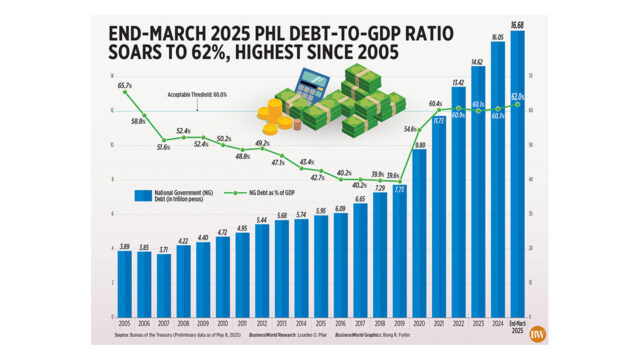
End-March 2025 PHL Debt-to-GDP ratio soars to 62%, highest since 2005

NATIONAL GOVERNMENT (NG) debt as a share of gross domestic product (GDP) rose to 62% at the end of the first quarter, the highest in 20 years. Read the full story.