Home Blog Page 1626

China trade dominance and small Philippine exports
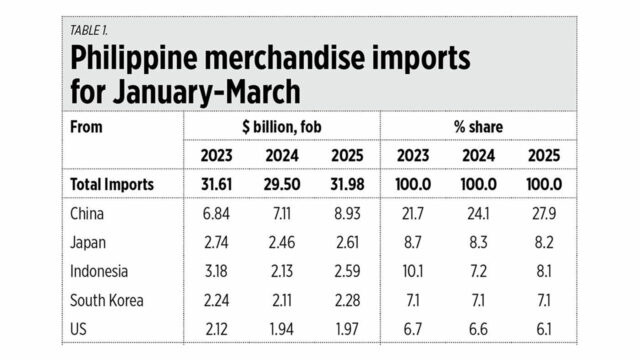
The Philippine Statistics Authority (PSA) released the country’s international merchandise trade statistics for March. Merchandise trade means goods only — services trade like overseas workers remittances, international tourism revenues, etc. are not included. I compared the numbers with similar periods in 2023 and 2024 and the results are amazing.

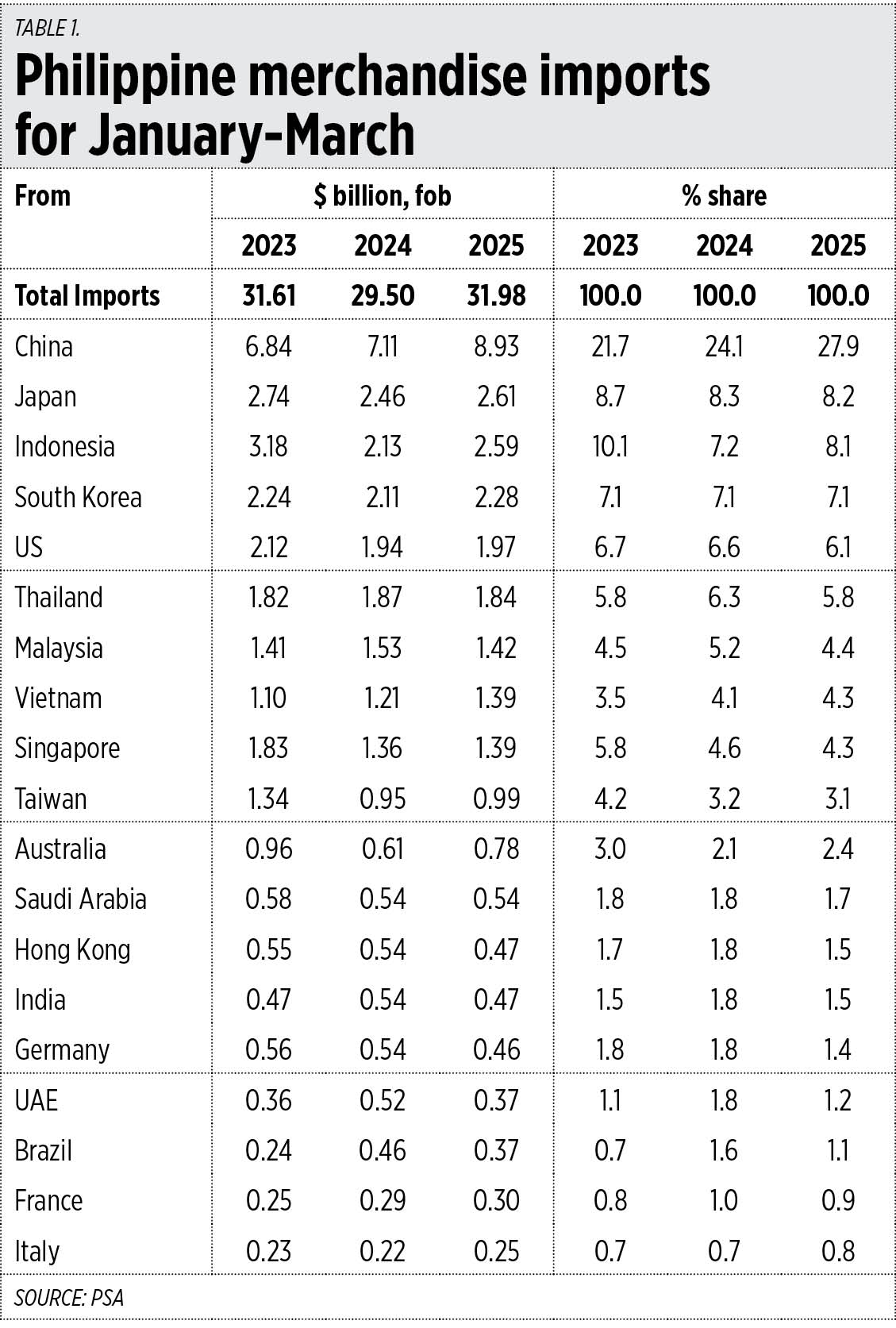
First, our total imports in the first quarter or January-March this year were similar to 2023’s level at nearly $32 billion.

Secondly, imports from China are rising by an average of $1 billion/year, the percent share of China is rising, from 21.7% of total imports in 2023 to 27.9% in 2025. If we combine China plus Hong Kong, their share is 29.4% of our total imports which is huge.

Third, the combined share of imports from the US plus Japan plus South Korea is declining, from 22.5% in 2023 to 21.4% in 2025. This implies that Philippine businesses are slowly replacing their Isuzu, Hino, Hyundai, Ford, etc. buses and trucks in favor of Howo, Jac, Sinotruck, Yutong, King Long buses and trucks.

Fourth, the share of ASEAN-5 (Indonesia, Malaysia, Singapore, Thailand, Vietnam) is also declining, from 29.7% in 2023 to 26.9% in 2025 (see Table 1).
Also, a few weeks ago the World Trade Organization (WTO) released the full year 2024 merchandise exports data by country. The numbers there are also interesting.

First, world exports on average were doubling per decade from 1985 to 2005. There is a similar trend for industrial countries like the US, Germany, the Netherlands, and Canada.

Second, for many East Asian nations the expansion was much larger over the same period: on average a tripling per decade in countries like South Korea, Hong Kong, Singapore, Taiwan, Malaysia, Thailand, and the Philippines. But others have expanded four or five times per decade, like China and Vietnam. China joined the WTO only in 2001 while Vietnam joined the WTO in 2007.

Third, from 2005 to 2024, those that experienced trade expansion of more than 300% were China, India, Vietnam and the United Arab Emirates (UAE).

Fourth, until 2000 all G7 countries except Italy had higher exports than China. By 2005 China had overtaken them all except the US and Germany. By 2010, China had overtaken both. In 2024, China exports were 1.7 times larger than those of the US, 2.1 times larger than Germany’s, five times larger than Japan’s, 5.6 times larger than France’s, and seven times larger than the UK’s (see Table 2).
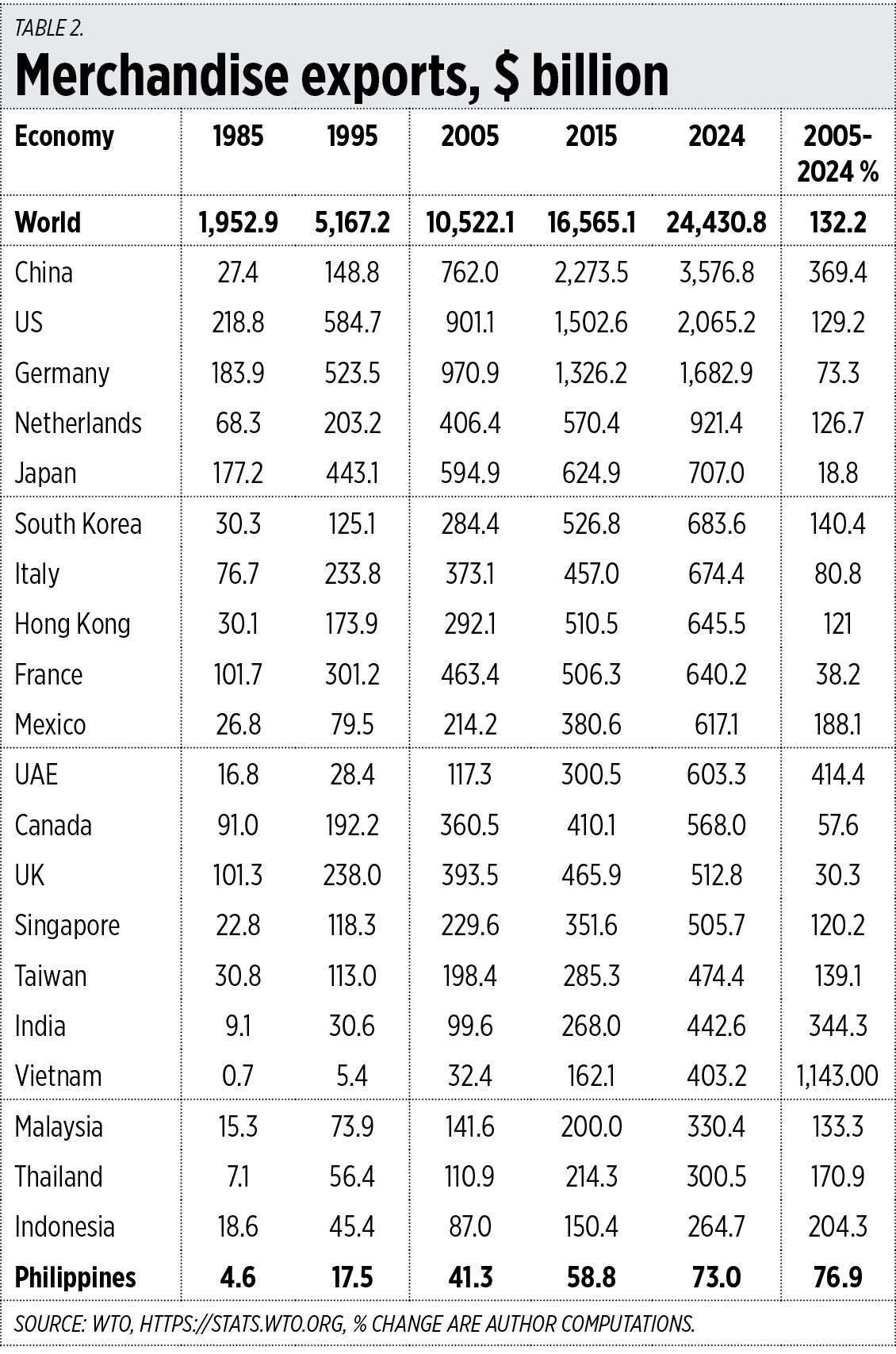
The Philippines still has the smallest number of exports among the ASEAN-6, with Vietnam’s exports 5.2 times larger than ours. There are two proximate reasons: geography and size of power generation. Vietnam can export to Thailand or China and vice-versa by land. Germany can export to France or Italy by land too. An archipelago, the Philippines can export only by sea and air.

In 2023, the Philippines’s generated only 119 terawatt-hours (TWH) of power while Malaysia generated 188 TWH, Thailand had 190 TWH, and Vietnam generated 276 TWH.

The country’s economic team can work with the infrastructure team to hasten the improvement of our infrastructure (airports, seaports, toll roads, rails, power generation-distribution, etc.). Our economic and fiscal policies should be as liberal, if not more liberal, than our neighbors because of our geographical isolation and disadvantage. We can also compensate with the increased exports of services, like attracting more foreign tourists, expanding the business outsourcing sector, and sending skilled Filipino workers overseas.


Bienvenido S. Oplas, Jr. is the president of Bienvenido S. Oplas, Jr. Research Consultancy Services, and Minimal Government Thinkers. He is an international fellow of the Tholos Foundation.

minimalgovernment@gmail.com

Kim Kardashian tells accused in Paris jewel heist that she forgives him

Kim Kardashian in a scene from the reality TV show The Kardashians.

PARIS — Reality TV star Kim Kardashian told the alleged mastermind of a jewel heist in which she thought she was going to die that she forgives him, but that this took away none of the trauma from being held at gunpoint in her Paris hotel room in 2016.

“I absolutely thought I was going to die,” the billionaire celebrity told a Paris court on Tuesday, recounting her shock and fear during the attack, in which she thought she was going to be raped and shot.

“I thought about my sister, thought she would walk in and see me shot dead and have that memory in her forever,” she said.

Ms. Kardashian cried as she recalled the start of the attack, in which the suspects are accused of tying her up with zip ties and duct tape before making off with jewelry, including a $4 million engagement ring given to her by her then-husband rapper Kanye West (now known as Ye).

Ms. Kardashian, 44, recalled the details of the attack.

“We were leaving the next morning so I was just packing up, it was around 3 in the morning. I heard stomping up the stairs when I was in bed,” she said, adding that men dressed as police officers barged in.

“Then I heard one of the gentlemen forcefully say ‘ring! ring!’ in English, with an accent, pointing,” she said. One of them pointed a gun at her.

“I was pretty hysterical and I just looked at the concierge and told him ‘What is going to happen to us? I have to make it home to my babies,’” Ms. Kardashian said.

She said at one point she feared she was going to be raped as the robbers threw her on the bed and one of them grabbed her leg. “But he ended up tying me up and closed my legs,” she said.

Ms. Kardashian said the intruders did not hit her.

“I was grabbed, and dragged into the other room, and thrown onto the floor, but wasn’t hit, no,” she said.

‘I FORGIVE YOU’
There was another emotional moment in court when a letter of apology written by 69-year-old defendant Aomar Ait Khedache, nicknamed “Omar the Old,” who can no longer speak, was read out.

“I’m honestly emotional about it,” Ms. Kardashian told the court, in tears.

“I do appreciate the letter for sure, I forgive you,” she said, looking at Mr. Khedache. “But it doesn’t change the feelings and the trauma and the fact that my life was forever changed, but I do appreciate the letter, thank you.”

Mr. Khedache is accused of being the ringleader of the robbery, which he denies. His response to Ms. Kardashian’s words was read out by the court. “Your forgiveness is a sunshine that has enlightened me… I am forever grateful,” he said.

SECURITY
The attack, during Paris fashion week, changed a lot of things, Ms. Kardashian said, including prompting her to increase her security.

“It changed the way that I feel safe at home. Now I have between four and six security at home for me to feel safe,” she said. “I can’t sleep at night if there aren’t multiple security people.”

Ahead of Ms. Kardashian’s testimony, her stylist Simone Harouche, who was asleep in the same luxury hotel flat at the time of the attack, told the tribunal of the “terror” they both felt during the robbery.

Ms. Harouche rushed to lock herself in the bathroom and texted Ms. Kardashian’s sister Kourtney and their bodyguard for help.

When the robbers left and Ms. Kardashian joined her downstairs, “she was beside herself, I’ve never seen her like that before,” Ms. Harouche said. “She just was screaming and kept saying we need to get out of here, we need help, what are we going to do if they come back.”

Ms. Harouche also cried at times during her testimony, and said she had changed careers and underwent therapy because of the robbery, which she said caused her post-traumatic stress and made her fearful of being around celebrities.

In all, nine men and one woman are being tried by the criminal court. Five of them — all men — face armed robbery and kidnapping charges and potentially risk being sentenced to life imprisonment. The others are charged with complicity in the heist or the unauthorized possession of a weapon.

As the robbers escaped on foot or with bicycles, they lost a cross with six diamonds, which a passerby found in the street and brought to the police. But most of the jewels, including the $4-million engagement ring, were never found.

Fans of Ms. Kardashian queued up early on Tuesday to get a chance to get a seat in the courtroom.

“We came to show our support for Kim Kardashian because she’s someone we’ve followed since we were very young,” social media influencer Leo Saint-Charles said.

“She inspires us a lot, and we’re here to support her in this trial, which was very traumatic for her. And there you have it, we hope justice will be done, right?” — Reuters

TikTok, Meta endure tougher Asia crackdown as US efforts stall

REUTERS

SOME of the toughest new laws attempting to rein in TikTok, Instagram and Snapchat aren’t coming from Washington or Brussels. They’re emerging from capitals such as Canberra, Jakarta and Kuala Lumpur.

Governments across the Asia-Pacific region are leading the global charge to protect children from online harms, presenting an unprecedented challenge to the likes of ByteDance Ltd., Meta Platforms, Inc. and Snap Inc. in markets with some of their largest and most youthful user bases.

Australia late last year passed a law requiring social media platforms to keep children under the age of 16 off their services. New Zealand’s governing party last week put forward a bill that mirrors Australia’s move.

Indonesia is formulating restrictions for those under 18 accessing social media. Malaysia is requiring social media firms to obtain licenses to operate in the country, while Singaporean policymakers have signaled they’re open to minimum-age laws.

Meanwhile, Vietnam is requiring foreign social platforms verify their users’ accounts and provide authorities with their identities on demand, and Pakistan wants such firms to register with a new agency.

“I’ve met with parents who have lost and buried their child. It’s devastating,” Australian Prime Minister Anthony Albanese said in November. “We can’t as a government hear those messages from parents and say it’s too hard. We have a responsibility to act.”

To be sure, it’s unclear how strictly some of the measures will be enforced. And social media titans face headwinds elsewhere, such as the European Commission’s Digital Markets and Digital Services Acts, along with moves by other nations attempting to curb children’s access to the platforms.

In the US, social media firms have come under fire in some states, but the federal government has yet to pass meaningful legislation requiring they establish more guardrails. The Senate in July passed the Kids Online Safety Act, which would force companies to prioritize children’s wellbeing, but the measure has stalled in the House.

Meta faces a landmark antitrust case by the US Federal Trade Commission, while TikTok could be banned in the country. Meanwhile one US law firm is pursuing a new legal strategy, focusing on product liability, to hold tech giants accountable for harms to children despite longstanding protections afforded by Section 230 of the Communications Decency Act.

New rules in Asia-Pacific could complicate companies’ operations across the region, said Ewan Lusty, a Singapore-based director at political and regulatory consultancy Flint Global.

“If you’ve got each country implementing their own version of a regulation, then the cost of complying with that will multiply” for tech firms, he said. 

The emerging restrictions also pose a new threat because they could curtail the tech titans’ growth in some of the world’s most populous markets.

Southeast Asia is home to more than 650 million people, while South Asia’s population stands at roughly 2 billion. Young internet users across the region are expected to play a vital role in propelling digital firms’ expansion in the years to come. China has for years blocked foreign online platforms, shutting them out of a market of some 1.4 billion people.

In a bid to capitalize on growth across Asia-Pacific, Amazon.com, Inc., Alphabet, Inc.’s Google, Microsoft Corp. and other tech giants are investing billions of dollars in the region as young users increasingly communicate with friends online, shop, stream video and use generative artificial intelligence.

Social network titans don’t typically break out user counts or sales by country, but they often derive most of their revenue from developed economies in the west, where advertisers pay more to reach wealthier consumers. User growth in many richer nations, though, has slowed over the years.

For Meta, Southeast and South Asian nations make up significant global shares of Instagram and Facebook user accounts, with those consumers tending to be younger, according to data from digital consulting firm Kepios Pte., which specializes in analyzing online behavior.

Markets across the region also have some of the world’s highest rates of user engagement for Meta’s products, and many citizens depend on Facebook, especially, as a gateway to the internet. Meta and other firms also often use such countries as testing grounds for new product initiatives.

TikTok’s largest market by users is the US, but five of its 10 biggest globally are in Southeast or South Asia, according to Kepios data. Snapchat has more than twice as many users in South Asia than in the US, the data shows.

Australia, which has a track record of battling big tech, in November passed its controversial law banning young children from social media beginning at the end of this year. Platforms will be responsible for enforcing the age limit, with penalties of as much as A$50 million ($32 million) for breaches.

While opinion polls have shown that many Australian voters support the new rule in principle, some of the companies, academics and children’s rights groups call it flawed and question how it might be enforced.

An executive at one major tech firm, asking not to be identified discussing sensitive matters, said Australia’s move has resulted in consternation among companies and uncertainty over how things will proceed.

A Meta spokesperson said the company is committed to keeping young people safe and that safety tools it has rolled out for such users have proven popular around the world.

A spokesperson for Snap pointed to concerns that have been raised about Australia’s new rules, but said the company would work with the Australian government ahead of their implementation and comply with any regulations.

TikTok has in the past highlighted voluntary measures it has implemented to support safety for teens.

X declined to comment.

The Asia Internet Coalition, an industry group that represents major tech players in matters of tech policy in the region, didn’t respond to requests for comment on the regulatory moves.

Asia-Pacific policymakers in the past haven’t been as quick as governments elsewhere to regulate tech firms, but that’s changing now, said Lusty of Flint Global.

“The region is becoming increasingly important in debates around how we govern the digital space,” he said. Bloomberg

BPI Securities targets to increase client base with enhanced platform

NEW.BPITRADE.COM

BPI SECURITIES Corp., the stock brokerage arm of Ayala-led Bank of the Philippine Islands (BPI), aims to grow its client base in the next two to three years through its upgraded web-based platform.

Currently, BPI Securities serves close to 100,000 clients. The company hopes to grow this number to approximately 300,000 clients by 2027.

“We are targeting a substantial increase in our client base in the coming years,” said BPI Securities President Mark Rome M. Race.

“In terms of client profile, millennials are the most active, followed by Gen X, and we are seeing a shift in user demographics within the Philippine investing space.”

As part of its growth strategy, BPI Securities introduced the new BPI Trade web-based platform, which aims to make stock market investing more accessible to Filipinos.

The platform will be available starting May 28, with no minimum initial investment required. Key features include real-time market data, streamlined trading tools, and access to insights and research from BPI Securities’ expert team.

One of the platform’s standout features is its fully digital account opening process, enabling clients to open trading accounts entirely online.

“BPI Trade offers a superior trading experience, empowering both new and seasoned investors to seize market opportunities,” said Mr. Race. “Our goal is to make stock investing more approachable, informative, and convenient for Filipinos.”

The platform’s simplified account opening, zero minimum funding requirement, and enhanced tools aim to provide a more intuitive and accessible investing experience.

While the online account opening facility is currently available to existing BPI clients and select users, the company plans to expand access in the coming months.

The digital account opening process is accessible via web browser, with plans for integration into the BPI Trade mobile app in the near future. — Revin Mikhael D. Ochave

BSP gets IMF assistance to strengthen PHL financial system’s operational resilience

THE Philippine central bank can further strengthen its regulations on operational resilience in the financial system, the International Monetary Fund (IMF) said in a technical assistance report.

The high-level summary report came after the IMF’s Monetary and Capital Markets department delivered a hybrid technical assistance mission to assist the Bangko Sentral ng Pilipinas (BSP) in developing a supervisory framework for operational resilience.

The multilateral institution conducted an earlier mission in 2022 to help the BSP craft a regulatory framework for operational resilience.

“The authorities have since developed the draft regulation leveraging on existing policies on operational risk management, business continuity management, IT risk and outsourcing, among others,” the IMF said. This draft circular has already been released to the public for comment.

“A follow-up hybrid mission during May 2024 addressed developing a supervisory framework for operational resilience,” the IMF said. This included both virtual and in-person missions to get updates on the developments since the earlier regulation and provide feedback, among other initiatives.

The IMF said the central bank will need to “closely manage the communication strategy with its supervised institutions to clarify the potential areas of additional effort to implement operational resilience.”

“In its onsite examinations, the BSP has established several touchpoints where operational risk management is assessed which it can leverage to include assessment of operational resilience.”

“There are benefits leveraging the ongoing role of the Technical Working Group on Operational Risk to help smooth implementation and integration into the supervisory framework,” it added.

The IMF recommended that the Basel Core Principle 25 (BCP25) should be reflected in the draft regulation. BCP25 covers operational risk and operational resilience.

It also recommended integrating operational resilience into its risk rating methodology and developing internal guidelines for supervisors on how to assess operational resilience.

The BSP should also integrate operational resilience assessment as part of risk-based supervisory framework and conduct thematic reviews focusing on domestic systemically important banks, it added. — Luisa Maria Jacinta C. Jocson

Apple introduces new accessibility features including braille note taker

STOCK PHOTO | Image by matcuz from Pixabay

APPLE said on Tuesday it is bringing a host of new features later this year that are geared towards making its devices more accessible, including a braille note taker and expanded “zoom” for its mixed-reality headsets, Vision Pro.

For users who are blind or visually impaired, vision accessibility features will be expanded using Vision Pro’s camera system. The updated zoom features can help users magnify everything in view using the main camera, the iPhone maker said.

“We are dedicated to pushing forward with new accessibility features for all of our products,” said Sarah Herrlinger, Apple’s senior director of Global Accessibility Policy and Initiatives.

Apple will allow approved apps to access the main camera on Vision Pro to provide live, person-to-person assistance for visual interpretation in apps such as Be My Eyes.

Be My Eyes is an application that connects people who are blind or visually impaired with volunteers and companies worldwide through live video.

The Vision Pro, lauded by analysts for its technology, represents Apple’s entry into the headset market otherwise dominated by Meta Platforms.

Apple is also introducing “Braille Access” that turns iPhone, iPad, Mac and Apple Vision Pro into a braille note taker.

With this feature, users can open any app by typing with a connected braille device or Braille Screen Input — an Apple system that allows users to enter braille into their devices.

Apple’s new features also include a system-wide reading mode designed to make text easier to read for users with disabilities such as dyslexia or low vision, the company said. — Reuters

Formal and informal services

CHRISTINA WOCINTECHCHAT.COM-UNSPLASH

DIFFERENT SITUATIONS require different rules. Social context determines when market or social rules apply, even for the same service.

In his 2009 book, Predictably Irrational economist Dan Ariely gives as an example having a wonderful Thanksgiving dinner at the mother-in-law’s place. To show appreciation for the roasted turkey, does the satisfied guest pull out a hundred bucks and give this to his host? The social context in such a well-meaning gesture becomes the height of bad manners. (Do I look like I need your money?) Yet the same meal at a restaurant is not concluded just by hearty compliments to the chef or good ratings on the customer feedback form. There is a bill that needs to be paid. (And don’t forget the tip.)

In one case, a social situation like putting clothes in the washing machine by the wife is provided for free. (Next time, it’s your turn.) In a market setting this same service (doing the hotel laundry) is charged.

Social relationships too can take on a commercial slant. Can the professional entertainer in a bar who becomes a regular partner still charge for her services? (We can do karaoke at home.) It is also possible for the fees to become even higher as the family expenses are folded in.

Even in business settings, not all relationships are covered by market norms where formal contracts usually define deliverables and fees. Thus, an expert can give solicited advice on a business issue, analyzing problems and providing ideas over lunch, but without the usual business props — can you see my screen?

Can a bill be charged for such advice?

To be sure the meeting is considered “purely social,” the talk is interspersed with extraneous topics like Trump’s tariffs or the latest gossip about former associates. (He’s looking for a new job.) No staff assistants are on hand. There is no taking of notes or designation of “next steps” and timelines. The lunch ends with a vague plan to meet up again with the spouses. The advice seeker picks up the bill — it’s your turn next time.

Informal chats over lunch are trapped in Dan Ariely’s social norms. Advisers feel awkward moving the informal consultations on a market norm, and putting some commercial value on the inputs provided, even when these have been acted on afterwards without credits given. If they even hint at possible compensation, the timid request to formalize some consultancy arrangement is met with an incredulous reaction. (Are you going to send me a bill for listening to your corny jokes?)

Lawyers, PR crisis managers, doctors, ghost writers, and tax accountants are experts in avoiding this predicament of an ambiguous market setting. These professionals have a ready response to anyone bringing up a problem for free consultation — I have this recurring ache in my big toe. Before the complainer removes his shoes and socks to show, he is quickly told not to take it up here at the party and just make an appointment with the secretary for a diagnosis at the clinic, so the problem can be more properly evaluated… and billed.

Still, the successful professional who gets paid by the hour for his advice can be generous with free comments. He understands where the line for the charging can be drawn as when contracts and pleadings need to be drafted.

In the realm of philanthropy and good works, market norms can be dispensed with. Legal and medical skills can be provided by a group pro bono in the service of disadvantaged sectors, using a purely social norm. These are called advocacies that enhance a professional’s biodata.

Relatives too like sons and daughters, or even nephews, are expected to give their professional opinions without charging. But even here there’s a limit in terms of referrals. (Can you also help my classmate?)

Formal and informal services are defined by the context of the engagement. Social situations, like family get-togethers, are bound to confuse the issue. It’s best to bring the one needing expert advice or service to a professional setting, and have somebody else in the firm to make the presentation… after clarifying the scope of work and cost.


Tony Samson is chairman and CEO of TOUCH xda

ar.samson@yahoo.com

Paris court convicts actor Depardieu of sexual assault, imposes suspended sentence

Gérard Depardieu in a scene from 2021’s Adieu Paris.

PARIS — A Paris court on Tuesday found actor Gerard Depardieu guilty of sexually assaulting two women on a film set and handed him an 18-month suspended sentence, with the judge saying he appeared not to have grasped the ‘traumatic’ impact of his behavior.

In the highest-profile #MeToo case to come before judges in France, Mr. Depardieu repeatedly denied any wrongdoing. His lawyer said he would appeal the court’s decision.

Mr. Depardieu, 76, was a towering figure in French cinema, starring in more than 200 films over five decades, including Green Card, The Last Metro, and Cyrano de Bergerac.

His trial marked a moment of reckoning for the #MeToo protest movement over sexual violence, which has failed to gain the same traction in France as in the United States, although there are signs that social attitudes are changing.

One of the two plaintiffs, Amelie K, a set decorator now aged 54, told the court the actor had groped her all over her body as he trapped her between his legs and made explicit sexual comments on set in 2021.

“I was terrified, he was laughing,” she recounted.

Mr. Depardieu, who denied sexual assault, had argued before the court that he did not consider placing a hand on a person’s buttocks sexual assault and that some women were too easily shocked.

Handing down his sentence, the presiding judge, Thierry Donard, said of Mr. Depardieu: “He does not seem to have grasped either the concept of consent or the deleterious and traumatic consequences of his behavior towards the women he assaulted.”

He ordered Mr. Depardieu, who was not in court for the verdict, to be put on a list of sex offenders.

#METOO RECKONING
Mr. Depardieu has figured prominently in the debate over the #MeToo movement in France, as he faced a growing number of sexual assault allegations that put a spotlight on how women are treated in the movie industry.

Prosecutors say he should face trial in a separate rape investigation, following allegations brought by actress Charlotte Arnould, 29, who said she could not bear remaining silent any longer.

More than a dozen women have accused Mr. Depardieu of sexual violence, though not all have filed complaints.

Mr. Depardieu has consistently denied wrongdoing. “Never, absolutely never, have I abused a woman,” he wrote in an open letter in the daily Le Figaro newspaper in October 2023.

The Depardieu trial laid bare a generational divide in France over sexism.

Earlier during the investigation, a group of 50 French stars, including Carla Bruni, wife of former president Nicolas Sarkozy, denounced what they called the “lynching” of Mr. Depardieu. Brigitte Bardot, 90, told BFM TV this week that “those who have talent and grope a girl get thrown into the gutter.”

Women’s rights campaigners say they have seen a shift in attitudes in France — notably following the case of Gisele Pelicot whose ex-husband was convicted last year of inviting dozens of men to rape her after drugging her unconscious.

“It’s truly a victory and a step forward. We’re making progress,” Amelie K. told reporters after the verdict. — Reuters

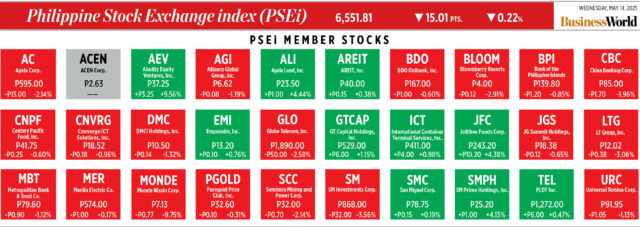
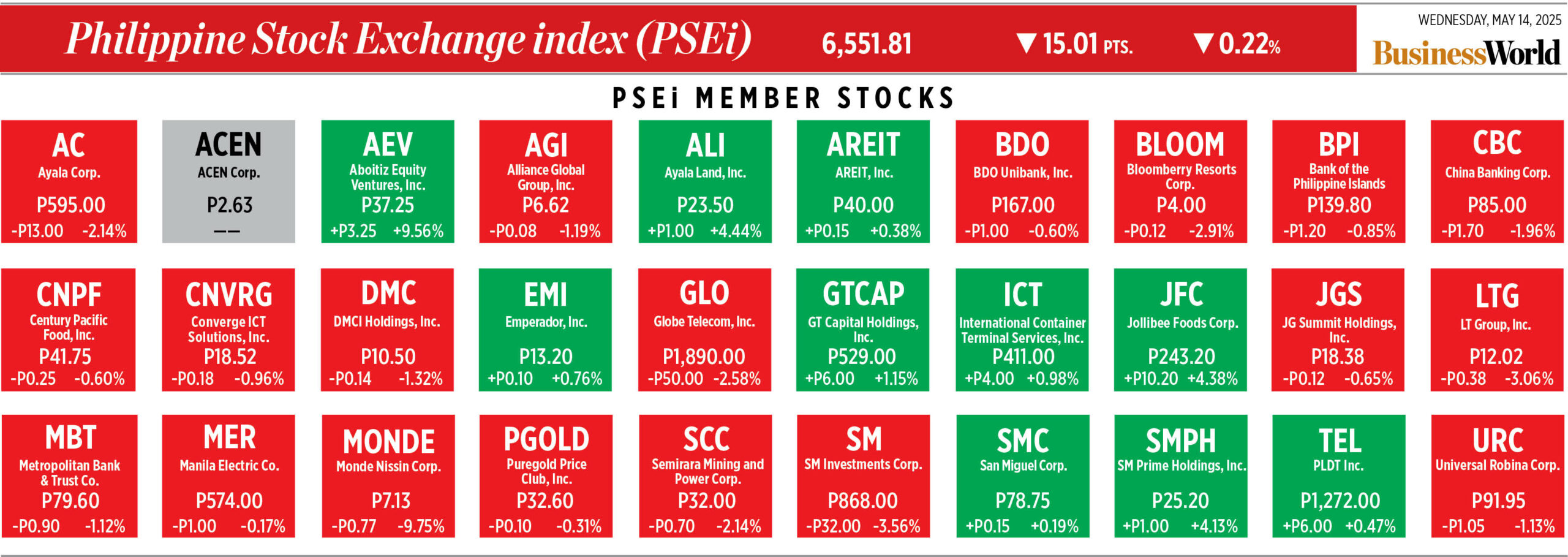
How PSEi member stocks performed — May 14, 2025

Here’s a quick glance at how PSEi stocks fared on Wednesday, May 14, 2025.


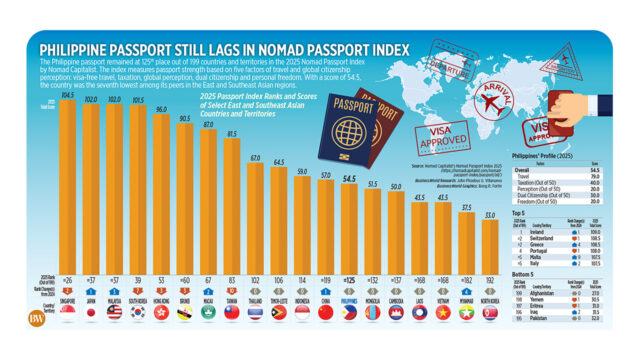
Philippine passport still lags in Nomad Passport Index

The Philippine passport remained at 125th place out of 199 countries and territories in the 2025 Nomad Passport Index by Nomad Capitalist. The index measures passport strength based on five factors of travel and global citizenship perception: visa-free travel, taxation, global perception, dual citizenship and personal freedom. With a score of 54.5, the country was the seventh lowest among its peers in the East and Southeast Asian regions.

Philippine passport still lags in Nomad Passport Index

How Trump’s trade war has evolved in three months

REUTERS

US PRESIDENT Donald J. Trump’s tariff decisions since he took office on Jan. 20, from imposing sweeping duties to abruptly pausing some of them, have shocked financial markets and sent a wave of uncertainty through the global economy.

Here is a timeline of the major developments:

Feb. 1 — Mr. Trump imposes 25% tariffs on Mexican and most Canadian imports and 10% on goods from China, demanding they curb the flow of fentanyl and illegal immigrants into the United States.

Feb. 3 — Mr. Trump suspends his threat of tariffs on Mexico and Canada, agreeing to a 30-day pause in return for concessions on border and crime enforcement. The US does not reach such a deal with China.

Feb. 7 — Mr. Trump delays tariffs on de minimis, or low-cost, packages from China until the Commerce department can confirm that procedures and systems are in place to process them and collect tariff revenue.

Feb. 10 — Mr. Trump raises tariffs on steel and aluminum to a flat 25% “without exceptions or exemptions.”

March 3 — Mr. Trump says 25% tariffs on goods from Mexico and Canada will take effect from March 4 and doubles fentanyl-related tariffs on all Chinese imports to 20%.

March 5 — The president agrees to delay tariffs for one month on some vehicles built in Canada and Mexico after a call with the chief executive officers of General Motors and Ford and the chairman of Stellantis.

March 6 — Mr. Trump exempts goods from Canada and Mexico under a North American trade pact for a month from the 25% tariffs.

March 26 — Mr. Trump unveils a 25% tariff on imported cars and light trucks.

April 2 — Mr. Trump announces global tariffs with a baseline of 10% across all imports and significantly higher duties on some of the US’s biggest trading partners.

April 9 — Mr. Trump pauses for 90 days most of his country-specific tariffs that kicked in less than 24 hours earlier following an upheaval in financial markets that erased trillions of dollars from bourses around the world.

The 10% blanket duty on almost all US imports stays in place.

Mr. Trump says he will raise the tariff on Chinese imports to 125% from the 104% level that took effect a day earlier. This pushes the extra duties on Chinese goods to 145%, including the fentanyl-related tariffs imposed earlier.

April 13 — The US administration grants exclusions from steep tariffs on smartphones, computers and some other electronics imported largely from China.

April 22 — The Trump administration launches national security probes under Section 232 of the Trade Act of 1962 into imports of both pharmaceuticals and semiconductors as part of a bid to impose tariffs on both sectors.

May 4 — Mr. Trump imposes a 100% tariff on all movies produced outside the US.

May 9 — Mr. Trump and British Prime Minister Keir Starmer announce a limited bilateral trade agreement that leaves in place 10% tariffs on British exports, modestly expands agricultural access for both countries and lowers prohibitive US duties on British car exports.

May 12 — The US and China agree to temporarily slash reciprocal tariffs. Under the 90-day truce, the US will cut the extra tariffs it imposed on Chinese imports to 30% from 145%, while China’s duties on US imports will be slashed to 10% from 125%.

May 13 — The US cuts the low value de minimis tariff on China shipments, reducing duties for items valued at up to $800 to 54% from 120%. — Reuters

LGUs’ ban on mining ruled unconstitutional

FREEPIK

By Kyle Aristophere T. Atienza, Reporter

LOCAL government units (LGUs) are prohibited by the Constitution and a 1995 law from declaring blanket bans on mining, the Supreme Court (SC) ruled.

The ruling nullified a 25-year moratorium on large-scale mining by Occidental Mindoro and the municipality of Abra de Ilog in that province, which was found to have violated Republic Act (RA) No. 7942 or the Philippine Mining Act of 1995.

It stemmed from a case filed by Agusan Petroleum and Mineral Corp., which argued that the ban violated its exclusive rights to mine in Mamburao and Abra de llog under a government-approved Financial or Technical Assistance Agreement (FTAA).

The ordinances interfered with the State’s ownership and control over the exploration, development, and use of mineral resources, Agusan Petroleum also argued.

RA 7942 prescribes environmental safeguards that render a total ban unnecessary, it added.

Occidental Mindoro brought the case to the SC after a regional trial court declared the ordinances void.

The province argued that the ordinances were a valid exercise of its police power since their purpose was to protect the environment and the lives and safety of its residents.

The SC said large-scale mining and exploration of mineral resources are legal under the Constitution and the Philippine Mining Act of 1995, adding that it is the State’s duty to promote such activities “to support national development, while also ensuring environmental protection and safeguarding the rights of affected communities.”

Local ordinances are not considered “laws” that can bar mining activity under Section 19 of RA 7942, according to the ruling.

The power of LGUs to issue ordinances comes from Congress, and interpreting “laws” to include local ordinances would, in effect, allow LGUs to override Congressional authority to regulate mining, it said.

RA 7942 gives LGUs the power to approve or deny individual mining applications based on their effects on the environment, livelihoods, and land rights.

“However, the law does not authorize them to impose a blanket ban on all large-scale mining in their area,” the court said.

“Each mining application must be evaluated on a case-by-case basis,” it added.

The High Court noted that all mining applications must undergo environmental impact assessments, which include prior consultation with LGUs.