Home Blog Page 1520

Gov’t to build 3,000 housing units in Cebu

PHILSTAR FILE PHOTO

THE DEPARTMENT of Human Settlements and Urban Development (DHSUD) is looking to build 3,000 housing units in Toledo City, Cebu, as part of its flagship housing project.

“The DHSUD, together with the city government of Toledo and the Pag-IBIG Fund, sign a tripartite memorandum of agreement for a housing project under President Ferdinand R. Marcos, Jr.’s flagship Pambansang Pabahay para sa Pilipino Program (4PH) on Friday, marking a major step toward providing decent yet affordable housing for Toledohons,” it said in a statement posted on its Facebook page last week.

The property will also have open spaces, parking lots and other amenities.

The Home Development Mutual Fund or Pag-IBIG will provide financing support for the program.

In his message, DHSUD Secretary Jose Rizalino H. Acuzar said that the 4PH program seeks to address homeownership concerns in the country, such as high costs.

A flagship program of the Marcos administration, the 4PH Program aims to construct one million housing units annually until 2028, with the price range of housing units at P580,000 to 1,150,000.

The Philippines’ housing need is projected to jump to 22 million by 2040, according to a report by the United Nations Human Settlements Programme. — Beatriz Marie D. Cruz

Fraud audit sought over BARMM’s alleged anomalous P6.4-B spending

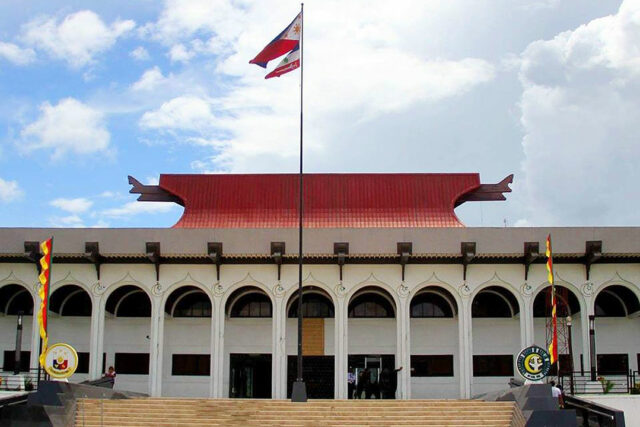
@BANGSAMOROGOVT

A HOUSE of Representatives committee on Monday urged the Commission on Audit (CoA) to start a fraud investigation into the Bangsamoro Autonomous Region in Muslim Mindanao’s (BARMM) use of its P6.4-billion support fund amid corruption concerns.

State auditors could investigate BARMM’s alleged misuse of its multi-billion fund, which was allegedly disbursed to barangays allied with the regional government’s administration, Assistant Majority Leader and Lanao del Sur Rep. Zia Alonto Adiong said.

“Maybe it’s [time] that we invite the attention of the CoA central to conduct the necessary auditing procedures that they would tend to do to assess, monitor the utilization of the P6.4-billion local government support fund in the BARMM,” he told during a House public accounts hearing on Monday, based on a statement.

The House public accounts panel in January opened an inquiry into the alleged fund misuse, which was raised by Mr. Adiong during his privilege speech earlier that month. He said that bank accounts of over 400 barangays in Lanao del Sur province received funds amounting P500,000 to P2.5 million from the support fund. — Kenneth Christiane L. Basilio

Marcos urged to raise minimum wage to P200

PNA FILE PHOTO

THE TRADE Union Congress of the Philippines (TUCP) on Monday called on President Ferdinand R. Marcos, Jr. to push for and sign into law a measure increasing the daily minimum wage to P200 after he raised the daily subsistence allowance for military personnel by P200.

“April is shaping up to be a month of train, jeepney, bus, water, and power  price hikes — yet Congress expects us to wait until June, when only six session days remain, to pass this badly-needed wage increase which has been even below the poverty line and the daily healthy food requirement for over three decades now?” the TUCP said in a statement.

The group said current minimum wages are not enough to keep Filipinos from living in poverty.

The President on March 14 issued Executive Order (EO) 84 that raised the subsistence allowance for enlisted personnel of the Armed Forces of the Philippines (AFP) to P350 from P150.

The order said the existing allowance for the military was “no longer adequate to meet the daily sustenance of an active-duty soldier, which is essential for their well-being and performance of their duties.”

The House Commitee on Labor earlier approved a bill that would grant a P200 across-the board wage increases for private sector workers.

The Senate approved a bill increasing the daily minimum wage in the private sector by P100 in February last year. — John Victor D. Ordoñez

OPAPRU: Appointment of new BARMM officials legal

COTABATO CITY — The appointment by President Ferdinand R. Marcos, Jr. of a new chief minister for the Bangsamoro regional government did not violate the government’s peace compact with the Moro Islamic Liberation Front (MILF), a senior state official said on Monday.

President Marcos on March 3 appointed chief of the Bangsamoro Islamic Armed Forces-MILF, Abdulrauf A. Macacua, as chief minister of the Bangsamoro Autonomous Region in Muslim Mindanao (BARMM), replacing Ahod B. Ebrahim, who is chairman of the front’s central committee.

Presidential Adviser on Peace, Reconciliation and Unity Carlito G. Galvez, Jr., clarified to reporters in Cotabato City that there was nothing wrong with the appointment.

The Office of the Presidential Adviser on Peace, Reconciliation and Unity (OPAPRU) has projects complementing the national government’s separate peace overtures with the MILF and the Moro National Liberation Front.

Both fronts have separate peace accords reached via tedious and drawn-out negotiations supported by the Organization of Islamic Cooperation, a bloc of more than 50 Muslim nations, including petroleum-exporting states in the Middle East and North Africa.

As chief minister, the newly appointed Mr. Macacua shall function as figurehead of BARMM’s 80-seat BARMM regional parliament.

“The change of leadership in the BARMM adheres to both the letter and spirit of the Comprehensive Agreement on the Bangsamoro and the Bangsamoro Organic Law,” Mr. Galvez said, referring to the charter of BARMM.

The chiefs of the 12 base commands of the MILF from across BARMM had signed a manifesto recognizing Mr. Macacua as the new BARMM chief minister.

They assured Mr. Galvez during a dialogue in Cotabato City on Sunday that they will support Mr. Macacua’s leadership of the region’s interim 80-seat law-making body.

They also promised Mr. Galvez that they will help Mr. Macacua push forward his sustainable development, peace and security programs for the Muslim, Christian and non-Moro indigenous communities in the autonomous region.

President Marcos had also appointed 77 members of the 80-seat BARMM parliament, according to officials of different agencies under the regional government. — John Felix M. Unson

4 Dawlah gunmen killed in Maguindanao del Norte clash

COTABATO CITY — Personnel of an anti-terror Philippine Marine unit shot dead four members of the outlawed Dawlah Islamiya in an encounter in Barira, Maguindanao del Norte before dawn Monday.

The encounter in Sitio Palao in Barangay Barira in the upland Barira town erupted when Dawlah Islamiya gunmen opened fire on members of the Marine Battalion Landing Team-2, dispatched to check on reports by residents about their presence in the area.

Army Major Gen. Donald M. Gumiran, commander of the 6th Infantry Division told reporters on Monday afternoon that he is thankful to officials of the 1st Marine Brigade for acting promptly on reports by villagers about their sightings of Dawlah Islamiya members in their surroundings.

Community leaders had told reporters that the companions of the four Dawlah Islamiya members killed in the clash scampered away when they sensed that Marine and police reinforcements were closing in. They were seen carrying three wounded companions as they fled, according to traditional ethnic Iranun elders in Barira.

The Marines and barangay officials who responded to the incident found two assault rifles, ammunition and more than a dozen 40-millimeter grenade projectiles scattered at the scene of the encounter, left by the retreating Dawlah Islamiya gunmen. — John Felix M. Unson

Peso drops slightly as market awaits Fed review

BW FILE PHOTO

THE PESO weakened slightly against the dollar on Monday amid cautious trading as the market looks ahead to the US Federal Reserve’s meeting this week, where it is expected to keep rates steady but provide fresh guidance on their policy stance moving forward.

The local unit closed at P57.30 per dollar on Monday, declining by 4.9 centavos from its P57.251 finish on Friday, Bankers Association of the Philippines data showed.

The peso opened Monday’s session stronger at P57.20 against the dollar. Its intraday best was at P57.175, while its worst showing was at P57.31 versus the greenback.

Dollars traded went down to $1.02 billion from $1.39 billion on Friday.

“The dollar-peso closed a bit lower but moved mostly sideways on cautious trading ahead of the FOMC (Federal Open Market Committee) meeting later this week. Some are betting they will cut because of the weaker data recently, but most are expecting it in June,” a trader said in a phone interview.

The US central bank will review its policy settings on March 18-19. Fed policy makers are universally expected to leave rates in their current 4.25%-4.5% range when they meet this week, and traders are also betting against a rate cut at their May meeting, Reuters reported.

Investors will pay particularly close attention to the Fed’s own projections for inflation, unemployment and the path of rates, due to be published at the end of their two-day policy-setting meeting. In December, Fed policy makers forecast two interest-rate cuts this year.

Pricing of short-term interest-rate futures still reflects an expectation for a June start to Fed rate cuts, with likelier than not a total of three quarter-point reductions by the end of the year.

The peso was also dragged down by higher global crude oil prices recently, Rizal Commercial Banking Corp. Chief Economist Michael L. Ricafort said in a Viber message.

For Tuesday, the trader expects the peso to move between P57.10 and P57.40 per dollar, while Mr. Ricafort sees it ranging from P57.20 to P57.40.

The US dollar hovered close to a five-month low against its major peers on Monday, pressured by President Donald J. Trump’s erratic trade policies and a run of soft macroeconomic data, Reuters reported.

The US dollar index, which measures the currency against the six major counterparts, was little changed at 103.71 early in the Asian morning — A.M.C. Sy with Reuters

PSEi rises to 6,300 level on China stimulus plan

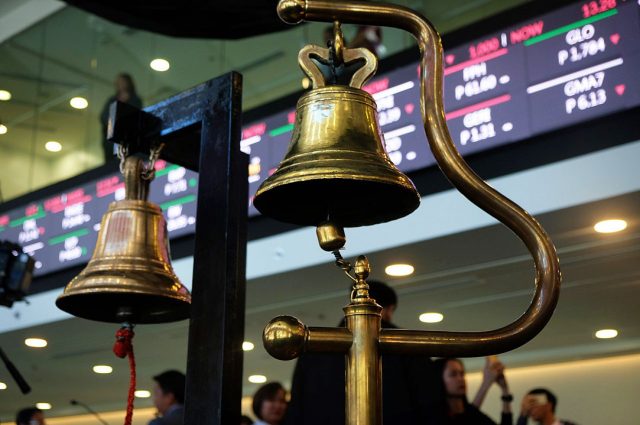
BW FILE PHOTO

THE MAIN INDEX climbed to the 6,300 level on Monday, tracking gains of other Asian markets, as sentiment was lifted by China’s planned stimulus measures.

The Philippine Stock Exchange index (PSEi) rose by 0.19% or 12.08 points to end at 6,306.19 on Monday, while the broader all shares index inched up by 0.03% or 1.22 points to 3,722.82.

“The local market managed to extend its climb this Monday… The bourse rose further, joining its regional peers, as China revealed a special action plan to boost its economy’s consumption,” Philstocks Financial, Inc. Senior Research Analyst Japhet Louis O. Tantiangco said in a Viber message.

“Philippine shares built on the sentiment from Friday, managing to close above the 6,300 level,” Regina Capital Development Corp. Head of Sales Luis A. Limlingan said in a Viber message.

China’s State Council unveiled on Sunday what it called a “special action plan” to boost domestic consumption, featuring measures including increasing residents’ income and establishing a childcare subsidy scheme, Reuters reported.

The plan comes as levels of consumer demand in China have suffered various setbacks in recent years, due to factors such as COVID-19 disruptions and a prolonged property slump, chilling the propensity of households to spend and adding to deflationary trends.

The plan was issued to all regions and departments to “vigorously boost consumption, expand domestic demand in all directions, improve consumption capacity by increasing income and reducing burdens,” a report from the Council said.

Pressure has been building on Chinese officials for consumer-focused stimulus measures to fend off deflationary pressures and reduce the world’s second-largest economy’s reliance on exports and investment for growth.

MSCI’s broadest index of Asia-Pacific shares outside Japan climbed 0.9%, while Japan’s Nikkei advanced 0.93%.

Majority of sectoral indices closed lower on Monday. Mining and oil declined by 0.65% or 58.55 points to 8,882.48; property went down by 0.59% or 13.32 points to 2,216.14; industrials dropped by 0.35% or 31.19 points to 8,722.47; and financials decreased by 0.26% or 6.44 points to 2,428.46.

Meanwhile, services increased by 1.57% or 32.27 points to 2,084.76 and holding firms advanced by 0.40% or 21.26 points to 5,232.14.

“Converge ICT Solutions, Inc. was the top index gainer, climbing 3.83% to P17.34. Bloomberry Resorts Corp. was the main index laggard, falling 3.55% to P3.53,” Mr. Tantiangco said.

Value turnover declined to P5.26 billion on Monday with 1.33 billion shares traded from the P6.32 billion with 785.67 million issues exchanged on Friday.

Advancers narrowly beat decliners, 94 versus 92, while 59 names were unchanged.

Net foreign buying went down to P357.25 million on Monday from P365.15 million on Friday. — Revin Mikhael D. Ochave with Reuters

Duterte-related unrest risks delays to reform legislation

PHILIPPINE STAR/KJ ROSALES

POLITICAL instability stemming from the arrest of former President Rodrigo R. Duterte could disrupt the progress of key legislative reforms, ING Bank said.

In a report, ING Regional Head of Research for Asia-Pacific Deepali Bhargava said: “From a policy perspective, there’s a possibility that the implementation of certain reforms that were recently passed gets delayed,” Ms. Bhargava said.

ING cited recent Senate bills seeking to lower the tax on stock transactions and proposed fiscal mining regime.

“These bills were seen to be financial market-friendly but could be delayed with the renewed focus on politics,” she said.

Mr. Duterte, who led the Philippines from 2016 to 2022, was arrested last week on charges of crimes against humanity. He faced the International Criminal Court (ICC) in a pre-trial session on Wednesday.

The push to raise minimum wages by P200 could also be derailed, “pushed to the back burner” in the face of the political turmoil, she added.

Earlier this year, a House of Representatives committee approved on second reading a bill that seeks to grant a P200 across-the-board wage increase for private-sector workers.

However, ING does not expect the arrest to have any significant impact on the overall economy.

“From the markets’ perspective, we do not expect the political climate to impact the macro stability narrative, given that our forecasts suggest contained inflation and moderating fiscal deficits.”

ING also noted the potential spillovers on the midterm elections, which will be “crucial,” following the impeachment proceedings against Vice-President Sara Duterte-Carpio.

“To avoid her removal as Vice-President and maintain her eligibility to run for president in 2028, the Duterte family needs their allies to secure seats in the Senate,” she said.

“This suggests that political unrest might continue, as the outcome of Ms. Duterte’s impeachment trial and the potential shifts in Senate power will keep both the public and the media intensely focused on the unfolding drama.”

The House of Representatives impeached Ms. Duterte before it went on a four-month break on Feb. 5. The allegations against her include misuse of secret funds, unexplained wealth, acts of destabilization and plotting the assassination of the President, the First Lady and the Speaker. — Luisa Maria Jacinta C. Jocson

Pork sellers largely ignoring MSRP — DA

PORK meat products are sold at the Murphy Market in Cubao, Quezon City, Feb. 11, 2021. — PHILIPPINE STAR/ MICHAEL VARCAS

THE Department of Agriculture (DA) said compliance with the maximum suggested retail price (MSRP) for pork has been spotty over a week after the scheme took effect.

The compliance rate among about 170 retailers monitored by the DA was 20%, Agriculture spokesman Arnel V. de Mesa told reporters.

Retailers have failed to comply with the MSRP because the price set by traders remains high, he said, even though the farmgate price for hogs has decreased.

On March 10, the MSRP was set at P380 per kilo for liempo (belly) and at P350 per kilo for kasim (shoulder) and pigue (rear leg).

The DA has also imposed a maximum suggested price of P300 per kilo for sabit ulo, the price at which traders pass on pork to retailers.

Pork sold in so-called “modern markets” such as supermarkets and hypermarkets is exempt from the MSRP scheme due to their higher operating costs.

Mr. De Mesa said farmgate prices have fallen to as little as P220.

“So, why can’t it reach P300 when in fact they agreed that the profit margin for viajeros (traders) should be P70 pesos?” he said.

The government first applied the MSRP approach to rice.

Mr. De Mesa said the DA was expecting the pork MSRP to be more broadly observed because hogs need to be sold in markets immediately after they are butchered.

“It’s not like rice that you can store for a longer time,” he said.

The level of compliance after the first week of the MSRP for rice was 40-45%.

Mr. De Mesa said prevailing prices remain high for pork belly (P420 per kilo) and rear leg (P380). — Kyle Aristophere T. Atienza

Ajinomoto Philippines sees food industry posting steady growth, revenue rising by double digits

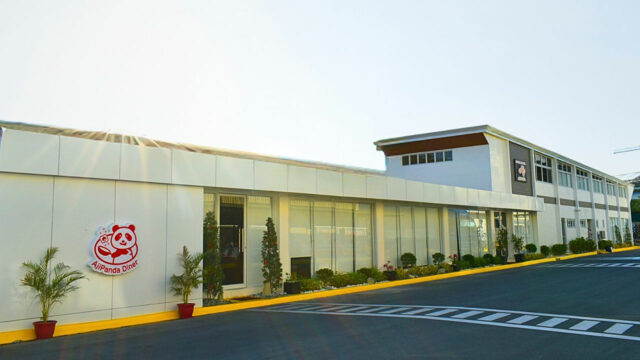
FACEBOOK.COM/AJINOMOTOPHILIPPINESCORPORATION

AJINOMOTO Philippines Corp. (APC) said the food industry is expected to post “steady” growth this year, driving a double-digit rise in its sales.

“We do not reveal this information officially, but I can say (it will be) more than double-digit (growth). As you can imagine, the food industry is not an up-and-down business; it is a very steady business,” Koichi Ozaki, president of Ajinomoto Philippines, said, on the sidelines of a briefing on Monday.

In particular, he said that the company’s sales in the Philippines is expected to outpace the growth rate of the overall food and beverage industry, which he estimated at less than 10%.

“Now the driving force is, of course, our main business, which is the seasoning segment, which is growing steadily. But in addition to that, our other businesses are also our growth drivers,” he added.

Aside from seasoning products, APC also recently launched frozen food such as gyoza (dumplings), karaage (deep fried chicken) and instant soup preparations.

According to Mr. Ozaki, the Philippines is among Ajinomoto’s top markets within ASEAN in terms of sales. Its top market in the region is Thailand.

On Monday, APC launched the Ajinomoto Shared Value (ASV) program, which seeks to reduce the company’s environmental footprint by 50% and help increase global life expectancy by 2030.

The company “recognizes responsibility for how we impact the environment. Our ASV signifies our role is beyond providing Filipinos with key products that enhance taste in our food — it highlights our commitment to environmental stewardship,” Mr. Ozaki said.

The company has transitioned its two factories to renewable energy (RE) in partnership with ACEN Renewable Energy Solutions.

The company currently has two factories in the Philippines, located in Bulacan and Cebu, and employs 2,000 workers.

“The two factories are now being powered by 100% RE, significantly lowering their scope 2 carbon emissions, which prevents around 5,000 metric tons of carbon dioxide emissions per year,” the company said.

In partnership with FAST Logistics and MOBER Philippines, the company is also seeking greener logistics in its warehouse transfers and product deliveries. — Justine Irish D. Tabile

Domestic trade declines by value, volume in Q4 due to typhoons

REUTERS

DOMESTIC TRADE in goods by value posted a double-digit decline in the fourth quarter after multiple typhoons disrupted economic activity, the Philippine Statistics Authority (PSA) said, citing preliminary data.

According to the PSA’s  Commodity Flow in the Philippines report, the value of trade goods in the quarter fell to P246.22 billion from P326.56 billion a year earlier.

The PSA said domestic trade by value is the outflow value of commodities transported from the place of origin to the place of destination.

Commodity flow includes goods transported by water, air, and rail, with waterborne goods the dominant segment.

The volume of trade declined 25.9% year on year to 6.23 million tons.

“The slowdown in domestic trade can be attributed to natural calamities during the last quarter that have negatively affected supply chains in the country,” Reinielle Matt M. Erece, economist at Oikonomia Advisory and Research, Inc. said in an e-mail.

Mr. Erece added that subdued demand caused by global economic uncertainty and higher inflation expectations also slowed domestic trade in the fourth quarter.

In December, headline inflation accelerated to 2.9% year on year from 2.5% in November.

This brought 2024 inflation to 3.2%, in line with the central bank’s target.

Six typhoons between October and November caused more than P22 billion in damage, according to the National Disaster Risk Reduction and Management Council.

Of the 10 commodity groups monitored by the PSA, seven groups declined by value.

These were machinery and transport equipment, down 59.5%, followed by animal and vegetable oils, fats and waxes (-47.2%); food and live animals (-19.4%), beverages and tobacco (-14.7%); mineral fuels, lubricants and related materials (-10.2%); chemicals and related products (-7.8%); and crude materials, inedible, except fuels (-1.5%).

Commodity groups posting growth were manufactured goods classified chiefly by material (25.8%), miscellaneous manufactured articles (9%), and commodities and transaction not classified elsewhere in the PSCC (5.7%).

Food and live animals accounted for the most value among traded commodities at P72.07 billion during the period.

The category accounted for 29.3% of the value of  domestic trade in the fourth quarter. Machinery and transport equipment amounted to P47.48 billion (19.3%), and manufactured goods classified by material P45.15 billion (18.3%).

The National Capital Region accounted for the most goods traded by value with 53.3%. Outflows amounted to P131.31 billion and inflows P24.29 billion, resulting a surplus of P107.02 billion.

The value of inflows into the Western Visayas was P46.63 billion or 18.9% of the total.

Mr. Erece said that a rebound is expected in domestic trade, driven by easing inflation and expectations of higher government spending in the runup to the elections.

Inflation cooled to 2.1% in February, the weakest reading in five months. — Pierce Oel A. Montalvo


PHL, UK start joint trade committee talks

REUTERS

THE PHILIPPINES and the UK on Monday embarked on their first Joint Economic and Trade Committee (JETCO) meeting in London, the Department of Trade and Industry (DTI) said.

“We are just reinforcing our trade and economic ties through the JETCO mechanism,” Bureau of International Trade Relations Director Marie Sherylyn D. Aquia said via Viber.

She said that the Philippines is hoping that the JETCO will cover “infrastructure, energy, agriculture, trade promotion, and investment promotion.”

British Chamber of Commerce Philippines (BCCP) Executive Chairman Chris Nelson said that the JETCO is a reflection of how the UK and the Philippines see the trade going.

“It’s going to be increasing; it’s already reached 2.8 billion pounds, and there are a lot more opportunities. So this is a very encouraging start. I think from the Philippines, Trade Undersecretary Alan Gepty has gone to London,” Mr. Nelson said by phone.

“You have got to look at this as an overall increase in relations. And it follows on from the work we have been doing at the British Embassy,” he added.

He said JETCO signifies an upgrade of trading relations.

“The UK launched about two years ago the Developing Countries Trading Scheme (DCTS). Trade has continued to grow between the two countries, obviously due to the work of the embassy, business and trade, and also ourselves, the British Chamber,” he added.

The Philippines is currently a participant in the UK’s DCTS, which gives duty-free access to 92% of its product lines entering the British market.

“I’m sure it (the JETCO) would cover those under DCTS. I mean, I am not there at the discussions, but I am sure they are going to discuss all possible areas of cooperation,” he said.

The BCCP hopes the UK and the Philippines will also discuss priority legislation.

“For example, we’d like to see the Cybersecurity Act passed because we think that’s very important,” he said.

“We also want to see e-governance, as this will further improve the opportunities. If ease of doing business improves, this will, in our opinion, increase and assist in terms of investments coming into the country. So, we’re hoping that JETCO will also touch on that,” he added.

The DTI’s Export Marketing Bureau reported that total trade between the UK and the Philippines was $1.18 billion in 2024. The UK was the Philippines’ 23rd leading trading partner last year. — Justine Irish D. Tabile