Home Blog Page 1481

My bloody valentine: Why women read crime-romance novels

VECTEEZY

The thrilling, morally dubious world of crime fiction and the emotionally charged realm of romance novels may at first glance seem incompatible. But the blending of these two popular genres makes for compelling reading.

Romance novels generated almost $1.5 billion in revenue in 2022; with 82% of readers being women. Because crime-romance is relatively new, little research exists as to how many readers it specifically attracts, but it’s safe to say its readership is predominantly female. (Women also read more crime fiction than men.)

In crime-romance novels, female empowerment is heightened. The heroine often finds herself in perilous situations – sometimes as the target of a killer, a witness to a crime, or as an investigator – but these threats do not define or limit her.

Instead, the added layer of romance provides another dimension: she might save herself, take down the villain, connect with someone who deeply understands her, or all three. The dangers she faces magnify the stakes of any romantic involvement. Her bravery is amplified, her vulnerability is authentic, and her triumph doubly sweet.

Though there is a long tradition of novelists combining crime and romance (queen of crime Agatha Christie published six romance novels as Mary Westmacott, and often included romance subplots in her crime fiction), crime-romance novels, marrying a mystery to solve with an emotionally satisfying love story, began to take off in the 1990s. They have become increasingly popular in the last decade.

Nora Roberts (also writing as J.D. Robb) is perhaps the most prolific writer of these novels. Roberts has achieved remarkable success with her In Death series of more than 50 books, featuring Eve Dallas, a “feisty,” “hardboiled heroine” with a tragic childhood. She is a “tough cop for whom doing the job right and standing up for the dead” is the only reason for existing. Until romance comes along.

Also popular in the crime-romance genre is Janet Evanovich, best known for her bounty-hunter heroine Stephanie Plum. In a series of over 30 books, Plum has numerous relationships, along with flirtations with her on-again-off-again boyfriend, her ex-husband and other bounty-hunters. (Other characters also have various romances.) The Plum novels made crime-romance mainstream.

One sub-genre, dark romance, typically features morally complex main characters, exploring themes such as kidnapping, stalking, and often controversial or taboo topics related to relationships and sexuality. Books such as Hooked by Emily McIntire and The Ritual by Shantel Tessier receive hundreds of thousands of reviews by readers online.

WHAT READERS TOLD US
We surveyed 233 readers (72% of whom were female) from around the world, including Australia, to explore what’s behind the popularity of crime-romance novels.

A key ingredient for many readers was when the romantic leads worked together to solve a crime while simultaneously falling in love. Said one: “I like the bond that takes place between leads who are solving a puzzle together.”

One participant said quite bluntly: “normal romance is too boring.” Another described these books as “more exciting than normal romance. They have some nice suspense and interesting stories.” These responses point to a common criticism of romance novels, that they can be formulaic and repetitive.

Said one person: “I don’t like it when romance stories are too sweet and cheesy, so the addition of crime usually makes it more pragmatic and realistic […] instead of rehashing the tropes constantly.”

The twin jeopardies of the romance and crime narrative arcs lead to a more satisfying experience for the reader. As one respondent said: “Crime is thrilling and evokes my curiosity […] Romance is soft and cute […] Together these genres also balance and enhance each other.”

Participants often used the words “excitement” or “thrilling” to explain their interest in the genre. For some it was the crime element that created the thrill, especially when contrasted with their everyday lives, suggesting these books fulfill an important emotional function, allowing readers to experience the danger and intrigue of crime, safely between the covers of a book.

GENDER A FACTOR
Gender is also a factor in understanding why this genre is popular. The majority of serial killers are men. And the majority of their victims are women. Women may be drawn to crime fiction as a way of exploring safety, power dynamics, and even justice. Romance readers, in contrast, are often looking for what romance novelist Maya Rodale has described as “entertainment, relaxation, and escape.” Crime-romance offers both experiences.

Most of the readers we surveyed said they liked “sexy” crime-romance novels as opposed to the darker side of the genre.

Interestingly, men who read crime-romances do seem more interested in the crime aspects, appreciating the thrills and the pursuit of justice. Some said the romance narratives were of lesser interest.

Of those we surveyed who also read straight crime fiction, Agatha Christie was their favorite crime novelist. Nora Roberts was the most popular crime-romance writer.

Our research shows crime-romance offers readers intellectual stimulation, emotional catharsis, and the satisfaction of seeing justice done and characters thrive against the odds.


Lisa J. Hackett is a senior lecturer in sociology & criminology, and Jo Coghlan is an associate professor in humanities, arts and social sciences, both at the University of New England. The authors received funding from the Romance Writers of America through their academic grant to conduct the survey mentioned in this article.

Unicapital sees up to 5 IPOs this year

REUTERS

INDEPENDENT investment house Unicapital Group said the Philippine Stock Exchange (PSE) could see three to five initial public offerings (IPO) this year on the back of expected economic growth.

“Some of them are actually optimistic despite the current market condition. But they don’t push through with the IPOs yet. (I see) roughly three to five IPOs on the conservative side (this year),” Unicapital Securities, Inc. Research Head Wendy B. Estacio-Cruz said during a media briefing in Makati City on Thursday. Unicapital Securities is the brokerage arm of the Unicapital Group.

The PSE previously said it was targeting six IPOs this year. The local bourse saw three public listings in 2024.

Ms. Estacio-Cruz said the benchmark PSE index (PSEi) is forecasted to reach 7,800 this year driven by improving macroeconomic conditions.

The PSEi ended 2024 in negative territory as it fell by 0.15% or 10.23 points to 6,528.79. The main index’s close in 2024 was higher by 1.2% or 78.75 points from its 6,450.04 finish in 2023, marking the first time that it closed higher since 2019.

“We are setting it at 7,800. This is actually a slight decline from our 8,000 outlook (made) by the end of 2024. We still expect corporate earnings to increase by 10% this year with an implied price-to-earnings ratio of 13x and an anticipated 10% growth in earnings per share for 2025,” she said.

“Other key catalysts for our index target are easing inflation, the rate cut prospect, some election spending boost, and gross domestic product (GDP) growth that’s going to hit 6% target,” she added.

Unicapital’s PSEi forecast was trimmed because of lower earnings per share for last year, which reached 13%, lower than the initial projection of 16%.

Ms. Estacio-Cruz also forecasted a bear case scenario of 7,200 and a bull case scenario of 8,100 for the PSEi this year. Some of the sectors seen to grow include banking, consumer, real estate, real estate investment trust market, and gaming.

However, she noted that inflationary pressures, elevated interest rates, and escalation of geopolitical tensions could hamper the market’s growth.

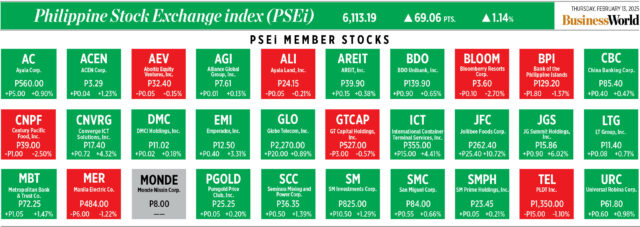
On Thursday, the PSEi rose by 1.14% or 69.06 points to 6,113.19, while the broader all shares index increased by 0.78% or 28.54 points to 3,647.73.

“Right now, the PSEi is still significantly undervalued, trading at 51% discount to historical average. This is actually an opportunity for some of the funds to enter into the market,” she said.

Unicapital said the PSEi also sees a short-term rally during election season, with consumer companies registering a 5% to 10% increase in revenues due to heightened spending.

Meanwhile, Ms. Estacio-Cruz projected that the country’s GDP could grow by 6.3% this year, while the Philippine central bank could slash interest rates by another 50 basis points.

“We see an all-out election spending both on a local and national scale as we move closer to the May midterm elections. This, coupled with easing inflation, will boost household spending and ultimately favor the economy’s growth this year,” Ms. Estacio-Criz said.

“With 2025 being a favorable year for the Philippine economy, Unicapital also believes it is an opportune time for investments. This will further usher the country in its post-pandemic rebound,” she added.

Bank of the Philippine Islands Lead Economist Emilio S. Neri, Jr. said in the same event that external supply shocks for food and oil could impact the country’s growth. — Revin Mikhael D. Ochave

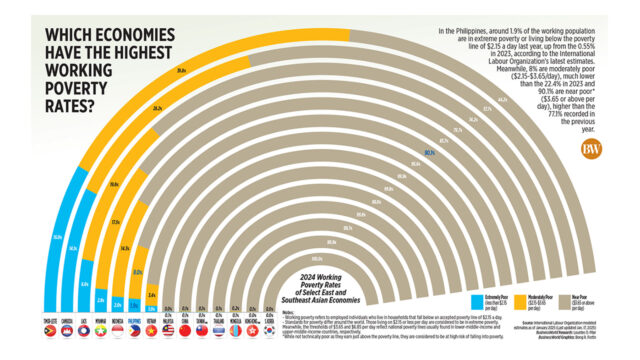
Which economies have the highest working poverty rates?

In the Philippines, around 1.9% of the working population are in extreme poverty or living below the poverty line of $2.15 a day last year, up from the 0.55% in 2023, according to the International Labour Organization’s latest estimates. Meanwhile, 8% are moderately poor ($2.15-$3.65/day), much lower than the 22.4% in 2023 and 90.1% are near poor* ($3.65 or above per day), higher than the 77.1% recorded in the previous year.

Which economies have the highest working poverty rates?

How PSEi member stocks performed — February 13, 2025

Here’s a quick glance at how PSEi stocks fared on Thursday, February 13, 2025.


China urges Philippines to reconsider keeping US Typhon missile system

PHILSTAR FILE PHOTO

By Adrian H. Halili, Reporter

THE PHILIPPINES should “change its course” by reconsidering its plan to keep US Typhon missile launchers, the Chinese Foreign Ministry said.

“We call on the Philippines to change its course and make a strategic choice that truly serves the fundamental interest of itself and its people, rather than staying on the wrong path and hurting the Philippines itself when it comes to issues like Typhon,” Chinese Foreign Ministry spokesperson Guo Jiakun told a news briefing in Beijing late Wednesday.

Mr. Guo said this in response to President Ferdinand R. Marcos, Jr.’s remark that he was willing to pull out the US Typhon missile once China stops its aggression in the South China Sea.

Foreign Affairs spokesperson Ma. Teresita C. Daza did not immediately reply to a WhatsApp message seeking comment.

A United Nations-backed tribunal based in The Hague in 2016 voided China’s claim to more than 80% of the waterway Sea for being illegal. China has ignored the ruling.

Manila and Beijing have repeatedly clashed in the disputed waterway, with both sides accusing each other of raising tensions.

The Typhon missile system was deployed by US forces to the Philippines in April last year as part of their Balikatan or “shoulder-to-shoulder” military exercises. The Philippines had said the deployment was temporary, but they have since remained in the country, drawing the ire of the Chinese government.

“It has breached such commitments, claiming they would acquire its own midrange system and field these deterrent capabilities, and linking the South China Sea issue with the Typhon system,” Mr. Guo said.

He added that the stationing of the Typhon missiles in the Philippines would severely disturb the peace and stability of the region and harm the security of other countries.

“China will not sit idly by when its security interests are harmed or threatened,” Mr. Guo said. “Countries in the region will by no means accept this move that goes against the trend of the times.”

The Philippine Army earlier said the US Typhon missile launchers would not be used for live-fire exercises.

Meanwhile, Philippine Foreign Affairs Secretary Enrique A. Manalo said he would meet with international partners from the UK and Germany to discuss international security issues and seek deeper bilateral ties.

Mr. Manalo would visit Munich and London from Feb 14 to 19, the Department of Foreign Affairs (DFA) said in a statement.

The DFA said that he is expected to exchange views with several international partners on regional developments and discuss means to further strengthen bilateral relations, including the commitment to safeguard a rule-based international order.

He is scheduled to meet with the US secretary of state and the European Commission’s vice-president and high representative for Foreign Affairs and Security Policy on the sidelines of the 61st Munich Security Conference on Feb. 14-16.

The agency added that Mr. Manalo would also participate in a roundtable discussion during the event. “From Munich, the secretary will proceed to London to hold bilateral meetings with UK officials,” it added.

Mr. Manalo is expected to hold separate dialogues with officials from UK-based think tanks Chatham House and Asin House.

INDIAN ARMS DEAL
Meanwhile, India expects to sell short-range missiles to the Philippines this year in a deal worth more than $200 million for New Delhi’s second major defense export contract with Manila, Indian sources told Reuters.

The Akash missile system developed by India’s defense research body has drawn interest from the Philippines, which has told New Delhi it would make an order in the fiscal year that begins in April, said three sources.

All the sources spoke on condition of anonymity because the matter is a sensitive one.

The surface-to-air missile system with a range of up to 25 kilometers was exported to Armenia last year in a $230-million deal, the sources said, adding that the Philippine sale is expected to be bigger than the Armenian deal.

However, they did not reveal the number of missiles and accompanying systems, including radars, involved.

India’s Bharat Dynamics Ltd., the maker of the missiles, was one of the exhibitors at last year’s Asian Defense and Security Exhibition in Manila.

The company and India’s Defense Ministry did not immediately respond to requests for comment.

Arsenio R. Andolong, a Philippine defense spokesman, declined to comment on the specifics of any deal or on procurement plans, but said the country’s armed forces had “manifested it requires these capabilities.”

The expected deal would follow India’s $375-million sale of the mid-range BrahMos supersonic cruise missile to the Philippines in 2022.

The purchase comes at a time when Manila is building its military strength as tension escalates with Beijing on overlapping claims in the busy waterway of the South China Sea, where the two have clashed in recent years.

India is the world’s biggest arms importer but is stepping up domestic production and boosting defense exports to counter China’s military strength and influence in its neighborhood after their troops clashed on the Himalayan border in 2020.

India’s exports of defense equipment, including arms and ammunition, have jumped nearly 150% since 2020 to cross $2.4 billion in the fiscal year that ended in March 2024.

However, its arms exports are lower than those of nations like Australia and South Korea, and far below those of China, the world’s fourth-largest arms exporter.

The Armed Forces of the Philippines chief on Wednesday said the country was looking to buy more military hardware to modernize its arsenal, including additional BrahMos missiles from India and at least two submarines.

“We are getting more of this (BrahMos system) this year, and in the coming years,” General Romeo S. Brawner, Jr. said in a speech to top businessmen in the Philippines, but did not mention the Akash missile system. — with Reuters

Senatorial bets urged to disclose stance on Sara impeachment and trial

VICE-PRESIDENT SARA DUTERTE-CARPIO — FACEBOOK.COM/MAYORINDAYSARADUTERTEOFFICIAL

SENATORIAL CANDIDATES in this year’s midterm elections should disclose their stance on Vice-President Sara Duterte-Carpio’s impeachment, lawmakers said on Thursday.

Candidates’ stance on Ms. Duterte’s looming impeachment trial would reveal how they stand on issues involving corruption and public accountability, they added.

“They should include in their platforms how they intend to decide on those who commit constitutional violations,” Assistant Majority Leader and Taguig Rep. Amparo Maria J. Zamora said in a statement.

“This is a big challenge and litmus test as to how strong the values of our candidates are when it comes to public service,” she added.

The Office of the Vice-President did not immediately reply to an e-mail and Viber message seeking comment.

More than 200 congressmen last week filed and signed an impeachment complaint against Ms. Duterte, more than the one-third vote required by the Constitution for her to be impeached, paving the way for her trial by the Senate.

Filipinos will pick a new set of congressmen and thousands of local officials on May 12, but the key contest will be for 12 spots in the influential 24-seat Senate, which would try the embattled vice-president as an impeachment court.

“Voters should no longer base their preferences on popularity or personality politics,” said Party-list Rep. Ramon Rodrigo L. Gutierrez, a prosecutor-congressman in the impeachment trial.

The senatorial race will feature allies of Mr. Marcos and Ms. Duterte who will become jurors in the Senate impeachment trial. At least 16 senators must vote to convict Ms. Duterte to remove her from office and bar her from running for office in the future.

Mr. Marcos is limited to a single six-year term under the 1987 Constitution and is expected to groom a successor, while Ms. Duterte would be eligible to run in 2028 if she survives the impeachment.

Senators only need to convict Ms. Duterte of one impeachment article for her to be ousted, Manila Rep. Ernesto M. Dionisio, Jr. told a news briefing. “You can file an impeachment complaint with just one article. So, one should be sufficient.”

The ouster charges consisted of seven articles of impeachment, including allegations of plotting the assassination of the President, misusing secret funds, amassing unexplained wealth and committing acts of destabilization.

Ms. Duterte has denied any wrongdoing, including having threatened to get Mr. Marcos assassinated in case she herself was killed. She earlier said her lawyers are busy preparing for her defense.

Prosecutors in Ms. Duterte’s trial should secure her conviction by focusing on the allegations that can be easily proved by documents from state auditors and the Budget department, Neri J. Colmenares, a party-list nominee in the midterm elections, said in a separate statement. — Kenneth Christiane L. Basilio

Comelec on track to finish printing ballots by March

PHILIPPINE STAR/ MICHAEL VARCAS

By Chloe Mari A. Hufana, Reporter

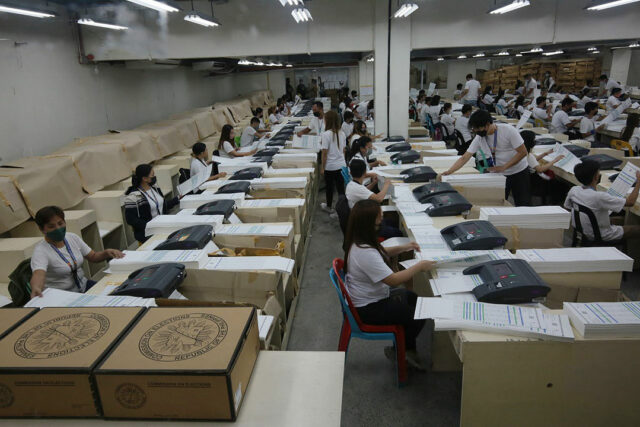
THE Commission on Elections (Comelec) has printed more than 27 million ballots — 36% of the required total — for the May 12 midterm elections, and is on track to finish it by mid-March, its chairman said on Thursday.

Speaking at the newly opened ballot verification satellite office in Amoranto Sports Complex in Quezon City, Comelec Chairman George Erwin M. Garcia said they have exceeded their daily printing targets.

However, verification efforts remain a challenge, prompting an increase in personnel and machines to expedite the process.

He said Comelec has about 260 verification machines at the National Printing Office and about 600 verifiers. Half of them serve the day shift and the other half are assigned to the night shift, he told reporters.

Mr. Garcia said they have 200 machines at the Amoranto verification satellite but plan to increase this to 250.

“This way, we would need around 500 emergency job-order workers to ensure we have a night shift as well,” he said. “But for today, we only have a day shift. As for the night shift, we might start tomorrow.”

Rejected ballots are few, he added, with most defects attributed to printing issues such as smudges and alignment errors. Defective ballots are immediately flagged for reprinting to prevent a shortage at election precincts.

To ensure security and efficiency, Comelec has implemented stringent quality control. Each verified ballot is vacuum-sealed and securely packed to prevent damage.

The agency has also placed replacement voting machines at the municipal level and established 110 repair hubs nationwide.

Comelec also said it would not reprint ballots for withdrawn candidates. Votes for them would instead be considered stray.

Ballot verification is expected to be fast-tracked in the coming weeks and would be completed by April 14, Mr. Garcia said.

The campaign period for senatorial and party list candidates started on Feb. 11, while local bets will start their campaign on March 28.

Up for grabs in the May 12 elections are 317 congressional seats and thousands of local posts. The biggest battle will be for 12 spots in the 24-seat Senate, a chamber packed with political heavyweights and wielding outsized influence.

Immigration bureau told to hasten deportation of foreign POGO workers

PHILIPPINE STAR/RYAN BALDEMOR

A PHILIPPINE senator on Thursday called on the Bureau of Immigration (BI) to fast-track the deportation of foreign nationals apprehended due to their involvement in Philippine offshore gaming operators (POGOs).

“I’ll give (the BI) a deadline in two weeks do something about it… I want them accounted for and they are deported before the end of the month,” Senator Rafael T. Tulfo told a Senate hearing.

Mr. Tulfo said that the 438 foreign nationals allegedly involved in POGOs should immediately be deported.

BI legal division Chief Arvin Cesar G. Santos said that the agency would comply with the deadline and “submit an official report to the Senate committee.”

According to the Philippine Amusement and Gaming Corporation, there were 42 internet gaming licensees, seven content providers, and 11 support providers that were shut down, as of Dec. 31.

A Senate Committee report, however, found that illegal financial activities and scam hubs have persisted despite moves to outlaw POGOs. The report also said that public officials were also involved in facilitating crimes, from human trafficking to money laundering.

President Ferdinand R. Marcos, Jr. Issued last year an executive order, banning POGOs due to their links to organized crime, such as human trafficking. This is in line with his policy directives during his third State of the Nation Address to shut down POGOs by the end of 2024.

In the same hearing, Senator Mark A. Villar raised concern over the potential involvement of government agencies in running these illegal operations.

“Some of their fake documents were marriage certificates, birth certificates and passports of foreign nationals using Filipino names. These illegal agencies that issue fake documents are sure to have connections with various government agencies,” Mr. Villar added.

He said that these agencies might be accomplices in the issuance of fake documents to foreign POGOs.

“We need to look at the angle that there is an inside job. This is the possible reason for the continued entry of foreign nationals into the Philippines using fake documents,” he added. — Adrian H. Halili

LPA monitored outside PAR

PAGASA.DOST.GOV.PH

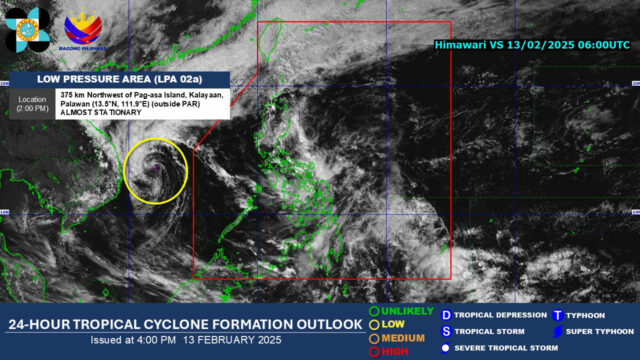
THE STATE weather bureau on Thursday said a low pressure area (LPA) that it is monitoring outside the Philippines’ area of responsibility (PAR) had a low chance of developing into a tropical depression.

The LPA was last located 370 kilometers northwest of Pag-asa Island in Kalayaan, Palawan at 8 a.m. on Thursday, the Philippine Atmospheric, Geophysical and Astronomical Services Administration (PAGASA) said in a report.

It has a low chance of developing into a tropical depression within the next 24 hours, it added.

PAGASA is also monitoring the shear line affecting Northern Luzon, and the Intertropical Convergence Zone (ITCZ), which is influencing the weather in Mindanao.

It said the shear line may cause cloudy skies with scattered rain and isolated thunderstorms in Batanes and the Babuyan Islands.

PAGASA flagged possible flash floods or landslides.

It said the ITCZ may result in cloudy skies with scattered rain and thunderstorms in Caraga, the Davao Region, Camiguin, Misamis Oriental, and Bukidnon. It also flagged possible flash floods or landslides. 

Meanwhile, PAGASA said the Visayas, Bicol Region, and Romblon may experience cloudy skies with scattered rain and thunderstorms due to the easterlies.

Easterlies could also cause partly cloudy to cloudy skies with thunderstorms in Metro Manila and other parts of the country. — Kyle Aristophere T. Atienza

NOLCOM joins US, Canada drills

BAGUIO CITY — Naval forces attached to the Northern Luzon Command (NOLCOM), joined last Wednesday’s 7th Multilateral Maritime Cooperative Activity (MMCA) off the waters of Northern Luzon.

The Naval Forces Northern Luzon (NFNL), which operates under NOLCOM’s operational control, served as the participating unit representing the Philippine Navy alongside maritime forces from the United States and Canada, said Army Major Al Anthony B. Pueblas, spokesman of the NOLCOM.

The maritime exercises sought to strengthen coordination, improve cooperation, and enhance maritime security among our American and Canadian counterparts, said NOLCOM chief Lt. Gen. Fernyl G. Buca.

NOLCOM, through the NFNL deployed BRP Andres Bonifacio (PS17) and Beechcraft King Air (NV394) in the Division Tactics, Anti-Submarine Warfare, and Communication Exercises, to improve operational readiness.

Mr. Buca explained “NOLCOM’s participation in the 7th MMCA reinforces our commitment to protecting our maritime territory, securing our sovereign rights, and working with our allies to promote regional stability.” — Artemio A. Dumlao

PCO’s Chavez on leave, appoints OIC

EMERALD ANNE R. RIDAO — PCO.GOV.PH

PRESIDENTIAL COMMUNICATIONS Office (PCO) Senior Undersecretary Emerald Anne R. Ridao has been appointed officer-in-charge (OIC) of the agency while acting Secretary Cesar B. Chavez is on leave, according to the agency.

In a special order dated Feb. 12, Mr. Chavez said the undersecretary will take care of the “day-to-day operations” of the agency from Feb. 17 to 21.

He said in a separate Viber message to reporters that he will try to work at “full capacity” while on leave. The acting PCO chief did not give a reason why he was going on leave.

Philippine President Ferdinand R. Marcos, Jr. appointed Mr. Chavez, who was also a senior undersecretary at the time, as acting PCO chief in September. — John Victor D. Ordoñez

Peso strengthens vs dollar

BW FILE PHOTO

THE PESO strengthened against the dollar on Thursday on news of potential Ukraine-Russia peace talks and as the Bangko Sentral ng Pilipinas (BSP) paused its rate-cut cycle.

The local unit closed at P58.06 versus the greenback on Thursday, climbing by 13 centavos from its P58.19 finish on Wednesday, Bankers Association of the Philippines data showed.

The peso opened Thursday’s session weaker at P58.25 against the dollar. It traded within a wide range as intraday best was at P58.02, while its worst showing was at P58.34 versus the greenback.

Dollars exchanged rose to $1.64 billion on Thursday from $1.24 billion on Wednesday.

“The dollar-peso initially traded higher on growing bets that the Federal Reserve will lessen cutting interest rates on the wheels of the higher CPI (consumer price index) print, but was lower in the afternoon after news of Trump and Putin agreeing to negotiate ending the war in Ukraine,” a trader said in a phone interview.

The dollar weakened due to lower global crude oil prices on news of potential Ukraine peace talks, Rizal Commercial Banking Corp. Chief Economist Michael L. Ricafort likewise said in a Viber message.

US President Donald J. Trump said both Russian President Vladimir Putin and Ukrainian President Volodymyr Zelensky expressed a desire for peace in separate phone calls with him on Wednesday, and Mr. Trump ordered top US officials to begin talks on ending the war in Ukraine, Reuters reported.

The conversations came after Mr. Trump’s Defense secretary earlier said Kyiv would have to give up its long-held goals of joining the NATO military alliance and regaining all of its territory seized by Russia, signaling a dramatic shift in Washington’s approach to the conflict.

In the foreign exchange market, the dollar lost 0.2% to 154.15 yen, having jumped 1.3% overnight following the US CPI data.

US consumer prices rose by the most in nearly 1-1/2 years in January. The closely watched core inflation index, which excludes food and energy prices, rose 0.4% in the month, above forecasts for 0.3%.

With the Federal Reserve already signaling no rush to cut rates further, investors scaled back expectations of more policy easing this year to just 28 basis points (bps), equivalent to just one cut.

“In addition to that, the BSP shocked the market as they expected a cut but they opted to hold key rates in their meeting, which is why the peso reached its high of P58.02,” the trader said.

The Monetary Board on Thursday kept its target reverse repurchase rate unchanged at 5.75%, contrary to market expectations of a 25-bp cut.

The pause came following three consecutive 25-bp reductions since the BSP began its easing cycle in August 2024.

“The Monetary Board noted that domestic growth prospects continue to be firm. However, uncertainty over global economic policies and their impact on the domestic economy has increased significantly,” BSP Governor Eli M. Remolona, Jr. said.

For Friday, the trader expects the peso to move between P57.90 and P58.30 per dollar, while Mr. Ricafort sees it ranging from P57.95 to P58.15. — A.M.C. Sy with Reuters