Home Blog Page 1465

Intense Russian drone attack on Kharkiv kills 2, injures 54, Ukraine says

Army soldier figurines are displayed in front of the Ukrainian and Russian flag colors background in this illustration taken, Feb. 13, 2022. — REUTERS/DADO RUVIC/ILLUSTRATION

KHARKIV, June 11 (Reuters) – A nine-minute-long Russian drone attack on Ukraine’s second largest city of Kharkiv in the middle of the night killed at least two people and injured 54, including five children, regional officials said on Wednesday.

The intense strikes with 17 drones sparked fires in 15 units of a five-storey apartment building and caused other damage in the city close to the Russian border, Kharkiv Mayor Ihor Terekhov said.

“There are direct hits on multi-storey buildings, private homes, playgrounds, enterprises and public transport,” Terekhov said on the Telegram messaging app.

“Apartments are burning, roofs are destroyed, cars are burnt, windows are broken.”

A Reuters witness saw emergency rescuers helping to carry people out of damaged buildings, administering care and firefighters battling blazes in the dark.

Nine of the injured, including a 2-year-old girl and a 15-year-old boy, have been hospitalised, Oleh Sinehubov, the governor of the broader Kharkiv region, said on Telegram.

He added that the strikes hit also a city trolley bus depot and several residential buildings.

There was no immediate comment from Russia. Kharkiv, in Ukraine’s northeast, withstood Russian full-scale advance in the early days of the war and has since been a frequent target of drone, missile, and guided aerial bomb assaults.

The attack followed Russia’s two biggest assaults of the war on Ukraine this week, a part of intensified bombardments that Moscow said were retaliatory measures for Kyiv’s recent attacks in Russia.

Both sides deny targeting civilians in the war that Russia launched on its smaller neighbour in February 2022. But thousands of civilians have died in the conflict, the vast majority of them Ukrainian.

“We are holding on. We are helping each other. And we will definitely survive,” Terekhov said. “Kharkiv is Ukraine. And it cannot be broken.” — Reuters

Trump tariffs may remain in effect while appeals proceed, US appeals court rules

REUTERS

A federal appeals court allowed President Donald Trump’s most sweeping tariffs to remain in effect on Tuesday while it reviews a lower-court decision blocking them on grounds that he had exceeded his authority by imposing them.

The decision by the U.S. Court of Appeals for the Federal Circuit in Washington, D.C. means Mr. Trump may continue to enforce, for now, his “Liberation Day” tariffs on imports from most U.S. trading partners, as well as a separate set of tariffs levied on Canada, China and Mexico.

The appeals court has yet to rule on whether the tariffs are permissible under an emergency economic powers act that Mr. Trump cited to justify them, but it allowed the duties to remain in place while the appeals play out.

The Federal Circuit said the litigation raised issues of “exceptional importance” warranting the court to take the rare step of having the 11-member court hear the appeal, rather than have it go before a three-judge panel first. It scheduled arguments for July 31.

The tariffs, used by Mr. Trump as negotiating leverage with U.S. trading partners, and their on-again, off-again nature, have shocked markets and whipsawed companies of all sizes as they seek to manage supply chains, production, staffing and prices.

The ruling has no impact on other tariffs levied under more traditional legal authority, such as duties on steel and aluminum imports.

A three-judge panel of the U.S. Court of International Trade ruled on May 28 that the U.S. Constitution gave Congress, not the president, the power to levy taxes and tariffs, and that the president had exceeded his authority by invoking the International Emergency Economic Powers Act, a law intended to address “unusual and extraordinary” threats during national emergencies.

The Trump administration quickly appealed the ruling, and the Federal Circuit in Washington put the lower court decision on hold the next day while it considered whether to impose a longer-term pause.

The May 28 ruling came in a pair of lawsuits, one filed by the nonpartisan Liberty Justice Center on behalf of five small U.S. businesses that import goods from countries targeted by the duties, and the other by 12 U.S. states led by Oregon.

Jeffrey Schwab, an attorney for the small businesses that sued, said Tuesday’s federal appeals court decision was disappointing, but it did not mean that the Trump administration would win in the end.

“It’s important to note that every court to rule on the merits so far has found these tariffs unlawful, and we have faith that this court will likewise see what is plain as day: that IEEPA does not allow the president to impose whatever tax he wants whenever he wants,” Mr. Schwab said Tuesday.

The White House and state of Oregon did not immediately respond to requests for comment after normal business hours on Tuesday.

Mr. Trump has claimed broad authority to set tariffs under IEEPA. The 1977 law has historically been used to impose sanctions on enemies of the U.S. or freeze their assets. Mr. Trump is the first U.S. president to use it to impose tariffs.

Mr. Trump has said that the tariffs imposed in February on Canada, China and Mexico were to fight illegal fentanyl trafficking at U.S. borders, denied by the three countries, and that the across-the-board tariffs on all U.S. trading partners imposed in April were a response to the U.S. trade deficit.

The states and small businesses had argued the tariffs were not a legal or appropriate way to address those matters, and the small businesses argued that the decades-long U.S. practice of buying more goods than it exports does not qualify as an emergency that would trigger IEEPA.

At least five other court cases have challenged the tariffs justified under the emergency economic powers act, including other small businesses and the state of California. One of those cases, in federal court in Washington, D.C., also resulted in an initial ruling against the tariffs, and no court has yet backed the unlimited emergency tariff authority Mr. Trump has claimed. — Reuters

Tesla’s public robotaxi rides set for tentative June 22 start, CEO Musk says

MILAN CSIZMADIA-UNSPLASH

SAN FRANCISCO – Tesla tentatively plans to begin offering rides on its self-driving robotaxis to the public on June 22, CEO Elon Musk said on Tuesday, as investors and fans of the electric vehicle maker eagerly await rollout of the long-promised service.

Mr. Musk has staked Tesla’s future on self-driving vehicles, pivoting away from plans to build a cheaper EV platform, and much of the company’s valuation hangs on that vision.

But commercializing autonomous vehicles has been challenging with safety concerns, tight regulations and soaring investments, and many have been skeptical of Mr. Musk’s plans.

“We are being super paranoid about safety, so the date could shift,” Mr. Musk said in a post on X. — Reuters

World Bank cuts global growth forecast as trade tensions heighten uncertainty

REUTERS

WASHINGTON – The World Bank on Tuesday slashed its global growth forecast for 2025 by four-tenths of a percentage point to 2.3%, saying that higher tariffs and heightened uncertainty posed a “significant headwind” for nearly all economies.

In its twice-yearly Global Economic Prospects report, the global lender lowered its forecasts for nearly 70% of all economies – including the US, China and Europe, as well as six emerging market regions – from the levels it projected six months ago before US President Donald Trump took office.

Trump has upended global trade with a series of on-again, off-again tariff hikes that have increased the effective US tariff rate from below 3% to the mid-teens – its highest level in almost a century – and triggered retaliation by China and other countries.

The World Bank is the latest body to cut its growth forecast as a result of Trump’s erratic trade policies, although US officials insist the negative consequences will be offset by a surge in investment and still-to-be approved tax cuts.

It stopped short of forecasting a recession, but said global economic growth this year would be the weakest outside of a recession since 2008. By 2027, global gross domestic product growth was expected to average just 2.5%, the slowest pace of any decade since the 1960s.

The report forecast that global trade would grow by 1.8% in 2025, down from 3.4% in 2024 and roughly a third of its 5.9% level in the 2000s. The forecast is based on tariffs in effect as of late May, including a 10% US tariff on imports from most countries. It excludes increases that were announced by Trump in April and then postponed until July 9 to allow for negotiations.

The World Bank said global inflation was expected to reach 2.9% in 2025, remaining above pre-COVID-19 levels, given tariff increases and tight labor markets.

“Risks to the global outlook remain tilted decidedly to the downside,” it wrote. The lender said its models showed that a further increase of 10 percentage points in average US tariffs, on top of the 10% rate already implemented, and proportional retaliation by other countries, could shave another half of a percentage point off the outlook for 2025.

Such an escalation in trade barriers would result “in global trade seizing up in the second half of this year … accompanied by a widespread collapse in confidence, surging uncertainty and turmoil in financial markets,” the report said.

Nonetheless, it said the risk of a global recession was less than 10%.

‘FOG ON A RUNWAY’

Top officials from the US and China are meeting in London this week to try to defuse a trade dispute that has widened from tariffs to restrictions over rare earth minerals, threatening a global supply chain shock and slower growth.

“Uncertainty remains a powerful drag, like fog on a runway. It slows investment and clouds the outlook,” World Bank Deputy Chief Economist Ayhan Kose told Reuters in an interview.

But Kose said there were signs of increased dialogue on trade that could help dispel uncertainty, and supply chains were adapting to a new global trade map, not collapsing. Global trade growth could modestly rebound in 2026 to 2.4%, and developments in artificial intelligence could also boost growth, he said.

“We think that eventually the uncertainty will decline,” Kose said. “Once the type of fog we have lifts, the trade engine may start running again, but at a slower pace.”

Kose said while things could get worse, trade was continuing and China, India and others were still delivering robust growth. Many countries were also discussing new trade partnerships that could pay dividends later, he said.

WHITE HOUSE PUSHES BACK

The World Bank said the global outlook had “deteriorated substantially” since January, mainly due to advanced economies, which are now seen growing by just 1.2%, down half a percentage point, after expanding by 1.7% in 2024.

The US forecast was slashed by nine-tenths of a percentage point from its January forecast to 1.4%, and the 2026 outlook was lowered by four-tenths of a percentage point to 1.6%. Rising trade barriers, “record-high uncertainty” and a spike in financial market volatility were expected to weigh on private consumption, trade and investment, it said.

The White House pushed back against the forecast, citing recent economic data that it said pointed to a stronger economy.

“The World Bank’s prognostications are untethered to the data: investment in real business equipment surged by nearly 25% in Q1 of 2025; real disposable personal income grew by a robust 0.7% month-over-month in April; and Americans have now seen three consecutive expectation-beating jobs and inflation reports,” White House spokesperson Kush Desai said. He added that a sweeping budget package currently making its way through Congress would provide tax relief and “further turbo-charge America’s economic resurgence under President Trump.”

The World Bank cut growth estimates in the euro zone by three-tenths of a percentage point to 0.7% and in Japan by half a percentage point to 0.7%.

It said emerging markets and developing economies were expected to grow by 3.8% in 2025 versus 4.1% in the forecast in January.

Poor countries would suffer the most, the report said. By 2027, developing economies’ per capita GDP would be 6% below pre-pandemic levels, and it could take these countries – minus China – two decades to recoup the economic losses of the 2020s.

Mexico, heavily dependent on trade with the US, saw its growth forecast cut by 1.3 percentage points to 0.2% in 2025.

The World Bank left its forecast for China unchanged at 4.5% from January, saying Beijing still had monetary and fiscal space to support its economy and stimulate growth. — Reuters

US, China reach framework deal to ease export restrictions

REUTERS

LONDON – U.S. and Chinese officials agreed on a framework to put their trade truce back on track and resolve China’s export restrictions on rare earth minerals and magnets, U.S. Commerce Secretary Howard Lutnick said on Tuesday at the conclusion of two days of intense negotiations in London.

Mr. Lutnick told reporters that the framework puts “meat on the bones” of a deal reached last month in Geneva to ease retaliatory tariffs that had faltered over China’s curbs on critical minerals exports. The deal also will remove some U.S. export restrictions that were recently put in place, he said.

“We have reached a framework to implement the Geneva consensus and the call between the two presidents,” Mr. Lutnick said. “The idea is we’re going to go back and speak to President Trump and make sure he approves it. They’re going to go back and speak to President Xi and make sure he approves it, and if that is approved, we will then implement the framework.”

The top U.S. and Chinese economic officials were pushing for a deal that would ease dueling export controls that had threatened to unravel the Geneva accord that cut tariffs back from triple-digit levels.

In a separate briefing, China’s Vice Commerce Minister Li Chenggang also said a trade framework had been reached that would be taken back to U.S. and Chinese leaders.

“The two sides have, in principle, reached a framework for implementing the consensus reached by the two heads of state during the phone call on June 5th and the consensus reached at the Geneva meeting,” Mr. Li told reporters.

Mr. Lutnick said China’s restrictions on exports of rare earth minerals and magnets to the U.S. will be resolved as a “fundamental” part of the framework agreement.

“Also, there were a number of measures the United States of America put on when those rare earths were not coming,” Mr. Lutnick said. “You should expect those to come off, sort of as President Trump said, in a balanced way.” — Reuters

Trump tells soldiers ‘we will liberate Los Angeles’

REUTERS

FORT BRAGG, North Carolina – President Donald Trump used a speech honoring soldiers on Tuesday to defend his decision to deploy troops to Los Angeles in a confrontation over his immigration policy, a move critics have decried as a politically motivated over-reaction.

“Generations of Army heroes did not shed their blood on distant shores only to watch our country be destroyed by invasion and third-world lawlessness,” Mr. Trump told soldiers at the Army base in Fort Bragg, North Carolina.

“What you’re witnessing in California is a full-blown assault on peace, on public order and on national sovereignty, carried out by rioters bearing foreign flags,” Mr. Trump said, adding his administration would “liberate Los Angeles.”

Mr. Trump’s visit to Fort Bragg, home to some 50,000 active-duty soldiers, followed his move to deploy 700 Marines and 4,000 National Guard troops to Los Angeles in an escalating response to street protests over his immigration policies.

The Republican president said the military deployment was needed to protect federal property and personnel. California’s Democratic-led government has sued to block Mr. Trump’s move, calling it an abuse of power and an unnecessary provocation.

Street demonstrations have been underway since Friday, when activists clashed with sheriff’s deputies. Los Angeles officials have said the unrest has been limited to a few downtown blocks and that the majority of demonstrators are protesting peacefully in support of immigrants.

In North Carolina, Mr. Trump and Defense Secretary Pete Hegseth took part in long-scheduled commemorations of the U.S. Army’s 250th anniversary, watching soldiers demonstrate a special forces assault and use a long-range missile launcher.

It was the first in a series of celebrations of the Army anniversary involving Mr. Trump, ahead of a major parade in Washington on Saturday.

Speaking to reporters earlier on Tuesday in the Oval Office, Mr. Trump warned against demonstrators at that parade, saying “they’re going to be met with very big force.” He made no distinction between peaceful and violent protesters. The FBI and the Metropolitan Police Department have said there are no credible threats to the event.

POMP AND POLITICS

The week’s Army commemorations combine Mr. Trump’s penchant for patriotic pomp and his political positioning as a law-and-order president. Saturday’s celebrations in Washington include thousands of troops, dozens of military aircraft and coincide with Trump’s 79th birthday.

The Army was established on June 14, 1775, more than a year before the Declaration of Independence.

During his speech at Fort Bragg, Mr. Trump led a crowd filled with traditionally non-partisan service members through punchlines he repeats at political rallies. He drew jeers directed at the press corps and cheers for attacks on efforts to embrace transgender service members.

He also announced that the military would rename a number of bases which were changed after racial justice protests in 2023, including reverting to Fort Lee, which was originally named after Civil War-era Confederate commander Robert E. Lee.

Earlier this year, Mr. Trump restored the name Fort Bragg to the base, one of the largest in the world, despite a federal law that prohibits honoring generals who fought for the South during the Civil War. His administration says the name now honors a different Bragg – Private First Class Roland Bragg, who served during World War Two. In 2023, the base had been renamed Fort Liberty.

Since launching his second term in office in January, Mr. Trump has made the military a focus of his efforts. The president’s cost-cutting government reforms have largely spared the Defense Department’s nearly $1 trillion annual budget. He has pledged to avoid international conflict while launching new weapons programs and increasing the use of the military domestically, including in immigration enforcement.

Mr. Trump has pledged to deport record numbers of people who are in the country illegally and to lock down the U.S.-Mexico border, setting the ICE border enforcement agency a daily goal of arresting at least 3,000 migrants.

Demonstrators in Los Angeles have assembled, among other places, at a government facility where immigrants are detained.

Though military forces have been deployed domestically for major disasters such as Hurricane Katrina and the attacks of September 11, 2001, it is rare for troops to be used domestically during civil disturbances.

Even without declaring an insurrection, however, Mr. Trump can deploy Marines under certain conditions of law or under his authority as commander in chief.

The last time the military was used for direct police action under the Insurrection Act was in 1992, when the California governor at the time asked President George H.W. Bush to help respond to Los Angeles riots over the acquittal of police officers who beat Black motorist Rodney King. — Reuters

A service that feels like home

“In the bustling hospitality sector of Batangas, Cecille and Nelson Terrible, owners of Club Balai Isabel, shared that the resort distinguishes itself by offering a service that feels like home.

Interview by Edg Adrian Eva
Video editing by Arjale Queral

Philippine Senate returns VP impeachment case to lower house hours after convening trial

VICE-PRESIDENT SARA DUTERTE-CARPIO FACEBOOK PAGE PHOTO

MANILA – Philippine senators on Tuesday voted to return an impeachment case against Vice President Sara Duterte to the lower house to clarify its constitutionality, in a surprise move just hours after convening a trial that could end her political career.

After heated debates among members that included efforts by a Duterte ally to dismiss the case, the senators agreed not to terminate the trial, but first send it back to the lower house to certify that its handling of the process had been lawful.

The impeachment of the daughter of firebrand former President Rodrigo Duterte follows an acrimonious falling out last year with President Ferdinand Marcos Jr, with whom she ran on a joint ticket that won the 2022 election in a landslide.

The Senate’s late-night move could provide a lifebuoy for presidential contender Duterte in her make-or-break trial and impact the policy agenda and succession plans of former ally Marcos.

Marcos is limited to a single term in office and has created a powerful enemy in Duterte. He is expected to try to retain influence and protect his legacy by grooming a successor capable of fending off his rival in the next election should she be acquitted.

“I think we have upheld our oath to be politically neutral,” said Senator Alan Peter Cayetano, a Duterte loyalist who presented the motion to return the case to the House of Representatives.

The lower house in February voted to impeach the vice president for high crimes and betrayal of the public trust, alleging budget irregularities, amassing of unusual wealth and a threat to the lives of Marcos, his wife, and the house speaker. She has denied all allegations.

FIERCE DEBATE

The unprecedented move by the Senate could add fuel to fierce public debate on what is already an emotionally charged issue in the Philippines, with the specter of discord in the bicameral legislature and more legal action to try to dismiss the case against the popular Duterte.

The trial will officially proceed, according to senators, who issued a summons to Duterte to respond to the charges, despite sending the case back to the lower house until a time when a Congress newly-formed after last month’s midterm elections is “willing and ready” to pursue the impeachment complaint.

Duterte will have 10 days to comply. A new Congress will convene at the end of July.

Duterte’s office late on Tuesday reiterated an earlier statement that said she was ready to “expose the baselessness of the accusations”.

“The impeachment process must never be weaponized to harass, silence, or eliminate political opponents,” it said.

The president’s office did not immediately respond to a request for comment on the Senate’s move. Marcos has distanced himself from the impeachment, even though it was launched by his legislative allies.

Duterte is the fifth top official in the Philippines to be impeached, only one of whom, Renato Corona, a former Supreme Court chief justice, was convicted.

The trial of former President Joseph Estrada was aborted in 2001 after some prosecutors walked out, while an election commission chief and an ombudsman both resigned following their impeachments.

Both the vice president and a group of pro-Duterte lawyers have separately petitioned the Supreme Court to nullify the impeachment complaint.

Makabayan, a minority bloc of left-wing lawmakers, said the senators had abdicated their constitutional duty in a “legally baseless” decision.

“This brazen move represents a dangerous departure from constitutional procedure and sets a perilous precedent that undermines impeachment as a means for exacting accountability from the highest officials,” it said. — Reuters

FDI net inflows slump to 3-month low

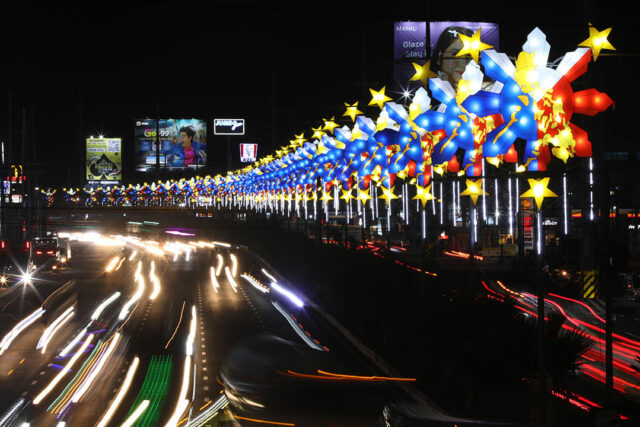
LANTERNS inspired by the Philippine flag line the street in San Fernando, Pampanga. Net inflows of foreign direct investment into the Philippines dropped to a three-month low in March. — PHILIPPINE STAR/WALTER BOLLOZOS

NET INFLOWS of foreign direct investments (FDI) fell to a three-month low in March, with first-quarter inflows also dropping by more than 40% year on year, amid heightened global uncertainty arising from the US tariff policies.

Preliminary data from the Bangko Sentral ng Pilipinas (BSP) showed that FDI net inflows declined by 27.8% to $498 million in March from $689 million in the same month a year ago.

Net Foreign Direct InvestmentThis was the lowest FDI level in three months or since the $110-million inflow posted in December.

“The said decline resulted from lower net inflows across all major FDI components,” the BSP said.

Nonresidents’ net investments in debt instruments of local affiliates plunged by 31.6% to $329 million in March from $481 million in the same month in 2024.

Nonresidents’ net investments in equity capital, other than the reinvestment of earnings, declined by 27.4% to $102 million from $141 million year on year.

This came as equity capital placements dropped by 5.5% to $148 million. On the other hand, withdrawals nearly tripled (185.1%) to $46 million.

Equity placements in March mostly came from Singapore (25%), Japan (24%) and the United States (20%), as well as South Korea (9%) and Malaysia (5%).

“These were infused largely to the real estate; manufacturing; financial and insurance; and administrative and support services industries,” the central bank said.

Reinvestment of earnings dipped by 1.2% to $66 million in March from $67 million a year ago.

Investments in equity and investment fund shares fell by 19% to $168 million in March from $208 million a year earlier.

FIRST-QUARTER SLIDE
In the first quarter, FDI net inflows plunged by 41.1% to $1.76 billion from $2.99 billion in the comparable year-ago period.

Net investments in debt instruments dropped by 35.3% to $1.2 billion in the period ending March from $1.85 billion a year ago.

Investments in equity capital other than the reinvestment of earnings plummeted by 66.7% to $298 million in the January-March period from $894 million in the previous year.

Equity placements declined by 64.4% year on year to $397 million while withdrawals fell by 54.8% to $99 million.

These placements were mainly from Japan (42%), followed by the United States (17%), Singapore (14%), and Malaysia and Singapore (both at 6% each).

Nearly half (47%) of these were invested in the manufacturing sector, followed by real estate (22%) and the financial and insurance (13%) sectors.

On the other hand, nonresidents’ reinvestment of earnings rose by 8.8% to $264 million from $242 million.

“The decline in FDI is among the different indicators, along with increasing debt and rising unemployment, that show the gradually decreasing economic growth in the country,” Leonardo A. Lanzona, an economics professor at the Ateneo de Manila University, said.

In the first quarter, the Philippine economy grew by a weaker-than-anticipated 5.4%, well below the government’s 6-8% target for the year.

Gross capital formation, the investment component of the economy, grew by 4% in the first quarter, slowing from the 5.5% seen in the fourth quarter.

“The truth of the matter is the country’s growth is only dependent on its remittances and consumption. Hence, if global conditions remain poor, we will not be expecting FDIs to come in,” Mr. Lanzona added.

John Paolo R. Rivera, a senior research fellow at the Philippine Institute for Development Studies, said the drop in FDI is due to a combination of global and domestic headwinds.

“Externally, rising geopolitical tensions, high interest rates in developed markets, and global trade uncertainties especially from US tariff actions continue to dampen cross-border investments,” he said.

Rizal Commercial Banking Corp. Chief Economist Michael L. Ricafort noted the US government’s tariff policies have led investors to adopt a wait-and-see stance on investments.

US President Donald J. Trump had started making tariff threats since he assumed office in late January. However, it was only in early April that he announced a baseline 10% tariff on all its trading partners, as well as higher reciprocal tariffs on most of its trading partners. The so-called reciprocal tariffs are suspended until July.

Domestically, Mr. Rivera said investors were likely more cautious in the first quarter and are now awaiting more clarity on “policy direction, post-election stability, and economic strategy execution in medium to long term.”

“Internally, the Philippines is contending with political noise, investor concerns over regulatory predictability, and slow progress in structural reforms that are necessary to boost long-term investor confidence.”

For the coming months, Mr. Ricafort said the full implementation of the Corporate Recovery and Tax Incentives for Enterprises to Maximize Opportunities for Reinvigorating the Economy Act could entice investors.

“Some foreign investors could have also waited for Fed and BSP rates to go down further before becoming more aggressive to finance more FDIs,” he added.

BSP Governor Eli M. Remolona, Jr. has signaled further easing this year, possibly through two more 25-basis-point (bp) rate cuts. He said a rate cut is also still on the table at the Monetary Board’s policy review on June 19.

The BSP’s FDI data differ from the investment data of other government sources as they cover actual investment flows, it said.

The approved foreign investments data published by the Philippine Statistics Authority are sourced from investment promotion agencies and represent investment commitments that may not be fully realized in a given period. — Luisa Maria Jacinta C. Jocson


Philippine IT-BPM industry expected to outpace global growth

BW FILE PHOTO

By Justine Irish D. Tabile, Reporter

THE GROWTH of the Philippine information technology and business process management (IT-BPM) industry this year is expected to outpace the global average in terms of job generation and export revenues, an industry group said.

“We have grown to 1.82 million in 2024 and will hit 1.9 million by the end of 2025. So, we are closing in on the 2-million mark. What we will also hit in 2025 is $40 billion in export revenue,” IT & Business Process Association of the Philippines (IBPAP) President and Chief Executive Officer Jonathan R. Madrid said at a press briefing late on Monday.

“That is a growth of 5% over last year and 4% in jobs over the previous year. Growth is always good news but considering that the global growth of our industry only grew 3%, it shows that yet again the Philippines is leading the growth of the industry,” he added.

These numbers, he said, are the recalibrated targets for the year but are below the industry’s aggressive targets under the IT-BPM Industry Roadmap 2028.

“We are exceeding our baseline targets, but we are slightly below our aggressive targets,” Mr. Madrid said.

When setting the targets, he said that the industry considers the changing work types, availability of talent, and ease of doing business.

“This industry is no longer about cost optimization. It is about the availability of the talent, ease of doing business, and balancing where you give the work. Because investors cannot put all their work in one place, there has to be diversification,” he said.

“So, being such a leader, together with India, the issue of overconcentration has become a topic, and so we really need to address those other issues so that we can maintain our market share,” he added.

According to IBPAP officials, the industry continues to face challenges at the local government unit (LGU) level despite the implementation of the Corporate Recovery and Tax Incentives for Enterprises to Maximize Opportunities for Reinvigorating the Economy (CREATE MORE) Act and its implementing rules and regulations (IRR).

“With the passage of CREATE MORE, we hope that problems with LGUs and the Bureau of Internal Revenue will have been addressed,” said IBPAP Chief Operating Officer Celeste B. Ilagan.

“But we see that even with the issuance of the IRR, some of our members still encounter problems with certain LGUs. And it really revolves around how the LGUs interpret the provisions of CREATE MORE in terms of incentives that enterprises are entitled to,” she added.

To resolve this, she said that the Department of Trade and Industry, the Department of Finance, and the Department of the Interior and Local Government are planning to issue a joint memorandum circular (JMC) that will specify how the LGUs should interpret CREATE MORE.

“We have seen a draft of that JMC that has done the rounds of consultation. We know that there’s one more consultation in the province before they are able to pass that JMC,” she said.

“That will specify what the LGUs should follow in terms of imposing fees and charges, what requirements there are for business permits, all of that,” she added.

Ms. Ilagan said these challenges are being experienced by existing enterprises, as new investors are still checking out which cities they should set up shop.

Meanwhile, Mr. Madrid said there are opportunities for growth in global capability centers (GCC).

“I am happy to say that every week our office is visited by locators and investors who want to expand their footprint in the Philippines and are considering setting up operations in the Philippines,” he said.

“Much of the growth and interest comes from GCC; these are companies like JPMorgan and HSBC. I think this is a sector that we need to focus on because these tend to offer higher value-added jobs,” he added.

For instance, Mr. Madrid noted that India has seen an increase of 100 GCCs per annum, with its entire GCC industry already as big as the entire Philippine IT-BPM industry.

“I think we should really emphasize and focus on growing GCCs. As it is, we only have 150 GCCs in the country. I think the potential is much more,” he said.

“I think there is an opportunity to grow our presence in the GCCs. And I think this is important because the revenue per employee in GCC is much higher than the broader industry,” he added.

To date, the industry has 250,000 employees in GCCs led by banking and financial, insurance, and healthcare services. The GCCs accounted for $8 billion, or 20% of the total industry revenues last year.

Also, Mr. Madrid said that there has been a rise in employment in the countryside mostly because cities in the provinces do not have the same kind of public commuting issues faced by workers in Metro Manila.

“The countryside is a bright spot for the industry. Before COVID, we were only 25% outside Metro Manila. Today, we are at 32% of a bigger base,” he said.

“And according to our roadmap projections, we see that growing to 40% by 2028. Congestion in Metro Manila is an issue, so the countryside helps to decongest that,” he added.

However, he said that revenues are still higher in Metro Manila, as most of the GCCs are located in Metro Manila and Cebu.

SEC chief wants GOCCs to list on stock market

FRANCISCO Ed. Lim assumed his post as the chairperson of the Securities and Exchange Commission (SEC) on Tuesday. — COURTESY OF THE SECURITIES AND EXCHANGE COMMISSION

By Revin Mikhael D. Ochave, Reporter

FRANCISCO ED. LIM, the new chairperson of the Securities and Exchange Commission (SEC), is hoping to encourage Philippine government-owned and -controlled corporations (GOCC) to list on the stock exchange to spur investor activity.

“It is being done in Vietnam, their state-owned enterprises (SOEs) are listing. Let’s take a look at them (SOEs) and see which are listable,” Mr. Lim said during a media briefing after officially taking the helm on the SEC on Tuesday. 

There are no GOCCs, also known as SOEs, listed on the Philippine Stock Exchange (PSE).

Mr. Lim, who also served as PSE president from 2004 to 2010, said he will also look into the implementation of laws that require the public listing of companies availing of government incentives.

“There are laws that require companies, who avail of incentives, to go public. That’s not being fully implemented. We give you incentives, but you should share your blessings with the public. Unfortunately, that has not been done,” he said.

In its Capital Market Review of the Philippines last year, the Organisation for Economic Co-operation and Development (OECD) said there are many Philippine SOEs that are candidates for public listing such as Land Bank of the Philippines and Development Bank of the Philippines.

The OECD also said the Philippines could grow its capital markets by listing the minority stakes of financially significant SOEs.

SOEs occupy a significant share of market capitalization in other ASEAN countries like Singapore, Indonesia, Malaysia, and Vietnam.

Sought for comment, AP Securities, Inc. Research Head Alfred Benjamin R. Garcia said that the proposal to push the public listing of SOEs is a viable option to boost the market.

“It’s a welcome move to increase market depth. And it will provide other sources of funding for GOCCs other than taxpayer money,” he said in a Viber message.

China Bank Capital Corp. Managing Director Juan Paolo E. Colet said there should be efforts to push the listing of “high quality” GOCC on the stock exchange.

“That would help boost our equity market and provide an alternative avenue for government fundraising. To be a viable IPO (initial public offering) candidate, a GOCC should have strong financials and prospects as well as a professional, business-oriented culture,” he said.

CHANGES?
Meanwhile, Mr. Lim plans to form task groups composed of the SEC, the PSE, and the Philippine Dealing and Exchange Corp. to determine what needs to be done to boost the capital market.

“The task groups will tell us what needs to be done, how to amend the rules, how to streamline, and so on and so forth. Simple but easy to enforce or implement,” he said.

“It’s no secret that while we are one of the oldest exchanges, our market still lags behind. It’s ensuring that the investing public will trust their money with our market,” he added.

Mr. Lim also plans to resolve all the pending applications and deliverables of the SEC.

“The law sets clear timeframes. While we recognize the complexity of our work, we must uphold the standards,” he added.

Mr. Lim will also focus on implementing current initiatives rather than push for more reforms, adding that the SEC will further streamline its processes and requirements.

“We have all the laws. We have amendments to the Real Estate Investment Trust Act… There are also amendments about the Personal Equity and Retirement Account Act. It’s just a matter of pushing them harder and harder. It’s more execution and implementation than more reforms,” he said.

Meanwhile, Mr. Lim also said he will explore reductions in the SEC’s fees to help micro, small and medium enterprises.

“Regulation must support, not suffocate,” he said.

Asked about the previously allowed lower initial public float for some IPOs, Mr. Lim said the market should be allowed to decide.

The SEC previously allowed an initial public float of 15% for some companies seeking to go public through exemptive relief.

“If an issue is attractive, it is not a problem,” he said.

Tourism projected to contribute P5.9T to Philippine GDP

Tourists visit the colorful houses in Lucban, Quezon during Pahiyas Festival. — PHILIPPINE STAR/RYAN BALDEMOR

By Justine Irish D. Tabile, Reporter

THE TRAVEL and tourism sector is expected to contribute P5.9 trillion to the Philippine economy this year, according to the World Travel & Tourism Council (WTTC).

“This new record would represent more than one-fifth (21%) of national gross domestic product (GDP), cementing travel and tourism’s place as a backbone of the Philippine economy,” the WTTC said in a statement, citing its 2025 Economic Impact Research report.

Economic managers are targeting 6-8% GDP growth this year until 2028.

The WTTC also projected the travel and tourism sector to employ 11.7 million by yearend, accounting for 23.8% of all jobs in the Philippines.

Last year, the travel and tourism sector contributed P5.3 trillion to the country’s GDP and accounted for 11.2 million jobs.

If the projections are realized, it will represent an 11.3% and 4.5% increase in GDP contribution and employment, respectively, from last year.

The WTTC said that the travel and tourism sector’s contribution for this year would be 13.5% higher than the 2019 level or before the pandemic.

“International visitor spending is also on the rise, projected to reach P709.2 billion — up 2.1% on the previous high in 2019, while domestic visitor spending is anticipated to reach P4.1 trillion — a 9.3% increase over its previous peak,” the WTTC said.

Last year, spending by domestic visitors stood at P3.6 trillion, while spending of international visitors hit P644.8 billion.

If the WTTC’s spending projections are realized, these will represent an almost 10% increase in international spending and a 13.9% increase in domestic spending.

“The Philippines is a standout example of how travel and tourism, when supported by a clear, long-term vision, can deliver real economic impact and long-term opportunity,” said WTTC President and Chief Executive Officer Julia Simpson.

“This success speaks to the country’s extraordinary appeal, its policy focus on tourism as a growth engine, and the energy of its people and private sector,” she added.

By 2035, the WTTC expects the travel and tourism sector to contribute P9.2 trillion to the Philippine economy, representing 19.8% of GDP.

It also expects the creation of 2.5 million jobs, which will bring total sector employment to 14.1 million.

“As the country continues to strengthen air connectivity, invest in infrastructure, and prioritize destination resilience, travel and tourism are positioned not just to grow but to transform the national economy,” said the global tourism body.

“WTTC calls on policymakers to continue fostering this trajectory with clear regulation, long-term investment in workforce development, and sustained global promotion of the Philippines as a world-class destination,” it added.

Sought for comment, Rizal Commercial Banking Corp. (RCBC) Chief Economist Michael L. Ricafort said that tourism is a “low-hanging fruit” for the Philippines.

“The Philippines is yet to fully catch up with other Asian or Association of Southeast Asian Nations countries that have three to five times more foreign tourism, so this could be a major source of economic growth,” said Mr. Ricafort in a Viber message.

He said that the tourism sector has the potential to create more jobs, generate more investments, and spur business activity.

“This could be made possible with further development of the country’s infrastructure, especially airports, seaports, mass transport systems, and accommodation facilities,” he added.

Colliers Research Director Joey Roi H. Bondoc said it would be a challenge to reach the tourism targets this year.

“The 2024 figures are down compared to the target of the government, and that was even before the South Korean economic crisis. But now that you no longer have the Chinese tourists, and then the Korean figures are down, so it will be extra challenging,” he said in a phone interview.

Data from the Department of Tourism  showed that the Philippines booked 5.95 million visitor arrivals last year, missing the agency’s target of 7.7 million.

However, Mr. Bondoc said that the DoT’s initiatives are in the right direction but need to be complemented with initiatives that will address infrastructure, peace and order, and affordability, among others.

“I think they’re doing the right thing; attracting Indians and implementing visa-upon-arrival or visa-free access to the Philippines are steps in the right direction, but it needs to be complemented,” he said.

ADVERTISEMENT
ADVERTISEMENT