Home Blog Page 1457

BSP survey: Business sentiment remains upbeat in Q1

Business sentiment in the country was less optimistic in the first quarter, the Bangko Sentral ng Pilipinas’ (BSP) Business Expectations Survey showed. The overall confidence index for businesses fell to 31.2% in the third quarter from 44.5% a quarter ago.

BSP survey: Business sentiment remains upbeat in Q1

Blindfold tests show how to save more with Watsons

WATSONS let guests take a blind test with their products on March 24 at their SM Mall of Asia branch to convince customers that their products are at par, or even better, than some well-known brands.

With blindfolded guests comparing hand soap, mouthwash, tissues, and other products from (concealed) popular brands, they all guessed correctly which the Watsons brand product was — and rated them better. This is part of the wellness and beauty store’s Nation of Switchers campaign, where shoppers are invited to experience firsthand how personal care products match the quality of leading brands.

“The reason why we’re doing this switchers’ test is we want to prove that you can actually get better quality versus the brand that you’re probably buying, at an 80% cheaper price,” said Jared de Guzman, customer director for Watsons Philippines in a group interview. “When you switch to the Watsons brand health or beauty products, you’re basically getting quality… at an affordable price.”

The Watsons savings extend from oral care and beauty products to their own brand of generic medicines and supplements.

Mr. De Guzman explained how Watsons can bring down prices: “Watsons goes straight to the manufacturers. We talk to the manufacturers directly.” While Watson sources products globally, they also have some local sources, according to Mr. De Guzman. “Whoever makes it best,” he said.

A statement says that Watsons products are approved by dermatologists. “Each supplier has to undergo certain qualifications for them to become a Watsons product supplier,” said Mr. De Guzman.

“They undergo more than 40 quality tests. All of our Watsons branded products, they are European-certified quality level. But you don’t have to pay European-quality price(s).”

Watsons is part of the AS Watson Group, the world’s largest international health and beauty retailer, operating over 16,500 stores under 12 retail brands in 29 markets, with over 130,000 employees worldwide. For the fiscal year 2023, AS Watson Group recorded revenue of $23 billion. — JL Garcia

Century Pacific eyes ‘mid-teen’ growth in 2025

PHILIPPINE STAR/MIGUEL DE GUZMAN

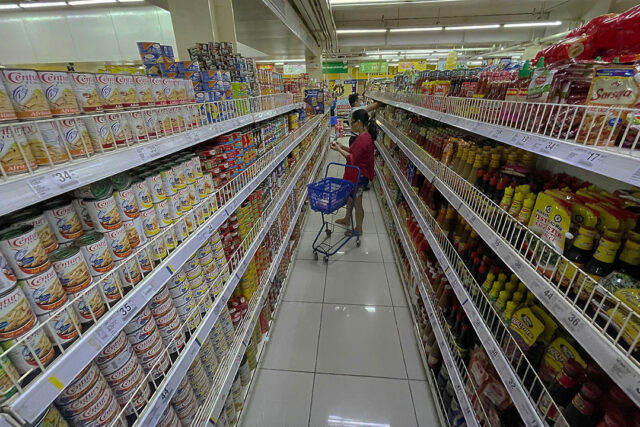
CENTURY PACIFIC FOOD, Inc. seeks mid-teen growth in profit and revenue this year as it boosts production capacity.

“We always try to go for double-digit growth,” Century Pacific Chief Operations Officer Gregory Francis H. Banzon told reporters on the sidelines of a forum in Pasay City last week. “Mid-teens is always our objective, both for top line and bottom line.”

He noted that the company had consistently hit 13% sales and income growth. “We try to best that in a consistent level…Some years are better than the others, but when you average it out, it’s somewhere within that mid-teen level.”

Century Pacific’s net income for the first nine months of 2024 rose 14% to P5.3 billion from a year earlier, while sales improved 13% to P56.9 billion on better exports and branded segments. The company has yet to disclose its full-year 2024 financial results.

This year, Mr. Banzon said the company is allotting about P3 billion in capital expenditure (capex), which will be used to boost its production capacity in the tuna, coconut and pet food segments.

“It is going to be mostly on capacity expansion, particularly to be able to sustain the growth of our tuna business,” he said. “We’re also seeing a surge in demand in the coconut product space. Obviously, maintenance is always key for us to run efficiently.”

“Last year, we were a little north of P3 billion (capex). But there’s still carryover of some of that,” he added.

In September, Century Pacific announced a $40-million (P2.3 billion) investment to acquire full ownership of Coco Harvest, Inc., which operates a coconut processing facility in Misamis Occidental. The plant can produce coconut water, coconut milk, desiccated coconut and virgin coconut oil.

Meanwhile, Mr. Banzon said the company cut the prices of several products such as canned meat, tuna and sardines.

“As commodity prices corrected, we looked at the key stock keeping units that drive the business and tried to look for opportunities to ease the burden of the consumer,” he said.

Century Pacific stocks fell 40 centavos to close at P37.60 each on March 28. — Revin Mikhael D. Ochave

Argentine farmers delay sales of soy over murky forex outlook

REUTERS

BUENOS AIRES — Argentine farmers are selling their soy crop at the slowest pace in 10 years as producers bet on a likely weakening of the peso currency and potential tax relief from the government of libertarian President Javier Milei.

The latest government data show that farmers in Argentina, the world’s largest exporter of soybean oil and meal, had sold 8.4 million tons of 2024/25 soybeans as of March 19, equivalent to between 17.3%-18.1% of the expected harvest.

That marked the slowest pace since the 2014/15 season when 15.7% of the soy harvest was sold at the same time of the year.

The sales are a quarter below where they were last year.

“Producers are selling only what they need to cover their expenses. It’s another year when they are waiting to see what happens later, especially with the exchange rate,” said Pedro Jaquelin, a farmer from the grains hub town of Pergamino.

Argentine traders have been placing bets on a faster devaluation of the peso ahead of an expected $20-billion loan deal with the International Monetary Fund. Peso futures have spiked since the middle of the month.

Farmers’ crops are priced in dollars, but they receive the peso equivalent, meaning a weaker peso would give them more local currency, an incentive to hold onto their crops.

“The uncertainty and the numbers don’t add up. Producers are waiting to see a change,” said Mr. Jaquelin, who is also president of the rural society of Pergamino in Buenos Aires province.

The slower soybean sales are a worry for Milei, whose government needs dollars to help stabilize the peso. Soy is the country’s main source of foreign currency, mainly through exports of processed soy oil and meal.

The peso is currently at 1,070 per dollar, though a June futures contract spiked to near 1,200 per dollar in recent weeks. The government has moved to play down talk of a potential devaluation.

Farmers also said that they were watching tax rates on soy exports, currently at 26% and 24.5% for soybeans and their derived oil and meal respectively. Some producers hope that Milei will follow through on pledges to cut these further after a temporary reduction until June.

“The idea in producers’ heads is that if they already lowered them once, why wouldn’t they lower them again?” said Ricardo Bergmann, vice-president of soy chamber AcSoja.

The farmer from Monte Buey in Córdoba province added there are several bills in the committee phase in Congress that aimed to reduce these taxes, in a year in which Milei will try to consolidate his power in the October midterm elections.

The delay in soybean sales is also linked to adverse weather that hit Argentine farmers at different spells of the 2024/25 season, earlier during planting last year and a tough drought in January-February that made producers more cautious.

Heavy rains that fell in the second half of February, however, allayed fears about the drought impact and have helped spur a strong early corn crop. Farmers said they have been focused more on corn sales, taking advantage of stronger prices.

“More early corn is being harvested, and it’s arriving now. Producers are choosing to sell more corn,” said Rosario-based agricultural analyst Lorena D’Angelo.

Meanwhile, the chamber of grain exporters and processors CIARA-CEC noted that due to the slower pace of sales, crushers have increased trade with Paraguayan farmers, who send their goods to Rosario factories by barge on the Paraná River. — Reuters

Yields on government debt end mixed on dovish BSP bets, tariff uncertainty

YIELDS on government securities (GS) traded in the secondary market were mixed last week amid dovish comments from the Bangko Sentral ng Pilipinas (BSP) chief, positioning after the reserve requirement ratio (RRR) cut, and uncertainty over the Trump administration’s tariff plans.

GS yields, which move opposite to prices, rose by an average of 0.32 basis point (bp) week on week, according to the PHP Bloomberg Valuation Service (BVAL) Reference Rates as of March 28 published on the Philippine Dealing System’s website.

Yield movements were mixed. At the short end, rates went up week on week across the board, with the 91-, 182-, 364-day Treasury bills (T-bills) rising by 12.09 bps (to 5.2978%), 9.05 bps (5.6163%), and 8.86 bps (5.7763%), respectively.

Meanwhile, at the belly, yields fell across all tenors. The two-, three-, four-, five-, and seven-year Treasury bonds (T-bond) saw their rates decline by 2.99 bps (to 5.7475%), 4.82 bps (5.7831%), 5.77 bps (5.8362%), 6.3 bps (5.9001%), and 6.32 bps (6.0353%), respectively.

Tenors at the long end closed mixed. The 20- and 25-year bonds rose by 1.17 bps and 0.87 bp to fetch 6.3180% and 6.3149%, respectively. Meanwhile, the yield on the 10-year debt fell by 2.35 bps to 6.2190%.

GS volume traded amounted to P40.72 billion on Friday, higher than the P27.98 billion recorded a week earlier.

“Anticipation of likely policy move from the BSP continues to influence the short-term yields, while the effectivity of the lower reserve requirement for Philippine banks have driven the significant movement in the belly of the curve owing to increased liquidity in the domestic bond market,” a bond trader said.

“BSP Governor Remolona’s positive forward guidance on a potential 25-bp policy rate cut in April influenced the local bond market, leading to declining yields throughout the week… Offshore flows pushed the yield curve lower, with the belly of the curve outperforming,” ATRAM Trust Corp. Chief Investment Officer Alessandra P. Araullo likewise said in a Viber message.

She added that the latest round of RRR cuts that took effect on Friday compressed yields on the front end as banks redeployed their excess liquidity into short-term papers.

BSP Governor Eli M. Remolona, Jr. last week said that there is a “good chance” that the Monetary Board will cut rates by 25 bps at their April 10 meeting, Bloomberg reported.

Mr. Remolona said the BSP remains on an easing cycle and could bring down borrowing costs by as much as 75 bps this year depending on data.

The central bank has reduced benchmark interest rates by a cumulative 75 bps since it began its rate-cut cycle in August last year, with its policy rate currently at 5.75%.

The Monetary Board in February unexpectedly kept rates unchanged amid uncertainties stemming from the Trump administration’s policies.

Meanwhile, the RRR of universal and commercial banks and nonbank financial institutions with quasi-banking functions was brought down by 200 bps to 5% from 7% effective Friday.

The reserve ratio for digital banks was cut by 150 bps to 2.5%, while the ratio for thrift lenders was lowered by 100 bps to 0%, now at par with rural and cooperative banks’ RRR.

On the other hand, yields on long tenors mostly rose due to inflation concerns, the trader added. “While domestic inflation has been moving favorably so far for the year, the threat of a stronger dollar could amplify domestic inflationary risks in the coming summer months. Potential sources are likely to come from higher energy prices and higher price of imported food items.”

Still, yield movements last week were mostly subdued as the market stayed cautious before the release of key US economic data on Friday, the trader said.

“The local currency fell against the dollar due to uncertainty over US President Donald J. Trump’s tariff plans and a US Federal Reserve official’s statement that these plans will boost inflation. This uncertainty led to global investors reallocating their cash, causing movements in the local bond market,” Ms. Araullo added.

Mr. Trump on Friday said that he was open to carving out deals with countries seeking to avoid US tariffs but those agreements would have to be negotiated after his administration announces reciprocal levies on April 2, Reuters reported.

For this week, the market will continue to monitor developments in the Trump administration’s trade policies, both analysts said.

“Local yields might continue to be somehow muted for the first half of the week as market participants await the fuller disclosure of US tariff policies on April 3,” the trader said. “However, yields might start to move higher towards the end of the week in anticipation of a likely rebound in domestic inflation for March from the February lows.”

“Renewed uncertainty from the US and global markets may drive offshore flows into local bonds, influencing yield movements. Given these factors, yields are expected to remain on a downward trajectory in the short term, particularly on the front end and belly of the curve. However, investors should remain cautious of external risks, such as unexpected inflation surprises or global market volatility, which could trigger a reassessment of current market positioning,” Ms. Araullo said.

She added that a lower-than-expected March inflation print could support “a bullish bias” for bonds and expectations of a rate cut at the BSP’s policy meeting next month.

The Philippine Statistics Authority will release March consumer price index (CPI) data on April 4 (Friday).

Headline inflation may have eased slightly in March amid lower prices, analysts said. A BusinessWorld poll of 18 analysts conducted last week yielded a median estimate of 2% for the March CPI.

If realized, this would be a tad slower than the 2.1% in February and the 3.7% clip in the same month a year ago. This would also be the lowest monthly inflation in six months or since the 1.9% print in September. — Abigail Marie P. Yraola


Health Workers: The heart of health

FREEPIK

Every year, the first week of April marks World Health Worker Week, a global tribute to the dedicated professionals who form the backbone of healthcare systems. This year’s theme, “Health Workers: The Heart of Health,” underscores the indispensable role of doctors, nurses, pharmacists, epidemiologists, community health workers, laboratory technicians, and related professions who safeguard public health.

This week also serves as a rallying cry for increased investment in human resources for health, emphasizing the need for sustained leadership and long-term support to strengthen healthcare systems and advance development goals.

THE FIGHT AGAINST NCDS: A COLLECTIVE EFFORT
Noncommunicable diseases (NCDs) like heart disease, cancer, stroke, and diabetes remain among the leading causes of death in the Philippines, accounting for 47% of deaths between January and August 2024. These chronic illnesses not only devastate families but also strain the economy, costing the country P756.5 billion annually in direct and indirect expenses, according to a WHO-UNDP (World Health Organization and United Nations Development Programme) report.

Healthcare professionals are at the forefront of this battle. From health education to early detection, they work tirelessly to prevent and manage NCDs. Community health workers and barangay health workers play a pivotal role, conducting house-to-house visits, promoting health checkups, and encouraging healthy behaviors in underserved areas. These grassroots efforts are crucial in bridging the gap between communities and accessible healthcare.

ADDRESSING RISK FACTORS
NCDs, often associated with lifestyle factors, affect people of all ages. Risk factors such as unhealthy diets, physical inactivity, tobacco use, and alcohol consumption contribute to conditions like high blood pressure, obesity, and elevated blood glucose levels, which can lead to life-threatening complications.

To mitigate these risks, the WHO advocates for a multi-sectoral approach involving health, finance, education, agriculture, and other sectors. Simple yet impactful interventions, like promoting healthy eating, increasing physical activity, and reducing harmful substance use, can yield significant benefits. For every peso invested in NCD prevention, the return ranges from P7 to P29.9, highlighting the economic wisdom of proactive healthcare strategies.

INVESTING IN BETTER HEALTHCARE
The Department of Health’s Philippine Package of Essential Noncommunicable Disease Interventions (PhilPEN) is a prime example of how primary healthcare can tackle NCDs effectively. Through screening for cardiovascular risks like smoking and diabetes at the community level, PhilPEN aims to reduce premature deaths and strengthen early intervention efforts.

Meanwhile, partnerships with the private sector and the pharmaceutical industry are crucial in advancing this mission. By delivering innovative medicines, vaccines, and support for universal health coverage, these collaborations accelerate progress toward the 2030 Sustainable Development Goals.

A CALL TO ACTION
As we honor health workers this week, let us remember the essential role they play not only in saving lives but also in shaping resilient healthcare systems. Their tireless dedication deserves more than gratitude — it demands action. Policymakers, private organizations, and individuals must rally behind health workers, advocating for investments in health workforce development and community-based care.

Together, we can empower our health workers to continue being the heart of health and to build a future where NCDs no longer overshadow the lives of millions.


Teodoro B. Padilla is the executive director of Pharmaceutical and Healthcare Association of the Philippines which represents the biopharmaceutical medicines and vaccines industry in the country. Its members are in the forefront of research and development efforts for COVID-19 and other diseases that affect Filipinos.

House prices up 6.7% in Q4

Housing prices in the Philippines grew by 6.7% year on year in the fourth quarter, the central bank’s latest Residential Real Estate Price Index (RREPI) data showed. In the October-to-December period, RREPI at the national level for all housing units was the highest in five quarters since the 12.9% logged in the fourth quarter of 2023.

House prices up 6.7% in Q4

All-new Nissan Patrol debuts

PHOTO BY KAP MACEDA AGUILA

The all-new, seventh-generation Nissan Patrol was formally launched last Friday. ‘Velocity’ was among media outfits afforded a preview ride-and-drive of the SUV. Our full coverage next week.

Style (03/31/25)


Alo opens in Manila

ALO, the fashion and lifestyle brand known for luxury activewear rooted in mind-body wellness, is set to open its first store in the Philippines in partnership with retailer SSI Group, Inc. Located at Level 1, Greenbelt 5, the new flagship store is slated to open in Q2 2025, marking the brand’s official entry into the Filipino market. Alo Yoga (Alo) is a Los Angeles-based premium lifestyle brand specializing in luxury activewear, first launched in 2007. “Bringing Alo Yoga to the Philippines reflects our commitment to offering world-class brands that resonate with the evolving lifestyles of Filipino consumers,” said Anthony T. Huang, chief executive officer & president of SSI Group, Inc., in a statement “As wellness and mindful living continue to gain importance, we are excited to introduce a brand that empowers our customers to look and feel their best — whether in motion or at rest.” The store will feature Alo’s signature styles across women’s, men’s, and unisex categories; from loungewear and coordinated sets to elevated leisure looks. For updates on Alo Yoga’s launch in the Philippines, follow @ssilifeph on Instagram and Facebook, or visit ssilife.com.ph for more details.


ArteFino opens applications for 2025 edition

LIFESTYLE FAIR ArteFino will be held anew at The Fifth at Rockwell on July 31, and they are looking for new artisans to showcase their wares. According to a statement, they are seeking brands that are “globally competitive, yet deeply rooted in local traditions.” “We value brands that collaborate with local communities, fostering cultural heritage and economic growth. We are looking for conscious designers and creators with innovative design concepts to showcase and authentic stories to share,” said the statement. Interested parties may apply through https://docs.google.com/forms/d/e/1FAIpQLSdkavN__5PdmRmia_siYdMDtkGjKYMZHo75uXFPd-pzCJGopQ/viewform until April 21.


Ternocon exhibit opens

PHILIPPINE visual arts and fashion intertwine in Filipiniana x Obra, an exhibit featuring capsule collections designed by winners, mentors, and finalists of the recent TernoCon 2025. Organized by the Cultural Center of the Philippines (CCP) in partnership with the Bench/Suyen Corp., this is open to the public until May 4 at the Sandiganbayan Reception Hall of the National Museum of Fine Arts in Manila. Following TernoCon 2025’s successful runway showcase on Jan. 26, the Filipiniana x Obra exhibit displays terno collections inspired by the visual masterpieces of Filipino artists — several of whom are National Artists — who have shaped the nation’s cultural and artistic landscape. Visitors may view the winning collection by Peach Garde of Tapaz, Capiz who won the Pacita Longos Medal (Gold Award) of TernoCon 2025. Mr. Garde’s pieces reinterpret the brutalist works of National Artist for Architecture Leandro Locsin, like the Philippine International Convention Center and the CCP Main Building. Visit www.culturalcenter.gov.ph for more information.


TikTok Shop expands plus-size category

TIKTOK SHOP commits more to inclusivity with the launch of its Womenswear Plus-Size subcategory. This expansion provides plus-size women with greater access to fashion that fits while also supporting female creators and entrepreneurs in the digital commerce space. TikTok Shop’s new subcategory introduces a selection of quality and authentic plus-size fashion items; from wardrobe staples to statement pieces. As part of TikTok Shop’s commitment to accessibility, the platform integrates interactive features such as live try-on sessions, authentic creator reviews, and direct engagement with sellers. This allows shoppers to make informed purchasing decisions while discovering brands that cater specifically to their needs. “With the launch of our Womenswear Plus-Size subcategory, we want to ensure that every woman has access to fashion that makes her feel confident and empowered,” said Jonah Ople, TikTok Shop Philippines fashion category lead in a statement. “TikTok Shop is more than just a shopping platform — it’s a space where inclusivity thrives, and where shoppers, creators, and entrepreneurs can connect and grow together.” Visit TikTok shop and view posts with #OwnYourCurves.

P5-M pavilion to rise in New Clark City

THE Bases Conversion and Development Authority (BCDA) is building a P5-million multi-purpose pavilion within the Ayta Ethno Botanical Center (AEBC) in New Clark City, Tarlac.

“In New Clark City, our goal is to ensure that economic growth and development benefit all sectors of society, especially our local Aeta communities,” said BCDA President and Chief Executive Officer Joshua M. Bingcang in a statement over the weekend.

“We are committed to empowering our stakeholders and building this Ayta Ethno Botanical Center into a cornerstone for agricultural education, innovation, and environmental stewardship,” he added.

The multi-purpose pavilion is part of a memorandum of agreement (MoA) the BCDA signed with Hann Philippines, Inc. and Hann Foundation, Inc.

The project is expected to provide the local community with a venue for training, meetings, assemblies, exhibits, and other activities for the purpose of protecting and preserving Ayta culture and heritage.

“Aside from promotion of cultural heritage, agriculture, and innovation, this project also promotes employment and entrepreneurship,” said Hann Foundation Executive Director Ana Christi G. Galura.

The 10-hectare AEBC, a project between BCDA, Department of Agriculture Regional Field Office III, and Pampanga State Agricultural University, aims to scale up the agricultural capabilities of local farmers and fisherfolk.

The project will be rolled out in three phases, beginning with the multi-purpose pavilion, a ceremonial ground, a market, a coffee shop, a tamarind orchard, a coffee farm, and a pond.

Phase 2 will include a mango orchard, picnic areas, and natural trails, while Phase 3 will add rice terraces, a bamboo grove, a dormitory, and a viewing deck, according to BCDA.

BCDA plans for the AEBC to serve as a model for food forests to be established in other green areas of New Clark City, which is eyed to boost food security and provide livelihood opportunities. — Justine Irish D. Tabile

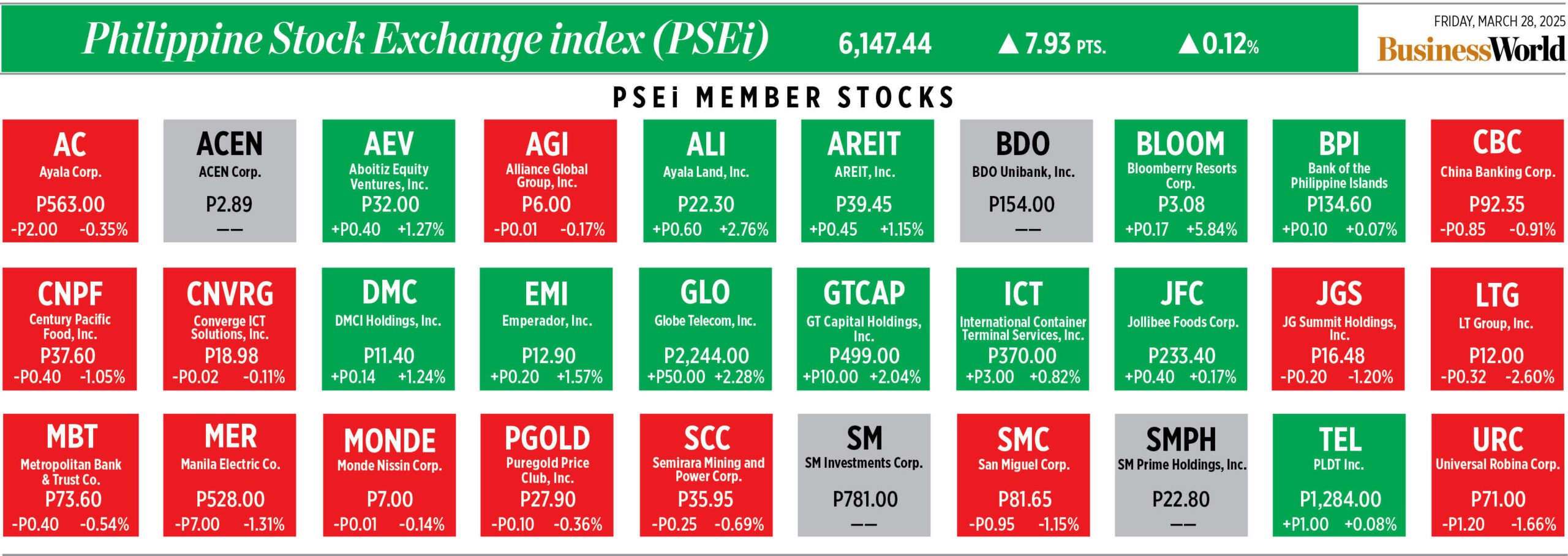
How PSEi member stocks performed — March 28, 2025

Here’s a quick glance at how PSEi stocks fared on Friday, March 28, 2025.


Peso to move sideways vs dollar before next tariff announcement

BW FILE PHOTO

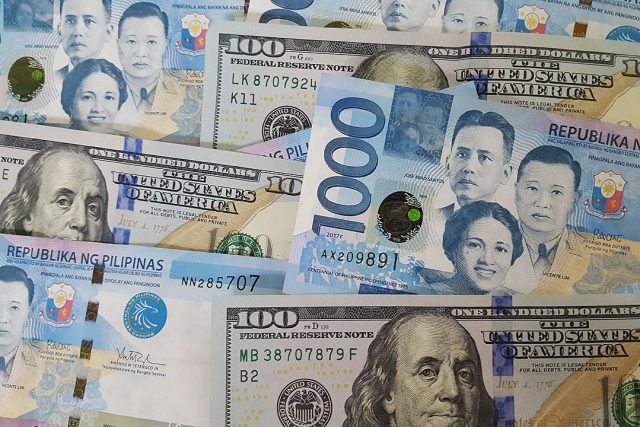
THE PESO may continue to move sideways against the dollar this week as investors await the details on the Trump administration’s planned retaliatory tariffs.

The local unit closed at P57.381 per dollar on Friday, inching down by 1.1 centavos from its P57.37 finish on Thursday, Bankers Association of the Philippines data showed.

Week on week, the peso dropped by 5.1 centavos from its P57.33 finish on March 21.

The peso slipped against the dollar on Friday before the release of the US personal consumption expenditures (PCE) price index data later in the day, Rizal Commercial Banking Corp. Chief Economist Michael L. Ricafort said in a Viber message.

“The dollar-peso traded sideways as market participants continued to wait for details on Trump’s retaliatory tariffs and ahead of the PCE, which should provide cues on the US Federal Reserve’s monetary path,” a trader said in a phone interview.

US consumer spending rebounded less than expected in February while a measure of underlying prices increased by the most in 13 months, stoking fears the economy was facing a period of tepid growth and high inflation amid an escalation in trade tensions, Reuters reported.

Economists say President Donald J. Trump’s protectionist trade agenda, marked by a rush of tariff action announcements since taking office in January, will boost prices of imported goods and drive inflation higher in the coming months.

The PCE price index increased 0.3% in February after advancing by the same unrevised margin in January and in line with economists’ expectations.

In the 12 months through February, PCE prices increased 2.5%, matching January’s rise.

Before the PCE data release, the dollar was headed for a steady week as concern about tariffs slowing US growth has pushed down US yields, stocks and the currency.

The dollar’s decline over the past few months has confounded market expectations for a higher US currency under Mr. Trump’s tariffs, wiping out long dollar positions and leaving traders unsure how to position or react as he upends trade relations.

For this week, the trader said the peso’s movements will largely depend on the PCE data and the Trump administration’s tariff announcements.

The trader sees the peso moving between P57.20 and P57.60 per dollar this week, while Mr. Ricafort expects it to range from P57.20 to P57.70.

Mr. Trump said on Friday that he was open to carving out deals with countries seeking to avoid US tariffs but those agreements would have to be negotiated after his administration announces reciprocal tariffs on April 2, Reuters reported. — A.M.C. Sy with Reuters