Home Blog Page 1350

URC sets sights on volume, market share recovery

URC.COM.PH

UNIVERSAL ROBINA CORP. (URC) is targeting volume and market share recovery this year, its president said.

“We’re looking very much forward to a strong volume recovery and market share recovery,” URC President and Chief Executive Officer Irwin C. Lee said during the Money Talks with Cathy Yang program on One News Channel on Wednesday.

In 2023, URC’s net income fell 2% to P12.5 billion due to lower profit from its sugar and renewables segment. Sales, however, grew 3% to P161.9 billion on higher volume across all divisions.

Mr. Lee said the company will focus on expanding its Philippine business, which accounts for over 70% of revenue, while strengthening its presence in Southeast Asia. 

“Our businesses have been very strong in all the ASEAN countries. We’ve seen high single-digit to double-digit growth in Malaysia, Thailand, Vietnam, and Indonesia. The Philippines has been more of a drag, but now we’re seeing a bit of a turn. Cautious optimism is growing, and sentiments are improving with inflation easing slightly,” he said. 

“We will devote significant attention to the Philippines, sustain growth momentum in ASEAN, and drive volume recovery in the country,” he added.

Mr. Lee also said URC’s exit from the China market will be completed this year.

“We’re well on track. We’ve made all necessary announcements in China, and we’re working with regulatory authorities. The wind-down process is ongoing and will likely take the rest of the year to complete. China was not a major operation for us,” he said. 

In August last year, URC announced its exit from China, where it produces cereals and snacks. The company said the move would allow it to redeploy resources to higher-growth markets in the region. 

Meanwhile, Mr. Lee expects an income boost from the May midterm elections.

“Elections have always provided a lift for us. We’re, of course, banking on some of that lift this year,” he said.

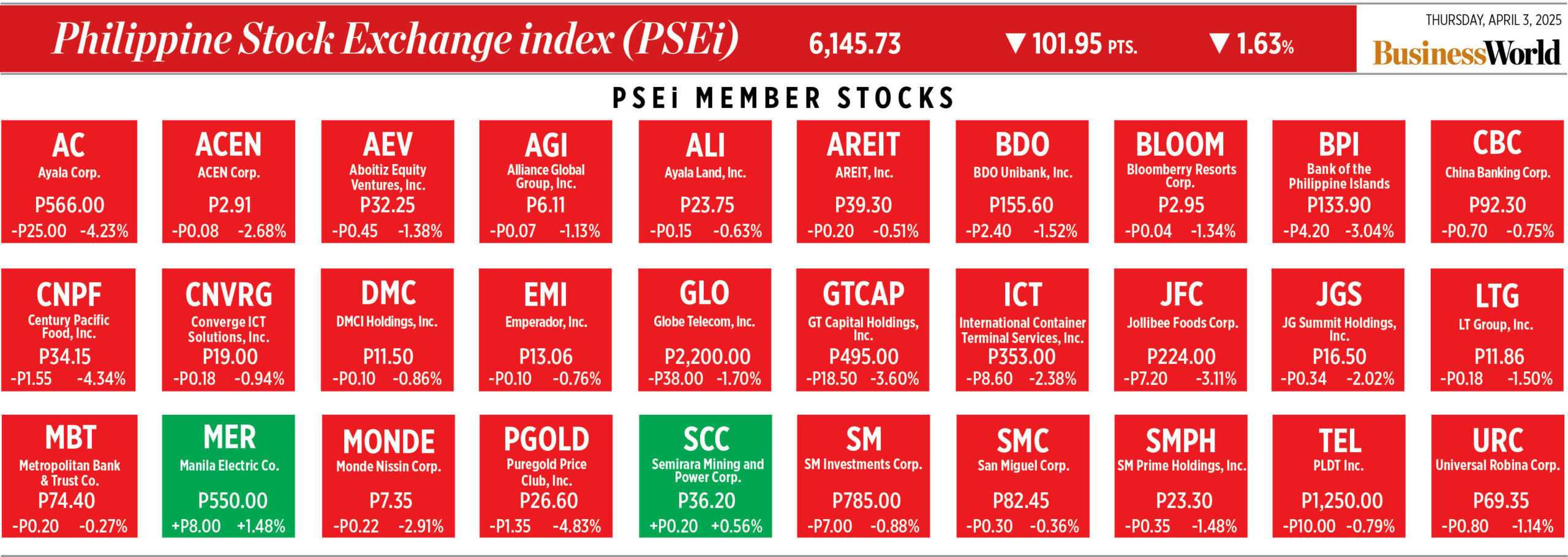
On Wednesday, URC shares rose 2.15% or P1.60 to P75.90 apiece. — Revin Mikhael D. Ochave

Barako coffee wins award from Paris

L-R: FOUNDER of the Coffee Heritage Project and co-founder of the Biyaya Sustainable Living Festival Rich Watanabe, the winners of the Gourmet Medal for the Hors Categories Niña Guinto and Martin Macalintal, and AVPA’s Philippe Juglar

THE AWARDING of international medals for local coffee growers and a new prize specifically created for a Batangas-grown coffee opened the Biyaya Sustainable Living Festival. The awards were given on the festival’s first day, March 14.

The Biyaya Festival, which ended on March 16, is an expanded version of the Manila Coffee Festival, and honored besides coffee, traditional handicrafts, textiles, and other local arts. A section of the festival, which was held in Parqal Mall in Parañaque, showed paintings, pottery, and traditional tattoo artists; another section was devoted to supernatural beliefs.

Richard Watanabe, founder of the Coffee Heritage Project and co-founder of the Biyaya Sustainable Living Festival said in a speech, “This festival was borne out of a simple but powerful idea: that the artisans, farmers, and craftsmen of the Philippines are not just producers of goods. They are artists, cultural bearers, entrepreneurs, and individuals. Their work is woven into the very fabric of our identity.”

“Our purpose is to have local growers in charge of developing locally roasted coffee to be recognized at an international level,” said Philippe Juglar in a speech. Mr Juglar is the president of the Paris-based Agence pour la Valorisation des Produits Agricoles (Agency for Valorization of Agricultural Products or AVPA). AVPA is a non-governmental, non-profit organization composed of producers and taste enthusiasts that provides certifications, training, and support for local growers worldwide. AVPA also holds contests for the best in their class for coffee, chocolate, tea, and edible oils. More than 700 producers from around the world participate in AVPA contests every year, according to its website.

The awards that were won last year were awarded in the Philippines last week by Mr. Juglar.

There were four awards given this year: Rebecca Gacayan from Sultan Kudarat won the Gourmet Medal from the Café Ronds Category, honoring well-balanced coffee, while George Dapliyan from Sagada won the Gourmet Bronze Medal for the Acidulé Floral category, recognizing coffees with bright acidity and delicate floral notes. Andrew and Mary Tomeg, and Filipa Villicana, also from Sagada, won the Silver for the same category.

Finally, Martin Macalintal and Niña Guinto of Batangas won the Gourmet Medal for the Hors Categories, created specifically for the Barako coffee given its uniqueness as an entry. “To obtain this level of quality requires years and years of effort,” said Mr. Juglar.

SWEET COFFEE
The coffee industry in Batangas was started in the 1700s by Spanish friars but was expanded in the next century through the estate of the Kalaw-Katigbak family (which was also honored during the festival). Barako, the coffee varietal grown there, belongs to the Liberica species of coffee, as opposed to the more mainstream Arabica. Mr. Macalintal said in a speech, “From a micro farm in Alitagtag, Batangas, here we are. We’re going to conquer the world.”

He discussed the qualities of his prize-winning coffee with BusinessWorld. He said that Ms. Guinto had submitted their coffee for judging by the AVPA in a previous contest, and the organization deemed it too sweet and suspected cheating. Scientists were brought to their small 200-tree farm to investigate, only to find out that bordering properties planted with sugarcane contributed to the coffee’s terroir.

“There was no cheating. There was inherent sugar or sweetness in the coffee,” he said. “It’s very fruity, but at the same time, you have the tanginess and acidity of Liberica.”

The small farm began as a plot of about 3,000 square meters. “Now that I know the quality of what we can make out of the land, then I’m going to start to expand,” said Mr. Macalintal. — Joseph L. Garcia

Philippines: Balance of Payments (BoP) Position

THE PHILIPPINES’ balance of payments (BoP) position swung to a surplus in February, the Bangko Sentral ng Pilipinas (BSP) said on Wednesday. Read the full story.

Philippines: Balance of Payments (BoP) Position

Indonesia takes currency, market measures after rupiah and shares fall

REUTERS

JAKARTA — Indonesia’s financial services regulator has allowed listed companies to buy back their stocks without shareholders’ approval, while the central bank conducted “bold” currency intervention to calm markets, officials said on Wednesday.

The moves came after the main stock index fell as much as 7.1% on Tuesday, pressured by concerns over the government’s policy, fiscal position and growth prospects.

The index recovered by around 1% as of 0430 GMT Wednesday after the announcement. The rupiah, however, extended losses, falling by as much as 0.7%, despite Bank Indonesia’s (BI) intervention.

The currency was hit by spillover impact from Tuesday’s drop in the stock market as well as global factors including US trade policy, expectations around the Federal Reserve’s meeting this week and tensions in the Middle East, BI’s Director of Monetary and Securities Asset Management Fitra Jusdiman told Reuters.

“BI has and will continue anticipatory, mitigatory responses to ensure stability in the rupiah exchange rate, maintain FX (foreign exchange) supply-demand, including by intervening in a bold and measured way,” he said.

The financial regulator’s new buyback rules are effective for six months and are intended to shore up market confidence, said Inarno Djajadi, chief regulator for the capital market at the Indonesia Financial Services Authority.

“We hope to give a positive signal that companies have good fundamentals, to provide market confidence to investors as well as give flexibility to listed companies to conduct corporate actions to reduce share volatility,” Inarno told a press conference.

Satria Sambijantoro, head of research at Bahana Securities, said cash-rich companies whose share prices are undervalued may opt to use the opportunity to reduce public holdings.

In past episodes of stock market plunges, state companies were among those which conducted buybacks to prevent further falls.

State-controlled banks last month announced plans for buybacks.

Iman Rachman, chief executive of the Indonesia Stock Exchange, said Tuesday’s index drop has not affected the pipeline for initial public offerings.

BI was due to hold a press conference on its monetary policy review later in the day. Most economists polled by Reuters expected BI to keep rates unchanged to prioritize rupiah stability, although a significant minority expected a 25-bp rate cut.

“Moves in local financial markets… create a headache for the central bank,” said Capital Economic’s Chief Emerging Markets Analyst William Jackson.

“While low inflation and slower economic growth should set the stage for another interest rate cut… concerns about the currency… may prompt it to act more cautiously and leave rates unchanged.”

CONCERNS OVER POLICY, POLITICS
Analysts id the market sell-off was triggered by several factors.

Those include an increase in the state’s role in Southeast Asia’s largest economy under President Prabowo Subianto, management of state companies, the set up of new sovereign wealth fund Danantara, rising risk of fiscal deterioration and speculation over the resignation of respected Finance Minister Sri Mulyani Indrawati, which she has since denied.

Of particular concern to investors was a government plan to have the military play a wider role in state institutions, which could allow armed forces personnel to serve in more civilian positions, said head of Indonesia research at Macquarie Capital Ari Jahja.

Parliament is set to pass contentious revisions to the military law on Thursday. 

Appearing alongside financial regulators at Wednesday’s press conference, lawmaker Budi Djiwandono said no active military personnel would be placed in state-owned companies. Djiwandono is deputy head of the parliamentary committee overseeing the deliberation of the military law revisions and Prabowo’s nephew.

Foreign investors, who make up around 40% of Indonesia’s stock market participants, recorded net sales of around 2.49 trillion rupiah ($150.68 million) on Tuesday. — Reuters

Google’s $32-billion deal for Wiz accelerated under Trump, sources say

REUTERS

NEW YORK — Less than a year after Google’s plans to acquire Israeli cybersecurity firm Wiz fell apart, executives were able to ink a deal in a flurry of negotiations after US President Donald J. Trump was sworn into office just eight weeks ago.

Google sweetened its original offer for $23 billion in July to $32 billion, making it one of the largest tech deals ever, and dramatically upped the breakup fee to more than $3.2 billion, people familiar with the agreement said. But the real closer for Wiz and Google executives was the change at the White House that brought with it the prospect of a friendlier antitrust review under Trump, these people said.

Google made another pass last fall while Wiz considered a potential initial public offering, these people said. While negotiations continued sporadically over several months, executives started meeting regularly to hammer out details of a deal after Mr. Trump’s Jan. 20 inauguration and appointment of key antitrust officials in his administration, these people said.

Fazal Merchant also joined Wiz as its new Chief Financial Officer in January, while the company was still weighing a potential initial public offering. Merchant played a major role in shaping the deal, along with CEO Assaf Rappaport, helping to get it across the finish line, one of the people said. Google’s cloud chief Thomas Kurian was also a key architect of the agreement, two people said.

SWEETENED DEAL
Wiz executives found it hard to turn down Google’s revised offer, which valued the cybersecurity startup 39% higher than the earlier bid, and also included a higher reverse breakup fee of more than $3.2 billion, or over 10% of the deal value, payable to Wiz if the deal falls through, the sources said.

Google sees the premium as justified given Wiz’s 70% annual revenue growth and over $700 million in annualized revenue, according to a source familiar with the discussions.

Reverse termination fees, more commonly referred to as breakup fees, are paid by buyers to compensate target companies when deals fall apart due to regulatory reasons.

Such a high breakup fee is not common in corporate dealmaking in the United States, even though such fees have been on the rise in recent years as regulatory threats to large deals have increased globally. According to a study by law firm Fenwick & West, which reviewed deals worth at least $1 billion that were signed in 2023, breakup fees on an average ranged between 4% and 7% of the overall transaction value.

It is not clear if Google and Wiz approached US antitrust authorities prior to the signing of the deal.

Some companies have preemptively briefed US antitrust watchdogs to warm them up before signing a deal. For instance, in 2023, Tempur Sealy sought the blessing of the US Federal Trade Commission before signing a $4-billion deal to acquire Mattress Firm.

Wiz executives were wary after seeing Adobe’s attempted $20-billion takeover of Figma fall apart due to antitrust scrutiny in late 2023, two people said. Google is also currently battling two US Department of Justice lawsuits over its domination of online search and another about ad technology.

Google had offered to pay Wiz a breakup fee of about $2 billion at the time — a sum that Wiz felt was not high enough for them to undertake the risk of signing the deal, the sources said.

Some of Wiz’s largest venture-capital backers were worried that then-Federal Trade Commission Chair Lina Khan would tank the deal, the sources said.

Mr. Trump’s appointment of Andrew Ferguson to chair the FTC and Gail Slater to helm antitrust reviews at Justice also gave executives at both companies more confidence in a smoother regulatory review, people familiar with the deal said.

Google, Wiz, the White House, and Justice officials did not immediately respond to requests for comment.

Bank of America advised Google on the deal, while Goldman Sachs advised Wiz. Reuters

Globe Telecom, Inc. to conduct 2025 Annual Meeting of Stockholders virtually on April 22


Click to enlarge


Spotlight is BusinessWorld’s sponsored section that allows advertisers to amplify their brand and connect with BusinessWorld’s audience by publishing their stories on the BusinessWorld Web site. For more information, send an email to online@bworldonline.com.

Join us on Viber at https://bit.ly/3hv6bLA to get more updates and subscribe to BusinessWorld’s titles and get exclusive content through www.bworld-x.com.

Towards a flat income tax of 10% to 15%

An interesting study was released recently by the Congressional Planning and Budget Research Department (CPBRD) of the House of Representatives entitled “Progressivity, Fairness, and Efficiency: An Evaluation of the Impact of the TRAIN Law on the Distribution of the Income Tax Burden,” CPBRD Policy Brief No. 2025-04. The authors were David Joseph Emmanuel Barua Yap, Jr., Edrei Y. Udaundo, and Jubels C. Santos.

The old name of the CPBRD was the Congressional Planning and Budget Office (CPBO) and I worked there from 1991-1999.

Among the study’s findings were that the tax share of the top earners — those who earned at least P1.35 million in 2017 and P1.43 million in 2023 — increased from 72.4% (P183 billion) to 88.1% (P258 billion) under the Tax Reform for Acceleration and Inclusion (TRAIN) Law of 2017. See this report about it in BusinessWorld by Kenneth Basilio, “Flat tax seen easing burden on top earners — think tank” (March 18).

Among the recommendations of the CPBRD paper are that there should be a flat income tax of 10% to 15%, VAT should be hiked from 12% to 14%, and that there be a 10% reduction in government bureaucracy.

I support these suggestions except the value-added tax (VAT) hike to 14%. Currently our 12% VAT is among the highest in Asia, with most of our neighbors having VAT or sales taxes of 7-10%.

In the accompanying table I summarized the existing and proposed tax rates, including my own proposal. An income tax cut often leads to a broader tax base because those who evade paying income taxes at 20% to 35%, or who downscale their declared income to avail of lower tax rates, will be encouraged to declare their real income and pay only 10% to 15%.

I think a flat 12% national income tax regardless of income level will attract more people to be more honest about their real income. Then we can allow the local government units (LGUs) to impose their own income tax.

The CPBRD paper also proposes a spending cut, which is among my favorite advocacies. They estimate that a 10% reduction in the government payroll would save taxpayers some P160 billion, equivalent to half of the 2023 income tax take.

I checked the reactions to the report of two officials in charge of taxation and spending. Department of Finance (DoF) Secretary Ralph G. Recto said that: “We are committed to maximizing tax administration efficiency and ensuring a progressive tax system. Right now, our priority is to collect what is already on the table by accelerating digitalization and closing tax loopholes. By doing so, we can maximize revenue collections without placing an additional burden on our people through new taxes.

“One of the critical mandates of the DoF is to ensure that economic growth is inclusive and equitable by providing more government assistance to those who are in greater need. This can only be done through a progressive tax system, wherein higher-income brackets can contribute more, enabling the government to provide more public services and support to vulnerable sectors.”

Meanwhile, Budget Secretary Amenah F. Pangandaman was happy that the National Government Rightsizing Program (NGRP) was mentioned in the study as they really intend to streamline and make public spending more efficient and not wasteful.

OK then, Secretaries Recto and Pangandaman.

I hope that some legislators someday will be bold enough to push for a flat income tax 10% to 15%. My idea is to have a flat 12% national income tax, then allow the LGUs to impose their own income tax, encourage more devolution of functions to LGUs and then they will have social services competition, infrastructure competition, and peace and order competition among themselves.

Currently 10 countries and territories have zero income tax. Bless them (see Table 2).


Bienvenido S. Oplas, Jr. is the president of Bienvenido S. Oplas, Jr. Research Consultancy Services, and Minimal Government Thinkers. He is an international fellow of the Tholos Foundation.

minimalgovernment@gmail.com

Vitarich partners with NOVOGEN for NOVOgen White hen distribution

VITARICH CORPORATION FACEBOOK PAGE

LISTED feed manufacturer Vitarich Corp. (VITA) has partnered with French breeding company NOVOGEN for the exclusive distribution of NOVOgen White hens.

VITA said it finalized the partnership in Clark, Pampanga, on Monday.

NOVOGEN’s products are sold in more than 50 countries, with global sales increasing annually, particularly in Asia.

“We use various tools to select and improve the products generation after generation: a mix of traditional and innovative environments, genomic research, RFID technology, and artificial intelligence,” NOVOGEN Chief Executive Officer Mickael Le Helloco was quoted as saying in a statement.

“Thanks to the implementation of these tools in research and development, we have been able to speed up yearly genetic progress by 2.5 times compared to the rate observed 10 years ago,” he added.

VITA said NOVOgen White hens can lay efficiently for over 100 weeks, producing up to 470 eggs per cycle — extending laying cycles beyond other breeds.

Compared to other breeds, NOVOgen White hens have better feed conversion, requiring less feed per egg, reducing production costs, and maximizing profits, the company added.

The hens also produce strong, uniform eggshells with a gradual increase in egg weight until the end of the production cycle, minimizing losses from breakage.

“They perform well and can realize their production potential under the most varied conditions, including the tropical climate of the Philippines,” VITA said.

VITA said customers will receive expert technical and marketing support, including guidance on housing, nutrition, and layer business management, as well as supply chain support for sourcing high-quality feeds and medications.

“They can also get assistance with laboratory tests for the quality of water, feeds, and raw materials,” the company said. — Kyle Aristophere T. Atienza

Auto Sales (February 2025)

NEW VEHICLE SALES jumped by an annual 2.9% in February, the slowest growth in five months amid a decline in passenger car sales, according to a joint report by the Chamber of Automotive Manufacturers of the Philippines, Inc. (CAMPI) and the Truck Manufacturers Association (TMA). Read the full story.

Auto Sales (February 2025)

‘Digital dollar’ now available on GCash crypto trading platform

PHILSTAR FILE PHOTO

STABLECOIN USD Coin (USDC) is now available on GCrypto, the cryptocurrency trading platform of electronic wallet giant GCash.

This allows GCrypto users to receive, buy, hold, or transact the cryptocurrency stablecoin, which is issued by Circle.

“The integration of USDC is a significant step in enhancing financial inclusion in the Philippines. By offering easy access to digital dollars, we empower our users with a stable and globally recognized financial asset,” GCash Group Wealth Management Head Arjun Varma said in a statement on Wednesday.

Stablecoins are pegged to a fiat currency or commodity to give it a stable value, unlike other cryptocurrencies like Bitcoin or Ethereum, which have volatile prices as they are not backed by assets.

USDC is held at a stable value of one-to-one to the dollar and backed by cash and cash equivalents stored in regulated financial institutions.

“With USDC, GCash users can access a stable digital dollar that helps provide stability while facilitating seamless and cost-effective transactions in an evolving digital economy,” the company said.

To acquire USDC, GCash users must select USDC on GCrypto via the GCash app and complete the conversion with their GCash balance.

“At Circle, we believe expanding access to digital financial tools drives economic empowerment. We are excited that GCash is enabling millions of Filipinos to participate in the digital economy with confidence and security,” Circle Asia-Pacific Vice-President Yam Ki Chan said. — AMCS

US appeals court rejects copyrights for AI-generated art lacking ‘human’ creator

WORKERS around the world fear they may be displaced by artificial intelligence (AI). — REUTERS/DADO RUVIC/ILLUSTRATION

A FEDERAL appeals court in Washington, D.C., on Tuesday affirmed that a work of art generated by artificial intelligence (AI) without human input cannot be copyrighted under US law.

The US Court of Appeals for the District of Columbia Circuit agreed with the US Copyright Office that an image created by Stephen Thaler’s AI system “DABUS” was not entitled to copyright protection, and that only works with human authors can be copyrighted.

Tuesday’s decision marks the latest attempt by US officials to grapple with the copyright implications of the fast-growing generative AI industry. The Copyright Office has separately rejected artists’ bids for copyrights on images generated by the AI system Midjourney.

The artists argued they were entitled to copyrights for images they created with AI assistance — unlike Thaler, who said that his “sentient” system created the image in his case independently.

Mr. Thaler’s attorney Ryan Abbott said he and his client “strongly disagree” with the ruling and intend to appeal. The Copyright Office said in a statement that it “believes the court reached the correct result.”

Mr. Thaler, of St. Charles, Missouri, applied for a copyright in 2018 covering “A Recent Entrance to Paradise,” a piece of visual art he said was made by his AI system. The office rejected his application in 2022, finding that creative works must have human authors to be copyrightable.

A federal district court judge in Washington upheld the decision in 2023 and said human authorship is a “bedrock requirement of copyright” based on “centuries of settled understanding.” Mr. Thaler told the D.C. Circuit that the ruling threatened to “discourage investment and labor in a critically new and important developing field.”

US Circuit Judge Patricia Millett wrote for a unanimous three-judge panel on Tuesday that US copyright law “requires all work to be authored in the first instance by a human being.”

“Because many of the Copyright Act’s provisions make sense only if an author is a human being, the best reading of the Copyright Act is that human authorship is required for registration,” the appeals court said. Reuters

On the side

FREEPIK

IT’S TRUE that fans do not buy tickets for a ballgame to watch those on the side like the coaching staff, the referees, and even the bench players. They just look at the game and how the players on the court are competing. And yet the seemingly peripheral characters influence how the game is played and what the outcome of the contest is likely to be.

Those on the side are not given much attention.

Inattentive participants at meetings ignore the speaker and quietly amuse themselves by offering comments, now usually by text messages, to other inattentive colleagues. (How many more slides does he have?)

More indiscreet are side conversations at a conference. Even whispered comments not meant to be overheard by the one presenting can still be distracting. (How many times has he said “at the end of the day”?)

Side comments are annoying to a presenter, and those trying to follow him. They are irrelevant and do not relate to the subject at hand. Calling attention to such inattentiveness (Can you please stop yapping there at the back?) only invites the rude chatterer to be even more pugnacious: “Why? Is your presentation worth listening to?”

Giving opinions on the side is a habit quelched from childhood — stop butting in, can’t you see that the grown-ups are having a heated debate here? In school, chatty classmates not called for recitation are quickly punished — write “I will not be a chatterbox” 50 times on the blackboard. (Ma’am, can you spell the last word?)

Still, side comments can be amusing in a social context. Is it related to freedom of expression? Digressions can provide comic relief and lessen tension when the discussion gets heated — let’s settle this outside.

Even in chat groups when political or religious beliefs cause clashes, the irrelevant comments of those on the side can diffuse tension — what’s the temperature in Baguio at this time?

In literature, parenthetical remarks are revered.

The open and close parentheses are paired to provide an enclosure for a humorous phrase or footnote to support or divert from a too-serious narrative. The etymology of “parenthesis” gives a clue to its function. In Greek, the original word pertains to “inserting.” Insertions may be part of an intimate act as well as a way to introduce pork in the legislative debates.

In theater, side comments (or “asides”) allow a character to step forward and share his thoughts with the audience. A character expresses his feelings aloud, as the other actors on stage pretend not to hear his comments about them — they’re clueless about the plot against them.

This theatrical convention is called a “stage whisper” to signal that it is intended only for the “fourth wall” of the audience. A conniving Iago in Shakespeare’s Othello recites his evil intent to be taken as a thought balloon as far as the intended victims beside him are concerned.

This invitation of the viewer as participant is employed by Alfred Hitchcock in his movies, like Psycho where the audience sees a killer about to plunge a knife into his heedless target seen through a translucent curtain taking a shower, just before she is repeatedly stabbed to jarring syncopated music. It is Hitchcock too who likes to make cameo appearances in all his movies, crossing a street or buying some cough drops from the drugstore. It’s a visual side comment.

Isn’t small talk before a formal meeting also a form of distraction on the side?

Just before the discussion on past due loans from a big bank client, there is chitchat about the volatile crypto market and how a known associate forgot his 20-digit password to access his account. Other topics intrude and set the mood for the main agenda to follow — okay, can we start now?

Side comments distract from the topic at hand. Is that its true value? The presenter, especially if he has no prepared slides, can digress from his assigned topic on why he did not meet his budget targets for the quarter. He makes comments on the change of management in other companies, then rambles along on how the new American tariffs can affect agricultural products, before going back to the subject at hand — where were we?

The penchant to change the topic with side remarks is a diversionary tactic.

Still, the one presiding over the meeting tries to maintain order when there are too many side comments going on loudly and distracting the official presentation — Wait, can we just have one conversation please? Someone on the side may well ask which one.


Tony Samson is chairman and CEO of TOUCH xda

ar.samson@yahoo.com