Home Blog Page 135

Stuff to Do (03/20/26)

Get Exploding Galaxies’ new imprint, anthology

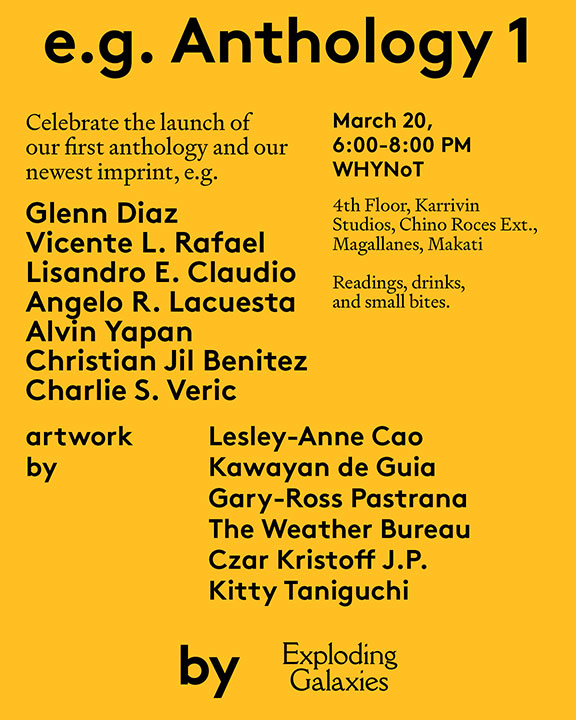
INDEPENDENT press Exploding Galaxies is launching a new imprint, e.g., and their first anthology, this month. The anthology is a collection of works from e.g.’s maiden year, featuring contributions from some of the most talented contemporary Filipino writers and artists. The collection includes the personal writings of the late Vicente L. Rafael, an eminent postcolonial historian whose academic works shaped Philippine and Southeast Asian historiography. The launch on March 20, 6 p.m., will be held in part in his memory, with drinks, small bites, and live readings by writers Alvin Yapan and Christian Jil Benitez. Interested guests can RSVP via tinyurl.com/egAnthology. The event will be held at WHYNoT, 4th Floor Karrivin Studios, Makati.


Visit Netflix’s activations for K-pop group BTS’ comeback

NETFLIX has curated a three-day fan activation in various Metro Manila locations, in celebration of BTS THE COMEBACK LIVE | ARIRANG, a live airing of the group’s comeback special taking place on March 21, 7 p.m. The zones — located at the ground level of Glorietta, Makati; level three of SM Mall of Asia, Pasay; and level four of TriNoma, Quezon City — will be open from March 20 to 22, and they will include Netflix x BTS photobooth pop-ups.


Check out the POP QC bazaar at Gateway Mall

IN CELEBRATION of Women’s Month, Araneta City has partnered with the local government of Quezon City to promote women entrepreneurs through a bazaar. The Proudly Original Products of Quezon City (POP QC) bazaar will be held from March 20 to 22, at the activity area at the upper ground floor of the Gateway Mall. The three-day event will feature women entrepreneurs with interesting products like bags, accessories, and home decor.


Learn from a printmaker’s perspective

THE M is hosting a printmaking talk centered on the work of multi-awarded Filipino artist, printmaker, and board member of the Philippine Association of Printmakers, Ambie Abaño. Her prints were exhibited at Art Fair PH 2026 in an exhibit titled Beyond Body. The artist will share her insights on exploring the evolution of the human form, namely the transformations our bodies undergo through life. It will also delve into her journey as a printmaker and her advocacy for the practice, taking place within Femme Homage, The M’s newest exhibition featuring works by women artists from their permanent collection. The workshop will take place on March 21, 2 to 3:30 p.m., at the 3rd floor South Gallery in Metropolitan Museum of Manila in BGC, Taguig. It is meant for those aged 13 years old and up. Register for P550 via the link https://metmuseum.helixpay.ph/products/m-conversations-beyond-body-a-printmakers-perspective?group=programs.


Join Best Buddies Philippines’ 1st Friendship Walk

BEST BUDDIES Philippines Foundation, Inc. will host its first-ever Friendship Walk in Metro Manila on March 22, 6 a.m. to noon, at the Bonifacio High Street Amphitheater, BGC, Taguig City. The event marks a milestone for the organization as it brings the world’s largest walk for individuals with intellectual and developmental disabilities (IDD) to the heart of the nation’s capital. The event will include a warm-up with Best Buddies participants and Special Olympics Pilipinas, a Friendship Walk through BGC with marching band accompaniment, the Best Buddies Friendship Concert featuring musicians and dance troupes of Best Buddies School Chapters, the Inclusive Friendship Village showcasing products, talents, and services by and for the PWD community, the Community Building Corner with booths for partner organizations, and Interactive Activity Zones including a photobooth, craft corner, and jungle gym area. While the event is free, registration is required at bestbuddiesph.org/friendship-walk-2026. Participants are encouraged to fundraise through a tiered donation system starting at P1,500, with incentive packages including Best Buddies merchandise, grocery vouchers, gift certificates from sponsors, and memberships to LIFELINE 16-911 emergency services. Building on the success of the Cebu Friendship Walk held on March 29, 2025, which drew at least 1,200 inclusivity experts, student leaders, and community heads, the 2026 Metro Manila event aims to welcome 1,500 participants for a day of celebration, awareness, and fundraising. The Friendship Walk is the premier flagship event celebrated by Best Buddies chapters across the globe with nearly 100 events/walks held each year around the globe, raising millions of dollars to support friendship, leadership, and employment programs for individuals with IDD. Since its establishment in 2020, Best Buddies Philippines has impacted 63,309 lives through 21 active chapters, including 19 schools and two citizen groups. The organization was appointed in June 2025 as a member of the Advisory Committee for Learners with Disabilities with the Department of Education, positioning it as a strategic partner in implementing the Inclusive Education Act (Republic Act No. 11650).


Shop and run to celebrate Lazada’s birthday

LAZADA Philippines is celebrating its 14th birthday sale, offering LazFlash Deals of up to 90% off as well as vouchers worth up to P2,000. There are also exclusive offers from LazMall and global brands across beauty, electronics, fashion, home, and everyday essentials. Shoppers will also have access to 5,000 new arrivals from global brands such as d’Alba, RedChef, Giordano, Momcozy, and more. To bring the celebration beyond the app, Lazada will also host the Lazada Run Wellness Fest on March 22, a community run and wellness street festival expected to gather over 1,000 participants including run clubs, media, content creators, and brand partners, featuring wellness activities, brand experiences, and giveaways. Download the Lazada App to see more details.


Watch sci-fi blockbuster Project Hail Mary

THE film Project Hail Mary is now showing in Philippine cinemas. It takes viewers on a journey light years away from our own galaxy, in a film adaptation of Andy Weir’s hit sci-fi novel of the same name. Longtime collaborators Phil Lord and Christopher Miller are at the captain’s seat as producers and directors of the film. It follows science teacher Ryland Grace (played by Ryan Gosling), who wakes up in a spacecraft far away from the solar system. He is meant to save humanity from a mysterious lifeform that seems to be draining the sun of its energy, and encounters an unlikely ally in the middle of his research. The film also stars Sandra Hüller, Lionel Boyce, Ken Leung, and Milana Vayntrub.


Watch a Taiwanese supernatural horror film

MUDBORN, a supernatural horror blockbuster in Taiwan, is now in Philippine cinemas through Encore Films Philippines. The mystery-thriller tells the story of a (virtual reality game developer (played by Yo Yang), who accidentally brings home a broken clay baby doll from a haunted house. His pregnant wife (Cecilia Choi) is an artifact conservator who becomes obsessed with the doll and continues restoring it, even as strange and terrifying events unfold in their family.


Watch ONE PIECE: Into the Grand Line on Netflix

ONE PIECE: Into the Grand Line, Netflix’s high-seas pirate adventure, is back for Season 2. It follows Luffy and the Straw Hats who set sail for the Grand Line, a legendary stretch of sea where danger and wonder await. The episodes follow their encounters of bizarre islands and formidable new enemies. ONE PIECE is a live action pirate adventure created in partnership with Shueisha and produced by Tomorrow Studios (an ITV Studios partner) and Netflix.

Volatility boosts protection plans

PRULIFEUK.COM.PH

PRU LIFE Insurance Corp. of UK Philippines expects growing consumer interest in traditional life insurance products as market volatility worsens as a result of war in the Middle East.

“The markets have obviously been volatile, and that would also mean customer interest and appetites would also have changed to products that offer health and protection that are not tied to market [swings],” Pru Life UK Senior Vice-President and Chief Actuary Glolibeth L. Villahermosa told a news briefing on Thursday.

Traditional policies, which offer guaranteed protection without investment risk, are expected to gain traction as investors and policyholders reassess risk amid surging oil prices and expectations of faster inflation.

“The more we face these types of risks or vulnerabilities, the more [people] understand what protection really means,” Pru Life UK Chief Investment Officer Princess Charm Baun Balingit said, adding that the impact on overall demand should remain manageable.

“That’s where we come in. But hopefully, it will not really greatly impact us,” she added.

The pivot reflects a broader trend in the Philippine insurance market, as investors and policyholders respond to heightened uncertainty from global energy and financial shocks.

Traditional life insurance offers a hedge against market swings, appealing to consumers looking for stability in times of volatility.

The company has begun rebalancing its product portfolio. In 2025, only 15% of new business came from traditional products, a share set to expand with planned launches of guaranteed protection policies this year.

“For our customers, we are seeing that [traditional products] should grow in the coming year,” Ms. Villahermosa said.

Pru Life UK leads the Philippine life insurance market in terms of new business annual premium equivalent, recording P10.05 billion in 2025 and capturing a 13% market share. Total premium income last year reached P52.8 billion.

Ms. Villahermosa said the insurer would continue launching more traditional products this year to meet market demand.

“For the longest time, we have mainly been an investment-linked product company, so that product portfolio is still strong,” she said. “But we do see the value of offering more traditional products and more guarantees.” — Aaron Michael C. Sy

Allied Care Experts (ACE) Medical Center – Tacloban to conduct Annual Stockholders’ Meeting on June 15 via Zoom


Spotlight is BusinessWorld’s sponsored section that allows advertisers to amplify their brand and connect with BusinessWorld’s audience by publishing their stories on the BusinessWorld Web site. For more information, send an email to online@bworldonline.com.

Join us on Viber at https://bit.ly/3hv6bLA to get more updates and subscribe to BusinessWorld’s titles and get exclusive content through www.bworld-x.com.

PhilWeb, Okada Manila partner for online gaming platform

BW FILE PHOTO

PHILWEB CORP. has partnered with Tiger Resort, Leisure and Entertainment, Inc., the operator of Okada Manila, to launch an online gaming platform.

Under the agreement, PhilWeb will provide a full online gaming platform (OGP) solution for OKADA PLAY, including gaming content, technology, customer service, and marketing support.

“This partnership reflects our continued commitment to providing best-in-class gaming solutions to industry leaders. By working with Tiger Resort, Leisure and Entertainment, Inc., we are enabling the extension of a globally recognized luxury gaming brand into the online space through a robust and scalable platform,” PhilWeb President Brian Ng said in a statement on Thursday.

The partnership is expected to expand Okada Manila’s presence in digital gaming and support its operations as an integrated resort.

“OKADA PLAY marks a strategic step in scaling our digital gaming presence and reinforcing our leadership in the market,” Okada Manila President and Chief Operating Officer Nobuki Sato said.

“By expanding our platform portfolio through this partnership, we are able to reach new player segments while continuing to elevate the premium digital experience associated with the Okada brand,” he added.

OKADA PLAY will operate in the Philippines’ regulated online gaming market, drawing on PhilWeb’s experience in gaming platforms.

The launch forms part of Okada Manila’s digital initiatives to expand customer engagement beyond its physical property and complement its existing platforms.

PhilWeb has been expanding its presence in regulated online gaming. In February, it partnered with casino equipment provider FBM to develop and deploy an online gambling platform integrated into FBM’s network of electronic bingo machines across more than 500 locations.

In January, the company also partnered with Hann Casino to support the expansion of its online gaming operations. — Alexandria Grace C. Magno

Ryan Gosling goes solo in space for film Project Hail Mary

Project Hail Mary (2026)

LOS ANGELES — A great deal of Ryan Gosling’s journey through the film Project Hail Mary unfolded in solitude. The La La Land actor spent long stretches filming alone on set, or acting opposite an alien creature his character, Dr. Ryland Grace, dubs Rocky.

“A lot of times I’d be locked into the set for hours on end with an earwig,” Mr. Gosling told Reuters. “The directors would talk to me through the mic, ready to explore. There’s an experimentation process that keeps it from being a typical blockbuster — it’s not overwhelmed by its own scale.”

Directed by the “Spider-Verse” franchise director duo Philip Lord and Christopher Miller, Project Hail Mary opens in US theaters on Friday. The film opened in Philippine theaters on March 18. It has a PG rating from the MTRCB.

The science‑fiction drama, adapted from Andy Weir’s bestselling novel, follows mild‑mannered science teacher Grace, who wakes up alone on a spacecraft and slowly remembers he is humanity’s last hope to stop the sun from dying. His mission takes an unexpected turn when he forms an unlikely friendship with an alien partner.

The cast also features Sandra Hüller as Eva, a government official who recruits Grace for the perilous assignment. With their characters leading experts in their fields, Mr. Gosling said the actors were well supported behind the scenes.

“We had molecular biologists on set for the experiments, and astronauts advising us,” he said. “We were provided with the best possible team and support system.”

Mr. Gosling’s involvement went deeper than starring in the film. Mr. Weir, who also wrote the award-winning novel The Martian, sent him the unpublished manuscript and urged him not only to take the lead role but to help shape the project as a producer.

“I’ve never had a film take a bigger chunk out of me, but it’s never been more worth it,” the Barbie actor said. “It’s been a six‑year journey to this point and just an experience of a lifetime.” — Reuters

PDIC submits 46 payout plans in 2025

PHILSTAR FILE PHOTO

THE PHILIPPINE Deposit Insurance Corp. (PDIC) submitted 46 payout plans for closed banks in 2025, meeting its full-year target and speeding up payments to creditors and uninsured depositors.

The plans included 20 final payout plans, which cover all remaining assets needed to complete liquidation, and 26 partial plans for assets already sold or recovered, the agency said in a statement on Thursday.

“Every asset distribution plan we file brings creditors and uninsured depositors closer to receiving what is lawfully due to them,” PDIC President and Chief Executive Officer Roberto B. Tan said.

He added that meeting the target shows steady progress in settling claims.

Once approved by the courts, the plans will allow the PDIC, acting as liquidator, to distribute proceeds from recovered assets to creditors.

Each plan outlines how funds will be allocated based on the estimated value of assets, following rules on creditor priority under Philippine law.

As of end-2025, the PDIC was handling 303 closed banks, covering 1,245 banking units.

Of these, 64 banks have final payout plans awaiting court approval, which would let the agency complete their liquidation once cleared.

The PDIC said it would continue working through its remaining cases, with these plans helping unlock payments and help complete long-running liquidations.

The filings come as lawmakers push to strengthen the country’s bank resolution framework.

A bill filed in the Senate seeks to expand the PDIC’s authority, including allowing its board to adjust deposit insurance coverage and linking it to economic indicators such as inflation.

Senate Bill No. 1667 also aims to speed up insurance payouts and extend coverage to certain nonbank financial products.

It would allow temporary full deposit insurance during financial crises, upon determination by the Monetary Board, when there is a threat to financial system stability.

“The amendments would empower the PDIC to respond decisively to emerging risks and financial crises, while minimizing disruptions to the financial system,” Senate President Vicente C. Sotto III, who authored the bill, said in the bill’s explanatory note. — Aaron Michael C. Sy

Philippines’ consumer credit surge: A test the system is passing… for now

RAWPIXEL

By Shunsuke Endo

THE rapid growth of consumer lending in the Philippines in recent years has raised some important questions: Does it signal rising risks to financial stability, or does it reflect healthy progress in financial inclusion? Consumer loans have expanded considerably faster than overall bank lending, growing by about 18% on average since mid-2022, compared with roughly 11% for total loans. Growth in consumer loans accelerated further to over 21% in the third quarter of 2025, with credit cards accounting for nearly 40% of this increase.

Against this backdrop, it is natural to ask whether the banking system remains sound, and whether consumers are piling up excessive debt, especially as credit card use becomes more widespread. According to an AMRO analysis, the consumer loan market in the Philippines appears, for now, to have largely succeeded in supporting financial inclusion while maintaining financial stability, as household debt stood at around 13% of GDP in 2025, low by regional standards. Building on this assessment, this article discusses the key conditions that will determine whether consumer lending can continue to support the Philippine economy in a stable and sustainable way.

Individuals can benefit from a deeper consumer loan market which enables them to use credit to pursue personal goals and improve their quality of life, thereby enhancing their financial well-being. Banks can diversify their borrower base through consumer lending, thereby achieving greater risk diversification within their loan portfolios.

From a broader economic perspective, consumer lending can help smooth consumption over time for households and bring people who previously had limited access to financial services into economic activity, improving overall welfare. If the market remains sustainable over the medium to long term, consumer loans can continue to support the resilience of the Philippines’ domestic demand.

For consumer lending to continue expanding in a way that preserves financial stability and support financial inclusion, three key areas of efforts are particularly important.

1. Sound risk management by banks. Banks themselves must act with discipline, supporting economic growth while preventing excessive lending and serving as guardrails for their sustainable business expansion. Philippine banks have so far shown solid performance. Key indicators of asset quality, such as non-performing loan ratios for consumer loans, hovering at around mid-5%, remain broadly healthy and capital adequacy has not shown major signs of stress, staying above 16% as of September 2025. Banks have been shifting toward business models that generate higher-yield income, while incurring more credit costs through provisioning for credit losses and bad debt write-offs, resulting in stronger profitability.

At the same time, the rapid growth in consumer lending has been mainly driven by credit card loans. As unsecured lending becomes more prominent, this form of lending underscores the need for banks to maintain prudent lending standards and effective risk management. On the positive side, the growing number of credit cards also reflects the spread of cashless payments and signals progress in financial inclusion for previously underserved groups.

As digital finance continues to develop and new financial products and platforms become more widespread, the risk management frameworks of banks will need to evolve in line with changing consumer behavior in the evolving financial sector landscape. Responsible and disciplined lending can help reduce sharp swings of credit conditions in business cycles, contributing to a more stable financial cycle overall.

2. Better borrowing decision-making by consumers. Financial literacy on the borrowing side matters. As financial services become more accessible, closing the gap between merely having access to them and being able to use them well becomes increasingly important. Stronger financial literacy can help consumers make better economic decisions. In times when banks take a more aggressive lending stance to improve profitability, consumers should rely on their financial knowledge to choose a borrowing option that matches their repayment capacity with life circumstances, thereby avoiding excessive debt.

Improved financial education can also complement consumer protection measures taken by regulators. At the same time, it can encourage banks to offer affordable financial products that better reflect consumers’ repaying ability. Through these interactions, overall financial well-being among consumers can be enhanced.

3. Proper oversight by authorities and stronger financial infrastructure. If banks and consumers are on the front line, regulators play the role of referee, overseeing the balance of the whole system. Authorities need to continue monitoring financial stability closely and respond in a timely manner when necessary. This includes both macro- and micro-prudential policies, as well as maintaining and strengthening institutional frameworks for consumer protection. Looking ahead, attention is also needed to the possibility that digital innovation and new financial products could shift risks beyond the traditional banking sector, including into short-term investment vehicles linked to buy-now-pay-later (BNPL) and e-commerce activity, stablecoins and crypto platforms, as well as fintech wallets.

Strengthening financial infrastructure is another key medium-term challenge. Wider use of credit cards can help new borrowers build credit histories, making it easier for them to access other financial products. To make the most of this progress, robust credit information systems are essential: they help borrowers avoid unfavorable terms, allow lenders to manage risks more carefully, and enable regulators to better understand current conditions. In addition, improving statistical systems that capture both formal and informal lending would help provide a clearer picture of household debt and repayment capacity.

In conclusion, the expansion of consumer lending in the Philippines reflects the economy’s strong underlying potential and is not, in itself, a problem. Whether it becomes a problem will depend on whether discipline by lenders, sound judgment by borrowers, and effective oversight by authorities continue to function. In this sense, the Philippines’ experience with surging consumer lending offers a useful case for other countries seeking to balance economic development with financial stability.


Shunsuke Endo is a senior economist at the ASEAN+3 Macroeconomic Research Office (AMRO).

Basic Energy signs deals for 43-MW Cadiz solar project

STOCK PHOTO | Image by Oleksandr Ryzhkov from Freepik

LISTED Basic Energy Corp. is moving forward with the development of a P1.9-billion solar farm in Cadiz, Negros Occidental after finalizing agreements with a supplier and contractor for the project.

Basic Energy Cadiz 1 Corp., a subsidiary of Basic Energy, has signed engineering, procurement, and construction (EPC) agreements with Raynergy Engineering Co., Ltd. and TBEA Subic, Inc. for the 43-megawatt (MW) solar farm, the company said in a statement on Thursday.

Raynergy will supply materials for the project, while TBEA Subic will serve as the onshore contractor.

“The finalization of these EPC agreements serves as the primary catalyst for the next phase of development,” Basic Energy said. “With the partners officially on board, early works shall begin at the project site in Cadiz, Negros Occidental, as soon as possible.”

The development follows the company’s receipt of a certificate of authority from the government two months ago.

The project was among the winning bids under the fourth green energy auction (GEA-4) held in 2025.

The solar facility is scheduled to begin commercial operations on or before the yearend.

“Basic Energy Cadiz 1 Corp. has full faith and confidence in our selected EPC partners. With our successful GEA-4 bid in place, and as we move into the early works phase, we are fully committed to ensuring this 43-MWac (alternating current) project contributes to the national grid on schedule,” Basic Energy Chief Executive Officer Oscar L. De Venecia, Jr. said.

Last year, the company said it earmarked up to P300 million to fund pre-development activities for its renewable energy projects over the next two to three years.

Basic Energy is developing three solar projects with a combined potential capacity of about 150 MW and aims to build a 1-gigawatt renewable energy portfolio by 2030. — Sheldeen Joy Talavera

Netflix turns to theaters to launch Stranger Things animated spinoff

Stranger Things: Tales from ‘85 (2026)

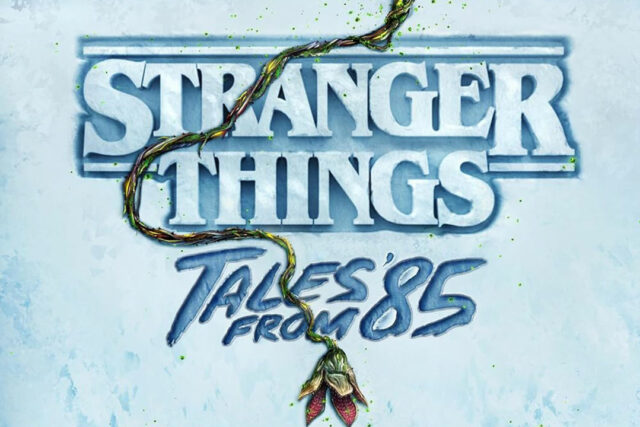
LOS ANGELES — Netflix is inviting fans back into the supernatural world of Stranger Things with limited theatrical screenings of its upcoming animated series, Stranger Things: Tales From ’85, the streaming platform announced in a press release on Tuesday.

Netflix said select AMC theaters will host special screenings of the first two episodes beginning April 18, ahead of the show’s global release on April 23. The screenings will take place in 34 theaters across the United States, as well as at the Paris Theater in New York and Netflix House Philadelphia.

The animated series reunites Stranger Things creators Matt and Ross Duffer as executive producers, alongside showrunner Eric Robles, best known for creating the animated Nickelodeon series, Fanboy & Chum Chum.

Set in the winter of 1985, the series finds Eleven, Mike, Will, Dustin, Lucas, and Max having settled back into something resembling normal life — filled with Dungeons & Dragons games, snowball fights, and quiet days in Hawkins, Indiana. But peace is short‑lived, as something terrifying awakens, forcing the group to band together once more to solve a mystery and save their town.

Tales From ’85 marks the latest expansion of the Stranger Things universe, which has continued to grow since the Duffers launched their production company Upside Down Pictures in 2022 under an overall deal with Netflix. That agreement also includes a planned live‑action Stranger Things spinoff series.

Beyond television, the franchise has expanded into a Tony Award‑winning Broadway stage play, video games, cosplay, immersive live experiences, and a wide range of merchandise.

Stranger Things, which premiered in 2016, follows a group of adolescent friends in rural Indiana during the 1980s as they confront monsters from an alternate dimension known as the Upside Down. The series quickly became one of Netflix’s biggest breakout hits. — Reuters

Philguarantee, Sterling Bank sign P5-billion home guarantee cover

PHILSTAR FILE PHOTO

PHILIPPINE GUARANTEE CORP. (Philguarantee) has signed a P5-billion housing retail guarantee facility with Sterling Bank of Asia, Inc., aiming to expand access to home financing and support bank lending to underserved borrowers.

The agreement lets Philguarantee provide credit guarantees that reduce lending risks, allowing banks to extend more housing loans while maintaining prudent credit standards.

“Philguarantee provides an important mechanism that enables banks like Sterling Bank of Asia to extend housing loans with greater confidence and reach more deserving borrowers,” Sterling Bank President and Chief Executive Officer Cecilio Paul D. San Pedro said in a statement on Thursday.

“This partnership allows us to do what the banks are meant to do — support aspirations while ensuring that lending remains prudent and sustainable,” he added.

The facility is expected to support financing for socialized and low-cost housing, segments that often face limited access to credit.

Philguarantee Senior Vice-President and Housing Guarantee Group Head Teresito Cayo A. Butardo said the agency’s guarantees go beyond risk mitigation by strengthening trust in both lenders and the broader financial system.

“As a government-owned and -controlled corporation attached to the Department of Finance, Philguarantee provides credit guarantees that reduce the risks of lending to sectors vital to economic growth, particularly housing, which is often underserved,” he said.

The partnership was formalized in a signing ceremony on March 17, building on a relationship between the two institutions that began in 2007.

“Our partnership with Sterling Bank of Asia plays an important role in fulfilling our mandate of strengthening the country’s credit delivery system,” Philguarantee President and Chief Executive Officer Alberto E. Pascual said.

Since end-2019, Philguarantee has backed almost P640 billion worth of loans, supporting more than 640,000 housing units as well as financing for farmers, fisherfolk and micro, small and medium enterprises. — Aaron Michael C. Sy

Anthropic, OpenAI talk safety. Their headcounts don’t

AI GENERATED IMAGE/FREEPIK

By Parmy Olson

ARTIFICIAL INTELLIGENCE (AI) presents a transformative moment for society, but it appears that the number of people focused on making sure it’s safe might fit on a single transatlantic flight.

Perhaps that shouldn’t surprise given the global arms race that has propelled generative AI companies to stratospheric valuations, but it should cause some alarm. The technology makes errors, is largely untested in the wild and has shown toxic side effects on mental health. Yet a rough estimate of how these companies are staffed suggests a disturbing imbalance, with investment into safety-oriented roles looking like a rounding error compared with the money going into making their systems more powerful.

There are 373 people identified as working full time on making artificial intelligence systems safe and trustworthy at OpenAI, Alphabet Inc.’s Google DeepMind, Anthropic, and Elon Musk’s xAI, a fraction of the more than 11,000 employees estimated to work for these four major AI labs. The estimates comes from Glass.ai, a London-based business intelligence firm. When the labs declined to provide stats on their personnel, I asked Glass.ai to investigate — which it did by crawling LinkedIn profiles, company websites, news articles, and other online sources to identify staff doing safety-related work. That includes tasks like making sure AI tools are aligned with human values, ensuring they’re secure, and that they won’t send users spiraling into psychosis.

To give tech companies the benefit of the doubt, Glass.ai cast a wide net for anyone who might work on making AI safe for human use, including people with generic-sounding titles like “member of technical staff,” bug bounty participants, and safety “fellows” on temporary contracts. The analysis likely misses some relevant staff for each firm, as scraping public data provides only a rough approximation. But it beats the information one can glean directly from AI labs on such figures, which amounts to nothing.

OpenAI, Google DeepMind, and Anthropic pushed back on the estimates as being too low, but again declined to provide alternative figures. Anthropic said that safety was embedded across all its key teams, “not siloed into one function,” and that the estimate of 119 safety staff at the company “materially understates the number of people whose day job is reducing risks from advanced AI.” OpenAI said it had large and growing teams of people working on safety, while Google DeepMind said that safety had always been a top priority. “We have an extensive team contributing to it across the company,” a spokeswoman added. xAI didn’t respond to e-mails seeking comment.

AI firms have long been secretive about their work. They typically refuse to share details about how their powerful models are developed and what data they are trained on. And a study from Stanford University late last year suggests they have become more opaque. That’s made it harder for researchers or academics to scrutinize the tech and its impact from the outside.

But the companies have also made grand pronouncements about human welfare, often sparked by efforts to claim the moral high ground over rivals. Elon Musk and Sam Altman co-founded OpenAI in 2015 partly as a response to Google’s purchase of DeepMind, saying the latter represented dangerous corporate control of AI, while they would build AI to “benefit humanity.” Dario Amodei split from OpenAI in 2021 to co-found Anthropic as a more “safety-focused” AI lab, asserting that Altman’s venture had become too commercial.

OpenAI made a grand overture toward responsible AI in 2023 when it announced its “Superalignment team” led by Ilya Sutskever and Jan Leike, with a promise to use 20% of its computing power on safety research. Within a year, the team was dissolved, Sutskever and Leike left, and OpenAI deleted the word “safely” from its mission statement.

Anthropic, meanwhile, has been happy to participate in warfare. Its insistence on red lines over domestic surveillance or fully autonomous weapons didn’t stop it from actively seeking and winning Pentagon contracts worth up to $200 million.

However much tech firms brand themselves as safety-focused — to the point of religious fervor in the case of Anthropic — the real measure comes from where they put their money. Anthropic’s all-important “Constitution,” an 84-page set of moral guidelines for its AI system Claude that tells the model to respect people’s rights and avoid helping them hurt others, was primarily authored by one person.*    

It’s not unusual for humanitarian efforts by tech firms to court and receive outsized public attention. DeepMind’s work on protein folding, which earned co-founder and Chief Executive Officer Demis Hassabis the 2024 Nobel Prize for chemistry and reams of positive press, was largely carried out by a core team of roughly a dozen people, out of workforce of about 4,000.

Ex-staff say the responsibility rhetoric rings hollow, reporting that they’ve rarely seen models be held back over safety concerns or complaining of a reckless culture. After she left OpenAI earlier this year, research scientist Zoe Hitzig warned that the company was optimizing its models for engagement over user welfare, just as Facebook had done. Mrinank Sharma, who was head of Anthropic’s Safeguards Research Team, also quit in February, writing in a farewell note that he’d “repeatedly seen how hard it is to truly let our values govern our actions,” amid constant “pressures to set aside what matters most.”

No other transformative technology, from nuclear energy to aviation to pharmaceuticals, has been deployed at such speed and with so little insight into what looks like modest safety infrastructure. Those older industries built their safety regimes over decades, often after catastrophic failures. Now we’re expected to trust a few hundred people to oversee AI systems that their own creators predict could decimate jobs or threaten civilization, and with no public accountability on metrics.

The very fact that this column had to be based on crawling LinkedIn and the web, rather than on numbers provided directly by the AI labs, suggests safety might not be the priority they claim it is.

BLOOMBERG OPINION

*Anthropic staffer Amanda Askell told me in an interview that she was the primary author of Claude’s Constitution, with significant input from both internal and external sources including philosophers, ethicists, and theologians.

DoLE releases list of double-pay workdays in April

BW FILE PHOTO

PRIVATE SECTOR reporting for duty during the Easter and Araw ng Kagitingan holidays will be entitled to up to double their daily wage, the Department of Labor and Employment (DoLE) said.

In Labor Advisory No. 05, Series of 2026, DoLE said Maundy Thursday (April 2), Good Friday (April 3), and Araw ng Kagitingan (April 9), are regular holidays. On these dates, the employer must pay 200% of the employee’s wage for the first eight hours.

DoLE said that if the regular holiday falls on an employee’s rest day, the employer must pay an additional 30% of the 200% wage. 

For those not working on these regular holidays, the employer must pay 100% of the wage if the employee worked or was on leave with pay on the day immediately before the holiday.

DoLE added that if the day before the holiday is a non-working day or a rest day, the worker is still entitled to holiday pay if they were present or on paid leave on the day immediately before that non-working day.

It said Black Saturday, April 4, is a special non-working day where the “no work, no pay” principle applies.

This means employees who do not work are not paid unless a company policy or collective bargaining agreement says otherwise.

Those who do report for work on this special day will be paid an additional 30% of their basic wage for the first eight hours.

If the work is done on a special day that also falls on the employee’s rest day, the employer must pay an additional 50% of the basic wage.

It said any work done in excess of eight hours on these holidays and special days will result in an additional 30% of the hourly rate for that day.

The guidelines were signed by Benedicto Ernesto R. Bitonio, Jr., officer-in-charge, on March 17.

President Ferdinand R. Marcos, Jr. signed Proclamation No. 1006 in September, which set the official list of regular holidays and special non-working days for 2026. — Erika Mae P. Sinaking