Home Blog Page 1327

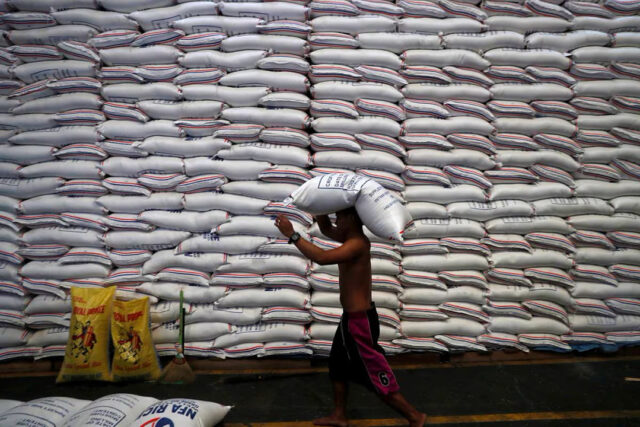
Rice tariff stays at 15% till November

REUTERS

THE 15% TARIFF on imported rice will remain unchanged at least until November, according to the Department of Economy, Planning, and Development (DEPDev), as the government seeks a “win-win” solution that balances inflation control with protecting local farmers.

“Not in the immediate [term], but most likely by November,” DEPDev Undersecretary for Policy and Planning Rosemarie G. Edillon told a news briefing on Wednesday. “After four months, we will submit the study to the President.”

The lower tariff was introduced through Executive Order (EO) No. 62, which took effect in July 2024 and slashed the import duty on rice to 15% from 35% until 2028. The EO mandates a review every four months to assess its impact.

The announcement comes amid a petition from farmer groups, including the Samahang Industriya ng Agrikultura, to go back to the original 35% duty to shield local producers from the influx of cheaper rice imports.

The Department of Agriculture, meanwhile, said it would recommend a gradual tariff increase during the next harvest season.

Ms. Edillon said they met to discuss the review and petition, and they agreed that the periodic review is meant to report on what has happened, not to make recommendations at this stage.

The lowered tariff appears to be achieving its inflation-control goals. Rice prices dropped by 14.3% in June, improving from the 12.8% decline in May, according to the local statistics agency. It was the sharpest drop since 1995.

Rice supply also appears to be stable. As of June, the country’s rice inventory reached 2.24 million metric tons (MT), 3.5% more than a year earlier. “Most of them are still in the warehouses. And we had the bumper harvest, actually, for the first half,” Ms. Edillon said.

She added that the rice import volume would be capped at 3.5 million MT for the year.

The government is also exploring more measures to support farmers, including enhanced access to the Rice Competitiveness Enhancement Fund, which provides planting assistance.

The DEPDev is also participating in discussions on whether to restore the regulatory powers of the National Food Authority (NFA), which was stripped of many functions following the Rice Tariffication Law.

Speaker Ferdinand Martin G. Romualdez said the House of Representatives is ready to act on a draft bill that seeks to reinstate the NFA’s market functions once it reaches the chamber.

The Agriculture department has said the draft legislation includes provisions for the NFA to manage buffer stocks, regulate rice marketing and set floor prices for rough rice.

“I think at that time, the context was different. So NFA was so much in debt. It was really bleeding, hemorrhaging,” Ms. Edillon said, referring to the agency’s former monopoly on imports. “It was not really fulfilling its mandate… What we need to consider now is how the market has adjusted to the new regime.”

She also acknowledged the challenges in setting floor prices. “It will be very tricky though, operationalizing it and even estimating it. But yes, that’s something that we’re studying as well.” — Aubrey Rose A. Inosante

Income-price gap keeps Filipino families from owning homes — ULI

PHILSTAR FILE PHOTO

By Beatriz Marie D. Cruz, Reporter

HOME OWNERSHIP in the Philippines remains out of reach for many households due to the wide gap between residential property prices and income, particularly in urban areas like Metro Manila and Davao, according to the Urban Land Institute (ULI).

In the 2025 ULI Asia-Pacific Home Attainability Index, the Philippine capital was identified as one of the most expensive livable cities in the Asia-Pacific region.

How affordable are Metro Manila’s home prices compared with its peers in the region?Condominium prices in Metro Manila are now 19.8 times the median annual household income, far exceeding affordable levels, the Washington, DC nonprofit research and education group said. Townhouses are even more unattainable at 33.4 times the average income.

“Home attainability is still a problem in Metro Manila, to the extent that many families, even those working in one of the capital’s business districts, choose to buy a landed home on the outskirts of the city and commute,” ULI said in the report.

To be considered attainable, median home prices should not exceed five times a household’s annual income, while median monthly rents should take up no more than 30% of their monthly income. Metro Manila and Davao, however, both far exceed these thresholds.

ULI said the average rent for a Metro Manila apartment consumes about 141% of a household’s monthly income. In Davao, rents take up 94% of earnings, still significantly above the affordability benchmark.

While Davao fares better than Metro Manila, home prices are still about 14 times the median income, which ULI described as “scarcely more attainable.”

Data from the Bangko Sentral ng Pilipinas showed that in the first quarter, condominium prices rose 10.6% year on year, while house prices climbed 4.5%.

Amid rising property prices, ULI noted that the development of major railway infrastructure projects has made living outside the capital more attractive to working families, even as commuting remains a challenge.

Ironically, despite high prices, Metro Manila is also grappling with a supply glut of condominiums due to a wave of new projects launched from 2019 to 2023.

Many of these unsold units are in areas outside business districts that were affected by the government’s crackdown on Philippine offshore gaming operators.

“The oversupply is mainly noticeable in the lower-mid segment, where units typically cost between P3 million and P7 million,” ULI said, citing data from real estate consultancy KMC Savills, Inc.

For a studio or one-bedroom condo in this price range, monthly mortgage payments may run from P20,000 to P40,000 ($354 to $708) — a significant burden for Filipino families earning P50,000 to P60,000 monthly.

At the same price, a three- to four-bedroom house outside Metro Manila could be bought, according to the report. “The problem is that many of these condominiums were targeted at middle-class families who prefer a more distant home to a city condo,” it pointed out.

While developers have introduced more flexible payment terms to drive sales, high land acquisition and construction costs have limited their ability to offer significant price cuts.

“Some observers believe this will lead more to explore alternatives such as co-living or multifamily rental use for unsold projects,” ULI said.

To improve affordability, the group urged property developers to cut construction costs and use less expensive land.

“Developers could look at using modular construction to reduce development costs and focus on simple, repeatable designs to ensure faster delivery and therefore lower costs,” Mark Cooper, senior director for thought leadership at ULI Asia-Pacific, said in an e-mailed reply to questions.

“They should consider partnering with local governments to access land more cheaply in return for developing public or affordable housing,” he added.

Across the Asia-Pacific region, ULI said home attainability remains a widespread issue. Only seven of 51 market segments studied offered homes priced within five times the median income. In contrast, rental homes were generally more affordable, with 41 of 51 markets offering rents below 30% of monthly income.

ULI noted that key factors influencing home demand include population growth, aging demographics, household formation, urbanization, immigration, income growth, financing availability and transaction costs.

NCR wage hike unlikely to stoke prices

A customer buys fresh produce at the public market in Marikina. — PHILIPPINE STAR/ WALTER BOLLOZOS

THE P50 daily minimum wage hike for Metro Manila workers that will take effect on July 18 is unlikely to fuel inflation, according to economists.

Its limited coverage means it probably won’t be inflationary compared with earlier proposals for a nationwide wage hike, said Ruben Carlo O. Asuncion, chief economist at Union Bank of the Philippines, Inc.

“It’s going to take effect this month, so that has to be factored in,” he told Money Talks with Cathy Yang on One News on July 2. “But versus P100 to P200, I think P50 is a huge difference from the huge uptick that was originally proposed by Congress.”

The P50 wage hike is a “well-calibrated move,” said Jonathan L. Ravelas, senior adviser at Reyes Tacandong & Co.

“It boosts worker income without significantly stoking inflation,” he said. “Given current low inflation and soft growth, the impact should be manageable — especially if businesses adjust gradually and productivity improves.”

“It’s a positive step, but we’ll need to watch for second-round effects in labor-intensive sectors,” he added.

The Labor department last week said the P50 daily wage increase — the biggest pay hike ever granted by the National Wages and Productivity Commission — would benefit about 1.2 million workers in the Philippine capital and nearby cities and provinces.

The new daily minimum wage in the National Capital Region (NCR) is expected to increase to P695 in the nonagricultural sector.

The pay of workers in the farm sector, service and retail outlets with 15 or fewer staff members and factories with fewer than 10 workers will go up to P658.

Congress adjourned last month without approving the bill seeking to hike the daily minimum wage by P100-P200. Economic managers had warned that the legislated wage hike could have “dangerous repercussions” for the Philippine economy.

Philippine inflation picked up to 1.4% in June from 1.3% in May amid higher utility costs, the government reported on Friday.

This was slower than 3.7% in June last year and was within the central bank’s 1.1% to 1.9% forecast for the month. This was also below the 1.5% median estimate in a BusinessWorld poll of 17 analysts.

National Statistician Claire Dennis S. Mapa on Friday said the latest wage hike’s impact on inflation could be lagged, adding that this would likely be reflected in personal care, miscellaneous goods, and services.

Michael L. Ricafort, chief economist at Rizal Commercial Banking Corp., said a P50 wage hike that is given to other regions could add a percentage point to inflation.

“Businesses tend to pass the higher minimum wages, or pass-through effects, as much as possible, depending on competition locally and from imports,” he said in a Viber message.

Ateneo Center for Economic Research and Development Director Ser Percival K. Peña-Reyes said the NCR wage hike could “lead to job losses or inflation if the hike is merely artificially imposed and is not commensurate with any actual productivity increase.”

IBON Foundation Executive Director Jose Enrique “Sonny” A. Africa said the hike is “minuscule” and should not have any impact on consumer prices.

“The P50 NCR wage hike is just 0.4% of NCR establishment expenses and barely 2.5% of profits,” he said in a Viber message.

He added that “any firm that raises prices because of the tiny hike is just using that as an excuse for further profiteering.” — Aubrey Rose A. Inosante

S&P sees 11-13% loan growth in next 2 years

REUTERS

S&P GLOBAL RATINGS expects Philippine bank lending to grow by 11% to 13% in the next two years, supported by the country’s resilience to global tariff shifts and a growing focus on consumer loans.

“The Philippine economy is expected to be resilient to tariffs due to its low reliance on exports,” Nikita Anand, director of financial institution ratings at S&P Global Ratings, told a webinar on Wednesday.

“This could benefit banks, translating to stable operating conditions for the next two years. We forecast strong credit growth of 11% to 13% over the next two years,” she added. She expects loans to grow faster at about 18% after that.

Outstanding loans of universal and commercial banks rose 11.3% year on year to P13.37 trillion as of May, according to Philippine central bank data. This was slightly faster than 11.2% in April.

Ms. Anand said banks’ increased focus on consumer lending would help diversify their portfolios and boost profitability.

“Unsecured consumer loans such as credit cards and personal loans will continue to grow rapidly,” she said. “Yields for these products are significantly higher compared with corporate or housing loans, providing opportunities for profitability improvement.”

Corporate loan growth is expected to stabilize after rebounding in 2024, while overall asset quality is likely to remain steady in the next two years, aided by lower inflation and borrowing costs.

The banking system’s bad loan ratio rose to 3.39% in April from 3.3% in March, though it was lower than 3.45% a year earlier. This was the highest level since 3.54% in November 2024.

Still, Ms. Anand warned that the rising share of unsecured consumer credit and household debt could pressure banks’ asset quality.

“We are observing an uptick in the nonperforming loan ratio of unsecured loans, i.e., credit cards and personal loans,” she said. “We believe this trend is likely to continue over the next few years.”

S&P Global Ratings also flagged potential vulnerabilities stemming from Philippine banks’ significant exposure to the property sector, alongside geopolitical tensions that could affect loan demand.

“Any disruptions or sharp corrections in property prices will affect the banking sector’s revenues,” Fiona Chen, associate director at S&P Global Ratings, told the webinar.

She said property developers are increasingly capturing a larger share of the financing market amid weak activity in traditional income-related lending. “The interconnectedness is increasing, and these loans are not monitored at all.”

“We are also seeing elevated vacancy rates in office spaces and condominiums,” she said. “Both of these pose some risk to the banking sector because the sector has significant exposure to the real estate market — about 20% of its revenues,” she added.

Ms. Chen further cautioned that inflationary pressures due to rising geopolitical tensions and oil prices could dampen credit demand. Geopolitical instability could also weaken the peso and weigh on companies with foreign currency exposure.

Still, she noted that Philippine companies remain relatively shielded. They would be able to absorb any currency depreciation due to the “relatively small” share of external debt in their funding, she added. — AMCS

SM Prime debuts premium line, sets P25-B initial budget

SUSANA HEIGHTS ESTATE ENTRANCE — SM PRIME HOLDINGS, INC.

LISTED real estate developer SM Prime Holdings, Inc. has allocated an initial P25 billion in capital expenditure for the first project under its newly launched Signature Series by SM Residences, marking its entry into the premium residential market.

With the P25-billion budget, Signature Series by SM Residences will develop a 284-hectare property in Susana Heights, Muntinlupa City, featuring residential clusters, neighborhood retail, civic spaces, pocket parks, and an ultra-luxury village.

Jose Juan Z. Jugo, SM Prime executive vice-president and Signature Series Group head, said the residential lots in the Susana Heights project will feature large cuts of land with a starting price of P100 million per lot.

“These are not small cuts (of land). Nothing less than 750 square meters (sq.m), probably all the way up to 1,000 sq.m,” he said during a media briefing on Wednesday.

“We’re looking probably at an entry level of P100 million per residential lot. These are not small cuts. These are very exclusive, very premium cuts,” he added.

Mr. Jugo said there is no launch date yet for the planned Susana Heights project. However, he noted that developing a residential subdivision typically takes about three to four years.

“A residential subdivision in my experience would take anywhere between three and four years to develop. We haven’t fixed the launch date yet. It’s coming soon,” he said.

“It’s been there — brewing and appreciating in value — and now we are unlocking its full potential. It is a very powerful address, and there is no other parcel of land of this size and scalability in Metro Manila that will be developed from scratch,” he added.

Including the Susana Heights project, Mr. Jugo said the Signature Series Group has a 400-hectare landbank, of which over 300 hectares are located within Metro Manila.

“It’s a bit fragmented, but still very prime locations,” he said.

Aside from the Susana Heights project, the Signature Series Group is also partnering with an unnamed high-end real estate developer to develop a 6,000-square meter property in Makati City.

The Signature Series Group has also identified locations in Manila, Pasay, Pasig, Parañaque, Taguig, Cebu, Cavite, Tagaytay, and Batangas as part of its project pipeline.

Mr. Jugo said the residential offerings of the Signature Series Group will range from entry-level premium (starting at P15 million), upscale (starting at P25 million), and luxury and ultra-luxury (P65 million and above).

Jessica Bianca Sy, SM Prime vice-president and head of design, innovation, and strategy, said that every Signature Series development comes with a specialized and dedicated team of designers, strategists, technical experts, and service professionals.

“From the earliest design decisions to the way every detail comes together on-site, intentionality, wholeheartedness, and excellence define how we work,” she said.

“For Signature Series, this means creating visually refined spaces that are responsive to how people live, and are built to stand the test of time,” she added.

Meanwhile, Mr. Jugo said the Signature Series Group is a separate organization operating under the company Signature Development Corp.

“This is Signature Series, which is under a separate company called Signature Development Corp. wholly owned by the SM Group,” he said.

SM Prime shares rose by 4.46% or P1.05 to P24.60 per share on Wednesday. — Revin Mikhael D. Ochave

AirAsia PHL to get 20 new aircraft in 5 years

NEWSROOM.AIRASIA.COM

LOW-COST carrier AirAsia is accelerating its fleet expansion with a planned purchase of 150 additional aircraft, with up to 20 expected to be delivered to its Philippine unit over the next five years.

Tony Fernandes, chief executive officer (CEO) of AirAsia’s parent company Capital A Berhad, announced the plan on Tuesday during the inauguration of AirAsia Philippines’ new office at Horizon Center in Pasay City.

“The strategy of the group is this: to have aircraft that can fly at the best cost. The newer generation of aircraft will save about 30% of operational costs,” AirAsia’s Deputy Group CEO for Airline Operations Chester Shee Soon Voo said during a media briefing.

The airline’s aircraft order is expected to be finalized within the next three weeks, Mr. Voo said, adding that over the next five years, AirAsia Philippines is looking to add 20 new aircraft.

This planned purchase is separate from the 70 Airbus A321XLRs of AirAsia, valued at $12.15 billion, which was announced earlier this month.

“We are currently operating 15 aircraft. For 2025, we are going to revamp the aircraft numbers up to a total of 21 aircraft. Moving forward, for 2026, our route is going to be two to four aircraft,” AirAsia Philippines President and General Manager Suresh Bangah said.

The budget airline also said it is still choosing an aircraft manufacturer for its large-scale fleet expansion plan.

“We will have to wait two to three weeks for that… We are looking for the best fit to actually be able to achieve the best plan to keep our price competitive,” Mr. Voo said.

The planned aircraft order will be deployed for its domestic and international operations, he said, noting that the airline is planning to strengthen its domestic presence.

Further, Mr. Voo said the airline is working with airport authorities and the slot committee to accommodate its growing fleet.

“Again, we will look at how we will position the aircraft. We can even look at having bases where it makes sense. The growth will have to be there because we are not going to end the growth just because there are some slot issues,” he said.

Earlier, AirAsia Philippines said it was studying the possibility of launching new hubs outside Manila, with Bohol, Clark, and Cebu being considered as potential alternative hubs.

For this year, AirAsia Philippines is confident it will reach more than seven million passengers after carrying over three million in the first half of the year. — Ashley Erika O. Jose

Xurpas in talks to sell stake in Indonesian firm

STOCK PHOTO | Image by Docusign from Unsplash

LISTED technology firm Xurpas, Inc. is exploring the potential sale of its stake in Indonesian company PT Sembilan Digital Investama (SDI) as part of efforts to improve its equity position.

In a regulatory filing on Wednesday, Xurpas said it has started preliminary talks with a prospective buyer and aims to finalize definitive agreements by September.

The Philippine Stock Exchange asked the company about its plans to address its negative equity, which puts it at risk of involuntary delisting.

“Proceeds from the sale will support the company’s liquidity. The funds will be used to support the company’s operations, with the goal of improving financial performance and, in the long term, contribute to equity recovery,” Xurpas said.

As of end-March, Xurpas posted negative equity amounting to P111.51 million.

In March 2015, Xurpas acquired a 49% stake in SDI for P10.83 million. The acquisition provided Xurpas with access to SDI-owned mobile content and distribution company PT Ninelives Interactive.

Xurpas has extended advances totaling P22.08 million to SDI as of end-March and end-December last year to support its mobile content and distribution services.

Aside from the divestment, Xurpas is also planning various initiatives from this month until December to increase equity capital and improve its financial position, including ongoing discussions with prospective investors for a private placement.

“The company aims to finalize terms and execution within the second half of 2025,” it said.

Xurpas is looking to implement cost-saving initiatives such as workforce rightsizing, strategic resource allocation, streamlining of administrative functions, and prioritization of high-margin service offerings. It is also considering the use of its additional paid-in capital to reduce its deficit.

“The company is also strengthening its revenue base by expanding enterprise services such as information technology staff augmentation and artificial intelligence consulting, developing digital solutions targeted at small and medium enterprises to diversify its customer base and enhancing brand positioning through targeted marketing and international expansion,” Xurpas said.

For the first quarter, Xurpas trimmed its net loss to P9.43 million from P26.36 million in the same period last year. Service income rose by 20% to P42.4 million, driven by an increase in enterprise and other services.

The company provides mobile marketing and advertising solutions integrated into consumer digital products and platforms for mobile users.

Xurpas shares were last traded on July 8, closing unchanged at P0.241 per share. — Revin Mikhael D. Ochave

FDC gets SEC nod for P8-B preferred share sale

ONE FILINVEST IN ORTIGAS AVENUE — FILINVEST.COM

GOTIANUN-LED Filinvest Development Corp. (FDC) has secured approval from the Securities and Exchange Commission (SEC) for its planned P8-billion preferred share offering.

On July 8, the commission en banc favorably considered FDC’s registration statement and issued the corresponding pre-effective approval for the offer, the conglomerate said in a regulatory filing on Wednesday.

“Nonetheless, the offer remains subject to further approval by the Philippine Stock Exchange (PSE) and the SEC,” FDC said.

FDC aims to issue up to 8 million preferred shares priced at P1,000 per share.

The offer will include a base tranche of up to 6 million preferred shares and an oversubscription option of up to 2 million preferred shares.

The shares will be offered in up to two series.

The offer period will run from July 21 to July 25, with the listing on the PSE scheduled for Aug. 4.

FDC will use the proceeds to refinance existing obligations and support growth initiatives aligned with its long-term investment strategy.

The conglomerate tapped BPI Capital Corp. as the sole issue manager. BPI Capital, along with BDO Capital & Investment Corp., China Bank Capital Corp., Land Bank of the Philippines, and Security Bank Capital Investment Corp., will serve as joint lead underwriters and bookrunners.

FDC shares were last traded on July 8, closing unchanged at P4.89 per share. — Revin Mikhael D. Ochave

Fuel your business growth with Global Dominion

By Jay Ann Bonghanoy

Every great business idea deserves the chance to thrive, but without the right financial support, even the most promising ventures can stall. For Filipino entrepreneurs and small business owners, access to fast and flexible funding is essential to turning ambition into real progress. That’s where Global Dominion steps in, as your committed partner in success.

With a solid track record of providing fast, flexible, and customer-focused financial solutions, Global Dominion continues to support thousands of Filipino enterprises in building their future.

Whether you’re launching a new venture, managing day-to-day operations, or scaling up, having sufficient capital is crucial. Global Dominion’s loan services help entrepreneurs address key business needs such as maintaining healthy cash flow, purchasing equipment or vehicles, expanding to new locations, replenishing inventory, and hiring or training staff, all essential steps toward sustainable growth.

But more than just providing funds, an ideal financing partner understands your goals, challenges, and capacity. That’s what makes Global Dominion different.

In just the first quarter of 2025, Global Dominion disbursed over ₱3 billion in loans, a testament to its commitment to uplifting Filipino enterprises across industries. From market vendors to logistics operators, from sari-sari store owners to service providers, Global Dominion’s clients represent the backbone of the Philippine economy.

And because Global Dominion is deeply rooted in purposeful financing, the company goes beyond loan approvals, offering clients access to knowledge-sharing sessions, mentorship support, and financial literacy initiatives.

Whether you’re a seasoned entrepreneur or just starting out, choosing the right financing partner is a game-changer. With Global Dominion, you gain more than just capital, you gain a “Ka-Partner Mo sa Pag-Angat” who understands your journey and is committed to helping you move forward.

Ready to grow your business? Visit www.gdfi.com.ph or drop by the nearest Global Dominion branch to get started today.


Spotlight is BusinessWorld’s sponsored section that allows advertisers to amplify their brand and connect with BusinessWorld’s audience by publishing their stories on the BusinessWorld Web site. For more information, send an email to online@bworldonline.com.

Join us on Viber at https://bit.ly/3hv6bLA to get more updates and subscribe to BusinessWorld’s titles and get exclusive content through www.bworld-x.com.

PHL businesses must build expertise to prepare for agentic AI era, Microsoft says

Artificial Intelligence words are seen in this illustration taken March 31, 2023. — REUTERS/DADO RUVIC/ILLUSTRATION/FILE PHOTO

By Beatriz Marie D. Cruz, Reporter

PHILIPPINE BUSINESSES looking to adopt agentic artificial intelligence (AI) must put an emphasis on agent training to guard against biases and ensure responsible data use, Microsoft Philippines said.

“The agents aren’t people — they are designed by us. So, we’re the ones that ground the AI, point it to the data that it works with, and we’re the ones that train it against biases and wrong information,” Microsoft Philippines Chief Executive Officer Peter D. Maquera said in an interview with BusinessWorld.

“If you don’t have the AI expertise to architect that in your organization, then how will you ever deploy it at scale? You’ll just be stuck doing AI at the individual level.”

About 89% of Philippine leaders say they are confident about having AI agents as digital team members to expand their workforce capacity in the next 12 to 18 months, according to Microsoft’s 2025 Work Trend Index report.

However, while 60% of Philippine leaders are extremely familiar with AI agents, only 42% of employees can say the same, it said.

It added that 80% of company leaders in the Philippines said their company is considering adding AI-focused roles.

Mr. Maquera said the increased interest among organizations about using AI-powered tools highlights the need to include AI governance frameworks in their business models.

“For AI to work, you have to be able to trust it. It has to be fair, transparent, and you have to be able to trace where it’s getting its data,” he said.

“For data in the company, you need to be able to classify its sensitivity. Some data can be for general purposes that you can share publicly, or some could be highly sensitive,” Mr. Maquera added. “A lot of it is around — data governance, protecting a person’s identity, and making sure that the data is not leaked outside and can’t be stolen by others.”

Business leaders should also ensure that the AI investments are in line with their organization’s needs and prioritize technologies that can boost value creation, he said.

In its 2025 Work Trend Index report, Microsoft noted the emergence of a new organizational blueprint that combines machine intelligence with human judgment.

Companies are on their way to becoming frontier firms, or those powered by hybrid teams of humans and agents, in the near term, it said.

The journey to becoming a frontier firm would happen in three phases: human with assistant; human-agent teams; and human-led, agent-operated. This would mean a shift in a human worker’s roles to be in charge of strategizing and orchestrating AI agents.

“Organizations today must navigate the challenge of preparing for an AI-enhanced future, where AI agents will gain increasing levels of capability over time that humans will need to harness as they redesign their business,” Microsoft said in the report.

The Work Trend Index survey was conducted by independent research firm Edelman Data x Intelligence. From Feb. 6 and March 24, the firm surveyed about 31,000 full-time employed or self-employed knowledge workers across 31 markets, including the Philippines.

Seafront divests HEDC stake, targets energy

STOCK PHOTO | Image by Matthew Henry from Unsplash

LISTED holding company Seafront Resources Corp. (SPM) has divested its stake in Hermosa Ecozone Development Corp. (HEDC) under a P325-million deal, as it looks for potential investments in the energy sector.

SPM sold its entire 11.33% stake in HEDC, equivalent to 1 million common shares, the holding company said in a regulatory filing on Wednesday.

The shares were sold to Science Park of the Philippines, Inc., Regatta Holdings, Inc., and Asset Growth Inc.

“The sale will help SPM raise funds for future investments and growth. The proceeds will improve SPM’s cash position and may be used for potential new investments in the energy sector,” SPM said.

SPM said that P300 million will be paid upfront in cash, while the remaining P25 million will be settled through an earnout based on future dividends from the shares sold.

“The divestment is not expected to have a material adverse effect on the overall business of SPM,” the company said.

SPM is a holding company with a portfolio of investments in stocks traded on the Philippine Stock Exchange and in government securities.

Meanwhile, HEDC is a private company involved in the development of the Hermosa Ecozone Industrial Park in Hermosa, Bataan.

SPM shares were unchanged at P2.70 per share on Wednesday. — Revin Mikhael D. ochave

Flanking tactics

AN OFFICIAL PHOTO of the Permanent Court of Arbitration shows a July 2015 hearing at the Peace Palace, The Hague on the case filed by the Philippines on the legality of China’s actions in the South China Sea. — PERMANENT COURT OF ARBITRATION

Don’t look now, but if we’re not careful, we could find ourselves legally outflanked over the West Philippine Sea.

In a move widely reported abroad on May 30 but which merited just minor, bottom-page treatment in the “World” pages of two local dailies, China Foreign Minister Wang Yi “and high-level representatives from 33 countries” signed a convention setting up an intergovernmental mediation body in Hong Kong. An article in the China Business Law Journal (CBLJ) said that the newly formed International Organization for Mediation (IOMed) that was initiated by Beijing “is modeled on the International Court of Justice and the Permanent Court of Arbitration (PCA) at The Hague, Netherlands.”1

It is Beijing’s latest move in its bid to gradually change an international order long dominated by the West (wouldn’t you do the same if you were the only other political-military-economic superpower?), but one that could soon impact us directly.

IOMed’s website does not yet provide a complete list of signatories, although one article cited China and “31 other ‘like-minded’ countries” like Pakistan, Papua New Guinea, and Venezuela2, while the CBLJ piece cited Algeria, Cuba, and Indonesia. Besides these countries, others that in 2022 signed the joint statement on IOMed’s “future establishment” also included Belarus, Cambodia, Cameroon, Côte d’Ivoire, Djibouti, Equatorial Guinea, Ethiopia, Gabon, Lao PDR, Madagascar, Sri Lanka, Sudan, Thailand, and Zimbabwe.3

The CBLJ article quoted Tao Chun-ming, former secretary-general of the respected Hong Kong International Arbitration Center (HKIAC), as telling media that he expected the IOMed to “resolve disputes in Asia and Africa at the beginning of operations” by early next year.

HURTING
It can be recalled that the Arbitral Tribunal at The Hague ruled in July 2016 against China’s “nine-dash line” in the South China Sea and its claim to exclusive “historic rights to resources” within that unilateral boundary.4

Beijing refused to participate in that case which the Philippines filed in January 2013, arguing that the tribunal lacked jurisdiction, and wielded the “might-is-right” principle by sending its navy, coast guard, and maritime militia (anyone still believes they are legit fishermen?) to elbow out Philippine ships and fishermen from areas in the Philippines’ 200-nautical mile exclusive economic zone (EEZ). It has also been deploying survey ships to loiter illegally within our EEZ and, in some instances, even territorial waters, violating the concept of innocent passage under international law (not to mention that someone has been leaving Chinese-marked drones off our shores).

While the IOMed differs from the commercial row-focused Hong Kong-based South China International Arbitration Center that was formed in 2019 and the private sector-led HKIAC formed in 1985 (more than a decade before China took over Hong Kong in July 1997) — in that the former will handle disputes (a) between states, as well as (b) between a state and the national of another state, besides (c) international commercial disputes between private parties — an official primer clarified that the new body will not mediate “disputes concerning territorial sovereignty, maritime delimitation, maritime interests or other issues… which have been excluded” by a state “through a declaration.”5

In this sense, it is similar to the PCA, which said in a press release on the Arbitral Tribunal’s July 2016 ruling that “it does not rule on any question of sovereignty on land territory and does not delimit any boundary between the Parties” under compulsory dispute settlement limitations of the convention that set up that court.

SORE POINT
Expect any superpower to find ways to plug any loophole in its power/influence projection.

Beijing’s statements since the July 2016 ruling show that while the former is secure in its coercive power, it has been smarting from the widespread support that the ruling has garnered. (I used to question the belief that the value of “saving face” remains compelling for Beijing, but its statements and actions in this matter have laid to rest such doubts.)

To Beijing’s dismay, we no longer fit in its playbook, which prescribes bilateral talks between a superpower and individual small neighbors in order to ensure that the former gets its way in any dispute. It is a course still advocated by some among us, even if the last administration — which adopted that tack (well, someone had to test it) — admitted in its final year that Chinese forces had pushed around Filipino troops (not to mention fishermen) within the Philippines’ EEZ. It’s just that military and coast guard personnel who bore the brunt were purportedly told back then not to talk to media about such incidents in order not to aggravate bilateral ties.

Beijing has reeled from the hit to its reputation, the latest occasion marked by the statement of visiting Lithuanian Defense Minister Dovilė Šakalienė, who said that incidents in the West Philippine Sea “shatter[s] the illusion of China being a peaceful and friendly neighbor.”6

Through its consulate-general in Auckland, New Zealand, Beijing also tried in vain to block the showing of the independent film, Food Delivery: Fresh from the West Philippine Sea, at the Doc Edge Festival on June 30, “in the interest of public and China-New Zealand relations.”7

Given this gap in its power/influence projection and as part of its efforts to shift the world order away from the West, Beijing decided: why not set up a new arbitration body within its own territory, where it wields unquestioned sway (one wonders whether IOMed can ever rule vs Beijing’s interests)?

I’m no lawyer, so it bears watching if China will file any case in that new HK venue that will, in some way, counter or somewhat dilute our 2016 legal victory which has been supported by many countries keen on unhindered South China Sea transit.

One possibility can stem from a July 2024 claim by China’s Natural Resources ministry that the grounding of the BRP Sierra Madre at the Second Thomas Shoal in 1999 has “seriously damaged the diversity, stability and sustainability of the coral reef ecosystems” in the area.8

Hence, mounting calls for the Philippines to follow up its July 2016 legal victory with a separate case on the massive ecological damage caused by China’s large-scale land reclamation and construction of artificial islands, as well as Beijing’s failure to stop the harvest by Chinese fishermen of “endangered sea turtles, coral, and giant clams on a substantial scale in the South China Sea (using methods that inflict severe damage on the coral reef environment)” — a finding cited in that arbitral ruling. Justice Secretary Jesus Crispin C. Remulla had said in January that the government was studying such a case.9

Well, it took the Arbitral Tribunal three years to rule on the Philippines’ suit — albeit that was a more comprehensive case — and President Ferdinand R. Marcos, Jr. will be marking the midpoint of his six-year term with his state-of-the-nation address come July 28.

One legal expert belittled any environmental case that China could file over BRP Sierra Madre’s continued grounding, saying that any damage caused by that decaying wreck — still registered as an active Philippine warship in order to trigger the Mutual Defense Treaty if attacked — pales in comparison to that caused by China’s island-building.

NEW ORDER EMERGING
To be sure, the establishment of this new arbitration court fits in with other moves to supplant an international order long dominated by the West, and from which we could benefit.

Take for instance the call in a July 5 joint statement of the finance ministers of the fast-growing BRICS group for reforms at the International Monetary Fund that include a more equitable distribution of member voting rights and an end to longstanding European leadership at the multilateral lender.10

China also spearheaded the establishment in 2016 of the Asian Infrastructure Investment Bank, which grew membership to 103 countries and territories by end-2020 from 57 founders and is headquartered in Beijing, as part of a broader thrust to provide alternatives to western-dominated institutions like the International Monetary Fund and the World Bank.

Beijing and Moscow have also signaled support for a nuclear weapons-free Southeast Asia — formalized by ASEAN in its December 1995 Bangkok Treaty — while Washington is reportedly considering the same.11

WATCH OUT
But one upcoming situation of immediate concern to us is the Philippines’ assumption of the ASEAN chairmanship next year.

The ASEAN regularly tracks a whole range of economic cooperation targets and had originally eschewed more divisive political issues. But it could not avoid taking note of the latter (without mentioning individual economies) in the past decade, e.g., as the Philippines and China clashed in the West Philippine Sea since 2013. Neither can it ignore simmering Thai-Cambodian border tensions of late.

One matter related to the West Philippine Sea (WPS) is the long-awaited Code of Conduct in the South China Sea (CoC) — the WPS is simply the part of South China Sea within the Philippine EEZ — for which negotiations began in 2018 even if this idea had been discussed since 2002, when ASEAN and China signed a Declaration on the Conduct of Parties in the South China Sea on consensus to seek peaceful dispute resolution and maritime cooperation.12

One knowledgeable diplomat who I consulted, however, expects talks to drag on — even if ASEAN hopes to finalize the CoC next year — doubting that there would be much progress so long as China insists on delinking the envisioned CoC from the landmark 2016 arbitration ruling (in order to dilute the effects of that decision), while the Philippines and Vietnam assert otherwise.

Judging from ASEAN statements and actions of individual members and China since 2013 (when the Philippines haled China to court at The Hague), it would be unrealistic to expect material progress on the CoC next year unless one side gives in (which could give China its desired legal gain vs the 2016 ruling).

I am not sure if anything else on this matter could be achieved even at the sidelines of next year’s ASEAN meetings, and even with the Philippines at the helm, especially in the wake of China’s top-level meetings with the leaders of Indonesia (in April and November 2024, plus a phone call last April), as well as Cambodia, Malaysia, and Vietnam on April 14-18 that served to further deepen bilateral ties. Those engagements yielded scores of agreements in agriculture, trade, infrastructure, artificial intelligence and other technologies, as well as health and education. China is on a charm offensive to project itself as a more reliable strategic partner in the wake of global trade and political disruptions after US President Donald Trump returned to the White House as 2025 began.13

THE NEXT PHASE
At this point, let me just note that Vietnam — which marked a successful visit by Mr. Xi in April — is able to maintain fruitful bilateral ties with its giant northern neighbor despite occasional clashes (Hanoi protested in October last year an incident in which Chinese coast guard sailors wielded iron bars to attack Vietnamese fishing around the Paracel Islands in the South China Sea, injuring at least 10 Vietnamese).14

Sure, the fact that both countries are ruled by communist parties — with Mr. Xi praising their “brotherly” relations in his April 14 arrival statement in Hanoi15 — helps provide stability amid hiccups in their relationship.

But I hope our leaders have been consulting their counterparts from Vietnam and Indonesia — who we consider our closest “brothers” in ASEAN — for tips on how to move forward with China.

To be sure, we have not been lacking in gains in our ties with China — from more of their companies setting up shop or expanding presence here to close cooperation in the fight against transnational crime.

It’s just that, perhaps, it could help for us to emphasize those positive elements — as both of those neighbors do — without giving up an inch of our rights in our waters and EEZ.

Striking that balance could do the trick. n

1 https://tinyurl.com/ypwpm2gm

2 https://tinyurl.com/yw47jbzl

3 https://tinyurl.com/yv5qebm3

4 https://pcacases.com/web/sendAttach/1801

5 https://tinyurl.com/yv98yong

6 https://tinyurl.com/yk73bk2h

7 https://tinyurl.com/ym4gtwpg

8 https://tinyurl.com/2cam9aen

9 https://tinyurl.com/244jwftl

10 https://tinyurl.com/yuokb84f

BRICS now counts as members Brazil, Russia, India, China, South Africa, Egypt, Ethiopia, Indonesia, Iran and the United Arab Emirates, while Belarus, Bolivia, Cuba, Kazakhstan, Malaysia, Nigeria, Thailand, Uganda and Uzbekistan have been inducted as partner countries. ( https://www.mea.gov.in/Portal/ForeignRelation/BRICS-2025.pdf )

11 https://tinyurl.com/yw79dzv2

12 https://tinyurl.com/yo9exws5

13 https://tinyurl.com/yld9vt72

14 https://tinyurl.com/yrygr6dm

15 https://tinyurl.com/yofa3jva


Wilfredo G. Reyes was editor-in-chief of BusinessWorld from 2020 through 2023.