Home Blog Page 1300

Maynilad, delaware Philippines team up on HR roadmap

DELAWARE PHILIPPINES

WEST-ZONE concessionaire Maynilad Water Services, Inc. has partnered with global ICT solutions provider delaware Philippines to assess its current human resource (HR) system and develop a roadmap for future improvements.

In a statement on Monday, delaware said that the initiative includes a comprehensive review of HR areas such as talent acquisition, employee engagement, and workforce management.

Using insights from the assessment, delaware Philippines will help create a roadmap that outlines potential enhancements, along with timelines and implementation priorities.

“This collaboration ensures that Maynilad’s HR team is actively engaged throughout the process to ensure alignment with operational realities,” the company said.

The assessment will run for three months and will include consultations, evaluations, and workshops with key stakeholders.

“This engagement is designed to provide Maynilad with a practical and structured view of how to evolve its HR systems in the coming years,” Maynilad Chief Information Officer and Head of Information Technology Services Francisco Castillo said.

At the end of the assessment, the water utility will receive a roadmap identifying priority areas for improvement, aimed at strengthening internal processes that support employee services and administrative efficiency.

“Our people are at the heart of our operations, and by refining internal processes, we aim to deliver better support to employees across the organization,” Maynilad Head of Human Resources Martin B. De Guzman said. — Sheldeen Joy Talavera

BSP approves 16 new bank branches

BW FILE PHOTO

THE BANGKO SENTRAL ng Pilipinas (BSP) approved 16 new regular bank branches in the first quarter.

The Monetary Board okayed the applications of seven banks — two universal and commercial banks and five rural and cooperative banks — to set up a total of 16 new banking offices in the period, according to a circular letter dated July 16.

The circular showed that the central bank allowed BDO Unibank, Inc. to open six new regular branches located in Caloocan City; Calumpit, Bulacan; Cebu City; Surigao City; Toledo City; and Zamboanga City.

The Monetary Board also approved the application of Security Bank Corp. to put up seven regular branches located in Cadiz City; Concepcion, Tarlac; Davao City; Naic, Cavite; Quezon City; San Mateo, Rizal; and Tagaytay City.

BDO Network Bank, Inc. (A Rural Bank) was also allowed to open a regular branch in Bongao, Tawi-Tawi.

Cebuana Lhuillier Rural Bank, Inc. was also allowed to set up a regular branch in Tanjay City, while Rural Bank of Solano (Nueva Vizcaya), Inc. got the BSP’s approval to open a branch in Diffun, Quirino.

BRANCH-LITE UNITS
Meanwhile, the BSP also approved applications for 31 new branch-lite units in the period.

BDO Unibank and Security Bank secured approval to open two branch-lite units each. BDO’s branch-lite units will be located in Sorsogon City and Tagum City, while Security Bank’s are both in Makati City.

The central bank also granted the application of Bayanihan Rural Bank, Inc. to open a branch-lite unit in Date, Camarines Norte.

It likewise approved BDO Network Bank’s proposal for 26 branch-lite units in several locations nationwide, including Tawi-Tawi, Cebu, Iloilo, Davao, North Cotabato, Bukidnon, Pangasinan, Aklan, and Negros Oriental, among others.

Lastly, CARD Bank, Inc. obtained BSP approval to open an Islamic branch in Marawi City.

Meanwhile, a total of eighteen lenders opened new banking offices during the first quarter. These offices included regular branches, branch-lite units, and a microfinance-oriented branch.

Bank of the Philippine Islands, BDO Unibank, BDO Private Bank, Inc., China Banking Corp., Development Bank of the Philippines, Rizal Commercial Banking Corp., and Security Bank were among the universal and commercial banks that opened new offices during the quarter. — Luisa Maria Jacinta C. Jocson

10 issues about CMEPA and US-PHL trade

Last week, lots of misconceptions (if not outright falsehoods) about the new Capital Markets Efficiency Promotion Act (CMEPA) circulated on social media. And today, President Ferdinand R. Marcos, Jr. is meeting with US President Donald Trump at the White House. Among the topics to be discussed between them is the 20% tariff on Philippine exports to the US. I will discuss both topics here.

PHL SAVINGS RATE AND CMEPA
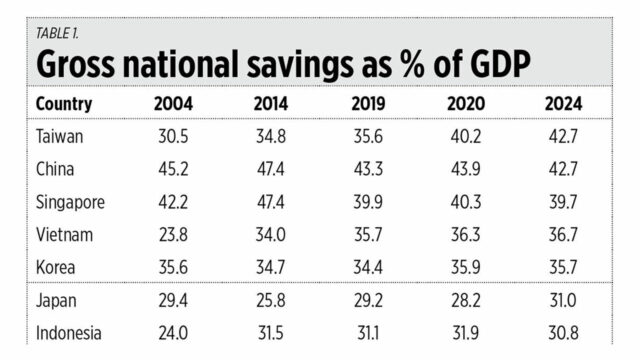
I checked the savings rate as a percentage of GDP (S/GDP ratio) and saw that the Philippines had somehow caught up with some East Asian neighbors like Hong Kong and Malaysia in 2019. But when the lockdown dictatorship happened in 2020, many people’s savings evaporated and now we have the lowest S/GDP ratio in Asia (see Table 1).

We need to devise ways to raise our S/GDP ratio. The newly enacted CMEPA (RA 12214) is one tool, and yet it encountered pushback due to misconceptions. Among these are the following:

1. The CMEPA taxes our bank savings. Wrong. It taxes only the interest income of our savings. For instance, savings of P100,000 in a bank earning, say, 0.8% a year, means an interest income of P800/year. A tax of 20% means a tax payment of only P160/year.

2. The 20% final withholding tax (FWT) on interest income is due to CMEPA. Wrong. That FWT is an old law under the National Internal Revenue Code of 1997 (28 years ago), charging a 20% final tax on interest earned from bank deposits with a maturity of less than three years. The tax on interest income for both savings and time deposits is now a uniform FWT of 20%. There is no more preferential treatment for wealthy depositors.

3. The CMEPA raises transaction costs for other investments. Wrong. It reduces transaction costs. Before, the Philippines had the highest Stock Transaction Tax (STT) on the sale or exchange of shares in the ASEAN at 0.6%. CMEPA reduced the STT to 0.1%, so investing in the Philippine Stock Exchange (PSE) becomes more cost-competitive.

My friend and fellow free marketer Eric Jurado, who owns The International Investor which manages the SeA (Southeast Asia) Focus Portfolio, has good data on the trading value in the stock markets of the ASEAN-6 in May this year. Looking at value in billion dollars and the number of listed companies, respectively, these are the results: Thailand, $25.2 billion, 857 companies; Singapore, $21 billion, 612; Vietnam, $17.9 billion, 699; Indonesia, $15.3 billion, 956; Malaysia, $12.1 billion, 1,056; and the Philippines, $3 billion, only 284 companies. With CMEPA, we hope that our country’s stock market would become as dynamic as Malaysia’s or Indonesia’s in a few years.

4. The CMEPA has raised other taxes. Wrong. It reduced the Documentary Stamp Tax (DST), or stamp duty on the original issuance of shares by corporations, from 1% to 0.75%. The equity side — sales tax has been reduced from 60 basis points to just 10 basis points.

5. The CMEPA discourages savings with new financial taxes. Wrong. The CMEPA encourages savings outside of time deposits, like the stock market or real estate investment trusts (REITs) where the tax is lower at 10% and is liquid, meaning the money can be pulled out any time and is not locked in for several years. Plus, there are other saving programs managed by the government like Pag-IBIG MP2 savings and Retail Treasury Bonds (RTBs), which are additional options for investment by the public.

6. Savings of OFWs like time deposit are taxed. Wrong. Savings of OFWs are exempted. In addition, the DST on Mutual Funds and Unit Investment Trust Funds (UITFs) — collective investment schemes which are popular among young professionals and middle-class savers, are now tax-exempt.

Bottomline, the CMEPA is a good law. It opens more savings and investment options for the public so they can build their wealth and retirement funds while removing the preferential rates for the very rich who can afford to park their money for several years at higher, untaxed, interest income.

US TARIFF AND PHILIPPINE EXPORTS
Continuing the 10 issues, here are the other four which are related to trade.

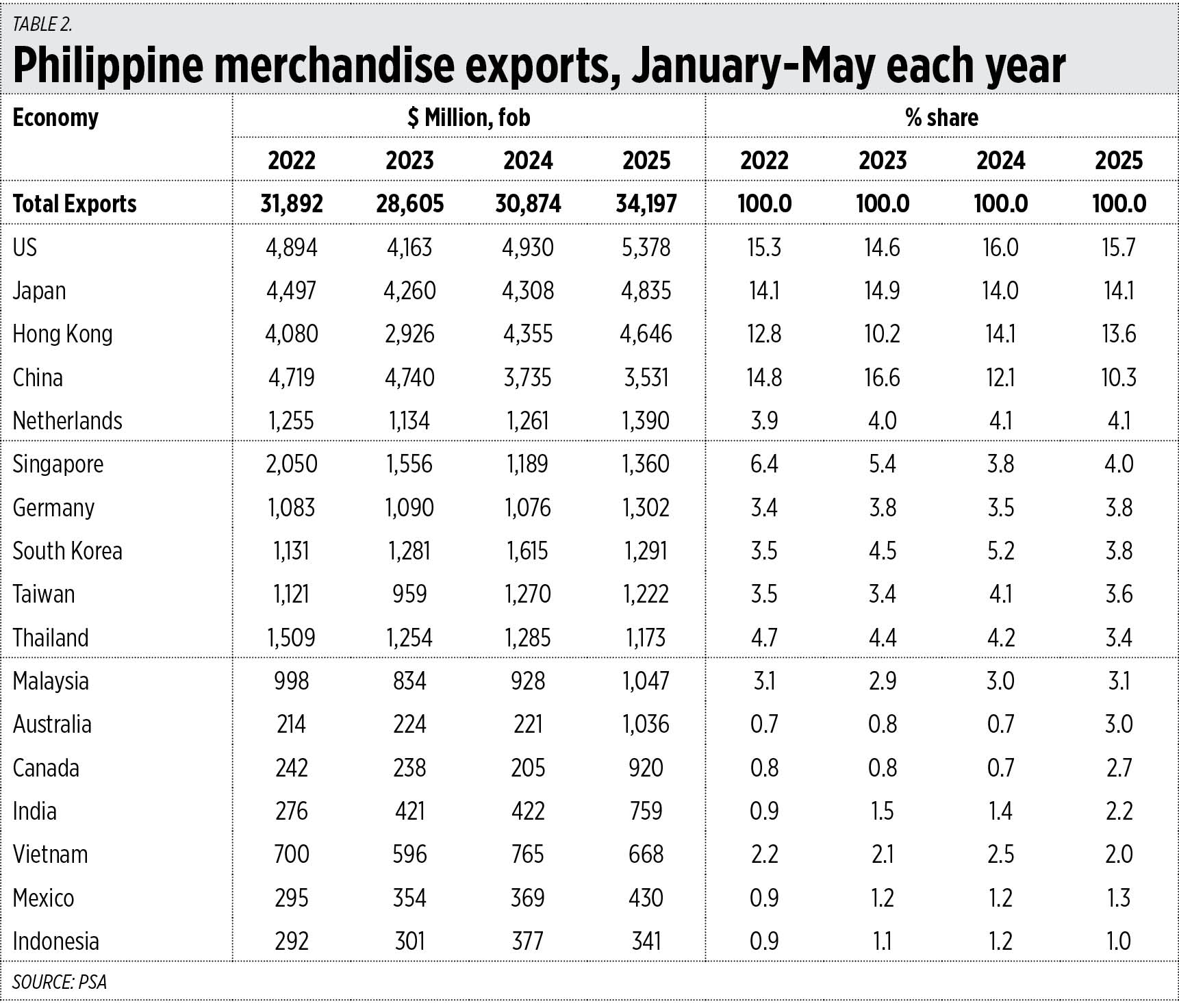
7. The US is the Philippines’ number one exports market. The latest data for January to May this year show that nearly 16% of our total exports went to the US, up from 15% in 2022 and 2023. Japan, Hong Kong, and China are the next three big destinations of our exports (see Table 2).

8. The US has imposed a 20% tariff on Philippine exports effective Aug. 1 which is next week. This is lower than the tariffs imposed on most East Asian nations but still high compared to the previous rate of below 10%.

9. The Philippines is ready to charge zero tariff on some US exports to us. Two recent reports in BusinessWorld are related to this: “Indonesia-US trade deal poses competition challenges for PHL” (July 16), and “PHL eyes zero tariffs on some US goods” (July 21).

Indonesia was earlier slapped with a 32% tariff, but after negotiations, this was brought down to 19% while US exports to Indonesia will be tariff-free. Finance Secretary Ralph G. Recto announced that we are ready to impose no tariffs for imports from the US as part of tariff negotiations with Washington. “Not for all products, but we have identified a set of products.” This is a good position.

10. Ultimately, we should push for free trade agreements (FTA) with the US and more countries, go for zero tariffs both ways and reduce non-tariff barriers.

There are net gains — the gains are larger than the pains — from lower taxes and from free trade. We should go for these.


Bienvenido S. Oplas, Jr. is the president of Bienvenido S. Oplas, Jr. Research Consultancy Services, and Minimal Government Thinkers. He is an international fellow of the Tholos Foundation.

minimalgovernment@gmail.com

Avida reports strong take-up, plans more suburban housing

AVIDA VERRA Settings Vermosa — AVIDALAND.COM

AVIDA LAND Corp., the mid-income residential brand of property giant Ayala Land, Inc. (ALI), is looking to build more homes outside Metro Manila amid stronger take-up at its ongoing developments there, it said.

“The company remains focused on launching more horizontal developments in high-demand areas across South and Central Luzon, prioritizing projects within ALI’s estates,” Aris Gonzales, Avida Land project and strategic management group head, said in an e-mailed reply to questions.

When expanding into a particular location, Avida Land ensures that the area is accessible via major transit routes, supports sustainable residential growth, and is close to essential lifestyle needs, according to Mr. Gonzales.

As of July, the 10-hectare (ha) Verra Settings Vermosa in Imus City, Cavite, is 97% sold, ALI said.

Parklane Settings Vermosa, Avida Land’s second residential development in the Vermosa area, has sold 92% of its inventory.

Under the 12-ha project, sectors one and two will be completed by June 2026, while sectors three and four will be finished by March 2027.

Likewise, Southdale Settings Nuvali in Laguna is 90% sold. The 20-ha residential development will be completed by January 2026.

Meanwhile, Crescela Nuvali, which offers modern contemporary homes within its 13.53-ha subdivision, has sold 38% of its inventory. Construction on the property will be finished by July 2028, Avida Land said.

“Crescela Nuvali, the newest residential project, has demonstrated robust demand, outperformed initial projections, and solidified the developer’s reputation for delivering high-value communities,” Mr. Gonzales said.

All four residential developments incorporate sustainability practices, he also said.

These include a 1:1 tree-planting ratio, where a new tree is planted whenever one is removed or affected.

To support waste management and urban greening, each development also features an eco-yard, composed of a plant nursery, composting facility, and materials recovery facility, Avida Land said.

Community layouts are also designed to optimize lot and amenity access, support residents’ well-being, and manage traffic flow, Mr. Gonzales said. Newer developments also have solar-powered streetlights in common areas.

“ALI estates are master-planned, mixed-use communities that emphasize connectivity, livability, and long-term value, making them ideal for future horizontal residential projects,” Mr. Gonzales said. — Beatriz Marie D. Cruz

Alan Bergman, great American lyricist, 99

ALAN BERGMAN with his wife Marilyn Bergman in 2002. — JOHN MATHEW SMITH/FLICKR

NEW YORK — Alan Bergman wrote a song with his future wife on the day they first met. Over the next 60 years they never stopped making music together.

Mr. Bergman was one half of one of the greatest American songwriting duos. The other was his wife Marilyn, who died in 2022.

Together, the couple wrote the lyrics for “The Way We Were” and “The Windmills of Your Mind,” tunes for the film Yentl, and the theme songs for 1970s television comedies Maude, Alice, and Good Times.

“It was a terrible song, but we loved the process,” Mr. Bergman said in 2011 of that first collaboration. “And from that day on, we’ve been writing together.”

The songwriting team went on to win three Oscars, four Emmys, and two Grammy awards, and to be inducted into the Songwriters Hall of Fame in 1980.

Their lyrics were set to the music of composers including Michel Legrand, Marvin Hamlisch, John Williams, and Quincy Jones. Singers ranging from Dean Martin and Frank Sinatra to Johnny Mathis, Barbra Streisand, and Sting recorded their songs.

Mr. Bergman died on Thursday, aged 99, family spokesperson Ken Sunshine told Reuters.

‘THAT’S THE ADVENTURE’
Mr. Bergman wrote his first song when he was 13 years old and continued to pen lyrics into his 90s, after his wife’s death. The song “Wherever I May Go (for Marilyn)” was a tribute to her.

“It’s such a deeply personal song,” composer Roger Kellaway told the San Francisco Classical Voice newsletter in 2022. “You could look at this, like, that’s how committed Alan is to the relationship and how committed he is to songwriting.”

Alan Bergman was born in September 1925 in Brooklyn, New York in the same hospital as his wife a few years later. But the couple didn’t meet until 1956 when they were introduced by the composer Lew Spence in Los Angeles.

Mr. Bergman studied at the University of North Carolina and completed a Master’s degree in music at the University of California, Los Angeles, where he met songwriter Johnny Mercer. Mr. Mercer, who wrote the lyrics of “Moon River” for the film Breakfast at Tiffany’s in 1961, became his mentor.

Despite his desire to write songs, Mr. Bergman first worked as a TV producer in Philadelphia. At Mr. Mercer’s urging he moved to California in the 1950s.

“I was writing both music and lyrics in those days, and he would listen to what I was writing and critique it and encourage me” Mr. Bergman told JazzTimes magazine last year. “I would not be here today without him. He was a great influence.”

Mr. Bergman liked to use a baseball analogy to explain the couple’s writing process — pitching and catching ideas back and forth.

He preferred to have the music before he began to write the lyrics. Composers would leave their compositions with the couple. They would then write words that fit the notes.

“We believe that words are at the tips of those notes and it’s our job to find them,” he told radio station NPR in 2011. “That’s the adventure.”

‘THE KIDS’
“Yellow Bird” was the duo’s first money-making song, but their big break came with Frank Sinatra’s 1960 album Nice ‘n’ Easy. The crooner became a friend of the couple. He referred to them as “the kids.”

They had another career breakthrough when they worked with composer and producer Quincy Jones in 1967 on the song “In the Heat of the Night” for the film of the same name.

They won their first Academy Award for best original song for writing “The Windmills of Your Mind” the following year, with Michel Legrand, for the film The Thomas Crown Affair. They were awarded another Oscar in 1974 for “The Way We Were” with Marvin Hamlisch, as well as a Grammy for Song of the Year in 1975.

In 1983, the couple were the first songwriters to have written three of the five Oscar-nominated songs. Two years later they took home their third Academy Award for Yentl, starring Barbra Streisand. The singer became a friend and frequent interpreter of their music.

Ms. Streisand recorded more than 50 of their songs. She released the album What Matters Most as a tribute to the Bergmans and their music.

“When she does our songs, she finds things that always surprise us,” Mr. Bergman told Reuters in 2011. “She deepens them. She gets all the nuances, everything, so it’s thrilling.”

The couple’s Emmys included awards for the TV movies Queen of the Stardust Ballroom (1975) and Sybil (1977), and the song “Ordinary Miracles” from the 1995 Streisand special Barbra: The Concert.

The couple married in 1958 and had one daughter.

Mr. Bergman said he loved songwriting. Doing it for so long with someone he loved made it that much more beautiful. — Reuters

ICCP: GSIS’ P1.45-B investment in Alternergy complied with regulations

ALTERNERGY.COM

THE P1.45-billion investment by state-run Government Service Insurance System (GSIS) in Alternergy Holdings Corp. complied with the “rigorous requirements” of regulators, according to the latter’s financial advisor, Investment & Capital Corp. of the Philippines (ICCP).

In a statement on Monday, ICCP affirmed that the redeemable preferred shares (RPS) offering to the institutional investor was conducted in accordance with corporate governance standards and existing securities regulations.

The RPS, an equity security specifically designed for investors seeking attractive and long-term fixed income yield, also complied with the rigorous requirements of the Philippine Stock Exchange, Inc. (PSE) and the Securities and Exchange Commission for its subsequent listing on the exchange in March last year, the advisor said.

“These transactions followed strict due diligence and compliance processes. We ensured transparency at every stage of these transactions in line with our commitment to ethical and professional standards,” said ICCP Chairman and Chief Executive Officer Valentino S. Bagatsing.

Mr. Bagatsing added that Alternergy reported to the PSE the payment of the first annual coupon on the RPS in December 2024.

In November 2023, GSIS subscribed to P1.45 billion worth of Alternergy’s perpetual preferred shares 2 Series A under a private placement.

“ICCP remains committed to providing trusted financial advisory services that enable companies like Alternergy to raise capital responsibly, supporting national objectives for energy security and sustainability,” the advisor said.

The statement follows a report saying that the Ombudsman imposed a six-month preventive suspension on GSIS President and General Manager Jose Arnulfo Veloso over GSIS’ investment in Alternergy. — Sheldeen Joy Talavera

Decoding hints that Xi Jinping may be under pressure to relinquish some of his power

CHINESE PRESIDENT XI JINPING — UN PHOTO/PIERRE ALBOUY/FLICKR

Political and economic pressures might force Chinese president and overall leader Xi Jinping to delegate some of his powers to his deputies in a highly significant move. This has prompted some observers and media outlets to speculate that Xi’s grip on power may be waning.

A major part of why this is happening is likely to stem from Xi’s difficulties in dealing with China’s economic woes, which began from a real estate crisis in 2021. For years, the Chinese Communist Party (CCP) has relied on providing economic prosperity to legitimize its rule over the country.

But the continuously lackluster performance of the Chinese economy over the past four years coupled with Trump’s trade war with Beijing is making recovery a difficult task. And this is likely to be a factor that undermines Xi’s rule.

These rumors about Xi started just after the latest meeting, on June 30, of the politburo (the principal policy making body of the party), which brings China’s top leaders together to make major decisions.

For people who don’t follow Chinese politics, the idea of Xi delegating some authority might seem nothing special. However, in understanding China, it’s important to understand that Xi has massive power, and it seems the politburo is signaling there are some changes on the horizon.

WHAT ARE THE CLUES?
Symbolism and indirect language play an important role in how the communist party communicates with Chinese people. The way it is done comes through slogans or key phrases, which are collectively known as “tifa           .”

This method of information is important since it shapes political language and debate, and influences how a Chinese, and international, audience understands what’s going on. At first glance, the politburo’s call for enhancing “policy coordination” and the “review process” of major tasks may appear to indicate that the central government is seeking to ensure local officials follow through with Beijing’s agenda.

But there is probably more to the politburo’s statement than meets the eye. The statement said that specialized bodies that exist within the party’s central committee, which includes the powerful commissions that Xi’s loyalists now hold, should focus on “guidance and coordination over major initiatives” and to “avoid taking over others’ functions or overstepping boundaries.”

For experienced China watchers there are hints here that this powerful decision-making body is making a veiled threat against Xi for holding on to too much power. But the opaque nature of China’s elite decision-making process, where a great deal of backroom politics occurs behind closed doors, means that decoding its messages isn’t always easy.

Because of all of this, there is increasing speculation that a power struggle is in progress. This isn’t entirely surprising given Xi’s purge of many senior party officials through anti-corruption campaigns and dominance over the highest levels of government is likely to have earned him many enemies over the years.

Another sign that all isn’t going well with Xi’s regime is the removal of some of his allies from key positions within the government. Xi began his anti-corruption campaign in 2012 when he became China’s leader. On paper, while officially framed as a drive to clean up corruption, evidence suggests that the campaign may have been used to remove Xi’s political rivals.

The problem for Xi is that the campaign is being used against his loyalists as well. In October 2023, defense minister Li Shangfu, who was considered a Xi ally, was sacked due to what was later confirmed in 2024 to be from due to corruption charges. But the dismissals of Xi loyalists continued.

Admiral Miao Hua, who was in charge of ideological control and personnel appointment within the armed forces and Xi’s associate since his days as a party official in Fujian province, was suspended from office in November 2024. And in June 2025, he was removed after being investigated for corruption.

The previous month, General He Weidong, who was vice-chairman of the powerful Central Military Commission, was arrested also for alleged corruption. Are the purges a consequence of Xi ceding ground to political rivals? This is a possibility.

But even if it weren’t and the purges are part of a concerted effort to stamp out corruption, Xi’s campaign will not only cast aspersions on his ability to appoint the right people into government, but also create a climate of fear among allies and potentially create further enemies. Either scenario puts Xi on the spot. But since Xi became China’s head of state in 2013, he and his loyalists have taken over leadership of many key national commissions, making him the most powerful Chinese leader since the time of Chairman Mao.

These commissions include the Central Financial Commission, which regulates China’s financial markets, the Central Science and Technology Commission, which aims to accelerate China’s technological progress, and the Central Cyberspace Affairs Commission, which regulates China’s digital content.

WHO IS ON THE UP?
But it looks like Xi is about to delegate some of his power, and there are some other decisions that may indicate a shift. For the first time since coming into power in 2012, Xi skipped the annual summit organized by the BRICS group (named after Brazil, Russia, India, China, and South Africa). Instead, from July 5 to 7 this year, Chinese premier Li Qiang, led a delegation to Rio de Janeiro.

This isn’t the first time that Li has represented Xi in high-profile conferences abroad. In September 2023, Li attended the G20 summit in New Delhi, India, and has taken part in ASEAN summits.

But the BRICS appearance alongside with Li’s increasingly prominent role in economic policy making may suggest that his influence is on the rise, while Xi’s is declining. Watch this space.

THE CONVERSATION VIA REUTERS CONNECT


Chee Meng Tan is an assistant professor of Business Economics at the University of Nottingham.

Peso slips as markets eye trade talks

BW FILE PHOTO

THE PESO slipped against the dollar on Monday as markets await developments on countries’ negotiations the United States ahead of the Aug. 1 deadline for its planned “reciprocal” tariffs.

The local unit closed at P57.175 per dollar, dropping by three centavos from its P57.145 finish on Friday, Bankers Association of the Philippines data showed.

The peso opened Monday’s session slightly stronger at P57.10 against the dollar. Its intraday best was at P57.06, while its worst showing was at P57.23 against the greenback.

Dollars exchanged went up to $1.36 billion on Monday from $1.31 billion on Friday.

The peso weakened slightly as the dollar continued to be supported by safe-haven demand as the Aug. 1 deadline for trade negotiations with the US draws closer, Rizal Commercial Banking Corp. Chief Economist Michael L. Ricafort said in a Viber message.

Several countries, including the Philippines, are moving to negotiate the Trump administration’s planned reciprocal tariff rates, which are set to take effect starting next one.

“The peso depreciated anew from the uptick in US consumer sentiment report last Friday, underscoring the persistent strength of the US economy,” a trader added in an e-mail.

US consumer sentiment improved in July and inflation expectations declined, but households still saw substantial risk of price pressures increasing in the future, the University of Michigan’s Surveys of Consumers released on Friday showed, Reuters reported.

For Tuesday, the trader said the peso could depreciate further ahead of potentially hawkish remarks from US Federal Reserve Chair Jerome H. Powell at the Integrated Review of the Capital Framework for Large Banks Conference in Washington, DC.

The trader expects the peso to move between P57.05 and P57.30 on Tuesday, while Mr. Ricafort said it could range from P57.05 to P57.25. — A.M.C. Sy

Metro Manila surpasses national average in internet usage

DESPITE HIGHER cybersecurity awareness, the number of individuals who fell victim to cyber incidents, such as text scams, phishing, and hacking, in the country doubled in 2024, the Philippine Statistics Authority (PSA) reported. Read the full story.

Metro Manila surpasses national average in internet usage

Developers told to spread risk across locations, segments

Davao City, Philippines — STOCK PHOTO | Image by Maynard Magallen from Unsplash

PROPERTY CONSULTANTS said Philippine developers should diversify their real estate portfolios across segments and locations to manage risks amid high vacancies.

“If you are a developer and all your assets are in one city, and the area where they are located is down, then your assets depreciate,” PRIME Philippines Founder and Chief Executive Officer Jettson P. Yu told BusinessWorld.

This comes as some areas within the commercial real estate sector have experienced “persistently high vacancies and falling rents,” a spokesperson for the International Monetary Fund said.

In particular, the Philippine capital continues to face an oversupply of condominiums, with 82,800 unsold units as of end-June, according to Leechiu Property Consultants.

For Mr. Yu, developers should also diversify their portfolio across various real estate segments to ensure stronger take-up.

“Real estate is always cyclical… it’s not all down. People just move,” Mr. Yu said.

Property developers should further expand their portfolio beyond the Philippine capital amid the ongoing “shift to suburbia,” said Joey Roi H. Bondoc, director and head of research at Colliers Philippines.

“While there’s a slowdown in Metro Manila, developers should look into other growth areas,” he said in an interview.

Mr. Bondoc cited key expansion areas such as Region III (Central Luzon), Region IV-A (Calabarzon), Region VI (Western Visayas), Region VII (Central Visayas), Region X (Northern Mindanao), and Region XI (Davao Region).

These regions, along with Metro Manila, account for more than 90% of the country’s total residential units.

“So, this is where growth is likely to come from, given the slower take-up in the capital region,” he added.

Mr. Bondoc also recommended that property developers take advantage of the rising demand for lot-only projects.

“We’ve noticed that price growth for condominiums has slowed or corrected,” he said. “But if there’s one property segment where we still see capital or price appreciation, it’s the lot-only segment.”

According to Mr. Bondoc, investors typically favor lot-only developments with green, breathable spaces and access to nearby golf courses.

“Imagine buying an upscale luxury condo in Metro Manila at P400,000 to P500,000 per square meter… In comparison, a lot-only unit in Bulacan, Batangas, or Pampanga costs around P20,000 to P30,000 per square meter,” he said.

The take-up rate for lot-only units outside Metro Manila averaged 52% to 97%, according to Colliers data. The provinces of Batangas, Cavite, Laguna, Pampanga, Cebu, Davao, and Bulacan posted take-up rates above 90%, while Tarlac recorded the lowest at 52%.

“If there is one important piece of advice we can give, it’s to look into the lot-only projects being launched by major national developers outside Metro Manila, especially if you’re banking on price appreciation,” Mr. Bondoc said. — Beatriz Marie D. Cruz

How PSEi member stocks performed — July 21, 2025

Here’s a quick glance at how PSEi stocks fared on Monday, July 21, 2025.


PHL suspends classes, gov’t work; 2 low-pressure areas being watched

RESIDENTS wade through heavy flooding along Araneta Avenue in Quezon City as the southwest monsoon continued to bring torrential rain on Monday. — PHILIPPINE STAR/ MIGUEL DE GUZMAN

By Kyle Aristophere T. Atienza and Sheldeen Joy Talavera, Reporters

THE PHILIPPINE government on Monday suspended classes and government work for Tuesday, July 22, as the country continued to reel from the effects of the southwest monsoon and Severe Tropical Storm Wipha (Crising), which left the Philippine landmass at the weekend.

The state weather bureau said it was monitoring two low-pressure areas (LPA) in the country’s north.

In a Facebook post, Interior and Local Government Secretary Juanito Victor C. Remulla, Jr., said classes in both private and public schools had been suspended in Metro Manila, Zambales, Bataan, Pampanga, Bulacan, Cavite, Batangas, Rizal, Pangasinan, Tarlac and Occidental Mindoro.

It would be up to private employers whether to suspend work, he added.

Communications Secretary Dave M. Gomez told Palace reporters Mr. Remulla was authorized to announce suspensions.

As of 2 p.m., the LPAs had a “medium” chance of developing into tropical depressions in the next 24 hours, the Philippine Atmospheric, Geophysical and Astronomical Services Administration (PAGASA) said in its afternoon weather bulletin.

In a separate report, the weather bureau said one LPA was seen about 1,220 kilometers east of southeastern Luzon, while the other was estimated at 405 kilometers east of Calayan, Cagayan.

PAGASA said the southwest monsoon remained the dominant weather system affecting large swaths of the country.

The National Disaster Risk Reduction and Management Council (NDRRMC) said at least five people died from the combined effects of Crising and the monsoon rains, up from two the previous day. At least seven people were still missing.

The tropical storm and monsoon rains have affected almost 900,000 people from about 226,000 families in 1,556 villages. More than 20,000 people from almost 6,000 families were staying in evacuation centers.

Flooding was reported in 138 areas, with 125 floods having subsided and 38 receding as of the latest data. Seven landslides were also recorded — one in Central Luzon, two in Calabarzon, one in Western Visayas and three in Central Visayas.

The agency said 1,234 houses were affected across multiple regions, including Ilocos, Cagayan Valley, Calabarzon, Western Visayas, Zamboanga Peninsula, Northern Mindanao, Davao, Soccsksargen, Caraga, Bangsamoro, Cordillera Administrative Region (CAR), and Negros Island. Of these homes, 299 were totally damaged.

Infrastructure damage reached P219.37 million, affecting 44 structures in Ilocos, Western Visayas, Northern Mindanao, Mimaropa and Cordillera.

FARM DAMAGE
The Department of Agriculture (DA) at the weekend estimated farm damage at P53 million in Western Visayas and Mimaropa. More than 2,000 farmers working on more than 2,400 hectares of land were affected.

“Floodwaters have submerged fields planted with rice, corn and other high-value crops,” the agency said. “Poultry and livestock operations have also suffered losses. Meanwhile, damage assessments in the fisheries sector are still under way.”

It said the National Food Authority (NFA) warehouse in Mindoro was affected by flooding. In response, the NFA has been releasing rice stocks to local government units and national agencies, with 500 sacks already distributed in Palawan, it added.

The Philippine Crop Insurance Corp. (PCIC) has been tasked to conduct rapid damage assessments in affected areas to fast-track insurance claim processing. “The PCIC has instructed its personnel to extend full assistance to affected farmers and expedite the processing of their damage claims,” the DA added.

The department said it might offer additional assistance to affected farmers and fisherfolk, such as agricultural inputs through its regional field offices, rehabilitation support under the quick-response fund and zero-interest loans of up to P25,000 payable in three years.

Meanwhile, parts of the Cordillera Administrative Region were still experiencing brownouts due to the combined impact of Crising and the southwest monsoon, the Department of Energy (DoE) said in a separate statement.

Power and fuel supply across the country had largely normalized, except in certain areas of CAR, where restoration efforts continued.

As of 10 a.m., three electric cooperatives remained under close monitoring — Benguet Electric Cooperative, Inc., Mountain Province Electric Cooperative, Inc., and Abra Electric Cooperative, Inc., based on the latest report from the National Electrification Administration.

“Restoration efforts are well under way, with power already restored in 37 of the 51 affected municipalities, energizing 5,487 customer connections, representing 72.55% of affected areas,” the DoE said.

“We are closely monitoring the situation and actively assisting our local distribution utilities,” Energy Secretary Sharon S. Garin said. “We urge all concerned entities to continue proactive clearing operations including the removal of debris and vegetation that may obstruct power lines to accelerate restoration in affected areas.”

The National Grid Corp. of the Philippines (NGCP) said its transmission facilities remained unaffected.

“All NGCP transmission facilities are currently under normal conditions,” it said in a statement. It was ready to operate its 24/7 command center if monsoon rains or other weather threats disrupt transmission, it added.

Controlled spilling operations were ongoing at Binga and Ambuklao Dams to manage high water levels, with discharges at 161.57 cubic meters per second (cms) and 78.74 cms, respectively.

Manila Electric Co. (Meralco) said about 11,000 customers, or less than 1% of its total customer base, experienced service interruptions as of noon.

Most of the affected households were in Cavite, Bulacan, and Rizal, with others in Metro Manila, Laguna, Batangas and Quezon.

“Our crews are continuously working to restore power service to affected areas as soon as possible,” Meralco Vice- President and Head of Corporate Communications Joe R. Zaldarriaga said in a separate statement. “We are closely monitoring the situation and urging our customers to continue observing electrical safety practices.” — with Chloe Mari A. Hufana


ADVERTISEMENT
ADVERTISEMENT