


Tesla Model Y and Model 3 on display at Power Plant Mall

TESLA PHILIPPINES is showcasing its latest product lineup — the new Model Y and the Model 3 — at the South Court of Rockwell Power Plant Mall up to July 27. Their electric vehicle (EV) technology will be on display, and various charging options will be highlighted during the showcase, “underscoring Tesla’s commitment to convenience and accessibility,” said the company in a statement.
The Model Y boasts a striking redesign that captures the essence of the Cybertruck while integrating cutting-edge technology and features designed for both excitement and safety behind the wheel. The Model Y starts with a price of P2.369 million and is available to order via Tesla Philippines’ official website. Visit https://www.tesla.com/en_PH/modely/design#overview.
Also to be displayed is the Model 3, whose Performance variant gets from a standstill to 100kph in 3.1 seconds and features a sporty aesthetic “tailored for the adventurous driver.” The Model 3 is also available to order on the Tesla Philippines official website with pricing starting from P2.109 million.
Test drives may be arranged through the event page. Tesla Philippines said the market is “embracing Tesla with enthusiasm, evidenced by over 1,500 units sold and delivered. This success encourages Tesla to expand its presence, allowing more individuals to explore their options for transitioning to electric vehicles.”
Interested parties can also visit the Tesla BGC Center at the Uptown Parade, Uptown Bonifacio, Taguig City and Opus Mall on Bridgetown Blvd. corner C5 Road in Quezon City. For more information, contact Tesla Philippines at (02) 8230-8850.
DoE exploring mechanisms to reallocate terminated service contracts
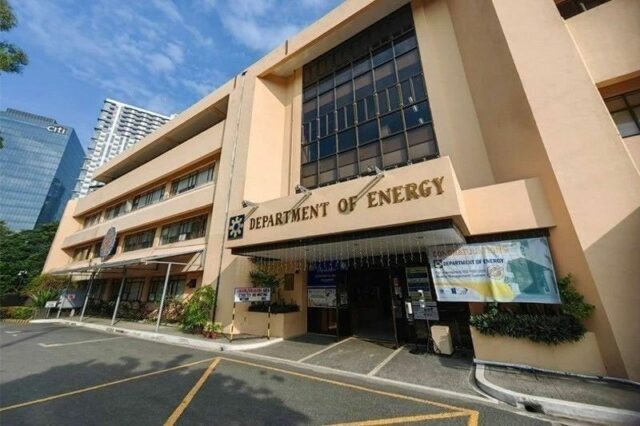
THE Department of Energy (DoE) is looking into creating a new mechanism to reassign terminated service contracts to remove the barriers in renewable energy (RE) development.
“Usually, our general policy, if terminated or relinquished, we do the Open and Competitive Section [Process] (OCSP),” Energy Assistant Secretary Mylene C. Capongcol told reporters last week.
“But we’re also looking at a possible new mechanism to avoid OCSP. Of course, it has to be the least cost, most efficient, and most beneficial to the country,” she added.
The DoE is exploring ways to reallocate terminated service contracts aside from OCSP as the scheme does not cater to solar power service contracts.
The OCSP is a mode for the selection and award of RE contracts particularly for pre-determined areas (PDAs) offered by the DoE through a bidding process. PDAs refer to locations with potential RE resources that are suitable for further development.
The government last conducted an OCSP in 2023 where it received 25 bids for geothermal, hydropower, and wind energy technologies.
Ms. Capongcol said the agency is actively monitoring contract holders’ performance to flag “sleeping” power projects.
“[Our goal] is to at least remove the barriers to RE development, so we can make use of the available space and increase the capacity in RE to help sustain our energy requirements,” she said.
“We’re not saying that RE will solve everything as far as the power supply but at least we can sustain the local or indigenous supply,” she added.
The Philippines is hoping to expand the share of renewable energy in the country’s power mix to 35% by 2030 and 50% by 2040.
As of February, the DoE has awarded a total of 1,411 service contracts, equivalent to a potential capacity of 154 gigawatts.
In October last year, the agency said that at least 105 renewable energy projects were being processed for termination due to “non-compliance” with project timelines.
Among the reasons cited for the delays was failure to obtain possessory rights or system impact studies, which poses a problem in linking the country’s grid system. — Sheldeen Joy Talavera
Nestlé to help restore parts of Brazil cocoa, coffee regions

SAO PAULO — Nestlé said it will undertake environmental restoration projects in partnership with reforestation startup re.green and chocolatier Barry Callebaut in Brazil, seeking to plant millions of trees in areas where it sources key ingredients.
The initiative is part of a wave of corporate investments scaling up Brazil’s reforestation industry and aligns with Nestle’s goal to achieve net zero by 2050, while restoring ecosystems in areas critical for cocoa and coffee production.
The companies said the two separate projects will plant 11 million trees across 8,000 hectares
The re.green project, designed to span 30 years, involves planting 3.3 million trees of native species from Brazil’s coastal Atlantic rainforest in the northeastern state of Bahia.
It is expected to generate 880,000 carbon credits.
The separate partnership with Barry Callebaut seeks to restore 6,000 hectares in the states of Bahia and Para, most of which will be converted into agroforestry systems with cocoa.
“These projects will support our decarbonization targets, but our sustainability strategy goes beyond carbon removal,” Nestlé Brasil’s Business Transformation and ESG Director Barbara Sapunar said.
“We want to regenerate areas in regions where we source ingredients. Environmental restoration increases the resilience of supply chains,” she added.
Re.green CEO Thiago Picolo said the initiatives showcase how companies can go beyond carbon offsetting and invest in restoring landscapes tied to their supply chains.
Brazil is the world’s largest coffee producer and exporter, as well as the world’s fifth-largest chocolate market.
Nestlé will fully fund the re.green project and cover 60% of costs for the Barry Callebaut initiative, it said. They are part of the company’s broader goal of planting 200 million trees by 2030 in regions where it sources ingredients such as coffee, cocoa and milk.
Re.green is backed by Brazilian billionaire Joao Moreira Salles and asset manager Gavea, founded by former Brazilian central bank governor Arminio Fraga. Swiss-based Barry Callebaut is the world’s top chocolatier. — Reuters
Vaccines help protect people with diabetes

Diabetes is one of the leading non-communicable diseases (NCDs) in the Philippines, with nearly 5 million Filipino adults diagnosed with the condition. In 2024, diabetes ranked as the fifth leading cause of death nationwide.
This chronic disease occurs when the body cannot produce or effectively use insulin. Left uncontrolled, diabetes can lead to devastating complications such as blindness, kidney failure, heart attack, stroke, and lower limb amputation.
As the country marks “Diabetes Awareness Week,” it is timely to highlight five key steps in managing the disease. First, engage in regular physical activity. Second, follow a healthy, low-fat, low-salt, fiber-rich diet. Third, take prescribed maintenance medications, including insulin, as prescribed by your doctor. Fourth, see your doctor regularly. Finally, stay up to date with your vaccinations.
Vaccination plays a vital yet often underappreciated role in diabetes management. People with diabetes have weakened immune responses, making them more vulnerable to infections. High blood sugar levels impair immune function and hinder the body’s ability to fight off disease-causing pathogens.
Respiratory infections, in particular, pose a serious risk. These can trigger spikes in blood sugar that may require hospitalization. Studies show that people with diabetes are twice as likely to die from influenza and more than four times more likely to develop pneumococcal disease compared to those without diabetes.
To address these risks, the Philippine Society of Endocrinology, Diabetes, and Metabolism (PSEDM) recommends the following vaccines for adults with diabetes: influenza vaccine, pneumococcal vaccine, Tdap (tetanus, diphtheria, pertussis) vaccine, hepatitis B vaccine, and herpes zoster (shingles) vaccine.
Vaccines have a measurable impact on health outcomes in people with diabetes. For example, flu vaccination has been shown to reduce flu- and diabetes-related hospitalizations. One study found that individuals with diabetes who received a seasonal flu shot were 66% less likely to require flu-related medical care.
Likewise, the pneumococcal vaccine helps prevent serious infections such as bacteremia (bacteria in the blood) and meningitis. Immunized individuals with diabetes have a lower risk of hospitalization or death due to pneumococcal disease.
Hepatitis B is another concern. People with diabetes face higher rates of hepatitis B infection, possibly due to shared glucose monitoring equipment or reduced immune protection. PSEDM recommends hepatitis B vaccination for diabetic adults under 60, and at a doctor’s discretion for those aged 60 and above.
Finally, the herpes zoster virus causes shingles, which tends to be more severe and prolonged in people with diabetes. They also have a higher risk of developing post-herpetic neuralgia, a painful condition that can last long after the shingles rash disappears. The recombinant zoster vaccine is recommended for those with diabetes aged 50 and older.
While vaccines are typically associated with infectious disease prevention, they also play a critical role in reducing the burden of chronic diseases like diabetes. Preventing infections in this population reduces complications, hospitalizations, and strain on the healthcare system.
This broader value of immunization is underscored in a 2022 policy report titled “From Protection to Prevention: The Power of Immunizing People Living with Diabetes” by the Health Policy Partnership, a UK-based research organization. Funded by the International Federation of Pharmaceutical Manufacturers and Associations, the report outlines a roadmap to protect individuals, health systems, and economies through adult immunization.
The study offers four strategic policy priorities. First is enable innovation by embedding vaccination into standard diabetes care pathways; and using innovative outreach and delivery models.
Second is mobilize investment by allocating prevention budgets to support adult immunization; and investing in data-driven approaches to maximize impact.
Third is drive implementation by increasing public awareness among people with NCDs.
It is also crucial to equip healthcare workers to provide consistent vaccine guidance, and to remove barriers to vaccine access.
Fourth is to ensure accountability by integrating immunization targets into national NCD frameworks. It is equally important to strengthen data systems to track and improve outcomes.
As we reflect on the toll of diabetes in the Philippines, we must expand our view of what it means to manage chronic illness. Vaccination is preventive care, not optional care, especially for those whose health is already compromised.
By protecting people with diabetes through timely immunization, we not only reduce their risk of serious infection, but also strengthen public health, reduce healthcare costs, and build a more resilient society.
Teodoro B. Padilla is the executive director of Pharmaceutical and Healthcare Association of the Philippines which represents the biopharmaceutical medicines and vaccines industry in the country. Its members are in the forefront of research and development efforts for COVID-19 and other diseases that affect Filipinos.
Peso may move sideways amid trade concerns

THE PESO could move sideways against the dollar this week as the market awaits developments in the United States’ negotiations with its trading partners regarding its planned import tariffs.
On Friday, the local unit rebounded after a four-day losing streak as it closed at P57.145 per dollar, strengthening by 14.5 centavos from its P57.29 finish on Thursday, data from the Bankers Association of the Philippines showed.
Week on week, however, the peso was down by 67.5 centavos from its P56.47 close on July 11.
The local unit rose on Friday on profit taking before the weekend, a trader said in a phone interview.
The market was also cautious as players looked ahead to the US Federal Reserve’s policy meeting on July 29-30 and the Trump’s administration’s Aug. 1 tariff negotiation deadline, the trader added.
Market optimism before President Ferdinand R. Marcos, Jr.’s scheduled trip to the US this week to negotiate the Philippines’ 20% tariff rate also supported the peso, Rizal Commercial Banking Corp. Chief Economist Michael L. Ricafort said in a Viber message.
The dollar also corrected slightly on Friday, which led to the peso’s rise, Mr. Ricafort added.
For this week, the peso may continue to move sideways as investors await developments related to the US’ tariff policies, the trader said.
The trader sees the peso moving between P56.80 and P57.30 per dollar this week, while Mr. Ricafort said it could range from P56.90 to P57.40.
The US dollar slipped against the euro on Friday but held on to weekly gains, as investors weighed expected Federal Reserve policy amid signs that tariffs may be starting to increase some inflation pressures and as US President Donald J. Trump continued to criticize Chair Jerome H. Powell, Reuters reported.
Data on Tuesday showed that consumer prices rose in June, though the increase was seen as moderate. Wednesday’s producer price inflation report showed that prices were steady last month.
Mr. Powell has said he expects inflation to rise this summer as a result of Mr. Trump’s tariff policies. His comments have pushed out expectations of when the US central bank is likely to cut interest rates.
But the labor market is showing signs of weakness even as headline job gains and the unemployment rate remain relatively solid.
Fed Governor Chris Waller said on Friday that he favors a rate cut at the July meeting because he feels tariffs are likely to have a limited impact on inflation. Mr. Waller added that underlying data “are not indicating a super healthy private sector labor market,” and the Fed should “get ahead” of a possible hiring slowdown.
Mr. Powell is facing almost daily criticism from Mr. Trump over the Fed’s reluctance to cut rates. The dollar tumbled on Wednesday on reports that Mr. Trump was planning to fire the Fed chair, but rebounded after Mr. Trump denied the reports. Mr. Powell’s term will end in May.
Fed funds futures traders are pricing in 46 basis points (bps) of cuts by yearend, implying that two 25-bp cuts are seen as most likely, with the first coming in September.
The dollar index was roughly flat on the day at 98.49, and was on track for a 0.65% weekly gain.
The euro was last up 0.22% at $1.1621 but was headed for a weekly drop of 0.59%.
The euro pared gains after the Financial Times reported that Mr. Trump is pushing for a minimum tariff of 15% to 20% in any deal with the European Union.
The Japanese yen was slightly lower against the greenback heading into Sunday’s upper house election. The dollar gained 0.1% to 148.75 yen and was on track for a weekly gain of 0.93%. — Aaron Michael C. Sy with Reuters
How PSEi member stocks performed — July 18, 2025
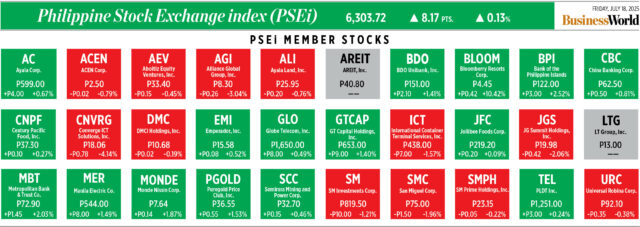
Here’s a quick glance at how PSEi stocks fared on Friday, July 18, 2025.


Experts urge HPV vaccine upgrade as new high-risk strain emerges

Health experts calling for the adoption of a more comprehensive nonavalent human papillomavirus (HPV) vaccine after a recent local study found that a different cervical cancer-causing strain, one not covered by the commonly used vaccine, is emerging to be the most dominant type affecting Filipino women.
The findings of the local study DEFEAT HPV show that, among the 1,100 women surveyed from 2022 to 2024 in urban Tondo, Manila, and rural Naic, Cavite, the proportion who tested positive for HPV was high at 15.1% and 12.8%, respectively.
Among the women who tested positive, 52% were found to have HPV-52, a high-risk type of the virus that is not covered by the widely used quadrivalent vaccine.
It has already toppled the same high-risk HPV (HR-HPV) types 16 and 18, which have traditionally been the most prevalent strains targeted by the quadrivalent vaccine.
“So, in our old data in the Philippines… we saw in the 1998 study that HPV-52 was not that common. But in the current study, we saw that HPV-52 is even more common in the community compared to HPV-16,” Dr. Ourlad Alzeus G. Tantengco, the head of the study, told BusinessWorld on the sidelines of the study’s presentation last Monday.
Mr. Tantengco also said that HPV-52 was found to persist even after 12 months in four out of five women infected with the strain, leading to a ninefold increase in the risk of cervical cancer.
“Persistence is the main risk factor for developing cervical cancer,” Mr. Tantengco said. “If we ignore these prevalent but uncovered strains, we risk leaving thousands of women unprotected.”
“And this is why, in terms of vaccination, we really need to cover these other genotypes,” he added.
Currently, the country’s National Immunization Program (NIP) only administers the quadrivalent HPV vaccine, which covers high-risk types 16 and 18, and low-risk types 6 and 11.
Given the results of the study, Mr. Tantengco is calling for the use of the more comprehensive nonavalent vaccine, which covers nine HPV strains, including HPV-52.
“We’re using vaccines that don’t match the real-world data anymore,” Mr. Tantengco said. “The nonavalent vaccine, which covers nine genotypes including HPV-52, offers the broadest and most relevant protection for Filipinas today.”
According to the World Health Organization (WHO), to achieve herd immunity against HPV, the country must vaccinate at least 90% of eligible girls with at least one dose of the HPV vaccine before they turn 15 years old.
It also recommends that 70% of women be screened for cervical cancer by ages 35 and 45, and that 90% of those diagnosed receive timely treatment. – Edg Adrian A. Eva
Multiple sexual partners heighten risk of cervical cancer-linked HPV

Each additional lifetime sexual partner raises the probability of acquiring a high-risk strain of human papillomavirus (HPV) — closely associated with cervical cancer — by nearly 11%, according to expert findings. HPV is a prevalent sexually transmitted infection comprising over a hundred related viruses, some of which can lead to serious health complications.
During the presentation of the Defeat HPV study on Monday, community physician Dr. Ourlad Alzeus G. Tantengco said that the risk of acquiring high-risk HPV increases by 10.91% with each additional lifetime vaginal sex partner, and by 10.58% with each additional oral sex partner.
“Kung dalawa yung partner mo, then tumaas na ng 11%. Kapag nadagdagan ng isa, tataas na naman siya. So, pataas siya nang pataas as you increase your number of vaginal sex partners [So, if you’ve had two partners, then your risk has already increased by 11%. If you add one more, it will increase again. So, it keeps going up as you increase the number of your vaginal sex partners],” Mr. Tantengco said.
High-risk HPV types, such as 16, 18, and 52, are known to persist in the body longer than most common HPV genotypes and can increase a woman’s risk of developing cervical cancer by about 9 times, Mr. Tantengco’s said, based on his earlier studies.
Meanwhile, for women who delay their sexual debut, the risk of acquiring high-risk HPV decreases by about 5.44% for each year of delay.
The World Health Organization recommends immunizing girls aged 9 to 14 years old with the HPV vaccine, ideally before their sexual debut, to ensure the vaccine’s optimal effectiveness.
Vaccines like the commonly available quadrivalent HPV vaccine can offer up to 95% protection against high-risk HPV types such as 16 and 18, and also provide protection against low-risk types 6 and 11.
Meanwhile, the more expensive nonavalent HPV vaccine offers broader protection by covering nine HPV types, adding types 31, 33, 45, 52, and 58 to those already included in the quadrivalent vaccine.
According to a 2022 report by the World Health Organization (WHO), the Philippines fell short of reaching even 33% coverage toward the target of vaccinating 90% of eligible girls with at least one dose of the HPV vaccine.
To expand the country’s HPV vaccine coverage, Mr. Tantengco said that local government units (LGUs) must demonstrate strong political will to bridge these vaccines to more women.
“Yung mga LGUs, may kapangyarihan sila to decide sa mga health programs na meron sila in their municipalities [LGUs have the authority to decide on the health programs they implement in their municipalities],” he said.
He added that if more LGUs have done it, others can probably do it as well. – Edg Adrian A. Eva
TikTok highlights safety features to protect Filipino teens online
TikTok, one of the go-to social media applications of Filipinos, has laid out its initiatives and in-app safety features to ensure the protection of teenagers while using the platform.
Launched in 2020, the platform’s Family Pairing feature enables parents or guardians to connect their account with their teenage kin, providing tools to oversee and support their app usage and digital experience.
“What we want to do is empower these guardians to utilize safety tools and resources, and to have conversations with their teens about good digital habits and digital literacy skills,” Bea Bautista, communication head of TikTok Philippines said during the platform’s panel discussion on Tuesday.
Using the feature, parents can adjust account settings, such as setting screen time limits, filtering inappropriate content on the ‘For You Page’ (FYP), restricting direct messaging (especially for users under 16), and enabling other safety controls.
TikTok is also actively monitoring content that violates its community guidelines, including issues such as artificial intelligence (AI), online gambling, and sexual exploitation involving minors.
“We require all AI-generated content to be labeled as such so that users, no matter their age, especially teenagers who are only beginning to develop their discernment, are able to see, ‘Oh, I’m interacting with content that is AI-generated,” Peachy A. Paderna, public policy manager of TikTok Philippines said.
“If it’s not labeled, then it doesn’t follow our guidelines, and we take action on content like that,” she added.
For online gambling, which has recently come under public scrutiny, TikTok is also taking measures within its community guidelines, such as not allowing content that provides links to gambling services and restricting gambling-related content from being promoted to users under 18 years old.
Ms. Paderna said that for its content moderation, the platform has a stringent system that combines automated and human detection.
In the first three months of 2025, TikTok reported that it removed around 4.5 million videos in the Philippines for violating its community guidelines.
To further help Filipino youth navigate the social media space, Ms. Bautista said that more digital literacy programs are in the platform’s pipeline. One of these is the upcoming launch of the #ThinkTwice campaign 2.0, a program that encourages TikTok users to think critically before posting or engaging with content. She has not provided a specific launch date. – Edg Adrian A. Eva
PSEi seen range-bound with PHL-US talks in focus

PHILIPPINE shares may move sideways this week amid a lack of fresh leads and as the market awaits updates on President Ferdinand R. Marcos, Jr.’s trip to the United States, where he is scheduled to meet with US President Donald J. Trump as part of efforts to negotiate the country’s 20% reciprocal tariff rate.
On Friday, the bellwether Philippine Stock Exchange index (PSEi) halted its three-day slide as it rose by 0.13% or 8.17 points to close at 6,303.72, while the broader all shares index went up by 0.35% or 13.14 points to 3,736.28.
Week on week, however, the PSEi was down by 2.42% or 156.16 points from its 6,459.88 finish on July 11.
“The PSEi briefly breached the 6,500 level during the week before concerns were raised on the US’ 20% tariff on Philippine exports,” online brokerage 2TradeAsia.com said in a market note.
“The PSEi corrected slightly higher [on Friday] ahead of the US trip of President Marcos to meet US President Trump that could include negotiations towards a possible trade deal,” Rizal Commercial Banking Corp. Chief Economist Michael L. Ricafort said in an e-mail.
Mr. Marcos headed to the US on Sunday to meet with Mr. Trump. Besides trade discussions, the two heads of state will also talk about closer cooperation in defense and security matters.
For this week, the market could take its cue from the Trump-Marcos meeting, Unicapital Securities, Inc. Equity Research Analyst Peter Louise D.C. Garnace said in a Viber message.
“We anticipate range-bound trading in the local bourse this week amid the lack of strong catalysts,” Mr. Garnace said.
“On the local front, we see investors positioning ahead of President Marcos’ State of the Nation Address on July 28. Furthermore, investors will also be closely monitoring corporate results as the second quarter earnings season kicks off,” he added.
He said they expect the PSEi to trade at the 6,300 to 6,400 range this week.
Mr. Ricafort put the PSEi’s immediate support at 6,105-6,200 and immediate resistance at 6,500.
For its part, 2TradeAsia.com placed the index’s immediate support at 6,300 and resistance at 6,500-6,550.
“Beyond the upcoming earnings cycle, attention should pivot towards the potential for robust growth stories into 2026. Outsized spending plans, particularly in infrastructure, are poised to be significant catalysts, with further anticipated Bangko Sentral ng Pilipinas rate cuts potentially prompting a follow-on wave of private capital expenditure,” it said.
“The market’s dance between sectors enjoying revenue momentum plus domestic policy tailwinds versus those exposed to external trade frictions or regulatory shifts has yet to crest. Position accordingly and catch the wave,” it added. — Revin Mikhael D. Ochave
Doubts raised about proposed BSP curbs on online gambling

By Luisa Maria Jacinta C. Jocson, Senior Reporter
THE proposed rules floated by the Bangko Sentral ng Pilipinas (BSP) to regulate the participation of payments services in online gambling are unlikely to change problematic behavior among gamblers, according to a senior lawyer.
Geronimo Law founder and Managing Lawyer Russell Stanley Q. Geronimo said in a commentary that some of the institutional compliance provisions of the BSP circular “while necessary, are unlikely to change or curb harmful gambling behavior among vulnerable users or alter the supply-side conditions that enable it.”
The BSP recently released a draft circular to regulate the payments side of online gambling to deter the misuse of financial services.
The booming gaming industry in the Philippines is now drawing heightened scrutiny amid concerns over rising addiction and financial problems.
The Department of Finance (DoF) has proposed a tax on online gaming, as well as other possible measures to crimp the public’s access to digital gambling platforms, such as imposing limits on cash-in.
Under the BSP’s proposed circular, these regulations could cover payment service providers (PSPs) engaged in these services as well as operators of a payment system (OPSs) serving as payment acquirer or aggregator of the online gambling operator.
“Notably, only one out of ten substantive provisions in the draft circular directly addresses player-level transaction restrictions,” Mr. Geronimo said.
He said the other provisions focus on institutional compliance, onboarding procedures, and reporting obligations.
“I have no doubt that the largest payment providers have the financial and legal resources to meet these requirements. Likewise, the most established gambling operators already maintain compliance departments and legal teams capable of adapting to the draft circular’s proposed framework.”
The central bank would require PSPs to provide a facility for the creation of a separate online gambling transaction account (OGTA) for eligible account holders.
Under the draft rules, the transfer of funds to the OGTA will be subject to a daily limit that should not exceed 20% of the average daily balance (ADB) of the eligible owner’s transaction account. Incoming fund transfers beyond this limit must be rejected by the PSP.
Mr. Geronimo said the 20% limit is a “weak and ineffective deterrent.”
“Low-income users, who are most at risk, often maintain small balances (e.g., P500 to P1,000).” These users could still gamble P100 to P200 per day, he said, which would still be a “substantial portion” of the daily minimum wage.
“For low-income users living on tight daily budgets, gambling P100 to P200 a day can mean skipping meals, delaying utility payments, or forgoing transport to work.”
“At that scale, it directly undermines household stability and financial resilience. What may appear modest in absolute terms is, in relative terms, economically destabilizing for the poor.”
In place of the 20% limit, Mr. Geronimo recommended introducing tiered transaction limits with absolute caps tied to user verification and financial capacity.
“The current one-size-fits-all 20% of ADB cap fails to distinguish between users with vastly different financial profiles,” he said.
“Users should be classified into tiers based on the depth of identity verification and proof of income or economic standing. Each tier should have corresponding limits on OGTA funding,” he added.
Meanwhile, Mr. Geronimo also noted the provision on PSPs setting a transaction window within which online gambling payment services could be offered.
This transaction window should not exceed six hours per day, according to the draft circular. He said this measure “does little” in curbing gambling behavior.
“Limiting gambling payments to a six-hour daily window does not reduce the total volume or intensity of gambling; it merely compresses it into a narrower time band,” he said.
“Users with compulsive behavior or high intent to gamble will simply adjust their activity to match the permitted window. Moreover, the rule does not prevent multiple PSPs or platforms from offering overlapping windows, effectively nullifying the time-based restriction.”
In place of the six-hour window, Mr. Geronimo said the BSP can opt for “controls based on transaction frequency and fund velocity, which better capture compulsive or high-risk usage.”
He also pointed out that some definitions in the draft rules should be more clear and uniform, such as the term “heavy usage.”
Under the proposed regulations, “in cases of heavy usage of the online gambling payment service, as defined by the PSP concerned, a 24-hour cooling off period shall be implemented.”
“This undermines the credibility of the provision and creates a clear conflict of interest and moral hazard,” he said.
“PSPs, particularly those that benefit from high transaction volumes, have no commercial incentive to define or enforce heavy usage rigorously. As a result, this mechanism risks becoming purely formalistic or inconsistently applied.”
“Heavy usage” could be measured by cumulative OGTA top-ups exceeding P2,000 or more than 10 gambling-related transactions, he added.
“The absence of a BSP-prescribed threshold also invites regulatory arbitrage, where the same behavior may be treated differently depending on the platform,” he said.
Mr. Geronimo also recommended several other enhancements to the draft circular, such as revising the disabling of lending options within the platform to be more clear and strengthen the self-imposed limits and user-initiated safeguards.
“Several key protections (such as the option to disable OGTA, pop-up alerts, and advertising restrictions) are embedded as part of a policy document rather than mandated as industry-wide technical implementations,” he said.
“This approach lacks enforceability and risks being reduced to boilerplate compliance without real operational impact.”
The draft is open for public comment until July 25.