FILIPINO FIDE MASTER Christian Gian Karlo Arca got slowed down in his bid for a Grandmaster (GM) norm after he drew with countryman International Master (IM) Pau Bersamina after seven rounds of the Bangkok Chess Club Open in Thailand on Saturday.
The 16-year-old Mr. Arca came out a pawn up in the opening phase of their King’s Indian Attack duel but failed to convert it into an edge before forcing a 41-move draw by repetition.
That kept Mr. Arca stranded in a group at No. 4 with 5.5 points, which included Mr. Bersamina and another countryman, IM Michael Concio, Jr., a 63-move winner over Chinese Zhang Haoxuan in a Queen’s Pawn London System.
But the Panabo, Davao del Norte bet could still earn a GM norm if sweeps his last two games, including one versus Indian GM Surya Shekhar Ganguly in the eighth and penultimate round.
Mr. Arca could settle for an IM norm — his third if it happens — if he could just get a point. — Joey Villar
RICO HOEY failed to make headway on moving day, submitting one-under 71 to find himself eight down in the Corales Puntacana Championship on Saturday in the Dominican Republic.
After a 68-68 opening, the Filipino PGA Tour campaigner turned in a two-birdie, one-bogey round at the Corales course of Puntacana Resort en route to a 54-hole aggregate of nine-under 207.
With his third-round card, which also featured several scrambling pars, the ICTSI-backed golfer climbed two spots to a share of 15th entering the Easter Sunday final push.
However, Mr. Hoey remained eight strokes off Joel Dahmen, who despite slowing down with a 71 after sizzling bogey-free performances of 62 and 66, stayed at the summit at 17-under 199.
Mr. Dahmen, who salvaged a one-under for the day with birdies on Nos. 12 and 13, grabbed a three-shot lead against fellow Americans Chan Kim (69) and Michael Thorbjornsen (70) and South African Garrick Higgo (70), who are tied at 202.
One shot back at 203 are Vince Whaley of the US (66), Jeremy Paul of Germany (67), and Ben Martin of the US (67). — Olmin Leyba
As expected, the Hyde side of Russell Westbrook made a number of appearances just when the Nuggets would have benefited from prudence on Sunday. For instance, he saw fit to attack a double team with the time winding down in regulation when the much better option would have been to give the ball back to an open Nicola Jokic. And then, with about a minute and a half left in overtime, he took a heavily contested shot in the paint after an offensive rebound; never mind that they were then leading by three and in prime position to milk the clock for a superior stab at the basket.
In the aftermath, interim head coach David Adelman acknowledged Westbrook’s capacity to impact matches both ways. “Russ is Russ… Offensively, a couple of times I thought he attacked, maybe we could have pulled it out and executed. But that’s what Russ does. He’s going to play in attack mode. I don’t think he’s going to change after 17 years.” And on Sunday, he made his fair share of contributions to help the Nuggets claim Game One of their first-round playoff series versus the Clippers. His was the corner three that gave them the lead in the final minute of regulation — and, yes, that enabled them to survive his last-second gaffe. And his was the defensive gem that forced a turnover with 9.1 ticks left in the extra period to clinch the win.
For those on the outside looking in, Westbrook’s stat line told much of the story: 15 points (on five-of-17 shooting from the field) along with eight rebounds, three assists, and two steals in 34 minutes of action. And to argue that he was all over the court, literally and figuratively, would be to understate the obvious. He is best described as a human roller-coaster ride, one that has had several franchises, including the Clippers, surrender in frustration. On Sunday, the latter only too willingly gave him space to take jump shots from the perimeter, what with simple mathematics supporting the contest-wide gamble.
Perhaps the Nuggets would themselves be tempted to abandon the Westbrook experiment if armed with a choice. As things stand, they have none in light of their shallow bench and the evident regression of starter Michael Porter Jr. In other words, they’re banking on Jokic to get a fellow Most Valuable Player awardee to toe the line — at least enough to deem him a net positive. On Sunday, the risk paid off. It’s anybody’s guess as to whether it will do so throughout the postseason.
Anthony L. Cuaycong has been writing Courtside since BusinessWorld introduced a Sports section in 1994. He is a consultant on strategic planning, operations and human resources management, corporate communications, and business development.
The US Supreme Court is seen in Washington, US, May 2, 2022. — REUTERS
WASHINGTON — The US Supreme Court on Saturday temporarily barred the Trump administration from deporting a group of Venezuelan migrants it accused of being gang members under a rarely used wartime law, but the government urged the justices to lift their order.
The court issued the decision after lawyers for the American Civil Liberties Union (ACLU) asked it to intervene on an emergency basis, saying dozens of Venezuelan migrants faced imminent deportation without the judicial review the justices previously ordered.
“The Government is directed not to remove any member of the putative class of detainees from the United States until further order of this Court,” the justices said earlier in a brief, unsigned decision.
Conservative Justices Clarence Thomas and Samuel Alito publicly dissented from the decision, issued around 12:55 a.m. (0455 GMT).
The Trump administration filed a response on Saturday afternoon urging the justices, once they review the matter further, to formally reject the ACLU’s request on the migrants’ behalf.
The White House responded that President Donald J. Trump would stay the course in his immigration crackdown but gave no immediate indication that the administration would defy the Supreme Court, appearing for now to avert a potential constitutional crisis between coequal branches of government.
Although it was unclear where the Venezuelan migrants were headed, the Trump administration already has deported to a maximum-security prison in El Salvador more than 200 Venezuelan and Salvadoran men it claims are gang members.
The deportees included Kilmar Abrego Garcia, a Salvadoran immigrant whom the administration admitted was removed by mistake, igniting an outcry over its immigration policy.
Many of the migrants’ lawyers and family members say they were not gang members and had no chance to dispute the government’s assertion that they were.
“We are confident in the lawfulness of the Administration’s actions and in ultimately prevailing against an onslaught of meritless litigation brought by radical activists who care more about the rights of terrorist aliens than those of the American people,” White House Press Secretary Karoline Leavitt said in a statement.
The case has raised questions about whether Mr. Trump, who has shown a willingness at times to defy court decisions since returning to office on Jan. 20, will comply with limits set by the nation’s highest court.
MEN LOADED ABOARD BUSES The high court majority issued Saturday’s stay after ACLU lawyers filed urgent requests for immediate action in multiple courts, including the Supreme Court, after reporting that some of the men already had been loaded aboard buses and were told they were to be deported.
The ACLU said the administration was poised to deport the men using a 1798 law that historically has been employed only in wartime without affording them a realistic opportunity to contest their removal — as the Supreme Court had ordered.
US Solicitor General D. John Sauer, in a written filing, asked the court to lift its temporary order halting the deportations to first allow lower courts to resolve the “adequacy of notice that designated enemy aliens receive.”
Barring that action, Mr. Sauer wrote, the court should clarify its order to say that it “does not preclude the government from removing detainees pursuant to authorities other than the Alien Enemies Act.”
Mr. Sauer said the government provided advance notice with “adequate time” to the detainees prior to starting deportations — though he did not say how much time was given.
Lee Gelernt, the ACLU’s lead attorney in the case, said in a statement earlier on Saturday: “These men were in imminent danger of spending their lives in a horrific foreign prison without ever having had a chance to go to court. We are relieved that the Supreme Court has not permitted the administration to whisk them away the way others were just last month.”
In an audio recording posted on TikTok, several men said they were Venezuelans falsely accused of being gang members and held at Bluebonnet immigration detention center in Texas. They said they were taken by bus to a regional airport late on Friday but then returned.
The recording has not been verified by Reuters. An earlier post on TikTok from the same account was cited in court filings on Friday.
More than 50 Venezuelans had been scheduled to be flown out of the country — presumably to El Salvador — from the immigration center, the New York Times cited two people with knowledge of the situation as saying.
Among the detainees was Diover Millan, 24, a Venezuelan who came to the US in 2023, had no criminal record and was granted temporary protected status, according to his wife, who declined to give her full name for fear of retaliation.
“I’m scared,” she said her husband, who was arrested in Atlanta last month, told her. The men were told they would be being taken to the CECOT prison in El Salvador but the bus turned back after one of the officials got a phone call, she said.
Elected last year on a promise to crack down on migrants, Trump invoked the 1798 Alien Enemies Act in a bid to swiftly deport accused members of Tren de Aragua, a criminal gang originating from Venezuelan prisons that his administration labels a terrorist group.
Mr. Trump and his senior aides have asserted their executive power grants them wide authority on immigration matters, testing the balance of power between branches of government.
The administration scored one victory on Friday when an appeals court put on hold a threat by District Judge James Boasberg of contempt charges.
Mr. Trump previously called for Boasberg’s impeachment following an adverse ruling, prompting a rare rebuke from US Chief Justice John Roberts.
HABEAS CORPUS RELIEF The Venezuelans’ deportation would be the first since the Supreme Court’s 5-4 ruling that allowed removals under the 1798 law while specifying that “the notice must be afforded within a reasonable time and in such a manner as will allow them to actually seek habeas relief in the proper venue before such removal occurs.”
Habeas corpus relief refers to the right of detainees to challenge the legality of their detention. It is considered a bedrock right under US law.
The Supreme Court did not indicate how much notice should be provided. Lawyers around the country have asked that the migrants be given 30 days’ notice to allow them to contest their deportations.
Asked about the planned deportations on Friday, Mr. Trump said he was unfamiliar with the particular case but added: “If they’re bad people, I would certainly authorize it.”
“That’s why I was elected. A judge wasn’t elected,” he told reporters at the White House. — Reuters
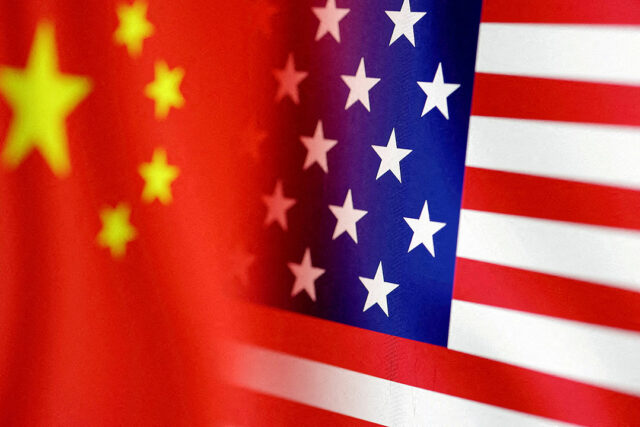
US and Chinese flags are seen in this illustration. — REUTERS
CHINA’S ambassador to the United States, Xie Feng, has urged Washington to seek common ground with Beijing and pursue peaceful coexistence while warning that China stood ready to retaliate in the escalating trade war.
Speaking at a public event in Washington on Saturday, details of which were posted on the Chinese embassy’s website, Mr. Xie said tariffs would devastate the global economy and drew a parallel between the Great Depression and tariffs imposed by the US in 1930.
Referring to concepts in traditional Chinese medicine like the need to balance the opposing forces of yin and yang, Mr. Xie said harmony should guide relations between the world’s two largest economies.
“A good traditional Chinese medicine recipe usually combines many different ingredients which reinforce one another and creates the best medical effect,” he said.
“Likewise, the earth is big enough to accommodate both China and the US,” he said. “We should pursue peaceful coexistence rather than collide head-on, and help each other succeed rather than get caught in a lose-lose scenario.”
The trade war has all but frozen the mammoth trade between the world’s two largest economies with tariffs over 100% in each direction and a suite of trade, investment and cultural restrictions.
China’s top shipbuilding association on Saturday attacked a US plan to apply port fees on China-linked ships.
While Japan, Taiwan and others are already in talks or preparing to negotiate with Washington over President Donald J. Trump’s “Liberation Day” tariffs, there is currently no high-level dialogue planned with China.
Mr. Trump said on Friday the US is having good conversations privately with China amid the two countries’ trade war.
“By the way, we have nice conversations going with China,” he told reporters at the White House. “It’s, like, really very good.” He did not offer additional details.
China has said the US should show respect before any talks can take place.
Mr. Xie said China opposed the trade war and would retaliate to any country imposing tariffs on it. — Reuters
A HANDBAG is displayed at a Louis Vuitton store in Bordeaux, southwestern France. — REUTERS
PARIS — European governments urgently need to ease tensions with the United States over President Donald Trump’s tariffs, LVMH Chief Executive Officer Bernard Arnault said on Thursday, adding it would be “Brussels’ fault” if no solution is found.
“European countries should try to manage these negotiations, and not leave them to bureaucrats,” he told the group’s annual shareholder meeting.
Without mentioning Mr. Trump, Mr. Arnault linked current market turmoil to global trade tensions and said LVMH’s business would suffer.
US tariffs could include a 20% charge on European fashion and leather goods and 31% for Swiss-produced watches if fully applied. Last week, Mr. Trump paused his reciprocal tariffs on most countries for 90 days, but maintained a general 10% levy.
In January, Mr. Arnault — who is France’s richest man — praised Trump for boosting economic growth and entrepreneurship and referred to a “wind of optimism” after attending his inauguration.
Since then, investor concerns over the possible economic damage of Mr. Trump’s trade policies have dragged LVMH’s shares 36% lower, reducing the group’s market capitalization by more than 100 billion euros ($114 billion).
Sector rival Hermes overtook LVMH as France’s most valuable company this week, though LVMH had regained the top position by Thursday’s market close. Around half of the LVMH’s shares are owned by the Arnault family.
To try to lessen the impact of US tariffs, Mr. Arnault repeated on Thursday that he would consider moving more production to the United States, where the group makes 25% of its annual sales.
He said Brussels would be to blame if no deal is negotiated and Europe loses some of its production, and that other companies were also considering increasing US manufacturing.
“I’ve already heard of several companies who are thinking about shifting more production to the United States, but you couldn’t say this is the fault of the companies. This would be Brussels’ fault,” he said.
The European Commission, the European Union (EU) executive, has said that the US has yet to set out its negotiating position, while US officials have not commented on talks with the EU.
Analysts have said any production shifts would likely be limited and would do little to mitigate tariff risks.
Apart from three Louis Vuitton workshops and some Tiffany jewelry-making sites, LVMH has little production capacity in the United States. Much of its business comes from selling “made in France” luxury leather goods, champagne and spirits.
Production problems at its high-profile Texas facility have meant the site has been consistently ranked among the worst-performing for Louis Vuitton globally, Reuters has reported. — Reuters
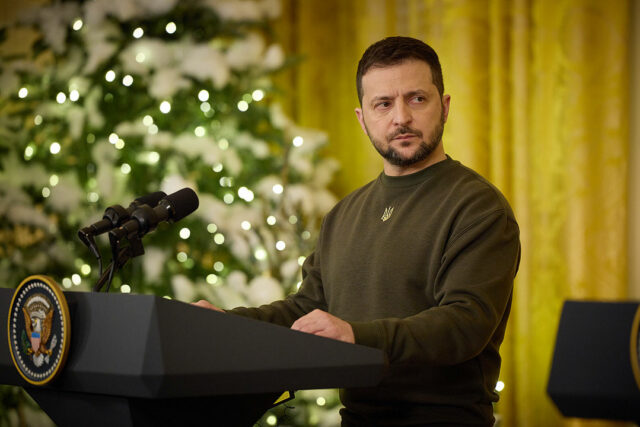
PRESIDENT Volodymyr Zelensky said on Sunday that the Russian army is making a pretense of an Easter ceasefire declared by President Vladimir Putin, continuing overnight attempts to inflict front-line losses on Ukraine.
“In general, as of Easter morning, we can say that the Russian army is trying to create a general impression of a ceasefire, but in some places, it does not abandon individual attempts to advance and inflict losses on Ukraine,” Mr. Zelensky said in a post on social media.
Mr. Putin, hours before heading to an Orthodox Easter service late on Saturday, announced the surprise one-day ceasefire, ordering his forces to “stop all military activity” along the front line in the three-year-old war.
The gesture followed a US announcement that it could abandon peace talks within days unless Moscow and Kyiv showed they were serious about negotiating.
Fighting was to stop from 6 p.m. Moscow time (1500 GMT) on Saturday until midnight on Sunday night, Mr. Putin said.
But Mr. Zelensky said there had been hundreds of instances of shelling on Saturday evening. Early on Sunday, Ukrainian forces reported 59 instances of shelling and five assault attempts along the front line, he said.
“Russia must fully comply with the conditions of silence,” Mr. Zelensky said.
He reiterated that Kyiv was willing to extend the ceasefire for 30 days but said that if Russia kept fighting on Sunday, so would Ukraine.
“Ukraine will continue to act in a mirror manner,” he said. — Reuters
WASHINGTON — Harvard said on Saturday the Trump administration was “doubling down” on far-reaching demands on the university despite a published report that government officials had sent a letter spelling out those demands without authorization.
The letter from government lawyers, received by Harvard on April 11, was sent before senior officials of US President Donald J. Trump’s administration could approve it or give the go-ahead for its release, the New York Times reported late on Friday, citing unnamed sources familiar with the matter.
Three days after that letter arrived, Harvard rejected numerous demands that it said would amount to the school giving up control over hiring, admissions and instruction to the government.
The Trump administration subsequently froze $2.3 billion in funding to Harvard and threatened to strip Harvard of its tax-exempt status and take away its ability to enroll foreign students. It also demanded information on the university’s foreign ties, students and faculty.
“Even assuming the administration now wishes to take back its litany of breathtakingly intrusive demands, it appears to have doubled down on those demands through its deeds in recent days,” a Harvard spokesperson said. “Actions speak louder than words.”
Since his January inauguration, Mr. Trump has cracked down on top US universities, saying they mishandled last year’s pro-Palestinian protests and allowed antisemitism to fester on campus. Protesters, including some Jewish groups, say their criticism of Israel’s actions in Gaza is wrongly conflated with antisemitism.
Columbia University was an early target but in recent weeks, the administration has focused on Harvard, where it is seeking oversight of its student body, faculty and curriculum in an apparent effort to curb what it perceives as the university’s liberal bias.
The content of the April 11 letter was authentic but the New York Times reported differing accounts inside the Trump administration of how it was mishandled.
The newspaper said some at the White House believed the letter was sent prematurely while others thought it was meant to be first circulated among government officials.
The White House had no immediate comment.
The administration had already sent a list of demands on April 3 to Harvard for the elite school to continue receiving federal funding. These included a mask ban, removal of diversity, equity and inclusion programs, and more cooperation with law enforcement.
The April 11 letter signed by officials at the Education Department, Health Department and General Services Administration expanded that list. It told Harvard to stop recognizing some pro-Palestinian groups and asked it to report to federal authorities foreign students violating university policies, among other demands.
Harvard had believed it could still avoid confrontation with the Trump administration because they were engaged in dialogue, the newspaper said, but the letter made Harvard feel a deal was not possible.
Harvard said it did not doubt the letter’s authenticity and called its demands “astonishing in their overreach.” — Reuters
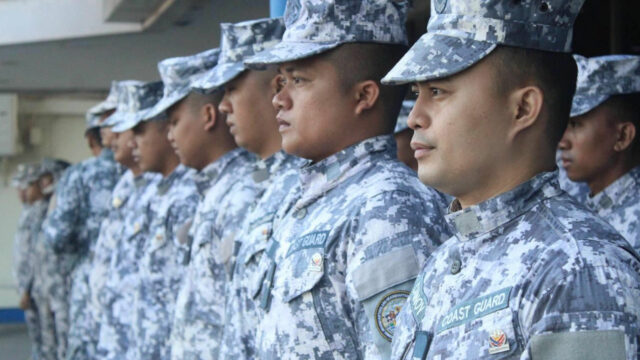
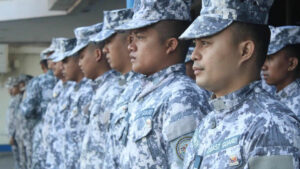
Philippine Coast Guard personnel during the flag ceremony for the Day of Valor. — COURTESY OF PCG
by Edg Adrian A. Eva, Reporter
The Philippine Coast Guard (PCG) often makes headlines for its presence and assertion of the country’s rights over the West Philippine Sea (WPS). Others may recognize them at ports, managing crowds and ensuring commuter safety. But beyond these visible roles—what do we really know about these uniformed personnel in navy blue and white?
Courtesy of PCG: Philippine Coast Guard personnel during the flag ceremony for the Day of Valor.
With over 30,000 personnel, the PCG is an armed and uniformed maritime service under the Department of Transportation (DOTr).
The agency is mandated to uphold maritime security, enforce maritime laws, ensure safety, conduct search and rescue operations, and protect the marine environment.
As the Holy Week rush kicks in, the PCG is on heightened alert to carry out its mandate for the estimated 1.73 million passengers passing through various ports nationwide from April 14 to 20.
The PCG said in a statement that it will conduct round-the-clock assistance, passenger safety checks, baggage inspections, and vessel pre-departure inspections this year, in partnership with various stakeholders such as the Philippine Ports Authority and the Maritime Industry Authority.
Bataan, home to some of the country’s economically significant ports, is also preparing for the Holy Week rush.
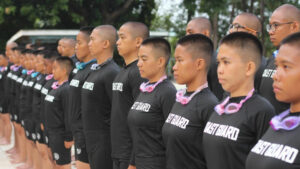
PCG trainees at the Regional Training Center Bataan prepare for their swimming lesson. | photo by BusinessWorld
Ensign Jesus S Mandi, Deputy Commander of Coast Guard Station Bataan, told BusinessWorld that they have increased the number of personnel and heightened preparations in anticipation of the expected influx of people during the holy week.
“We are preparing our life-saving equipment… we are deploying our personnel to the beach resorts, to the outposts at the beach resorts, for them to monitor the area,” Mr. Mandi said in an interview in Filipino during a pre-departure vessel inspection at Camaya Coast, Bataan, last month.
Vessel Inspection
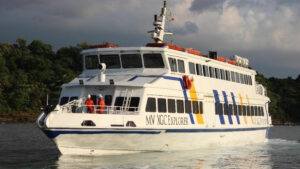
Passenger vessel MV XGC Explorer docked at Camaya Coast, Mariveles, Bataan. | photo by BusinessWorld
To ensure passenger safety, the PCG is conducting pre-departure inspections on every passenger vessel.
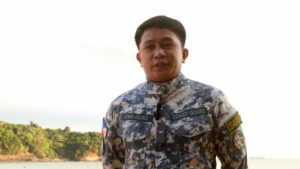
Vessel inspector Probationary Ensign Reynaldo Y Enriquez during an interview at Camaya Coast, Mariveles, Bataan. | Photo by BusinessWorld
BusinessWorld witnessed this firsthand during anoperation last month with vessel inspector Probationary Ensign Reynaldo Y Enriquez and his team, as they inspected the MV XGC Explorer, a passenger vessel docked at Camaya Coast, Bataan during that time.
“We conduct pre-departure inspections to ensure that the vessels meet safety criteria… and to prevent the accidents that occurred in the past from happening again,” Mr. Enriquez said in Filipino during an interview.
Mr. Enriquez said pre-departure inspections typically begin an hour before a vessel’s scheduled departure, starting with the team requesting permission from the captain.
Vessel inspector Probationary Ensign Reynaldo Y Enriquez and his team inspect the vessel’s documents at the bridge. | photo by BusinessWorld
Following Memorandum Circular No. 07-2012, Mr. Enriquez checked the vessel’s documents, including its safety certificates, to make sure everything was up to date and that the vessel was safe to depart.
The team also inspected the vessel’s navigation and control systems to ensure they were functioning properly.
Mr. Enriquez checks the vessel’s lifesaving equipment | photo by BusinessWorld
Going from the vessel’s bridge, Mr. Enriquezproceeded to inspect vessel’s life-saving equipment—such as life jackets, lifeboats, emergency signals and lights, and floating devices—to ensure they were adequate and functioning properly.
The vessel inspection also extends to the tight and sweltering space of the vessel’s engine, ensuring it is in good condition and that a backup engine is available in case of emergency.
At the vessel’s engine room, Mr. Enriquez explains the factors considered to determine if the engine is safe to depart. | photo by BusinessWorld
But beyond the critical aspects of the vessel, Mr. Enrique said that the PCG also check the crew’s well-being and workplace relationships.
“Because sometimes, on a vessel, there are conflicts. If there’s conflict, it’s hard to work,” Mr. Enriquez said in Filipino during an interview.
Coast Guard Working Dog Harold with his PCG handler. | photo by BusinessWorld
Also part of the pre-departure inspection team was Coast Guard Working Dog ‘Harold,’ a 6-year-old Belgian Malinois, working alongside his handler, Petty Officer Third Class Jason A Cajilig.
“We inspect the entire vessel by conducting a paneling of bags and luggage, as well as checking passengers, to determine if they are carrying explosives, narcotics, or any illegal items in their bags,” Mr. Cajilig said in a mix of English and Filipino during an interview.
Once the vessel passes all inspections, it is deemed fit for departure. Otherwise, any deficiencies found will be subject to fines and penalties, as outlined in the memorandum
The MV XGC Explorer was given the go signal to depart at that time, which Mr. Enriquez and the rest of the team consider a fulfilling part of their duty, knowing that passengers are assured of their safety.
“It feels good to hear civilians say, ‘Sir, we feel secure when you’re around’,” Mr. Enriquez said in Filipino during an interview.
This level of orderliness is no coincidence—it’s the result of rigorous training programs that every member of the PCG must go through before being deployed to field operations.
PCG Training
PCG trainee Rodney P Gonzales during an interview at the Regional Training Center Bataan. | photo by BusinessWorld
Rodney P Gonzales, a trainee from Class 31-2025 “Charlie” at the Regional Training Center (RTC) Bataan, joined the Philippine Coast Guard in response to a calling to serve the country.
As a practicing lawyer, he aims to make a positive change in the law enforcement of the PCG.
“The dire situations in the WPS… They are facing with many challenges, particularly in protecting our coastal waters—not just our coastal waters, but also in enforcing customs laws and other important laws,” Mr. Gonzales said in an interview at RTC Bataan last month.
PCG trainees at RTC Bataan do their morning calisthenics before sunrise. | photo by BusinessWorld
Mr. Gonzales is one of 130 trainees from the combined Class Alpha and Class Charlie, currently undergoing the boot camp phase of their four-month training program.
Ensign John Paolo R Bautista, Charlie’s Course Director, told BusinessWorld that the boot camp phase focuses on developing leadership skills and instilling a military-like character.
Ensign John Paolo R Bautista, Class Charlie’s course director, during an interview at RTC Bataan. | photo by BusinessWorld
“Here, we need to take them out of their comfort zone. We need to teach them how to move quickly, how to do 10 counts, how to bathe in just 30 seconds or less, and how to eat in just 10 seconds,’ Mr. Bautista said in a mix of English and Filipino during an interview.
“There’s a big difference between who they were before and what they are going through now in their training, which will serve as their weapon for the future as Coast Guards.”
The siren echoes as early as 4:00 am, signaling that the trainees must already be outside for their rigorous morning calisthenics, which include series of push-ups, squats, and running.
After morning mess (breakfast), morning colors, and body conditioning, during that time, the trainees proceeded to their swimming training, focusing on basic breathing techniques and swimming strokes.
PCG trainees submerge in the pool during their swimming lesson. | Photo by BusinessWorld
The routine remains similar throughout the day, often endured under the scorching heat of the sun, until the day ends at 22:00 military time.
For Mr. Gonzales, shedding his civilian habits and mindset is the hardest part of the training. But he is in ‘high morale’ to sail forward, thinking of the future of his child with his wife and his dream of serving the PCG.
Earning the navy blue and white uniform is no easy feat, but Mr. Bautista said that with determination and the ability to adapt, nothing is impossible.
Global chip stocks were battered on Wednesday on fresh evidence of how U.S. President Donald Trump’s shifting trade policy was complicating the outlook for semiconductor and computing giants, including AI pioneer Nvidia and its rival AMD.
The U.S. restriction, which also hit the MI308 processor of Advanced Micro Devices, marked the latest blow for the AI chip trade that is losing steam after a two-year rally as tariff threats and fears over Big Tech’s spending weigh on sentiment.
Nvidia shares closed down nearly 7% on Wednesday, with the company losing more than $148 billion in market value. AMD fell 5.8% as it warned of a $800 million hit from the latest curb, while AI-related chip stocks including Arm ARM.O, Broadcom AVGO.O and Micron MU.O dropped between 2.5% and 4.6%.
Nvidia said on Wednesday that it follows the U.S. government’s directions on where it can sell its chips after the U.S. Commerce Department announced on Tuesday it was issuing new export licensing requirements for Nvidia’s H20 chips.
“The U.S. government instructs American businesses on what they can sell and where — we follow the government’s directions to the letter,” Nvidia said.
“The technology industry supports America when it exports to well-known companies worldwide – if the government felt otherwise, it would instruct us,” the company added.
Tightening U.S. export curbs have in recent years made it harder for American chipmakers to tap the Chinese market, but the country remains a key source of revenue.
“The U.S. export restrictions on Nvidia’s H20 chips highlight the growing geopolitical uncertainty enveloping the tech and semiconductor sectors, particularly under Trump-era-style policy reversals,” said Michael Ashley Schulman, chief investment officer at Running Point Capital.
“This unpredictability rattles businesses and investment markets, as evidenced by Nvidia’s selloff this morning and broader pressure across chip stocks.”
Nvidia drew over 13% of its sales, or about $17 billion, from China in its last financial year, although that was down from 21% in fiscal 2023. For AMD, China was its second-largest market last year, accounting for more than 24% of total sales.
“The H20 portion was about $12 billion or so (of the total China revenue), roughly about 30 cents of earnings per share, not trivial but not enormous in the grand scheme of things,” Bernstein analyst Stacy Rasgon said.
“H20 performance is low, well below already-available Chinese alternatives; a ban essentially simply hands the Chinese AI market over to Huawei.”
Mr. Rasgon said the move may have surprised many investors as shares had surged nearly 18% last week, partly due to a report that the Trump administration planned to back off from such a curb after CEO Jensen Huang attended a Mar-a-Lago dinner.
The company had earlier this week unveiled plans to build AI servers worth as much as $500 billion in the U.S. over the next four years, a move largely seen as an overture to Trump.
Mr. Trump has for now exempted semiconductors and some other electronics from his tariffs, but he has warned that sector-specific levies will be announced in the coming weeks.
Such tariffs could cost U.S. semiconductor equipment makers more than $1 billion a year, Reuters reported on Tuesday.
NVIDIA FALLOUT
News of the latest export curb on Nvidia sparked a selloff in chip companies and its suppliers across the globe.
In South Korea, Samsung closed down about 3%, while SK Hynix closed 4% lower.
European chipmakers ASM International and Infineon Technologies fell more than 2%, while Japanese chip-testing equipment maker Advantest – an Nvidia supplier – was the Nikkei’s second-worst performer with a 5% tumble.
Still, some analysts said Nvidia’s overall sales have continued to surge even as the China contribution slows while chip demand remains strong from big cloud companies.
“While we acknowledge the likely impact to near-term numbers, we would stress that Blackwell shipments to core hyperscale customers remains the driver of fundamentals,” TD Cowen analysts said, referring to Nvidia’s latest line of AI systems. – Reuters
WASHINGTON – In a potential landmark discovery, scientists using the James Webb Space Telescope have obtained what they call the strongest signs yet of possible life beyond our solar system, detecting in an alien planet’s atmosphere the chemical fingerprints of gases that on Earth are produced only by biological processes.
The two gases – dimethyl sulfide, or DMS, and dimethyl disulfide, or DMDS – involved in Webb’s observations of the planet named K2-18 b are generated on Earth by living organisms, primarily microbial life such as marine phytoplankton – algae.
This suggests the planet may be teeming with microbial life, the researchers said. They stressed, however, that they are not announcing the discovery of actual living organisms but rather a possible biosignature – an indicator of a biological process – and that the findings should be viewed cautiously, with more observations needed.
Nonetheless, they voiced excitement. These are the first hints of an alien world that is possibly inhabited, said astrophysicist Nikku Madhusudhan of the University of Cambridge’s Institute of Astronomy, lead author of the study published in the Astrophysical Journal Letters.
“This is a transformational moment in the search for life beyond the solar system, where we have demonstrated that it is possible to detect biosignatures in potentially habitable planets with current facilities. We have entered the era of observational astrobiology,” Mr. Madhusudhan said.
Mr. Madhusudhan noted that there are various efforts underway searching for signs of life in our solar system, including various claims of environments that might be conducive to life in places like Mars, Venus and various icy moons.
K2-18 b is 8.6 times as massive as Earth and has a diameter about 2.6 times as large as our planet.
It orbits in the “habitable zone” – a distance where liquid water, a key ingredient for life, can exist on a planetary surface – around a red dwarf star smaller and less luminous than our sun, located about 124 light-years from Earth in the constellation Leo. A light-year is the distance light travels in a year, 5.9 trillion miles (9.5 trillion km). One other planet also has been identified orbiting this star.
A ‘HYCEAN WORLD’
About 5,800 planets beyond our solar system, called exoplanets, have been discovered since the 1990s. Scientists have hypothesized the existence of exoplanets called hycean worlds – covered by a liquid water ocean habitable by microorganisms and with a hydrogen-rich atmosphere.
Earlier observations by Webb, which was launched in 2021 and became operational in 2022, had identified methane and carbon dioxide in K2-18 b’s atmosphere, the first time that carbon-based molecules were discovered in the atmosphere of an exoplanet in a star’s habitable zone.
“The only scenario that currently explains all the data obtained so far from JWST (James Webb Space Telescope), including the past and present observations, is one where K2-18 b is a hycean world teeming with life,” Mr. adhusudhan said. “However, we need to be open and continue exploring other scenarios.”
Mr. Madhusudhan said that with hycean worlds, if they exist, “we are talking about microbial life, possibly like what we see in the Earth’s oceans.” Their oceans are hypothesized to be warmer than Earth’s. Asked about possible multicellular organisms or even intelligent life, Mr. Madhusudhan said, “We won’t be able to answer this question at this stage. The baseline assumption is of simple microbial life.”
DMS and DMDS, both from the same chemical family, have been predicted as important exoplanet biosignatures. Webb found that one or the other, or possibly both, were present in the planet’s atmosphere at a 99.7% confidence level, meaning there is still a 0.3% chance of the observation being a statistical fluke.
The gases were detected at atmospheric concentrations of more than 10 parts per million by volume.
“For reference, this is thousands of times higher than their concentrations in the Earth’s atmosphere, and cannot be explained without biological activity based on existing knowledge,” Mr. Madhusudhan said.
Scientists not involved in the study counseled circumspection.
“The rich data from K2-18 b make it a tantalizing world,” said Christopher Glein, principal scientist at the Space Science Division of the Southwest Research Institute in Texas. “These latest data are a valuable contribution to our understanding. Yet, we must be very careful to test the data as thoroughly as possible. I look forward to seeing additional, independent work on the data analysis starting as soon as next week.”
TRANSIT METHOD
K2-18 b is part of the “sub-Neptune” class of planets, with a diameter greater than Earth’s but less than that of Neptune, our solar system’s smallest gas planet.
To ascertain the chemical composition of an exoplanet’s atmosphere, astronomers analyze the light from its host star as the planet passes in front of it from the perspective of Earth, called the transit method. As the planet transits, Webb can detect a decrease in stellar brightness, and a small fraction of starlight passes through the planetary atmosphere before being detected by the telescope. This lets scientists determine the constituent gases of the planet’s atmosphere.
Webb’s previous observations of this planet provided a tentative hint of DMS. Its new observations used a different instrument and a different wavelength range of light.
The “Holy Grail” of exoplanet science, Mr. Madhusudhan said, is to find evidence of life on an Earth-like planet beyond our solar system. Mr. Madhusudhan said that our species for thousands of years has wondered “are we alone” in the universe, and now might be within just a few years of detecting possible alien life on a hycean world.
But Mr. Madhusudhan still urged caution.
“First we need to repeat the observations two to three times to make sure the signal we are seeing is robust and to increase the detection significance” to the level at which the odds of a statistical fluke are below roughly one in a million, Mr. Madhusudhan said.
“Second, we need more theoretical and experimental studies to make sure whether or not there is another abiotic mechanism (one not involving biological processes) to make DMS or DMDS in a planetary atmosphere like that of K2-18 b. Even though previous studies have suggested them (as) robust biosignatures even for K2-18 b, we need to remain open and pursue other possibilities,” Mr. Madhusudhan said.
So the findings represent “a big if” on whether the observations are due to life, and it is in “no one’s interest to claim prematurely that we have detected life,” Mr. Madhusudhan said. – Reuters
TOKYO – When a severe rice shortage sent prices skyrocketing in Japan last year, Tokyo restaurant owner Arata Hirano did what had once seemed unthinkable: he switched to an American variety.
The price of the Californian Calrose rice he buys has doubled since his first purchase last summer, but even so it’s far cheaper than home-grown grains.
“Unless domestic prices fall below Calrose prices, I don’t plan to switch back,” said Hirano, whose restaurant offers meal sets of fish, rice, soup and sides.
His willingness to embrace foreign rice may presage a seismic change in mindset for Japanese businesses and consumers – one that could allow Tokyo leeway to relax some restrictions if rice becomes a thorny topic in tariff talks with U.S. President Donald Trump, who has called out Japan’s high levies on its staple grain.
Wholesale prices for domestic rice have surged about 70% over the past year to hit their highest levels since current records began in 2006. Crops were hit by extreme heat while a tourism boom has added to demand. Worries abound that not much will change this year.
With inflation also raising the cost of living, businesses are now betting that a nation of people known for their discerning palates and pride in their staple grain is open to change.
Supermarket giant Aeon 8267.T last week began selling an 80-20 American-Japanese blend that’s about 10% cheaper than domestic rice after a test sales-run proved a hit. Fast-food chain Matsuya 9887.T and restaurant operator Colowide 7616.T began serving pure American rice this year. At supermarket chain Seiyu, Taiwanese rice has been flying off the shelves since last year.
It’s a sharp contrast to 1993, when the Thai rice the Japanese government imported during an acute shortage was largely shunned, leaving supermarkets with piles of unsold bags.
Rare shortages aside, for most of the past six decades, nearly all of Japan’s so-called staple rice – which is consumed at meals as opposed to rice used for feed or ingredients in other products – has been home-grown. There hasn’t been much need for imports while high tariffs, put in place to ensure Japanese self-sufficiency for its most basic food, have protected local farmers from competition.
Japan limits tariff-free “minimum access” imports of staple rice to 100,000 metric tons a year, or around 1% of total consumption. The U.S. accounted for roughly 60% of that amount last fiscal year, trailed by Australia, Thailand and Taiwan. Anything above that is subject to a levy of 341 yen per kilogram.
When Trump announced sweeping tariffs on much of the world this month, he lambasted Japan for what he said was a 700% tariff on rice, a reference to that levy. Japanese policymakers called his remarks on the sensitive topic “regrettable”. They also dispute the 700% figure, saying it’s based on outdated international rice prices.
It’s unclear, however, just how much – if at all – rice will be discussed in bilateral tariff negotiations that began this week. Some analysts think Trump’s Republican administration might not be focused on rice as exports to Japan come from California, a Democratic-leaning state. Nor is it clear how much Japan might be willing to yield in opening up its rice market.
In one sign that there might be room for some change, a panel advising the finance ministry on Tuesday proposed expanding imports of staple rice, saying that lifting the 100,000-ton tariff-free cap could help stabilize supply.
That said, Prime Minister Shigeru Ishiba’s Liberal Democratic Party is unlikely to risk angering farmers, traditionally a strong support base, ahead of upper house elections in July.
“It’s not possible to make big concessions on rice just before the elections,” said Junichi Sugawara, senior fellow at Tokyo-based Owls Consulting Group.
MORE IMPORTS TO COME
What is clear is that supply remains an issue.
In the financial year that ended in March, tariff-free imports of staple rice hit Japan’s 100,000-ton cap for the first time in seven years.
The amount of tariffed imports, while still tiny, also jumped, quadrupling in the first 11 months of fiscal 2024 to just under 1,500 tons.
And this year, rice importer Kanematsu 8020.T is shipping in its first large-scale purchase of American staple rice, 10,000 tons worth.
“We’re receiving many enquiries from the restaurant industry, convenience stores, supermarkets and rice wholesalers,” a Kanematsu spokesperson said.
In the week to April 6, Japanese supermarket rice prices hit an average of 4,214 yen ($29.65) per 5 kg, marking their 14th straight week of increase and more than double the same period a year earlier. That’s despite a rare release of rice from the government’s emergency stockpiles that started last month and is set to continue every month through July.
As for the quality and taste of imported rice, Miki Nihei, a customer at Hirano’s restaurant, Shokudou Arata, said she had no complaints and was surprised to learn it wasn’t Japanese.
“I had no idea,” she said. “I have no qualms about eating imported rice. Prices have gone up, so I’m always looking for cheaper options.” – Reuters