Home Blog Page 125

Globe expands laser link rollout with Transcelestial

BW FILE PHOTO

GLOBE TELECOM, INC. is expanding its partnership with Singapore-based laser communications company Transcelestial Technologies Pte. Ltd. to roll out 400 wireless laser links over the next three years.

“Our 400-link rollout with Globe is a signal that the country is embracing new infrastructure models to overcome old constraints,” Transcelestial Chief Executive Officer and Co-founder Rohit Jha said in a media release on Sunday.

Globe said Transcelestial’s wireless laser links help address the country’s geographic challenges, offering an alternative to fiber-optic cables that are slow and costly to deploy across coastlines, mountains, and disaster-prone areas.

The company added that by utilizing the laser technology for last-mile and backhaul connectivity, Globe is tackling traditional infrastructure limitations.

Globe Senior Vice-President for Engineering and Network Planning Joel R. Agustin said that deploying Transcelestial lasers will accelerate 5G network expansion and accommodate rising capacity needs while addressing environmental constraints.

This partnership further strengthens Globe’s collaboration with Transcelestial following an investment from Kickstart Ventures, Globe’s corporate venture capital arm, in 2021.

“Kickstart’s investment in Transcelestial reflects Globe’s broader commitment to strengthening the country’s digital backbone. By supporting scalable, resilient connectivity solutions, we’re helping enable more inclusive economic participation across regions, which is fundamental to building a more future-ready Philippines,” said Kickstart Ventures General Partner Joan Cybil Yao.

The planned rollout follows the deployment of laser technology in Visayas and Mindanao between 2024 and 2025 to support Globe’s broadband and 5G networks. — Ashley Erika O. Jose

FinTech Alliance PH to launch Fraud Intelligence Data Sharing Network

FinTech Alliance PH is signing a memorandum of agreement (MoA) with the Cybercrime Investigation and Coordinating Center (CICC) to foster a deeper collaboration in the fight against cybercrime and digital fraud.

The signing will be held at the FinTech Alliance 2026 General Membership Meeting and New Members’ Oath-Taking ceremony on March 11 at Marquis Events Place, Bonifacio Global City, Taguig.

The collaboration kicks off with the official launch of the Fraud Intelligence Data Sharing Network, a coordinated, industry-wide effort to enable timely intelligence exchange, reinforce fraud prevention capabilities, and enhance trust across the Philippine digital finance ecosystem.

The FinTech Alliance PH is the Philippines’ premier and largest digital industry association, comprising over 140 corporate members that collectively account for more than 95% of the country’s digital retail financial transaction volume with combined user base in excess of 110 million Filipinos.

The meeting will also spotlight strategic priorities for 2026, including cybersecurity as infrastructure, blockchain and digital assets, collaboration with the ASEAN Business Advisory Council, and key initiatives for 2026.

Delivering the keynote address is Atty. Eugene Teves, managing director of the Technology and Digital Innovation Office of the Bangko Sentral ng Pilipinas, who will share regulatory perspectives on digital innovation, blockchain enablement, and the evolving supervisory framework for emerging technologies.

Also joining the roster of speakers are Joey Concepcion, chairman of the ASEAN Business Advisory Council (ASEAN BAC), who will present on the Philippines’ role in advancing inclusive economic growth and regional fintech collaboration within ASEAN; and Atty. Renato “Aboy” Paraiso, executive director of the CICC, who will discuss the government’s strengthened enforcement strategy and the importance of public-private intelligence sharing in protecting digital infrastructure.

Lito Villanueva, founding chairman of FinTech Alliance PH, emphasized the importance of industry solidarity in addressing evolving digital threats: “Fraud does not recognize institutional boundaries, and neither should our response. The launch of the Fraud Intelligence Data Sharing Network reflects our shared commitment to come together as one ecosystem to protect the integrity of our digital economy.”

“By strengthening collaboration and institutionalizing intelligence exchange, we are reinforcing trust as the foundation of innovation. This is about standing united to secure the future of digital finance in the country,” he said.

Another highlight of the event will be the signing of multiple Memoranda of Understanding with key industry bodies, including ASEAN Business Advisory Council, the Philippine Chamber of Commerce and Industry (PCCI), and the oath taking of the new set of corporate members. These partnerships highlight FinTech Alliance PH’s continued effort to foster cross-sector collaboration in advancing financial inclusion, digital trust, and sustainable fintech innovation.

In addition to major partnership milestones, the program will culminate in the oath-taking ceremony of new member organizations, formally welcoming them into the country’s premier fintech association.


SparkUp is BusinessWorld’s multimedia brand created to inform, inspire, and empower the Philippine startups; micro, small and medium enterprises (MSMEs); and future business leaders. This section will be published every other Monday. For pitches and releases about startups, e-mail to bmbeltran@bworldonline.com (cc: abconoza@bworldonline.com). Materials sent become BW property.

T-bill, bond rates may rise on BSP’s policy rate hike signals

BW FILE PHOTO

By Aaron Michael C. Sy, Reporter

RATES on Treasury bills (T-bills) and Treasury bonds (T-bonds) may rise this week as markets reassess the Bangko Sentral ng Pilipinas’ (BSP) policy outlook following signals that the central bank could tighten monetary policy if global oil prices surge further.

Analysts said yields in the primary market could follow the upward trend seen in the secondary market last week as rising geopolitical tensions pushed crude oil prices higher.

Rizal Commercial Banking Corp. Chief Economist Michael L. Ricafort said the prolonged conflict in the Middle East has lifted global oil prices, raising the risk of faster inflation and potentially affecting the BSP’s monetary policy stance.

The Bureau of the Treasury (BTr) will auction P27 billion worth of T-bills on Monday, offering P9 billion each in 91-, 182- and 364-day debt.

On Tuesday, it will also offer reissued 10-year T-bonds with a remaining life of seven years and five months, targeting to raise P20 billion to P30 billion.

Data from PHP Bloomberg Valuation Service Reference Rates posted on the Philippine Dealing System’s website showed yields on government securities rising across most tenors late last week.

Short-term Treasury bill rates moved higher, while yields on medium- and long-term bonds posted sharper increases.

The 10-year government bond yield climbed significantly, reflecting investors’ concerns about inflation risks and the potential shift in the interest rate outlook.

The seven-year yield, which is closest to the remaining life of the bonds to be auctioned this week, also rose sharply.

A trader said the sell-off in bonds was partly driven by remarks from BSP Governor Eli M. Remolona, Jr., who indicated that the central bank might consider raising borrowing costs if global oil prices climb beyond $100 per barrel and trigger higher inflation.

“Bids were very thin throughout the session as players recalibrated their policy outlook,” the trader said in an e-mailed reply questions.

“US nonfarm payroll data will be the next catalyst aside from developments in the Middle East,” the trader added.

Mr. Remolona told Bloomberg TV rising oil prices could affect inflation if higher fuel costs spill over to the prices of other goods and services.

“When the price of oil begins to have effects on the prices of many commodities, that tends to be something we have to worry about when it comes to inflation,” he said.

The BSP last month cut its benchmark interest rate by 25 basis points (bps) to 4.25%, extending an easing cycle that began in 2024. The reduction brought cumulative rate cuts since the start of the cycle to 225 bps.

Before that, the central bank last raised borrowing costs in October 2023 through an off-cycle increase that brought the policy rate to a 17-year high.

Despite the recent rise in yields, demand for government securities remained strong in the latest Treasury bill auction.

The government raised P27 billion as planned last week after the offer was almost three times oversubscribed, with total tenders exceeding P76 billion.

The Auction Committee fully awarded the debt across all tenors as accepted yields remained below prevailing secondary market levels, the Treasury said in a statement.

Demand was strongest for the shorter tenors, particularly the three- and six-month bills, which attracted robust bids from investors seeking relatively safer short-term placements amid market volatility.

The government also fully awarded the one-year paper after receiving more than twice the amount on offer.

The reissued 10-year bonds to be auctioned this week were last sold in February, when the government raised P30 billion at an average yield well below the security’s coupon rate.

The Treasury is targeting to raise P248 billion from the domestic market this month, composed of P108 billion in T-bills and P140 billion in T-bonds.

Proceeds from the debt sales will help finance the government’s budget deficit, which is capped at P1.647 trillion this year, equivalent to 5.3% of gross domestic product.

Abraca-Denza

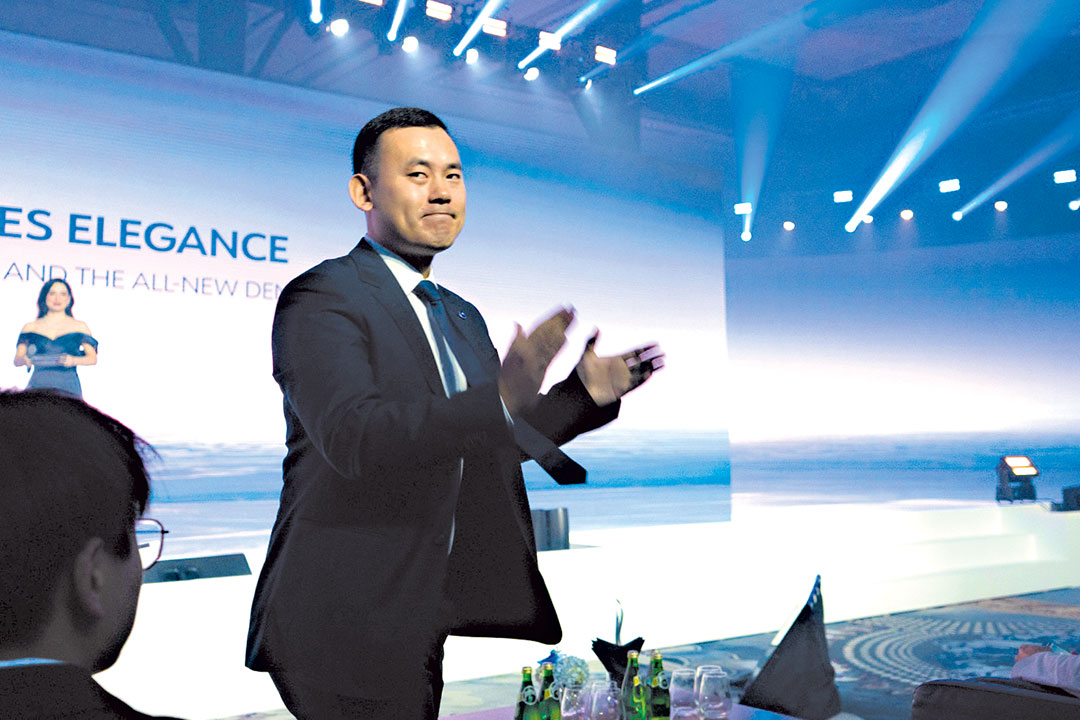
Heralding the entry of Denza and its first product (the D9) to be sold here, are (from left) BYD Philippines and Denza Philippines Country Head Adam Hu; Denza Greenhills (E-Vantage Motors, Inc.) Dealer Principals Roger Chiu and Walter “Wally” Alvarez; BYD Asia-Pacific Auto Sales Division General Manager Liu Xueliang; BYD Philippines, BYD Singapore, and BYD Brunei Managing Director James Ng; ACMobility Premium Dealerships, Inc. President Dana Unson; Denza Makati (Harmony New Energy Auto Service [Philippines] Ltd. Corp.) Country Manager Fred Guowang; and BYD APAS Intelligent Product Department Manager Xiao Jinfu. — PHOTO BY KAP MACEDA AGUILA

BYD’s luxe marque hopes to replicate the magic

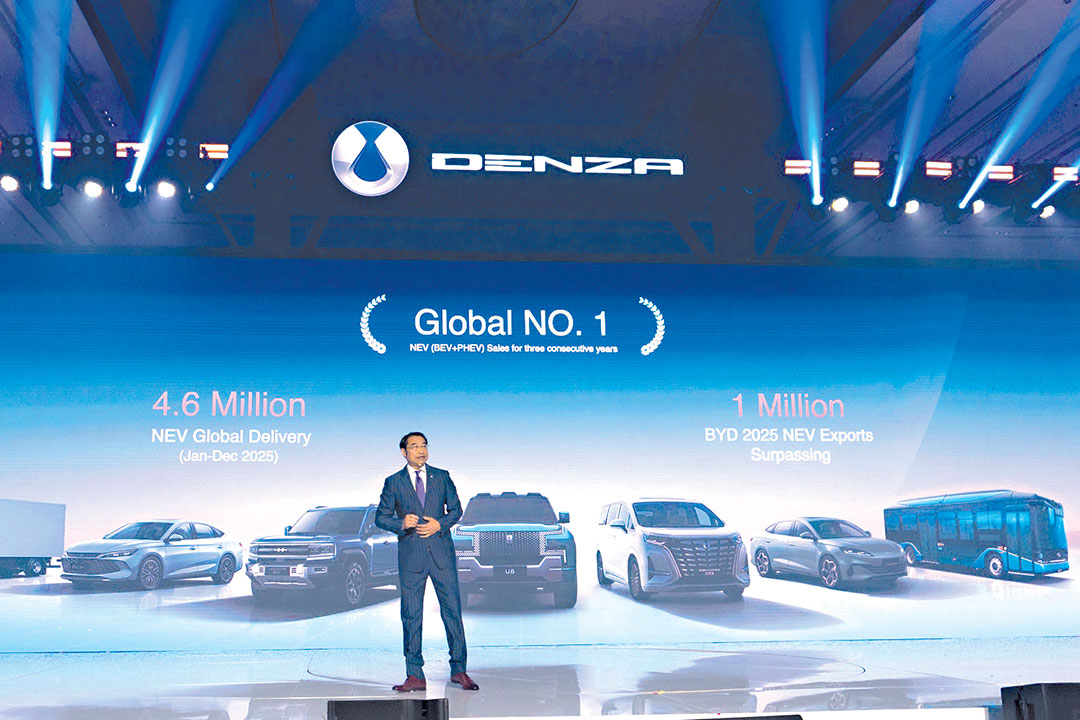
SURELY, hardly anyone was still surprised by BYD’s report that its 2025 sales totaled 26,122 units — allowing the China-headquartered brand to leapfrog to third place on the list of top auto movers here, bested only by perennial leaders Toyota Motor Philippines and Mitsubishi Motors Philippines — in first and second place, respectively.

BYD had made its mark in a big way in recent years, buoyed by the unqualified success of its array of new energy vehicles — particularly the strong-selling BYD Sealion 6 hybrid SUV and its entry-level BEV, Seagull.

It’s a bit of a no-brainer that the marque deigned to formally bring in its luxury nameplate, Denza.

The dealerships of Denza’s initial partners ACMobility Premium Dealership, Inc.; Harmony New Energy Auto Service (Philippines) Ltd. Corp.; and E-Vantage Motors, Inc. were inaugurated on the same week the brand held a launch in Makati.

And a few nights before, Denza Philippines hosted dinner for a small group of media practitioners where “Velocity” got a chance to pose some questions for BYD Philippines and Denza Philippines Country Head Adam Hu.

Mr. Hu described the country as being “very promising with its population, growth, good weather, and time zone.” This writer asked why Denza was being led directly by the BYD team, without the involvement of ACMobility — which is in charge of BYD distribution.

“First all, we respect all the efforts made by our partner for BYD,” the executive began. “(ACMobility) is really capable; it’s a good company, a good organization. (But) when it comes to Denza, we are also taking some references from legacy brands here in the Philippines like Lexus. We believe we should learn from (this) pioneer which is doing an outstanding job here. We should also train ourselves to be more adaptive to this country, so that’s why we want to do it by ourselves.”

The executive continued, “As you know, ACMobility is still part of our Denza business. We have three dealer groups, and they are one of them. We have a very good working relationship with them, even for the Denza brand.”

Ayala Group-owned ACMobility established a wholly owned subsidiary, ACMobility Premium Dealership, Inc., to oversee operations of its initial 3S (sales, service, and spare parts) Denza dealerships, Denza Alabang and Denza Cebu. Denza Alabang is currently the largest of the brand’s facilities, measuring 5,410 sq.m. Located on the stretch of Alabang-Zapote Road corner Investment Drive in Ayala Alabang, Muntinlupa, the showroom “can display up to eight vehicles and includes a merchandise section, VR zone, customer lounge, and children’s play area,” said the company in a release. “Its 12-bay service center is equipped with two AC charging points and will soon be enhanced with two additional DC chargers to support electric vehicles owners.”

Meanwhile, Denza Cebu spans 3,680 sq.m. and is located on A. Soriano Avenue in the North Reclamation Area of Cebu City. It has a seven-vehicle showroom, merchandise area, lounge, delivery bay, two VIP rooms, a children’s play space, and a VR zone. Eight-bay service bays and four on-site charging stations, composed of two AC units, are “ready to support the growing EV ecosystem in the Visayas.”

Then there’s Denza Makati on 2261 Chino Roces Avenue, operated by Harmony New Energy Auto Service (Philippines) Ltd. Corp. Measuring 2,500 sq.m., the facility gets a seven-car showroom, merchandise section, lounge, delivery area, VIP room, children’s play space, VR zone, and two massage rooms. A nine-bay after-sales center “ensures prompt and reliable support,” while two existing AC charging points, and two more additional DC charging points to be installed soon.

As it waits for a permanent showroom to open on the corner of Connecticut and La Salle Streets in San Juan City by Q3 2026, E-Vantage Motors, Inc. (operator of Denza Greenhills) oversees “interim pop-up stores” at Greenhills Mall in San Juan City and The Podium in Mandaluyong City. The permanent showroom is expected to measure 3,423 sq.m. and accommodate five display vehicles. It will have two VIP rooms, a children’s area, a car club space, bar area, delivery waiting room, and VR experience lounge.

In a statement, BYD Asia-Pacific Auto Sales Division General Manager Liu Xueliang averred, “Denza represents a new standard of premium mobility, where advanced technology enhances comfort, innovation is seamless, and sustainability meets performance. Every detail of Denza is designed to provide a refined and effortless driving experience.”

When asked by this writer whether the direct control BYD exerts on Denza is normal in other countries where it does business along with BYD, Mr. Hu replied, “There are some countries where we have our local distributor; but for many countries, we’re doing it by ourselves. This is the practice we follow for Denza.”

Of course, the premium market is a very different one in the Philippines where there are firmly entrenched legacy brands. How does Denza intend to compete in this niche or segment? “Good question,” he enthused. “Let me first share my view about where the confidence is coming from. Denza is a brand of the BYD group, which is highly invested in technology research and development. Internally, we have what we call a technology pool. Whenever we find a need from the market, we just pick up from our technology pool to equip our models.”

He added, “For Denza, we have applied more advanced technology compared to BYD cars. This is where our confidence is coming from. Because of technology, we feel we are capable of fulfilling the demand from different groups of customers.”

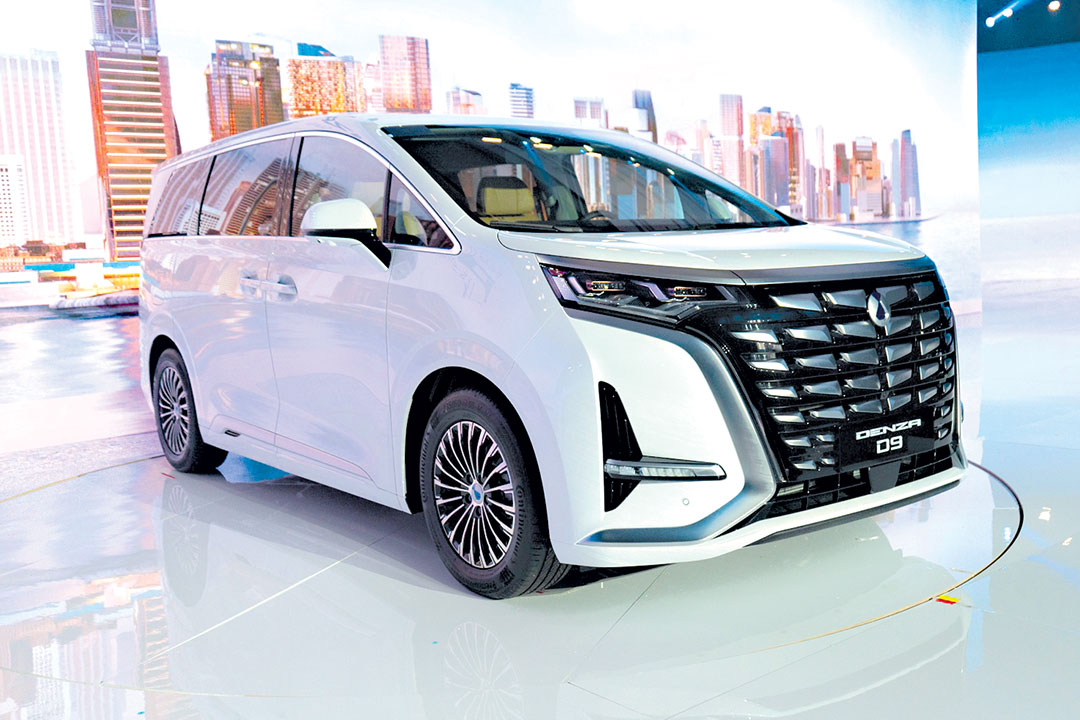
The first product to go on sale is the D9 DM-i multi-purpose vehicle (MPV) with a plug-in hybrid powertrain. A Super DM-i system combines a 1.5-liter turbocharged gasoline engine with “high-performance” dual electric motors to produce up to 400hp and 681Nm of torque expressed in all-wheel drive. A claimed combined range reaches up to 980km, per Denza — due partly to a BYD Blade Battery with a 40-kWh capacity. “Built on BYD’s advanced e-Platform 3.0 architecture, the D9 achieves a refined balance of efficiency, safety, adaptability, and ride comfort — ensuring a composed and confident drive in varying conditions,” said Denza Philippines. The first 300 customers can get the D9 for P3.998 million; the regular SRP is P4.298 million.

Mr. Hu revealed that Denza is looking to open a dealership at the Bonifacio Global City, but isn’t keen on running that or any other facility directly. As for sales projections, the executive stressed that will be a metric, but isn’t a top priority to measure success. “Customer experience is very much important; that should be our top priority,” he declared.

“Customer satisfaction should be number one,” stressed Mr. Hu. “Then comes brand health; sales numbers are not tier one (in our concerns). It’s about building a reputation, brand image, and (market) trust.”

Labor of love

LOVE, MARINA book

Fashion designer granddaughter launches book about fashion designer grandmother

WHILE fashion designer Marina Antonio may have passed in 2006, her gowns live on, and so does her line. Granddaughter Vicky Veloso Barrera preserves the life that these gowns meant in a book, Love, Marina.

Love, Marina, published last year by Far Eastern University (FEU), held a book launch and fashion show at Tesoro’s in Makati where it will be sold (alongside FEU’s own online and physical facilities). The event was held on March 3.

The author appeared on the runway, alongside friends and family to showcase the creations made by Mrs. Antonio (who was the wife of National Artist for Architecture Pablo Antonio) and by the generations of women succeeding her. The author wore a black and white Filipiniana creation, with an extra fold of fabric that appeared like a little sail, from the Antonio archives. This particular dress was strewn all over with little white ribbons rolled to look like sampaguita flowers.

Then Mrs. Antonio’s daughter, Malu Veloso, another storied designer whose work became famous in the 1970s, showed off her own creations. Back then, editing the silhouette of the traje de mestiza, pairing the fichu with Western gowns, was revolutionary.

Ms. Veloso Barrera, alongside her sister Letlet Veloso, was also a fashion designer in the 1990s, making gowns for celebrity weddings like Sharon Cuneta’s to politician Francis Pangilinan. Ms. Veloso showed off dresses with sequins forming the shapes of flowers, appearing like they came straight from a fairy tale.

The fourth generation of designers in the family, Ms. Veloso Barrera’s daughter Hannah Barrera, showed off a yellow gown, hand-ruched and beaded to form a yellow sun, with a train edged with a bit of beadwork cut off from a French couture gown. The young designer is already making a mark — Ms. Barrera was selected last as the first Filipina to show her clothes at the Piattaforma Sistema Formativo Modato show in Milan.

The book, meanwhile, shows off the family’s story, beginning in pre-war Manila with Mrs. Antonio’s own troubled family life. Left by a father and then her husband, she remarried and started a fashion dynasty with her daughter and grandchildren, also helping nurture one in architecture through her sons. The book, with about 200 pages, details this life, a story told through clothes, gardening, and cooking. The book’s title comes from Mrs. Antonio’s sign-off for her letters to her friends, including Jean MacArthur, the second wife of Douglas MacArthur (for whom she also made clothes).

Her granddaughter, Ms. Veloso Barrera, herself an accomplished cook, said that her favorite memory of her grandmother was, “Standing beside her in the kitchen,” she recalled. “She allowed me to make a mess.”

There’s a problem with growing up in a home with an icon: can you ever truly measure up to their success? Mrs. Antonio’s own daughter, Malu Veloso, waved off these fears and said during a Q&A session at the launch: “I don’t think it’s intimidating. My mom is my inspiration.”

Speaking with BusinessWorld, Ms. Veloso Barrera told a story about her artist son, a scion of architects and designers, being asked in school about living with such great names hovering over his career. He answered, “I don’t feel like I walk in their shadow. I feel like I walk in their light.”

“I think it’s genetic and I think that’s in example,” she said about the family’s creative legacy. She notes that her daughter picked up dyeing, painting, and sewing almost naturally. “You see somebody living the life, doing something that’s their passion, and it’s just so natural. It’s like breathing.”

As we celebrate National Women’s Month in March, Ms. Veloso Barrera discussed dynasty and legacy from a woman’s perspective. For so long, we’ve been fed stories about men breaking ground and letting their sons take over, but it’s nice to know about women doing the same with their daughters.

“I think it’s very natural for women to nurture and to want to share what they know with their daughters,” said Ms. Veloso Barrera, explaining that her grandmother helped with the clothes even up to her generation. She said that she and her sister would be summoned by their grandmother and told to look at a certain dress from the inside out. “I have to show you all these things before I pass on,” Ms. Antonio would say. “I think it’s easier with women,” said Ms. Veloso Barrera, citing male dynasties with professional rivalries.

Love, Marina is available for purchase through TAMS Bookstore at TamsBookstore@feu.edu.ph and at Tesoros 1016, A. Arnaiz Ave., Makati City. — Joseph L. Garcia

Philippine CEOs see AI as key but still face cost, legacy system hurdles

PHILIPPINE STAR/NOEL B. PABALATE

By Beatriz Marie D. Cruz, Reporter

MANY PHILIPPINE chief executive officers (CEOs) view artificial intelligence (AI) investments as crucial in navigating geopolitical and economic pressures this year, but they cite cost and legacy system upgrades as challenges, according to Ernst & Young (EY).

“CEOs see technology as one of the fastest ways to strengthen agility, improve competitiveness, and create more resilience in the face of uncertainty,” Noel P. Rabaja, deputy managing partner and strategy and transactions leader at SGV & Co., said in a forum last week.

In its 2026 Philippine CEO Outlook, SGV reported that 32% of Philippine CEOs ranked investing in AI and digital technologies as the most important action for navigating geopolitical and economic shifts.

However, 46% of CEOs said their AI initiatives are underperforming, with 28% citing difficulties in investing due to the rapid pace of technological change.

“Companies still lack sufficient network infrastructure, and their data is still very much non-digitized,” Mr. Rabaja told reporters on the sidelines of the forum.

He also highlighted gaps in companies’ upskilling efforts, while others struggle to transition from legacy systems.

“I think, for some companies, they find high costs of not just the technology itself, but changing their legacy system to be able to adapt the new technology or AI,” Mr. Rabaja said.

The report noted that 48% of Philippine CEOs expressed measured optimism about their business prospects for 2026, citing strong macroeconomic fundamentals despite weaker economic growth last year.

In 2025, the Philippine economy expanded by 4.4%, down from 5.7% in 2024, as the flood control scandal weighed on government spending and consumption.

“Leaders are feeling generally confident about their organizations and the local business environment,” Mr. Rabaja said.

Philippine CEOs, however, remain cautious about the global environment this year amid ongoing geopolitical tensions and trade disruptions.

EY also reported that 73% of Philippine CEOs are confident in their ability to optimize operations and enhance productivity, driven by continued digitalization and process improvements.

The survey showed that 64% of the country’s leaders are optimistic about revenue growth, even as 42% expect a rise in operating costs.

Leaders are pacing expansions carefully to balance governance requirements with market conditions, while facing pressures from input costs, cost pass-through limitations, and free cash flow constraints.

About 42% of CEOs accelerated a planned investment over the past 12 months due to geopolitical and trade policy developments.

EY added that 98% of CEOs reported adjustments to their strategic investment plans over the past year, with 40% delaying and 28% halting an investment.

The Philippines’ CEO Confidence Index declined to 59 in 2026 from 74 in 2025, reflecting a “steady but guarded sense of optimism.”

Compared with last year, CEOs showed lower confidence in price inflation (54); company growth (61); talent (60); technology transformation (60); organic transformation (63); portfolio transformation (55); and investment and technology (59).

The survey also noted that 75% of CEOs remain confident in their ability to improve employee engagement and retention.

“Philippine leaders are strengthening their foundations, accelerating AI adoption, and reshaping their portfolios to stay ahead of shifting economic and geopolitical currents,” Mr. Rabaja said.

SGV & Co. is a member of EY Global Ltd.

Peso may weaken on prolonged Middle East war

PHILIPPINE STAR/ MIGUEL DE GUZMAN

THE PHILIPPINE peso could weaken further this week as escalating war in the Middle East boosts demand for safe-haven assets such as the dollar.

The local currency closed at P59 a dollar on Friday, weakening by 37 centavos from its P58.63 finish a day earlier, according to data from the Bankers Association of the Philippines. It was the peso’s weakest close in more than a month.

Week on week, the currency dropped sharply from P57.665 on Feb. 20.

A trader said the peso’s decline reflected persistent demand for the dollar amid geopolitical uncertainty and rising oil prices.

“The dollar-peso rate continued its strong uptrend and closed at its intraday high amid persistent demand for safe-haven assets due  to the escalating Middle East tension and soaring oil prices,” a trader said by telephone on Friday.

Concerns about higher energy prices could also complicate the monetary policy outlook for the Bangko Sentral ng Pilipinas (BSP).

BSP Governor Eli M. Remolona, Jr. said the central bank could consider raising interest rates if global oil prices climb above $100 per barrel and push inflation beyond the BSP’s 2% to 4% target.

“When the price of oil begins to have effects on the prices of many commodities, that tends to be something we have to worry about when it comes to inflation,” he told Bloomberg TV on Friday.

The central bank last month cut its benchmark interest rate by 25 basis points to 4.25%, the lowest in more than three years. The move extended the easing cycle that began in August 2024.

Mr. Remolona also said the BSP intervenes in the foreign exchange market only to limit excessive volatility in the peso.

The trader expects the peso to remain under pressure this week as markets monitor developments in the Middle East and movements in global oil prices.

The trader expects the peso to move at P58.80 to P59.20 a dollar, while Rizal Commercial Banking Corp. Chief Economist Michael L. Ricafort sees a slightly wider range of P58.75 to P59.25. — Aaron Michael C. Sy

Add it up

Cars await browsers at the Lexus Manila Gallery in Bonifacio Global City. — PHOTO BY KAP MACEDA AGUILA

How much do you love your car? Let us count the pesos.

BUYING A CAR is a serious matter. It is often said that next to a house, this is the single most expensive purchase of a Filipino. A quick dive into the universe of car-ownership factoids online reveals some interesting insights, albeit a tad dated. A 2023 study by the International Trade Administration of the United States government avers that the average vehicle lifespan in the Philippines is 15 years or more. A 2013 Nielsen survey, on the other hand, found that 47% of Filipino households were carless, 38% owned one car, and 16% owned more than one. The same study revealed that in Thailand the percentages were 82%, 54%, and 27%, respectively. Another report published by Ken Research in 2021 revealed that although a high-income individual may own eight or more cars, the average Filipino would own only two to four in their lifetime.

The statistics above would clearly benefit from updated research. They were culled from when the country was on the cusp of motorization and during the pre-COVID years or those immediately following. Somehow, I get the feeling that the numbers might change only slightly, since our socioeconomic landscape has not moved much either.

Undoubtedly, motorization has progressed much in the intervening years. In 2024, the auto market eclipsed its previous record of some 473,000 units sold back in 2017. In 2025, it broke the record of 2024 with 493,000 or so units moved. This year, the fearless forecast is that the market may finally breach the elusive half-million mark.

But car ownership is definitely not for the faint-hearted, and the rise in auto sales is largely reflective of the rising purchasing power of the Filipino consumer. In 2024, the Philippines recorded a gross national income (GNI) per capita of US$4,470 which was US$26 short of the threshold for an upper middle-income economy. For 2025, it was expected that the country would hopefully surpass the threshold, despite the dip in GDP in the last quarter.

So, what does it take to own a car? Car ownership costs go beyond just the purchase price. Let us take the example of an entry-level sedan with a 1.3-liter gasoline engine and automatic transmission. The suggested retail price is around P1 million. If bought by cash, you will need to pay for the three-year registration fee of P8,400. You will also need to get the mandatory Third Party Liability (TPL) insurance that costs P1,800 for the three years. A comprehensive insurance policy is optional, but most buyers would get one. Yes, Juan dela Cruz, accidents — and acts of God like floods — happen. That policy though will set you back around P35,000.

Let us assume for simplicity that you will take the car
ex-stock. Otherwise, you will need to pay extra for accessories such as glass tint that, again, most buyers would do because of the heat. This would cost you about P4,000. There are a host of other accessories that could easily add up to a tidy sum, if you choose to dress up your vehicle.

Technically, your drive-away price for a cash purchase of the vehicle will be P1,010,200, excluding comprehensive insurance and accessories which will all be add-ons.

In the Philippines, an estimated 40% of vehicle sales are done via cash. I think this is a function of the low propensity to save by most Filipino households, which is estimated at between 5.4% to 10%. The bulk of sales, particularly for first-time car buyers that are entering the auto market, is still done through bank financing.

If you buy the car through financing, there will be added costs though you will cough up less money up front. Assuming you can get bank approval, you will need to pay a 20% down payment or about P200,000 on the P1-million SRP. In case of financing, you must get a comprehensive insurance policy that I mentioned will cost you P35,000 for the first year. Your registration fee and TPL insurance is the same as with cash. Then, with some banks, you need to pay a chattel mortgage fee of about P32,000. Your total cash out will be approximately P277,200.

On a five-year tenure for the loan, you will need to pay an estimated P20,500 per month for 60 months, at prevailing rates of interest. Simply adding your up-front cash-out and your monthly payments over the term of the loan, your cost to purchase will total P1,507,255. That is a pretty hefty sum, but it makes your acquisition more affordable in relation to your earning capacity. Of course, you can choose a higher down payment or shorter term, depending on your financial circumstances.

The choice between a cash or financing purchase is yours to make, but it is always best to make that choice with eyes wide open.

So far, we have only tackled the purchase price of the car. Vehicle ownership comes with other recurring costs, though. After the third year, registration costs will be P2,500 a year, including the TPL and required emissions testing. Assuming you will keep your car for five years, insurance premiums for the remaining four years will add up to about P92,000 or an average of about P23,000 per year.

You will also need to cover periodic maintenance service (PMS) expenses. Assuming your average annual mileage is 10,000 km, PMS will cost you an estimated P120,000 covering your regular checkups up to 60,000 km over five years. These exclude costs for tire and battery changes and other general repair servicing (that are out of warranty). In case of accidents, you will need to pay for the owner’s equity on repair costs on the premise, of course, that you did take out an insurance policy. If not, the entire repair costs will come out of your pocket.

But wait, there is more to the cost of car ownership in addition to the up-front costs and recurring costs. We need to cover the variable operating costs that are a function of your usage of the vehicle. These consist of your fuel expenses, toll fees, car cleaning (if you are the type to take your car for cleaning), parking expenses, a driver (if you prefer the luxe experience or if you don’t drive) and other contingent usage costs (traffic citations, for example).

Finally, there is the depreciation cost of your car. A car is, after all, a depreciable asset. Over the life of your vehicle ownership, you will not recover the full amount of money you put up to buy it and to keep it in operation. This cost is directly affected by the resale (or residual) value of your car and should, therefore, be a consideration in your choice of brand and model up front and not as an afterthought.

So, what is the point of running through all these costs of vehicle ownership? Surely, it is not meant to discourage your purchase or intent to do so. We love cars; personal mobility is an essential part of life. I just wanted to underscore the economic responsibility that comes with car ownership. Sometimes, with so many sales promotions being offered by auto retailers, it is easy to get confused or misunderstand what having a car in our garage entails. The freebies given and special offers made by dealers may bring down the acquisition price of your vehicle. However, it really does not absolve you of the responsibilities. Assuming the dealer cuts back on its promotions, you need to cough up the cost of all the attendant costs such registration, insurance, down payment, and the like. And, surely, all the recurring and variable costs are coming out of your own budget.

When the time comes that we are ready to buy a car, we must be aware of how it will impact on our economic well-being. If we are willing and able to take on the responsibility, then owning a car can bring us a lifetime of happy moments on the road.


From food to beauty

After the ownership shift at Bistro Group, what’s next?

LAST YEAR, ownership of The Bistro Group shifted to the Bounty Fresh chicken family, the Chens. What’s next then, for Bistro Group founder, William Stelton? Quite a lot.

On March 5, BusinessWorld took a tour of a portion of the 6th floor of the Shangri-La Plaza mall. That area, called the Techno Holdings Health & Beauty Hub, is occupied by businesses in Mr. Stelton’s Techno Holdings Corp.: NORA Japanese Hair Salon, its training arm NORA Lab, Phiten (a sports-centric boutique), and Miss Esthe Facial Salon and Skin Care.

NORA is owned by Hidezaku Ando, though Techno Holdings has two branches as part of a franchising deal, in Shangri-La and in Alabang. All the hairstylists go through Mr. Hidezaku’s training for six months, and only allowed on the floor once they pass (Mr. Hidezaku is based in the Philippines and has three other branches under his own name: in SM North EDSA, in Makati’s Legaspi St., and in Robinsons Place Manila). NORA, with 12 branches in Japan, is listed on the Kami Charisma Japanese Hair Salon Guide (like a Michelin Guide for top-rated restaurants). They use hair products from Japanese company Milbon, according to Mylene Manlogon, vice-president for business development of Techno Holdings. According to her, Milbon products, present in the Japanese market for 40 years, are tested on human hair and take into account water acidity in every country they’re imported to.

Miss Esthe, meanwhile, uses products they developed themselves, and every treatment by Japanese-trained estheticians is customized according to age bracket and skin condition of the customer.

Phiten, meanwhile, focuses on athletic health and performance, especially on products that integrate metals into wearable items. Soon, Phiten will also open the Phiten IP Salon, featuring advanced wellness technologies, including a hyperbaric oxygen (O2 Alpha) chamber, the Light Bathing Capsule, the Aqua Titan Bathing Egg, Bathing Egg Beauty, and water-wave massage beds.

All of these brands are from Japan.

“We’re sure about the quality (of Japanese products) and the brands that we carry,” said Ms. Manlogon during the tour.

“We’d like any of our clients to make sure that when they come in, and then when they go out, they feel like a new person,” she said. “They have to have a certain level of happiness that was not there before.”

They are surprisingly affordable (but we must admit we didn’t focus too much on Phiten’s offerings). A haircut at Nora costs about P500++, while treatments at Miss Esthe start at a little over P1,500.

Mr. Stelton’s businesses, after food, cover a whole range of industries. These include lighting, hotel and restaurant equipment, lawn and golf course care, and then beauty and wellness, among others. This isn’t new to the company: they’ve been offering body alignment treatments from Karada for about 13 years, not to mention another business in beauty, Stelton Dermascience. Miss Esthe has been in the country through the company for seven years. “Everything for everyone in the family,” Ms. Manlogon said about the Steltons’ mix of businesses. “All are complementary brands.”

With the aforementioned acquisition of The Bistro Group last year, Ms. Manlogon discussed this new chapter in everything else except food. “He says that everyone in his family and community would relate to health, beauty, and wellness. We need it — and we would want to be beautiful all the time, and of course we want to be healthy.

“I think that’s the threshold and the focus of the company; where we’re going.” — Joseph L. Garcia

The case for offshore wind energy

STOCK PHOTO | Image by Rawpixel.Com from Freepik

The Philippines has launched the 5th round of its Green Energy Auction Program, or GEA-5, and this one is different. It is the country’s first auction dedicated exclusively to offshore wind. The Department of Energy (DoE) has set an installation target of 3,300 megawatts for delivery between 2028 and 2030, while the Energy Regulatory Commission (ERC) has fixed a ceiling tariff — the Green Energy Auction Reserve, or GEAR, price — at P11 per kilowatt-hour (kWh). That makes GEA-5 more than another procurement round. It is the country’s first serious market test of whether offshore wind can move from PowerPoint to steel, cable, and delivered electricity.

This matters because the Philippines cannot discuss energy security the old way anymore. The war in the Middle East has again reminded import-dependent economies how quickly external shocks spill into domestic inflation, power costs, and public anxiety. The country still relies heavily on imported fossil fuels, and every spike in oil or LNG risk is eventually transmitted to transport, electricity, and food. Offshore wind will not solve that immediately. But if built at scale, it can become one of the few large indigenous resources capable of materially reducing exposure to imported fuel over time.

So what exactly is GEA-5? In simple terms, it is a competitive auction where qualified developers bid to supply electricity from offshore wind projects, subject to technical and commercial rules. The DoE has limited this round to fixed-bottom offshore wind, not floating wind, explicitly citing current technical, regulatory, and infrastructure readiness. The supply delivery period is 20 years, which is critical because projects of this scale need long-term revenue certainty to attract lenders and equity investors. The logic is sound: start with the part of offshore wind the country is most capable of building first, then expand later as ports, transmission, and supply chains mature.

The location question is central. While the auction is technology-based rather than branded around one province, early fixed-bottom opportunities are not evenly distributed across the archipelago. The ERC’s own benchmark model for the ceiling tariff uses four Philippine reference areas — Manila Bay, San Miguel Bay, Guimaras Strait, and Southern Mindoro — to estimate capacity factors and project costs. The World Bank’s offshore wind roadmap similarly identifies six major potential development zones, including Manila, Northern Mindoro, Southern Mindoro, Guimaras Strait, Northwest Luzon, and Negros/Panay West. But not all of these are equal for GEA-5. Guimaras Strait is identified as a fixed zone; Manila includes both fixed and floating potential but faces severe shipping constraints; Southern Mindoro has the largest resource, yet the roadmap treats it as strategically important but complex, requiring major transmission and port planning. In practice, that means the early auction is likely to favor shallower, more buildable sites rather than the country’s largest but more difficult resource base.

That is also why GEA-5 matters for energy security. Offshore wind is not just another renewable. Properly developed, it can produce utility-scale domestic power close to major load centers and coastal industrial corridors. The World Bank and DoE roadmap estimates that the Philippines could install as much as 21 gigawatts (GW) by 2040 under a high-growth scenario, and the broader technical resource has often been cited at around 178 GW. Those numbers should be treated as long-term potential, not near-term promise. Still, even a modest first wave would diversify supply, reduce fossil-fuel exposure, and strengthen the country’s strategic energy position. An archipelago with strong marine wind resources should not remain structurally dependent on imported coal, imported gas, and oil-linked price shocks forever.

But the case for offshore wind is not the same as the case for any offshore wind price. The hardest question in GEA-5 is affordability.

At P11/kWh, the ceiling price is not absurd for a first-of-a-kind offshore wind auction in an emerging market. But it is still high compared with recent wholesale and generation benchmarks in the Philippines. Meralco’s generation charge in early 2026 was around P7.64/kWh, while average spot prices in the Wholesale Electricity Spot Market, or WESM, fell to roughly P4.14/kWh in the first half of 2025 and even lower in some months. Offshore wind is therefore not entering the market as the cheapest source of electricity today. It is entering as a strategic resource whose value lies in diversification, fuel-risk reduction, and long-term decarbonization — but only if the costs fall over time and only if implementation risk is controlled.

That last point is crucial. First-round auctions are expensive not only because technology costs are higher, but because uncertainty is higher. The ERC itself raised the price from the preliminary P10.3859/kWh to P11/kWh after updating assumptions for capacity factor, inflation, foreign exchange, port rental, fishery compensation, and land acquisition or rental. In other words, the auction price is already carrying the weight of unresolved implementation risks. That is understandable. But it also means consumers must be protected from paying for avoidable delays and policy failures.

Implementation may in fact be the biggest challenge of all. Offshore wind is not like auctioning solar farms on flat land. The DoE’s own supplemental terms of reference effectively admits this by adopting a milestone approach that links private developers and government agencies to parallel deliverables. Ports have to be identified and made available. Transmission and grid-connection agreements have to be completed. Multiple permits must be secured across agencies. The DoE even provides that delays caused by government agencies can count as force majeure for affected bidders. That is a sensible protection for investors, but it is also a quiet confession that the real bottleneck may lie outside the wind farm itself.

Then there is the Philippines’ most obvious challenge: typhoons.

Can offshore wind survive in a country hit by severe tropical cyclones? The answer is yes, but not cheaply and not everywhere. The World Bank roadmap is explicit: all potential Philippine offshore wind development zones face extreme wind speeds above normal design limits for standard turbines. It notes that typhoon-class turbines will likely be needed in many locations, and that some northern and eastern areas may become too risky or too expensive because extreme gusts can exceed 110 meters per second. This does not kill the case for offshore wind. It changes the engineering and the economics. Philippine offshore wind has to be designed for Philippine seas, not copied from the North Sea.

That has two implications. First, policymakers should stop overselling offshore wind as cheap power in the near term. It is not. It is strategic power. Second, the first auction must be disciplined. Projects should be concentrated in the most bankable sites, with realistic wind data, credible port access, clear transmission paths, and strong community engagement, especially where fisheries and coastal livelihoods are affected. The ERC’s model already includes fishery compensation for a reason. This is not a footnote. It is part of project viability.

So, should GEA-5 proceed? Yes. But with realism.

The Philippines needs offshore wind because it needs more indigenous energy, more long-term supply diversity, and more options beyond imported fuels. It needs offshore wind because energy security is no longer just about capacity; it is about resilience to geopolitical shocks. But the country also needs to avoid making offshore wind a symbol of overpromising and underdelivering. A failed first auction would be worse than a cautious one.

The right test for GEA-5 is not whether bids come in below P11. The right test is whether the auction awards projects that can actually be financed, connected, built, and operated in Philippine conditions. If it does, GEA-5 will mark the start of a new domestic energy industry. If it does not, it will become another reminder that in power policy, ambition is easy but execution is everything.


Dianne Araral is a green and sustainable finance and energy analyst based in Singapore.

Aboitiz Foundation expands digital skills, AI training

Aboitiz Foundation, the corporate social responsibility arm of Aboitiz Group, marked the start of the year with the graduation of 231 women from across Luzon, Visayas, and Mindanao under its Elevate AIDA program — an initiative that expands access to digital skills and income opportunities for women.

Implemented in partnership with Connected Women, the Department of the Interior and Local Government (DILG), the Office of the Presidential Adviser on Peace, Reconciliation and Unity (OPAPRU), and various local government units, Elevate AIDA equips women who face barriers to traditional employment with foundational skills in data annotation, which is an essential component in training artificial intelligence systems.

Through an online learning model, the program allows participants to pursue flexible, home-based work while managing caregiving and household responsibilities.

Graduation ceremonies held throughout January recognized participants from several communities, with the training of each cohort supported by Aboitiz Group business units and local government units. Sponsored by Union Bank of the Philippines, the training programs benefited 44 participants in Ifugao with the help of SN Aboitiz Power, 48 in Malvar, Batangas with the support of Aboitiz Construction, and 49 in Cebu City in partnership with Visayan Electric. Additionally, Davao Light supported 90 graduates from Davao Del Norte, consisting of 68 individuals from Tagum City and 22 from Samal Island.

An orientation session held at the Benguet Capitol in the same month introduced the Elevate AIDA program to 148 female participants and community stakeholders, underscoring the strong interest in digital livelihood opportunities and helping pave the way for future cohorts. The session also highlighted Aboitiz Foundation’s commitment to expanding access to skills development in underserved communities.

Elevate AIDA forms part of a broader nationwide goal to upskill 300,000 women and expand access to digital work opportunities. Through sustained collaboration with local governments, community partners, and Aboitiz business units, the program reflects a shared commitment to inclusive growth and to ensuring that more women can participate in and benefit from the digital economy.

“Aboitiz Foundation believes that when women are equipped with future-ready skills, they are better positioned to uplift not only themselves but also their families and communities,” Ginggay Hontiveros-Malvar, president of Aboitiz Foundation, said.

“Through Elevate AIDA, we are helping open doors to the digital economy for women who may otherwise be left behind. These graduations are not just the culmination of training — they mark the beginning of new possibilities for sustainable income, greater confidence, and more resilient communities across the country.”

After graduation, Connected Women will provide the graduates with upskilling sessions and assistance in accessing online job platforms to help translate their training into real income opportunities. To further strengthen their readiness for remote work, Aboitiz Foundation, in collaboration with UnionBank, will conduct an online session on financial literacy and cybersecurity to support safe and responsible participation in digital work.

As Elevate AIDA continues to scale, Aboitiz Foundation remains committed to work alongside communities, as well as partners from the government and private sector to equip women with future-ready skills to unlock more income opportunities to support their families.


SparkUp is BusinessWorld’s multimedia brand created to inform, inspire, and empower the Philippine startups; micro, small and medium enterprises (MSMEs); and future business leaders. This section will be published every other Monday. For pitches and releases about startups, e-mail to bmbeltran@bworldonline.com (cc: abconoza@bworldonline.com). Materials sent become BW property.

PLDT deploys agentic AI to strengthen risk management

INSTAGRAM.COM/PLDT

PLDT INC. has announced its first use of agentic artificial intelligence (AI) to enhance enterprise risk management across its operations.

In a media release on Sunday, the Pangilinan-led telecommunications company said it has deployed the Enterprise Risk Intelligence Companion Agent (ERICA), an autonomous system built on its platform.

“For the PLDT Group, the real value of ERICA goes beyond the technology itself… It reflects how we are embedding innovation into core enterprise functions in a way that is deliberate, disciplined, and aligned with how the business actually works,” said PLDT and Smart Communications, Inc. First Vice-President and Group Head of Information Technology and Transformation Office Gilbert O. Gaw.

ERICA was developed by the PLDT Group’s Enterprise Risk Management team in partnership with PLDT and Smart’s Information Technology team and UiPath, an enterprise automation software provider.

PLDT said ERICA is designed to strengthen enterprise risk management across the organization by enhancing risk assessment, identification, and management.

“ERICA was introduced to make risk assessments more seamless and consistent across the organization. By reducing the effort required at each stage, the solution allows teams to focus on insights and decision-making, rather than administrative efforts,” the company said.

The technology is expected to make risk assessment faster and translate complex operational information into comprehensible insights that can be validated, allowing the company to respond efficiently.

ERICA is built to adapt to the needs of different business units, PLDT added, noting that it supports teams in understanding the impact of operational changes and in pinpointing critical risk areas that need to be managed.

“Human oversight remains central to ERICA’s design. All outputs are reviewed and validated by risk professionals, with full traceability maintained through existing governance systems. This ensures transparency and accountability while supporting the Group’s broader commitment to the responsible use of AI,” the company said.

PLDT is also planning to expand agentic AI adoption with UiPath and may extend ERICA’s use across its business units to strengthen enterprise-wide resilience.

Hastings Holdings, Inc., a unit of the PLDT Beneficial Trust Fund subsidiary MediaQuest Holdings, Inc., holds a majority stake in BusinessWorld through the Philippine Star Group, which it controls. — Ashley Erika O. Jose