Home Blog Page 1249

Gov’t vows to protect local industries as it finalizes US trade deal
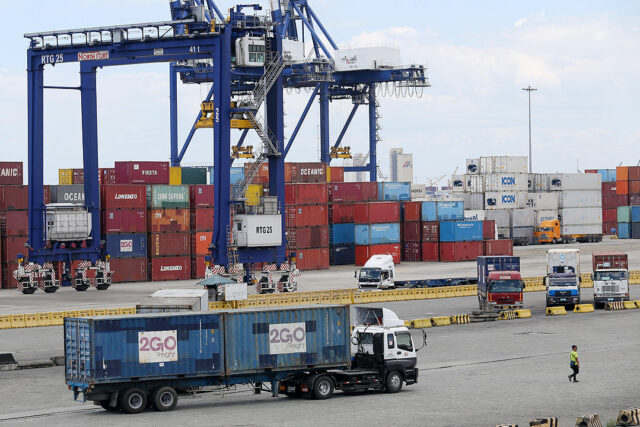
Trucks enter the port area in Manila. — PHILIPPINE STAR/EDD GUMBAN

THE GOVERNMENT on Thursday said that the details of the US-Philippines deal concerning the US reciprocal tariff are still being finalized but noted that the government will protect the interest of Philippine domestic industries.

“The details are not yet final. The Philippines and the US will still have to negotiate the details of the agreement, including products that are covered by market access commitments on both sides,” Trade Secretary Ma. Cristina A. Roque said in a statement.

The statement was jointly issued by the Department of Trade and Industry (DTI) and the Office of the Special Assistant to the President for Investment and Economic Affairs (OSAPIEA).

The government will be working closely with stakeholders in finalizing the trade deal with the US.

“We are mindful of the sensitivities of our domestic stakeholders, and the same will be duly considered in the negotiations,” Ms. Roque said.

Special Assistant to the President for Investment and Economic Affairs Frederick D. Go said that the “concessions we will extend are strategic to the Philippines.”

“These are products that we do not locally produce and are critical inputs to reducing the cost of healthcare, for example,” he said.

The two officials had accompanied Philippine President Ferdinand R. Marcos, Jr. during his meeting with US President Donald J. Trump at the White House.

After the meeting, Mr. Trump announced a 19% tariff would be imposed on Philippine goods, while the Philippines will open its markets to US goods.

The 19% tariff rate is slightly lower than the threatened 20% but is higher than the 17% “reciprocal tariff” announced by Mr. Trump in April. The new tariff will be implemented starting Aug. 1.

“This revised tariff rate places the Philippines among the most competitive Southeast Asian economies trading with the US,” the DTI and OSAPIEA said.

The Philippines’ new US tariff rate is now the same as Indonesia, and slightly lower than Vietnam’s 20%. Singapore faces the lowest US tariff rate of 10%.

“Enhanced market access will enable the Philippines to become a more attractive destination for export-oriented investments — opportunities that might have otherwise gone to our neighbors,” Mr. Go said.

Since the US imposed a “relatively mild” tariff on Philippine goods, the Philippines could attract more foreign investments while its exports gain a “competitive edge” as a manufacturing hub focused on the US market.

“This encourages foreign companies targeting the US to consider relocating their operations here, creating more investment and job opportunities for Filipinos,” the DTI and OSAPIEA said.

The trade deal with the US is not just limited to tariffs but also includes other trade-related matters which will be finalized by negotiators.

“Our objective is to ensure that this bilateral deal will complement our existing international trade commitments as well as the capabilities and needs of our domestic industries,” the DTI and OSAPIEA said.

AGRI SECTOR
At a briefing in Malacañang, Mr. Go said the negotiating team sought to protect the agricultural sector during tariff negotiations with the US.

Mr. Go dismissed criticisms that the Philippines gave up too much in the deal, emphasizing that the government focused on protecting sectors where local production is strong.

While the Philippines is opening its market for US automobiles, wheat, soy and pharmaceuticals, Mr. Go said they preserved tariff protections on key sectors such as rice, corn, sugar, pork, chicken, and fisheries.

“I can guarantee you that we thoroughly studied all of our major industries in the Philippines, where we are a significant producer, and we did not include them in what we gave to America,” he said in Filipino. “The DTI carefully reviewed which products we need to protect and which of our farmers we need to protect, and we protected all of them.”

Mr. Go said that zero tariffs on US pharmaceuticals would lower the cost of medicines in the country.

He said zero tariffs on US-made vehicles would not hurt the domestic industry since there is minimal vehicle manufacturing in the country.

“By opening the automotive sector, we are not hurting any local producers,” he said.

He noted lifting tariffs on imports of US wheat and soy would help reduce overall food prices.

In a separate statement, the Federation of Philippine Industries expressed its readiness to collaborate with the government in making sure that the deal will not “compromise national industrial resilience.”

However, the group stressed the need for structured consultations with industry stakeholders and transparency in the disclosure of products covered by the agreement in mitigating the potential adverse impact.

“These measures may also support the timely activation of appropriate safeguard mechanisms for sectors at risk,” it said.

‘TREATED SHABBILY’
With the Philippines losing its advantage of a lower tariff rate compared to its neighbors, the economy could face headwinds and struggle to attract foreign direct investments, HSBC Global Research economist for ASEAN Aris D. Dacanay said.

Mr. Dacanay said the reciprocal tariff of 19% would erase the Philippines’ competitive advantage, and “risks putting Philippine exports at a disadvantage in the US market.”

“In contrast to Indonesia and Vietnam, which succeeded in lowering their respective tariff impositions without their heads of state physically making a state or official visit to the US capital, the initial diplomatic efforts of the Philippines yielded disappointing results,” GlobalSource Partners Country Analyst Diwa C. Guinigundo said in a report.

“So, the Philippines thought that at the initial round of tariff imposition, it was a winner. It was not. It was instead treated shabbily by the US government.”

Mr. Guinigundo said it is now “imperative for the Philippines to capture relocation and supply-chain shifts as the US and China trade war intensifies.”

“Manila should prepare, and prepare seriously, to host all the companies fleeing from China and other high-tariff countries in electronics, semiconductor packaging, production of converters, power supplies and telecom devices.”

Mr. Dacanay said the Philippines will likely continue negotiating with the US to secure a lower tariff rate.

“Based on the trade deals Vietnam and Indonesia have had with Washington, finding ways to open domestic markets to the US seems to be a useful bargaining chip,” he said.

“In the meantime, without the relative advantage of a lower tariff rate, the Philippines will likely rely on its old (but effective) playbook of maintaining a robust reform narrative to attract investments and technologies from abroad.”

On the other hand, University of Asia and the Pacific professor emeritus Bernardo M. Villegas said there is no need to pursue a lower tariff rate.

“It’s not worth the effort. Because we are not really oriented towards exports. If it just prolongs and prolongs the discussion, it’s not worth it,” he told BusinessWorld on the sidelines of a forum. “Trade is not a very important part of GDP. So, I wouldn’t worry about the differences,” he added.

Fitch Solutions’ CreditSights in a separate report likewise said the tariff will not significantly impact Philippine economic growth.

“We anticipate the US tariffs to have a limited impact on the Philippines’ economy, given the Philippines’ low export exposure to the US, and relatively low export contribution to its total GDP,” it said.

The US goods trade deficit with the Philippines reached nearly $5 billion in 2024, up by 21.8% from 2023. This as US goods trade with the Philippines amounted to around $23.5 billion while US goods exports stood at $9.3 billion.

The US is the top export destination for Philippine goods, accounting for about 16% of total exports in the first five months of the year. — Justine Irish D. Tabile, Luisa Maria Jacinta C. Jocson and Chloe Mari A. Hufana

Philippines to tap GCash to sell bite-sized bonds to attract more investors

Commercial and residential buildings in Manila, Philippines, Dec. 16, 2022. — SEONGJOON CHO/BLOOMBERG

THE PHILIPPINES is tapping mobile wallet GCash to sell small-denominated government securities, according to the Bureau of the Treasury (BTr), seeking to broaden the investor base as it raises more money to refinance debt and fund the growing economy.

The government will sell Treasury bills for a minimum P500 ($8.80) net of fees, and retail Treasury bonds for a minimum P5,000, National Treasurer Sharon P. Almanza said on Thursday.

“Investing in government bonds is about to get easier,” the BTr said in a post on its Facebook account, highlighting that the offering of what it calls GBonds is “coming soon.”

The Philippine central bank is working with the Treasury bureau on widening the nation’s capital markets, Bangko Sentral ng Pilipinas (BSP) Governor Eli M. Remolona, Jr. said on Thursday. “This initiative of GBonds is part of that, extending the deepening of capital markets to the retail level,” he said.

Virtual asset company Philippine Digital Asset Exchange, or PDAX, is providing the technology for the bond registry while its wholly owned unit Bond.PH will act as the licensed broker-dealer, according to PDAX founder and Chief Executive Officer Nichel Gaba. The bite-sized bonds will be available to users of GCash, he said.

“T-bills are already accessible to some GCash users,” Mr. Gaba said by phone. “It’s a small set of users meant mainly for testing,” he said, adding that GBonds this time around will be marketed broadly.

A unit of Globe Telecom, Inc., GCash has around 94 million users.

Bond sales to retail investors are a big source of financing for the Philippine government, which faces an estimated budget deficit equivalent to 5.5% of gross domestic product for this year. The government’s reliance on the funding source has seen robust demand in the past. — Bloomberg

Aboitiz finalizing 40% infra arm stake sale to BlackRock’s GIP

ABOITIZ INFRACAPITAL operates the Mactan-Cebu International Airport (MCIA), the largest international aviation hub outside of Metro Manila. — ABOITIZINFRACAPITAL.COM

LISTED conglomerate Aboitiz Equity Ventures, Inc. (AEV) said it is finalizing a strategic partnership with Global Infrastructure Partners (GIP), a US-based infrastructure fund manager owned by global asset management giant BlackRock, Inc., for the acquisition of a 40% stake in its infrastructure arm, Aboitiz InfraCapital, Inc.

“We are honored to explore this opportunity with Global Infrastructure Partners,” AEV President and Chief Executive Officer (CEO) Sabin M. Aboitiz said in a statement to the stock exchange on Thursday. “Our shared vision of modern, world-class infrastructure aligns with the country’s ambitions for progress,” he added.

GIP, which manages over $183 billion in infrastructure assets across sectors such as energy, transport, digital infrastructure, and water, has stakes in major assets including London’s Gatwick Airport and Australia’s Port of Melbourne. Its parent firm, BlackRock, is the world’s largest asset manager and is listed on the New York Stock Exchange under the ticker symbol BLK.

AEV said its executives, along with President Ferdinand R. Marcos, Jr., met with GIP Chairman and CEO Bayo Ogunlesi during a recent high-level meeting in the United States.

“This collaboration marks a strong vote of confidence in the Philippines’ future. With global partners like GIP working alongside respected Filipino firms such as Aboitiz, we can build infrastructure that is more resilient, inclusive, and forward-looking,” Mr. Marcos said.

“GIP’s entry signifies the remarkable potential for infrastructure investments in the Philippines. The choice of Aboitiz is very strategic,” China Bank Capital Corp. Managing Director Juan Paolo E. Colet said in a Viber message to BusinessWorld.

AEV said the parties are “in the process of finalizing” the transaction, which it described as potentially one of the most significant foreign equity investments in Philippine infrastructure in recent years.

“This collaboration underscores growing global investor confidence in the Philippine market and reinforces the country’s standing as a prime investment destination in Asia,” the company added.

Aboitiz InfraCapital is the Aboitiz group’s infrastructure arm and the private operator of several airport assets in the Philippines, including the Mactan-Cebu International Airport (through Aboitiz InfraCapital Cebu Airport Corp.), the Laguindingan International Airport, and the New Bohol-Panglao International Airport.

The company also has interests in water infrastructure, data centers, and telecommunications.

According to Mr. Colet, GIP is not only acquiring a stake in a strong infrastructure portfolio but is also forming a flexible partnership platform for future expansion.

“It is also creating a formidable partnership that can expand aggressively in the local infrastructure space. There is ample liquidity and appetite among the leading domestic banks to back the investment plans of the Aboitiz-GIP tandem,” he said.

He added that infrastructure investment has significant multiplier effects on the broader economy, making the deal strategically important.

“We are pleased to have the opportunity to become a strategic partner of the Aboitiz group… The Philippines has compelling growth prospects, which can be further enhanced by developing world-class infrastructure,” GIP’s Mr. Ogunlesi said.

BDO Capital President Eduardo V. Francisco said the partnership would boost AEV’s capital and expand its pipeline of infrastructure projects.

“This would provide positive signals on the Philippine economy and financial markets with the possible investment by one of the biggest global investors,” Rizal Commercial Banking Corp. Chief Economist Michael L. Ricafort said, describing the deal as a vote of confidence in the country and a potential catalyst for attracting other global fund managers to Philippine infrastructure.

Shares in AEV rose by 75 centavos or 2.29% to close at P33.50 each on Thursday. — Ashley Erika O. Jose

SEC offers 30% discount on public offering fees until yearend

BW FILE PHOTO

THE Securities and Exchange Commission (SEC) said it is offering discounted registration fees to companies conducting public offerings until the end of the year to encourage greater participation in the capital market.

The corporate regulator said in Memorandum Circular (MC) No. 9 issued Thursday that all registration statement applications submitted until Dec. 31 will be entitled to a 30% discount on assessed registration fees.

MC No. 9 also streamlines the evaluation and approval process for registration statements by integrating the clearance processes across the SEC’s departments within the 45-day processing timeline under the Securities Regulation Code.

The 45-day calendar period will begin from the date the Markets and Securities Regulation Department receives proof of payment for the first tranche of the registration fee and full payment of clearance-related fees.

The guidelines cover all registration statement applications of firms looking to do initial public offerings or follow-on offerings, as well as those issuing investment contracts, certificates of participation, profit-sharing agreements, bonds, and debt securities.

Also covered are other forms of securities being registered by power generation companies, distribution utility companies, real estate developers, and managers in relation to rental pool arrangements.

Agri-business corporations and hospitals, which are subject to a 28-day processing period, are excluded from the 45-day review timeline.

“Our goal for the Philippine capital market is clear — increase market participation to bring it up to par with our peers in the Southeast Asian region,” SEC Chairperson Francisco Ed. Lim said in a statement.

“The SEC will streamline processes and provide discounts or incentives where possible, in order to encourage more businesses to tap into the capital market, enabling them to unlock their full growth potential through diverse financing options,” he added. — Revin Mikhael D. Ochave

Top stars and directors head to Venice for high-powered 2025 festival

LABIENNALE.ORG

HOLLYWOOD STARS, Oscar-winning directors, Asian heavyweights and European auteurs will vie for top honors at this year’s stellar Venice Film Festival, all looking to make a splash at the start of the awards season.

Running from Aug. 27 to Sept. 6, the 82nd edition of the world’s oldest film festival will showcase a rich array of movies that span psychological thrillers, art-house dramas, genre-bending experiments, documentaries, and buzzy studio-backed productions.

Among the leading A-listers expected to walk the Venice Lido’s red carpet are Julia Roberts, Emma Stone, George Clooney, Dwayne Johnson, Emily Blunt, Andrew Garfield, Oscar Isaac, Cate Blanchett, and Amanda Seyfried.

NETFLIX RETURNS
A who’s-who of global directors will also be premiering their latest pictures at the 11-day event, including US filmmakers Kathryn Bigelow, Jim Jarmusch, Noah Baumbach, and Benny Safdie, alongside top Europeans Yorgos Lanthimos, Paolo Sorrentino, and Laszlo Nemes, and Asia’s Park Chan-wook and Shu Qi.

Netflix, which skipped Venice last year, returns in full force in 2025 with a trio of headline-grabbing titles, including Guillermo del Toro’s Frankenstein, a new take on the classic horror tale starring Mr. Isaac, Jacob Elordi, and Mia Goth.

Mr. Baumbach’s comedy-drama Jay Kelly, starring Mr. Clooney, Adam Sandler, and Laura Dern, is also in the main competition and on the Netflix slate, alongside the geopolitical thriller A House of Dynamite, with Idris Elba and Rebecca Ferguson, and directed by Ms. Bigelow, who won an Oscar in 2010 for The Hurt Locker.

Venice fires the starting gun for the awards season, with films premiering on the Lido in the last four years collecting more than 90 Oscar nominations and winning almost 20, making it the place to be seen for actors, producers, and directors alike.

In the past nine editions of the Oscars, the award for Best Actress or Best Actor has gone eight times to the protagonists of films first seen in Venice, including Ms. Stone for her role in Poor Things in 2024.

FIGHTERS AND FAMILIES
Ms. Stone returns to Venice this year, teaming up again with Poor Things director Mr. Lanthimos in an offbeat satire, Bugonia.

The indie icon of US cinema, Jim Jarmusch, will be showing his Father Mother Sister Brother, a three-part tale exploring fractured families with a cast that includes Ms. Blanchett, Vicky Krieps, Adam Driver, and Tom Waits.

Another US film getting its first outing at Venice is the MMA fighter biopic The Smashing Machine, starring Mr. Johnson and Ms. Blunt, and directed by Benny Safdie.

A very different biopic is The Testament of Ann Lee — a musical take on the life of the radical 18th century Shaker leader, which stars Ms. Seyfried and is directed by Norway’s Mona Fastvold.

European auteurs are well-represented, with Paolo Sorrentino’s La Grazia, starring Toni Servillo, selected as the festival’s opening film, while Hungary’s Nemes presents the family drama Orphan and France’s Francois Ozon showcases his retelling of Albert Camus’ celebrated novel The Stranger.

Another French director, Olivier Assayas, will premiere The Wizard of the Kremlin — a political thriller about the rise of Vladimir Putin, starring Paul Dano and Alicia Vikander, with Jude Law playing the Russian leader.

TRAGIC STORY OF PALESTINIAN GIRL
One film that looks certain to raise emotions is Kaouther Ben Hania’s The Voice of Hind Rajab, which uses original emergency service recordings to tell the story of a five-year-old Palestinian girl who was killed in Gaza in 2024 after being trapped for hours in a vehicle targeted by Israeli forces.

“I think it is one of the films that will make the greatest impression, and hopefully (won’t be) controversial,” said the festival’s artistic director, Alberto Barbera, his voice trembling as he recalled the movie.

Among the battery of films being shown out of competition is Luca Guadagnino’s MeToo-themed psychological drama After The Hunt, starring Ayo Edebiri, Mr. Garfield, and Julia Roberts, who will be making her red carpet debut at Venice, Mr. Barbera said.

The jury for the main competition will be chaired by US director Alexander Payne. He will be joined by fellow directors Stephane Brize, Maura Delpero, Cristian Mungiu, Mohammad Rasoulof, and the actresses Fernanda Torres and Zhao Tao. — Reuters

MPAV acquires coconut processor Franklin Baker

MANUEL “MANNY” V. PANGILINAN

METRO PACIFIC AGRO VENTURES, Inc. (MPAV) is expanding its presence in the local coconut export industry through the acquisition of coconut processor Franklin Baker Group of Companies (Franklin Baker).

MPAV, a unit of the Pangilinan-led Metro Pacific Investments Corp. (MPIC), said in an e-mailed statement on Thursday that it had signed agreements for the acquisition of Franklin Baker.

Under the deal, MPAV will infuse capital into Franklin Baker to help stabilize its operations, clear pending export backlogs, and return to sustainable growth.

MPAV did not disclose the value of the acquisition, but earlier news reports placed the deal at around P1 billion.

Founded in 1921, Franklin Baker is one of the country’s most established coconut processors. It operates manufacturing facilities in Laguna and Davao and supplies various coconut products to over 50 countries. These include desiccated coconut, coconut water, virgin coconut oil, and coconut cream.

MPAV said the acquisition of Franklin Baker builds on its previous investment in listed coconut product exporter Axelum Resources Corp.

In 2023, MPAV acquired a 34.76% stake in Axelum through a P5.3-billion deal.

Franklin Baker and Axelum have a combined capacity to process more than 2 million coconuts daily, according to MPAV.

“With Franklin Baker and Axelum, we now have the opportunity to scale a globally competitive coconut platform — one that brings together world-class processing, long-standing customer relationships, and strong ties to our farming communities,” MPIC Chairman and Chief Executive Officer (CEO) Manuel V. Pangilinan said.

“This is a unique opportunity to strengthen a flagship export sector and help make Filipino agricultural products a global standard,” he added.

MPAV said the acquisition supports its strategy to create a vertically integrated agribusiness portfolio consisting of coconut investments through Franklin Baker and Axelum; dairy through Carmen’s Best and Bukidnon Milk Co.; and fruit and vegetable production through Metro Pacific Fresh Farms.

The deal is also expected to safeguard the jobs of over 5,000 workers and maintain a reliable market for more than 50,000 coconut farmers nationwide.

“This transaction is about growth. With Franklin Baker joining Axelum in our portfolio, we are building a coconut powerhouse that combines heritage, scale, and global reach,” MPAV President and CEO Jovy I. Hernandez said.

“Our goal is to strengthen the entire value chain — from farmer to processor to export markets — while cementing the Philippines’ leadership in the global coconut industry,” he added.

China Bank Capital Corp. Managing Director Juan Paolo E. Colet said in a Viber message that the acquisition will position the Metro Pacific group as a major player in the coconut industry.

“It’s a business with many challenges but also significant potential. They would have to boost productivity and efficiency through substantial investments to ensure coconut exports remain competitive, especially in the face of United States tariffs,” he said.

“We expect Metro Pacific to leverage its management acumen, operational discipline, and financial resources to make this a profitable and socially impactful business,” he added.

MPIC is one of the three key Philippine units of Hong Kong-based First Pacific Co. Ltd., alongside Philex Mining Corp. and PLDT Inc.

Hastings Holdings, Inc., a unit of PLDT Beneficial Trust Fund subsidiary MediaQuest Holdings, Inc., holds a majority stake in BusinessWorld through the Philippine Star Group, which it controls. — Revin Mikhael D. Ochave

The new Fantastic Four does nothing to end Marvel’s losing streak

A STILL from The Fantastic Four: First Steps. — IMDB

By Esther Zuckerman

Movie Review
The Fantastic Four: First Steps
Directed by Matt Shakman

IT’S almost too easy to pit the movies Superman (2025) and The Fantastic Four: First Steps against each other. They are this summer’s big superhero swings at the box office, both attempting to inject new life into their respective studios, DC and Marvel, which are owned by competitors Warner Bros. Discovery, Inc. and Walt Disney Co. And besides their positioning in the market, they are easy to compare for other reasons as well. These are classic superheroes with a dose of retro, All-American sheen to them, and both films profess a return to earnestness.

But while Superman felt bracingly modern with the political sentiments to boot, The Fantastic Four has a halo of cobwebs it can’t quite shake off.

That means, if you’re keeping score, it looks like the newly revitalized DC Universe with Superman director James Gunn and Peter Safran at the helm is a point above Marvel, the once-dominant force in the Hollywood comic book ecosystem, at least when it comes to current creative path. If both these films are intended to get us excited about the future of these franchises, Superman, the more thrilling movie, wins. We’ll see about the box office.

That’s not to say that Fantastic Four, directed by Matt Shakman of Marvel’s TV show WandaVision, is all bad. It’s just that it never capitalizes on its best qualities, leaving the entire affair feeling a bit staid and ultimately disappointing. (Disney gained control over the Fantastic Four when it bought Fox, thus giving the studio an attempt to finally get these guys right after the incredibly hokey 2000s versions starring Chris Evans and Jessica Alba, and the disastrous attempt at a reboot in 2015 with Miles Teller.)

The idea behind the film is a solid one. The Fantastic Four team has always felt strongly rooted in its 1960s origins. They are a product of the space race, a group of astronauts who acquire superpowers after running into some pesky cosmic rays on a mission. Instead of trying to update the foursome to the present day, in First Steps they exist in the time of their creation — or at least a version of it. They are living on Earth-828, which is not the usual “Earth” for these movies. (You know, the multiverse and all of that.) The score by Michael Giacchino is twinkly and enervating, making you feel like you’re heading to the World’s Fair.

The 1960s setting, however, means that in the opening moments I was struck not by any bit of action or dialogue, but by the dreamy red mid-century modern finishes in the vast bathroom of their retro-futurist abode. If nothing else the Fantastic Four have a great sense of interior design.

The action hits four years into their debut as a superhero team. (Not unlike the way Superman takes place three years after he emerges on the scene in Metropolis.) Specifically, it opens with a reveal: Sue Storm (Vanessa Kirby), aka the Invisible Woman, is pregnant. The father, of course, is her husband Reed Richards (Pedro Pascal), the uptight scientist, also known as Mister Fantastic, who can get real stretchy. Their fellow Fantastics are overjoyed — including Sue’s brother Johnny Storm (Joseph Quinn), the Human Torch, and their pal Ben Grimm (Ebon Moss-Bachrach), who turned all rocky in their accident and became the Thing.

But there’s a problem: Earth is visited by the Silver Surfer (Julia Garner), a hot, nearly naked babe who, yes, rides a surfboard. (Remember the character is a product of the 1960s when the Beach Boys were all the rage.) This metallic herald tells the crew that her boss Galactus (Ralph Ineson) is going to eat the planet. In order to stop this catastrophe, the Four travel to Galactus’ ship where he gives them an ultimatum: They can stop the destruction if Sue hands over her then-unborn baby to him. Sue and Reed performed tests and concluded the baby was “normal” and not superpowered like them, but Galactus recognizes that the kid is going to have some major gifts.

Giving over their child — who is born in zero gravity on the trip back home in a self-serious sequence — is a no-go for Sue, Reed, Johnny, and Ben. As such they have to figure out other ways to save everyone and everything, all the while fending off a public that is pretty mad at them for their decision.

What follows is a relatively talky movie for the superhero genre as the crew tries to strategize ways to defeat Galactus. I would normally cheer this if the result didn’t feel so dreary. There’s a huge discrepancy between the pop art color palette — similar to Superman — and the tenor of the saga which forgoes the whizz bang humor for somber discussion.

This isn’t the fault of the actors. Kirby, best known for The Crown, is impassioned as Sue. Moss-Bachrach, your cousin from The Bear, is a jovial brute as Ben. (My favorite part of the entire film is his crush on a schoolteacher played by Natasha Lyonne, which eventually brings him to a local shul.) Stranger Things’ Quinn taps into Johnny’s hot shot energy, while Pedro Pascal, of every single movie and TV show these days, offers Reed bottled-up gravitas.

But the script by Josh Friedman, Eric Pearson, Jeff Kaplan, and Ian Springer wastes every opportunity to have fun with their dynamic. The fact that there’s a newborn in the apartment is waved off with a couple lines about lack of sleep. Sue and Johnny have barely any sibling banter. Sue and Reed’s relationship is blandly chaste. Mostly we’re treated to dour monologues about their predicament that all end in platitudes about the importance of family, a message designed to ruffle as few feathers as possible. When the action does hit, it fails to find innovative ways to utilize the Four’s wacky powers.

Although the ’60s milieu gives the story every opportunity to be kitschy, the movie squanders that too. An expositional news report early on offers a taste of what could have been with clips of the Four fighting kooky villains like Mole Man (Paul Walter Hauser). Galactus has none of that goofiness. He and Silver Surfer are rendered in janky, muddled-looking CGI that lacks the visual pop of the throwback sets.

The failures of Fantastic Four speak to the lingering problems that Marvel faces. For those of you not keeping track, we are now in the sixth phase of their ongoing project, and the period setting of this reboot should have given the filmmakers leeway to experiment with tone, taking big swings along the way. (Think: the revelation that was Guardians of the Galaxy when it first came out.) Instead it is all played very safe. There’s now an entrenched base to please, and Marvel isn’t going to mess with that. But at least that bathroom looks fabulous. Bloomberg

Asia-Pacific banks see scams, mule accounts as top threats

STOCK PHOTO | Image by Jcomp from Freepik

SCAMS and money mule accounts are the top fraud concern of bank executives in the Asia-Pacific, according to a survey by global analytics software firm FICO.

Seven in 10 or 69% of senior officials of financial institutions in the region said scams and mule accounts have become the “dominant threat” for the industry, according to a FICO poll, which it conducted during its Asia Pacific Fraud Forum in June and had more than 40 fraud and risk executives as respondents.

This reflects the continued rise in these forms of fraudulent activities where victims are tricked into sending money to criminals, it said.

“Unlike traditional fraud, which typically involves unauthorized transactions that banks can detect and block, scams often bypass existing defenses because payments are authorized by the victim. Once the money is sent, criminals rely on mule accounts to quickly move funds across institutions and borders, making recovery extremely difficult,” FICO said.

This comes as scam-related losses reported by the financial sector reached “historic highs” last year, it noted, with Malaysia recording $12.78 billion in losses. Thailand also saw $1.7 billion in damages and Singapore reported $860 million in losses, up 70% year on year.

“Similar trends were reported in the Philippines and Indonesia, where scam-related activity now dominates cybercrime reports,” FICO said.

The Bangko Sentral ng Pilipinas (BSP) earlier said that its supervised financial institutions saw P5.82 billion in losses from cyberattacks in 2024, up 2.6% from P5.67 billion the previous year.

Top cybersecurity risks faced by BSP-supervised institutions last year include phishing, “card-not-present” fraud, account takeover or identity fraud, and hacking, with losses due to phishing and card-not-present activities estimated at P1.8 billion and P1.5 billion, respectively.

FICO’s poll also found that 52% of banking officials in Asia-Pacific said that social media platforms are the top external threat vector for scams, followed by messaging apps (35%).

“In a region with more than two billion social media users, platforms such as Facebook, TikTok, and Telegram have become key channels for targeting scam victims and recruiting money mules,” it said.

“Criminal syndicates use these platforms to impersonate officials, promote fake investments, or advertise bogus job opportunities. Many victims are lured into schemes that appear legitimate on the surface, while others are convinced to “rent out” their accounts in exchange for quick cash, not realizing they are enabling financial crimes.”

Banks in the region also said that operational barriers limit their ability to detect and respond to scams. These barriers included siloed data (46%), a lack of connected insights across products and channels (28%), and limited real-time integration with third-party systems (13%).

“Scam activity is often fast, fluid, and fragmented,” said Dattu Kompella, managing director of Asia-Pacific for FICO. “To respond effectively, banks need connected systems that provide a complete, real-time view of risk. Without breaking down internal silos and unifying insights across teams, many institutions will remain on the back foot.”

Meanwhile, only 14% of executives said banks should fully reimburse customers that fall victim to scams, while half said compensation should only apply when the bank is at fault. The remaining 36% of respondents said they support a “shared responsibility model” between banks and customers.

A FICO survey released in May showed that Filipinos are most concerned about falling for financial scams amid the surge in real-time payments, with 35% of respondents saying their top worry is the risk of being tricked into sending money to criminals.

Meanwhile, concerns about identity theft also persist among Filipino respondents, with over 23% citing it as their top financial crime concern. This was followed by having a bank account taken over by a fraudster (16%), their credit or debit card being stolen and used (13%), their cash being stolen (8%), and fake online retailers and fake advertisement tricking them into buying goods that never arrive (6%).

The Anti-Financial Account Scamming Act (AFASA), which was signed into law by President Ferdinand R. Marcos, Jr. in July 2024, aims to help prevent and penalize digital financial cybercrime.

Money mule activities are part of the prohibited acts or offenses under the AFASA, along with social engineering schemes, which could be considered economic sabotage if it involves three or more people as perpetrators or victims, mass mailers, and human trafficking, as well as opening a financial account under a fictitious name or using the identity or identification documents of another person.

The law allows the BSP to probe financial accounts suspected to be involved in prohibited acts identified under the law. BSP-supervised institutions can also freeze disputed funds related to these incidents.

Financial institutions are also required to adopt stricter information technology risk management measures to protect their customers from fraudulent schemes done online. These include adopting fraud management systems, as well as safeguards like the limitation on the use of interceptable authentication mechanisms like one-time passwords. — BVR

US tariff to have limited impact on PHL firms’ dollar bond issuances — CreditSights

PCO.GOV.PH

THE 19% tariff set by United States President Donald J. Trump on Philippine goods will have a limited impact on the planned dollar bond issuances by local companies, financial research firm CreditSights said.

“We expect the US tariffs to have a limited impact on the Philippine corporate dollar bond issuers,” CreditSights said in a report.

“We maintain our existing recommendations for the Philippine corporates under our coverage. We do not deem the 19% tariff imposition by the US on good imports from the Philippines as material enough, given their very limited export exposure to the US,” it added.

CreditSights said companies such as ACEN Corp., Globe Telecom, Inc., Manila Water Co., Inc., Petron Corp., PLDT, Inc., and SMC Global Power Holdings Corp. are largely focused on the domestic market.

It added that conglomerates Aboitiz Equity Ventures, Inc. and JG Summit Holdings, Inc. have export-heavy food manufacturing businesses primarily across Asia, and not to the US.

“Aboitiz’s animal feed business may face increased competition from higher US feed imports. JG Summit’s snack foods business could see lower wheat input costs from higher wheat imports from the US,” it said.

Ayala Corp. also has minimal export exposure to the US through its semiconductor subsidiary Integrated Micro-Electronics, Inc., which contributes only a small portion of its total revenue, CreditSights said.

The research firm also said that the Ang-led conglomerate San Miguel Corp. faces marginal export exposure to the US that can be offset by its diversified business portfolio.

“We acknowledge SMC could face weakened domestic competitiveness and pricing for its poultry and animal feed units, given the US is a major supplier of chicken, pork, and animal feed to the Philippines. That said, we deem the impact manageable, supported by SMC’s strong domestic brand equity, well-established presence and its diversified business portfolio,” CreditSights said.

Oil refiner Petron, another Ang-led company, might see higher logistics costs as it may be compelled to source crude oil and gas from the US. However, the company enjoys a full market pass-through mechanism to protect its margins.

CreditSights said the domestic ports of the Razon-led International Container Terminal Services, Inc. (ICTSI) could see higher volume with the expected increased imports of US goods into the Philippines.

“ICTSI has limited direct trade exposure to the US. While it could see some throughput weakness at its Mexico port, we take good comfort in ICTSI’s strong global geographical diversification and ability to preserve margins by hiking port fees,” it said.

The local business of fastfood giant Jollibee Foods Corp. also stands to benefit from lower input costs of wheat and poultry due to higher US imports.

Mr. Trump recently announced a 19% tariff on Philippine goods entering the US, a step down from the 20% duty set earlier this month. However, it is higher than the 17% tariff announced by Mr. Trump as part of his Liberation Day tariffs in April. — Revin Mikhael D. Ochave

Change of heart, or getting real?

PHILIPPINE STAR/EDD GUMBAN

We monitored, and even took notes of, the several Supreme Court oral arguments on the Philippine Health Insurance Corp. (PhilHealth) issue, that because of what the Palace and Congress thought a surplus fund existed, P60 billion was remitted to the National Treasury and the proposed subsidy of P74.43 billion was zeroed out.

Some justices of the High Court illustrated with their own personal experience that no matter how much one makes of PhilHealth’s reserve fund of P600 billion and the reported P150 billion surplus from its 2024 budget, the health corporation, which is funded by members’ contributions, is absolutely short of fulfilling its legal mandate of providing more health cover to more Filipinos. So many out-of-pocket expenses in the hospital have to be paid by members when they get sick. Many kinds of health issues remain outside PhilHealth coverage including procedures and therapies. Those “surplus” funds existed, and continue to exist, because PhilHealth has yet to settle its old and new obligations with both its members and hospitals. The deficit in its delivery to implement the Universal Health Care Act keeps on bloating.

The picture is no different from a man traveling with a full tank of gas, but he has a few thousand kilometers to travel. Even if he goes hybrid, he would still have to plug in, or rely on gas to recharge.

Up to the last of the oral arguments in Baguio City, the National Government insisted to the Supreme Court that the state health insurer enjoyed surplus funds and therefore sequestering P60 billion was more than justified, that the same amount was anyway channeled to health-related public spending.

This could have escaped the attention of the nation previously glued to the PhilHealth controversy for months, but in the 2026 proposed national budget, the Palace and the Department of Budget and Management seemed to have a sudden change of heart. Finance Secretary Ralph Recto himself announced that “in 2026, there is a subsidy for PhilHealth.”

As the media commented, such a subsidy allocation reversed the policy adopted during the finalization of the 2025 budget when the health agency was denied any subsidy. The numbers cited then and today don’t fit in.

PhilHealth’s fund balance is projected at P348 billion by the end of 2025, more than double the level last year, yet the health insurer is deemed entitled to a subsidy? The proposal to restore the subsidy next year is aimed at covering benefit payouts next year and, in the words of the Finance Secretary, “to support an increase of 30% to 50% in benefit packages, broadening coverage and enhancing service delivery across the country.”

What?

We don’t expect to hear mea culpa among policymakers. But no matter how they conceal it, the arguments of the petitioners against the Government and Congress are now being marshalled in support of restoring the subsidy and the higher allocation for the Department of Health. Unwittingly, the respondents are admitting that PhilHealth had no surplus funds, that any reserve balance would have to be used to settle its obligations with its members and partner health institutions, whether public or private, and the universal healthcare system is yet to fully see the light of day. Only a small portion of the population is covered, only a limited range of health problems and procedures could be financed.

On top of these, PhilHealth announced new-found good governance. With the subsidy, there will be no increase in members’ contributions, collections are to be streamlined and strengthened.

Nothing is new here.

As early as eight years ago, the World Health Organization (WHO) spelled out some five strategic priorities for the Philippines in the context of the country’s cooperation with WHO. Priority 1 is to save lives by ensuring a full access to immediate-impact interventions. Priority 2 is the promotion of well-being by empowering people to lead healthy lives and enjoy responsive health services. Priority 3 is health protection through anticipation and mitigation of disasters, and environmental and emerging health threats. Priority 4 is to optimize the health architecture by overcoming fragmentation and achieving universal health coverage. And Priority 5 is to use platforms for health through support in all aspects, settings, policies, and sectors.

These strategic priorities also resonate in various laws and executive orders on the universal healthcare system, and many of the policy implications have been funded by the National Budget. But it took a pandemic in 2020 and 2021 for public spending to start adhering to the constitutional and statutory provisions on the priority that should have been given to the health sector, in the first place.

In 2021 for instance, current health expenditure (CHE) reached P1.09 trillion or some 18.5% higher compared with P917.15 billion in 2020. But then, as reported by the Philippine Statistics Authority, investment or capital formation in health (HK) amounting to P71.15 billion actually declined from P88.54 billion in 2020, or by nearly 20%. Without such investment in health infrastructure, public health would not even be viable.

If not for health spending financed through government schemes and compulsory contributory healthcare financing schemes, public health would have been of arguably poorer quality. All in, they accounted for P546.64 billion or more than half of CHE. Most important, if the public sector is short of what needs to be delivered to the Filipino people in public health, and health insurance schemes are short of what is required, definitely it is the Filipino households who have to pick up the tab.

The last component should be very familiar to us, even to some jurists in the High Court who had to go through medical procedures in the past. Household out-of-pocket payment (OOP) stood at P451 billion — yes, that much. This is not too much of a stretch, but any deficit in budgetary allocation to the health sector, whether to the Department of Health or PhilHealth, will have to be absorbed by the poor Filipino households. Either by way of a bigger out-of-pocket expense, or by denied health services.

For hospitals and other partner health institutions, any unsettled accounts could ultimately lead to their inability to deliver health services to their constituency, or else, they close down.

Talo ang Pilipino! (Filipinos lose!)

It is not therefore surprising that the new head of PhilHealth Edwin Mercado should appeal to the private sector during the weekend “to help address gaps in the country’s healthcare system.” He correctly pointed out that while the demand for health services continues to rise, supply remains so much behind. Mercado is for strengthening primary care to keep members healthy in order to reduce the need for in-patient services.

As we wrote last week, this year’s budget was challenged at the Supreme Court for some unconstitutional provisions put together in an unconstitutional process. It would be difficult for this year’s budget to pass the ideal standard in the allocation of public resources, namely, that it should be “strategic, transparent, accountable, fair, and democratic.” Every peso squandered, or repurposed to serve bad governance, or dedicated to the politics of patronage and corruption is every peso denied an ordinary Filipino in terms of getting good public health or public education.

It’s a good sign that the subsidy to PhilHealth is to be restored and the health sector is to be given a higher allocation in next year’s budget. But like in the theater, we must suspend our applause until the fat lady sings.

Will we ever again see enormous allocations to flood control projects only to be flooded ourselves on the streets or in the privacy of our own homes? Will we ever again see congressional and senatorial allocations of pork while we hear moral praises to the highest? Will we ever again see corruption in the purchase of educational equipment, gadgets and supplies at the Education department while our senior high school students rank lowest in science, reading, and mathematics, and are bottom dwellers in creative thinking? Will we ever again see unconscionable wastage in public resources when they could instead be used to digitalize the delivery of public services and establish greater connectivity in government and industries?

It will be good to hear Senator Risa Hontiveros fiscalize the national budget and Senator Ping Lacson scrutinize each and every allocation in infrastructure, and institutionalize transparency and openness in the bicameral conference on the final shape of the 2026 national budget.

It would be unprecedented if this case of PhilHealth symbolizes a change of heart, or the policy makers are just getting real. Our wish is for the legislature to do its job on the budget while fulfilling their constitutional duty to hear the Articles of Impeachment against the Vice-President. Holding the purse hostage to dispose of the impeachment complaint would indeed be theatrical!


Diwa C. Guinigundo is the former deputy governor for the Monetary and Economics Sector, the Bangko Sentral ng Pilipinas (BSP). He served the BSP for 41 years. In 2001-2003, he was alternate executive director at the International Monetary Fund in Washington, DC. He is the senior pastor of the Fullness of Christ International Ministries in Mandaluyong.

BSP, BTr working to strengthen payments, settlements systems

By Luisa Maria Jacinta C. Jocson, Senior Reporter

THE BANGKO SENTRAL ng Pilipinas (BSP) and the Bureau of the Treasury (BTr) have signed a memorandum of understanding (MoU) to strengthen their payments and settlements systems.

“We are creating a safer and more efficient securities market that enables the government to raise funds more effectively, supporting vital public investments in education, infrastructure, healthcare, and more,” BSP Deputy Governor Mamerto E. Tangonan said during the MoU signing on Thursday.

The MoU aims to promote safety and resilience of the interconnected financial market infrastructures (FMIs) operated by the BSP and the BTr. Under the agreement, the agencies will link the central bank’s Peso Real-Time Gross Settlement (RTGS) System and the Treasury’s National Registry of Scripless Securities (NROSS).

“This collaboration also aims to align operational practices with international standards, enhancing our ability to manage risk, secure transactions, and build market confidence,” Mr. Tangonan said.

The agreement also covers other systems related to the Peso RTGS and NROSS, such as the Delivery versus Payment system and Intraday Settlement Facility.

National Treasurer Sharon P. Almanza said the signing “formalizes our mutual intent toward a more robust, secure, reliable, and resilient financial market infrastructure.”

“As the operator of the NROSS, which is the central securities depository and securities settlement system for all government securities and BSP securities, the BTr recognizes the vital role we play in ensuring the integrity of our system and maintaining financial market confidence and stability.”

Ms. Almanza said the partnership also strengthens their commitment to adhere to the financial market infrastructure principles issued by the Bank for International Settlements and the International Organization of Securities Commissions.

“Let me mention (the ways) in which the Treasury and the BSP could work together. In the BSP, we worry about systemic risk. We worry about big banks suddenly getting problems. And then we have to lend liquidity to those banks,” BSP Governor Eli M. Remolona, Jr. said.

“It would be nice if in lending that liquidity, all we had to do was look at NROSS. And we know exactly what the banks held. And we know exactly how much collateral the bank would have, that we can lend without worrying too much about the lawyers,” he added.

Ayala companies retain spots on FTSE4Good Index Series

Ayala Corp. President and Chief Executive Officer Cezar P. Consing — GLOBE.COM.PH

THE AYALA GROUP said its companies have once again been listed in the FTSE4Good Index Series for their respective environmental, social, and governance (ESG) practices.

The companies that remained on the list are holding company Ayala Corp., as well as core businesses ACEN Corp., Ayala Land, Inc. (ALI), Bank of the Philippine Islands (BPI), and Globe Telecom, Inc.

Ayala Corp., ALI, and BPI have been included since 2015. Globe has been part of the index since 2016, while ACEN has been cited since 2023.

“Our inclusion in the index reflects the commitment of our whole group to sustainability. For a developing country like ours, sustainability means investing in a future where every Filipino can thrive. We want to be part of that future,” Ayala Corp. President and Chief Executive Officer Cezar P. Consing said in an e-mailed statement on Thursday.

The FTSE4Good Index Series is a semi-annually reviewed index by global index and data provider FTSE Russell, a unit of the London Stock Exchange Group that periodically distributes stock market indices.

The index series measures the performance of companies demonstrating strong ESG practices.

Companies are evaluated on corporate governance, health and safety, anti-corruption, and climate change. Businesses included in the FTSE4Good Index Series meet a variety of environmental, social, and governance criteria.

As of end-2024, the Ayala group’s total sustainable finance transactions stood at $6.2 billion. — Revin Mikhael D. Ochave