Home Blog Page 1244

Shaping car power through engine

aopsan on Freepik

Most car buyers often focus on the brand, style or even the newest technology features of the vehicle. These features certainly matter, but beneath the polished exterior and flashing infotainment screens lies the heart of every vehicle: the engine.

The engine defines how a car moves, how it responds under pressure, and how efficiently it uses fuel. Simply put, the engine determines how well a car performs. Engine refers to what car makers call displacement; the total volume all the engine’s cylinders can push through a mix of fuel and air. This is typically measured in cubic centimeters (cc) or liters. A 1,000 cc engine, for instance, is also called a 1.0-liter engine.

But size alone does not tell the whole story. How it is designed and tuned plays a big part in a car’s power output and overall performance.

Horsepower is one of the most common ways to describe engine strength. It measures how much work the engine can do over time. In practical terms, more horsepower means quicker acceleration and better top-end performance.

That might sound appealing, but there is a trade-off as more horsepower usually requires more fuel. High-performance engines burn more gasoline to maintain power, which often results in lower miles per gallon (MPG). This is why car buyers often weigh performance against fuel economy.

Considering engine design

Compact engines ranging from 1.0 to 1.2 liters are commonly found in city cars and economy models. These engines usually have three or four cylinders and are built for lightness and efficiency. Their smaller size means they consume less fuel and emit fewer pollutants. On paper, they may not appear powerful as it produce only around 60 to 120 horsepower, but modern design techniques such as turbocharging and direct fuel injection help these engines deliver more punch than expected.

Car makers equip these engines with fuel-saving technologies such as start-stop systems and hybrid assistance to meet stricter emission standards without sacrificing much performance. 

Meanwhile, engines between 1.4 and 1.6 liters sit in the middle of the power-efficiency scale. Found in hatchbacks, sedans, and smaller sport utility vehicles (SUVs), these engines typically offer 90 to 150 horsepower, depending on tuning and whether they are turbocharged.

Turbocharging forces extra air into the engine, allowing for stronger combustion. This means more power without increasing engine size. Direct injection improves fuel burn efficiency. When combined, these technologies give drivers the feel of a larger engine while maintaining better MPG.

These engines are often four-cylinder setups but can also come in three- or six-cylinder configurations. They aim to offer a balance between power for highway driving and efficiency for urban traffic. Their torque is typically focused in the mid-range, which allows for smoother acceleration in everyday use. The balanced weight of these engines also improves handling, especially when paired with modern transmissions such as continuously variable transmissions (CVTs) or dual-clutch automatics.

Engines in the 1.8- to 2.0-liter range are designed for higher performance without completely sacrificing fuel economy. These engines usually have four cylinders, although some sportier models may include more. They produce between 120 and over 200 horsepower, making them suitable for compact cars, sedans, and light SUVs.

These engines shine on longer drives. Their torque delivery is often strong in the low to mid-range, allowing for easy overtaking and quick starts from a full stop. They are also refined enough to support a comfortable driving experience at higher speeds.

These engines perform well on longer drives. Their torque delivery is strong in the low to mid-range, allowing for quick starts and easy overtaking. They are also refined enough to support a smooth driving experience at higher speeds.

If a driver needs more strength for towing or carrying heavier loads, a 2.2- to 3.0-liter engine is often the go-to option. These engines typically feature four, six, or even eight cylinders. Vehicles in this category include larger sedans, SUVs, and performance cars. Their power outputs range from 150 to more than 400 horsepower. These engines are known for strong torque delivery, especially in the mid-range RPMs, making them suitable for demanding tasks such as long-distance cruising, pulling trailers, or navigating hilly terrain.

Drivers can also expect quicker acceleration and better response at highway speeds. However, fuel efficiency tends to decrease, although newer engines attempt to offset this with features such as cylinder deactivation and mild hybrid support.

Once engine size exceeds the 3.0-liter mark, the dynamics change significantly. These engines, commonly found in luxury vehicles and high-performance sports cars, often feature six, eight, 10, or even 12 cylinders. Their horsepower typically starts around 250 and can exceed 1,000 in some top-tier models.

With engineering features such as turbocharging, supercharging, and direct fuel injection, these engines deliver high performance, including rapid acceleration and high top speeds. Their torque remains available across a wide RPM range, supporting fast overtakes and smooth highway driving. Fuel efficiency is rarely a priority; instead, these engines emphasize performance, speed, and driving excitement.

After all, the number of cylinders, use of turbochargers, fuel injection systems, and engine tuning affect how much power the car produces and how efficiently it operates. Nowadays, even smaller engines can outperform older and larger ones due to technological advancements; so it is important to consider and evaluate how the vehicle will be used. — Mhicole A. Moral

Ayala Corp. posts P12.6-B Q1 profit as power, telco segments weaken

GLOBE.COM.PH

LISTED conglomerate Ayala Corp. recorded a 4% decline in its first-quarter (Q1) net income to P12.6 billion from P13.07 billion in the same period last year, due to weaker contributions from its power and telecommunications (telco) units.

First-quarter core net income, which excludes one-off items, likewise fell by 4% to P11.3 billion, Ayala Corp. said in a regulatory filing on Tuesday.

“We are seeing strong starts from our banking, real estate, and fintech businesses. Our telco and energy businesses have some catching up to do. Our smaller, newer companies are turning the corner. We are constructive on the year,” Ayala Corp. President and Chief Executive Officer Cezar P. Consing said.

The power business, led by ACEN Corp., saw a 28% drop in first-quarter net income to P2 billion due to lower generation from Philippine wind turbines rendered offline by typhoons in the fourth quarter last year, softer local electricity spot market prices, and depreciation expenses from newly operationalized plants.

For its telecommunications segment, Globe Telecom, Inc. recorded a 22% decline in core net income to P4.5 billion, weighed down by lower gross service revenues, higher financing costs, and increased depreciation expenses.

The Ayala-led telecommunications company, however, saw its Q1 attributable net income rise by 2.65% to P6.98 billion, driven by contributions from its e-wallet platform GCash.

“We reaffirm our outlook for 2025. We remain on track to deliver low- to mid-single-digit growth in service revenues, driven by a very resilient portfolio,” Globe President and Chief Executive Officer Carl Raymond R. Cruz said during a media briefing.

For the first quarter, Globe’s consolidated revenue declined by 3.42% to P43.76 billion from P45.31 billion a year ago.

Costs and expenses for the period increased by 2.1% to P40.54 billion from P39.72 billion in the first quarter last year.

“While the first quarter had some headwinds, the signals that we are actually seeing points to a stronger set of quarters ahead,” Mr. Cruz said.

“The industry is shifting rapidly that is why we are actually revisiting our guidance so we can respond with agility and seize opportunities without missing a beat,” he said.

Meanwhile, the banking business, led by the Bank of the Philippine Islands (BPI), grew its net income by 9% to P16.6 billion. Total revenue increased by 13% to P44.7 billion, driven by higher net interest income and an improved net interest margin.

The real estate segment, led by Ayala Land, Inc. (ALI), recorded a 10% increase in net income to P6.9 billion. Revenue rose by 6% to P43.6 billion on higher property development bookings, as well as healthy leasing and hospitality operations.

Ayala Corp. said its healthcare unit, AC Health, narrowed net losses to P59 million on improved facility utilization and higher margins.

Logistics subsidiary AC Logistics Holdings Corp. also reduced its core net loss to P303 million, driven by cost savings and margin improvements following the closure of Entrego and the last-mile operations of AIR21.

AC Industrials narrowed its core net loss to P115 million, supported by the turnaround of listed chip manufacturer Integrated Micro-Electronics, Inc. (IMI), and the reduced stake in Merlin Solar, which offset the loss in ACMobility that widened to P168 million due to higher marketing and manpower expenses from the ramp-up of the BYD brand and its charging infrastructure network.

In a separate disclosure, ALI’s real estate investment trust AREIT, Inc. posted a 43% increase in first-quarter net income to P2.1 billion, driven by contributions from previously infused mall, office, and hotel assets, which began in July last year.

Revenue rose by 38% to P2.9 billion, while earnings before interest, taxes, depreciation, and amortization (EBITDA) grew by 42% to P2.1 billion. The company’s properties registered a 99% overall occupancy rate at the end of the quarter.

AREIT’s assets under management (AUM) are expected to reach P138 billion following a P21-billion asset infusion under a property-for-share swap deal with ALI, involving eight commercial assets in Visayas and Mindanao. 

“We will see our AUM quintuple to P138 billion from our initial public offering, keeping us on track to reach our goal of reaching $3 billion within the coming years, scaling to levels comparable with major regional REITs,” AREIT President and Chief Executive Officer Mr. Jose Eduardo A. Quimpo II said.

Ayala Corp. shares rose by 3.40% or P20 to P608 apiece on Tuesday. — Revin Mikhael D. Ochave and Ashley Erika O. Jose

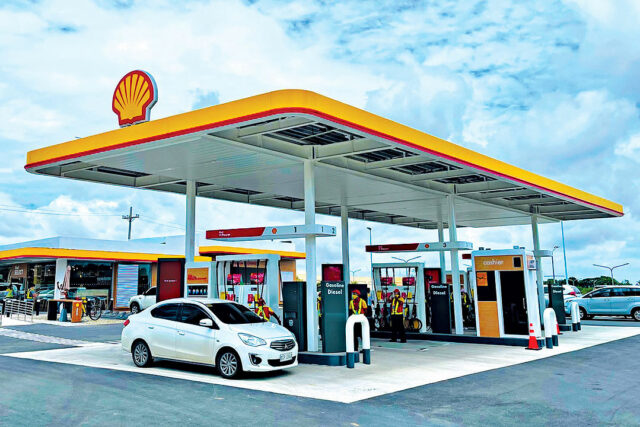
Shell Pilipinas sets up to P6-B budget through 2026

PHOTO FROM PILIPINAS SHELL

LISTED oil firm Shell Pilipinas Corp. (SPC) has allocated up to P6 billion in capital expenditures through 2026 to accelerate the expansion of its mobility network and further develop its import terminal.

“We will continue our disciplined approach in terms of capital spending in the next two years, 2025 to 2026. We will be investing a total capex between P2-3 billion pesos per year in the next two years and that will be equally split between our mobility business and our supply chain,” SPC Vice-President for Finance Reynaldo P. Abilo said during the company’s annual general meeting on Tuesday.

Mr. Abilo said the allocated capex will be used to “build, upgrade, and refresh” the company’s mobility stations “to continuously provide superior customer service and experience to our customers.”

Part of the budget will also fund SPC’s investment in the Tabangao import terminal in Batangas to sustain jetting operations, improve cost competitiveness, and unlock new revenue streams.

Mr. Abilo said the investments will be funded by internally generated cash flows and operations.

Michael P. Ramolete, SPC’s vice-president for mobility, said the company is targeting to put up 15 to 20 new sites after closing several locations last year that failed to attain expected returns.

“Part of our cost and capital reduction was to hydrate our mobility network to prevent further losses and generate cost savings. So, in 2024, we actually closed 53 sites… These sites failed to meet criteria of expected returns,” he said.

“We will continue year-on-year to review our portfolio each year to ensure that all sites are delivering the target earnings,” he added.

Meanwhile, asked how the partnership between Saudi Arabian oil giant Aramco and Unioil Petroleum Philippines, Inc. will affect SPC’s business, Mr. Ramolete said that “competition continues to be very challenging in our industry.”

“That will obviously give us more things to think about in terms of how to be more competitive with a company like Aramco coming in the country,” he said. “But we will stay the course in terms of trying to defend and grow our business, manage our prices properly where we can afford them, and be more competitive, build new sites.”

In a statement on Tuesday, SPC reported a net income of P740 million in the first quarter of 2025, down 47% from a year ago, amid a volatile market environment and external headwinds from US tariff policies.

The company said earnings from its mobility business grew, backed by business-to-business growth through new customer acquisitions and increased volumes with existing customers.

SPC’s non-fuel retail segments, such as “convenience retail and alliance,” improved compared to the previous year.

Commercial fuels sales volume rose by 3% year on year, driven by stable demand and new customer acquisitions in the construction, mining, and manufacturing sectors.

Lubricants volume increased by 7% due to the expansion of route-to-market strategies, which enabled service in more remote locations and improved coverage in existing areas, with promotions boosting premium penetration.

For 2025, SPC President and Chief Executive Officer Lorelie Quiambao-Osial said the company will focus on “cash, returns, and growth.”

“Where we have been successful and achieved a positive trajectory in 2024, we will build on that. And where we have fallen short, we are adjusting that and continuing to improve that,” she said. — Sheldeen Joy Talavera

PHINMA sets capex at P3.8 billion amid growth push

PHINMA

DEL ROSARIO-LED conglomerate PHINMA Corp. is allocating P3.8 billion for capital expenditure (capex) this year, lower than the P4.5 billion set in 2024, as it expects continued growth in its education and property businesses.

“The PHINMA Group has set a capex of P3.8 billion for 2025 to better support its business initiatives to uplift underserved families and communities,” PHINMA Chairman and Chief Executive Officer Ramon R. del Rosario, Jr. said in a statement on Tuesday.

“We are optimistic for sustained growth with the expected higher enrollment for education, the accelerated implementation and completion of PHINMA Property Holdings Corp.’s (PHINMA Properties) projects, the strategic launch of our community housing business unit, and the continued implementation of our growth initiatives,” he added.

PHINMA Chief Financial Officer EJ A. Qua Hiansen said in a Viber message that P3.1 billion will be allocated to PHINMA Education, while P460 million will be allotted to PHINMA Properties.

He added that the remaining capex will be allocated to PHINMA’s other business units and to fund potential business initiatives.

For the first quarter, PHINMA recorded a 27% increase in consolidated net income to P562.62 million, led by improved sales across its business units. Attributable net income for the period stood at P191.27 million.

January-to-March consolidated revenue rose by 21% to P6.6 billion from P5.45 billion in the same period last year.

“The first-quarter results demonstrate the effectiveness of PHINMA’s strategic direction and the benefits of a diversified portfolio, with revenues increasing by 21% and net income growing by 27%. Our strong balance sheet and commitment to operational excellence position us favorably to seize opportunities and provide innovative solutions,” Mr. Qua Hiansen said.

PHINMA Education posted P907.35 million in net income and P2.1 billion in revenue. Second-semester enrollment for school year 2024-2025 grew by 5% to 137,498 students, while the retention rate reached 89%.

The conglomerate’s Construction Materials Group (CMG) recorded a net loss of P69.71 million due to higher operational costs and interest expenses to support sales volume growth and future expansion. Revenue reached P3.87 billion, driven by higher sales volumes and efforts to expand market share.

To boost margins, PHINMA CMG continues to optimize its facilities while negotiating better terms with suppliers.

PHINMA Properties reported a P100.61-million net loss and P411.96 million in revenue during the period. The company’s performance reflected new sales and carryover sales from last year. Unbooked revenues from these developments will be recognized as construction progresses.

The hospitality segment, led by Coral Way City Hotel Corp., PHINMA Hospitality, Inc., and PHINMA Microtel Hotels, Inc., posted combined revenues of P136.34 million and a combined net income of P5.23 million for the quarter.

The business sustained chain-wide occupancy and higher average room rates. Hotel and venue bookings were mainly from the leisure, corporate, and events segments.

PHINMA shares were last traded on May 9, closing unchanged at P18.90 apiece. — Revin Mikhael D. Ochave

Jollibee Q1 earnings fall 8.1% to P2.41 billion

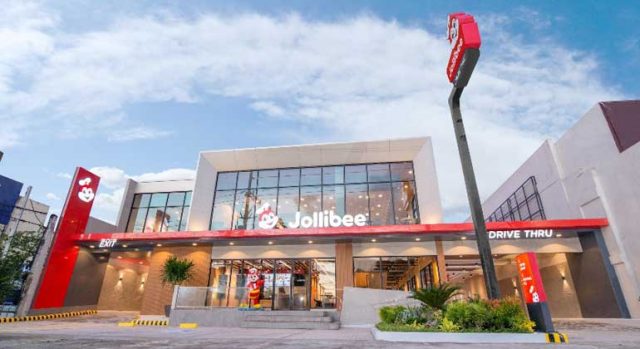
JOLLIBEE FOODS Corp. (JFC) reported an 8.1% decline in first-quarter (Q1) net income to P2.41 billion, down from P2.62 billion last year, due to higher non-operational costs.

“On a quarter-on-quarter basis, both operating income and net income after tax (NIAT) increased by double digits. While NIAT was slightly lower year-over-year, this was primarily due to non-operational factors,” JFC Chief Financial and Risk Officer Richard Shin said in a statement to the stock exchange on Tuesday.

Systemwide sales (SWS) increased by 18.9% to P103.2 billion, driven by 5.5% same-store sales growth (SSSG) from higher volume and contributions from new stores. Operating income rose by 17.6% to P4.8 billion.

Jollibee Group Chief Executive Officer Ernesto Tanmantiong said that the SWS of the domestic and international businesses grew by 11.9% and 29.5%, respectively.

“The growth in SWS of the Philippine business was led by Mang Inasal (+15.3%), Jollibee (+13.3%), Chowking (+9.9%), and Red Ribbon (+8.5%). The Philippine business’ SWS growth was driven by robust same-store sales growth across all four brands, mainly coming from volume or transaction count (TC),” he said.

Mr. Tanmantiong also said that the higher SWS of the international business was supported by the acquisition of South Korean coffee brand Compose Coffee.

“Our coffee and tea segment — now comprising 45.4% of the international business’ SWS — recorded a 62.2% increase, with Compose Coffee accounting for 49% of this growth. The international business’ SWS for the quarter also includes Tim Ho Wan, which is now 100% owned by the Jollibee Group effective January 2025,” he said.

Consolidated revenue rose by 14.6% to P70.2 billion, led by the increase in advertising and promotions.

“The substantial increase in advertising and promotions drove a 14.6% rise in revenues. Our strong first-quarter revenues, combined with our disciplined and prudent approach, led to double-digit growth in operating income and a notable improvement in margins. These results highlight the effectiveness of our strategic initiatives and the resilience of our core business,” Mr. Shin said.

JFC said that the SSSG of the Philippine business increased by 8.5%, led by the Mang Inasal, Red Ribbon, Jollibee, and Chowking brands. The international business saw a 0.7% increase in SSSG.

SSSG of the company’s China business declined by 8.3%, but Yonghe King showed sequential improvement in monthly volume. Smashburger registered a negative 8% SSSG, mainly from TC decline.

Meanwhile, Mr. Shin said that JFC is sticking with its full-year growth targets for this year. He previously announced that JFC is aiming for 8% to 12% SWS growth, 4% to 6% SSSG, and 10% to 15% operating profit growth.

“We are confident in our strategy and execution, and, accordingly, we are reaffirming our full-year guidance,” he said.

“Looking ahead, the Jollibee Group expects continued strong operational performance, and we remain proactive in managing macroeconomic and financial headwinds,” he added.

As of end-March, JFC grew its store network by 44.3% to 9,935, of which 3,393 are in the Philippines and 6,542 are international stores.

Of the international stores, 560 are in China, 361 in North America, 393 in EMEA, 865 with Highlands Coffee mainly in Vietnam, 1,246 with The Coffee Bean and Tea Leaf, 340 with Milksha, 2,700 with Compose Coffee, and 77 with Tim Ho Wan.

JFC shares dropped by 0.85% or P2 to P233 apiece on Tuesday. — Revin Mikhael D. Ochave

ICTSI to invest over $84M in Poland terminal upgrade

ICTSI.COM

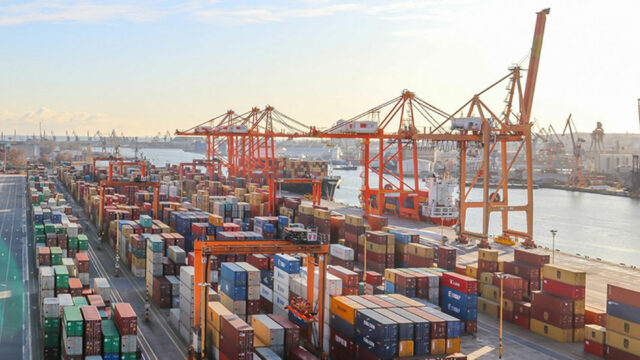
INTERNATIONAL CONTAINER Terminal Services, Inc. (ICTSI) has announced plans to invest over $84 million through its Baltic Container Terminal (BCT) in Gdynia, Poland, to enhance its terminal facilities.

In a statement released on Tuesday, ICTSI confirmed the completion of Phase 1 of a two-phase major upgrade at the Helsie Quay.

“The completion of Phase 1 of our development program lays the foundation for major benefits that will be realized by our clients,” said BCT Chief Executive Officer Wojciech Szymulewicz.

Phase 1, which involved an investment of $42 million, saw the construction of 400 meters of quay, along with additional works including the installation of a new third rail to accommodate wider-span cranes, new hydrotechnical structures, and the development of roads and utility networks.

The upgrade is part of the Port of Gdynia’s efforts to accommodate larger vessels. ICTSI further announced that Phase 2 of the project is set to begin in September, which will involve the commissioning of an additional 100 meters of quay line.

Phase 2 is expected to be completed by the second quarter of 2026, according to ICTSI. Upon completion, the project will deliver two to four new super post-panamax quay cranes, enhancing the quay’s berthing and operational capacities.

ICTSI said the new cranes are expected to increase BCT’s annual handling capacity to between 1.2 million and 1.6 million twenty-foot equivalent units (TEUs).

Since 2003, ICTSI has held a 20-year concession granted by the Port Authority of Gdynia to develop, operate, and manage the container terminal in Pomerania, Gdynia, Poland. The company also acquired BCT, which holds the lease for the terminal.

On Tuesday, ICTSI shares closed at P407 apiece, up by P22 or 5.71%. — Ashley Erika O. Jose

Big Bad Wolf goes to Greenhills

JACQUELINE NG, co-founder of Big Bad Wolf Books, announces that the book fair will be opening at V-Mall at San Juan’s Greenhills Shopping Center.

COMING FROM a successful March edition in Clark, Pampanga, the Big Bad Wolf Book Sale is back again in Metro Manila, to be held for the very first time in San Juan City. The fair will take place from May 23 to June 2 in V-Mall (previously Virra Mall) at the city’s Greenhills Shopping Center.

Bookworms can expect a wide variety — over 2 million books — at the sale, with more promos and bargains for fairgoers of all ages, said its founder Jacqueline Ng. Through the years she brought Big Bad Wolf from Malaysia to 15 countries globally, including the Philippines.

“In our region, there are books, but they only serve a certain percentage of the population. It’s too inaccessible to the lower-middle class,” said Ms. Ng at a May 6 preview of the upcoming book fair.

She cited a report from the Philippine Statistics Authority that said that nearly 19 million people in the Philippines are struggling with functional literacy.

“Through the quality and affordable price of the books that we present, Big Bad Wolf aims to assist people who are not able to buy as much as they want, so that they become readers,” she added.

Alongside Big Bad Wolf Books’ return to Metro Manila at V-Mall is the continuation of the Red Readerhood program, through which they donate books to underserved communities.

Another program to look forward to is the return of the Little Wolfies Crew, where young readers can get involved with the behind-the-scenes of the book sale. Those interested can sign up via the Big Bad Wolf Books’ social media pages.

Ms. Ng explained that Little Wolfies is “an experiential program for the children.” Some activities they’ll get to join are creative writing workshops and reading-aloud sessions.

“The core objective is to increase their self-confidence and self-esteem, so that they feel that they’re good enough to face people. The fun thing is that they experience being part of the crew. They’ll put on the apron and welcome customers, and be exposed to working in the cashier area by packing the books,” she said.

“By putting kids there, they get to absorb the excitement and understand more about purchases and the value of money through the transactions.”

While often open for 24 hours, since the book fair will be held at a mall this time, it will run during the mall’s operating hours, from 10 a.m. to 9 p.m., Monday to Thursday, and from 10 a.m. to 10 p.m., Friday to Sunday.

The carefully selected titles will be organized through shelves and tables reflecting a variety of genres: bestselling novels, BookTok sensations, educational tomes, children’s activity books and more.

Ms. Ng told BusinessWorld that the Philippine market is unique because it sustains equal interest from both adults and children, with the fiction category being a favorite.

“The reason we present books in these sections — bestsellers, what’s trending on TikTok, the gift ideas table, top 10 in fiction, and top 10 in non-fiction, and so forth — is so that it’s not overwhelming. These are our recommendations to those who aren’t quite sure where to start,” she said.

Big Bad Wolf offers books for as low as P60. This year, they are holding a Reels Challenge for visitors to get a chance to win a P5,000 cash voucher, with 10 lucky creators also eligible for a P1,000 cash voucher as a consolation prize.

Some titles saw at the preview showed just how affordable the prices will be (even for hardbound copies).

There was the 20th anniversary edition of The Kite Runner by Khaled Hosseini, available for P560 when it would easily fetch a price of P1,800 elsewhere. The novel The Party Crasher by Sophie Kinsella can be bought for P500, a bargain compared to its original price of P1,120. For kids, the Dinosaur ABC Activity Book, which should cost P650, is available at the fair for P280.

As for the next leg of Big Bad Wolf in the Philippines, Ms. Ng teased that they are not yet revealing the next cities the wolf will visit. “We will definitely do a few more throughout the country,” she said.

“Clark, Pampanga, was our first this year, and it was great. Greenhills is just our second. Filipinos will see more of us this year, for sure.”

The book sale takes place May 23 to June 2 at V-Mall, Greenhills, in San Juan City. Admission is free. — Brontë H. Lacsamana

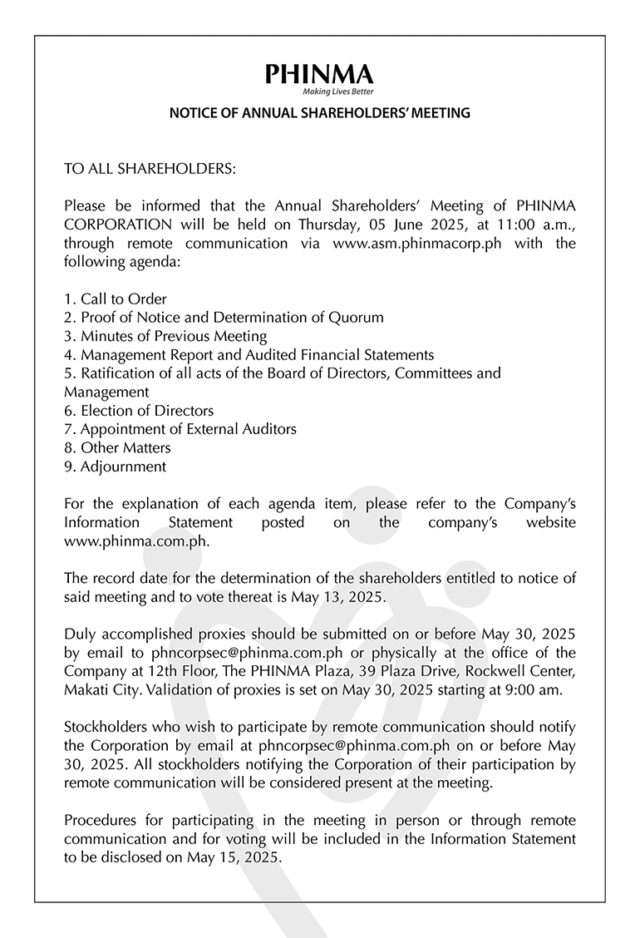
PHINMA Corp. to hold Annual Stockholders’ Meeting on June 5 via remote communication


Spotlight is BusinessWorld’s sponsored section that allows advertisers to amplify their brand and connect with BusinessWorld’s audience by publishing their stories on the BusinessWorld Web site. For more information, send an email to online@bworldonline.com.

Join us on Viber at https://bit.ly/3hv6bLA to get more updates and subscribe to BusinessWorld’s titles and get exclusive content through www.bworld-x.com.

San Miguel Food and Beverage, Inc. to conduct virtual Annual Meeting of Stockholders on June 4

NOTICE OF ANNUAL MEETING OF STOCKHOLDERS 

June 4, 2025

The 2025 Annual Meeting of the Stockholders of San Miguel Food and Beverage, Inc. (the “Company”) will be held on June 4, 2025, Wednesday, at 2:00 p.m. As unanimously approved by the Board of Directors at its meeting on March 5, 2025, the Company will not hold a physical meeting. The meeting will be conducted virtually and streamed live through the Company’s website at https://www.smfb.com.ph/stockholdersmeeting_2025. Stockholders can therefore only attend the meeting by remote communication, by voting through the sending of ballots, or the appointment of a proxy.

The agenda of the meeting is as follows:

  1. Call to Order
  2. Certification of Notice and Quorum
  3. Approval of the Minutes of the 2024 Annual Stockholders’ Meeting
  4. Presentation of the Annual Report and Approval of the 2024 Audited Financial Statements
  5. Ratification of Acts and Proceedings of the Board of Directors and Corporate Officers
  6. Appointment of External Auditor and Ratification of External Auditor Fees
  7. Election of the Board of Directors
  8. Other Matters
  9. Adjournment

The Company’s Definitive Information Statement on SEC Form 20-IS with its annexes (the “DIS”), including Management’s Discussion and Analysis of Financial Position and Financial Performance, 2024 Audited Consolidated Financial Statements and interim unaudited financial statements for the first quarter of 2025, has been posted on the website and can be accessed via the QR code below. It may also be found at PSE Edge.

The rationale and explanation of each relevant Agenda item requiring shareholder approval may be found in Appendix 1 of the Notice attached to the DIS. The Company’s dividend policy, acts and resolutions of the Board of Directors from June 5, 2024, and draft of the minutes of the 2024 annual stockholders’ meeting for approval, may likewise be found in the DIS. The said draft of the minutes is also separately posted on the website at https://www.smfb.com.ph/disclosures. Questions and comments may be sent by email to smfbasm@sanmiguel.com.ph.

Votes will be cast through ballots or proxies, the deadline for submission of which is May 21, 2025.  A sample of a ballot/proxy is attached to the DIS and available for download at the website. For an individual, your ballot/proxy must be accompanied by a valid government-issued ID with a photo. For a corporation, your proxy must be accompanied by a Corporate Secretary’s certification setting the representative’s authority to represent the corporation in the meeting. Ballots and proxies may be sent through email at smfbasm@sanmiguel.com.ph or by mail to the office of SMC Stock Transfer Service Corporation (STSC) at the 2nd Floor, SMC Head Office Complex, 40 San Miguel Avenue, Mandaluyong City 1550. Proxies need not be notarized. Validation of proxies will be on May 28, 2025, 10:00 a.m. at the office of STSC. Only the stockholders attending through proxies or who have submitted ballots, all of whom have been validated to be stockholders of record of the Company as of May 5, 2025, will be considered in computing stockholder attendance at the meeting and in determining quorum.

The Company’s 2024 Annual Report on SEC Form 17-A is available for download at https://www.smfb.com.ph/disclosures, as well as at PSE Edge. Upon written request, the Company will provide the stockholder with a copy of the Annual Report, DIS, and/or 2025 first quarter report on SEC Form 17-Q, at no cost.

(Sgd.)  

Alexandra Victoria B. Trillana 

Corporate Secretary


Spotlight is BusinessWorld’s sponsored section that allows advertisers to amplify their brand and connect with BusinessWorld’s audience by publishing their stories on the BusinessWorld Web site. For more information, send an email to online@bworldonline.com.

Join us on Viber at https://bit.ly/3hv6bLA to get more updates and subscribe to BusinessWorld’s titles and get exclusive content through www.bworld-x.com.

New York’s billion-dollar May art auctions could actually be a success

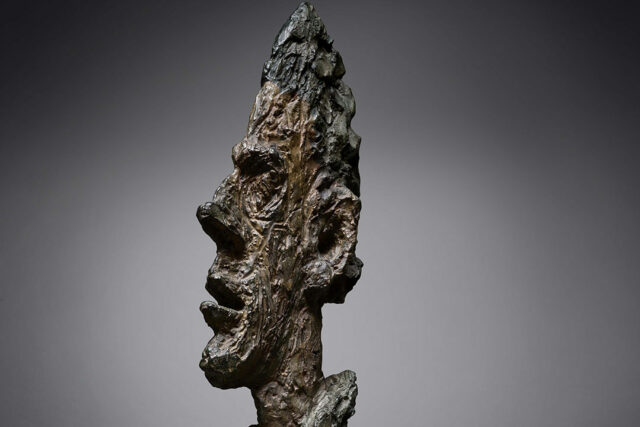
THERE is a preponderance of sculptures in the New York auctions this week at both Christie’s and Sotheby’s, including Alberto Giacometti’s Grande tête mince, a painted bronze with an unofficial estimate of $70 million.

IT’S HARD to imagine less auspicious conditions for May’s New York auction season. The art market is limping, hobbled by high prices and low morale, which managed to sink even lower as Mr. Trump’s tariff war seemed to bulldoze whatever green shoots emerged during fairs and auctions earlier this year.

“After the Trump election, we felt that a lot of the volatility and guesswork that had been plaguing the market was kind of settled business,” says Lisa Dennison, the executive vice-president and chairman of the Americas at Sotheby’s. “Everything was kind of going in the right direction.” But 100 days later, she says, “the kind of disruption and volatility that we saw continued, and markets do not like uncertainty. So that’s been a bit of a challenge.” (Currently, contemporary art seems to be exempt from tariffs, although it is certainly not exempt from their broader economic repercussions.)

And yet despite the many headwinds howling in their faces, the auction houses have managed to put together what is, under the circumstances,  a robust sales slate. In just the single week beginning May 12, Christie’s plans to sell between $600 million and $811 million worth of art. Sotheby’s anticipates selling between $485 million and $673.5 million of art in the same week. And Phillips, the perennial bridesmaid of the contemporary auction market, anticipates selling between $74.7 million to $108.9 million. (Estimates do not include auction house fees known as buyer’s premiums, but totals do.)

“I’m feeling very, very confident about everything we have and how we priced it — and interest thus far,” Ms. Dennison says, speaking a few days before previews began. “We’re not sitting here wondering if anybody’s going to show up. We’re kind of trying to keep them out the door for a few days while we make everything look gorgeous.”

FILLING THE SALES
As always, auction houses are faced with two (oddly distinct) mandates: Finding art, and selling it.

It’s the former, auction house specialists say, that proved the toughest part of the season: With a new crisis every day, collectors have been understandably reluctant to submit their multimillion-dollar artwork to the mercy of the market.

“The clients that I deal with when I put together a sale are impacted by larger events in the economy,” says Alex Rotter, who was just appointed global president of Christie’s. “Now, if somebody dies and it’s an estate, then it’s a very different story, because then it’s not dictated by a greater economic or any other big picture considerations.”

Accordingly, this year’s sales at Christie’s and, to a lesser extent at Sotheby’s, are built around estates. Christie’s has this season’s trophy, the collection of the late Barnes & Noble founder Leonard Riggio, whose 39 artworks are estimated between $252 million and $326 million — they hit the block in a standalone sale on May 12. “What the Riggio collection has, which is very advantageous for this market today, is a little bit of everything good,” Mr. Rotter says. “It’s almost a various owner sale put together by a collector, because it spans Surrealism to Warhol to Picasso — it’s everywhere in the 20th century.”

For its part, Sotheby’s has work from the estate of the late dealer Barbara Gladstone, along with 40 works by Roy Lichtenstein from the artist’s estate.

But estates, however robust, are not enough to fill an evening sale, let alone the week’s many day sales, which are filled with hundreds of lots apiece. Believe it or not, specialists say that there actually were living, breathing consignors who decided to pull the trigger.  “We’re seeing discretionary selling,” says Ms. Dennison. “And there, I guess it’s a question of the financial deal and what you can say to a consigner to make it attractive.”

The most ubiquitous of these deals is what’s known as a guarantee, where either the auction house or a third party buys the work in advance in exchange for a percentage of the upside if it sells for more.

There’s also a contingent of consignors, Mr. Rotter says, who are relatively unbothered by yielding less than they might in a bull market. “People said this was a convenient time for them to sell,” he says, adding that one consignor told him “We want to sell this; it’s a beautiful painting, we enjoyed it, and it will sell for what it will sell for.”

THE MOST EXPENSIVE LOT OF THE WEEK
As always, the majority of the action will be in the evening sales. Almost certainly the most expensive lot of the week will hit the block on May 13th at Sotheby’s, when a sculpture cast in 1955 by Alberto Giacometti, Grande tête mince, will be sold with an unofficial estimate of $70 million. It joins what happens to be a preponderance of sculpture in both Christie’s and Sotheby’s evening sales: Sotheby’s modern evening auction has 11 sculptures; Christie’s 21st century evening sale has 12.

Both Ms. Dennison and Mr. Rotter noted that there’s more sculpture than usual in the sales, though neither thinks that’s anything more than an accident. That said, Ms. Dennison has a theory that interest in sculpture has increased with more collectors moving into glass towers. “They have a lot of windows and not a lot of walls, and are very light sensitive,” she says. As such, “people can always find space for something on a pedestal or a coffee table or hanging from the ceiling.”

What is not accidental are collectors’ stated spending habits, which appear to be locked in. “I can’t convince anyone,” Mr. Rotter says. “I see it in the behavior of clients: They’re either 100% in, or they’re 100% out, there’s no ‘Ohhh, I’ll just buy the weaker one,’ which I’ve seen in markets where you can sell anything.” — Bloomberg

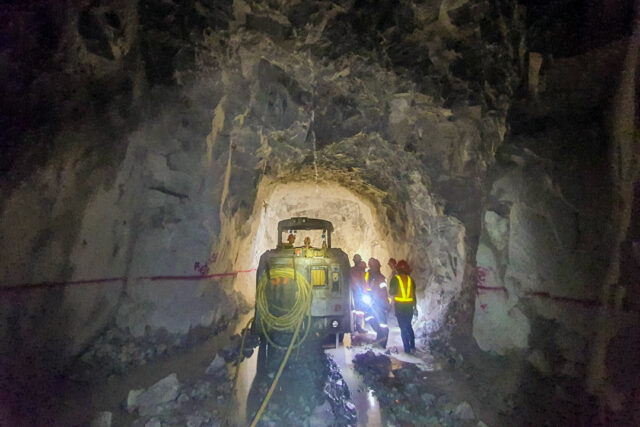
Apex Mining posts 70% profit growth for Q1

APEXMINES.COM

APEX MINING CO., Inc. reported a 70% increase in its consolidated net income for the first quarter (Q1), reaching P1.4 billion, up from P852.7 million in the same period last year, driven by higher metal prices and a stronger peso.

For the January to March period, Apex Mining saw a 33% rise in its consolidated gross revenues to P4.5 billion, from P3.4 billion in the same period last year.

During the period, Apex Mining sold 25,362 ounces of gold at a realized price of $2,953, reflecting a 7% decrease in volume compared to last year.

However, the lower volume was offset by the higher realized price, which was up 37% from $2,149 last year, the company said in a regulatory filing on Tuesday.

“While the surging metal prices and strong position of the dollar versus the peso bolstered the financial performance of Apex Mining, the cost management initiatives that are being implemented across the mine sites are also creating a stronger foundation for the company to fortify its operations,” said Apex Mining President and Chief Executive Officer Luis R. Sarmiento.

“Alongside reducing costs in the short term, our supply chain has been implementing strategies with the end goal of cost avoidance,” he added.

The gold and silver sold by Apex Mining came from its Maco Mine in Davao de Oro and the Sangilo Mine in Itogon, Benguet.

In the first quarter, the company milled 230,070 ore tonnes at the Maco Mine, which was 12% higher than last year’s 204,636 tonnes.

The gold recovery rate at the Maco Mine was also higher at 86.49%, compared to 85.45% last year. However, the ore gold grades averaged lower at 3.16 grams per tonne, down from 3.59 grams per tonne last year.

At the Sangilo Mine, operated by Itogon Suyoc Resources, total milled ores reached 34,573 tonnes in the first quarter, down 5.6% from 36,641 tonnes a year ago.

“Despite the lower tonnage, the gold grade per tonne of ore averaged 3.75 grams in 2025, compared to 2.87 grams per tonne in the same period last year, resulting in 7% fewer gold ounces produced,” the company said.

Citing Mine Reserves and Resource Certifications for 2025, Apex Mining said the Maco Mine has enough reserves and resources to continue at “the targeted production rate of 3,000 tonnes per day until 2034.”

To ensure it meets its production targets, the company said it is working on optimizing its operating mines’ infrastructure, processes, and manpower. These include upgrades to its equipment, the use of a drain tunnel, and the acquisition of training simulators. 

Meanwhile, the company said the permitting process for Asia-Alliance Mining Resources is ongoing.

“We will disclose relevant updates as they unfold,” Mr. Sarmiento said.

On Tuesday, Apex Mining shares closed 0.12 centavo, or 1.92%, lower at P6.12 apiece. — Justine Irish D. Tabile

Yuchengco firm eyes solar farm in Capiz

STOCK PHOTO | Image by Pixabay from Pexels

YUCHENGCO-LED PetroEnergy Resources Corp. (PERC) has secured approval from the Department of Energy (DoE) to begin permit processing for a proposed ground-mounted solar power project in Capiz province.

EcoSolar Energy Corp. (ESEC), a new special-purpose company of PetroGreen Energy Corp., was granted a certificate of authority (CoA) by the Department of Energy, the company said in a media release on Tuesday.

The CoA grants ESEC exclusive authority for its planned 90- to 100-megawatt-direct current (MWdc) Panit-an Solar Power Project (PSPP) spanning 88 hectares of land.

Following the grant of the permit, the company has one year to secure the necessary development permits, conduct feasibility studies, and advance the project towards a final investment decision and the application for a solar energy operating contract.

Construction of the solar power project is targeted to begin next year, while completion is slated by end-2027.

“When completed, it will yet be PGEC’s single biggest contiguous solar power facility,” said Hiroki Hiwatashi, PGEC’s PSPP project manager.

PERC aims to increase its renewable energy capacity to 500 MW by 2029 by expanding its existing 145 MW.

For 2024, the company’s attributable net income nearly tripled to P471.82 million from P156.88 million in the previous year. 

Revenues grew by 14.45% to P3.45 billion from P3.01 billion, led by the increase in electricity sales.

The company said it is accelerating the completion of its 25-MWdc Bugallon Power Project in Pangasinan and the 40-MWdc Limbauan Solar Power Project in Isabela, which will begin their respective testing and commissioning in the fourth quarter. — Sheldeen Joy Talavera