Home Blog Page 1240

Cooperatives: In union there is strength

STOCK PHOTO | Image by Jcomp from Freepik

My adventurousness and occasional volunteer work has exposed me to different kinds of cooperatives; some successful and others failures.

It is hard to believe, but in the poor province of Negros Oriental, there are no less than two credit cooperatives worth over a billion. Another poor province, Leyte, also has two such billionaire credit co-ops. During the last century, a farmer-owned cooperative in Cavite won over the majority of the market for animal feeds in Southern Luzon from corporate giant San Miguel. When the farmers wanted to increase their incomes by going into poultry and pig raising, they also decided to produce their own feeds as the agricultural technicians were required to endorse the choice of suppliers of feeds and fertilizers to rural bank borrowers. There was a tendency for some suppliers to deliver adulterated products.

The three biggest cooperatives in asset size in the world are owned by farmers. Two are in France and one in Japan. In the Philippines, the biggest co-ops are worker-related: two credit coops in the military and one among employees of PLDT, the privately owned phone company.

There are over 20,000 co-ops registered with the Cooperatives Development Authority (CDA) in the Philippines. The CDA is currently supervised by the Department of Trade and Industry (DTI). It had earlier been part of the Department of Agriculture, and later with the Department of the Interior and Local Government.

As I am always trying to find ways that the government can reduce poverty in our country, I sat down with Edgar Comeros, one of a few activist experts in mobilizing and helping to strengthen cooperatives in our country.

When I asked him if it was a good idea for CDA to be under the DTI, he said “it doesn’t matter.” Government-sponsored cooperatives have generally failed, he explained. The Samahang Nayon to promote rice production, and electric power co-ops in many provinces provided government grants to get the cooperatives organized. In one town in Samar, there were constant brownouts. It turned out that the board members bought themselves cars and failed to provide maintenance of the electricity distribution lines.

Comeros said that the co-ops that have succeeded have been organized by individual persons who were willing to contribute their meager resources for common purposes. The main difference is their willingness to attend educational seminars prior to and in the course of their being members of cooperatives.

The billionaire credit co-ops in the Visayas had been mobilized by Christian missionaries and diocesan communities. In Negros Oriental and Leyte, the Redemptorist fathers and the Bishops’ teams helped particularly with providing education to the memberships. The education was provided and required to build strong values orientation and appreciation of the personal commitments and responsibilities of co-op members. No funding was granted to the co-ops by the missionaries.

There are three levels of cooperatives. Primary co-ops have individual persons as members. Secondary co-ops are organized among “juridical persons” or primary co-ops. And tertiary co-ops are organized by secondary co-ops as support. Comeros, who has retired, had been one of the leaders of VICTO, a secondary co-op that works mainly in the Visayas. VICTO mobilizes and organizes, then provides education to the primary co-op members. They may also provide audit services by certified public accountants.

Credit co-ops collect fees from their members. They generally charge market rates in order to build capital which is made available to members as loans for emergencies, tuition and books for education, health needs, housing, car loans, and capital for businesses. Members are oriented that as they are the owners of the co-op, the profits belong to them, and effectively the interest rates are below market rate.

What makes for greater chances of success? Of course, compliance with the education requirement. And the quality of the board members.

I found it interesting that Comeros revealed that boards that had women in them tended to do better. Why? I asked. He said matter of factly that women are multitasking, managing homes and families, and especially budgeting and working within these budgets. Unfortunately, he said, in general, only one or two out of the nine board members are women. Women should be empowered to help run cooperatives, he said.

One of the billionaire credit co-ops in Negros Oriental is run by a woman. I had a couple of opportunities to spend a few days in a hotel owned and operated by them. It was at least four-star or even five-star in quality of facilities and services. It was also certainly a good job generator.

The training and education of co-op members is paid for by the co-op, which is required by law to provide 10% of its income for education and audit and other contractual services.

The interesting trend is that productive loans for small businesses are becoming more common than consumer loans.

Entrepreneurship training should probably be provided to and by the secondary and tertiary co-ops to enable primary co-ops to generate more employment and reducing poverty among our food producers, the farmers and fishers. The billions raised by credit co-ops have great potential to generate jobs and help reduce poverty, especially among our farmers and fishers, who, after all, produce the food we eat.

Also, the less intervention by government, the better, says Comeros.


Teresa S. Abesamis has been a development management, social and political marketing consultant for over 20 years.

tsabesamis0114@yahoo.com

Philex Q2 profit drops 20.5% to P170.81M on lower gold, copper output

The Bulawan project in Sipalay City, Negros Occidental — PHILEXMINING.COM.PH

PANGILINAN-LED Philex Mining Corp. saw its second-quarter (Q2) attributable net income decline by 20.5% year on year to P170.81 million due to lower gold and copper output.

Operating revenues dropped by 17% to P1.86 billion, while costs increased by 3.3% to P1.77 billion for the three months ending June, the mining firm said in a stock exchange disclosure on Tuesday.

Gold production from April to June 2025 reached 6,769 ounces, down from 7,962 ounces in the same period a year earlier, Philex said.

Its copper output also fell to 4.788 million pounds from 5.133 million pounds.

Average realized gold prices in the second quarter of 2025 rose to $2,504 per ounce from $2,008 per ounce a year earlier, the company said.

Realized copper prices during the second quarter fell to $4.09 per pound from $4.45 per pound in the same period of 2024.

Philex’s attributable net income for the six-month period ended June dropped by 8.5% to P301 million.

Revenues decreased by 5.3% to P3.76 billion, while costs and expenses slightly increased by 1.8% to P3.53 billion.

Despite sluggish financial performance, the company remains “positive” about the continued development works at its Silangan Copper and Gold Project in Surigao del Norte.

“We continue to accelerate development works of the Silangan Project, as we target our first metal production by the first quarter of 2026,” said Philex President and Chief Executive Officer Eulalio Austin, Jr. “With the periphery of the Sta. Barbara I ore body (formerly Boyongan) reached last year, we’ve begun drives at the first production level.”

Mr. Austin said that the company is also building up an ore stockpile from its first production drifts that would feed a process plant it seeks to commission by yearend.

“Construction on all other ancillary facilities continues and is progressing steadily, with the tailings storage facility ready to accept tailings before the year ends and power infrastructure already in place,” he said.

At the local bourse on Tuesday, shares of the company closed unchanged at P5.79 apiece. — Sheldeen Joy Talavera and Kyle Aristophere T. Atienza

PHINMA Education eyes Vietnam expansion by 2027

PHINMA

PHINMA EDUCATION Holdings, Inc. is eyeing expansion into Vietnam by 2027 as the educational provider seeks to widen its international presence.

“We’re hoping we can enter Vietnam by 2027,” PHINMA Education President and Chief Executive Officer Chito B. Salazar told reporters on the sidelines of the Ramon V. del Rosario (RVR) Siklab Awards on Monday.

“(It is) most likely (an) acquisition. That’s our style. We were told by our investors, KKR, that they’re most interested in investment in Vietnam. Mainly tertiary schools, mainly low-income (focused),” he added.

In October last year, KKR-managed Phoenix Investments II Pte. Ltd. completed its P2.52-billion initial investment to fund PHINMA Education’s expansion.

The initial amount is equivalent to 70.22% of KKR’s total investment worth P3.59 billion.

Mr. Salazar also mentioned that Cambodia and Laos are possible locations for the company’s future expansion.

“Vietnam should be the target. After Vietnam, we’ll look at Cambodia and Laos,” he said.

Mr. Salazar said PHINMA Education is also eyeing growth in its presence in Indonesia.

The company currently operates Kalbis University in Jakarta and Horizon University in Karawang.

He confirmed that the company will search for other cities in Indonesia for potential expansion, which could happen within the year.

“We’re more excited about Indonesia because right now we’re only managing two schools. Indonesia is bigger than the Philippines. It’s two times the population. That’s why we’re hoping to continue to expand,” he said.

“We’re hoping at least a third (school) within the year maybe, whether in a different city, or we’ll expand the (current) branches,” he added.

Mr. Salazar also said PHINMA Education is eyeing 180,000 students this school year, up from the current 164,000.

For the financial year 2024-2025 (April 2024 to March 2025), PHINMA Education saw an 8% increase in net income to P1.5 billion, led by higher enrollment. Revenue grew by 14% to P6.5 billion.

PHINMA Education previously announced plans to open additional campuses in San Pablo in Laguna, Roxas City, Bacolod City, and Butuan City in the coming years to meet increasing demand.

The company also expanded its school network to 12 with the recent addition of Saint Jude College in Dasmariñas, Cavite, and Kalbis University in Jakarta.

PHINMA Education is the education subsidiary of the listed holding company PHINMA Corp.

PHINMA Corp. shares were last traded on Aug. 1, unchanged at P17.84 per share. — Revin Mikhael D. Ochave

Ateneo develops AI tool to digitize logbooks for small businesses

RESEARCHERS from Ateneo de Manila University have developed an artificial intelligence (AI) system that helps small food stalls and convenience stores digitize handwritten logbooks and analyze inventory data to improve operations.

The system, developed by the university’s Business Insights Laboratory for Development (BUILD), uses AI to scan logbook photos, recognize products, match prices and generate sales summaries.

“The system allows even someone with no digital training to grasp inventory trends with ease,” BUILD said in a statement on Monday. “This helps businesses quickly identify bestsellers or slow-moving stock, thereby making it easier to keep up with customer demand.”

Small neighborhood stores and food stalls in the Philippines have traditionally relied on pen-and-paper ledgers to manage sales, inventory and deliveries. This analog system limits data analysis and slows business decisions, according to the researchers.

The team introduced their AI “copilot” model after observing hesitation among many micro, small and medium enterprises in adopting tech due to “steep learning curves and job redundancy.”

“AI lends itself perfectly to business data analysis: it makes short work of identifying which products are performing well or poorly; tracking sales trends over time; and offering recommendations on inventory, pricing, and restocking,” they said.

The prototype system runs on Python, using Amazon Web Services for optical character recognition and Anthropic’s Claude 3 Haiku large language model to interpret handwritten logbook entries.

Initial testing was conducted at a student-run food stall in Ateneo’s enterprise center. Researchers said the system achieved moderate accuracy and showed potential for broader applications.

The team noted that the tool could be adapted to process other types of handwritten records including inventory sheets, delivery logs and payroll ledgers.

“Not unlike analog logbooks themselves, this AI tool is meant to be simple, affordable and easily upgradable,” the researchers said. “As AI accuracy improves by training on more shorthand writing, local stalls can eventually gain reliable, low-cost access to business insights once reserved for larger enterprises.”

The initiative aligns with state efforts to modernize microbusinesses. Last year, the Department of Science and Technology supported local startup Packworks in helping mom-and-pop stores nationwide adopt AI-driven inventory systems.

The Department of Trade and Industry in June said more than 1.3 million such stores across the Philippines continue to operate with minimal capital and limited access to digital tools. — Katherine K. Chan

Peso drops as inflation data bolster BSP easing hopes

BW FILE PHOTO

THE PESO weakened anew against the dollar on Tuesday on expectations that the Bangko Sentral ng Pilipinas (BSP) would cut rates again as early as this month after headline inflation hit a near six-year low in July.

The local unit closed at P57.63 per dollar, dropping by 34 centavos from its P57.29 finish on Monday, Bankers Association of the Philippines data showed.

The peso opened the session lower at P57.40 against the dollar. Its worst showing was at P57.69, while its intraday best was at P57.26 against the greenback.

Dollars exchanged jumped to $2.11 billion on Monday from $1.69 billion on Friday.

“The peso depreciated after Philippine headline inflation for July 2025 at 0.9% fueled expectations of an August policy rate cut from the BSP,” a trader said in an e-mail.

The consumer price index (CPI) rose 0.9% year on year in July, slower than the 1.4% in June and 4.4% clip a year ago. It was also within the BSP’s 0.5% to 1.3% forecast for the month.

The July CPI print was below the 1.2% median estimate in a BusinessWorld poll of 17 analysts conducted last week. This also marked the fifth straight month that the CPI settled below the central bank’s 2-4% target range.

“On balance, a more accommodative monetary policy stance remains warranted. Emerging risks to inflation from rising geopolitical tensions and external policy uncertainty will require closer monitoring, alongside the continued assessment of the impact of prior monetary policy adjustments,” the BSP said in a statement.

BSP Governor Eli M. Remolona, Jr. has said that a rate cut is “on the table” at the Monetary Board’s Aug. 28 policy meeting, which would mark the central bank’s third straight easing move this year.

This would mark the central bank’s third straight easing move this year following the rate cut in June that brought the policy rate to 5.25%.

Since starting its easing cycle in August 2024, the central bank has lowered interest rates by a cumulative 125 bps.

The peso weakened on Tuesday as the dollar also rebounded following days of decline as US jobs data revived bets of a September rate cut by the Federal Reserve, Rizal Commercial Banking Corp. Chief Economist Michael L. Ricafort said in a Viber message.

For Wednesday, the trader said the peso could continue to decline ahead of a potentially upbeat US services purchasing managers index report.

The trader sees the peso moving between P57.50 and P57.75 per dollar on Wednesday, while Mr. Ricafort expects it to range from P57.50 to P57.80. — Aaron Michael C. Sy

Ancient pre-Hispanic grave unearthed under residential Lima street

LIMA — Human remains pointing to a 1,000-year-old pre-Hispanic cemetery were unearthed in northern Lima by workers digging under the Peruvian capital to install a gas pipeline, an archaeologist told Reuters on Thursday.

The tomb was found on a residential street just two meters (6.6 feet) from the front gate of a house.

Jose Pablo Aliaga, an archaeologist for gas distribution firm Calidda, said the remains of a man wrapped in burial cloths alongside pottery likely pointed to a burial complex, after another body was found nearby last month.

“The material evidence suggests that it could be a burial of the Chancay culture, from approximately 1,000 to 1,200 years ago,” said Mr. Aliaga, pointing to a coastal fishing-based civilization known for its textiles and ceramics.

“We are probably over a pre-Hispanic cemetery, as we found another burial just around the corner from here,” he added.

It is common for companies excavating under Lima to hire archaeologists due to the number of sites scattered in the city.

Last month, Calidda gas workers working in the same district of Puente Piedra discovered the remains of a mummified woman, which researchers estimate are over 900 years old.

Peru’s 10 million-strong capital hosts over 400 archaeological sites dotted around the city. Calidda has itself reported over 2,200 archaeological discoveries in the last two decades, most of them traced back to the Chancay culture.

The South American nation is home to hundreds of archaeological sites, including the Inca citadel of Machu Picchu in the Andean region of Cusco, and the ancient Nazca lines carved into the coastal desert of its Ica region. — Reuters

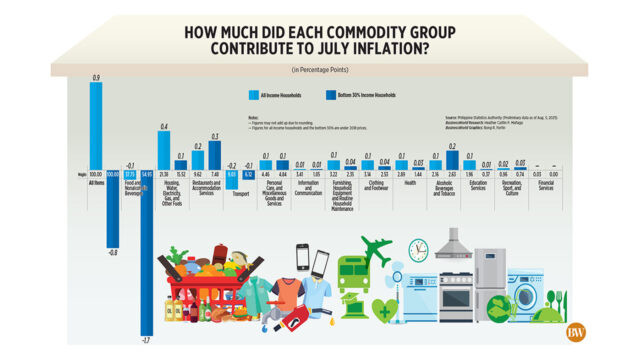
How much did each commodity group contribute to July inflation?

HEADLINE INFLATION sharply slowed to a near six-year low in July as utilities and food costs continued to ease, data from the Philippine Statistics Authority (PSA) showed. Read the full story.

How much did each commodity group contribute to July inflation?

Implementing rules of CMEPA: A spring within its source?

STOCK PHOTO | Image by Rawpixel.Com from Freepik

The Capital Markets Efficiency Promotion Act (CMEPA) took effect on July 1 following its complete publication. CMEPA was passed in recognition that the financial sector plays a significant role in the long-term growth of the national economy. A key policy consideration of this law is to allow our capital markets to develop as efficiently as possible, with the least intervention.

Drafts of several implementing rules and regulations (IRRs) have been circulated. On passive income, it is observed that the regulations implement the changes to the rates of taxes effective “1 July 2025.” The regulations adopt the definitions introduced by CMEPA and present a summary of the applicable tax rates for different types of taxpayers. The draft regulations also reflect the veto message of the President recognizing that any income of nonresidents from transactions with depositary banks under the foreign expanded system shall continue to be exempt from tax.

Before CMEPA, taxpayers could exclude “gains realized from the sale, exchange, or retirement of bonds, debentures, or other certificates of indebtedness with a maturity of more than five years” from gross income. CMEPA amended this rule. Instead, taxpayers may exclude from gross income specific government bonds or instruments issued by government that fund capital expenditures or high-priority programs under the Philippine Development Plan, as determined by the Secretary of Finance. The current draft regulations, however, do not specify the government bonds covered by the exemption.

The draft regulations also implement the additional allowable deductions afforded to the financial sector. Securities held by a dealer will be considered as ordinary assets and if deemed worthless, such instruments will be considered as ordinary losses deductible from taxable income. The deductions include losses from wash sales of stock or securities, provided the same arises out of transactions made in the ordinary course of the business. Prior to CMEPA, Revenue Regulations (RR) 05-99 required taxpayers to present clear and convincing evidence that securities were worthless to claim capital losses. It is observed that this requirement is stated in the draft regulations.

The draft regulations also implement that any interest income from debt instrument, bank deposit, deposit substitutes, trust funds and other similar arrangements, such as bonds, notes or other interest bearing obligations of residents, corporate or otherwise, regardless of the place of execution of said instruments, including debt or debt securities issued by the government or any of its agencies or instrumentalities, are considered to be sourced within the Philippines. The draft regulations adopt the amended provision of Section 42 and adds the phrase “regardless of the place of execution of said instruments.” It is observed that there is no change in the situs of interest income, it remains to be based on the residence of the payor.

The draft regulations provide that for sales of shares in a domestic corporation listed and traded on both local and foreign stock exchanges, the selling shareholder, or through the stockbroker or authorized representative, is the one responsible for collecting and remitting the stock transaction tax, as well as complying with all related reporting requirements. A stock transfer agent, corporate secretary, or stockbroker who causes the registration of transfer of ownership or title on any share of stock in violation of the Tax Code, or its implementing rules shall be the one penalized.

On the deductibility of Personal Equity and Retirement Account (PERA), the draft regulations illustrate scenarios where an employer may claim a deduction. These deductions apply to qualified employer’s contributions made to PERA on or after July 1.

On the removal of pickups from excise tax exemption, the draft regulations amend relevant provisions of RR 25-2003, primarily removing pick-ups from the list of tax-exempt automobiles. Within 15 working days from the effectivity date of these Regulations, all manufacturers, assemblers, and importers are required to submit: a.) an updated sworn statement; and, b.) a notarized inventory list.

The draft regulations also reiterate the lower DST rates and tax exemptions. The Bureau of Internal Revenue (BIR) issued Revenue Memorandum Order (RMO) 35-2025 to revise Alphanumeric Tax Codes in BIR Form 2000 and reflect updates in revenue sources.

Our lawmakers expressly recognized in CMEPA that tax administration is a driver of economic growth. By making tax compliance easier and equitable, progressivity is ensured and tax effort is improved. Before CMEPA, the Philippines had the highest stock transaction tax in Southeast Asia. Reduced rates on dividends, stock transaction tax, and DST enhance regional tax competitiveness and are expected to attract more foreign investors.

CMEPA instructs the issuance of IRRs within 60 calendar days from effectivity. The Secretary of Finance has until Aug. 30 to issue the final implementing rules and regulations, which are to take effect 15 days after publication. These promulgated regulations must be issued within the confines of CMEPA, and, most importantly, aligned with the basic principle that a spring cannot rise higher than its source.

The views and opinions expressed in this article are those of the author. This article is for general information and educational purposes, and is not offered as, and does not constitute, legal advice or legal opinion.


Kaye Geozen T. Ebuengan is an associate of the Tax department of the Angara Abello Concepcion Regala Cruz Law Offices.

ktebuengan@accralaw.com

(02) 8830-8000

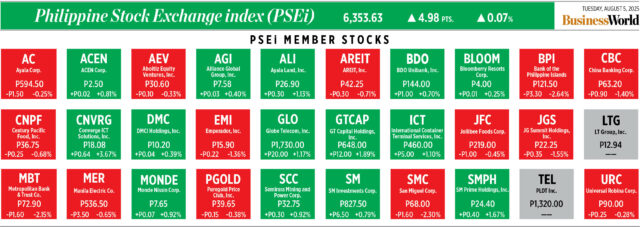
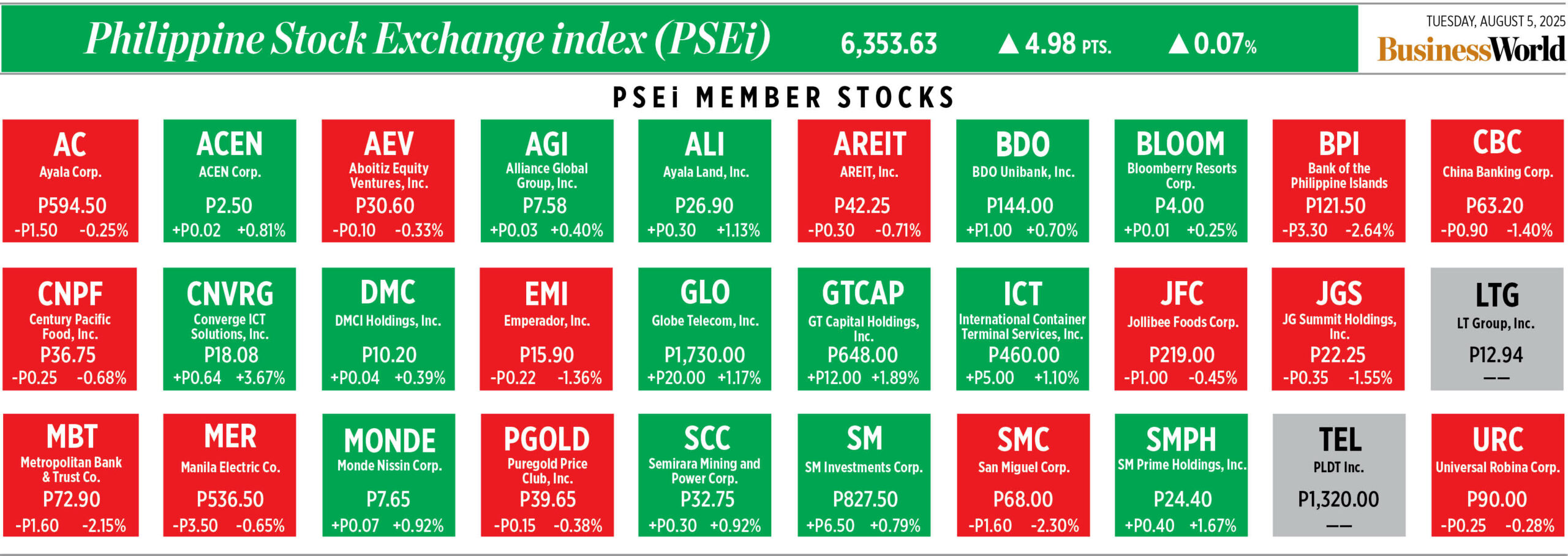
How PSEi member stocks performed — August 5, 2025

Here’s a quick glance at how PSEi stocks fared on Tuesday, August 5, 2025.


Stocks go up as inflation cools to near 6-year low

BW FILE PHOTO

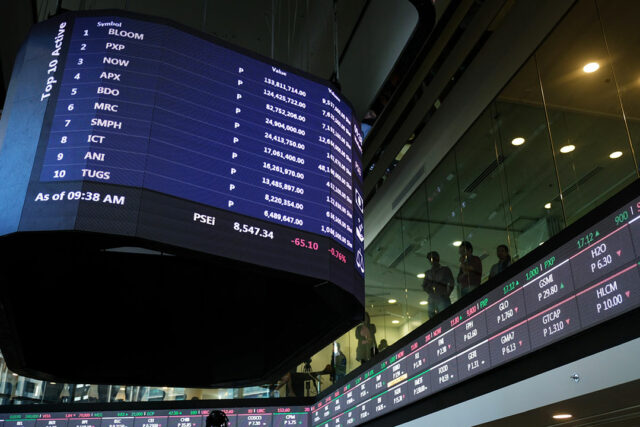
PHILIPPINE STOCKS edged higher on Tuesday as market sentiment got a boost from slower July inflation, which boosted bets of another rate cut as early as this month.

The bellwether Philippine Stock Exchange index (PSEi) rose by 0.07% or 4.98 points to 6,353.63, while the broader all shares index climbed by 0.11% or 4.34 points to 3,770.94.

“The local market’s sideways movement closed in the positive territory as appreciation of inflation’s decline last July took over. Investors are also optimistic toward the Bangko Sentral ng Pilipinas’ (BSP) policy outlook following the latest inflation print,” Philstocks Financial Inc. Research Manager Japhet Louis O. Tantiangco said in a Viber message.

“The PSEi closed at 6,353.63, up by 0.07%, as investors continue to digest the recent update on Philippine inflation,” Regina Capital Development Corp. Head of Sales Luis A. Limlingan said in a Viber message.

Headline inflation slowed to 0.9% last month from 1.4% in June and 4.4% in July 2024, the Philippine Statistics Authority reported on Thursday.

This was the lowest consumer price index in nearly six years or since the 0.6% in October 2019. The figure was also within the BSP’s 0.5% to 1.3% forecast for the month.

“On balance, a more accommodative monetary policy stance remains warranted. Emerging risks to inflation from rising geopolitical tensions and external policy uncertainty will require closer monitoring, alongside the continued assessment of the impact of prior monetary policy adjustments,” the central bank said in a statement.

However, the market’s gains were tempered ahead of the release of second quarter gross domestic product (GDP) data on Thursday (Aug. 7), Mr. Tantiangco said.

“At the same time, companies are still releasing their first-half earnings results, which play a significant role in shaping investor sentiments and influencing the broader market’s direction,” Mr. Limlingan added.

Almost all sectoral indices closed higher on Tuesday. Property climbed by 1.02% or 24.75 points to 2,451.49; services increased by 0.94% or 20.95 points to 2,233.34; mining and oil went up by 0.92% or 83.33 points to 9,058.44; holding firms climbed by 0.26% or 13.96 points to 5,356.27; and industrials inched up by 0.03% or 2.80 points to 9,072.59.

Meanwhile, financials dropped by 1.19% or 26.57 points to 2,198.42.

“Converge ICT Solutions, Inc. was the day’s index leader, climbing 3.67% to P18.08. Bank of the Philippine Islands was the main index laggard, falling 2.64% to P121.50,” Mr. Tantiangco said.

Value turnover climbed to P5.67 billion on Tuesday with 1.28 billion shares traded from P5.2 billion with 797.02 million shares exchanged on Monday.

Advancers bested decliners, 93 versus 86, while 67 names were unchanged.

Net foreign selling declined to P153.3 million on Tuesday from P257.77 million on Monday. — Revin Mikhael D. Ochave

DBM reluctant to reenact ‘most corrupt’ 2025 budget

BUDGET SECRETARY AMENAH F. PANGANDAMAN — PHILIPPINE STAR/KRIZ JOHN ROSALES

THE Department of Budget and Management (DBM) expressed caution about reenacting the “most corrupt” 2025 budget, but added that preparations are underway in case President Ferdinand R. Marcos, Jr. follows through on his warnings to Congress not to deviate significantly from the Executive branch’s spending priorities.

“Hopefully not, because if the 2025 budget is reenacted… it’s the most corrupt kind of budget. So why reenact it?” Budget Secretary Amenah F. Pangandaman said, responding to a question about the likelihood of a reenacted budget.

Nevertheless, the DBM is preparing rules that will govern operations in case the President refuses to sign the budget bill, she said. If no budget is in place by the new year, the government automatically reverts to the preceding year’s spending plan, which is typically smaller and is focused on priorities that could have changed.

The 2025 budget drew a Presidential veto covering P194 billion worth of spending items, and raised concerns over the size of the public works allocations. The Constitution requires governments to make education their top spending priority.

“I’ve instructed our legal team and budget operations team to start drafting the guidelines in case we need to operate under a reenacted budget,” Ms. Pangandaman told reporters on the sidelines of an inspection tour of public works in Pampanga on Aug. 4.

“Even now, my colleagues in the economic team and I are focused on this. Assuming a reenacted budget, what is the proper process that agencies should follow to request new programs and projects?” she told DZBB radio last week.

Ms. Pangandaman noted the absence of a formal framework for agencies to follow under a reenacted budget scenario.

The last major reenacted budget crisis was in 2019 under President Rodrigo R. Duterte, during which the government operated under the P3.757-trillion national budget from 2018. The 2019 budget bill was signed four months later.

Ms. Pangandaman remains confident that Mr. Marcos will sign the General Appropriations Bill before the year ends.

She also told reporters during the Pampanga event that the Official Development Assistance (ODA) projects classified as unprogrammed appropriations are those with no “perfected contract” yet.

“Actually, (ODA projects) should be included in the program. Everything in the President’s budget is included in the program. What we put in the unprogrammed (category is) very minimal, those without a perfected contract,” Ms. Pangandaman said. 

According to the recent ODA Portfolio Review Report, unprogrammed appropriations played a “critical role” in addressing funding shortfalls for ODA project implementation.

Unprogrammed appropriations are those with no clear sources of funding, and will be financed only if government revenue exceeds targets.

In the proposed 2026 budget, the government is proposing a 26.08% reduction in flood-control funding to P274.9 billion, against the P346.6 billion allocation in the 2025 GAA. — Aubrey Rose A. Inosante

BIR could miss revenue goal if online gaming is banned

PHILIPPINE STAR/RUSSELL PALMA

THE Bureau of Internal Revenue (BIR) may miss its collection target if the government bans online gambling.

“In case online gambling ceases, there should be a (target) adjustment. Definitely, the target will not be achieved,” BIR Commissioner Romeo D. Lumagui, Jr. told reporters on the sidelines of a Financial Times event on Tuesday.

The BIR collects a 5% franchising fee from gaming operators.

President Ferdinand R. Marcos, Jr. failed to mention his plans for the industry during his State of the Nation Address (SONA), after his previous SONA had encouraged speculation of another gambling-industry ban.

In his 2024 address, Mr. Marcos had ordered the shutdown of the Philippine Offshore Gaming Operators (POGO) industry, citing mounting social costs and crime.

Also putting the target at risk is the Capital Markets Efficiency Promotion Act, he said, due to reductions in taxes collected from issuing and trading securities.

The law cut the stock transaction tax to 0.1% from 0.6% and reduced the documentary stamp tax on the original issuance of shares of stock to 0.75% from 1% of par value.

BIR collections rose 11.72% to P1.36 trillion in the first half, according to the Bureau of the Treasury. Its collection goal of P3.232 trillion this year remains unchanged.

He also said hitting collection targets in the second half will be a “challenge” but added that the 12% value-added tax on foreign digital service providers could provide a boost.

Mr. Lumagui said illicit tobacco manufacturers are using economic zones to dodge excise taxes.

“If it’s meant for export and not for local consumption, there’s no excise tax. It’s being manufactured here in the ecozones. That’s what they’re trying to show — that the license they’re getting is for exporting all these products,” Mr. Lumagui said.

“Sometimes, they go to great lengths to make it look like they’re exporting, but the products end up being returned,” he said, saying these practices deprive the government of revenue.

In the first half, excise tax collections increased 9.38% to P134.54 billion. Excise collections from tobacco products rose 34.16% to P58.97 billion during the period.

He pushed for the need to address such tax dodges via the digital track-and-trace system, which will affix Quick Response codes to tobacco products. — Aubrey Rose A. Inosante