Home Blog Page 1205

Gas firm taps First Gen to power manufacturing facility with RE

NIPPONSANSO-HD.CO.JP

GAS manufacturing firm Nippon Sanso Ingasco Group (NSIG) has partnered with Lopez-led First Gen Corp. to power its gas manufacturing facility in Mindanao with renewable energy (RE).

First Gen, through its subsidiary Energy Development Corp., will supply 2.6 megawatts (MW) of electricity from its geothermal power plant in North Cotabato to NSIG’s facility within the Phividec Industrial Estate in Tagoloan, Misamis Oriental, the companies said in a statement on Wednesday.

“As part of the Nippon Sanso Holdings Group’s global commitment to achieving carbon neutrality by 2050, we are continuously working to minimize our environmental impact. Partnering with First Gen to power our operations in Tagoloan with 100% RE marks a significant milestone in our sustainability journey,” said NSIG President Takenori Kawachino.

“This initiative aligns with our commitment to adopt cleaner energy sources for our production facilities and promote sustainable solutions across our global operations. We look forward to building on our partnership with First Gen as we accelerate our decarbonization efforts in the Philippines,” he added.

NSIG, a wholly owned subsidiary of Japan-based Nippon Sanso Holdings Group, is a manufacturer and distributor of liquid and compressed industrial gases for various industries, including electronics, food and beverages, and steel production.

The company is primarily engaged in the production and distribution of nitrogen, oxygen, argon, hydrogen, and specialty gases.

Under the Retail Competition and Open Access (RCOA), contestable customers, or qualified end-users consuming at least 500 kilowatts a month, are allowed to choose their own power suppliers.

“Transitioning to direct RE supply under RCOA comes with challenges, but the benefits far outweigh them. We are committed to helping our customers like NSIG achieve their decarbonization objectives by ensuring a stable and efficient power supply from RE sources and optimizing electricity utilization using energy efficiency solutions,” said Carlos Lorenzo Vega, chief customer engagement officer of First Gen.

First Gen has a total of 3,668 MW of combined capacity from its portfolio of plants that run on geothermal, wind, hydropower, solar energy, and natural gas. — Sheldeen Joy Talavera

The lush flavors of Italy and the Philippines

VENCHI CHOCOVIAR 75% paired with grilled liempo with muscovado glaze, and laing with toasted sesame and chili flakes.

Venchi pairs its chocolates with local dishes

VENCHI, the Italian brand of chocolate and gelato which arrived in the Philippines late last year, has presented six pairings that each feature a Venchi chocolate creation and a Filipino dish that it complements.

Founded by Silviano Venchi in 1878, the brand has been going on a world tour to prove how flavors of different origins can make up a unique cross-cultural assemblage. Leading the tour is Giovanni Battista (GB) Mantelli, the chocolatier descendant of the original Mr. Venchi and now the brand’s main ambassador.

While Venchi only has two stores in the Philippines — at Central Square in Bonifacio Global City (BGC) and The Podium in Ortigas — they are hoping to open more and connect with Filipinos, according to Mr. Mantelli.

“We want to be part of Filipino celebrations and everyday indulgences,” he said at the tasting event. “That’s why we’re here to connect your soul food with our chocolate.”

ANY TIME OF DAY
At M Dining + Bar in Makati City on April 1, the lights shone brightly at the restaurant to start off and welcome guests to the first mini meal of the day: brunch.

It was a sweet start for this writer, used to brunch being a savory affair, but the smooth Cremino 1878 is undeniably scrumptious. The silky taho and caramelized arnibal (brown sugar syrup) enhanced its hazelnut notes, while various kakanin (rice cakes) like puto, sapin-sapin, and kutsinta on the plate highlighted its nutty quality. A cocktail blending Don Papa Rum with earl grey-coconut soda served as a refreshing finish.

Other courses were a hit-or-miss, like the lunch course presenting coconut-based gising-gising with salted duck egg on the side: simply too strong for the Venchi pistachio chocolate to make its mark. It only stood out with the paired drink, the pineapple-and-lemon Don Papa Masskara with a dash of siling labuyo.

The afternoon snack or merienda was another miss — the manggang hilaw with bagoong (green mango with shrimp paste) was way too overpowering for the luxurious Chocoviar Arancia, which deserved its own time in the sun.

What quickly rose above as the best course was the appetizer course, brought in with the lights in the restaurant dimmed a bit to signal the late afternoon. The plate presented crispy chicharon with spiced vinegar on the side, pili nuts sprinkled around to add extra sweetness and crunch. Venchi’s Nougatine, one of its more famous chocolates blended as 60% dark chocolate with hazelnut crumbs, rounded out each element perfectly. The Don Papa ube macapuno (a coconut that developed abnormally; resulting in a juicy, wet, mush) lowball was a subtle complement to the course.

The lights dimmed even further to mimic nighttime, and grilled liempo and spicy laing (taro leaves cooked in coconut milk) came in for dinner. Already heavy and delicious on their own, the mini meal was topped off with Venchi’s Chocoviar 75%, providing a bitter profile to add sophistication to the experience.

Finally, the late-night cocktail closed the day out with toasted barquillos and latik, mixing crispy texture and caramelized sweetness. The chosen Venchi chocolate to pair with this was the Espresso Caffe, a 75% dark chocolate with arabica coffee notes. The Don Papa Rum with sweet vermouth cocktail was a strong finish.

“We hope we were able to show you that chocolate is perfect at any time of day,” Mr. Mantelli concluded.

Venchi stores are located in Central Square in BGC, Taguig City, and The Podium in Ortigas, Mandaluyong City. The brand was brought here by Good Eats by SSI, also the franchise holder of Salad Stop! and Shake Shack. — Brontë H. Lacsamana

PHL businesses must invest in data protection amid threats

REUTERS

PHILIPPINE BUSINESSES must increase their data protection investments as cyberthreats become more complex, according to Taiwan-based technology company Synology, Inc.

“As the Philippines undergoes rapid digital transformation, businesses must strengthen their data protection strategies to address the rising demand for secure data storage and management,” Joanne Weng, director of International Business at Synology, said in e-mail.

“To ensure business continuity and resilience, Philippine businesses must invest in scalable, reliable data protection solutions.”

Amid increasing digitalization in the country, many organizations in the Philippines struggle to keep up with evolving cyberthreats due to limited information technology (IT) expertise and inadequate protection measures, Ms. Weng said.

About 35% of Asia-Pacific’s chief executive officers are now prioritizing investments in data management and robust cybersecurity, according to the 2024 EY CEO Outlook Pulse survey.

In March, Synology launched its newest data protection system called ActiveProtect, which features a pre-configured, all-in-one solution that streamlines IT management and centralizes data backup across different environments.

“Its advanced source-side deduplication technology reduces storage demands by over 50% and saves up to 99% of transmission bandwidth, helping businesses minimize infrastructure costs while ensuring fast and reliable recovery,” Ms. Weng said.

ActiveProtect also allows users to scale their data easily as needed. It can also detect and restore corrupt data, verify backups, and test disaster recovery.

With the solution, a company can protect up to 150,000 workloads and monitor up to 2,500 sites and view its entire backup infrastructure, including primary backups, backup copies, tiered, and archived data.

Following its post-pandemic surge, the company expects significant growth as more firms shift to digital operations and hybrid work, Ms. Weng said.

For this year, the company is looking to expand its enterprise user base, she added.

“Since our last update in fourth quarter of last year, we remain optimistic about the Philippine market, which continues to be one of our fastest-growing countries in the Asia-Pacific region,” Ms. Weng said.

“The demand for a scalable, secure, and user-friendly data protection solution has never been greater, and ActiveProtect is positioned to meet that need in the Philippines,” Synology Regional Sales Manager Thachawan Chinchanakarn said in a separate statement.

As of 2024, Synology protects over 25 million workloads worldwide, managing over 350 extrabytes of data across 13 million servers. — Beatriz Marie D. Cruz

Sprout Solutions eyeing to raise $20M to fund expansion

SPROUT.PH

SPROUT Solutions, a local business solutions platform, is looking to raise $20 million (around P1.15 billion) to fund its acquisitions in the Philippines and across Southeast Asia this year, according to its chief executive officer (CEO).

“We’re raising a Series C round, so although we are a profitable company, we have many expansion plans, including some acquisitions,” Patrick Gentry, co-founder and CEO of Sprout Solutions, told BusinessWorld on the sidelines of SaaScon PH 2025 on April 8.

Sprout Solutions, a homegrown company, specializes in artificial intelligence (AI)-enhanced human resource and business solutions software. It is used by over 240,000 companies in the Philippines and Thailand, according to the company.

Demand for software-as-a-service (SaaS) platforms has been driven by Filipinos’ tech-savviness, Mr. Gentry said.

“Filipinos are incredibly sophisticated when it comes to technology in general, and specifically AI,” he said. “So, I think it’s really exciting to see how quickly AI adoption is happening in the Philippines and how we get to be a part of that adoption as the leading SaaS provider in the country.”

The Philippines’ generative AI market is expected to see a compound annual growth rate (CAGR) of 41.52% from 2025 to 2030, according to German online data platform Statista.

Sprout Solutions’ key products include its 24/7 AI Assistant, HR (human resources) information, consulting and analytics system, and payroll management system.

Mr. Gentry also cited the importance of salary benchmarking through its platform to help employers stay competitive and retain their employees.

“We have incredible amounts of data in our platform that we examine on an anonymized basis and provide insights for our clients. So, salary benchmarking is something that protects employees from being underpaid.”

According to the company’s report “Salary Benchmarking for Success: The Impact on Absenteeism, Attrition, and Employee Tenure in PH,” Philippine employees who earn less than the median salary have a higher attrition rate of 11.43% compared to those who earn more.

“By conducting regular salary benchmarking, companies can stay updated with market trends and make informed decisions about employee remuneration,” according to the report, which gathered data from over 1,000 companies across the country from January to December 2023. — Beatriz Marie D. Cruz

Is your mainframe a security blind spot?

STOCK PHOTO | Image from Freepik

By Praveen Kumar

ALTHOUGH cloud platforms and applications have become widely popular, many businesses still rely on mainframes to handle their most mission-critical tasks. According to IBM, over 70% of information technology (IT) workloads worldwide are handled by mainframes — and business leaders are steadily increasing their reliance on mainframes in parallel with cloud-based technologies. This is reflected in the Asia-Pacific mainframe market’s continued expansion, with GII Research expecting an increase in market value to about $1.78 million by 2030 from $1.249 million in 2022, with a compounded annual growth rate of 4.6%.

When it comes to security, companies have traditionally considered mainframes to be safer and far less vulnerable to cyberattacks. Such perceptions can create a false sense of security and cause organizations to prioritize other security investments and neglect important mainframe enhancements over time.

In life and in the realm of business, perceptions that don’t match reality can be perilous, especially amid the growing threat of cyberattacks in the Asia-Pacific region. In the Philippines, the Department of Information and Communications Technology’s National Cybersecurity Plan showed that the National Computer Emergency Response Team tracked 57,400 cybersecurity threats and managed 3,470 incidents from 2021 to February 2023. Most of these attacks targeted critical sectors such as government emergency systems (61%), academia (13%), and telecommunications (8%). These attacks can be financially devastating, with a PwC report showing that 35% of organizations suffered losses anywhere from $1 million to $20 million over the past three years.

The rise in frequency and potency of cyberattacks is a consequence of threat actors’ improving sophistication, as cybercriminals now have access to advanced technologies and artificial intelligence (AI)-powered tools. The only logical response to this is for organizations to evolve accordingly.

COMMON MAINFRAME VULNERABILITIES
While mainframes have a reputation for robust security, they are hardly immune to vulnerabilities. In the Philippines where digital transformation is rapidly advancing, the risk of cyberthreats is also on the rise. Statista reported that data breaches in the Philippines reached roughly 140,000 in the fourth quarter of 2023 driven by rapid digitalization, advanced hacking techniques, and insufficient cybersecurity measures. Given the growing reliance on mainframes in industries that handle mission-critical operations, businesses must rethink their approach to mainframe security.

Awareness is always the first step, and every organization should understand the following vulnerabilities:

– Configuration-based vulnerabilities, stemming from errors in system setup and parameters, create unintended access points for malicious actors.

– Code-based vulnerabilities grow out of programming errors or flaws within the mainframe’s software code, which can be exploited by malicious actors as entry points to infiltrate the system to siphon off data or cause system disruptions.

– Insider threats also pose a significant risk. Employees and contractors with authorized access can be weak links.

– Relying solely on passwords significantly weakens mainframe security. Multi-factor authentication (MFA), for instance, adds a layer of protection by requiring multiple forms of verification.

PRACTICAL STEPS TO WIN CONTROL BACK
New research by Rocket Software found that only 28% of IT leaders said they can assure that they could proactively navigate threats despite acknowledging mainframe security as a top priority.

To protect mainframe systems effectively and improve confidence, organizations should consider the following:

– Employ a mainframe security architect — A dedicated security architect aids the design and maintenance of a secure mainframe environment that is also tailored for an organization’s specific needs.

– Implement code-based vulnerability scanning — Regularly scrutinizing code for vulnerabilities helps identify issues before they escalate into more serious threats.

– Conduct regular mainframe penetration tests — To uncover possible weaknesses, scheduled penetration testing can unlock valuable insights, which can be used to enhance defenses.

– Implement real-time compliance checking — Compliance is crucial for cyber resilience, and continuously monitoring adherence to organizational policies ensures alignment with regulations and upholds mainframe security.

– Deploy MFA systemwide — MFA is central to a modern cybersecurity strategy. Implementing MFA across the system adds an additional layer of security that minimizes the risk of unauthorized access.

PROTECT YOUR BUSINESS, INVEST IN MAINFRAME SECURITY
The Philippine government is driving digital growth through infrastructure improvements and fostering local business development. As part of this effort, mainframes play a critical role in supporting essential functions for banks, government institutions, and large firms, but as cyberthreats evolve, organizations cannot afford to overlook their mainframe security. Failing to address these vulnerabilities not only increases the risk of financial losses and exposure to potential liabilities but also makes compliance with crucial regulations, such as PCI 4.0 or the Payment Card Industry Data Security Standard and the Data Privacy Act, more difficult.

IT and security leaders need to understand that mainframe security is an ongoing commitment and not just a one-time task. By being constantly aware of the vulnerabilities inherent to mainframes and implementing proactive security measures, they can significantly bolster their organization’s defenses against costly breaches and stay within the bounds of industry regulations.


Praveen Kumar is the vice-president for Asia-Pacific at Rocket Software.

Bonchon celebrates 15 years

ON MARCH 18, Bonchon, the Korean fried chicken chain that arrived in 2010 in the Philippines, celebrated its 15th anniversary by introducing new menu items.

The anniversary celebration was held during lunchtime at its SM Mall of Asia store, its third back then. Now, Bonchon has around 180 branches across the country, with a branch in Davao opening later this year, its first in Mindanao.

The new offerings include Rosé Tteokbokki, a creamy, spicy twist on chewy rice cakes and pasta; and the Sizzling Bibimbowl, a hearty rice dish available in original and spicy flavors. They’re changing up their beef stew, now served sizzling and offering a boneless option for their fried chicken. For drinks and desserts, Café Koreano blends rich coffee with milky Korean snow ice, and adding more options for Bingsu (a shaved ice dessert).

Part of the menu’s expansion comes from being awarded Most Influential Brand in the Korean Restaurant Category by InfluentialBrands late last year. “We’re not just fried chicken. We’re (now) a Korean restaurant,” said Scott Tan, Managing Director of Scottland Food Group Corp. in an interview with BusinessWorld. “That gave us more inspiration to really develop Korean heritage in Bonchon.”

He said that Bonchon, headquartered in South Korea, has given them liberty to develop their own dishes, and with good reason. The 180 (and counting) store count in the Philippines means that, “We’re number one. We’re even bigger than the actual owners in Korea.” Mr. Tan himself found out about Bonchon at its New York franchise while living abroad. “They really look up to us and follow our footsteps in terms of how to execute the food; the design,” he said. For starters, Bonchon was originally a beer-and-fried chicken bar, but when Mr. Tan brought it to the Philippines in 2010, he modified it into a fast-casual format to accommodate all ages. “Wala nang kids, paano yon (there won’t be kids in the original concept; how would that be)?” he said. “Now, all the new franchises, from Paris, to Malaysia…they’re copying our concept.”

From Bonchon, Mr. Tan is now exploring other ventures: he recently opened another Korean chain, Eat Pizza, with two stores. He also opened a homegrown Japanese-inspired concept, Go Bento, as well as another Asian franchise, Singapore’s Ya Kun Kaya Toast.

“What keeps me going is making sure that everyone gets to try good food,” he said. “Everyone deserves good food.” — JL Garcia

US chaos is catnip for wannabe autocrats around the world

NILS HUENERFUERST-UNSPLASH

AS the Game of Thrones character Littlefinger once put it, “chaos is a ladder” for the conniving. In the real world that insight applies to the strong, too, and provides as useful a lens as any through which to view Donald Trump’s unleashing of international mayhem.

In fact, for wannabe authoritarians anywhere, still struggling to break free from the constraints of freely contested elections and independent institutions, there has never been a better moment to climb the last rungs of the ladder to absolute rule.

Take Turkey’s President Recep Tayyip Erdogan. He recently had a tame judiciary jail his primary political rival Ekrem Imamoglu, confident he could now deal with any backlash. Prosecutors charged the popular Istanbul mayor with corruption, but this was a clearly political decision, taken just days before he was to be named a presidential candidate.

Erdogan’s move provoked large street protests, but little of the fierce international criticism it would have drawn a few years ago. At a time of economic chaos and military insecurity, Europe simply cannot afford to prioritize the spread of democracy over those imperatives. Its overwhelming concern is to keep Turkey — a major arms producer, trade partner and NATO member — onside.

In Washington, meanwhile, Erdogan has received only praise from the chaos-maker-in-chief. Trump sees him as a kindred spirit, whose cooperation he needs on Syria, Russia and Iran. Speaking alongside Israeli Prime Minister Benjamin Netanyahu in the White House on Monday, the US president talked about his great relationship with the Turkish leader, and how smart he was for “taking over” Syria. Not a peep about Imamoglu.

Turkey’s main opposition party has even accused Erdogan — without offering evidence — of asking the US for permission, before making the arrest. Finance Minister Mehmet Simsek, meanwhile, said in a Tuesday Financial Times interview that he saw upsides for Turkey’s beleaguered economy in Trump’s global trade war.

Netanyahu is another good example. You might think he’d be keeping a low profile, given his contributions to the spectacular security failure that allowed Hamas to launch the most devastating attack on Jews since the Holocaust on Oct. 7, 2023. That’s since been compounded by his failure to bring back all hostages, or to destroy Hamas as he promised, after a full year and a half of war.

He’s also facing multiple investigations and court cases, at home for fraud and security leaks, and in The Hague for war crimes. He’s trying to fire Israel’s top lawyer and top domestic security official, both for transparently self-serving reasons. Israel’s high court began hearings Tuesday on whether to back those judicial constraints, or let the government fire the domestic intelligence chief responsible for investigating Netanyahu’s advisers over the leaks.

And yet, Israel’s prime minister seems anything but chastened. He recently ended a US-negotiated ceasefire in Gaza to relaunch the war with a more ambitious goal of carving out so-called buffer zones. He also blocked access for humanitarian aid and called on Palestinians to “freely make a choice to go wherever they want,” from the territory he’s making uninhabitable.

Netanyahu nonetheless scored the first visit to Washington by any leader since Trump launched a trade war with the world. He also received red carpet treatment on the way, when he stopped off in Budapest. Hungary’s Prime Minister Viktor Orban chose not only to ignore the ICC warrant for Netanyahu’s arrest, but to announce that his country would be leaving the international court’s jurisdiction.

Orban himself just launched a campaign to eliminate the “bugs” who oppose him, including non-profits such as the anti-corruption group Transparency International and what remains of Hungary’s independent media. Like Erdogan, he’s progressed much further in eliminating judicial constraints on his power than either Trump or Netanyahu. And he’s seizing the opportunity to do more.

Last month, he introduced a new LGBTQ+ law that will make gay pride marches illegal. That’s likely to meet less international resistance than it would have before the departure of Ambassador David Pressman, a US diplomat in a same-sex marriage, who was a vocal Orban critic during the Biden administration.

Russia’s President Vladimir Putin, meanwhile, continues to get a free pass from the new US administration, including on tariffs. That’s something Israel, Ukraine, allies with which the US already runs a trade surplus, and even the penguins of Australia’s uninhabited Heard and McDonald Islands failed to achieve.

There is, though, a major caveat to all this winning for fledged and nascent autocrats. Russia, for example, may still be the major beneficiary of Trump’s decision to dismantle the US-led world order, but it’s unclear how America’s supremely transactional leader will react to the continued snubbing of his efforts to end the war in Ukraine. Netanyahu, meanwhile, got a valuable Oval Office meeting, but he also had to kotow for it on tariffs, like a tributary leader prostrating himself before a Ming dynasty emperor in Beijing.

The key here is that a new international order of the kind people like Putin, Netanyahu and Orban crave — one without rules and institutions to limit their powers or regulate issues of trade and war — is, by definition, a world of competing nationalisms.

For now, the world’s growing crop of leaders from the populist right are united with each other, and for the most part Trump, in their opposition to the old “liberal world order” that the US created after World War II. But they should be careful what they wish for. As that common liberal enemy disappears, they’re going to find themselves increasingly at odds with each other.

Just ask Pierre Poilievre, leader of the Conservative Party of Canada. Until a few weeks ago, his tax cutting, “Canada First” message had seemed a winner, giving him a consistent 10-percentage-point opinion poll lead ahead of elections later this month. Now he’s fallen behind as supporters defect, worried that this MAGA look-alike may not be the man to stand up to the new, raw, nationalist threat next door.

BLOOMBERG OPINION

FEU’s net income falls 10.2% despite revenue growth

FAR EASTERN UNIVERSITY FACEBOOK PAGE

LISTED EDUCATIONAL institution Far Eastern University, Inc. (FEU) reported a 10.2% decrease in its attributable net income for the third quarter (December to February) of its fiscal year ending in May, amounting to P647.49 million, down from P721.27 million in 2024, despite a revenue increase.

Revenue grew by 4.9% to P1.60 billion from P1.52 billion year-on-year, according to a regulatory filing.

Tuition fee revenue saw a 9.8% rise to P1.52 billion, while operating expenses decreased by 4.9% to P863 million.

For the first nine months of the fiscal year, attributable net income declined by 2.7%, totaling P1.28 billion, down from P1.31 billion in the same period last year.

Revenue for the period increased by 7% to P3.92 billion, driven primarily by a 7.9% growth in tuition fee revenue to P3.74 billion.

“Educational revenue streams were sustained through the first nine months of the fiscal year, showing a 7% increase compared to the same period last year,” FEU said.

“The group-wide student population remained stable despite a modest tuition fee increase at the start of the school year,” it added.

Operating expenses increased by 8% to P2.64 billion, attributed to the timely recognition of operating expenses and higher personnel costs, as well as investments in technology to support the growing student base.

FEU now serves 60,000 students across its education system. “The educational revenues earned, along with enrolment numbers, continue to show steady and sustainable growth,” the company said. “Despite challenges, the revenue stream remains stable due to the strong market acceptance of the FEU brand of quality education,” it added.

The company operates Far Eastern University in Manila and holds a majority stake in East Asia Computer Center, Inc., FEU Alabang, Inc., Far Eastern College Silang, Inc., FEU High School, Inc., and Roosevelt College, Inc.

FEU shares last traded on April 8, closing up by 1.05%, or P8, at P770 per share. — Revin Mikhael D. Ochave

Fintech companies caught up in US tariff turmoil

REUTERS

FINANCIAL TECHNOLOGY (fintech) companies like Robinhood and buy now, pay later provider Affirm have been caught in the whirlwind of President Donald J. Trump’s sweeping tariffs, sending shares sharply downward amid fears about worsening consumer finances.

Global markets have been battered since Trump last week introduced a new baseline 10% US tariff on goods from all economies. Investors fear that the duties could lead to higher prices, weaker demand and potentially a global recession.

That could spell trouble for fintech companies, many of which rely heavily on consumers to be able to repay loans and deploy extra income toward stocks and other investments.

Some fintech companies, including Affirm and Robinhood, also earn fees from debit card and credit card purchases — revenue that could be vulnerable if consumer spending cools.

While banks can have a diverse client base that could insulate firms from sudden market contractions, fintech companies are more likely to serve consumers that would be at the forefront of an economic shock, analysts say.

“A recession typically hits nice-to-have mass-market consumer businesses, including fintechs, harder than other sectors because the first group to pull back spending in a recession is lower-income consumers,” said James Ulan, director of research, emerging technology at PitchBook.

Shares in Affirm are down more than 21% since Mr. Trump launched his global trade war on April 2, while shares in Robinhood are down more than 17%. Shares in SoFi, which offers loans and banking services, are down nearly 20%.

“The adoption of honest financial products like Affirm is a secular and enduring trend across market cycles,” a spokesperson for Affirm said. “Against a backdrop of increased market volatility and uncertainty, Affirm’s products become even more compelling to both consumers and merchants.”

Robinhood declined to comment. A spokesperson for SoFi did not immediately respond to a request for comment.

For companies that extend credit, like Affirm and SoFi, worsening consumer sentiment and fears that tariffs could drive up prices have called into question the ability of borrowers to pay off loans.

Affirm reported that for the quarter ending Dec. 31, 2.5% of its monthly loans were delinquent by more than 30 days. That was a slight increase compared with the year prior, but the company attributed that increase to a pricing adjustment.

SoFi said that for the quarter ending Dec. 31, 0.55% of its personal loans were delinquent by more than 90 days.

Across banks, 2.75% of consumer loans were more than 30 days delinquent for the quarter ending Dec. 31, according to the US Federal Reserve.

“We know renewed inflation would be a drag on consumer credit. It crowds out excess cash flows, which means you have deteriorating ability to pay off debt,” said John Hecht, an analyst at Jeffries.

Goldman Sachs joined other investment banks in raising the odds of a US recession on Monday due to fears that Mr. Trump’s tariffs would roil the global economy. Mr. Trump has said his policies could cause short-term pain, but will ultimately boost the US economy and add more American jobs.

“The administration’s talking point seems to be tariffs are a one-time price adjustment different from systemic inflation. Now I would say, to the average household, higher prices are higher prices,” said Ted Rossman, senior industry analyst at Bankrate, a consumer finance publisher.

US consumer sentiment had already plunged to a nearly 2-1/2-year low in March amid worries that tariffs would boost prices and undercut the economy, according to the University of Michigan Surveys of Consumers.

Still, some analysts are optimistic about how fintech companies might fare.

If Mr. Trump’s tariffs push down Treasury yields, the cost of borrowing for companies could become much cheaper, making it less risky for lenders to extend credit, said Dan Dolev, senior analyst at Mizuho.

“This could have unintended positive consequences for all these names. I’m much more optimistic than what the market is suggesting right now,” he said.

Investors are also still holding out hope that Mr. Trump could be open to negotiations on tariffs, potentially softening the blow. That could lead to some repricing of expectations of a recession, said Nick Thompson, a research analyst at Intro-act.

“I think the only real damage that’s done so far is in psychology, and if we could get quick relief to that psychology, I think this could turn quite fast,” he said. Reuters

EastWest Bank optimistic on net income, lending growth

PHILSTAR FILE PHOTO

EAST WEST Banking Corp. (EastWest Bank) is optimistic about its profit growth this year as it continues to expand its lending business.

“I think we will continue to do well. It’s the focus of the segment — industries and so on. I think we have a good strategy in place and we’re executing it quite well. And then, we’re getting more efficient. We’re trying to get more efficiency and digital capabilities. They’re all coming together… So, we’re optimistic, as always,” EastWest Bank Chief Executive Officer Jerry G. Ngo told reporters on the sidelines of an event last week.

However, it could be hard to top the strong earnings growth that the bank posted in 2024 due to base effects, he said. EastWest Bank’s net income rose by 25% to an all-time high of P7.6 billion last year.

“As you grow bigger, the base effect kicks in. So, we just need to be a bit more balanced in our outlook as we get bigger. But hopefully, we’ll also not just get the same trajectory, but also become more efficient [so that the] underlying performance is better — changing the way we do things,” Mr. Ngo said.

The Gotianun-led bank expects continued lending growth as it expands into various market segments as seen in its recent rollout of co-branded credit cards, with the latest being one in partnership with listed retailer Puregold Price Club, Inc.

“We’re starting to get more collaborations… Hopefully we’ll be doing more,” Mr. Ngo said. “But the loan growth is already fairly large. Again, we need to do more. I’m hoping it has a big impact.”

Potential rate cuts from the central bank could also support overall loan growth, he added.

“Personally, I wish for them to cut because it’s really helpful from a lending perspective. It’s all about the financing cost. [Lower] financing cost creates access to financing. Access to financing leads to consumption. Consumption leads to economic activity, which is what we really need at this point in time,” Mr. Ngo said.

A BusinessWorld poll conducted last week showed that all 17 analysts surveyed expect the Monetary Board to reduce its target reverse repurchase rate by 25 basis points (bps) to 5.5% at its April 10 meeting.

This would mark its first easing move since December and after the Bangko Sentral ng Pilipinas unexpectedly kept benchmark interest rates steady in February to assess the potential impact of the Trump administration’s evolving policies on the Philippine economy.

The Monetary Board has brought down borrowing costs by a cumulative 75 bps since it began its easing cycle in August last year. — Aaron Michael C. Sy

Dining In/Out (04/10/25)


Easter at Solaire Resort North

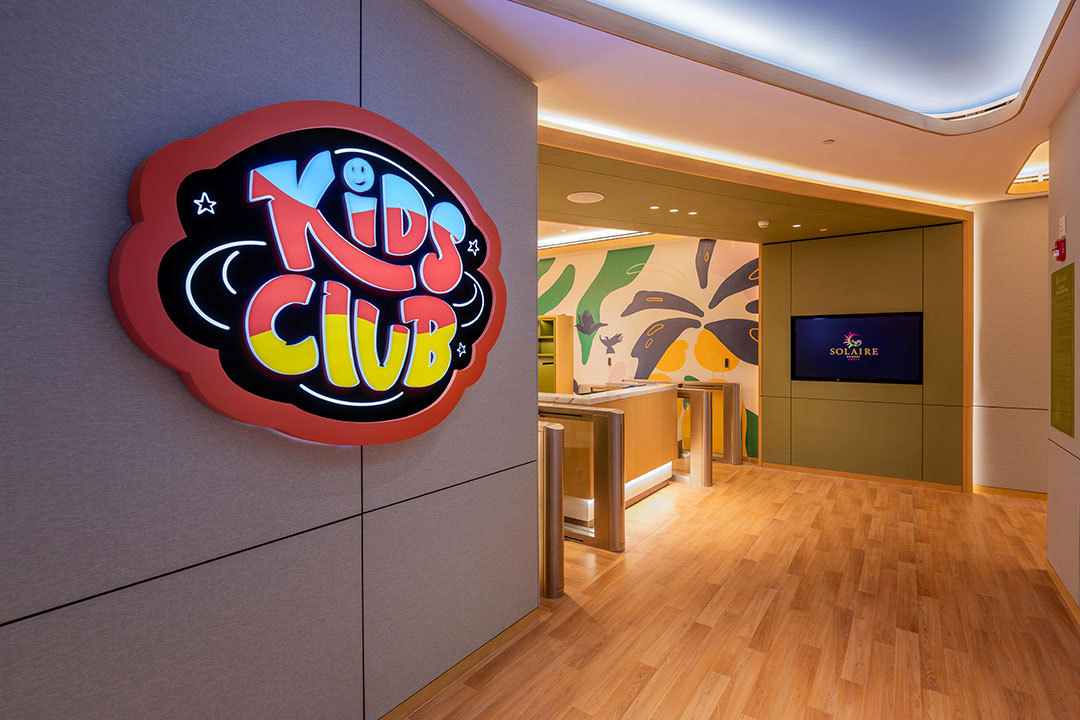
SOLAIRE Resort North is celebrating Easter for the first time. Start off with an Easter Egg Hunt at the Kids Club where each egg found holds a bounty of prizes. Hunt for eggs from 9 a.m. to 9 p.m. on April 20 to get a chance at winning exclusive vouchers to spend time at selected Solaire Resort North outlets. Relish Easter feasts at FRESH International Buffet, Lucky Noodles, and Manyaman for seafood galore, and for a more elevated celebration, savor in a succulent Easter Sunday brunch with Finestra and Yakumi. For inquiries, visit the Solaire Resort North website at sn.solaireresort.com/offers/rooms-suites/easter-family-fun-escape, or contact 8888-8888 or via e-mail at sn.reservations@solaireresort.com.


Easter down south at Solaire Resort Entertainment City

SOLAIRE Resort Entertainment City offers adventurous and exciting Easter Sunday celebrations for the entire family on April 20. The day starts with a Sunday mass at 10 a.m. in the Grand Ballroom followed by a range of interactive activities like luxurious brunch buffets, Easter egg hunts, bunny hopscotch races, face painting, and egg decorating. Earn special discounts and Easter goodie bags when you accomplish all activities with the family. The Grand Ballroom holds Easter egg hunting for all ages and bouncy inflatables to enjoy. At the Sky Tower area, kids can pick their own eggs to decorate at Waterside, complete a carrot toss at Oasis, and hop through Easter-patterned squares for a fun hopscotch activity at Fresh. At the Theatre Café, kids can enjoy cookies and cupcake decorating, face painting, balloon sculpting, and enhance their creativity through a coloring mural. You might just also catch the Easter Bunny hopping around. Indulge in an Easter brunch buffet at Finestra, Red Lantern, and Yakumi. Finestra offers casatiello, a ham and cheese savory cake together with herbs risotto, poached salmon, and chocolate eggs. Enjoy unlimited flutes of champagne, a seafood tower served directly at your table, a cold cuts station, a roast beef station by the kitchen counter, and luxurious desserts from a rich mille-feuille, macarons, tartalettes, homemade gelato. Eat all you can at Red Lantern with a dim sum buffet featuring crystal skin lobster dumplings, crispy deep-fried cheese and prawn spring rolls, baked signature black pepper wagyu beef tart, steamed Teochew dumpling, and more. At Yakumi, prepare for a sumptuous feast with eight live stations to choose from. Seafood lovers can enjoy grilled Boston lobster, scallops, blue marlin, prawns, and mackerel in the teppanyaki live station. You can also choose from a fine selection of meats like Kinross lamb chops, US ribeye steak, and Japanese sausage. For an Easter-inspired afternoon tea, delight in a wide array of tea sandwiches, delectable pastries and freshly baked scones at Oasis Garden Café. These include a savory chorizo and egg mousse tea sandwich, an orange cinnamon sable, Cheshire Pork Pie with glazed apple, and more. Enjoy it all with a pot of tea, an Easter-inspired mocktail or sparkling wine, and freshly brewed coffee. For inquiries, call 8888-8888 or e-mail reservations@solaireresort.com.


Blast off for Easter at Lanson

LANSON PLACE Mall of Asia invites families and travelers to embark on an interstellar Easter escapade with the Eggs-tronaut Easter Egg Hunt Adventure, an exclusive Holy Week Room Offer, and a cosmic Cyan Easter Lunch Buffet. The centerpiece of the celebration is the Cyan Easter Lunch Buffet on April 20, priced at P3,000 net per person. Families will appreciate exclusive discounts: children aged 0 to five dine for free, while kids aged six to 12 enjoy a 50% discount. As a special treat, one child receives a complimentary Easter Egg Hunt pass for every two full-paying adults, granting access to the Eggs-tronaut Easter Egg Hunt Adventure. The Eggs-tronaut Easter Egg Hunt Adventure will be a galactic journey filled with interactive activities, surprises, and cosmic-themed fun. While kids embark on their Easter space mission, adults can enjoy the exquisite dining offerings at Cyan Modern Kitchen. For guests who wish to attend the Easter event only, tickets are available for P1,800 net per person. For inquiries, visit https://lansonplace.com/mallofasia, e-mail reservations.lpmn@lansonplace.com, or contact 7777-0000.


The Plaza offers Easter treats

CELEBRATE Easter with a spread from The Plaza (aka one of the sources for prime Christmas ham). The Easter Special Bundle has The Plaza Premium Baked Ham (3.15 kilogram), two dozen pan de sal with Premium Glaze, with choice of one sauce (Gutsy Garlic, Sweet Mustard, or Wasabi Mayo), one tray of pasta (Spaghetti Puttanesca, Arrabiata, Bolognese, Carbonara, or Baked Macaroni), at P10,000. Order through https://theplazacatering.com/.


Jollibee helps out on Visita Iglesia

FOR THOSE observing Lenten traditions, Jollibee makes it easy to enjoy a meat-free option with its Tuna Pie with Fries & Drink for P145 (Save P12). Plus, consumers can access Jollibee’s Visita Iglesia Digital Map featuring recommended and notable churches. “Summer is all about creating fun-filled moments with family and friends, and we at Jollibee want to make those experiences even more special,” said Eloise Siccion, assistant vice-president and head of trade marketing group at Jollibee Philippines. “With the Summer Saya Treats, we’re bringing extra saya with sulit promos and exclusive treats that perfectly complement all your summer adventures,” she added. For more updates, follow @Jollibee on Facebook, Instagram, TikTok, and X, or visit https://www.jollibee.com.ph/.


Pizza Hut serves up something fishy

PIZZA HUT has whipped up a brand-new pizza creation that features the savory sweetness of kani complemented by a blend of fresh vegetables and a rich and creamy sauce, available for a limited time only. Savor the new Kreamy Kani Supreme Pizza (starts at P559 for Regular), made with premium kani chunks, green bell peppers, white onion, black olives, mushrooms, and creamy kani balls, all resting on a bed of creamy garlic sauce and mozzarella cheese, which is then drizzled with sweet chili sauce. You’ll also have the option to upgrade your regular Pan Pizza crust to the new Cheesy Kani Stuffed Crust. Watch out for these Kreamy Treat Combos, with three options to choose from: First, there’s the new Kreamy Treat for 2, priced at P899, with one Regular Kreamy Kani Supreme Pizza, one Regular Pasta (Four Cheese Baked Mac or Baked Tomato Cream), a side of Shrimp Poppers, and two servings of ice-cold Pepsi. There’s also the new Kreamy Treat for 4, priced at P1599, with one Large Kreamy Kani Supreme Pizza, one Large Pasta (Four Cheese Baked Mac or Baked Tomato Cream), a side of Shrimp Poppers, Mozzarella Sticks, and one Pepsi pitcher. Finally, there’s the new Kreamy Pizza Duo, priced at P799 for Regular and P1199 for Large, where you’ll get to pair your Kreamy Kani Supreme Pizza with either a Cheese Lovers or a Veggie Lovers Pan pizza. All Kreamy Kani Supreme Pizzas in the combos come with Cheesy Kani Stuffed Crust. Try these new offerings by visiting your nearest Pizza Hut store for dine-in and take-out orders. You can also order for delivery via the 8911-1111 hotline, www.pizzahut.com, or the Pizza Hut mobile app, available for Android and iOS devices; or through Pizza Hut’s official delivery partners GrabFood and Foodpanda.


Araneta City releases Lenten schedule

CHURCHGOERS are invited to attend the Eucharistic celebrations at the Sagrada Familia Church and Araneta City chapels on Palm Sunday, April 13. The malls in Araneta City, including Gateway Mall 1, Gateway Mall 2, Ali Mall, and Farmers Plaza, will remain open on most days during Holy Week. On April 14 to 16, (Holy Monday to Holy Wednesday), malls are open from 10 a.m. to 9 p.m. Malls will be closed on April 17 and 18 (Maundy Thursday and Good Friday), including the Sagrada Familia Church. The malls will reopen on April 19 (Black Saturday) from 10 a.m. to 10 p.m. On April 20 (Easter Sunday) malls will be open from 10 a.m. to 9 p.m. The Stations of the Cross will be on display for viewing at the Sensory Garden (outside Sagrada Familia Church) from April 11 to 20, except on April 17 and 18 (Maundy Thursday and Good Friday). Farmers Market remains operational on Holy Week. Normal operating hours will be in effect to provide fresh produce to patrons even during holidays. Expect some of the shops and tenants to be closed on April 17 and 18, Maundy Thursday and Good Friday.

Rethinking jeepney modernization

PHILIPPINE STAR/ MIGUEL DE GUZMAN

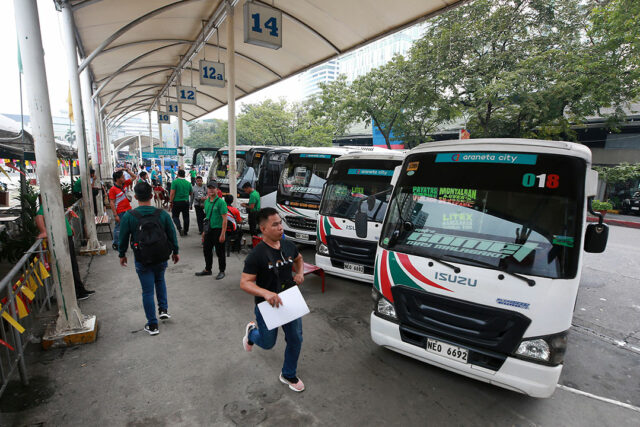
The government vows to proceed — even at a slower pace — with its long-standing plan to modernize public utility vehicles, particularly jeepneys, to ensure they are roadworthy and up to standard. The plan requires drivers and operators to organize themselves into cooperatives or corporations to qualify for new route franchises.

This move comes even as the Supreme Court has yet to decide on the petition filed by transport operators against the jeepney modernization program. At the center of the case is the required “consolidation” of operators. Drivers and operators argue that this process, if implemented now, will leave many routes unserved.

To date, the Land Transportation Franchising and Regulatory Board (LTFRB) continues to rationalize jeepney routes nationwide. These route plans will determine how many vehicles each route needs and who can get a franchise. Authorities say they aim to rationalize half of the routes by the end of 2025, with the remainder to be completed by the end of 2026.

The process is slow and tedious. It requires the Department of Transportation and the LTFRB — both operating with limited resources — to coordinate with local government units (LGU) nationwide. Together, they must identify viable routes and determine how many vehicles are needed for each.

Only after these new routes are established can the government award franchises. From there, cooperatives and corporations will have around two years to acquire modern vehicles that meet updated standards. All in all, it may take another four years before the public sees new jeepneys on the road.

In the meantime, several key issues remain unresolved. These include how cooperatives can raise enough capital to buy new units; how they can build operational capacity to maintain their fleets; and how they can fairly compensate, train and manage drivers.

In my opinion, the present-day jeepney is an outdated mode of transportation. It was born out of necessity after World War II, when surplus military jeeps were repurposed for mass transit. Eight decades later, that same basic design still dominates our roads as the most common form of public transport.

It is also a fact that small, less-capitalized operators can’t afford to replace their old vehicles, even if they form cooperatives. To be blunt, even after pooling resources, they still lack the capital to build a modern fleet. This, to me, is the crux of the issue.

The high cost of modern jeepneys becomes a “barrier to entry” that excludes poorer operators and favors wealthier ones. As a result, consolidation risks becoming a backdoor for larger corporations to monopolize the jeepney industry under the guise of modernization.

That said, I also believe that any group involved in delivering a vital public service should be financially sound enough to ensure that the service they provide is comfortable, efficient, safe and dignified. The public deserves nothing less, and the government should not settle for anything less.

Commuters deserve a modern, professionalized jeepney industry — one in which drivers earn decent salaries, operators pay the proper taxes and fees and profits are reinvested to improve services.

To achieve this, Congress should consider devolving certain powers to LGUs. There may be a way to empower local governments to take a more direct role in modernizing public transport in their own territories.

Currently, LGUs are already involved in planning local routes, with the LTFRB coordinating and issuing franchises. One idea is to allow LGUs to issue franchises for jeepneys operating exclusively within their jurisdictions — much like they already do with tricycles. The National Government would retain oversight and ensure inter-LGU coordination.

The aim is to make public transport more inclusive, efficient and responsive to the needs of local communities. In this context, we can imagine a tiered system: larger jeepneys or minibuses with LTFRB-issued franchises running inter-city routes along national roads, while smaller, electric jeepneys operate shorter, purely local routes within an LGU.

Local routes make particular sense for electric shuttles, which often have limited range. These routes should still be coordinated with the LTFRB but franchised locally — again, similar to how tricycles are regulated.

Under current law, LGUs have control over tricycle franchises, while jeepney and bus routes fall under the LTFRB. This one-size-fits-all system struggles to meet the diverse needs of cities and municipalities across the country. It creates the impression that centralized planning contributes to unnecessary bureaucratic delays.

We should redefine the LTFRB’s role — from micromanaging routes to enforcing standards. The LTFRB should become the national regulator and standard-setter, responsible for fare guidelines, vehicle specifications and safety regulations. Local route planning can be devolved to LGUs, who understand their own traffic flows and community needs.

This shift can begin as a pilot covering small, electric jeepneys for short-distance routes as supplements to the larger, national routes. LGUs can design and manage these local routes, subject to national standards and approval timelines set by the LTFRB.

The LTFRB would still ensure consistency and facilitate coordination across LGUs, but it would no longer dictate every route detail. This would free up central planners to focus on system-wide integration and allow LGUs to adapt faster to local changes — new roads, new neighborhoods or shifts in commuter demand.

An important part of this system is the establishment of “handoff points” or shared terminals at LGU borders. These would allow passengers to switch from local shuttles to inter-city transport modes. The network would remain interoperable and user-friendly, guided by national standards but managed locally.

In this model, LTFRB becomes a mediator and integrator. It sets unified national standards — for fares, payment systems and vehicle specs — and helps broker inter-LGU agreements. Together with agencies like the MMDA, it ensures seamless travel. A commuter could take a Makati-managed jeepney to the city border and easily transfer to a Quezon City-bound bus or rail line at a designated terminal.

Many LGUs already operate local shuttle services to and from city borders. While these programs remain limited in scope, they prove that cities can run effective transit systems that attract riders and reduce congestion. However, current law prohibits LGUs from operating fare-collecting transport routes. This needs to change.

One option is for the LTFRB to grant franchises to LGUs themselves, allowing them to operate local routes. These LGUs can then sub-franchise smaller routes to local cooperatives. In this scenario, the LGU maintains oversight and ensures service quality.

An LGU could choose to operate the system directly or contract local cooperatives to run day-to-day operations. If cooperatives are involved, LGUs can assist with financing — either by purchasing units outright or leasing them to operators. This addresses the capital shortfall among small operators. Cooperatives would function purely as operators, receiving a share of revenue rather than owning the vehicles.

It may seem like a long shot, but with proper planning and legislation, this approach can work. Congress must consider how to evolve the LTFRB’s role and how to legally empower LGUs to establish local routes and issue franchises — or to hold franchises themselves and contract operators.

Modernizing the jeepney industry is not just about replacing vehicles. It is about building a transport system that works — for commuters, for drivers and for cities. LGUs are closer to the ground and better positioned to lead this transformation. But they need the legal authority to act.


Marvin Tort is a former managing editor of BusinessWorld, and a former chairman of the Philippine Press Council

matort@yahoo.com