Home Blog Page 1178

US to complete review into AUKUS defense pact in autumn

ADOBESTOCK | 3D Rendering of two flags from Commonwealth of Australia and State of United States of America together with fabric texture, bilateral relations, peace and conflict between countries, great for background

 – The United States will complete a review into a defense pact with the United Kingdom and Australia in the northern hemisphere autumn, the office of a top Pentagon official said on Wednesday.

U.S. President Donald Trump’s administration said in June it had launched a formal review into the AUKUS defense deal – worth hundreds of billions of dollars – that will allow Australia to acquire U.S. nuclear-powered submarines, causing alarm in Canberra.

The review into the 2021 deal struck during the Biden administration is being led by Under Secretary of Defense for Policy Elbridge Colby, a public critic of the pact.

Mr. Colby’s office said in a post on X on Wednesday (Tuesday EST) the review will be an “empirical and clear-eyed assessment” of the deal.

“The Department anticipates completing the review in the fall,” the post said.

“Its purpose will be to provide the President and his senior leadership team with a fact-based, rigorous assessment of the initiative.”

AUKUS is Australia’s biggest-ever defense project, with Canberra committing to spend A$368 billion ($240 billion) over three decades to the program, which includes billions of dollars of investment in the U.S. submarine production base.

Mr. Colby, the Pentagon’s top policy adviser, said last year that submarines were a scarce, critical commodity, and U.S. industry could not produce enough to meet American demand.

Australia, which this month paid A$800 million to the U.S. in the second instalment under AUKUS, has maintained it is confident the pact will proceed.

Australia and Britain on Saturday signed a bilateral 50-year submarine pact, that they said builds on the AUKUS alliance with the U.S. – Reuters

Philippines issues tsunami warning after Russia earthquake

Philippine Institute of Volcanology and Seismology (PHIVOLCS), Public domain, via Wikimedia Commons

 – The Philippines’ seismology agency advised people to stay away from beaches in coastal areas facing the Pacific Ocean on Wednesday, as these regions are expected to experience tsunami waves of less than one meter in height.

PHIVOLCS issued the advisory following a magnitude 8.7 earthquake that struck off Russia’s Far Eastern Kamchatka Peninsula on Wednesday. – Reuters

Australia widens teen social media ban to YouTube, scraps exemption

REUTERS

 – Australia said on Wednesday it will add YouTube to sites covered by its world-first ban on social media for teenagers, reversing an earlier decision to exempt the Alphabet-owned video-sharing site and potentially setting up a legal challenge.

The decision came after the internet regulator urged the government last week to overturn the YouTube carve-out, citing a survey that found 37% of minors reported harmful content on the site.

“Social media have a social responsibility and there is no doubt that Australian kids are being negatively impacted by online platforms, so I’m calling time on it,” Prime Minister Anthony Albanese said in a statement.

“I want Australian parents to know that we have their backs.”

The decision broadens the ban set to take effect in December. YouTube says it is used by nearly three-quarters of Australians aged 13 to 15, and should not be classified as social media because its main activity is hosting videos.

“Our position remains clear: YouTube is a video sharing platform with a library of free, high-quality content, increasingly viewed on TV screens. It’s not social media,” a YouTube spokesperson said by email.

Since the government said last year it would exempt YouTube due to its popularity with teachers, platforms covered by the ban, such as Meta’s Facebook and Instagram, Snapchat and TikTok, have complained.

They say YouTube has key similarities to their products, including letting users interact and recommending content through an algorithm based on activity.

Artificial intelligence has supercharged the spread of misinformation on social media platforms such as YouTube, said Adam Marre, chief information security officer at cyber security firm Arctic Wolf.

“The Australian government’s move to regulate YouTube is an important step in pushing back against the unchecked power of big tech and protecting kids,” he added in an email.

The reversal sets up a fresh dispute with Alphabet, which threatened to withdraw some Google services from Australia in 2021 to avoid a law forcing it to pay news outlets for content appearing in searches.

Last week, YouTube told Reuters it had urged the government “to uphold the integrity of the legislative process”. Australian media said YouTube threatened a court challenge, but YouTube did not confirm that.

The law passed in November only requires “reasonable steps” by social media platforms to keep out Australians younger than 16, or face a fine of up to A$49.5 million.

The government, which is due to receive a report this month on tests of age-checking products, has said those results will influence enforcement of the ban. – Reuters

Powerful quake in Russia’s Far East causes tsunami, Japan and Hawaii order evacuations

STOCK PHOTO | Image by Elias from Pixabay

A magnitude 8.7 earthquake struck off Russia’s Far Eastern Kamchatka Peninsula on Wednesday, generating a tsunami of up to 4 meters (13 feet), damaging buildings and prompting evacuation warnings in the area and across most of Japan’s east coast, officials said.

“Today’s earthquake was serious and the strongest in decades of tremors,” Kamchatka Governor Vladimir Solodov said in a video posted on the Telegram messaging app, adding that a kindergarten was damaged.

A tsunami with a height of 3-4 meters (10-13 feet) was recorded in parts of Kamchatka, Sergei Lebedev, regional minister for emergency situations said, urging people to move away from the shoreline of the peninsula.

The U.S. Geological Survey said the earthquake was shallow at a depth of 19.3 km (12 miles), and was centered 126 km (80 miles) east-southeast of Petropavlovsk-Kamchatsky, a city of 165,000 along the coast of Avacha Bay. It revised the magnitude up from 8.0 earlier.

The Japan Weather Agency upgraded its warning, saying it expected tsunami waves of up to 3 meters (10 feet) to reach large coastal areas starting around 0100 GMT. Broadcast NHK said evacuation orders had been issued by the government for some areas.

Factory workers and residents in Japan’s northern Hokkaido evacuated to a hill overlooking the ocean, footage from broadcaster TBS showed.

“Please evacuate quickly. If you can move quickly to higher ground and away from the coast,” a newscaster on Japanese public broadcaster NHK said.

The U.S. Tsunami Warning System also issued a warning of “hazardous tsunami waves” within the next three hours along some coasts of Russia, Japan, Alaska and Hawaii. A tsunami watch was also in effect for the U.S. island territory of Guam and other islands of Micronesia.

Hawaii ordered evacuations from some coastal areas. “Take Action! Destructive tsunami waves expected,” the Honolulu Department of Emergency Management said on X.

An evacuation order for the small town of Severo-Kurilsk, south of the Kamchatka peninsula, was declared due to the tsunami threat, Sakhalin Governor Valery Limarenko said on Telegram.

Several people sought medical assistance following the quake, Oleg Melnikov, regional health minister told Russia’s TASS state news agency.

“Unfortunately, there are some people injured during the seismic event. Some were hurt while running outside, and one patient jumped out of a window. A woman was also injured inside the new airport terminal,” Melnikov said.

“All patients are currently in satisfactory condition, and no serious injuries have been reported so far.”

The Kamchatka branch of the Geophysical Service of the Russian Academy of Sciences said it was a very powerful earthquake.

“However, due to certain characteristics of the epicenter, the shaking intensity was not as high … as one might expect from such a magnitude,” it said in a video on Telegram.

“Aftershocks are currently ongoing … Their intensity will remain fairly high. However, stronger tremors are not expected in the near future. The situation is under control.”

Kamchatka and Russia’s Far East sit on the Pacific Ring of Fire, a geologically active region that is prone to major earthquakes and volcanic eruptions. – Reuters

Trump administration slashed federal funding for gun violence prevention

STOCK PHOTO | Image by gmsjs90 from Pixabay

 – The Trump administration has terminated more than half of all federal funding for gun violence prevention programs in the U.S., cutting $158 million in grants that had been directed to groups in cities like New York, Los Angeles, Chicago, Washington, DC, and Baltimore.

Of the 145 community violence intervention (CVI) grants totaling more than $300 million awarded through the U.S. Department of Justice, 69 grants were abruptly terminated in April, according to government data analyzed by Reuters.

The elimination of CVI programs is part of a broader rollback at the department’s grant-issuing Office of Justice Programs, which terminated 365 grants valued at $811 million in April, impacting a range of public safety and victim services programs.

A DOJ official told Reuters the gun violence grants were eliminated because they “no longer effectuate the program’s goals or agency’s priorities.” Thousands of Office of Justice Programs grants are under review, the official said, and are being evaluated, among other things, on how well they support law enforcement and combat violent crime.

The majority of CVI grants were originally funded through the 2022 Bipartisan Safer Communities Act and part of a push by former President Joe Biden to stem the rise of gun violence in America, including establishing the first White House Office for Gun Violence Prevention.

That office was “dismantled on day one” of Mr. Trump taking office, said former deputy director of the office, Greg Jackson Jr..

Prior to the Biden-era funding, most gun violence prevention programs were funded on the state level.

“These programs five years ago, if they did exist, had very small budgets and didn’t have large, multimillion-dollar federal investments,” said Michael-Sean Spence, managing director of community safety initiatives at Everytown for Gun Safety, which has worked with 136 community-based violence intervention organizations since 2019.

Twenty-five of the groups were impacted by funding cuts.

The grants supported a wide range of CVI programming to prevent shootings such as training outreach teams to de-escalate and mediate conflict, social workers to connect people to services and employment, and hospital-based programs for gun violence victims.

“[It’s] preventing them from doing the work in service of those that need it the most at the most urgent, and deadliest time of the year,” Spence said, referring to summer months when there’s typically an uptick in shootings.

Gun violence deaths in the U.S. grew more than 50% from 2015 to the pandemic-era peak of 21,383 in 2021, according to the Gun Violence Archive. Since then, deadly shootings have been in decline, falling to 16,725 in 2024, which is more in line with the pre-pandemic trend. As of May 2025, deaths are down 866 from the same period last year.


DEFUNDED PROGRAMS

While cities like New York City, Chicago and Los Angeles received the bulk of gun violence prevention funding, southern cities like Memphis, Selma, Alabama and Baton Rouge, Louisiana also received millions and were more reliant on the grants due to limited state support for the programs, experts told Reuters.

“Very few state legislatures are passing funding right now, that’s why the federal cuts were such a tragic hit,” said Amber Goodwin, co-founder of Community Violence Legal Network, who’s part of a coalition of lawyers working to get grants reinstated.

Nearly a dozen interviews with legal experts, gun violence interventionists, and former DOJ officials said funding cuts threaten the long-term sustainability of community violence intervention initiatives that have taken years to establish and are embedded in predominantly Black and Latino communities.

Pha’Tal Perkins founded Think Outside Da Block in 2016, a nonprofit based in Chicago’s violence-plagued Englewood neighborhood. Federal funding allowed him to hire full-time staff, but when grants were stripped, he was forced to lay off five team members.

“Being able to have outreach teams at specific places at the right time to have conversations before things get out of hand is what people don’t see,” Perkins said.

The programs initiated in 2022 marked the first time grassroots organizations could apply for federal community violence prevention funding directly, without going through law enforcement or state intermediaries, according to three former DOJ officials.

Aqeela Sherrills, co-founder of Community Based Public Safety Collective in Los Angeles, provided training on implementing violence intervention strategies to nearly 94 grantees, including states, law enforcement agencies, and community-based organizations.

Prior to the cuts, “we were onboarding 30 new grantees through the federal government. Many of these cities and law enforcement agencies have no idea how to implement CVI,” Sherrills said.


POLICE SUPPORT

Some critics of CVI argue that the programs aren’t effective and that federal dollars would be better spent on law enforcement to stymie gun violence. Others view the initiatives as inherently “anti-gun” and are “nothing more than a funnel to send federal tax dollars to anti-gun non-profits who advocate against our rights,” said Aidan Johnston, federal affairs director of the Gun Owners of America.

That view is not universally shared by law enforcement, however. In June, a letter signed by 18 law enforcement groups and police chiefs in Louisville, Minneapolis, Tucson and Omaha called on Attorney General Pam Bondi to reinstate funding that has resulted in “measurable and significant reductions in violence and homicides.”

“These aren’t feel-good programs; they’re lifesaving, law-enforcement-enhancing strategies that work,” they wrote.

Columbia, South Carolina Deputy Police Chief Melron Kelly, who was unaware of the letter, told Reuters that CVI programs were relatively new in the city, but as a result, the police began collaborating more with community organizations.

Mr. Kelly said Columbia’s CVI programs focused on preventing retaliatory shootings that can escalate a neighborhood conflict.

“Public safety really starts in the neighborhood before police get involved. CVI work is very important; we’ve seen a drastic reduction in violent crime post-COVID and shootings are almost at a 10-year low,” Kelly said.

Now, organizations are trying to figure out how to keep the doors open now that federal money has run dry.

Durell Cowan, executive director of HEAL 901, a community violence prevention nonprofit in Memphis, received a $1.7 million CVI grant in October 2024.

Mr. Cowan’s organization received $150,000 in federal funds since the beginning of the year before his grant was canceled. He’s had to dip into his personal savings to keep his 14-person staff on payroll, he said.

Recently, he secured funding from an out-of-state nonprofit as well as a $125,000 emergency grant from the city. Still, he may be forced to conduct layoffs if federal government dollars don’t start flowing again.

“We shouldn’t be pulling from our own personal finances and life insurance policies to cover the cost of public safety,” he said. – Reuters


US Fermilab hit in cyberattack targeting Microsoft’s SharePoint, Bloomberg News reports

TOWFIQU BARBHUIYA-UNSPLASH

One of the U.S. Department of Energy’s 17 national labs was attacked by hackers as part of a recent campaign seeking to exploit flaws in Microsoft’s SharePoint software, Bloomberg News reported on Tuesday, citing a department spokesperson.

“Attackers did attempt to access Fermilab’s SharePoint servers,” a Department of Energy spokesperson told Bloomberg, referring to the U.S. Fermi National Accelerator Laboratory.

“The attackers were quickly identified, and the impact was minimal, with no sensitive or classified data accessed,” the spokesperson said, adding that Fermilab’s servers are back online and running normally.

Microsoft, Fermilab and the U.S. Department of Energy did not immediately respond to Reuters’ requests for comment.

security patch released by Microsoft last month failed to fully fix a critical flaw in the U.S. tech giant’s SharePoint server software that had been identified in May, opening the door to a sweeping global cyber espionage operation.

Fermilab, established in 1967, is “America’s particle physics and accelerator laboratory,” according to its website.

Last week, a U.S. Department of Energy spokesperson told Reuters that on July 18 a SharePoint security flaw impacted its systems, including those of the National Nuclear Security Administration, which oversees the nation’s nuclear weapons stockpile.

The department had stated that all affected systems were being restored. – Reuters

BSP: Rate cut still on table in Aug.

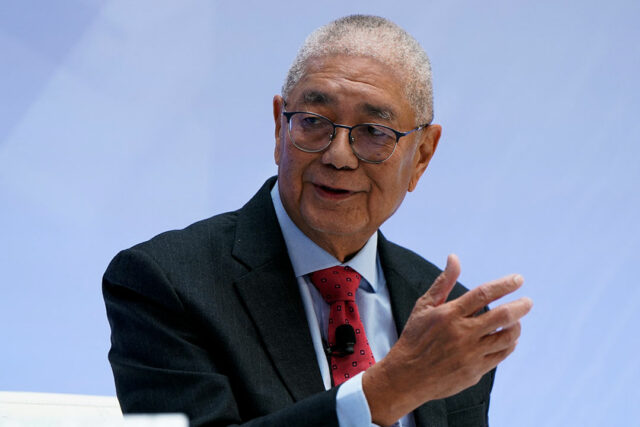
BANGKO SENTRAL NG PILIPINAS Governor Eli M. Remolona, Jr. attends a seminar during the 2025 annual IMF/World Bank Spring Meetings in Washington, DC, April 25, 2025. — REUTERS/ELIZABETH FRANTZ

By Luisa Maria Jacinta C. Jocson,  Senior Reporter

THE Bangko Sentral ng Pilipinas (BSP) could continue lowering interest rates at its meeting in August, its top official said.

BSP Governor Eli M. Remolona, Jr. told reporters on Tuesday that a rate cut is still “on the table” at the Monetary Board’s next policy review on Aug. 28.

If realized, this would mark the third straight rate cut delivered by the Philippine central bank.

The BSP has so far reduced borrowing costs by a total of 125 basis points since it began its easing cycle in August last year.

Key data releases such as the second-quarter gross domestic product (GDP) will be available by the next policy meeting, Mr. Remolona noted.

He said he expects GDP to have expanded by “around 5.5%” in the second quarter, which would be slightly faster than the 5.4% GDP growth in the first quarter.

The Philippine Statistics Authority is set to release second-quarter GDP data on Aug. 7.

The government is targeting a 5.5-6.5% growth this year.

The BSP can also continue easing rates even after the US starts imposing a 19% tariff on goods from the Philippines starting Aug. 1.

Mr. Remolona said the impact of the tariffs on the Philippine economy will be “modest.”

“Globally it’s much clearer now than before. Our issue is more the global spillover effects than the direct effect,” he said.

“A lot of sectors are exempt. We’re not a big trading economy so that limits the impact on us.”

The Philippines’ new US tariff rate is now the same as Indonesia, and slightly lower than Vietnam’s 20%. 

Meanwhile, the BSP chief said he is keeping his outlook for two more rate cuts this year.

After August, the Monetary Board has two remaining meetings scheduled for October and December.

Asked if there was a possibility for a third rate cut, Mr. Remolona said it would take “something very unusual” to warrant this scenario.

A drastic slowdown in growth was also “very unlikely,” he added.

“Growth has to slow down dramatically… it will depend on not just the quarterly growth but the prospects.”

Meanwhile, Mr. Remolona said they are still comfortable with the peso at the P57 level.

“That’s still quite strong,” he said in mixed Filipino and English.

The peso closed at P57.31 per dollar on Tuesday, depreciating by 11 centavos from its P57.20 finish on Monday. This was its weakest close in more than a month or since its P57.58 close on June 23.

“As you know, we don’t have a target for the peso. I’m more concerned about the potential inflationary effects.”

IMF raises Philippine growth forecast for 2026

A view of the central business district of Makati City on July 10. — PHILIPPINE STAR/RYAN BALDEMOR

THE INTERNATIONAL Monetary Fund (IMF) raised its gross domestic product (GDP) growth forecast for the Philippines for 2026 but kept its projection for this year amid heightened global uncertainty.

In its latest World Economic Outlook (WEO), the IMF upwardly revised its 2026 Philippine growth forecast to 5.9% from 5.8% previously. However, this would be below the government’s 6-7% GDP growth target for next year.

The IMF’s Philippine economic growth projection for 2026 is higher than Indonesia (4.8%), Malaysia (4%), and Thailand (1.7%).

IMF’s World Economic Outlook Growth Forecasts for Select East and Southeast Asian Economies

At the same time, the IMF maintained its GDP growth forecast for the Philippines at 5.5% this year, the same as its estimate in April. This would fall at the low end of the government’s 5.5-6.5% target range for 2025.

The IMF projects the Philippines’ GDP growth this year to outpace that of Indonesia (4.8%), Malaysia (4.5%), and Thailand (2%).

“Since the April 2025 WEO, uncertainty has remained elevated even as effective tariff rates have come down,” the IMF said in its report.

US President Donald J. Trump announced a 19% tariff on Philippine goods, following a meeting with President Ferdinand R. Marcos, Jr. last week. The new rate will take effect on Aug. 1

At the time the April WEO came out, the Philippines was slapped with a 17% tariff in Mr. Trump’s initial round of “Liberation Day” tariffs.

The IMF noted that the staff projections in the July update are “based on real-time current trade policy.”

IMF Chief Economist Pierre-Olivier Gourinchas in a speech at the report launch said that the US has “partly reversed course, pausing the higher tariffs for most of its trading partners.”

“Despite these welcome developments, tariffs remain historically high, and global policy remains highly uncertain, with only a few countries having reached fully fleshed out trade agreements,” he said.

“This modest decline in trade tensions, however fragile, has contributed to the resilience of the global economy so far.”

The IMF anticipates global growth at 3% for 2025 and 3.1% for 2026, both higher than its 2.8% and 3% projections in April.

“This resilience is welcome, but it is also tenuous. While the trade shock could turn out to be less severe than initially feared, it is still sizeable, and evidence is mounting that it is hurting the global economy,” Mr. Gourinchas said.

Mr. Gourinchas also warned that risks to the global economy “remain firmly to the downside” as the current trade environment remains “precarious.”

“Tariffs could well reset at much higher levels once the ‘pause’ expires on Aug. 1 or if existing deals unravel. If this were the case, model-based simulations suggest global output would be 0.3% lower in 2026,” he said.

Ongoing trade uncertainty would weigh on investment and activity without comprehensive agreements, he added.

“The geopolitical environment also remains fragile, with a potential for more negative supply disruptions.”

The IMF also flagged high public debt and deficits, which make economies vulnerable to financial shocks.

“The lack of fiscal space makes these countries especially vulnerable to a sudden tightening in financial conditions that increase term premia.”

“Such tightening becomes even more likely if central bank independence — a cornerstone of macroeconomic, monetary and financial stability — is undermined.”

Mr. Gourinchas said that vital policy recommendations include restoring stability in trade policy; preserving central bank independence; restoring fiscal space and efforts towards long-term productivity.

Meanwhile, Rizal Commercial Banking Corp. Chief Economist Michael L. Ricafort said the IMF may have maintained its 2025 growth projection due to expectations of the possible global economic slowdown stemming from the US tariffs.

“Though the local economy is relatively resilient and less affected amid relatively lower goods exports at around three to five times smaller compared to other major ASEAN (Association of Southeast Asian Nations) countries that are more export-dependent,” he said.

“Local economic growth would also be spurred by expansionary fiscal policy through deficit spending in view of wider budget deficits by the National Government, particularly the wider targets, provided by fiscal space available,” he added. — Luisa Maria Jacinta C. Jocson

Zero tariffs on US goods to result in up to P6B in foregone revenues

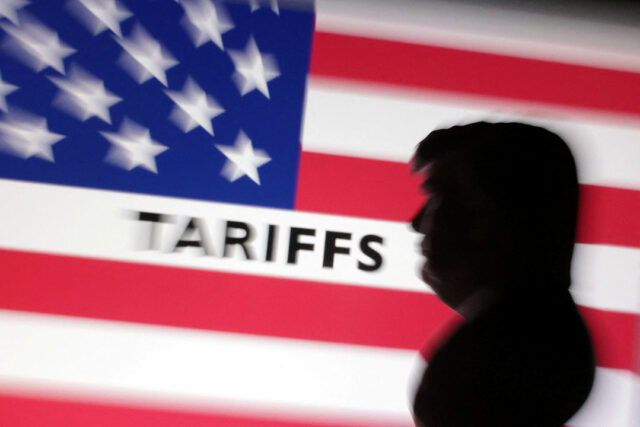
A 3D-printed miniature model of US President Donald J. Trump and the US flag pattern with the word “tariffs” are seen in this illustration. — REUTERS/DADO RUVIC/ILLUSTRATION

By Aubrey Rose A. Inosante, Reporter

THE PHILIPPINE GOVERNMENT is anticipating up to P6 billion in foregone revenues following its decision to grant zero tariffs on selected US products imported into the country.

“Our initial estimate is something like P3 billion to P6 billion. It depends if everything is included,” Finance Secretary Ralph G. Recto told reporters on the sidelines of the Post-State of the Nation Address (SONA) briefing on Tuesday.

While there is no final deal yet, Mr. Recto said the foregone revenue estimate assumes that the Philippines will grant zero tariffs on select products such as automobiles, wheat, soy and pharmaceuticals.

US President Donald J. Trump announced a 19% tariff rate for goods from the Philippines after a meeting with President Ferdinand R. Marcos, Jr. in Washington. This was a slightly lower rate than the 20% that Mr. Trump threatened to impose, but higher than the 17% “reciprocal tariff” announced in April.

“We concluded our trade deal, whereby the Philippines is going open market with the United States, and zero tariffs,” Mr. Trump said.

Mr. Recto said zero tariffs on US wheat and pharmaceuticals would translate to lower prices for consumers.

“Ayaw ba natin ng murang pandesal? Walang tariff sa wheat. Pabor sa atin ’yun (Don’t we want cheaper pandesal? There’s no tariff on wheat. That’s favorable for us),” he said.

At the same time, Mr. Recto acknowledged that the Philippines’ exports to the US would be affected “initially” as a result of the 19% tariff.

“We have one of the lowest tariffs in the world… As a whole, we have a better deal than many other countries,” he said.

The Philippines’ new US tariff rate is now the same as Indonesia, and slightly lower than Vietnam’s 20%.

However, Mr. Trump said on Monday most trading partners that do not negotiate separate trade deals would soon face tariffs of 15% to 20% on their exports to the United States, well above the broad 10% tariff he imposed in April, Reuters reported.

Analysts said the foregone revenues from slashing tariffs on some US goods are “minimal.”

“Yes, the P3-billion to P6-billion revenue loss sounds minimal in the grand scheme, but it’s not just about numbers — it’s about positioning. The deal opens the door to cheaper US goods like medicine, feeds (soyabeans and wheat) and cars, which helps consumers and could ease inflation,” Jonathan L. Ravelas, a senior adviser at Reyes Tacandong & Co. said in a Viber message.

Mr. Ravelas said the government has to monitor if local industries “get squeezed” as a result of the deal.

“Bottom line: it’s favorable for now, but we must stay agile and protect domestic competitiveness,” he said.

Union Bank Chief Economist Ruben Carlo O. Asuncion said the foregone revenue is a “manageable trade-off,” noting the deal’s long-term benefits in investment, defense, and technology cooperation.

“More importantly, the deal preserves access for Philippine exporters to a key market and opens doors for deeper cooperation in investment, defense, and technology — contributing to the country’s long-term growth and resilience,” he said in a Viber message.

John Paolo R. Rivera, a senior research fellow at the Philippine Institute for Development Studies, said the key is to ensure the gains from improved market access translates to more jobs and export growth which would offset the foregone revenue.

“If this concession helped lower the tariff on our goods and safeguard export competitiveness, albeit within limited bargaining power, especially in key sectors like electronics and garments, then the trade-off can be deemed acceptable on such ground,” he said in a Viber message.

Meanwhile, Jose Enrique A. Africa, executive director at IBON Foundation, said the reduction in tariff revenues would slash public funds for essential services.

“We still don’t even know the full extent of what deal President Marcos Jr. struck with the US, and the government is being opaque about any other economic, political or military concessions it might have given,” he said.

“But if the grossly one-sided tariff deal is any indication, the ambiguity could very well be hiding something even worse. Which could be the reason for the deal’s conspicuous omission from the President’s SONA.”

IBON Foundation had earlier estimated foregone revenues to reach P3.97 billion as a result from the zero-tariff treatment on some US goods.

BSP eyes prudential requirements for digital-centric banks

BW FILE PHOTO

THE BANGKO SENTRAL ng Pilipinas (BSP) is looking to set prudential requirements for “digital-centric” banks as it wants to level the playing field and ensure financial stability.

In a draft circular posted on its website, the central bank is looking to adopt progressive prudential requirements for digital-centric thrift, rural and cooperative banks to “ensure that regulatory standards remain commensurate with (risk exposures).”

“The progressive prudential requirements aim to foster innovation while ensuring the safety and soundness of the banking system,” the BSP said.

“This likewise promotes a level playing field for both incumbents and new entrants as banks navigate the opportunities and challenges brought about by rapid digitalization in the banking sector.”

Under the draft rules, thrift, rural and cooperative banks identified by the BSP as digital-centric will be considered as complex banks.

Complex banks are defined as those entities that use nonconventional business models, such as “using nontraditional delivery platforms such as electronic platforms.”

These banks may also have a business strategy “characterized by risk appetite that is aggressive, and risk exposures which are increasing, such as those with robust branch expansion programs or acquisition plans.” It could also refer to banks with digital-centric operations, it added.

“The BSP shall assess the extent of technology utilization of subject banks as well as the maturity or degree of their digitalization efforts.”

In assessing the level of digital centricity of a bank, the BSP will consider indicators such as capability to offer end-to-end e-KYC (electronic know your customer) and digital deposit funding; capability to digitally offer or service loans; and percentage of customers who avail of digital financial products or services; among others.

The proposed regulations will classify these digital-centric banks into three tiers with each tier representing a progressively higher level of digital centricity.

“Correspondingly, prudential requirements are calibrated to increase with each successive tier, reflecting the heightened complexity, scale, and risk profile of the bank’s digital operations.”

Tier 1 would cover rural or cooperative banks that have obtained an Electronic Payment and Financial Services (EPFS) license to enable the utilization of a mobile banking application and other channels that are capable of onboarding clients via e-KYC facilities and enable customers to fund their deposit accounts digitally.

They must also have at least 30% of its deposit or loan customers onboarded via digital channels; or have at least 30% of its deposits or loans out of their respective balances sourced from digital financial service offerings; or at least 30% of its total financial transactions as EPFS transactions.

This tier could also include rural or cooperative banks engaged in loan channeling arrangements whereby end-user loan clients are largely sourced digitally either by the thrift, rural or cooperative bank or their loan channeling partners.

Meanwhile, Tier 2 would include thrift, rural or cooperative banks that have at least 50% of their customers onboarded through digital channels; or deposits or loans sourced from digital financial service offerings; or their total financial transactions as EPFS transactions.

Banks under Tier 3 would have at least 75% of their customers and deposits or loans through digital channels, financial service offerings, or financial transactions.

Under the draft rules, banks must comply with prudential requirements depending on their tier.

Tier 1 banks would need to have a minimum capital requirement of at least P200 million.

Banks that fall under the Tier 2 category would need a minimum capital requirement of at least P500 million for rural and cooperative banks, while thrift banks’ minimum is set at P600 million.

Meanwhile, Tier 3 banks have a minimum requirement of at least P1 billion.

All three tiers must also ensure compliance with Basel III leverage ratio and other applicable prudential requirements; adopt an electronic anti-money laundering system; and implement automated and real-time fraud monitoring and detection systems.

“Once recognized as digital-centric and the corresponding level of digital centricity specifically identified, the (bank) will be required to provide regular updates or reports,” the BSP said.

These include the banks’ digitalization roadmap, specific plans and strategies related thereto and any manifestation on the extent of its operations that is technology-heavy or digitalized.

“Once a bank is classified under a specific tier, it shall no longer be permitted to adopt the capitalization or risk management requirements applicable to lower tiers, even if its level of digital centricity (i.e., percentage of digital accounts and/or transactions) subsequently declines.”

The BSP may also require banks “to immediately comply with the minimum capital requirements if the bank is observed to be performing excessive risk-taking activities.”

If a bank undergoes the voluntary conversion of an existing thrift, rural or cooperative bank to a digital bank license, they should immediately comply with the minimum capital of P1 billion.

“It shall submit an acceptable transition plan to comply with the other prudential requirements for a period of three years from the approval of the Monetary Board of its conversion to a digital bank.”

The draft rules also detail guidelines in establishing physical touchpoints for domestic banks. — Luisa Maria Jacinta C. Jocson

Love and revolution revived onstage

After winning awards in its first run, Walang Aray returns sharper

TWO YEARS after its debut, the original Filipino musical Walang Aray will return to reinforce its themes of love and revolution, at the PETA Theater Center from Aug. 29 to Oct. 12.

The musical garnered acclaim in 2023, with eight wins at the Gawad Buhay Awards in 2024, for outstanding Musical, Ensemble Performance, Stage Direction, Book, Original Score, Choreography, and acting performances for Neomi Gonzales and Shaira Opsimar.

This year, the Philippine Educational Theater Association (PETA) is giving Walang Aray new life, to be enjoyed by new audiences.

“This season, we explore how love and power intersect, examining how our romantic, familial, and national relationships are shaped and often wounded by systems of control,” said PETA artistic director J-mee Katanyag, at a press conference in Quezon City on July 28.

She added that Walang Aray “reimagines history and invites us to ask, what if love is not a feeling, but a revolutionary act?”

Inspired by Severino Reyes’ sarswela Walang Sugat, the latest production of Walang Aray is helmed by director Ian Segarra, playwright Rody Vera, and musical director Vince Lim. For this run, they are joined by Norbs Portales as associate director.

Walang Aray presents a love story between Julia and Tenyong, set during the Philippine revolution of 1896. Many of the award-winning lead cast are returning: Shaira Opsimar and Marynor Madamesila who alternate in the role of Julia, and Gio Gahol and Jon Abella as Tenyong. They are joined by a new cast member, transwoman Lance Reblando who also essays the role of Julia.

BLIND CASTING
The project marks Ms. Reblando’s first time to play a female lead, seen as a step forward for LGBTQ+ representation in musical theater.

“I’m thankful for PETA because I never knew this could happen, that I could be a leading lady. It’s a dream come true,” she said.

On what she will bring to the table as Julia, she said: “I think my presence alone gives a different flavor to the character, because I bring with me my lived experience as a transwoman.”

As for Mr. Gahol, who is the choreographer in addition to playing Tenyong, it was important that PETA open the various roles in the play to auditions from actors of different genders and identities.

“As a gay professional, I will always advocate for my community in any space. We didn’t feel the need to announce it as a marketing stunt. We just went and did it,” Mr. Gahol said.

He added that the exciting thing about having three different Julias to play off of is “to see the kind of love each Julia is capable of.”

The rest of the cast is a mix of old and new faces: Bene Manaois and Rendell Sanchez alternating as Miguel; Kiki Baento and Divine Aucina as Monica; Carlon Matobato and Ice Seguerra as Lucas; and Neomi Gonzales, Jolina Magdangal, and Gold Villar-Lim as Juana.

It will be Ms. Magdangal’s theater debut, and the first time for the role of Lucas to be played by a transman, Mr. Seguerra.

“When we did the rewrite, we had the chance to review the text and think of how it is relevant to the times. We discussed with Rody Vera that the Philippines was nonbinary until the Spanish colonized us,” Ms. Katanyag said.

“We cast these people because they fit the role. They were great when they auditioned.”

IMPROVEMENTS
As for what Walang Aray will be like in 2025 versus the original run in 2023, associate director Mr. Portales said that the themes are sharper now that they refined the dramaturgy.

“We want to manage the laughs, because we don’t want the sharpness of the wounds and the healing of these wounds to be lost amid the laughs,” he said.

Musical director Mr. Lim added that about “95% of the vocal and instrumental arrangements will be improved on.”

“The biggest difference is the new talent coming in, which brings a whole lot of good energy,” he said.

For Jun Reyes, grandson of Severino Reyes, the goal of Walang Aray is to “reinvent the sarswela into a modern musical.”

“The vision is for it to be translated to a modern audience, to actually entertain. Part of the entertainment process is the jokes, and the music with a more modern arrangement, so that the message of tumindig at umibig allows the classic sarswela of my grandfather to reach more audiences,” he explained.

“The basic spine of it has the original story, with the cast, the plot, the twists and everything, but we changed all the music. Essentially, it’s the same structure.”

Produced by PETA in partnership with Indie.Go Media and Metrobank, Walang Aray runs from Aug. 29 to Oct. 12 at the PETA Theater Center in Quezon City. Tickets are available via Ticket2Me. — Brontë H. Lacsamana

BTr fully awards 20-year bonds at higher rates before Fed meet

BW FILE PHOTO

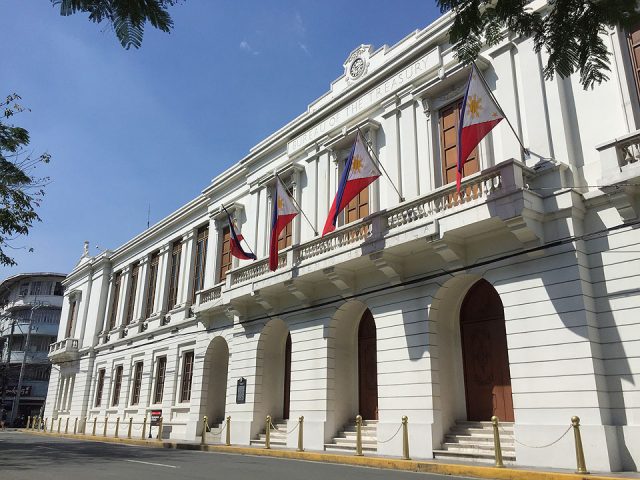
THE GOVERNMENT fully awarded the reissued 20-year Treasury bonds (T-bonds) it offered on Tuesday even as rates rose as market players awaited the US Federal Reserve’s policy decision this week.

The Bureau of the Treasury (BTr) borrowed P20 billion as planned via the reissued 20-year bonds, with total bids reaching P39.511 billion or almost double the amount on offer.

This brought the outstanding volume for the issue to P212.7 billion, the Treasury said in a statement.

The reissued notes, which have a remaining life of 18 years and 10 months, were awarded at an average rate of 6.584%. Accepted yields ranged from 6.5% to 6.62%.

The average rate for the reissued papers went up by 9.8 basis points (bps) from the 6.486% fetched for the series’ last award on May 15 but was still 29.1 bps below the 6.875% coupon for the issue.

This was also 3.4 bps above the 6.55% seen for the same bond series and 1.6 bps higher than the 6.568% quoted for the 20-year paper at the secondary market before Tuesday’s auction, based on the PHP Bloomberg Valuation Service (BVAL) Reference Rates data provided by the BTr.

The government fully awarded its T-bond offer as the result was “well within market expectations,” a trader said in a text message.

“The average awarded rate of 6.584% was [close to] the lower end of the indications (6.55%-6.7%),” the trader said. “The bid-to-cover ratio was decent at 1.98 times the awarded volume.”

“The increase in yield compared to previous auction may have been tracking the upward trend in US Treasury yields overnight. Additionally, the lower demand may be due to the Fed’s meeting this week,” the trader added.

Rizal Commercial Banking Corp. Chief Economist Michael L. Ricafort likewise said in a Viber message that the T-bonds fetched higher rates amid elevated US Treasury yields recently due to lingering fiscal concerns in the world’s largest economy.

Yields on 10-year Treasuries held at 4.408% on Tuesday after having crept higher on Monday as markets braced for another steady decision on interest rates from the Federal Reserve, Reuters reported.

Futures imply a 97% chance the Fed will keep rates at 4.25%-4.5% at its meeting on Wednesday and reiterate concerns that tariffs will push inflation higher in the short term.

Analysts also assume one, or maybe two, Fed officials will dissent in favor of a cut and supporting wagers for a move in September.

The odds could change depending on a slew of US data this week including gross domestic product for the second quarter where growth is seen rebounding to an annualized 2.4%, after a 0.5% contraction in the first quarter.

The central bank has been cautious on rate cuts as officials want to determine the impact of tariffs on inflation before making decisions.

Mr. Ricafort added that T-bond yields climbed ahead of an expected retail Treasury bond offering by the government, which could siphon off some liquidity from the market.

Tuesday’s auction was the last for the month. The government raised a total of P262.1 billion from the domestic market in July, higher than the P250-billion plan, as it fully awarded all its T-bond offers and upsized some awards of Treasury bills (T-bills).

For August, the BTr is looking to raise P220 billion from the local market, or P100 billion via T-bills and P120 billion through T-bonds.

The government borrows from local and foreign sources to help fund its budget deficit, which is capped at P1.56 trillion or 5.5% of gross domestic product this year. — Aaron Michael C. Sy with Reuters