Home Blog Page 1167

White House to target banks as Trump claims discrimination

REUTERS

 – President Donald Trump on Tuesday said he believes that banks, including JPMorgan and Bank of America, discriminate against him and his supporters, as he prepares to act against banks for allegedly dropping customers for political reasons.

Mr. Trump also said the country’s top two lenders had previously rejected his deposits, ramping up his attack on the industry.

“They totally discriminate against, I think, me maybe even more, but they discriminate against many conservatives,” he told CNBC in an interview.

Mr. Trump made the comments when asked about a report by the Wall Street Journal that said he planned to punish banks that discriminated against conservatives, but did not address the order specifically.

The executive order instructs regulators to review banks for “politicized or unlawful debanking” practices, according to a draft reviewed by Reuters. It is likely to be announced on Wednesday, an industry source said.

“They did discriminate,” Mr. Trump said of actions taken by JPMorgan after his first term in office. “I had hundreds of millions, I had many, many accounts loaded up with cash … and they told me, ‘I’m sorry sir, we can’t have you. You have 20 days to get out.'”

Mr. Trump’s latest criticism adds pressure on America’s largest lenders. The order would likely require banks to conduct sweeping reviews of their businesses to comply with regulations.

Mr. Trump said, without providing evidence, that the banks’ refusal to take his deposits indicated that the administration of former President Joe Biden had encouraged regulators to “destroy Trump.”

Mr. Trump said he subsequently tried to deposit funds with BofA and was also refused, and eventually split the cash.

“I ended up going to small banks all over the place,” he said. “I was putting $10 million here, $10 million there, did $5 million, $10 million, $12 million,” he said, without naming the lenders.

“I have them all over the place, the craziest thing, and it’s lucky I even had them. They were doing me a favour, and that’s because the banks discriminated against me very badly, and I was very good to the banks.”

In a statement, JPMorgan did not address the president’s specific claims about his account.

“We don’t close accounts for political reasons, and we agree with President Trump that regulatory change is desperately needed,” JPMorgan said. “We commend the White House for addressing this issue and look forward to working with them to get this right.”

BofA also did not address Mr. Trump’s specific claims.


‘REPUTATIONAL RISK’ ISSUE

During Biden’s administration, regulators were able to scrutinize banks’ decisions on the basis of reputational risks, a second source familiar with the matter said.

Lenders were under intense scrutiny and pressure to weigh reputational risks when dealing with Trump because of his legal woes, a third source said.

JPMorgan continues to have a banking relationship with members of the Trump family that dates back years, and it also banks a number of campaign accounts linked to Trump, the third source said.

After Mr. Trump took power, the Federal Reserve announced in June it was directing its supervisors to no longer consider reputational risk when examining banks, a metric that had been a focus of industry complaints.

The Wall Street Journal reported late Monday that the expected executive order would instruct regulators to investigate whether any financial institutions breach the Equal Credit Opportunity Act, antitrust laws or consumer financial protection laws by dropping customers for political reasons.

The order could authorize monetary penalties, consent decrees or other disciplinary measures against violators, according to the draft.

The White House had no immediate comment on the reported order.

“What the White House is doing is telling the banks not to hide behind regulations to deny loans or banking relationships,” said Wells Fargo bank analyst Mike Mayo. “Banks can use their normal underwriting standards and deny services, but not blame regulators or use reputational risk as a justification.”

BofA said it welcomed the administration’s efforts to clarify the policies.

“We’ve provided detailed proposals and will continue to work with the administration and Congress to improve the regulatory framework,” the bank said.

Mr. Trump in January admonished the CEOs of JPMorgan and BofA for denying services to conservatives. At the time, the two banks denied making banking decisions based on politics.


REGULATORY OVERREACH

Banks have consistently argued that any complaints about “debanking” should be aimed at regulators, as they argue onerous rules and overzealous bank supervisors can discourage them from engaging in certain activities.

“The heart of the problem is regulatory overreach and supervisory discretion,” the Bank Policy Institute, an industry group, said in a statement.

Lenders have held discussions around debanking and weighed scenarios around a potential order, the first source said.

Banks are also hopeful the administration may change anti-money laundering laws that they say are outdated and burdensome, the source added. – Reuters


Three years into war, US and Europe keep billions in trade with Russia

UNSPLASH

Three years after Russian President Vladimir Putin launched his full-scale invasion of Ukraine, the United States and European Union still import billions of euros worth of Russian energy and commodities, ranging from liquefied natural gas to enriched uranium.

India this week lashed out at what it called Western double standards, after facing renewed threats from U.S. President Donald Trump over its surging purchases of Russian crude oil.

Here are the main commercial ties that the U.S., Europe, and India maintain with Russia, and their evolution over the last four years:


A EUROPEAN UNION’S flag flutters outside the European Commission headquarters in Brussels, Belgium, Oct. 15, 2020. — REUTERS

EUROPE IMPORTS FROM RUSSIA

Since the beginning of the war, trade between the EU and Russia has drastically contracted due to EU sanctions and import restrictions on some products. Imports from Russia fell by 86% from the first quarter of 2022 through the first quarter of this year, according to the latest data from Eurostat.

Imports of goods from Russia in the first quarter of 2025 totaled 8.74 billion euros ($10.11 billion), down from 30.58 billion euros four years earlier. Since January 2022, the EU has imported 297 billion euros’ worth of Russian goods.

The EU, however, continues to purchase oil, nickel, natural gas, fertilizer, iron, and steel from Russia.


OIL

Four years ago, Russia was the largest supplier of petroleum products to the EU, but the EU ban on maritime imports of Russian crude oil reduced its share to 2.01% in 2025 from 28.74% in 2021. Oil imports fell to 1.48 billion euros in the first quarter of 2025 from 14.06 billion euros four years ago.


NATURAL GAS

Russia’s share in natural gas plummeted to 17% in the first quarter of 2025 from 48% in 2021’s first quarter.


IRON AND STEEL

Russia’s share in non-EU iron and steel imports slumped to 7.71% in the first quarter of 2025 from 18.28% four years ago.


FERTILIZERS

As for fertilizers, a sector in which the European Parliament voted in May to impose prohibitive tariffs, Russia remained, as of the first quarter of 2025, the largest exporter to the European Union. Its share fell slightly from 28.15% to 25.62% in the last four years.


A WORKER folds an Indian flag at a workshop in India, Aug. 11, 2005. — REUTERS

INDIA IMPORTS FROM RUSSIA

In contrast to Europe, India’s imports from Moscow surged to $65.7 billion in 2024 from $8.25 billion in 2021, data from the Indian Commerce Ministry website showed.


OIL

Crude oil has been the biggest driver of the growth in India’s imports from Russia, jumping to $52.2 billion in 2024 from $2.31 billion in 2021.


COAL PRODUCTS

India’s imports of coal and coal-related products from Russia surged to $3.5 billion from $1.12 billion in 2021.


FERTILIZERS

India’s fertilizer imports from Russia rose to $1.67 billion in 2024 from $483 million in 2021.


JAKOB OWENS-UNSPLASH

U.S. IMPORTS FROM RUSSIA

U.S. imports from Russia fell to $2.50 billion in the first half of 2025 from $14.14 billion four years earlier, according to U.S. Census Bureau and U.S. Bureau of Economic Analysis data. Since January 2022, the U.S. has imported $24.51 billion of Russian goods.


FERTILIZERS

Last year, the U.S. imported around $1.27 billion of Russian fertilizers, up slightly from $1.14 billion in 2021.


URANIUM, PLUTONIUM

The U.S. imported enriched uranium and plutonium from Russia worth around $624 million in 2024, down from $646 million in 2021.


PALLADIUM

Russia exported palladium to the United States for around $878 million in 2024, down from $1.59 billion in 2021. – Reuters

From ingredient costs to sagging demand, tariffs further pinch company earnings

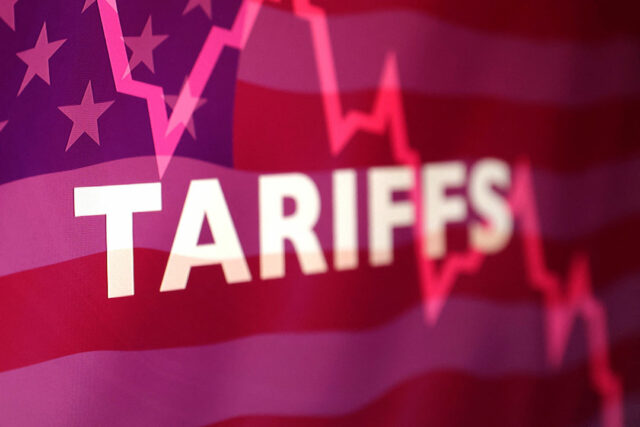
The US flag and the word “tariffs” are seen in this illustration taken on April 4, 2025. — REUTERS/DADO RUVIC/ILLUSTRATION

Companies across the corporate spectrum revealed more pain from the cost of U.S. President Donald Trump’s tariff war, with bellwethers Caterpillar, Marriott and others on Tuesday noting weaker demand and higher prices.

All told, global companies that have reported earnings so far this quarter are looking at a hit of around $15 billion to profits in 2025, Reuters’ global tariff tracker shows.

A majority of these come from industrial, manufacturing and automotive sectors, while financial and tech sectors are less affected.

Mr. Trump has said the tariffs are necessary to resolve U.S. trade imbalances and declining manufacturing power; he has said the levies on imports will bring jobs and investment to the United States.

“I think we’re just getting started,” said Steve Sosnick, chief market analyst at Interactive Brokers in Greenwich, Connecticut. “The tariffs are still in their infancy, especially with major trading partners like Canada, China and India still in flux.”

Tuesday’s round of earnings illustrates the different ways trade policy is affecting companies, from the rising costs of imported materials like metals to the slippage in consumer confidence that has sapped demand.

Caterpillar, for instance, saw a 0.7% hit to revenue, while its cost of goods rose by 6.5%, and CEO Joe Creed told investors that tariffs are “likely to be a more significant headwind to profitability in the second half of 2025.”

Beer maker Molson Coors said it was expecting costs of between $20 million and $35 million in the second half of the year due to a tariff-driven rise in the price of aluminum delivered to the U.S. Midwest.

Tariffs on aluminum shipped into the United States were doubled to 50% in June from the previous 25% duty imposed in March.

White House Spokesman Kush Desai, in a statement to Reuters, said the president’s trade deals “have unlocked unprecedented market access for American exports to economies that in total are worth over $32 trillion with 1.2 billion people.”


MARKET RESILIENCE

The markets, however, have remained resilient even as Trump’s policies continue to change. He said on Tuesday that he would raise tariffs on goods imported from India from the current 25% as part of an ongoing spat with the country over its purchases of oil from Russia.

U.S. equities rebounded sharply from their April lows following what Trump deemed “Liberation Day,” when he unleashed a wave of global tariffs.

The S&P 500 .SPX hit all-time highs last month on the back of strong earnings, led by the so-called Magnificent Seven, a group of tech companies that have benefited from surging investment in artificial intelligence.

Of the 370 companies in the S&P 500 that have reported earnings so far, 80.3% have reported quarterly earnings above analyst estimates, with their earnings growth rate at 11.9%, according to LSEG data.

“We are figuring out that some industries may be affected, but they also might gain because (new) markets are open to them that may have been closed in the past. We’re going to have to have a couple more quarters to see how this actually plays out,” said Kim Forrest, chief investment officer at Bokeh Capital Partners.

Several market strategists of late have warned that a correction could be in the offing, but are broadly optimistic about the market. Evercore ISI analysts believe the market could dip between 7% and 15% in the September-October period as growth slows and inflation increases, though the AI-driven bull rally should continue.

Higher ingredient costs ate into profits of Taco Bell parent Yum Brands, which, like McDonald’s and other fast-food chains, leaned on budget-friendly meal deals to boost demand as U.S. consumers pull back on eating out due to worries about rising costs.

Hotel operator Marriott International cut its 2025 forecast on softening travel demand, while agribusiness giant Archer-Daniels Midland posted its lowest profit in five years.

While some market participants noted that tariff-led uncertainty was likely to persist this year, with over 100 global companies withdrawing or cutting financial guidance, others said in the longer run, companies and investors would be able to see some green shoots.

“It seems that companies themselves are a little more optimistic about the outlook now that the Liberation Day tariffs are in the rearview mirror,” said Ross Mayfield, investment strategy analyst at Baird.

“Companies are going to have to be really deft in how they navigate this (tariffs), but obviously there’s no choice but to pass some of this on to the consumer. We see S&P margins hovering around record highs, and it wouldn’t surprise me if that ticked down a little bit in the coming quarters.” – Reuters

Marcos suspends rice imports for 60 days starting September

PHILIPPINE STAR/KRIZ JOHN ROSALES

By Chloe Mari A. Hufana, Reporter

Philippine President Ferdinand R. Marcos, Jr., on Wednesday announced a 60-day suspension of rice importation beginning on Sept. 1, 2025, in a bid to protect Filipino farmers.

In a statement sent to reporters, Presidential Communications Office Acting Secretary Dave M. Gomez said Mr. Marcos heeded the Department of Agriculture’s recommendation to “protect local farmers reeling from low palay prices during this current harvest season.”

The directive came after consulting with Cabinet members during his state visit to India.

However, Mr. Gomez noted the President said it is not yet time to hike tariffs on imported rice.

“We will still see if we need to resort to that. Right now, the decision is to suspend all rice importation for 60 days beginning Sept. 1,” he added.

The Philippines is the world’s biggest rice importer.

Data from the Bureau of Plant and Industry showed the country had brought in 2.44 million metric tons (MT) of rice as of end-July. The Southeast Asian nation last year imported 4.7 million MT and is expected to import even more this year.

In June, Agriculture Secretary Francisco P. Tiu-Laurel, Jr. told the House of Representatives he had recommended gradually restoring the rice import tariff to its original 35% rate from 15%, which was set under Executive Order No. 62 signed by President Ferdinand R. Marcos, Jr. in June 2024.

The 35% rate, valid until 2028, is subject to review every four months.

Mr. Tiu-Laurel had also advised timing tariff adjustments with harvests in Vietnam and Pakistan — major rice exporters to the Philippines — to mitigate market disruptions.

The debate comes as Philippine inflation slowed to 0.9% in July, the lowest since October 2019, according to data released on Tuesday by the Philippine Statistics Authority.

Food prices dropped, including a 15.9% year-on-year decrease in rice prices, helping ease overall price pressures

High costs and tax policy shifts hurt PHL chips industry, says SEIPI

High power, labor and water costs, along with changes in tax policy under the CREATE law, are posing burdens on the country’s semiconductor and electronics industry, Dr. Danilo C. Lachica, president of the Semiconductor and Electronics Industries in the Philippines, said.

Interview by Edg Adrian Eva
Video editing by Arjale Queral

#SemiconductorIndustry
#ManufacturingChallenges
#EnergyCosts
#CREATELaw
#BusinessWorldPH

Inflation cools further in July to 0.9%

A vendor waits for customers at a stall inside Commonwealth Market in Quezon City. — PHILIPPINE STAR/MIGUEL DE GUZMAN

By Luisa Maria Jacinta C. Jocson, Senior Reporter

HEADLINE INFLATION sharply slowed to a near six-year low in July as utilities and food costs continued to ease, data from the Philippine Statistics Authority (PSA) showed.

The PSA on Tuesday reported that the consumer price index rose 0.9% year on year in July, slower than the 1.4% in June and 4.4% clip a year ago.

This was the lowest inflation in nearly six years or since the 0.6% print posted in October 2019. It also marked the fifth straight month that inflation settled below the central bank’s 2-4% target range.

Inflation rates in the Philippines

The July print was within the Bangko Sentral ng Pilipinas’ (BSP) 0.5%-1.3% forecast for the month, but below the 1.2% median estimate yielded in a BusinessWorld poll of 17 analysts conducted last week.

For the first seven months of the year, inflation averaged 1.7%, a tad higher than the BSP’s 1.6% full-year forecast.

Core inflation, which excludes volatile prices of food and fuel, inched up to 2.3% in July from 2.2% a month prior. In the January-to-July period, core inflation averaged 2.3%.

The BSP in a statement said that the July inflation outturn is well within its forecast.

“Inflation is projected to average below the lower end of the target in 2025, primarily due to the continued easing of rice prices,” it added.

National Statistician Claire Dennis S. Mapa said the deceleration in July inflation was primarily due to the slower annual increase in the housing, water, electricity, gas and other fuels index.

The index eased to 2.1% in July from 3.2% in June, accounting for a 45.1% share to the overall downtrend in inflation.

This as electricity inflation decelerated to 1.3% in July from 7.4% a month ago, even as Manila Electric Co. (Meralco) hiked rates by P0.4883 per kilowatt-hour  during the month.

Liquefied petroleum gas (LPG) also posted 0.7% inflation, slower than the 1.9% clip in June. In July, LPG providers Petron and Solane implemented a price rollback of P1 per kilogram each.

Meanwhile, the heavily weighted food and nonalcoholic beverages index also fell to 0.2% from the 0.4% increase in June.

Inflation of cereal and cereal products further contracted to 11.5% in July from the 10.3% decline a month earlier.

RICE PRICES
Rice inflation continued to remain in the negative, falling to a new all-time low of 15.9% since 1995.

“For the next four months, we will perhaps still be seeing negative inflation for rice. It’s a continuous decline in prices, even in our price per kilogram,” Mr. Mapa added.

The average price of regular milled rice fell by 18.2% to P41.31 per kilogram from P50.90 a year ago. Well-milled rice likewise declined by 14.8% year on year to P47.60 from P55.85, while special rice dropped by 11.8% to P56.83 from P64.42 per kilogram.

Since last year, the government has deployed several measures to tame prices of the staple grain, such as slashing tariffs on rice imports.

However, the Agriculture department this week recommended to President Ferdinand R. Marcos, Jr. a suspension of rice imports and increased tariffs amid declining farmgate prices.

In July 2024, rice tariffs were slashed to 15% from 35% amid spiraling prices at the time. Agriculture Secretary Francisco P. Tiu Laurel, Jr. earlier proposed a phased increase in rice import duties to the original 35%.

Mr. Mapa said the potential increase in tariffs could impact rice inflation moving forward.

“It depends on the timing… when there is an increase in the tariff, there is an implication that there will be an increase in the retail price,” he said, noting that they study how high the tariffs are and the timing of when these will be implemented.

Vegetables, tubers, plantains, cooking bananas and pulses saw a decline to 4.7% from the 2.8% drop in June.

Despite agriculture damage caused by recent weather disturbances, Mr. Mapa said vegetable inflation continued to ease.

“But we saw in the National Capital Region, particularly in the second half of July, there was an adjustment in the rise of certain vegetable items, such as leafy vegetables… We expect this month of August that there may be an upward adjustment in our prices of vegetables, and that may have an impact on our inflation rate,” Mr. Mapa said.

Meanwhile, the contraction in transport inflation worsened to 2% in July from the 1.6% decline in June. This as passenger transport by sea eased sharply to 5.2% from  24.8% the previous month.

Gasoline inflation also fell to 10% from the 8.9% contraction a month ago.

In July, pump price adjustments stood at a net decrease of P1.10 a liter for gasoline and P1.10 a liter for kerosene. On the other hand, it stood at a net increase of P1.20 for diesel.

Inflation within the National Capital Region (NCR) likewise eased to 1.7% in July from 2.6% in June.

Outside NCR, inflation slowed to 0.7% in July from 1.1% in June.

Inflation for the bottom 30% of income households slipped to 0.8% from the 0.4% dip in June. Year-to-date, inflation for the bottom 30% income households averaged 0.5%.

How much did each commodity group contribute to July inflation?

OUTLOOK
The central bank said headline inflation will likely settle within the 2-4% target band from this year until 2027.

“For 2026 and 2027, inflation is expected to trend higher but will remain firmly within the 2-4% target range,” it said.

“Global economic activity is showing signs of deceleration, influenced by uncertainty over US trade policy and ongoing geopolitical conflict in the Middle East. These developments may contribute to slower domestic growth.”

The BSP expects inflation to average 3.4% in 2026 and 3.3% in 2027.

Department of Economy, Planning, and Development (DEPDev) Secretary Arsenio M. Balisacan said overall inflation this year will “remain favorable and supportive of domestic demand.”

“The sustained drop in rice prices and the easing of inflation for low-income households are clear signs that our interventions are working,” he said in a statement.

“This not only helps Filipinos preserve the value of their peso but also builds confidence for businesses and consumers to plan ahead.”

DEPDev also cited data from the Philippine Atmospheric, Geophysical, and Astronomical Services Administration which showed a “relatively favorable climate outlook” from this month until January 2026.

“Nine to 17 tropical cyclones are expected, but the prevailing ENSO (El Niño-Southern Oscillation) neutral condition is likely to support stable agricultural production.”

However, Mr. Balisacan noted the need to “remain vigilant against external risks, including global policy shifts and geopolitical tensions.”

With inflation expected to be well contained, the BSP said a “more accommodative monetary policy stance remains warranted.”

“Emerging risks to inflation from rising geopolitical tensions and external policy uncertainty will require closer monitoring, alongside the continued assessment of the impact of prior monetary policy adjustments,” it said.

Analysts expect inflation to remain within target for the remainder of the year.

“Although we could see an upward trend in inflation going forward due to base effects, we still expect monthly inflation prints to remain below the BSP’s 2-4% target for the rest of the year,” Chinabank Research said in a commentary.

Rice inflation is seen to remain negative for the year due to base effects and continued decline in monthly rice prices, it added.

“However, the impact of favorable base effects may begin to fade by September and inflation could move closer to 3% by yearend,” Bank of the Philippine Islands Lead Economist Emilio S. Neri, Jr. said.

Chinabank said upside risks include adverse weather and the proposals to raise the rice tariff rate and limit rice imports.

“A severe storm affecting agricultural output could lead to faster inflation. Global oil prices may remain stable due to the expected increase in oil supply, but any renewed conflict in the Middle East could trigger a spike,” Mr. Neri said.

RATE CUTS
However, with inflation well below the 2-4% target band, the central bank has more than enough room to deliver more rate cuts, analysts said.

“This benign inflation outlook bodes well for domestic consumption activities, and it supports the case for further monetary easing from the BSP,” Chinabank said.

Mr. Neri said the moderating inflation and dovish signals from the BSP make a rate cut in August “highly probable.”

For its part, Chinabank expects another 25-bp reduction at the Monetary Board’s meeting later this month and another cut in the fourth quarter.

“A downside surprise in gross domestic product (GDP) on Thursday would likely cement the case for a cut,” Mr. Neri said.

The PSA is set to release second-quarter GDP on Aug. 7 (Thursday).

The Philippine economy likely grew 5.5% in the second quarter, according to a median forecast of 17 analysts polled by BusinessWorld. If realized, this would be slower than the 6.5% expansion in the year ago period.

“A September Fed rate cut could pave the way for the BSP to follow with another cut in October,” Mr. Neri said.

The Federal Open Market Committee’s next meeting is scheduled for Sept. 16 to 17.

“Nevertheless, uncertainties continue to cloud the outlook for US monetary policy. Tariffs may not have been fully passed on to US consumers, and a pickup in US inflation could delay Fed easing.”

“In this scenario, the room for another BSP rate cut could narrow. As such, caution is still warranted and it might be too early to fully price in a BSP rate cut in October,” Mr. Neri added.

Treasury raises P210B from retail bonds offered on e-wallet

BW FILE PHOTO

By Aaron Michael C. Sy, Reporter

THE PHILIPPINE GOVERNMENT on Tuesday raised P210 billion from its latest retail Treasury bond (RTB) sale — the third under the Marcos government and the first to accept subscription via an e-wallet.

The Bureau of the Treasury (BTr) said the move is in line with state efforts to attract ordinary Filipinos into investing in government securities.

“This launch is also timely,” Finance Secretary Ralph G. Recto said at the launch, noting that it comes after the enactment of a measure that promotes efficient capital markets.

“It is time for the capital market not only to cater to experts in finance, but also to the Filipino people. And that’s why we are aggressively making our RTBs available and accessible to everyone,” he added.

BTr data released after the rate-setting auction showed tenders hitting P354.175 billion, almost 12 times the P30 billion offered at the first RTB auction this year.

The five-year RTBs fetch a 6% fixed coupon, down slightly from 6.125% in February 2024. Awarded rates ranged from 5.625% to 6%, averaging 5.943%. Interest will be paid quarterly, the BTr said.

Despite the competitive coupon, the RTB yield was slightly above comparable five-year bonds quoted at 5.9519% in the secondary market, based on PHP Bloomberg Valuation rates.

National Treasurer Sharon P. Almanza said the P210 billion raised exceeded the P162 billion take from the previous RTB issuance, with strong oversubscription observed.

“With the launch of RTB 31 (new RTB due 2030), we aim to further strengthen our commitment to financial inclusion by making government securities even more accessible to the public,” she said in a speech, citing the new GBonds platform accessible via GCash.

As of Tuesday morning, the platform had more than 88,000 users and P41 million in transactions. A total of P133 million flowed through online platforms, spread across 1,120 transactions from 6,700 investors.

At a press briefing after the auction, Ms. Almanza said the Treasury aims to raise P300 billion in fresh funding, excluding volume generated through the bond exchange offer program.

‘GAME CHANGER’
“We want to really tap retail investors,” she said. “If we are able to raise P90 billion more in fresh money, it will be a very successful RTB issuance.”

“If increasing the P210 billion to P300 billion and the rest will be retail, that will be a game changer for the Bureau of the Treasury and also for the Department of Finance and for this government, because that means that we really are able to target retail investors,” she added.

Despite ambitious targets, she said the government would not aim to surpass the P584.86 billion record achieved in last year’s RTB issuance.

“Given that we already substantially raised a portion of our requirements during the first half, and we still have several auctions that we will be conducting at the end of the year, we want to spread it out until the end of the year, making sure that investors will have instruments to place not only for RTB 31, but also for the rest of the year,” she added.

Ms. Almanza also pointed to a P300 billion benchmark issuance of 10-year fixed-rate Treasury notes (FXTN) in April, and said the total borrowing requirements for the remainder of 2025 remain under P800 billion, with upcoming auctions planned in September and the last quarter.

The BTr will continue to roll out new benchmark bonds and is preparing a regular swap program for RTBs under the National Registry of Scripless Securities (NROSS) system.

“You can expect another jumbo issuance for next year to establish a new benchmark,” she said. “We want to introduce a regular swap program… making sure… that NROSS will be able to accommodate a regular switch program.”

The RTB issuance excludes bonds for redemption under the exchange program, where roughly P400 billion in maturing RTBs remains eligible. Participation rates for prior swaps have ranged from 15% to 30%, with final allocation decisions left to the Treasury.

Retail Treasury bonds are designed for small investors seeking low-risk, government-backed instruments with higher yields than standard savings accounts.

The public offer period runs from Aug. 5 to 15, while settlement is on Aug. 20. The bonds will mature on Aug. 20, 2030. Holders of certain maturing FXTNs — due September 2025 and February 2026 — may exchange them for the RTBs, with a minimum conversion of P5,000, and repurchase prices from 99.79% to 100.42% of face value.

RTBs will be available in bank branches and digital platforms such as BTr’s Online Ordering Facility, the Bonds.PH app, Land Bank of the Philippines, Overseas Filipino Bank and GCash via GBonds.

The launch aligns with favorable macroeconomic conditions.

“Events unfolded in favor of the BTr,” a trader said, citing supportive inflation and US Treasury yields. “We think they can get close to P500 billion if they wish.”

July inflation was 0.9%, down from 1.4% in June, and well within the 0.5% to 1.3% forecast of the Bangko Sentral ng Pilipinas (BSP). It marked the fifth straight month of inflation staying below the central bank’s 2%-4% target.

Michael L. Ricafort, chief economist at Rizal Commercial Banking Corp., in a Viber message said demand for RTBs could climb further amid anticipated interest rate cuts.

BSP Governor Eli M. Remolona, Jr. has said that rate easing is “on the table” for the Monetary Board meeting on Aug. 28, after two rate cuts earlier this year that lowered the policy rate to 5.25%.

He expects two more cuts before yearend, with remaining Monetary Board sessions set for October and December.

Bank lending jumps to four-month high in June

STOCK PHOTO | Image from Freepik

BANK LENDING rose to a four-month high in June amid a jump in consumer loans, preliminary data from the Bangko Sentral ng Pilipinas (BSP) showed.

Outstanding loans of universal and commercial banks climbed by 12.1% year on year to P13.55 trillion in June from P12.1 trillion in the same period in 2024.

The lending growth was faster than the 11.3% expansion in May and was the highest in four months or since the 12.2% in February.

On a seasonally adjusted basis, big banks’ outstanding loans went up 1.2% month on month.

BSP data showed outstanding loans to residents jumped by 12.6% to P13.23 trillion in June, faster than the 11.8% growth a month prior.

On the other hand, loans to nonresidents declined by 6.4% during the month, although this eased from the 6.6% contraction in May.

Outstanding loans to residents for production activities expanded by an annual 11.1% to P11.49 trillion, faster than the 10.2% growth in May.

Loans for production accounted for the bulk (84.8%) of overall lending.

“Loan growth expanded faster as lending increased for the following key industries: real estate activities (9.9%); electricity, gas, steam and air-conditioning supply (29.2%); financial and insurance activities (12%); and transportation and storage (15.9%).”

Meanwhile, consumer loans climbed by 24% in June, picking up from 23.7% a month ago. Consumer loan data excluded residential real estate loans.

This as credit card loans rose by 29.9%, while loans for motor vehicles jumped by 18.4%. Salary-based general purpose consumption loans increased by 8.3%.

“The BSP monitors bank loans because they are a key transmission channel of monetary policy,” it said.

“Looking ahead, the BSP will ensure that domestic liquidity and bank lending conditions remain consistent with its price and financial stability mandates.”

Rizal Commercial Banking Corp. Chief Economist Michael L. Ricafort said the continued growth in bank lending was supported by the central bank’s rate-cutting cycle.

The BSP has lowered borrowing costs by a total of 125 basis points since it began its rate-cutting cycle in August last year.

Further rate cuts this year could continue to spur loan growth, Mr. Ricafort said.

This would “increase banks’ loanable funds and could also reduce intermediation costs and overall lending rates, thereby further leading to faster loan growth in the coming months.”

Mr. Ricafort said the latest cut in banks’ reserve requirement ratio  also likely increased the loanable funds of banks as it could have infused about P330 billion into the financial system.

“The jump in bank lending reflects sustained demand for credit, likely driven by stronger business sentiment, pre-election spending, and the ongoing rebound in investment activity,” John Paolo R. Rivera, a senior research fellow at the Philippine Institute for Development Studies, said.

MONEY SUPPLY
Meanwhile, domestic liquidity (M3) grew by 6.3% in June, faster than the 5.5% posted in May.

M3 — which is considered as the broadest measure of liquidity in an economy — increased to P18.6 trillion from P17.5 trillion a year earlier. M3 includes currencies in circulation, bank deposits, and other easily liquidated financial assets.

Month on month, M3 went up by 1.2% on a seasonally adjusted basis.

Central bank data showed domestic claims rose by 10.7% during the month, steady from May.

“Claims on the private sector alone grew by 11.3% in June from 10.9% in the previous month, driven by the continued expansion in bank lending to nonfinancial private corporations and households.”

“Net claims on the central government increased by 7.5% from 9.1%, driven by its higher borrowings,” it added.

Meanwhile, growth in net foreign assets (NFA) in peso terms dropped by 1.7% in June, easing from the 4.6% decline a month prior.

“The BSP’s NFA fell by 2.7% primarily due to the peso’s appreciation against the US dollar. Meanwhile, banks’ NFA rose largely on account of larger holdings of foreign currency-denominated debt instruments.”

The central bank said it will continue to “ensure that domestic liquidity conditions remain consistent with the prevailing stance of monetary policy, in line with its price and financial stability objectives.” — Luisa Maria Jacinta C. Jocson

Five Philippine companies now included in Forbes Asia’s ‘Best Under A Billion 2025’ list

REUTERS

FIVE Philippine companies have been included in Forbes Asia’s “Best Under A Billion 2025” list, which recognized the 200 top-performing small- and mid-sized listed companies in the Asia-Pacific region.

The Best Under A Billion list, which started in 2002, highlights 200 publicly listed companies in the Asia-Pacific region with annual sales of over $10 million and below $1 billion.

The five Philippine firms included in the list are holding company A. Soriano Corp. (Anscor); Razon-led mining company Apex Mining Co., Inc.; broadband and technology provider Converge ICT Solutions, Inc.; restaurant operator Figaro Culinary Group, Inc. (FCG); and financial institution Philippine Bank of Communications (PBCOM).

Forbes Asia said the list used the annual results of companies based on the latest available data as of July 7.

Anscor, whose core operating assets include Amanpulo owner Seven Seas Resorts and Leisure and cable and wire manufacturer Phelps Dodge Philippines, posted $82 million in net income in 2024, according to Forbes Asia data. The company’s market value was estimated at $643 million.

Apex Mining posted $254 million in sales, $76 million in net income, and $687 million in market value. The company is engaged in the production of gold, silver, copper, as well as other kinds of ores, metals, and minerals.

Converge, led by businessman Dennis Anthony H. Uy, posted a net income of $189 million and sales of $709 million in 2024.

The broadband giant recorded 2.7 million subscribers in the first quarter and over 710,000 kilometers of fiber-optic assets. It had an estimated market value of $2.33 billion.

FCG, which operates restaurant brands such as Angel’s Pizza and Figaro Coffee, posted an $11-million net income and $97 million in sales in 2024. FCG’s market value was pegged at $65 million.

PBCOM generated $195 million in sales, resulting in $39 million in net income in 2024. Its market value stood at $170 million. The bank had 90 regular branches, four branch-lite units and 166 automated teller machines as of March 31.

From over 19,000 listed companies, Forbes Asia said the companies on the list were selected based on debt, sales, and earnings-per-share growth over both the most recent fiscal one- and three-year periods, and the strongest one- and five-year average returns on equity.

“With trade tensions looming over the Asia-Pacific region, growth is predicted to continue to slow, according to the International Monetary Fund. Despite these challenges, the annual Best Under A Billion list showcases businesses that remained resilient over the past year and, in many cases, thrived,” Forbes Asia said in a statement. — R.M.D.Ochave

ICTSI Q2 profit rises 16% to $244.31M on volume, operational growth

MANILA INTERNATIONAL CONTAINER TERMINAL — MICT.COM.PH

RAZON-LED International Container Terminal Services, Inc. (ICTSI) saw its second-quarter (Q2) attributable net income rise by 15.97% to $244.31 million, driven by sustained earnings across all its port operations.

“We have seen significant growth both operationally, an 11% increase in consolidated volume, and in the value we create for our shareholders, with a 17% increase in diluted earnings per share, demonstrating the resilience of our business and success of our growth strategy,” ICTSI Chairman and President Enrique K. Razon, Jr. said in a statement on Tuesday.

For the three months ending June, the port operator’s gross revenue rose by 11.8% to $764.63 million from $684.03 million in the same period a year ago.

The company’s combined expenses for the second quarter rose to $344.68 million, higher by 12.4% from $306.66 million previously.

The listed global operator recorded an attributable net income of $483.84 million for the January-to-June period, marking an increase of 15.05% from $420.55 million in the same period last year.

For the first semester, ICTSI saw its gross revenues climb by 14.39% to $1.51 billion from $1.32 billion in the same period last year.

Its combined revenue for the period was mainly driven by earnings from its port operations, particularly in Asia, which logged a total revenue of $651.88 million, up by 21.42% from $536.88 million.

Revenues from port operations in the Americas totaled $572.8 million, marking an increase of 6.19% from $539.41 million, while operations from its ports in Europe, the Middle East, and Africa (EMEA) reached $142.02 million, up by 9.78% from $129.37 million in the same period last year.

ICTSI handled a total of 6.99 million twenty-foot equivalent units (TEUs) for the January-to-June period, marking an increase of 10.78% from 6.31 million TEUs in the same period a year ago.

The listed port operator attributed the increase in volume to improved trade activities across all regions, excluding the impact of its Visayas Container Terminal (VCT) and the discontinued Olah Jasa Andal (OJA) operations.

The company said its ports in Asia accounted for the majority of the volume during the period, handling a total of 3.67 million TEUs, followed by the Americas at 1.96 million TEUs, and EMEA at 1.36 million TEUs.

The company’s capital expenditures (capex), which exclude borrowing costs, amounted to $231.98 million for the first half of the year. These were mainly allocated for the expansion of Contecon Manzanillo S.A. (CMSA) in Mexico; the expansion of terminals in the Philippines and ICTSI DR Congo S.A. (IDRC) in the Democratic Republic of Congo; as well as the acquisition of equipment for its terminal upgrades.

ICTSI has set aside a $580-million capex budget for this year, primarily to fund the new project in Batangas, as well as the third-phase expansions of its terminals in Mexico and Manila.

At the stock exchange on Tuesday, shares in the company closed P5, or 1.1% higher, to end at P460 apiece. — Ashley Erika O. Jose

NGCP clears BuhaWind’s 2-GW wind project for grid link

BUHAWIND.COM.PH

BUHAWIND ENERGY Northern Luzon Corp. (BENLC) has secured approval from the National Grid Corp. of the Philippines (NGCP) for the integration of its 2,000-megawatt (MW) North Luzon Offshore Wind Power Project.

In a statement on Tuesday, the company said it received NGCP’s approval for its facilities study, outlining the critical technical requirements necessary for the integration of the wind project into the national grid.

NGCP’s planned 500-kilovolt Burgos Substation, the completion of which is a key prerequisite for the project’s energization, is the designated connection point for the offshore wind project in Ilocos Norte.

BENLC is a joint venture between Yuchengco-led PetroGreen Energy Corp. (PGEC) and Danish firm Copenhagen Energy Group.

“NGCP’s meticulous study and evaluation of the grid connection requirements put BENLC in a stronger position to design and deliver power infrastructure that not only meets the highest technical standards but also contributes meaningfully to the Department of Energy’s agenda of increasing the country’s power supply and accelerating our transition to clean energy,” said PGEC Vice-President for Technical Operations Paul Elmer C. Morala.

To successfully deliver the capacity from its project and ten other offshore wind service projects in northern Philippines, BENLC is awaiting the assessment of the Philippine Ports Authority on the development of the Port of Currimao for offshore wind service operations.

Offshore wind farms need to be serviced from specialized ports hosting maintenance facilities and enabling equipment transport.

BENLC secured the pre-development environmental compliance certificate for the offshore wind project in May. The project was certified as an energy project of national significance by the Department of Energy and was issued a green lane certificate by the Board of Investments.

The northern Luzon wind development is expected to commence commercial operations by mid-2030. — Sheldeen Joy Talavera

Megaworld Q2 profit up 35% on strong core segments

BAYTOWN PALAWAN — MEGAWORLDCORP.COM

LISTED real estate developer Megaworld Corp. saw a 35% increase in its attributable net income for the second quarter (Q2) to P5.6 billion from P4.15 billion last year, on growth across its residential, leasing, and hospitality businesses.

April-to-June revenue climbed by 10% to P22.16 billion from P20.22 billion a year ago, Megaworld said in a regulatory filing on Tuesday.

For the first half, Megaworld grew its attributable net profit by 25% to P10.7 billion from P8.55 billion in the same period last year.

Revenue for the first six months increased by 10% to P43.09 billion from P39.1 billion the prior year.

“What excites us most is the broad-based strength we are seeing — offices, malls, residential, and hotels are all growing. That gives us confidence as we scale further,” Megaworld President and Chief Executive Officer Lourdes T. Gutierrez-Alfonso said.

“We’re pushing forward with more townships, smarter spaces, and deeper integration across our developments, but at the same time, making sure that we build responsibly and sustainably,” she added.

Office leasing revenues by Megaworld Premier Offices increased by almost 18% to P3.7 billion during the second quarter and climbed by 17% to P7.4 billion in the first half of the year, led by the contribution of new assets and leases, as well as sustained rent escalations.

Megaworld Premier Offices closed nearly 100,000 square meters (sq.m.) in new leases during the quarter, driven by expansions from business process outsourcing and multinational companies.

Leasing revenues of Megaworld Lifestyle Malls went up by 9.4% to P1.67 billion in the second quarter and grew by 10% to P3.33 billion in the first half, on growing consumer foot traffic and new leases.

The mall business saw more than 30,000 sq.m. of new tenant openings, as well as new retail spaces at Lucky Chinatown in Binondo.

Hotel revenues rose by 12% to P1.39 billion in the April-to-June period and improved by 19% to P2.81 billion in the first six months, on higher room rates and more room keys compared to the previous year.

In June, Megaworld announced its partnership with global hotel chain Accor to elevate and expand its current hotel portfolio.

Real estate sales grew by 10% to P14.03 billion in the second quarter and increased by 9% to P27.12 billion in the first half, due to residential demand across projects in both Metro Manila and key growth centers in the provinces, along with ongoing project completions.

Key contributors include Uptown Bonifacio, McKinley Hill, McKinley West, Eastwood City, ArcoVia City, Iloilo Business Park, Maple Grove, and The Upper East Bacolod.

Megaworld recently launched its 36th township, the 116-hectare Nascala Coast, in Nasugbu, Batangas.

The P5-billion township, to be developed by Megaworld subsidiary Global-Estate Resorts, Inc., will feature residential villages, beachside condominiums, commercial hubs, as well as leisure and wellness facilities.

Megaworld’s 36 townships cover approximately 7,000 hectares.

The company is on track to launch another township development within the year as part of its continued provincial expansion.

The company also targets growing its office gross leasable area (GLA) to two million sq.m. by 2030, and its retail GLA to one million sq.m. in five years. These targets will bring Megaworld’s total leasing portfolio GLA to three million sq.m. by 2030.

Total assets reached around half a trillion pesos as of end-June.

Megaworld shares rose by 1.01% or two centavos to P2.01 per share on Tuesday. — Revin Mikhael D. Ochave