Home Blog Page 1166

Slower GDP and easing could spur loan growth

REUTERS

By Aaron Michael C. Sy, Reporter

BANKING LOAN GROWTH could quicken as slower-than-expected economic growth in the first quarter puts pressure on the Philippine central bank to hasten its policy easing cycle, analysts said.

“We think that the slower-than-expected GDP (gross domestic product) growth, along with the weak dollar and sustained disinflation, bolsters the case for two to three [or at least 50-basis-point] rate cuts from the Bangko Sentral ng Pilipinas (BSP),” Alfred Benjamin R. Garcia, research head at AP Securities, Inc., said in a Viber message.

The Philippine economy expanded 5.4% last quarter, slightly faster than 5.3% in the previous quarter but slower than 5.9% a year earlier. It was also below the government’s 6-8% target band for the year.

The growth was supported by higher government spending and private consumption, Luis A. Limlingan, head of sales at Regina Capital Development Corp., said in a Viber message.

BSP Governor Eli M. Remolona, Jr. told Bloomberg last week the central bank is open to cutting key rates by 75 basis points (bps) more this year after slower-than-expected April inflation data.

The Monetary Board last month resumed its easing cycle after an unexpected pause in February, cutting benchmark rates by 25 bps to bring the policy rate to 5.5%. Its next meeting is on June 19.

Mr. Garcia noted that while this could support banks’ loan growth, it could also compress their margins. “But overall, we believe that the effect would be net positive for banks.”

In March, bank lending rose 11.8% to P13.19 trillion from a year earlier. This was slower than 12.2% in February and was the slowest since November 2024.

Cristina S. Ulang, head of research at First Metro Investment Corp., expects loan growth to improve despite the below-target economic expansion in the first quarter, citing support from foreign investors.

“Loans will grow as the Philippines cuts a favorable trade and investment deal with the US and the uncertainties are mitigated and investors get clarity on the policy roadmap ahead,” she said.

Net Foreign Direct Investment

NET INFLOWS of foreign direct investments (FDI) dropped sharply in February due to a high base, the Bangko Sentral ng Pilipinas (BSP) said on Monday. Read the full story.

Net Foreign Direct Investment

Mediterranean Blue Diamond could fetch $20 million at auction

SOTHEBYS.COM

A 10-CARAT blue diamond which could fetch $20 million when it goes under the hammer later this month was presented by auction house Sotheby’s in Geneva on Thursday.

The cushion-shaped piece, known as the “Mediterranean Blue Diamond,” was mined in South Africa and displayed a rare color that qualified as fancy vivid blue, Sotheby’s said.

“The market for colored diamonds continues to go from strength to strength,” said Jessica Wyndham of Sotheby’s, adding that she expected a price in the region of $20 million. In 2016, another vivid blue diamond sold for 56.8 million Swiss francs ($68.7 million) at a Christie’s auction in Geneva.

Sotheby’s high jewelry collection, which includes other colored gemstones, was presented to journalists in Geneva ahead of a live auction scheduled for May 13 at the Mandarin Oriental Hotel. — Reuters

Generally peaceful elections may spur PSEi

The lobby of the Philippine Stock Exchange in Taguig City, Sept. 30, 2020. — REUTERS

By Revin Mikhael D. Ochave, Reporter

MARKETS are expected to cheer generally peaceful midterm elections on May 12, and with Philippine President Ferdinand R. Marcos, Jr’s economic policies likely to get a boost from allies in the new Congress, analysts said.

“The Philippine Stock Exchange Index (PSEi) will attempt to approach and break the tough 6,500 resistance if elections prove peaceful,” Cristina S. Ulang, head of research at First Metro Investment Corp., said in a Viber message.

“If peaceful nationwide, the market will cheer the Philippine election’s clarity and resolution, which is a step forward to a new future in terms of political governance and economic advancement,” she said. “If peaceful, this election will set an example in Southeast Asia of the country’s well-functioning democracy.”

Markets were closed on Monday as Filipinos picked a new set of congressmen, 12 of the 24-member Senate and thousands of local officials in midterm elections.

Commission on Elections Chairman George Erwin M. Garcia said there were no major technical issues during the elections.

But there was an attempt to prevent Filipinos from voting in some areas in Datu Odin Sinsuat, Maguindanao del Norte in southern Philippines, he pointed out.

Independent peace monitoring group Climate Conflict Action said there were some areas in the Bangsamoro Autonomous Region in Muslim Mindanao that reported violence and intimidation to prevent people from voting.

It also reported shootouts and brawls at election precincts in Cotabato City, as well as illegal blockades and road control by partisan groups in Lanao del Sur, all in the Mindanao region. There were also convoy ambushes and armed clashes in Basilan province.

Election watchdog National Citizens’ Movement for Free Elections likewise reported voting delays amid high voter turnout due to the lack of voter assistance desks and personnel.

On Friday, the main Philippine Stock Exchange Index rose 1.07% or 68.71 points to 6,458.2, while the broader all-share index added 0.6% or 22.5 points to 3,762.85.

The benchmark index gained 0.72% or 46.34 points from a week earlier.

The Commission on Elections earlier said more than 68 million Filipinos had registered to vote for more than 18,000 national and local positions.

The elections were expected to be battleground for the Marcoses and Dutertes, two of the most influential political dynasties in the country.

“A generally peaceful election outcome will help continue the gains in the PSEi,” Michael L. Ricafort, chief economist at Rizal Commercial Banking Corp., said in a Viber message.

“The administration garnering strong numbers at the House of Representatives and Senate would result in strong support for legislating more economic, fiscal and other reform measures,” he added.

Jarrod Leighton M. Tin, an equity research analyst at DragonFi Securities, Inc., said increased election-related spending should now be reflected in the latest financial reports of listed consumer companies.

“What is most impacted is consumer spending because of elections,” he said in a Viber message. “This should be reflected in the first quarter and second quarter financial results.”

“The market should have priced that (spending) already on consumer names,” he added.

No election failure amid reports of faulty machines and violence

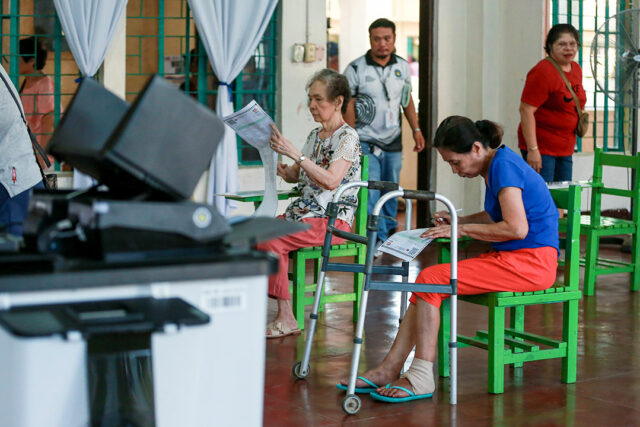
SENIOR CITIZENS and a person with disability (PWD) cast their votes during the early voting period at a polling precinct in an elementary school in Batac City, Ilocos Norte on Monday. — PHILIPPINE STAR/NOEL B. PABALATE

By Chloe Mari A. Hufana, Kenneth Christiane L. Basilio, and Adrian H. Halili, Reporters

THE Commission on Elections (Comelec) said on Monday there was no failure of elections in the 2025 midterm elections despite sweeping issues on faulty automated counting machines (ACMs), disinformation, and tensions in high-risk areas.

Speaking at The Manila Hotel, Chairman George Erwin M. Garcia said an election failure means electoral items did not arrive on time and teachers, who served as electoral board members, did not arrive.

Mr. Garcia dismissed claims that ACMs issued receipts that contradicted voters’ shaded choices, saying there is no evidence to support such allegations. He added that voters may have simply forgotten which candidates they selected.

He said the reported issues will be addressed during the ballot review, noting that the ballots will be manually counted during the random manual audit.

The polls chief said 311 ACMs were replaced but emphasized there were no major issues during the entire day as they have 16,000 spare voting machines.

“So far, we haven’t seen any major technical issues,” Mr. Garcia told reporters in Filipino after he cast his ballot in Indang, Cavite on Monday morning.

The poll chief said the process for an individual who knows who he is voting for can finish voting using the machine in less than three minutes.

As of 2:30 p.m., election watchdog Legal Network for Truthful Elections (LENTE) logged over 60 cases of malfunctions related to ACMs.

Among recurring issues were ballot rejection, scanner cleaning, and jams in the feeding of ballots, and release of voter receipts. Malfunctions were observed in Metro Manila and 20 other provinces.

Earlier, the group said that among the most common problems involved sensitive scanners that frequently rejected ballots. The Electoral Board (EB) had to temporarily pause operations to clean the scanner, resulting in delays and long queues.

Cristian Gaebriel C. Navarro, 24, said he had to push his freelance work for the day after the ACM at his polling precinct in Antipolo City, Rizal malfunctioned for about 20 minutes, disrupting the voting process.

“There was a problem with the voting machine. It lasted for about 15 to 20 minutes,” he told BusinessWorld in an interview after he voted.

“Instead of being able to go home and get to work, it caused a delay.”

Despite enduring nearly two hours in sweltering, humid weather, Mr. Navarro remained determined to cast his ballot, selecting candidates he believes can tackle key issues in the Philippines, including poverty, food security and inadequate school facilities.

“I hope they can create laws that will help many people,” he said.

The election watchdog added that voters have reported discrepancies in their choices versus their voter’s receipts, citing cases in Quezon City, Cainta, Parañaque, and Laguna.

“The Electoral Board failed to inform the voters of their right to challenge the voter’s receipt,” it added.

LENTE said that voters encountering this problem should file an objection, by informing the EB of the discrepancy and then signing the back of the voter’s receipt.

“The electoral board should then attach the contested voter’s receipt in the minutes. This can then be later used as evidence in a subsequent election protest,” the group added.

This led to calls for Comelec to conduct a manual recount of all votes cast in precincts nationwide to address concerns over possible poll rigging linked to discrepancies in ACM software versions.

The poll body should use the results of the manual recount instead of automated vote tallies if inconsistencies arise, the Makabayan said in a statement on Monday.

“We see a lack of transparency throughout the automated election process,” it said in Filipino. “The integrity of the software is questionable, and we continue to receive reports of overvoting, under voting and incorrect vote readings.”

Comelec on Sunday dispelled concerns linked to the difference in software versions, saying the source code used by ACMs is the same hash code as the one checked by independent auditors.

The Philippines first held its automated elections in 2010 after former President Gloria Macapagal-Arroyo signed in 2007 a law mandating the country to make use of automated election systems.

“We have always maintained that automation without transparency is a threat to democracy,” Roland G. Simbulan, chairman of the Center for People Empowerment in Governance, said in a separate statement.

“The recurring failures of ACMs – especially during the most critical hours of voting – should compel Comelec to seriously consider restoring manual counting at the precinct level where the votes are cast and witnessed,” he added.

VIOLENCE AND INTIMIDATION
Mr. Garcia also said this year’s election recorded the lowest red category area, compared to the last two polls.

“We have the lowest red category areas this year with 34. Compared to 2019 and 2022, this is the lowest,” he said in Filipino. “An election marred by violence, to us, is not acceptable.”

Earlier in the day, Mr. Garcia said there are attempts in some areas in Datu Odin Sinsuat in Maguindanao del Norte to prevent Filipinos from voting. He said Comelec had already alerted the police in the area.

“At least, there haven’t been any gunfights or actual violence, but the attempts to stop them are more about intimidation, and that kind of intimidation should not be happening in any part of our ballot process,” he added.

“There is only one thing we strongly emphasize: there must be no failure of election in any part of our country, in any precinct, in any village. At all costs, the election must proceed. At all costs, our fellow citizens must be able to vote.”

Climate Conflict Action (CCA), an organization monitoring conflict and violence, reported on Monday that some areas in the Bangsamoro Autonomous Region in Muslim Mindanao (BARMM) faced violence and intimidation to prevent voters from exercising their civic duty.

It has so far documented 239 deaths across the region since the filing of candidacy in October 2024. Of this, 21 occurred since May 1, including 5 on election day.

“Maguindanao del Sur remains the deadliest hotspot since October, with incidents and tensions most recently concentrated in Buluan, Shariff Aguak, Pandag, and Rajah Buayan,” it said in its Boto Bangsamoro 12 noon report.

The CCA said Datu Sinsuat remains “virtually under siege,” citing cases of incomplete ballot deliveries, barricades by supporters of the United Bangsamoro Justice Party (UBJP), and postponement of voting.

It also noted riots, wooden-club arrests, and vote-tampering by a barangay official in Cotabato City. There have also been repeated ACM malfunctions and flying-voter clashes in Special Geographic Areas (SGAs).

Lanao del Sur experienced fatal shootings of candidates and supporters allied with UBJP, and stone-throwing at polling sites; while Basilan saw fatal ambushes and firefighting. Sulu and Tawi-Tawi reported politically charged fistfights among rival supporters.
“Across all these areas, armed coercion, intimidation, and logistical breakdowns continue to threaten safe, free, and fair voting,” it said.

“As ballots are cast, voters face the stark choice between exercising their right to vote and preserving their personal safety.”

MORE ELECTION WOES
In a separate report, the National Citizens’ Movement for Free Elections (NAMFREL) said that the high voter turnout had caused delays in voting due to the lack of voter assistance desks (VAD) and personnel to meet demand.

“Problem arise depending on the turnout in the few hours of operation in voting centers, where observers noted high voter turnout,” NAMFREL Chairperson Angel S. Averia, Jr. said in a media briefing on Monday.

He added that NAMFREL observers reported overcrowding in VAD, lack of VAD volunteers to meet demand, a shortage of chairs for the vulnerable sector to use. This is even as NAMFREL observers noted the presence of VADs in more than 93% of voting centers observed.

Ma. Teresa C. Buhay, 69, a first-time voter at the Cong. Reynaldo Calalay Memorial Elementary School in Quezon City said that she had to wait for nearly an hour before she got her ballot despite being in the senior citizen and priority lane in her precinct.

“The teachers told me I had to stay in the priority voting area, but it’s been almost an hour, and my ballot still hasn’t arrived. They told me that my ballot was upstairs in my designated precinct, so they had to get it,” Ms. Buhay told BusinessWorld in Filipino.

“I waited for a long time, but couldn’t wait any longer, so I just walked up to the third floor to vote in my designated room,” she added.

“There were a lot of us in line earlier, some of them were in wheelchairs and couldn’t walk. We had to sit there for some time, and it was hot,” she said, noting there seems to be a shortage of people assisting those in the priority area.

Zenaida A. Constantino, 63, lined up as early as 6 a.m., but had yet to cast her vote when BusinessWorld spoke to her at around 8 a.m. at Silanganan Elementary School.

“They said they still had to get the ballot somewhere. Why isn’t the ballot ready?” she said in Filipino.

Marie Christine Apostor, the EB chairperson at the time, explained that senior citizens were indeed given priority; but some had arrived earlier than others, and with limited seating in the holding area, the rest had to wait in line.

Voters started lining up outside of polling places before the early voting period, which ran from 5 a.m. to 7 a.m., especially in urban areas.

“NAMFREL observers noted high voter turnout in more than 83% of voting centers observed,” Mr. Averia said, citing its 11:30 a.m. report.

Observers have also reported that the early voting period started late in some voting centers, with regular voters being let in despite a queue forming for members of the vulnerable sector.

He added that a large chunk of time spent by voters was used to determine whether they are on the voter list, trying to find their precinct number, and trying to locate their polling place.

He said that these should be information voters could have already obtained, or have been provided to them, prior to election day.

“Despite the high demand for voter assistance, observers cited the importance and usefulness of Voter Assistance Desks and onsite volunteers in facilitating the conduct of the voting process,” Mr. Averia added.

Meanwhile, LENTE said that they have received confirmed reports of vote buying, unlawful electioneering, unlawful entry, and illegal assistors across various provinces.

“The majority of vote-buying incidents involved direct cash handouts and promises of further payments in specific locations, often accompanied by the distribution of sample ballots,” the election watchdog said.

It added that illegal assistance by watchers and marshals are being reported across the country.

“The only people allowed to assist voters are relatives within the 4th civil degree of consanguinity or affinity, a household member of the voter who is a person of their confidence, or any member of the EB,” LENTE said.

Moreover, the group said that some candidates have not complied with Comelec’s requirement to remove campaign materials after May 10.

“These materials should already have been taken down. More critically, these posters are positioned close to voting centers, which constitute unlawful electioneering,” it added.

The watchdog group also said that vulnerable voters were being forced to vote within Priority Polling Places of their voting centers, as of early-Monday.

“It must be remembered that vulnerable sector voters have the option whether or not to avail of the privilege of voting at the PPPs, and they may choose to vote at the Regular Polling Place where an express lane should be provided for them,” LENTE added.

MISSING NAMES
Some residents of Barangay 176, Bagong Silang in Caloocan City have also reported that their names were missing from the voter list, speculating that it might be due to their absence in a plebiscite held last year.

“My name is not on the list… because I wasn’t able to vote in the plebiscite,” Richard, who declined to provide his surname, told BusinessWorld in Filipino after filing a complaint with a Department of Education Supervisor Official (DESO) at Bagong Silang Elementary School.

He said his name should still be on the voter list since he voted in the 2022 presidential elections and only missed the 2023 barangay elections.

Richard and two others who spoke to BusinessWorld speculated that their names may have been removed from the voter list due to their absence during the 2024 plebiscite in the said Barangay.

The plebiscite, held in August of that year, sought public approval for dividing the country’s largest barangay into six smaller units—Barangays 176-A to 176-F.   

A total of 25,345 residents voted “yes” to the proposal, while more than 2,580 voted “no.”

In a Viber message, election expert Luie Tito Guia said that a plebiscite is not considered a regular election, so missing it should not count toward the two consecutive missed elections that may lead to voter deactivation.

“The law states that the registration of a voter who failed to vote in two successive elections will be deactivated,” Mr. Guia said.   

“Thus, those who voted in either the 2022 national elections or the 2023 barangay elections, or in both, should be able to vote, even if they were not able to vote in a plebiscite held in between,” he added.

Richard said he was advised, along with his companions, to visit the Comelec office at Caloocan City Hall to address their concerns.

However, he felt that doing so was an added inconvenience for them.

Comelec did not immediately respond to a Viber message seeking comment. — with Edg Adrian A. Eva

Philippine Navy deploys warships off Mindanao coast for poll operations

PHILIPPINE STAR/EDD GUMBAN

THE Philippine Navy deployed three warships near western Mindanao, aiming to establish a strategic presence and deter potential threats that could disrupt peace amid the country’s elections.

In a statement late Sunday, it said three coastal patrol boats, including one carrying elite troops, conducted maritime security operations along the coast of a southern Philippine island.

“The deployment also highlights the Navy’s crucial role in enhancing mobility and providing logistical support, particularly in geographically isolated and disadvantaged areas,” it said.

“Given the region’s complex security environment, the strategic presence of naval assets significantly bolsters the AFP’s (Armed Forces of the Philippines) capacity to deter threats and preserve peace during the election period,” it added.

Elections in the southern Philippines are often marred by violence due to the presence of local political families in the region grappling for influence during poll campaigns in an attempt to remain in power.

Meanwhile, the Philippine Coast Guard (PCG) on Monday said it deployed a high-speed response boat in Masbate province to help local authorities respond to election-related issues that may arise during the polls.

The coast guard’s Bicol province detachment said it will hold maritime patrols within its locality to help address “any acts of violence” and to help in peacekeeping by rapidly responding to security issues. — Kenneth Christiane L. Basilio

Marcos could retain House control after midterm vote

PHILIPPINE STAR/KJ ROSALES

By Kenneth Christiane L. Basilio, Reporter

THE Marcos administration will likely maintain control over the House of Representatives after the Philippine midterm elections, with admin-endorsed candidates benefiting from access to established political machinery, political analysts said on Monday.

But congressional support for President Ferdinand R. Marcos, Jr. could erode over time due to his waning approval ratings, potentially leading to shifts in political alliances that could derail his legislative agenda.

“They possess an advantage over their opponents because they are the incumbent, they have more resources and they have the machinery,” Dennis C. Coronacion, who heads the University of Sto. Tomas Political Science Department, said in a Facebook Messenger chat.

The House has traditionally remained under the influence of the President, with congressmen often aligning with the policies of the sitting leader.

Filipinos on Monday casted their votes to fill all 318 seats in the legislative chamber, a dozen seats in the 24-member Senate, and thousands of local posts.

“Whatever the results of the midterm elections might be, if Mr. Marcos’ popularity keeps on falling while Vice-President Sara Duterte’s keeps on rising, then it would be difficult to form coalitions that can back up a legislative agenda,” Anthony Lawrence A. Borja, an associate political science professor at the De La Salle University, said via Facebook chat.

Mr. Marcos’ public approval rating fell to a record in March while Ms. Duterte’s rating hit an all-time high, according to a Pulse Asia Research, Inc. poll results in April.

“If the House will still be dominated by Marcos allies, the legislative agenda of the administration will be supported at the House level,” Maria Ela L. Atienza, a political science professor at the University of the Philippines, said via Viber.

“However, a more fragmented House composition will lead to failure to push the administration’s legislative agenda,” she added.

House Speaker Ferdinand Martin G. Romualdez in early May said the chamber would focus on passing bills seeking to boost job creation and support small businesses, while also looking at modernizing the agriculture sector when the next Congress convenes.

DUTERTE CHALLENGE
Some lawmakers are expected to realign with the Duterte camp when the House convenes for the first regular session of the 20th Congress, with Mr. Romualdez’s grip on the chamber likely to be challenged by someone from the Duterte camp, said Arjan P. Aguirre, who teaches political science at the Ateneo de Manila University.

“Some of them will start to side with the Dutertes for the second half of the Marcos regime,” he said via Facebook chat. “Expect that membership of administration political parties to start dwindling due to party switching, which could happen as early as before the State of the Nation Address in July.”

“Congressmen are always siding with the winnable presidential candidate years before the next presidential election,” he added.

Ms. Duterte had emerged as a frontrunner for the 2028 presidential election, setting the stage for a challenge against the Marcos clan amid a political feud that resulted in her impeachment. However, she faces a Senate trial in June, where a ruling could potentially bar her from holding public office permanently, casting uncertainty over her presidential ambitions.

“This midterm election is meant to consolidate the control of the Dutertes, to make sure she does not get impeached, to rally their supporters and secure the presidency,” said Mr. Aguirre.

The May election carries significant political stakes following the collapse of the once-solid alliance between the Marcos and Duterte families, which escalated into a bitter feud last year.

“Unfortunately, it was reduced to a mere extension of the political squabbling between the two factions,” Mr. Aguirre said. “We did not talk about more important issues or policies to be prioritized in the next Congress.”

“Our attention was forced to be focused on the mudslinging and excessive politicking brought by the impeachment and ICC (International Criminal Court) arrest of Mr. Duterte,” he added.

BuCor: Over 4,000 prisoners voted

COMELEC

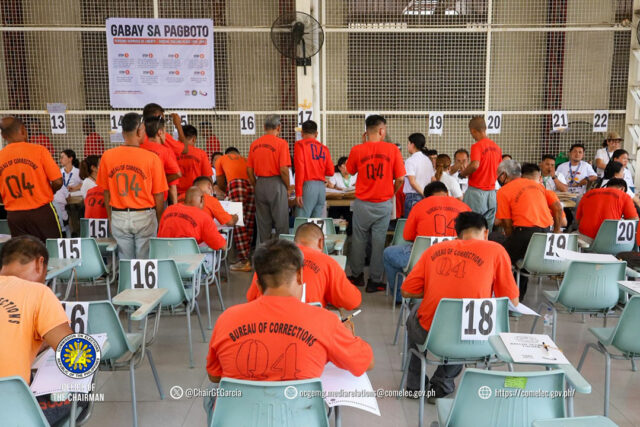
MORE than 4,000 prisoners across several facilities under the Bureau of Corrections (BuCor) cast their ballots for the midterm polls on Monday.

BuCor told reporters in a Viber chat that 4,125 prisoners were registered for this year’s polls.

The country’s national penitentiary, New Bilibid Prison in Muntinlupa City, had the highest number of registered voters at 2,135, including 473 inactive voters.

Other correctional facilities with registered voters included the Davao Prison and Penal Farm (924), the Leyte Regional Prison (421), and the San Ramon Prison and Penal Farm in Zamboanga del Sur (290).

Additionally, 140 prisoners from the Iwahig Prison and Penal Farm in Puerto Princesa, Palawan, were registered, alongside 123 from the Correctional Institution for Women (CIW) in Mandaluyong City and 92 from CIW-Mindanao.

“As long as their case hasn’t been finalized, as long as their case is under appeal or still being heard, they are allowed to vote,” Chairman George Erwin M. Garcia told reporters in Filipino when he visited New Bilibid Prison on Monday.

“All of their ballots will later be brought to the various precincts where they are actually registered voters. There, the ballots will be fed and entered into the machines.”

He added the law provides that a person retains his right to vote until there is a final judgment of conviction. — Chloe Mari A. Hufana

Gov’t eyes 1,600 new houses in Iloilo

DHSUD.GOV.PH

THE Department of Human Settlements and Urban Development (DHSUD) broke ground for its latest housing project in Iloilo City, which is expected to deliver more than 1,600 new units by 2030.

A total of 13 ten-storey buildings will be constructed under the Uswag 4PH Condominium Complex, which will be located in Barangay San Isidro, Jaro in Iloilo City.

The project will be constructed through a public-private partnership project with the Eon Realty and Development Corp., an Iloilo-based real estate developer. It will be completed by 2030, DHSUD said.

Each building is expected to have 129 units, with sizes ranging from 24 to 27 square meters.

In Uswag 4PH, a one-bedroom unit will cost P1.53 million, while a two-bedroom unit will be priced at P1.71 million.

The development will include amenities, such as a playground, basketball court, and swimming pool. It will also provide commercial spaces, a centralized sewage treatment plant, and solar streetlights.

Uswag 4PH will also house a materials recovery facility to support dignified and sustainable urban living for the locals, especially low-income earners and informal settler families.

The project is expected to provide equal opportunities to locals, Iloilo City Mayor Geromino P. Treñas said during the groundbreaking ceremony on May 9.

Under the Pambansang Pabahay Para sa Pilipino (4PH) housing program, the Marcos government aims to construct 3.2 million housing units by 2028.

The flagship housing program seeks to provide low-cost houses for the poor, with units costing around P1.6 million to P1.8 million. — Beatriz Marie D. Cruz

Lanao del Sur bet killed in ambush

COTABATO CITY — Gunmen killed a candidate for councilor and his sibling, who is an incumbent barangay chairman, while on their way to a polling site in Bayang, Lanao del Sur on Monday morning.

The fatalities, Afganie Balt Taha, aspiring for a seat in the municipal council of Bayang, and his brother, Walid, chairman of Barangay Sumbag in the municipality, are from a big Maranao clan that has elders who are locked in deep-seated political animosity with other politicians in Lanao del Sur.

Officials of the Lanao del Sur Provincial Police Office and Brig. Gen. Romeo Juan Macapaz, director of the Police Regional Office-Bangsamoro Autonomous Region, separately told reporters that the victims were on their way to a pooling precinct at the Mauyag Papandayan National High School in Barangay Rinabor in Bayang when they were attacked by gunmen positioned along the route.

They were both declared dead on arrival at a hospital where they were brought for treatment.

Relatives of the Taha siblings had told reporters that they are certain that the atrocity was perpetrated by political adversaries. — John Felix M. Unson

Cop, 4 others hurt in Cotabato clash

COTABATO CITY — Four civilians and a policeman were hurt in a shootout involving supporters of two rival political quarters in Barangay Rosary Heights 10 in this city on Sunday night.

Senior officials of the Army’s 6th Infantry Division and the Police Regional Office-Bangsamoro Autonomous Region told reporters on Monday morning that the incident left Corporal Deniel G. Gabucayan of the Cotabato City Police Mobile Force Company-Cotabato City Police Office and four individuals wounded.

The injured Mr. Gabucayan, Jomar K. Salik, Johaita S. Kanakan, Dennis D. Mamalangkay and Jomar M. Maton were all immediately brought to a hospital by policemen and government emergency responders for treatment.

Lt. Col. Roden R. Orbon, spokesman of the Army’s 6th Infantry Division, and Col. Jibin M. Bongcayao, Cotabato City police director, had separately told reporters that personnel of the Marine Battalion Landing Team-5 and policemen detained more than 30 male suspects reportedly involved in the gunfight.

Barangay officials and villagers had said that the two groups are identified with each of two regional political parties that pitted candidates for elective positions in Cotabato City. — John Felix M. Unson

Funding seen sufficient for expanded P20 rice rollout

PHILIPPINE STAR/WALTER BOLLOZOS

THE Department of Agriculture (DA) said the P20-per-kilo rice program will be offered in more regions, with funding and rice inventories deemed sufficient to support such an expansion.

The DA announced the start of selling of P20-per-kilo rice in government-subsidized minimarkets, known as Kadiwa stores, on May 13. The launch had been pushed back from May 1 to comply with the ban on government spending during the elections.

“While the program initially focused on the Visayas, a review of the DA’s budget and NFA stocks has revealed that it can now be extended to other regions, including Metro Manila and neighboring provinces, through KADIWA centers and local government units involved in the national food crisis emergency initiative,” the DA said.

The program had been initially scheduled for a six-month pilot in the Visayas.

The DA said 12 Kadiwa markets in Metro Manila will begin offering P20 rice on Wednesday, followed by 32 more sites in Bulacan, Cavite, Laguna, Mindoro, and Rizal by May 15.

LGUs will share the P13-per-kilo subsidy for the rice with Food Terminal, Inc. Eligibility of beneficiaries will be determined by the LGUs.

Vulnerable groups — including solo parents, persons with disabilities, senior citizens, and beneficiaries of the government’s 4Ps program — will have access to the P20 rice at KADIWA centers.

“With the expanded area covered by the pilot run, the DA has decided to adjust the monthly limit to 30 kilos per household — the same level set for the KADIWA P20 rice program,” the DA said.

The pilot test is expected to serve as many as two million households — or 10 million individuals — until December.

The DA said the program also seeks to clear out stock buildup in National Food Authority (NFA) warehouses to pave the way for more grain procurement from farmers. — Kyle Aristophere T. Atienza