Home Blog Page 1161

BTr hikes T-bill award as rates drop on BSP bets

THE GOVERNMENT upsized its award of the Treasury bills it offered on Monday as rates dropped across the board following dovish signals from the Bangko Sentral ng Pilipinas (BSP).

The Bureau of the Treasury (BTr) raised P28.6 billion from the T-bills it auctioned off on Monday, higher than the P25-billion plan, as total bids reached P84.255 billion, more than thrice the amount on offer and also higher than the P78.388 billion in tenders recorded on May 19.

The oversubscription prompted the auction committee to double its acceptance of non-competitive bids for the 364-day T-bills to P7.2 billion, the BTr said in a statement.

Broken down, the Treasury borrowed the programmed P8 billion via the 91-day T-bills on Monday as tenders for the tenor reached P25.565 billion. The three-month paper was quoted at an average rate of 5.468%, 4.7 basis points (bps) lower than the 5.515% seen in the previous auction. Tenders accepted by the BTr carried yields of 5.444% to 5.497%.

The government likewise made a full P8-billion award of the 182-day securities it auctioned off as bids for the paper amounted to P30.275 billion. The average rate of the six-month T-bill was at 5.551%, 6.1 bps below the 5.612% fetched last week, with accepted rates ranging from 5.508% to 5.6%.

Lastly, the Treasury raised P12.6 billion via the 364-day debt papers, higher than the P9-billion program, as demand for the tenor totaled P28.415 billion. The average rate of the one-year T-bill slipped by 0.8 bp to 5.694% from 5.702% previously, with bids accepted having yields of 5.65% to 5.704%.

At the secondary market before Monday’s auction, the 91-, 182-, and 364-day T-bills were quoted at 5.4551%, 5.6098%, and 5.7398%, respectively, based on the PHP Bloomberg Valuation Service Reference Rates data provided by the Treasury.

The BTr said it made a full award of its T-bill offer as the average rates fetched for all tenors were all lower than the levels seen at the previous week’s auction.

“It looks like the recent announcement from BSP that they are confident about future rate cuts did wonders for today’s auction. This resulted in strong bids and the eventual full award, including the additional award for one-year bills,” a trader said in a text message.

Rizal Commercial Banking Corp., Chief Economist Michael L. Ricafort likewise said in a Viber message that T-bill rates eased following the latest rate cut signals from BSP Governor Eli M. Remolona, Jr.

On Friday, Mr. Remolona said that the Monetary Board could deliver two more 25-bp cuts this year, with the next reduction on the table as early as next month.

The BSP chief said easing inflation gives them “plenty of room” to ease their policy stance further, although they don’t want to cut “too much” as this could stoke prices anew. 

In April, the Monetary Board cut benchmark interest rates by 25 bps to bring the policy rate to 5.5%. It has now reduced borrowing costs by a cumulative 100 bps since beginning its easing cycle in August last year.

There are four remaining Monetary Board policy meetings this year scheduled for June, August, October and December.

On Tuesday, the government will offer P30 billion in reissued 20-year Treasury bonds (T-bonds) with a remaining life of 13 years and eight months.

The Treasury is looking to raise P260 billion from the domestic market this month, or P100 billion via T-bills and P160 billion through T-bonds.

The government borrows from local and foreign sources to help fund its budget deficit, which is capped at P1.54 trillion or 5.3% of gross domestic product this year. — Aaron Michael C. Sy

SEC flags two online lenders for alleged violations

BW FILE PHOTO

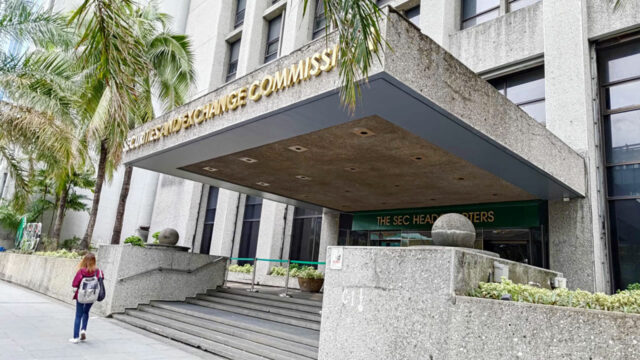
THE Securities and Exchange Commission (SEC) has taken action against two online lending firms for alleged violations of regulatory requirements, including noncompliance with disclosure rules and concerns raised by borrowers.

In an order dated May 13, the SEC Financing and Lending Companies and Valuation Department (FinLenD) issued a cease-and-desist order against Hupan Lending Technology, Inc. for operating an unrecorded online lending platform (OLP) called Magic Peso.

The SEC-FinLenD directed the company to halt operations of Magic Peso and its declared OLPs — Cashme, Sukiloan, Pesopoly, and Loan Tayo.

The regulator said the directive followed complaints from borrowers who claimed to have experienced abusive collection practices linked to Magic Peso.

According to the SEC, the platform’s continued operations violated a moratorium on new OLPs under SEC Memorandum Circular No. 10, Series of 2021.

“The SEC views the issuance of the cease-and-desist order as necessary to prevent fraud, injury, or harm to the public and financial consumers who are using Magic Peso,” it said.

In a separate order dated May 13, the SEC-FinLenD revoked the lending license of Hi-Fin Lending, Inc. for its failure to disclose WeWill Tech Corp. as one of its third-party service providers (TPSPs).

The SEC also canceled Hi-Fin Lending’s certificate of authority to operate as a lending company, along with its primary registration.

Hi-Fin Lending operates the online lending platforms Peso Wallet and Credit Cash.

On Jan. 31, the National Bureau of Investigation and the Presidential Anti-Organized Crime Commission conducted a raid on the premises of WeWill Tech as part of an investigation into complaints involving online lending platforms.

Authorities said the company served as a collection agent for Hi-Fin Lending.

The SEC said Hi-Fin Lending failed to meet the requirement for financing and lending companies to submit a list of TPSPs, as required under Republic Act No. 11765 or the Financial Products and Services Consumer Protection Act. — Revin Mikhael D. Ochave

Follow the mango, not the money

WIKIPEDIA.COM

By John Authers

WHATEVER happens, the global shipping lanes will still be active. Trade must continue. To use US Commerce Secretary Howard Lutnick’s favorite analogy, the US can never produce its own mangoes; it will keep importing them, and shouldn’t slap on tariffs that would only make them more expensive for Americans.

Lutnick isn’t the only one with a financial mango analogy. The British novelist John Lanchester, who became an avid student of economics during the Global Financial Crisis, has used them to denounce contemporary financialized capitalism. He offers this example of a farmer who will soon harvest his fruit:

“Because it’s helpful to get the money now and not later, you sell the future ownership of the mango crop to a broker, for a dollar a crate. The broker immediately sells the rights to the crop to a dealer who’s heard a rumor that thanks to bad weather mangoes are going to be scarce and therefore extra valuable, so he pays $1.10 a crate. A speculator on international commodity markets hears about the rumor and buys the future crop from him for $1.20…”

Lanchester then details deals involving a momentum trader, a contrarian trader, and short sellers, who take the price up to $1.30 and then down to 90 cents before the mangoes are harvested and shipped for a dollar a crate. His point is that the fruit can spark huge financial activity that creates no value. But while this is true, there are also transactions that are vital if trade in mangoes is to continue. And therein lies the problem.

Put the analogies together, and you can conclude that the mango trade is bound to continue, and even Lutnick says this will be without tariffs, but that it would be easy to halt the financial flows around them. For all of this year’s worries that global trade will dry up, the risk that capital flows will be thwarted is much greater.

This isn’t just about the edifice of derivative bets. Capital is the fuel for the capitalist economy, and it can be diverted at the stroke of a pen.

AUTARKY
Even before the trade war erupted, the anti-globalization backlash was well underway as countries moved toward national self-sufficiency, or what economists call autarky. Total self-sufficiency in goods cannot happen (assuming Americans can’t do without mangoes) but an autarky in capital — “national capitalism” or “capitalism in one country” — is already taking shape.

“I don’t think autarky in goods is possible,” says Julian Brigden of MI2 Partners. “The rush to negotiate deals shows that people want to preserve the global trading system. The greater risk is that you end up with financial Balkanization.”

The concept has deep roots, and both left and right have profound problems with it. “The reactionary tendencies of autarky,” Trotsky wrote a century ago, “are a defense reflex of senile capitalism to the task with which history confronts it.” Followers of Hayek denounce autarky for undermining economic freedom and democracy. Hayekians and Trotskyites alike have a point: If kept rigidly within national borders, neither capitalism nor socialism can flourish.

And yet some of the world’s most enthusiastic globalists are embracing self-sufficiency. French President Emmanuel Macron made a speech last year provocatively titled, “Europe: It Can Die.” To prevent that, he argued for the continent to be more self-reliant. Beyond defense, the European Union needed “dedicated financing strategies” for crucial sectors, including AI, quantum computing, space, and biotechnology.

“To do this, we need the right instruments,” he said. “This means we need to define, we need to invest in these sectors, and we need to act together.” In other words, governments need to force European finance to pour capital into those strategic efforts.

FINANCIAL REPRESSION
Countries have steered private capital this way in the past, and the institutionalization of finance makes it ever easier. Brigden draws an analogy with the period from the Second World War until the 1980s. “Governments were fighting tooth and nail to maintain solvency and so had to put in place all these rules to enforce Balkanization — exchange controls, capital controls, price and income policies. A return to that world is entirely possible, and it could happen out of necessity.”

Now, as then, governments have massive debt loads. Critical to paying down the debts from the war was financial repression — manipulation of laws and regulations to oblige low bond yields. Or, less kindly, to force people to lend to the state at preferential rates. This was arguably less painful than the alternatives of default or runaway inflation.

Unlike trade, capital flows can be shut off easily, because capital is corralled. After the war, about 90% of the New York Stock Exchange’s value was held by individuals on their own account. Now it’s dominated by institutions. Financial historian Russell Napier says: “The regulatory state is more powerful than fiscal or monetary policy. When capital is in the hands of capital institutions, not individuals, you can control it with regulation.”

The total assets held by mutual funds in the US have risen to $22 trillion now from $570 billion in 1990, mostly concentrated in the hands of a few huge players. Regulators can push these firms around easily, without provoking anything like the fuss that comes with other nationalistic moves, such as barring Harvard University from recruiting foreign students. Repeated skirmishes between politicians and BlackRock, the biggest US fund manager, have created much less of a stir.

Across the world, governments are moving to ensure that they have control over their biggest pools of capital. Last year, Canberra changed the mandate of The Future Fund of Australia, which backs public sector pensions, so that it’s now expected to address “national priorities” led by infrastructure and housing, and the energy transition. The Canadian province of Alberta fired the entire board of directors of its own pension fund in what was labeled by one academic as a “government takeover” of assets belonging to retirees.

WINNERS AND LOSERS
As capital returns home, there will be winners and losers. Britain has much to gain, as it has been the greatest loser from regulatory inertia. In 1990, British pension funds and insurance companies owned 54% of the country’s publicly quoted equities. Three decades later, that number had dropped to only 7%. Bankers complain that there are not enough local investors who understand the British market for small companies to go public.

Michael Tory, the Canadian financier who heads Ondra LLP in London, denounces “decades of policy negligence regarding the deployment of the nation’s savings.” Two decades ago, regulators were alarmed by the risk that pension funds might not be able to make good on their guarantees to pensioners, and took steps to ensure that they had enough assets to cover commitments. Inadvertently, that forced them to sell their UK holdings and channel money into the much deeper US market. This helped savers, but it starved the UK of capital.

Tory argues that the Pension Protection Fund, a state-owned backstop, should be mandated to allocate 75% of its assets to domestic equities. Chancellor Rachel Reeves refuses to rule out mandating pension funds to invest at home.

That is an autarkic move, but it looks like one the UK should take. “Self-sufficient economies will demand increasingly self-sufficient capital,” argues Ian Harnett of Absolute Strategy Research in London. “Weaponized trade may lead to weaponized capital flows, with big implications for global finance.”

If the UK (and others who feel the need to be in control of their own house) does bring capital home, that will mean drastic things for the US, where foreigners hold some 26% of Treasuries and 18% of equities. All those inflows have pushed up the dollar, limiting inflation but making exporters less competitive, so the Trump administration would welcome a cheaper currency. The problem is that the country could lose access to a huge pool of capital, like Britain did before it.

If this seems abstruse, we can return to fruit. All the money splashing through the American system at present makes it that much easier to afford mangoes. It also provides handy financing for those who import and retail the fruit. Mangoes may not carry a tariff, but financial balkanization could yet make them more expensive.

BLOOMBERG OPINION

OFW remittances, rate cuts may lift housing demand — Colliers

PHILSTAR FILE PHOTO

By Beatriz Marie D. Cruz, Reporter

METRO MANILA’S residential market is projected to see tempered launches of mid-income condominiums over the next three years, although anticipated interest rate cuts and steady inflows of remittances from overseas Filipino workers (OFWs) could help support demand for the segment, according to Colliers Philippines.

“Colliers is optimistic that further interest rate cuts and sustained remittances from Filipinos working abroad should partly lift the demand for mid-income projects,” Colliers said in its First Quarter Metro Manila Residential Report.

Pre-selling launches in the first quarter reached around 5,300 units, marking the highest quarterly level since the third quarter of 2023, Colliers said.

Among the notable projects launched during the period were Avida Land’s Avida Towers Makati Southpoint Tower 3 in Makati; 8990 Holdings, Inc.’s Urban Deca Tondo – Bldg. 7 in Tondo; and Shang Robinsons Properties’ Haraya Residences – North Residences in Bridgetowne, Pasig.

Despite the higher volume of launches, net take-up reached only 87 pre-selling units during the period, Colliers said.

Total back-outs, particularly for older developments, rose to 4,700 units in the first quarter, with the lower and upper mid-income segments accounting for 65% of the total.

Colliers said the central bank’s monetary easing, along with continued OFW remittance inflows, is likely to support a recovery in residential demand.

The Bangko Sentral ng Pilipinas (BSP) cut its policy rate by 25 basis points to 5.5% in April.

BSP Governor Eli M. Remolona, Jr. said the Monetary Board is open to two more rate cuts this year, with one possibly as early as June.

Cash remittances rose by 2.7% in the first quarter, based on BSP data.

“Lower interest rates should result in lower mortgage rates, and this should guide developers with their promos and payment schemes,” Colliers said.

In response, developers are advised to offer more flexible and curated payment terms for ready-for-occupancy (RFO) units, including leasing and early move-in promotions, it added.

Colliers also noted that developers must assess optimal product types and price points when expanding in key locations.

Upscale to luxury projects continue to perform well in central business districts such as Fort Bonifacio, the Makati Central Business District, and the Bay Area.

Meanwhile, mid-income projects remain more attractive in fringe locations such as Alabang–Las Piñas, Manila North, Makati Fringe, Mandaluyong, and the Caloocan–Malabon–Navotas–Valenzuela (CAMANAVA) corridor.

The residential vacancy rate in Metro Manila is expected to reach an all-time high of 26% in 2025, driven by the complete exit of Philippine offshore gaming operators (POGOs) and the scheduled completion of new condominium developments.

Colliers expects pre-selling launches to remain subdued in the near term.

From 2025 to 2027, new supply in Metro Manila is projected to average 5,800 units annually, down significantly from the 13,000-unit yearly average recorded from 2017 to 2019, during the peak of POGO-driven demand.

Despite the projected slowdown, Colliers said it is “not all doom and gloom” for the Metro Manila residential market.

“Recovery will focus around launching the ideal residential product at the right location with a viable price and favorable terms,” it said.

InstaPay, PESONet transactions hit P7.15 trillion

STOCK PHOTO | Image by David Dvořáček from Unsplash

THE COMBINED VALUE of InstaPay and PESONet transactions surged by 36.8% year on year as of in the first four months of 2025, data from the Bangko Sentral ng Pilipinas (BSP) showed.

Transactions coursed through the two automated clearing houses jumped to P7.15 trillion as of end-April from P5.22 trillion in the same period a year prior.

Meanwhile, the volume of transactions made via InstaPay and PESONet nearly doubled to 837.1 million in the period from 420.4 million last year.

Broken down, the value of transactions done through PESONet climbed by 28.6% to P4.01 trillion as of end-April from P3.12 trillion in the previous year.

The total volume of PESONet transactions also increased by 16.5% to 37.1 million from 31.9 million.

Meanwhile, the total value of InstaPay transactions stood at P3.13 trillion in the first four months of 2025, higher by 49% from P2.1 trillion a year prior.

The volume of transactions that went through the payment gateway more than doubled to 799.97 million from 388.5 million in the comparable year-ago period.

PESONet and InstaPay are automated clearing houses that were launched in December 2015 under the central bank’s National Retail Payment System framework.

PESONet caters to high-value transactions and may be considered as an electronic alternative to paper-based checks.

Meanwhile, InstaPay is a real-time, low-value electronic fund transfer facility for transactions up to P50,000 and is mostly used for remittances and e-commerce.

Latest central bank data showed digital payments made up 52.8% of the volume of retail transactions in 2023, higher than the 42.1% share in 2022.

In terms of value, 55.3% of retail transactions in 2023 were done online, higher than the 40.1% the year prior.

The central bank earlier said the increase in digital payments was driven by wider use of online transaction channels, especially e-wallets, among individuals and businesses, with the coronavirus pandemic accelerating the shift.

The BSP wants online payments to make up 60-70% of the country’s total retail transaction volume by 2028.

The share of Filipinos with bank accounts reached 65% of the adult population in 2022. — Luisa Maria Jacinta C. Jocson

It Was Just an Accident by Iran’s Jafar Panahi wins Cannes top prize

Jafar Panahi’s It Was Just an Accident won the top prize at the Cannes Film Festival.

Mysterious Gaze of the Flamingo wins Un Certain Regard

CANNES, France — Revenge thriller It Was Just an Accident by Iranian director Jafar Panahi, who was barred from filmmaking for 15 years by the government in Tehran, won the Palme d’Or top prize on Saturday.

With the award, Mr. Panahi now has the rare honor of winning the top prize at all three major European film festivals, after nabbing Berlin’s Golden Bear for Taxi in 2015 and the Golden Lion at Venice for The Circle in 2000.

The 64-year-old director, who last attended the festival in person in 2003, addressed his prize to all Iranians, saying the most important thing was Iran and the country’s freedom.

“Hoping that we will reach a day when no one will tell us what to wear or not wear, what to do or not do,” he said, in an apparent reference to Iran’s strict Islamic dress code for women.

The death in 2022 of a young Iranian Kurdish woman in the custody of the morality police for allegedly violating hijab rules sparked Iran’s biggest domestic unrest since the 1979 revolution that brought its clerical rulers to power.

Mr. Panahi, who has been imprisoned several times in Iran, plans to return to his country after the festival, he told Reuters.

“Win or not, I was going to go back either way. Don’t be afraid of challenges,” said the director who made films illegally during the 15-year ban that was recently lifted.

Mr. Panahi added that he would never forget his first day at this year’s festival, and getting to watch the film with an audience after all those years: “Every moment was thrilling.”

It Was Just an Accident, which follows a garage owner who rashly kidnaps a one-legged man who looks like the one who tortured him in prison and then has to decide his fate, is only the second Iranian film to win, after Taste of Cherry in 1997.

“Art mobilizes the creative energy of the most precious, most alive part of us. A force that transforms darkness into forgiveness, hope and new life,” said jury president Juliette Binoche when announcing why they chose Mr. Panahi for the award.

Twenty-two films in total were competing for the prize at the 78th Cannes Film Festival, with entries from well-known directors Richard Linklater, Wes Anderson and Ari Aster.

WITHOUT A HITCH
Saturday’s closing ceremony, which officially ends the glamor-filled festival, went off without a hitch after the Cannes area was hit by a power outage for several hours.

Sentimental Value from acclaimed director Joachim Trier received the Grand Prix, the second-highest prize after the Palme d’Or.

The jury prize was split between the intergenerational family drama Sound of Falling from German director Mascha Schilinski and Sirat, about a father and son who head into the Moroccan desert, by French-Spanish director Oliver Laxe.

Brazil’s The Secret Agent was handed two awards, one for best actor for Wagner Moura, as well as best director for Kleber Mendonca Filho.

“I was having champagne,” said Mr. Mendonca Filho after he ran up to the stage again to collect his own award after celebrating the win for Mr. Moura, who was not in attendance.

Newcomer Nadia Melliti took home best actress for The Little Sister, a queer coming-of-age story about the daughter of Algerian immigrants in Paris.

Belgium’s Dardenne brothers, who have the rare honor of already having won two Palme d’Or prizes, took home the award for best screenplay for their film Young Mothers.

UN CERTAIN REGARD
Chilean director Diego Cespedes’ first feature, The Mysterious Gaze of the Flamingo, won the Cannes Film Festival’s second-tier Un Certain Regard category on Friday evening.

The film set in the early 1980s centers around a queer family in Chile and the onset of the AIDS epidemic.

“This award doesn’t celebrate perfection. It celebrates that fear, that stubbornness to exist just as we are, even when it makes others uncomfortable,” said Mr. Cespedes while accepting the prize.

This year’s Un Certain Regard section, which usually focuses on more art-house fare, was particularly strong, with several promising directorial debuts from actors including Scarlett Johansson, Harris Dickinson, and Kristen Stewart.

Once Upon a Time in Gaza, which follows a low-level drug dealer and his underling in the coastal enclave the year the Islamist group Hamas took over, earned a directing award for Palestinian twin filmmakers Arab and Tarzan Nasser.

To everyone in Gaza, “to every single Palestinian: your lives matter and your voice matters, and soon Palestine will be free,” said Tarzan Nasser, eliciting a standing ovation.

Colombian director Simon Mesa Soto’s dark comedy exploring the art world, A Poet, received the runner-up Jury Prize.

Frank Dillane, who stars in Mr. Dickinson’s well-received debut about a homeless man, Urchin, took home best performance along with Cleo Diara, who stars in Portuguese director Pedro Pinho’s exploration of neo-colonialism, I Only Rest in the Storm.

The screenplay award went to British director Harry Lighton and his Alexander Skarsgård -led kinky romance Pillion. — Reuters

PLDT sees enterprise business driving growth

WIKIMEDIA COMMONS/PATRICKROQUE01

PLDT Inc. expects its enterprise business to continue driving growth amid rising demand for connectivity and technology solutions.

“Obviously, it is a very tough market right now, but I also think that we are well positioned to take advantage of the emerging needs of a lot of our customers,” PLDT Senior Vice-President and Enterprise Business Head Patricio S. Pineda III said in an interview with BusinessWorld on the sidelines of the BusinessWorld Economic Forum last week.

Mr. Pineda said the full information and communications technology suite, as well as the company’s strength in international markets, will support overall performance this year.

“All of these things come into play with us being quite competitive,” he said, adding that the strength of PLDT’s data center business will also propel the company’s growth.

For the first quarter, PLDT logged an attributable net income of P9.03 billion, down 8.04% year on year.

Total revenues rose 1.95% to P55.28 billion for the January-to-March period from P54.22 billion a year earlier.

Service revenues increased 2.34% to P53.42 billion from P52.2 billion, accounting for the bulk of the topline. Non-service revenues fell 8.38% to P1.86 billion from P2.03 billion.

Enterprise revenues reached P11.9 billion, driven by sustained demand for connectivity and digital solutions across sectors. Corporate data and ICT revenues grew 1% to P8.8 billion.

At the stock exchange on Monday, PLDT shares rose P40 or 3.25% to close at P1,271 apiece.

Hastings Holdings Inc., a unit of PLDT Beneficial Trust Fund subsidiary MediaQuest Holdings Inc., holds a majority stake in BusinessWorld through the Philippine Star Group. — Ashley Erika O. Jose

On the cabinet reshuffle and the BW Economic Forum

Last week, on May 22, the biggest piece of news was that President Ferdinand R. Marcos, Jr. requested all the Cabinet Secretaries and Presidential Advisers with Cabinet rank, to submit their courtesy resignations. The secretaries complied.

It is a good thing that the next day, May 23, the President rejected the resignations of the economic team and hence, reappointed them all. The team is composed of Finance Secretary Ralph G. Recto, Budget Secretary Amenah F. Pangandaman, Economics Secretary Arsenio M. Balisacan, and Presidential Adviser Frederick D. Go. Trade and Industry Secretary Ma. Cristina A. Roque was also reappointed. Many secretaries from the other teams — infrastructure, social sector, political, and defense — have not been reappointed as of May 26.

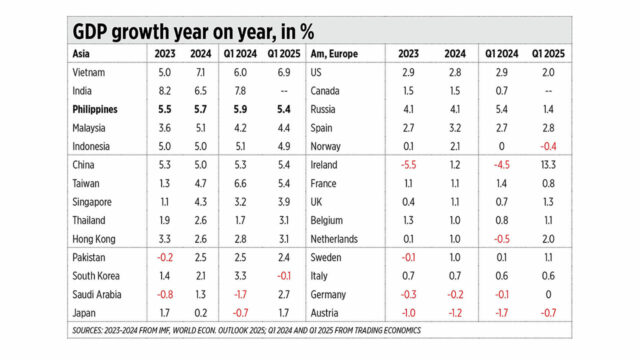
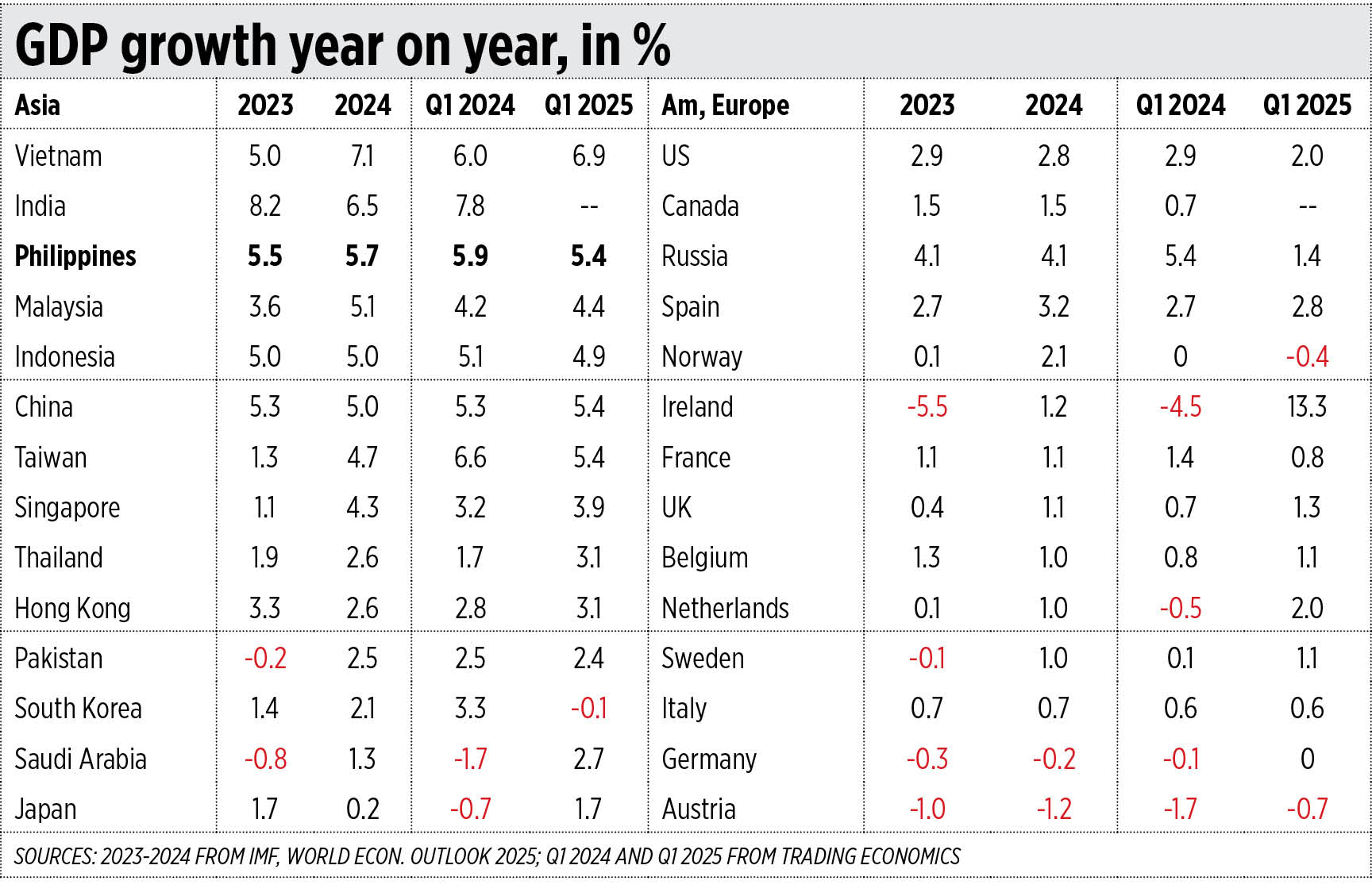
The economic team has delivered. It has pivoted the Philippine economy such that it has become one of the top three fastest-growing large economies in the world — those with a GDP size at Purchasing Power Parity (PPP) values of $500 billion and higher. There are 53 countries and economies in this category.

Some people and analysts are complaining that we are slowing down, that we were growing at a rate of 6-7% in 2021-2022. But they should see how other countries are doing, especially the developed economies of North America and Europe. Either they are crawling or contracting (“negative growth”).

Four indicators show that the economic team is composed of high performing and brilliant minds.

First is high GDP growth as discussed above.

Secondly, we are moving towards a low inflation rate, from 5.8% in 2022 to 3.4% in 2024, and only 1.4% as of April this year.

Thirdly, there is the pivot towards a low unemployment rate, from 5.4% in 2022 to 4.4% in 2023, and 3.9% in March this year.

Fourth is the sustained decline in the budget deficit. The deficit/GDP ratio went from -8.6% in 2021, to -7.3% in 2022, to -5.7% in 2024. Preliminary data from the first quarter of 2025, where non-tax revenues were rising at above-average growth while tax revenues were rising at a normal pace, suggests that the deficit/GDP ratio is likely to further fall to -5% by years end.

So, thank you, President Marcos Jr., for recognizing the great job done by the economic team, and ensuring the continuity and stability of their work and policies.

Over in the infrastructure team, Department of Energy (DoE) Secretary Raphael PM Lotilla has been moved by the President to become Environment Secretary. I think the President sees Mr. Lotilla’s good performance, like his continued promotion of nuclear energy, and hastening the expansion of LNG plants and NGCP transmission lines and projects. Meanwhile, I observe that the Department of Environment and Natural Resources (DENR) is not administered well, so the President needs a bright and performing secretary there.

Who will take the place of Mr. Lotilla? The OIC Secretary is DoE Undersecretary Sharon Garin, a former Congresswoman from Iloilo. I think Ms. Garin can lead the agency, but leaders from the energy sector can also do the job, like Emmanuel V. Rubio, an engineer-finance guy who is the current President and CEO of Meralco PowerGen (MGEN). But there might be legal problems in appointing him as DoE Secretary based on the DoE Act of 1992.

BW ECO FORUM
The BusinessWorld Economic Forum (BWEF) was held last week, on May 22, at the Grand Hyatt BGC. Among the stories and reports in BusinessWorld that came from the event are the following: “RoW, 99-year lease bills named PHL legislative priorities” (May 22), “Clarity sought on ‘green’ energy project economics” (May 22), “PHL must boost productivity, diversify growth drivers as trade shifts pose risks” (May 23), “Local governments deemed weakest link in ease-of-doing-business campaign” (May 25), “Unlocking the Philippines’ potential” (May 26, Amelia Ylagan’s Corporate Watch column in the Opinion page).

I liked the priority measures identified by Secretary Frederick D. Go, the Special Assistant to the President for Investment and Economic Affairs: bills on right-of-way (RoW), extended investor leases, and the mining fiscal regime.

The construction of toll roads, rail lines, transmission lines, power plants, and other infrastructure projects are often hobbled by RoW problems. The National Government should put its foot down hard on many local governments units (LGUs) and private landowners that prolong significantly the construction period and raise the cost of important infrastructure.

Related to this, I also liked the frank assessment by Eduardo V. Francisco, President of BDO Capital & Investment Corp., who said that many LGUs often become hurdles to ease of doing business in the country. Plus, the weak skills of many college graduates compared to what are needed by various industries.

To help unlock the country’s potential, we need real rule of law. The law applies equally to unequal people and businesses, no one is exempt, and no one can grant an exemption. This way even corrupt officials and legislators will be scared because the bureaucracy and heavy regulations they impose on ordinary businesses will also apply to them and their friends.


Bienvenido S. Oplas, Jr. is the president of Bienvenido S. Oplas, Jr. Research Consultancy Services, and Minimal Government Thinkers. He is an international fellow of the Tholos Foundation.

minimalgovernment@gmail.com

CLI expands Visayas footprint with 7.2-hectare Cebu township project

CEBU HOMEGROWN Developers, Inc., a joint venture between Cebu Landmasters, Inc. (CLI) and Ixidor Holdings, unveils Pristina Town, its most prime township in northern Cebu City. Anchoring the township is the P5.4-B North Grove, a garden-themed residential condominium and the township’s first residential project. — CEBU LANDMASTERS, INC.

LISTED developer Cebu Landmasters, Inc. (CLI) has launched a new 7.2-hectare township project in Cebu City, along with a P5.4-billion garden-themed condominium development, as part of its continued expansion in the Visayas property market.

The township, called Pristina Town, is being developed through Cebu Homegrown Developers, Inc., a joint venture between CLI and Ixidor Holdings. It will feature residential, commercial, and institutional components.

“Pristina Town is expected to strongly contribute to and benefit from the development of Cebu’s North Growth Center — an emerging hub transforming northern Cebu City into a vibrant, sustainable, and inclusive urban and economic center,” CLI Chairman and Chief Executive Officer Jose R. Soberano III said in a statement on Monday.

The development will incorporate sustainability features, including green spaces, pocket parks, smart programmable street lighting, and water catchment systems.

“The township stands out with its abundant green spaces, energy-efficient smart lighting, and innovative water reuse system,” Mr. Soberano said.

Planned infrastructure includes designated bike lanes, wide pedestrian walkways, planting strips, a transport hub, full underground utility cabling, and 24/7 security and surveillance systems.

Within the township, CLI launched North Grove, a P5.4-billion residential project that will comprise two condominium towers: Lumina and Terra.

Lumina will offer 386 units, including studio, one-bedroom, and one-bedroom garden layouts ranging from 24 to 35.14 square meters, with full-height windows. Amenities will include landscaped green areas, low-density floors, a fitness gym, game room, Zen garden, sky garden, lounge, and multi-purpose deck.

Terra will feature 643 studio units ranging from 22.75 to 25.37 square meters. It will be designed with natural tones and forest-inspired aesthetics and will have its own set of amenities, including a fitness gym, pocket gardens, and a multi-purpose deck.

North Grove will also have a retail podium with nearly 3,800 square meters of commercial space, including a supermarket and new retail formats.

The project marks the second development of Cebu Homegrown Developers following the completion of the Mandtra Residences in Mandaue City.

CLI shares closed unchanged at P2.48 each on Monday. — Revin Mikhael D. Ochave

Philippines First Insurance Group looks to cater to millennials, Gen Zs

AKSON-UNSPLASH

TANCO-LED Philippines First Insurance Group (PFI Group) is planning to launch products to cater to younger generations as it looks to increase its millennial and Generation Z clients, who now make up the majority of the country’s workforce.

“I think what we want to do is to take a look at all of the needs and to try to come up with a platform that will make it easier for the Gen Z, Gen Y to see what products they want, and at the same time, looking at all of our different products that we have in the four companies to come up with maybe bundled products so then it will be easier for them to understand. If they purchase an insurance [policy], they can be covered for the needs that they have,” PFI Group President and Chief Executive Officer Jaeger L. Tanco said at a media briefing on Monday.

The Tanco Group of Companies’ Philippines First Insurance Group has four brands, namely, health maintenance organization PhilhealthCare, Inc. (PhilCare), nonlife insurer Philippines First Insurance Co., Inc. (PhilFirst), life insurer Philippine Life Financial Assurance Corp. (PhilLife), and pre-need firm PhilPlans First, Inc. (PhilPlans).

A recent study conducted by the PFI Group for PhilLife showed that interest in insurance among millennials and Gen Zs was high, with 43.3% of 400 respondents nationwide aged 18 to 43 years old saying they are very interested and 35% saying they are interested.

Policies that protect family members were respondents’ top priority at 83.3%, followed by the policyholder (78.5%), and then their financial assets (54.8%). Almost half also preferred policies that protected their homes (48%), personal belongings (40.8%), and business or professional assets (27.8%).

For unforeseen events, the top five preferences of respondents were coverage for health emergencies (77.3%), accidents (76.3%), loss of life (67%), fire or property damage (60.8%), and disability (60%).

The study also found that the top three barriers for getting insurance were not having enough money (66.9%), having other financial priorities (41.9%), and that insurance products are too expensive (29.8%).

Mr. Tanco said PFI Group will introduce products with lower pricing and modified benefits to appeal to the younger generation and tap underserved markets.

“There are some markets that can afford higher pricing, then there are markets that may not be able to afford as much. Of course, there will also be a little change in benefits when that happens, because you don’t expect someone to pay higher or lower to get the same benefits as someone that pays higher,” he said.

“I think what we want to do is to give them the right pricing that will cater to what they need… We’ll come up with products that will target a certain segment taking into consideration their capability,” Mr. Tanco added.

PFI Group will focus on retail products rather than corporate, he said.  

PHILPLANS
Meanwhile, PFI Group’s pre-need unit PhilPlans hopes to rebound from the P546.82-million net loss it posted last year as the company looks to focus on other product lines and as they hope that financial markets perform better.

“PhilPlans has a trust fund. What they buy, part of it goes into the trust fund. The trust fund is invested. When you see red, it doesn’t mean that the company is in the red. It simply means that the investments that we have had are not performing well,” PhilPlans Vice Chairman Monico V. Jacob said at the same briefing.

“The equity market is down, and we have about 20% invested in the equity market. That affects our financial statements. The fixed-income instruments, the interest rates are not that high. Consequently, the fixed-income instruments you invested are not generating the kind of returns you want. This means that the trust fund of the company is being affected by the kind of investments we have made,” Mr. Jacob said.

PhilPlans will focus on selling memorial plans and making them more affordable to help offset low sales of education plans, he said.

“The education plan has not been a very popular pre-need product. What we are concentrating on right now are the memorial product and the pension product,” Mr. Jacob said. “We’re looking at making it a little bit more affordable because at the moment, we’re selling a lot of plans geared towards heritage because we own the crematory there and the mortuary there. But we feel that we should come up with memorial plans which are more affordable, and that’s what our product group is working on.”

He added that PhilPlans has about 300 partner funeral parlors. — Aaron Michael C. Sy

Entertainment News (05/27/25)


Everything About My Wife premieres on Netflix 

ROMANTIC COMEDY film Everything About My Wife, produced by GMA Pictures, CreaZion Studios, and Glimmer Studio Philippines, will be making its worldwide Netflix debut on May 29. Starring Jennylyn Mercado, Dennis Trillo, and Sam Milby, the film tells the story of Dom (Trillo), an unhappily married man who struggles to end his marriage to his wife (Mercado).


2 ABS-CBN restored films in Ayala Malls Cinemas

TWO FILMS restored by the ABS-CBN Film Restoration program will be screened at Ayala Mall Cinemas starting June 4. The 1982 film T-Bird at Ako, starring Nora Aunor and Vilma Santos, will be screened exclusively at Ayala Malls Cinemas. Directed by Danny L. Zialcita, it tells the story of lawyer Sylvia (Aunor), who tries to keep things professional between her and her client, Sabel (Santos), a dancer who accidentally kills a man in self-defense after he attempted to rape her. The other film is Mga Anak ni Facifica Falayfay, starring Dolphy, Roderick Paulate, Zsa Zsa Padilla, Lotlot de Leon, and more. Directed by Romy Villaflor, the 1987 film follows the death of the wife of Pacifico (Dolphy), deeply affecting their son Rodrigo (Paulate).


Father’s Day film program at UP Diliman

A FILM SERIES titled “Fathers of Circumstances” will be held at the University of the Philippines Film Institute (UPFI) Film Center in Diliman, Quezon City, on June 20 and 21. Curated by Eunice Helera and organized by Elevated Frames, it brings together five films from Japan and the Philippines that explore the many faces and meanings of fatherhood — whether by blood, choice, absence, or circumstance. It will also coincide with the reopening of Cine Adarna, UPFI Film Center’s main theater. Admission is free.


The Juans release single on ‘situationships’

FILIPINO band The Juans is back with their latest single, “Ano Ba Talaga Tayo?” The song is a heartfelt anthem for anyone who’s ever found themselves stuck in the emotional gray area of a “situationship.” An accompanying music video was also released, starring actors and real-life couple Elijah Canlas and Miles Ocampo. “Ano Ba Talaga Tayo?” is out now on all digital music streaming platforms.


Hip-hop newbie Khael Domaro releases new single

FILIPINO hip-hop newcomer Khael Domaro is entering the Pinoy hip-hop scene with “GODLIKE,” a single that features a verse from Gee Exclsv, a member of the chart-topping rap collective O SIDE MAFIA. The song is produced by Yung Bawal. “GODLIKE” is out now on all digital music streaming platforms.


Dwta drops new alt-rock single

FILIPINO singer-songwriter dwta is back with “Nasusunog (Pants On Fire),” her new single under Sony Music Entertainment. It marks a departure from her signature folk-pop sound, blending introspection with alt-rock instrumentation. It was written by dwta with Tiana Kocher, Ashley Mehta, and Martin Estrada, during the Sony x Monostereo Groove songwriting session earlier this year. The Bicol-born artist describes the track as “graceful wrath, the act of expressing anger in a way that remains vulnerable and composed.” It is out now on all digital music streaming platforms.


SB19 single in video game Fatal Fury music video

THE Japanese video gaming and interactive entertainment company SNK Corp. has unveiled its newest cross-cultural collaboration: a music video featuring their latest fighting game, Fatal Fury: City of the Wolves, and award-winning Filipino pop group SB19. It centers on SB19’s single “DUNGKA!,” inspired by the game’s key phrase, “rev it up.” The video combines the group’s sound with cinematic battle sequences from the video game. It is available to view online.


KOSTCON 2025 features K-Drama soundtracks live

K-DRAMA enthusiasts in the Philippines can now get tickets to KOSTCON 2025 – Korean OST Concert. It will be held at the SM Mall of Asia Arena, Pasay City, on Aug. 6, made possible by Random Minds. Among the performers are: balladeer Lyn (known for “My Destiny” from My Love from the Star and “With You” from Descendants of the Sun), Kim Bum Soo (known for “I Miss You” from Stairway to Heaven), K.Will (“Beautiful Moment” from The Beauty Inside). Soyou (“I Miss You” from Goblin), Heize (“Can You See My Heart” from Hotel Del Luna), and Lee Mujin (“Sweet” from Business Proposal).


Jollibee brings back the JolliKids Fun Camp

THE two-day JolliKids Fun Camp returns to offer kids a learning experience at Jollibee. The program allows children to step into the shoes of a Jollibee crew member over the course of two days, with each session lasting three hours. Participants will receive their own apron, booklet, and sticker set, used to track their performance. Registration is ongoing until June 14, and the program is open to children aged four to 12 years old. There is a registration fee of P620.


Johnnie Walker taps celebrities for campaign

JOHNNIE WALKER has launched its Greatest Of All Time (G.O.A.T.) campaign, featuring a lineup of Filipino icons: OPM band Urbandub, comedian Red Ollero, drag queen Marina Summers, A-Team streetdance duo Angelica and MJ Arda, and stylist Liz Uy. They each “embody the spirit of greatness in their respective fields,” with live performances, fashion showcases, and various events lined up as part of Johnnie Walker’s G.O.A.T. Fridays. The ongoing series pairs these events with Johnnie Walker cocktails. For more details, visit the liquor brand’s social media pages.


Korean stars reunite on Prime Video romance series

PRIME VIDEO has announced that Head Over Heels, a new Korean fantasy-romance series, will stream starting June 23. The show stars Cho Yi-hyun and Choo Young-woo, known for their work on various K-Dramas. It tells the story of a high school student-shamaness (Cho) setting out to save the life of her very first love (Choo).


Tom Odell announces new album, releases single

AMERICAN musician Tom Odell has announced that he will release a new album, A Wonderful Life, on Sept. 5 via UROK/Virgin. Recorded in London, it will feature 10 tracks including the recent introductory track and album opener, “Don’t Let Me Go.” In addition to the announcement, he has also released “Don’t Cry, Put Your Head On My Shoulder,” a guitar-led lullaby meant to be an anthem during concerts.

MWSS seeks retained water allocation for June

PHILIPPINE STAR/KRIZ JOHN ROSALES

THE Metropolitan Waterworks and Sewerage System (MWSS) is seeking to retain its water allocation of 50 cubic meters per second (cms) from the Angat-Ipo-La Mesa water system for June.

While the request is still subject to approval by the National Water Resources Board (NWRB), the Angat technical working group has agreed to the proposal, according to Patrick James B. Dizon, manager of MWSS’ water and sewerage management division.

“Based on the historical records and also since the hot weather will now be reduced, the water demand in the next months will be decreased,” he said in a Viber message.

“But considering we have sufficient water from Angat Dam, we will be requesting to NWRB to maintain the allocation of MWSS,” he added.

MWSS is mandated to ensure the uninterrupted and adequate supply and distribution of potable water, as well as the maintenance of sewerage systems, in its service area covering Metro Manila and parts of Cavite and Rizal.

NWRB regulates and manages all water resources and services in the Philippines. It determines and approves MWSS’ monthly water allocation based on the status of the Angat Reservoir, weather conditions, and MWSS’ request.

Angat Dam supplies about 90% of Metro Manila’s potable water.

As of Monday morning, the water level at Angat Dam stood at 199.07 meters, lower than the 199.35 meters recorded a day earlier, according to the Philippine Atmospheric, Geophysical and Astronomical Services Administration (PAGASA).

The latest readings remain below the dam’s normal high-water level of 210 meters. — Sheldeen Talavera