Home Blog Page 116

GCash Run 2026: A wellness festival for the green hero community

The GCash Run 2026 officially kicks off with the ceremonial gun start, signaling GForest Heroes to move with purpose.

Last year’s inaugural GCash Run proved to be more than a social fitness gathering by planting trees for every sign-up to pave the way toward a more sustainable future. This year, the event returned not only as a purpose-driven run but also as a full-fledged wellness festival.

GCash has been playing its part in protecting the environment for years with GForest, wherein every transaction earns green energy points. These can be redeemed to plant trees and contribute to a greener future, making users “GForest Heroes.” Last year, GForest Heroes participated in the first GCash Run that led to the planting of 76,000 mangroves trees across 11 hectares in the Negros Region. Last March 22, the event returned for its second edition along Ayala Avenue, gathering runners of all levels — including pets — and planting even more trees.

Runners fill the streets as the energy steadily builds with each stride — showing how the GCash Run champions shared experiences and a sustainable future.

“In partnership with Silliman University, we’ve reached a milestone of 40,500 trees planted and united eco-conscious brands and partners to share advocacies and inspire collective action,” Winsley Bangit, Group Head for New Businesses of Mynt, the parent company of GCash, said during the event. “Regardless of the distance, the first step today was a giant leap for a greener and sustainable tomorrow.”

This year’s GCash Run featured a range of activities and attractions highlighting diverse passions and advocacies, including music, wellness, sustainable shopping, and farm-to-table products.

After the run, participants explored the Green Hero Village and Eco Marketplace, sharing meaningful moments with fellow runners. Overall, the event combined fitness, community, and advocacy, leaving participants with a deeper appreciation for sustainability and shared experiences beyond the run.

It’s the ultimate lifestyle upgrade, with lots of exciting reasons to make a difference. Here are a few others that made GForest Heroes say “ready, set, grow!” at GCash Run 2026.

1. Record-breaking impact — GCash Run 2026 was a huge opportunity for everyone to join a bigger cause. Since 2019, GForest Heroes have contributed to the planting of 4.2 million trees, reforesting almost 19,000 hectares of land (larger than Quezon City), and supporting 15,000 farming families. GCash proves that heroes are made, not born.

2. Sustainably stylish with paw-sitive energy  At GCash Run 2026, GForest Heroes got to wear capes and flex their sustainable singlets made from recycled materials. Moreover, pets joined the movement in a 1km run. Alongside their humans, they sported their bandanas as well, reminding everyone that sustainability is a family affair, including furbabies.

3. Cashing-in on the vibe — GCash welcomed everyone to its “Green Hero Village,” where runners won GCash Credits and recycled with the PET Bottle Collector. From using their 100% recycled GCash Cards to visiting eco-friendly MSME booths that were rewarding in nature, it’s all about saving the planet all around.

At the Green Hero Village, runners take time to explore booths such as the GForest Booth, PET Bottle Collector, Medal Engraving, and GInsure Pet Insurance — each activity provides a learning experience about eco-friendly practices and ways to give back even after the run.

4. Mark of a hero — From in-app eco-actions to on-ground momentum, GForest Heroes demonstrated how digital transactions drive real-world environmental outcomes with their Digital Tree certificates. Apart from ringing the PR Bell, runners immortalized their “Hero Era” via medal engraving stations, while 10k finishers took home a special towel as a badge of honor, which also reflect their commitment to the environment.

A few stars and notable GForest Heroes explored the Green Hero Village. The crowd comes together not only to run, but to connect, celebrate, and take part in something bigger than the event itself. Left to right: Edrence Rutagines, Nicole Cordovez, Zeti Cuenca, and Issabelle Coronel

5. Gamified growth – This year, the race once again served as the ultimate “Level Up” through GForest where cashing in, sending money, paying bills, buying load, and cashing in earn green energy points that can be redeemed to plant virtual trees– proving that fitness and forest-building are the new power duo.

Moreover, sustainability took center stage at the village with 22 eco-marketplace partners, including araro.gelato, Kangkong King, Odd Cafe, Commune Cafe & Bar, new Hatchin Trading Corp, Planted Bodega, Cafe Leopoldo, Abel Philippines, Cut the Craft, Eco Shift Essentials, Kaunlaran Fabric, Wonder Home, Maginhawa Eco-Store, Pili Ani, Malingkat Weaves, For Keeps Clean Beauty, Plato Wraps, Vitargo, Rural Rising, and Colors and Petals. Also part of the fold were Maginhawa Eco-Store, araro.gelato, Planted Bodega, and Odd Cafe. Meanwhile, the cashless eco merchant zone showcased the convenience of GCash for Business solutions for runners, such as SoundPay, PocketPay, and EasyPOS, as they purchased sustainable products, healthy food, and eco-friendly goods.

Beyond the race itself, runners are seen showing off their 10K finisher towel, cooling down with friends, exploring the village, and ringing the PR bell that highlight how the event becomes a full wellness festival experience.

GCash Run 2026 was made possible by the strong support from advocacy organizations and corporate partners such as ABS-CBN Foundation, Angat Buhay, Berdeng Kalabaw, Caritas Manila, CRIBS Foundation, One Million Lights, Team Manila, UNICEF, WWF, and Zolo.

The event also had a robust network of sponsors and partners, including eTap Solutions, Globe, IKEA Philippines, Pay&Go, and Smart as Platinum Sponsors; BPI MS Insurance and Standard Insurance as Silver Sponsors; and ECPay, Park Access, REV, and Singlife as Bronze Sponsors. Lastly, Corporate Run Club Partners include ATRAM, ECPay, eTap Solutions, Globe, STTelemedia Global Data Centres, Pay&Go, PDAX, Seapeak, and Tech Mahindra.

At GCash Run 2026, the finish line was just the start of a more purposeful, sustainable journey.

Learn more about GCash by visiting www.gcash.com.


Spotlight is BusinessWorld’s sponsored section that allows advertisers to amplify their brand and connect with BusinessWorld’s audience by publishing their stories on the BusinessWorld Web site. For more information, send an email to online@bworldonline.com.

Join us on Viber at https://bit.ly/3hv6bLA to get more updates and subscribe to BusinessWorld’s titles and get exclusive content through www.bworld-x.com.

Trump issues new warning to Tehran, Iran calls US peace proposals ‘unrealistic’

SMOKE AND DUST rise after an Israeli strike on Beirut’s southern suburbs, March 2, 2026. — REUTERS/MOHAMED AZAKIR

TEL AVIV/WASHINGTON/ISLAMABAD — President Donald Trump warned on Monday that the US would obliterate Iran’s energy plants and oil wells if Tehran does not open the Strait of Hormuz, after Tehran described US peace proposals as “unrealistic” and fired waves of missiles at Israel.

Israel’s military said two drones from Yemen had also been intercepted on Monday, two days after the Iran-aligned Houthis entered the war by firing missiles at Israel, and that Lebanon’s Hezbollah had fired rockets at Israel.

Israeli forces carried out missile strikes on what they called military infrastructure in Tehran and infrastructure used by Iran-backed Hezbollah in Beirut, leaving black smoke hanging over the Lebanese capital.

Turkey’s defense ministry said a ballistic missile launched from Iran entered Turkish airspace before being shot down by NATO air and missile defenses deployed in the eastern Mediterranean, the fourth such incident since the start of the war.

Tehran remains defiant in the month-old war, which began with US-Israeli attacks on Iran on February 28 and has spread across the region, killing thousands, disrupting energy supplies, and hitting the global economy.

The majority of those reported killed were in Iran and Lebanon, and many were civilians. Iran has effectively blocked the Strait of Hormuz, a narrow waterway that normally carries about a fifth of global oil and liquefied natural gas supplies.

TROOPS DEPLOY AS TALKS CONTINUE
Thousands of soldiers from the US Army’s elite 82nd Airborne Division have started arriving in the Middle East, two US officials told Reuters on Monday, part of a reinforcement that would expand Mr. Trump’s options to include the deployment of forces ​inside Iranian territory, even as he pursues talks with Tehran.

White House press secretary Karoline Leavitt later said Mr. Trump wanted to reach a deal with Tehran before an April 6 deadline he set last week after extending an earlier deadline he had set for Iran to open the Strait of Hormuz. Ms. Leavitt said talks with Iran were progressing, adding that what Tehran says publicly differs from what it tells US officials in private.

Iran said earlier on Monday it had received US peace proposals via intermediaries, following talks on Sunday between the foreign ministers of Pakistan, Egypt, Saudi Arabia, and Turkey.

Iranian Foreign Ministry spokesperson Esmaeil Baghaei said the proposals were “unrealistic, illogical and excessive”.

“Our position is clear. We are under military aggression. Therefore, all our efforts and strength are focused on defending ourselves,” he told a press conference.

Soon after Mr. Baghaei’s remarks, Mr. Trump said in a social media post that the United States was in talks with a “more reasonable regime” to end the war in Iran, but he also issued a new warning over the Strait of Hormuz.

“Great progress has been made but, if for any reason a deal is not shortly reached, which it probably will be, and if the Hormuz Strait is not immediately ‘Open for Business,’ we will conclude our lovely ‘stay’ in Iran by blowing up and completely obliterating all of their Electric Generating Plants, Oil Wells and Kharg Island,” Mr. Trump wrote.

Mr. Trump also threatened to attack the desalination plants that supply clean water in Iran.

The national security committee in the Iranian parliament, meanwhile, approved a bill that bans ships from the US, Israel and countries that unilaterally sanction Iran, from moving through the Hormuz Strait, according to state media. The bill must still be approved by the full parliament and it was not clear when or if such a vote would take place.

A Pakistani security official, whose country is trying to mediate in the war, said it appeared unlikely there would be direct US-Iran talks this week.

Mr. Baghaei also said Iran’s parliament was reviewing a possible exit from the Nuclear Non-Proliferation Treaty, which recognizes the right to develop, research, produce and use nuclear energy as long as nuclear weapons are not pursued.

Mr. Trump has cited the prevention of Iran from obtaining nuclear weapons as a reason for attacking the country on February 28. Tehran denies it is seeking a nuclear arsenal.

Israeli Prime Minister Benjamin Netanyahu, in an interview with US media outlet Newsmax, declined to give a timeline for achieving his country’s objectives in the war. While he said that “it’s definitely beyond the halfway point,” he later clarified that he meant in terms of missions, not time.

OIL MARKETS BRACE FOR TURMOIL
The White House said Mr. Trump was considering asking Arab nations to pay for the cost of the war. “It’s an idea that I know that he has and something that I think you’ll hear more from him on,” Ms. Leavitt said in response to a reporter’s question about the idea.

His administration requested an additional $200 billion in funding for the war, which faces stiff opposition in the US Congress, which must approve new spending.

Iran has fired on Arab Gulf states during the conflict and war has been reignited between Israel and Hezbollah in Lebanon. Three members of the UN peacekeeping mission in Lebanon (UNIFIL) were killed in two separate incidents in southern Lebanon after a bloody weekend ​in which Lebanese journalists and medics were killed in Israeli strikes.

Benchmark oil prices extended gains on Monday, with Brent crude futures on course for a record monthly rise.

The Houthis’ attacks on Israel raised the prospect that they could target and block a second important shipping route, the Bab el-Mandeb Strait.

The oil market has all but discounted the prospect of a negotiated end to the war and “is bracing for a sharp escalation in military hostilities,” said Vandana Hari of oil-market provider Vanda Insights.

The International Monetary Fund warned that war in the Middle East has caused serious disruption to the economies of frontline countries, and is dimming the outlook for many economies that had just started to recover from previous crises.

G7 finance leaders also said they were ready to take “all necessary measures” to safeguard energy market stability and limit broader economic spillovers from recent volatility. — Reuters

Peso hits new low P60.69 vs dollar

Photo shows US dollar bills and Philippine peso coins. — PHILIPPINE STAR/RYAN BALDEMOR

THE PESO slid to an all-time low against the US dollar on Monday as soaring oil prices raise concerns over inflation and an economic slowdown.

The local unit declined by 14 centavos to close at P60.69 against the greenback from its previous record-low P60.55 finish on Friday, data from the Bankers Association of the Philippines showed.

Year to date, the peso has depreciated by P1.90 or 57.9832% from its P58.79 finish on Dec. 29, 2025.

The peso opened Monday’s trading session flat at P60.55, which was also its intraday best.

Its weakest level of the day was at P60.84, which surpassed the local currency’s previous all-time intraday low of P60.57 logged on Friday.

Dollars traded jumped to $2.007 billion from $1.336 billion on Friday.

“The peso reached new lows today following reports of potential land-based military deployment of US troops near Iran,” the first trader said in a Viber message.

Reuters quoted US President Donald J. Trump as saying that Iran’s new leaders have been “very reasonable,” as more US troops arrived in the region and Tehran warned it will not accept humiliation.

Markets have been rattled this month after the Iran conflict effectively shut the Strait of Hormuz, a chokepoint for about a fifth of global oil and gas flows, driving Brent crude toward a record monthly rise.

The US dollar index was roughly unchanged at 100.19. It hit 100.54 in mid-March, its highest level since May 2025, and was on track for its biggest monthly rise since July 2025.

The peso was also dragged by growing expectations of a prolonged war, Reyes Tacandong & Co. Senior Adviser Jonathan L. Ravelas said in a Viber message.

A prolonged war in the Middle East is expected to put pressure on the Philippines, which imports nearly all of its oil requirements from Middle Eastern countries. The Philippines is now looking to find alternative sources to alleviate a looming energy shortage.

The Bangko Sentral ng Pilipinas had raised its inflation forecast for 2026 to 5.1% from 3.6% previously and trimmed its 2026 gross domestic product growth estimate to 4.4% from 4.6% previously.

A second trader said via Viber that the local currency’s weakness continued to be a function of a strong dollar and strong demand for oil, adding that high liquidity exaggerated the peso’s drop.

Demand for the greenback was also driven by the government’s recent purchases of oil, which are settled in dollars and other foreign currencies, Rizal Commercial Banking Corp. Chief Economist Michael L. Ricafort said in a Viber message.

The second trader said the local unit could reach the P61-per-dollar level, though “not in a straight line as the market is stretched.”

For Tuesday, Mr. Ricafort and the first trader see the peso moving between P60.55 and P60.80 against the greenback. — AMCS with Reuters

Slow growth to keep BSP on hold despite oil price shocks

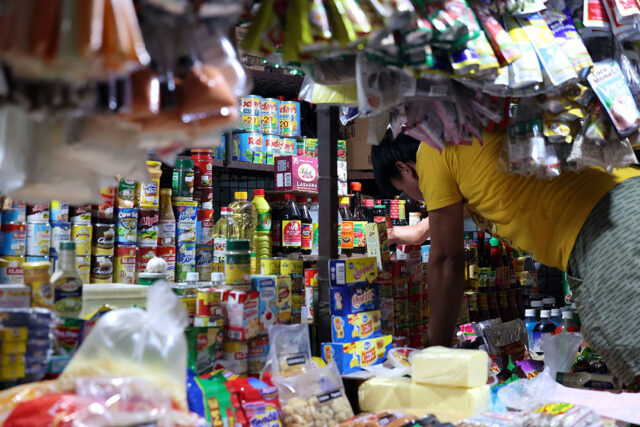
A vendor waits for customers inside the Commonwealth Market in Quezon City. — PHILIPPINE STAR/MIGUEL DE GUZMAN

By Katherine K. Chan, Reporter

TEPID ECONOMIC GROWTH will likely force the Bangko Sentral ng Pilipinas (BSP) to stand pat until yearend even as oil price shocks amid the Middle East war are expected to stoke inflation, Fitch Solutions unit BMI said. 

In a commentary on Monday, BMI said oil price pressures may push inflation beyond the central bank’s 2-4% target in the coming months, bringing it to a full-year average of 3.2%. This was slightly higher than its previous estimate of 3.1%.

“While we had previously expected the BSP to cut rates at its April meeting, the US-Iran conflict upended this view,” BMI said. “Inflation is likely to breach the BSP’s 2-4% inflation target range in the coming months, but sluggish growth will keep the BSP on hold rather than tighten.”

This came after the BSP maintained its policy rate in an off-cycle meeting last week as it looked past first-round inflation effects of the ongoing oil crisis, adding that tightening now may delay the economy’s recovery.

The BSP is scheduled to hold a regular policy review on April 23.

The Middle East war continues to escalate a month after the US and Israel’s initial attacks on Iran, with Iran still denying US President Donald J. Trump’s claims of resolution.

Locally, pump prices remain elevated as ongoing disruptions jeopardize the country’s oil supply. The Philippines imports over 90% of its oil from the Middle East, making it vulnerable to current oil shocks.

Last week, the central bank likewise revised its macroeconomic forecasts, with inflation now seen to reach 5.1% this year from 3.6% previously. 

It also trimmed its growth forecast to 4.4% from 4.6% for 2026 but maintained its 5.9% projection for 2027.

For BMI, tightening this early would be a “premature” move by the central bank as price pressures prove supply-driven and with growth still sluggish.

“All that said, we think it is premature to forecast rate hikes from the BSP,” it said. “While inflation will probably rise significantly, the BSP notes that it will be supply-driven and monetary policy is not well placed to tackle that. Moreover, softer growth will weaken the case for rate hikes.”

The BSP last raised its rates in October 2023 in an off-cycle move. It has followed an easing path since August 2024, reducing key borrowing costs by a total of 225 basis points (bps) to an over three-year low of 4.25%.

Its last few cuts came amid the flood control corruption fallout which dragged growth to a post-pandemic low of 4.4% last year.

Marco Antonio C. Agonia, an economist at the University of Asia and the Pacific, also sees the BSP pausing at its April meeting as he noted that second-round price effects will likely manifest within the second quarter.

“For now, we see another rate hold at the BSP’s April meeting as the fundamental supply issue remains unresolved and the economy keeps posting tepid performance,” Mr. Agonia told BusinessWorld in an e-mail.

“The upcoming March inflation reading will largely see first-round effects in the headline print. So far, we’re seeing early signs of second-round effects in transportation, food, and to some extent, food service activities,” he added.

Jonathan L. Ravelas, a senior adviser at Reyes Tacandong & Co., also noted that second-round inflation may be felt after two to three months, with major risk looming from wages.   

“Second‑round inflation effects usually show up after two to three months, with early pressure now visible in transport, logistics, food distribution, and power‑intensive industries — the key risk to watch is wages,” he said via Viber. 

On the other hand, Deutsche Bank Research still expects the BSP to raise its benchmark rate by 25 bps to 4.5% next month to prioritize its price stability mandate as escalating inflation pressures weigh on the policy outlook.   

“First-round effects on inflation may show in the data as soon as March and begin to breach the upper limit from April as second-round spillover effects emerge,” it said.

“A gradual tightening in policy settings from April would provide a strong signal of BSP’s commitment to proactively manage inflationary pressures and maintain macroeconomic stability,” it added.

BMI also warned about a possible rate hike later this year, particularly if the second-round price pressures worsen amid a prolonged Middle East war.

“Given that fuel prices largely dictate the cost of logistics that underpin the modern economy, a prolonged conflict even beyond our ‘Extend to End’ scenario would leave strong, broad-based second-round inflationary pressures in its wake, prompting the BSP to hike,” it said.

However, Pantheon Macroeconomics Chief Emerging Asia Economist Miguel Chanco and Asia Economist Meekita Gupta said the BSP’s move last week has raised the bar higher for any rate hike.   

“Our main takeaway from this anticlimactic off-cycle meet is that the scheduled sit-down in three weeks is no longer ‘live’ — assuming global oil prices don’t reach a new high — as the Board has set a very high bar for any action,” they said in a separate note on Monday.   

While they see the BSP standing pat until end-2027, Mr. Chanco and Ms. Gupta noted that risks remain of potential tightening later this year or early next year.

Back to WFH? Oil crisis reignites debate over hybrid work schemes

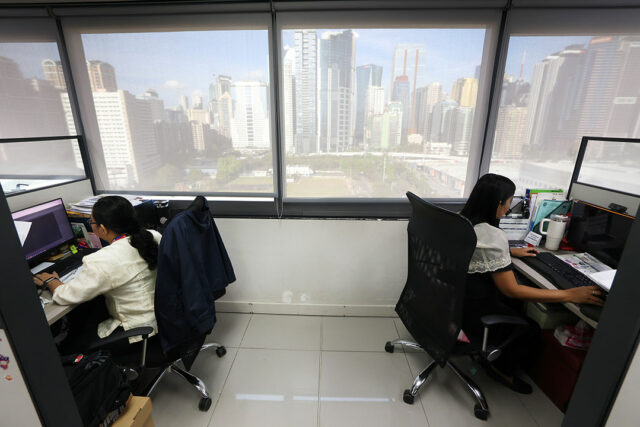
Employees work at a government agency in Pasig City in this file photo. President Ferdinand R. Marcos, Jr. earlier this month ordered the implementation of a four-day workweek in some government offices. — PHILIPPINE STAR/MIGUEL DE GUZMAN

By Justine Irish D. Tabile, Senior Reporter and Beatriz Marie D. Cruz, Reporter

PHILIPPINE COMPANIES are weighing a return to flexible work arrangements to cushion employees from the impact of soaring fuel costs.

But some experts caution that while work-from-home (WFH) schemes can ease energy demand, they must be applied selectively to avoid hurting productivity.

“Organizations should begin revisiting their COVID (coronavirus disease 2019) playbooks and be ready to activate flexible arrangements if conditions worsen, even if not immediately,” Management Association of the Philippines President Donald Patrick L. Lim told BusinessWorld in a Viber message.

The International Energy Agency on March 20 recommended the adoption of WFH protocols to reduce energy demand amid a looming global oil crisis.

While the pandemic has prepared Filipinos for flexible work arrangements, readiness is not uniform across all sectors, Financial Executives Institute of the Philippines (FINEX) President Carlo Enrico B. Lazatin said in an e-mailed reply to questions.

As an example, financial services and other knowledge-driven firms can work remotely, but industries like manufacturing, energy, logistics, and agriculture remain on-site dependent, he said.

“Work-from-home should be deployed where it delivers measurable gains in productivity and cost, without disrupting core operations,” Mr. Lazatin said.

He noted that FINEX members’ business continuity plans included investments in digital infrastructure, cloud-based systems, cybersecurity, and secure remote access.

“For roles where output can be delivered remotely without compromising quality, hybrid arrangements become a practical response,” Mr. Lazatin said, adding this would help protect employees’ purchasing power, sustain engagement, and reduce commute-related fatigue.

However, Mr. Lazatin noted that some micro, small, and medium enterprises may find it difficult to adopt WFH protocols due to limited digital infrastructure.

While some firms are considering WFH arrangements, they are pressured to balance costs, productivity, and client service requirements, American Chamber of Commerce of the Philippines (AmCham) Executive Director Ebb Hinchliffe said via Viber.

“No industry indicated any desire to return to a 100% WFH setting,” he said, citing talks with AmCham members.

He said that companies’ level of readiness for WFH depends on factors like digital infrastructure, workforce composition, and prior experience with hybrid work.

Angelito “Lito” M. Villanueva, founding chairman of FinTech Alliance.PH, said the Philippine financial sector is “far more prepared” to adopt WFH policies amid the fuel crisis.

He noted that adopting hybrid work arrangements is now a strategic lever amid energy and economic volatility.

“The real barriers are no longer technology but cybersecurity assurance, and management mindset,” he said in a Viber message.

ENERGY CONSERVATION
The Philippine government has adopted energy conservation measures to soften the impact of soaring oil prices. President Ferdinand R. Marcos, Jr. last week declared a national state of energy emergency and ordered the implementation of a four-day workweek in some government offices.

However, the Palace on Friday said it is up to private sector firms to decide whether to implement WFH arrangements for their employees.

“Working from home can meaningfully cut energy use during a crisis because transport is the biggest lever — nearly half of oil demand comes from moving people and goods,” said Reyes Tacandong & Co. Senior Adviser Jonathan L. Ravelas told BusinessWorld via Viber.

“Fewer commutes mean immediate fuel savings and some relief on transport-driven inflation,” it added.

Mr. Ravelas said that the policy could be a “temporary shock absorber” to ease price pressures without stalling growth.

Peter Lee U, an associate professor and dean of the School of Economics of the University of Asia and the Pacific, said that some offices have never returned to the 100% on-site arrangement since the pandemic.

“It can certainly help reduce fuel demand,” he said in a Viber message. “And consider that it won’t only be the Philippines that will resort to more work from home.”

“The whole world has learned from COVID-19 that it can be done and has learned how to make adjustments to minimize loss of efficiency or productivity from remote work. Thus, the whole world will reduce demand for oil, and this will alleviate the reduced oil supply,” he added.

PwC Philippines Chair Roderick M. Danao said that implementation of hybrid work schemes is being done to address demand from customers.

“Until now, we use hybrids because our clients need it, our customers need it, and our people also need it,” he told BusinessWorld on the sidelines of the Philippine Infrastructure Summit 2026.

Meanwhile, analysts said that the policy should be enforced on a case-to-case basis so as not to affect productivity.

“Productivity doesn’t necessarily suffer if this is done selectively: knowledge-based sectors like finance, information technology, business process outsourcing, and government back offices can maintain output with little disruption, while location-dependent sectors obviously can’t,” said Mr. Ravelas.

“The key is targeting, not blanket rules. If applied where it makes sense, the inflation relief from lower fuel and logistics costs can outweigh the limited production losses,” he added.

Mr. U said that the WFH arrangements are better left on a voluntary basis for private sector firms.

“They can judge better which workers need to be on-site to minimize efficiency or productivity losses. This would also guard against production losses,” he said.

Mr. U said some firms may extend transport allowances, but this may raise expenses and lower profits.

Mr. Danao said that for professional services firms like PwC Philippines, he does not recommend a full virtual setup.

“In our industry, we need to interact meaningfully with our clients and team members, especially as quality is our number one priority across all engagements,” he said.

“History will show that during the initial weeks of the pandemic when we, as well as some of our clients, implemented a 100% virtual work setup, timelines were affected, as the nature of professional services requires full compliance with applicable standards and client requirements,” he added.

For this reason, he said that the WFH scheme should be voluntary and tailored from entity to entity.

“Every entity, every industry, has a different operating model. For business process outsourcing firms, partly yes; in our case, partly yes; but for manufacturing, how can you do that, right? Also in healthcare and retail,” he added

Debt service bill jumps in January

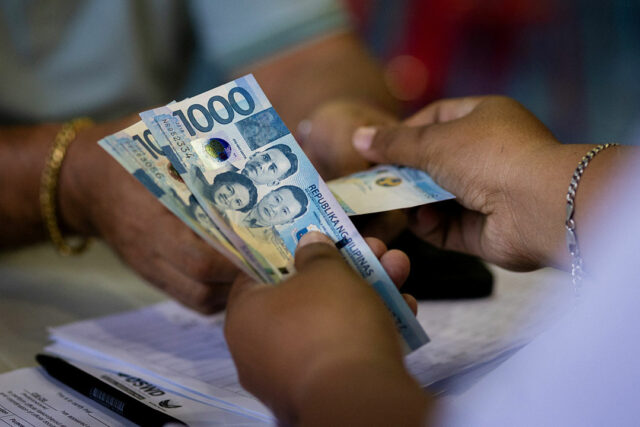
A government worker hands out cash aid to a driver in Quezon City, Philippines, March 24, 2026. — REUTERS/ELOISA LOPEZ

By Justine Irish D. Tabile, Senior Reporter

THE NATIONAL Government’s (NG) debt service bill jumped by nearly 30% to P137.67 billion in January amid higher interest payments, the Bureau of the Treasury (BTr) said.

The latest data from the Treasury showed that the debt service bill increased by 29.3% in January from P106.51 billion in the same month last year.

Month on month, the debt service bill surged by 75% from P78.64 billion in December.

Debt service refers to the payments made by the government on domestic and foreign borrowings.

Ateneo Center for Economic Research and Development Director Ser Percival K. Peña-Reyes told BusinessWorld that the higher debt service bill in January is due to “more expensive debt amid higher interest rates, larger total debt stock, and frontloading of repayments early in the year.”

“These factors combined pushed total debt servicing higher even if some components (like principal) did not increase dramatically,” he said in a Viber message.

The bulk, or 92.8% of debt payments, was made up of interest payments, the BTr data showed.

In January, interest payments went up by 22.4% to P127.82 billion from P104.44 billion in the same month a year ago.

Domestic interest payments also increased by 30.9% to P94.6 billion in January from P72.29 billion in the same month last year.

Broken down, P85.4 billion went to fixed-rate Treasury bonds, P3.68 billion to Treasury bills, P3.58 billion to retail Treasury bonds, and P1.95 billion to others.

Interest payments for foreign borrowings inched up by 3.3% to P33.2 billion in January from P32.15 billion in the same month in 2025.

As interest rates remain elevated, Mr. Peña-Reyes said interest payments will continue to make up the bulk of the debt service bill in the near term.

“What we are seeing is most likely a mix of structural pressures, which are persistent, and timing or base effects, which are not,” he added.

Jose Enrique “Sonny” A. Africa, executive director of the think tank IBON Foundation, said the higher debt servicing is the “inevitable outcome of inexorably rising debt stock compounded by higher rates and foreign exchange effects.”

“External interest payments will definitely keep rising, especially as the peso weakens further,” he added.

The local currency hit a new record low, weakening by 14 centavos to close at P60.69 from its P60.55 finish on Monday, data from the Bankers Association of the Philippines showed.

Meanwhile, amortization payments soared by 374.8% to P9.85 billion in January from P2.08 billion in the same month a year ago.

This was mainly composed of principal payments on domestic debt, which surged by 2,453.9% to P8.1 billion in January from P317 million in the same month last year.

Amortization paid on foreign debt was flat at P1.76 billion in January.

“Higher domestic amortization in January 2026 mainly implies scheduled repayments and active debt rollover, not necessarily fiscal stress,” said Mr. Peña-Reyes.

“Combined, however, with rising interest payments, it also highlights a heavier overall debt service burden, even if the month-to-month composition looks volatile,” he added.

IBON Foundation’s Mr. Africa said that the higher domestic amortization signals growing rollover dependence and liquidity pressure.

“The Philippines is in the right strategic direction with its long-standing bias for domestic borrowing, made even more sensible amid volatility like now when external markets should be used selectively,” he added.

However, he said that the country needs to fix structural fiscal gaps to avoid compounding debt service.

“The emphasis shouldn’t just be on debt management mechanics but more on who bears the burden of the current shock and how to prevent amplification of inequality and slowdown,” he added.

The NG debt stock increased to P18.13 trillion at the end of January due to frontloaded financing programs, up by 2.41% from the P17.71 trillion seen as of end-December.

“Frontloading looks immediately sound but may lock in high interest rates, and in a way just shifts today’s oil shock into tomorrow’s fiscal crisis,” said Mr. Africa.

“There’s an unstated policy bias toward protecting creditors over people in need, where relying on borrowing instead of progressive taxes such as on billionaire wealth or windfall profits is a form of socializing the costs of supply-side shocks while privatizing gains,” he added.

DoE says 900,000 barrels of diesel to arrive next month

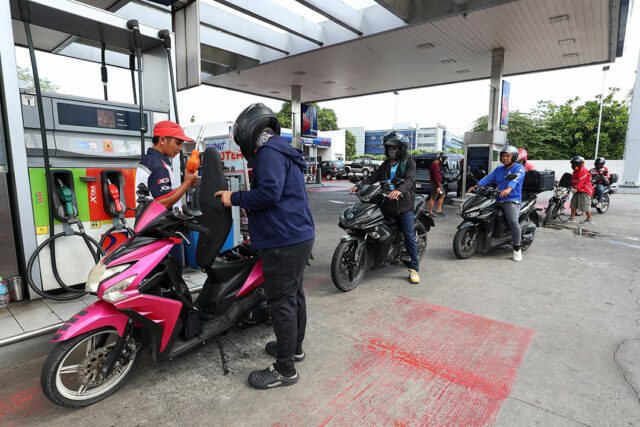
Motorcycle riders queue at a gasoline station in Quezon City. — PHILIPPINE STAR/MIGUEL DE GUZMAN

ENERGY SECRETARY Sharon S. Garin on Monday said that a new batch of diesel orders totaling 900,000 barrels are set to arrive in the country next month.

In a virtual press briefing on Monday, Ms. Garin said the Philippine government will receive 300,000 barrels coming from Malaysia and Singapore by early April, another 300,000 barrels from India by the middle of the month, and another 300,000 barrels from Oman by the end of April.

The new supply is expected to boost the country’s petroleum reserves, extending the current average supply to approximately 50.94 days.

“Even though we know that we have enough time to order or look for additional supply, we would like to remind the public that we need to be very prudent because we don’t know how long the war will last,” Ms. Garin said.

Monitoring from the Department of Energy (DoE) showed some oil companies are set to reduce gasoline prices by as much as P2.35 per liter, while some fuel retailers may raise gasoline prices by as much as P2.90 per liter. Diesel prices will increase by P4.50-P12.90 per liter while kerosene prices will go up by P1-P2.40 per liter.

Seaoil Philippines, Inc. will implement a one-time price increase of P12.50 per liter for diesel and P2 per liter for kerosene, beginning Tuesday morning. It will not adjust gasoline prices.

“For now, we’re holding off on gasoline price increases to give motorists a bit of relief where we can,” the company said.

Unioil Petroleum Philippines, Inc. and Petro Gazz will raise diesel prices by P12.50 per liter and gas prices by P2.50 per liter.

Petron Corp. will hike gasoline prices by P1.90 per liter, diesel by P11.90 per liter, and kerosene by P1.40 per liter, while Jetti Petroleum, Inc. will raise the price of diesel by P12.90 per liter and gasoline by P1 per liter.

The latest price adjustments have put a break on double-digit hikes for gasoline for the past three weeks. Diesel and kerosene, on the other hand, continue to see a steady uptrend in prices.

The rise in fuel prices will push the prevailing gasoline prices in the National Capital Region to nearly P115 per liter and diesel prices to as high as P156 per liter.

The Philippines is a net importer of crude oil and sources most of its supply from the Middle East, making the country vulnerable to global crude price swings.

To boost the country’s oil buffer, the government has moved to procure two million barrels of oil, with a budget allocation of P2 billion.

Last week, the Department of Energy (DoE) announced the arrival of the first shipment carrying 142,000 barrels of diesel, part of the 1.04 million diesel the government secured.

The Philippines has been under a state of national energy emergency due to global fuel supply disruptions and rising oil prices. — Sheldeen Joy Talavera

Petron turns to Russian oil, secures 2.48 million barrels amid disruptions

PETRON.COM

PETRON CORP., the country’s sole oil refiner, said it has secured 2.48 million barrels of crude oil from Russia to boost its petroleum product inventory until June.

In a statement on Monday, Petron said it may consider buying Russian crude again if the fuel supply disruption persists and it cannot source sufficient crude from other suppliers to augment the country’s fuel supply.

The company said procuring Russian crude oil is not its usual practice and that the purchases were made “out of extreme necessity” as an “extraordinary energy measure amid supply chain disruptions.”

It said it turned to sourcing from one of the world’s top exporters “only after exhausting all commercially and operationally viable alternatives.”

Petron said it encountered shipping constraints for a previous two-million-barrel crude oil order following the closure of the Strait of Hormuz, a key global oil transit route, amid escalating tensions in the Middle East.

The company said the first shipment was unable to pass through the strait, while the second shipment was canceled due to heightened risks in the Strait of Hormuz and the Red Sea.

As the country’s largest downstream oil player and sole refiner, Petron said the disruption in a key shipping route constrained it to procure Russian crude to help secure domestic fuel supply.

Petron’s refinery in Bataan has a capacity of 180,000 barrels per day and supplies about a third of the country’s fuel demand.

“A refinery shutdown for failure to secure crude would lead to serious nationwide fuel shortages, sharp price spikes, panic buying, disruption to transportation and logistics, and broader economic dislocation-outcomes that would have had serious consequences for households, businesses, and critical public services in a country that is highly dependent on imported fuel,” the company said.

The company said it coordinated with the Department of Energy and the Department of Finance, which encouraged oil firms to secure alternative sources of crude oil and finished products.

Petron also said it received confirmation from the Bangko Sentral ng Pilipinas in a March 12 letter that there are no domestic legal prohibitions on importing Russian crude oil.

The Philippines has been seeking alternative fuel sources as supply from the Middle East, a major oil-producing region, faces disruptions due to the ongoing conflict involving Iran.

The United States has temporarily eased certain sanctions on Russian oil to help increase global supply amid disruptions in key shipping routes.

Russian Deputy Prime Minister Alexander Novak earlier instructed the energy ministry to draft a resolution banning gasoline exports from April 1 to July 31, Reuters reported, citing state-run TASS news agency.

The Philippines was placed under a state of national energy emergency starting March 24 in response to risks to the country’s energy supply.

Petron President and Chief Executive Officer Ramon S. Ang earlier renewed an offer to sell the company back to the government as the country deals with supply issues and rising fuel prices. — Sheldeen Joy Talavera

MTerra Solar starts exporting power to grid

MGEN

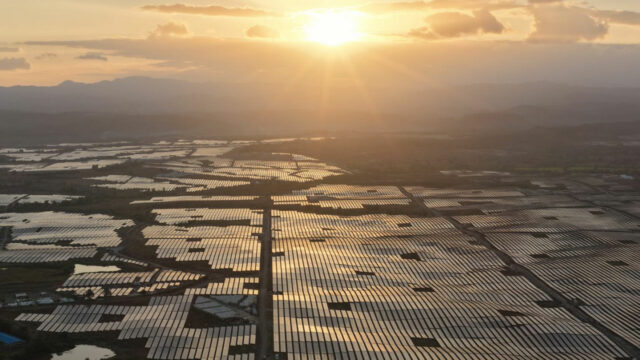
MTERRA SOLAR, the world’s largest battery-integrated solar power project, has begun exporting an initial 250 megawatts (MW) to the grid, Meralco PowerGen Corp. (MGEN) said.

In a statement on Monday, MGEN said MTerra Solar has also energized the first tranche of its battery energy storage system, allowing the plant to deliver up to 450 megawatt-hours (MWh) of energy to the grid at night.

“The project’s phased energization enables earlier delivery of capacity to the grid, helping ease supply constraints and supporting efforts to maintain stable electricity prices amid evolving global conditions,” MGEN President and Chief Executive Officer Emmanuel V. Rubio said.

MTerra Solar was initially authorized to export up to 85 MW of firm power to the grid as part of testing and commissioning activities.

Located across Bulacan and Nueva Ecija, the P200-billion MTerra Solar project is expected to generate up to 3,500 megawatt-peak (MWp) of solar power, supported by a 4,500-MWh battery energy storage system.

The project is being developed in phases, with full commercial operations targeted by 2027.

Once completed, the project is expected to generate enough clean energy to supply about 2.4 million households.

In a separate statement, the Department of Energy  said the project supports efforts to strengthen the country’s energy security amid continued volatility in global oil markets driven by developments in the Middle East.

“Every megawatt of domestic capacity that we bring into the grid strengthens our ability to withstand external shocks, protect consumers, and preserve system reliability,” Energy Secretary Sharon S. Garin said.

“Amid the Middle East conflict, accelerating the development of renewable energy and storage is both a strategic necessity and a national imperative,” she added.

MGEN is the power generation arm of Manila Electric Co. (Meralco), the country’s largest private electric distribution utility, serving more than 8.2 million customers in Metro Manila and nearby provinces.

Meralco’s controlling stakeholder, Beacon Electric Asset Holdings, Inc., is partly owned by PLDT Inc. Hastings Holdings, Inc., a unit of PLDT Beneficial Trust Fund subsidiary MediaQuest Holdings, Inc., has an interest in BusinessWorld through the Philippine Star Group, which it controls. — Sheldeen Joy Talavera

SEC to stand its ground on 9-year independent director term limit

Philippine Securities and Exchange Commission Chairperson Francis Ed. Lim

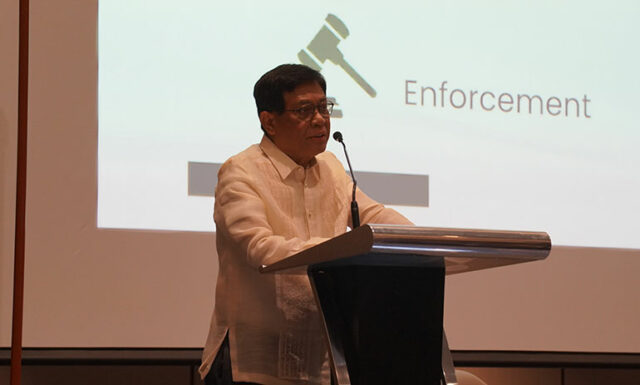
THE SECURITIES and Exchange Commission (SEC) said it will stand its ground on its nine-year term limit for independent directors, as it considers its response to a petition challenging the rule, which it said is meant to raise governance standards and restore investor confidence.

“We will stand our ground. Our people clamor against political dynasties — so our public companies must reject boardroom entrenchment. No double standards. We must raise our governance standards to restore investor confidence,” SEC Chairperson Francisco Ed. Lim said in a Viber message on Monday.

He said the regulator is preparing its response to the petition filed by GMA Network, Inc.

Last week, GMA Network said it filed a petition before a Makati court seeking to nullify the SEC’s rule imposing a nine-year term limit on independent directors of publicly listed companies.

“We must raise our governance standards to restore investor confidence. Our stock market has been falling behind. The time to act is now — and we call on everyone to step up for the sake of our country,” Mr. Lim said.

GMA Network said it filed a petition for certiorari on March 26 seeking to set aside the SEC’s memorandum.

The company is also seeking a temporary restraining order from the court to suspend the implementation of the rule while the case is pending. It said the memorandum would require it to replace two incumbent independent directors without sufficient time to conduct a full vetting process.

SEC Memorandum Circular No. 7, signed on Jan. 26, states that an independent director is elected for a one-year term and may serve for a maximum cumulative term of nine years in the same listed company.

The circular took effect on Feb. 1. Under the memorandum, independent directors elected before its effectivity are also covered by the nine-year limit, counted starting calendar year 2012. — Ashley Erika O. Jose

An apple pie showed the way to a slice of Eden

The Sanctuary’s altar is set against fine woodwork with the tilma of Our Lady of Guadalupe overhead

Story and photos by Anna Isabel C. Sobrepeña

PARADISE was lost through the bite of a forbidden fruit, but an apple pie opened the way to a garden that might have been a passageway to Eden.

The joyride to Tagaytay with my two sisters had no schedule or definite itinerary. We just needed to pick up our fourth sibling at half past eight in the evening after her workshop was done. Whim and spontaneity determined the course of our leisurely drive through the countryside. The idea of outlet shopping or passing by supermarkets evaporated with the changing landscape. We shed the city mindset and shifted to weekend mode on a surprisingly traffic-free Saturday.

PIONEER IN COUNTERCULTURE
There were two things we needed to buy for mom back home — freshly baked bread for her breakfast, and buko pie. It wasn’t just any coconut pie; the particular one she wanted was available in only one place in these parts but by the time we got there, all were sold out. Our quick alternative was an apple pie and that determined where we would have our late lunch.

It had been a while since my last visit to Gourmet Café, now renamed Gourmet Farms. If memory serves me, my late husband and I had enjoyed meals in a romantic, rustic setting — interiors of bamboo, wood, and thatched palm leaves, with the aroma of coffee wafting through. The design was reminiscent of tropical dwellings suited to the Philippine climate. I saw that that had certainly changed as we eased into a parking space of the updated establishment, an expansion born of a vision that owner Ernest Escaler had set out to do.

Ernest believed that Philippine coffee had a place in the world market and began trading Filipino beans abroad in the 1970s. By 1988, his company built the first commercial coffee roastery in the country. Not long after, he embarked on the farm-to-table concept in the country, another pioneering effort inspired by the popularity of the California Cuisine and Healthy Eating movement. It was a counterculture shift to promote fresh, organic, and locally sourced food that aimed to reduce the distance that food travels, connect consumers with farmers, support local livelihoods, and provide highly nutritious produce free from excessive processing.

Many expansions and innovations continued to widen the enterprise, but there was an overarching spirit that has prevailed over all these efforts, and it was enshrined in a very special place somewhere in the 11-hectare property.

BEYOND FARMING
We had lunch in a commodious dining room with a mix of different dining sets and art for sale on the walls. Russell, who attended our table, was also an artist although his works were not part of the exhibit. A salad section in the pleasant salon allowed diners to select their own ingredients to complement their meals. While we were enjoying our pasta and pizza, Ernest himself walked in with company. He had just come from the Sanctuary, a place he invited us to visit after we were done. We accepted and our guide, Ray, arrived came to take us there, providing wide-brimmed hats for cover from the afternoon sun.

We walked past beds of vegetables cultivated not just for the restaurant’s consumption but also for salad greens sold in supermarkets. Marigolds, a natural pesticide, bloomed brightly in another section. The sidewalk disappeared as we wound down the paved road through an undulating terrain. There was a whiff of pine from a towering tree on one side, a scent of happy memories. We reached a steel gate marked as The Sanctuary of St. Joseph. Ray unlocked the barrier, and we stepped into the heart of Gourmet Farms, Inc.

SAINT BY THE GATE
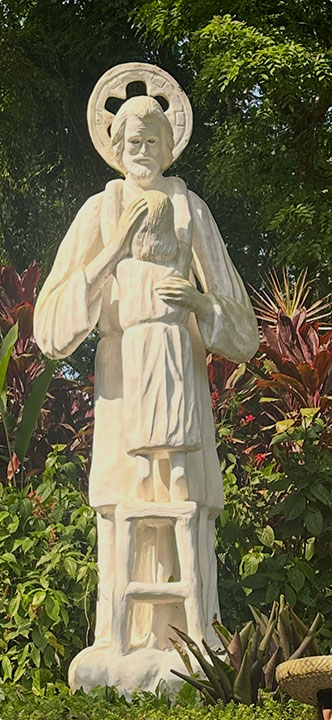
Right by the entrance was a log bench before a statue of St. Joseph, seemingly extending an invitation to sit and marvel. It provided a view of the vegetable patches outside the Tuscan-style gate. Towering over us was the kindly image of the venerated patron of the universal church, holding a child who stood on a stool, reaching up to be carried. It was such a loving and intimate depiction of the saint tasked to care for the Holy Family.

There was a peaceful stillness that opened the heart to a quiet joy. Bougainvillea leaned against the trunks of tall trees, blooming profusely in a shower of pink blossoms. Lush greenery lined a path, punctuating the grass carpet. Seven steps up led to a view of a pond with peace lilies blooming among the red, yellow, and green leaves of Baston de San Jose and San Francisco plants. Behind it were accommodations for those who wanted to spend more than a day in prayer.

A gazebo on the opposite side was fully covered by vines with little white flowers. Beneath this outdoor pavilion were 10 chairs around a table carved out of a tree, providing a resting place to write, reflect, or maybe have a cup of coffee or tea. If this had been all, it would have been enough to dispel weariness and refresh the spirit, but there was more.

SACRED LISTENING
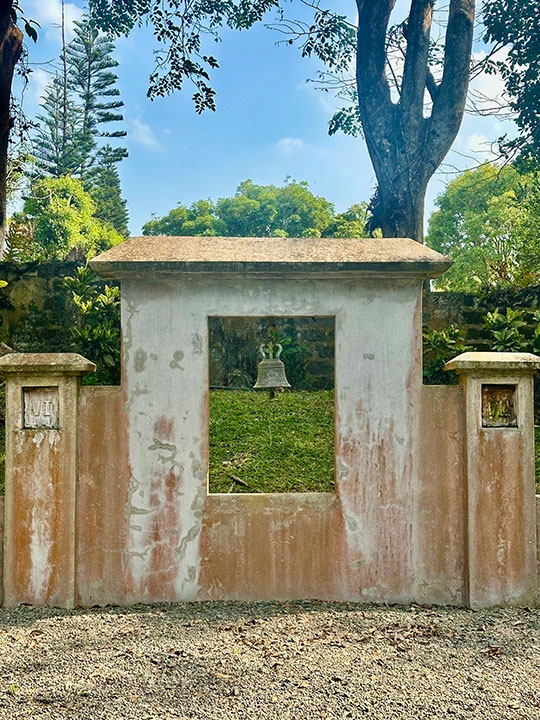
Steps away, the stone path leads past low walls topped with clay water jars, vessels that hold the life-giving source. An old-looking bell hangs on one side of the entrance, framed within a window in the wall. Beyond the walls stands a chapel, shaped like the octagonal Church of the Beatitude that had been built to mark where Jesus Christ gave His Sermon on the Mount.

Antique carved doors at the entrance opened into an intimate sanctum. The immediate response was to kneel before the altar, beside a tabernacle where a lighted candle burned. Even without the flame, I felt embraced by Divine Presence and serenity. A tilma of Our Lady of Guadalupe hung over the altar above the backdrop of lacework carving. The glass panel walls brought a sense of the natural world into the sacred space. Prayers of gratitude flowed, overtaking grief and tiredness.

Ernest had designed the Sanctuary. “It is the place for silence, where one can listen to God,” he said. “Nobody had more profound direct communication with God than St. Joseph.

“We do not advertise the place because we believe it is God who calls those whom He wishes to communicate with.”

I felt this truth in my heart and that He would even use an apple pie to lead the way to this holy place.

Dominion Holdings appoints Isidro Consunji as chairman

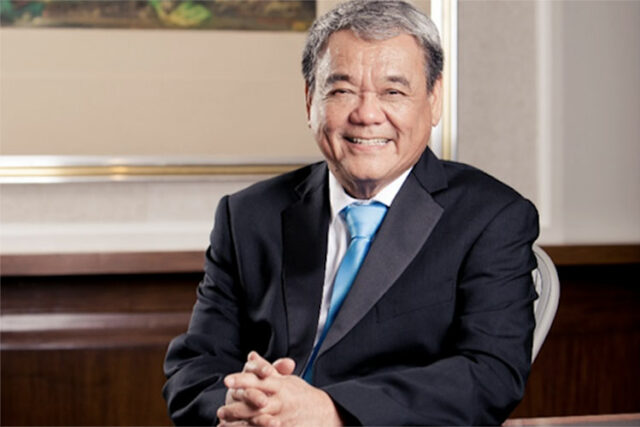
ISIDRO A. CONSUNJI — PHILSTAR FILE PHOTO

DOMINION Holdings, Inc. (DHI) said it has appointed Isidro A. Consunji as chairman of the board.

The appointment followed the board’s acceptance of former chairman Frederic C. Dybuncio, who will remain as company president, the company said in a disclosure to the stock exchange on Monday.

Mr. Consunji has served as chairman and president of DMCI Holdings, Inc. since March 1995.

He is also chairman of Semirara Mining and Power Corp. and a director of Atlas Consolidated Mining and Development Corp.

In earlier disclosures, DHI said it plans to expand its asset portfolio following the sale of all of BDO Unibank, Inc.’s shares to Monte Sur Equity Holdings, Inc.

Under its new owners and board, DHI said it intends to continue operating as a holding company focused on investments in mining corporations, including acquiring shares in firms with mining operations.

DHI, formerly BDO Leasing and Finance, Inc., previously held real estate properties, securities or shares of stock, and other assets, and engaged in investment and related business activities.

Mr. Consunji holds a Bachelor of Science in Engineering degree from the University of the Philippines. He also earned a Master of Business Economics from the Center for Research and Communication and a Master of Business Management from the Asian Institute of Management.

He also completed the Advanced Management Program at IESE Business School in Barcelona, Spain.

The board also approved the appointment of Tephanie M. Gandia as assistant corporate secretary. She will continue to serve as corporate information officer.

Ms. Gandia is a practicing lawyer specializing in corporate law, mergers and acquisitions, banking, and capital markets. She is also a partner at Serrano Law.

DHI reported a 31.05% decline in net income to P139.36 million in 2025 from P202.12 million in 2024. — Aaron Michael C. Sy