
How PSEi member stocks performed — August 22, 2025
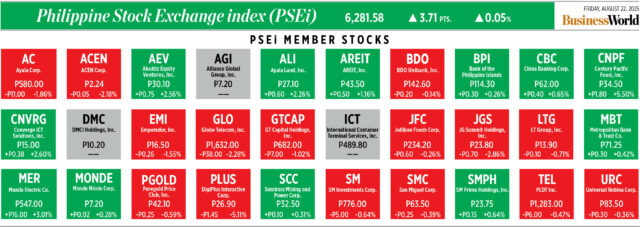
Here’s a quick glance at how PSEi stocks fared on Friday, August 22, 2025.


Here’s a quick glance at how PSEi stocks fared on Friday, August 22, 2025.

PHILIPPINE STOCKS inched higher on Friday after the country’s investment-grade rating was affirmed and on bargain hunting.
The benchmark Philippine Stock Exchange index (PSEi) went up by 0.05% or 3.71 points to close at 6,281.58, while the broader all shares index increased by 0.06% or 2.44 points to 3,737.58.
“The local market posted gains on the back of bargain hunting. Investors also appreciated Rating and Investment Information, Inc.’s (R&I) affirmation of the Philippines’ “A-” credit rating with a stable outlook,” Philstocks Financial Inc. Research Manager Japhet Louis O. Tantiangco said in a Viber message. “Finally, hopes of a Bangko Sentral ng Pilipinas (BSP) rate cut [this] week helped in lifting the bourse.”
R&I on Wednesday affirmed the Philippines’ investment-grade “A-” rating with a stable outlook as it said it expects sustained economic growth and improving incomes amid “robust public and private investments, development of domestic business such as information technology and business process management industry, and population growth.”
For the first half, Philippine economic growth averaged 5.4%, slightly below the government’s 5.5% to 6.5% target for this year.
Meanwhile, BSP Governor Eli M. Remolona, Jr. earlier said that a rate cut is “quite likely” at the Monetary Board’s Aug. 28 meeting amid easing inflation.
If realized, this would be the BSP’s third straight reduction since April. The Monetary Board has lowered benchmark interest rates by a cumulative 125 basis points since it began its easing cycle in August 2024, with the policy rate now at 5.25%.
Meanwhile, week on week, the PSEi dropped by 0.54% or 34.35 points from its 6,315.93 close on Aug. 15, marking its second straight week of decline.
“Without any positive catalyst, the local market succumbed to bearish pressures, leading to an extended decline in last week’s trading. This is the first week since June 9 to 13 that the market continued in a certain direction,” Mr. Tantiangco said. “The local market remains undervalued fundamentals-wise. As of last week’s closing, the PSEi’s price-to-earnings ratio is at 10.8 times. This is below its five-year historical average of 17.3 times and the regional average of 17.6 times.”
The majority of sectoral indices closed higher on Friday. Property went up by 1.02% or 24.69 points to 2,444.46; industrials rose by 0.89% or 80.98 points to 9,112.92; mining and oil climbed by 0.46% or 44.09 points to 9,489.24; and financials increased by 0.09% or 1.91 points to 2,116.45.
Meanwhile, holding firms declined by 0.8% or 42 points to 5,205.46 and services retreated by 0.35% or 8 points to 2,276.18.
Value turnover rose to P6.44 billion on Friday with 803.64 million shares traded from the P5.76 billion with 1.07 billion shares exchanged on Wednesday.
Decliners beat advancers, 97 versus 93, while 50 names were unchanged. Net foreign selling was at P721.91 million on Friday versus the P161.83 million in net buying recorded on Wednesday. — Revin Mikhael D. Ochave

THE Philippine Exporters Confederation, Inc. (Philexport), said the export targets set by the Philippine Development Plan (PDP) will be difficult to achieve if the US imposes tariffs on semiconductors.
“The Philippine Export Development Plan (PEDP) was not achievable… so we adapted the PDP (target), which is lower,” Philexport President Sergio Ortiz-Luis, Jr. told reporters last week.
“That is the target we are now following; officially we haven’t changed the target, but that is what we are looking at, and even that is difficult to achieve … I am not even sure if we will meet it, because exports of electronics to the US will drop,” he added.
Under the PEDP, Philippine merchandise and services exports are projected at $163.6 billion in 2025. The corresponding PDP target was initially $113.42 billion, rising to $115.49 billion in the midterm PDP update.
This month, US President Donald J. Trump said he will be imposing a levy on semiconductors entering the US market in a bid to revive US chip production.
“We are very worried. We hope that there will be some breaks, but it is quite dim at the moment. We were hoping that electronics would save us, but I think our major competitors have lower tariffs, and that is the problem,” Mr. Ortiz-Luis said.
He said the hope is for Philippine chip exports to be exempt but noted that the Philippines has little leverage with nothing to offer the US.
“We might have to change our geopolitics because we are being left behind by our neighbors,” he added.
He said exporters have been trying to diversify their markets for the last 20 years but are failing due to lack of support.
“Our neighbors have complete support for research and development, policy, and promotions. If there are export exhibitions, our exporters won’t join because… our booths will look pathetic,” he said.
“Unless the government seriously says we will support exports and really puts money into it… I don’t see anything happening,” he added.
However, he said that the free trade agreements (FTAs) are helping cushion the impact of the US tariff.
“At least here in ASEAN, Korea, and Japan, the FTAs are helping somewhat, but we only have about four, and the others have more,” he said.
Aside from the US, he said that the other potential big markets for Philippine exports are Greater China and Japan. — Justine Irish D. Tabile

THE Maharlika Investment Corp. (MIC) said it signed an agreement with Saudi Arabian energy company ACWA Power to develop renewable energy (RE) projects for off-grid locations in the Philippines.
“No specific island was targeted yet. We’re doing our assessment on which to aim at first,” MIC President and Chief Executive Officer Rafael D. Consing, Jr. told BusinessWorld via Viber.
The memorandum of understanding (MoU) signed on June 30 allows both parties to explore the development of renewable energy and energy storage projects for off-grid Philippine islands.
In a separate statement, ACWA Power said the collaboration involves joint technical, commercial, and financial studies to assess the feasibility of developing power generation and energy storage infrastructure in the islands.
“These studies will identify potential project sites, system sizing, transmission requirements, and offtake arrangements,” ACWA Power said.
ACWA Power operates as a developer, investor, and operator of renewable energy and green hydrogen projects. It is also the world’s largest private water desalination company.
“We are excited to partner with Maharlika Investment Corp. in exploring renewable energy solutions for communities in the Philippines. This MoU reflects our shared commitment to inclusive energy access and sustainable development,” ACWA Power Chief Investment and Development Officer Thomas Brostrøm said.
Ahead of the MoU signing, Meralco Powergen Corp. (MGen), the power generation subsidiary of Manila Electric Co. (Meralco) entered into a partnership with ACWA to jointly explore solar power development opportunities in the Philippines and across Southeast Asia.
The partnership was formalized on the sidelines of the ASEAN Summit in Kuala Lumpur.
MIC said it has deployed a portion of its P75 billion in funding and the balance will be invested within the year.
In January, the MIC signed a deal to acquire a 20% stake in Synergy Grid & Development Phils., Inc. for P19.7 billion or about P15 per preferred share, giving it a “foothold” in the National Grid Corp. of the Philippines. — Aubrey Rose A. Inosante

THE Energy Regulatory Commission (ERC) is proposing to amend the rules governing the power supply agreements (PSA) of distribution utilities and power suppliers to streamline the approval process to shore up investor confidence.
In a draft resolution, the ERC said the proposed changes are meant to expedite resolution of PSA applications and facilitate the entry of new generating capacities to support growing demand.
A PSA is a contract entered into by a distribution utility (DU) and a power supplier to procure a certain capacity for a price as a result of a competitive selection process (CSP). The CSP policy requires DUs to procure power through a transparent bidding exercise to secure least-cost supply.
One of the ERC’s proposed amendments is the immediate approval of the lowest bid under the executed PSA resulting from the CSP, as long as it complies with the guidelines and shows no indication of anti-competitive behavior.
Meanwhile, for PSAs resulting from direct negotiation, the ERC will review for reasonableness in terms of costs, risk allocation and other contractual terms “to ensure compliance with the least-cost obligation of the DU.”
Republic Act No. 9136 or the Electric Power Industry Reform Act of 2001 tasks the ERC with promoting competition, encouraging market development, and expanding consumer choice in the electric power industry.
The law also requires the Department of Energy (DoE) to facilitate and encourage reforms in the structure and operations of DUs for greater efficiency and lower costs.
In 2015, the DoE issued a circular requiring DUs to undergo CSP in securing their PSAs to ensure “transparent and reasonable prices of electricity in a regime of free and fair competition and full public accountability.”
In a recent open commission meeting, ERC Chairman and Chief Executive Officer Francis Saturnino Juan questioned the agency’s current evaluation methodology for PSAs.
He said the ERC still reviews rates based on cost-based methodology, even if contracts came via tendering or selection processes.
“Is our failure to honor the result of the CSP conducted in accordance with the DoE circular a violation of the DoE circular itself?” he said.
Mr. Juan said backlogs may affect investor confidence as they could end up not pursuing the power supply contracts because the bids are not honored.
“Maybe it is high time that we engage the stakeholders on a possible amendment to our existing guidelines,” he said. — Sheldeen Joy Talavera
LOCAL government units (LGUs) have signified their interest in building new economic zones (ecozones), according to the Philippine Economic Zone Authority (PEZA).
In a Facebook post, PEZA Director General Tereso O. Panga said that these include Naga City, Los Baños City, and San Pablo City.
“We certainly welcome these new host LGUs to join the PEZA network of 427 operating ecozones (and counting) all over the country,” he added.
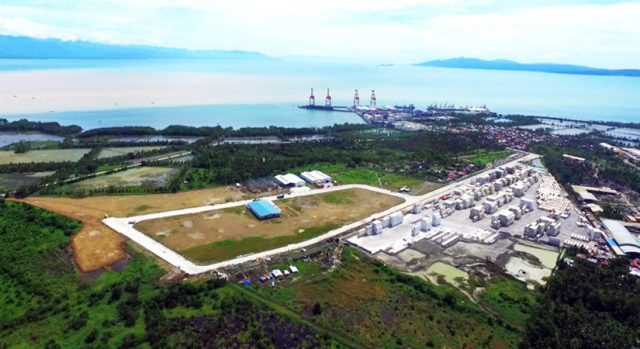
This week, he said PEZA visited three proposed ecozones in San Andres, Quezon (135 hectares), Pamplona, Camarines Sur (60 hectares), and Libon, Albay (40 hectares) to conduct due diligence and hold consultation meetings.
“These three ecozones are strategically located along the Bicol and Bondoc Peninsulas, fronting the Ragay Gulf — the third-largest gulf in the Philippines,” he said.
“By providing for port connectivity among San Andres, Pasacao, and Pantao ports, this will stimulate regional economic growth, as the goods produced and raw materials needed in the ecozones can be facilitated through barge deliveries,” he added.
He said the ports can serve as gateways for domestic and international commerce, tourism, and inter-island transportation.
He expects more LGUs to embrace ecozones to spur growth with the Philippines continuing to be one of the best-performing economies in the region.
“The Philippine economy could be boosted if business activities flourish in the ecozones as well as their linkages to the domestic market. This is where PEZA and host LGUs can collaborate in promoting and facilitating ecozone investments to accelerate our countrywide development,” he said.
As ecozones in rural and new growth areas are created, he said LGUs must draft investment codes, transform digitally, and develop human resources, infrastructure, and local supply chains to enhance their capacities and attract locators.
“All these key reforms will factor in as competing LGUs vie to host ecozones and locator industries to generate additional income, jobs, livelihood, and other economic opportunities for their constituents,” he said.
“It is already a proven fact that when ecozones exist in LGUs, it becomes a boon to their community as it generates new ancillary and complementary micro, small, and medium enterprises, service companies, and transport service opportunities that each ecozone spurs with its creation,” he added.
Citing a survey by the Philippine Statistics Authority, PEZA said that almost all the top 10 performing LGUs host ecozones.
“The bigger the number of ecozones and locator companies in a certain city or municipality, the higher is its level of socio-economic progress as compared to those LGUs that do not host any ecozones,” Mr. Panga said.
To date, 34 ecozones have been proclaimed under President Ferdinand R. Marcos, Jr., accounting for P14.7 billion in capital investment. — Justine Irish D. Tabile

THE Department of Agriculture (DA) said it is updating the cacao industry roadmap to focus on global branding and climate-resilient varieties to address the impact of climate change in the main supplier countries.
The cacao strategy will focus on “increasing production, developing processing facilities, and expanding markets while promoting sustainable and ethical sourcing practices,” the DA said in a statement.
Cacao accounted for P1.78 billion of the crop sector last year by value of production.
“The roadmap also encourages greater private sector investment to solidify the Philippines’ position as a global supplier of quality cacao,” it added.
The DA said cacao should be a “driver of rural employment, farmer income, and sustainable investment.”
It said it is developing a globally recognized “Bicol Cacao” brand, “one that’s rooted in quality, climate-smart practices, and community empowerment.”
The DA said the global market context “adds urgency and opportunity,” as the cocoa bean market is valued at approximately $14 billion and is projected to grow to $17 billion by 2030.
It noted that supply disruptions caused by climate change and new European regulations banning beans from deforested land have led to soaring prices of cocoa — the fermented version of cacao and main ingredient to making chocolate — peaking at over $12,000 per ton last year from $3,200 two years earlier.
The bulk of the global supply comes from Ivory Coast, Ghana, Nigeria and Cameroon.
These shifts open the door for naturally grown, climate-resilient cacao from the Philippines “to gain ground,” the DA said.
“Our targets are bold: higher yields, better incomes, and a stronger global footprint,” it said.
“But at the core is something deeper — empowering our farmers and inspiring the next generation to see cacao not just as tradition, but as a thriving, future-ready enterprise,” it added.
“The surge in cacao’s value reflects rising demand and improved farmgate prices, further underscoring its growing economic potential,” the DA said. — Kyle Aristophere T. Atienza

THE Asian Development Bank (ADB) said pension reforms are needed to protect the elderly from falling into poverty, with the elderly expected to account for one-fifth of the Philippine population by 2066.
In a working paper released in July, the bank also estimated the 60 and above age cohort to make up 10% of the population by 2029.
“The Lao People’s Democratic Republic (Lao PDR), the Philippines, and Timor-Leste will be the last three Southeast Asian economies to reach the milestone of older people constituting 10% of the population,” it said.
The ADB said Singapore and Thailand hit the 20% milestone in 2020. Brunei Darussalam and Vietnam are expected to hit 20% by 2037.
“There is a clear need to strengthen social protection systems, particularly pension and healthcare services, to support the needs of the growing population of older people and minimize their risk of falling into poverty,” it said.
Government Service Insurance System, the Social Security System, the Social Pension for Indigent Senior Citizens (SPISC), Philippine Health Insurance Corp. (PhilHealth) health insurance, and senior citizen discount and tax incentives remain available, but the population still have low to minimal access, the ADB said.
“The healthcare infrastructure will face mounting pressure to expand long-term care services while managing the growing burden on the PhilHealth system and public health facilities,” it said.
According to the 2026 National Expenditure Program, the government allocated P53.2 billion for PhilHealth in 2026 after granting it no subsidies this year.
The Department of Health was allocated P320.5 billion in next year’s budget, up 29%.
With healthcare costs expected to surge, the ADB urged the government to focus on increasing access to affordable healthcare and improvements in preventive care.
“The existing PhilHealth health insurance coverage may not be sufficient to cover the healthcare costs of older people,” the ADB said.
“With life expectancy projected to improve by 2050, healthcare systems are expected to experience increased demand, creating a need to strengthen existing infrastructure to ensure accessible care for older people,” it added.
Another challenge for the suggested reform is the expansion and accessibility of pensions especially for older people who were previously informal workers, older women, and those from the lowest income categories, it said.
Currently, these demographics are marginalized and underserved by the system, the ADB said.
At the same time, the ADB warned that poverty rates increase as individuals age. This vulnerability is also coupled by the higher essential spending for their food and healthcare, and lower asset ownership.
Citing 2021 Philippine Family Income and Expenditure Survey, the bank said 4.4% of older individuals in the 60–64 age group face extreme poverty.
The corresponding rate for those in the 65 to 69 age group was 5.2%. For the 70 to 74 cohort, the rate was 6.7%.
The 75 and over age group has the highest rate of extreme poverty at 8.1%. It also has the highest percentage in the moderately poor category, at 29.9%, compared to other age groups. — Aubrey Rose A. Inosante

IN BRIEF:
• Philippine organizations are continuously advancing towards transitioning to more renewable energy sources while also considering fairness to its end-users.
• Businesses have implemented various strategies and innovations in transitioning to more just energy operations.
Amid the increasing demand for energy accompanying a developing economy, both the public and private sectors in the Philippines continue to advance the transition toward a sustainable, energy-independent economy, adhering to the principles of a ‘Just’ Energy Transition (JET).
JET entails promoting social well-being, including the protection of vulnerable groups, while achieving cleaner and more efficient models to safeguard environmental integrity and create opportunities for new economic growth.
Bringing together industry leaders, policymakers, and sustainability experts, the SGV Knowledge Institute, together with SGV Sustainability, hosted a conference, “Building a Sustainable Future Through Just Energy Transition.” The event covered innovative strategies, best practices, and collaborative frameworks in both the supply and demand side of the power sector. The sector seeks to achieve its ambition to aid economic stability by reducing dependence on global market volatilities tied to imported fuel.
Achieving a just transition requires prioritizing energy independence. Driving investment to utilize indigenous and renewable energy sources is essential for reducing the Philippines’ reliance on volatile fossil fuel imports. The economic implications of relying on external sources for traditional energy components were also highlighted. In July, fuel imports amounted to $1.40 billion or over 12% of total imports, equivalent to more than one-third of the trade deficit.
The conference emphasized the vulnerability and volatility of the Philippine energy system to spikes in energy prices, driven by external factors such as global market shocks, supply constraints, geopolitical tensions, and currency fluctuations. These factors have further triggered increases in interest rates and the cost of capital, while simultaneously reducing foreign investment interest. By diversifying and developing indigenous renewable resources, we can strengthen supply resilience, energy affordability, and accessibility, thereby paving the way for a JET.
SUPPLY-SIDE INNOVATION
Keynote speaker Felix William Fuentebella, Undersecretary of the Department of Energy, highlighted the strategic direction of ‘ARC’: Access and Affordability, focusing on energy provisioning; Reliability and Resiliency of energy infrastructure; and Clean and Sustainable Energy. This approach aims to increase renewable energy capacity and address the energy trilemma of security, affordability, and sustainability. By creating a balance between energy growth, access, and cost, it advances energy self-sufficiency and accelerates the transition to renewable energy usage.
In their respective presentations, a speaker from a regional multilateral development bank highlighted support for indigenous energy such as geothermal through the Geothermal Resource De-Risking Facility, allowing for a financing mechanism and tool to augment risk implications associated with geothermal exploration. Through its financing services, the bank remains committed to helping the Philippines meet climate goals while ensuring inclusive and sustainable development.
On the other hand, ACEN Corp., one of the key players in the energy industry, highlighted the rapid expansion of renewable energy capabilities in both the Philippines and in the Asia-Pacific (APAC) region, while pioneering innovative financing instruments such as transition credits and the Energy Transition Mechanism (ETM).
ACEN highlighted the significant impact of having clean, reliable, and affordable energy. It noted that renewable energy ensures energy pricing stability, unlike traditional sources that are affected by volatile global markets. Additionally, ACEN emphasized the importance of keeping a long-term mindset for both consumer and investors, citing that while traditional coal may still be cheaper in the present, the volatility of coal prices may cause rising costs in the future.
Meralco PowerGen (MGen) President and CEO, Emmanuel V. Rubio, highlighted the importance of addressing the Energy Trilemma (Security, Affordability, and Sustainability), with initiatives such as the MTerra Solar project and LNGPH facility. MTerra is set to be the world’s largest integrated solar photovoltaic (PV) and battery energy storage system (BESS) facility, and LNGPH, the country’s first and most expansive LNG facility to date, reaffirms commitments to further integrate renewable energy initiatives in operations.
REALIZING VALUE IN THE NEW ENERGY ECONOMY
In the latter part of the program, a speaker from a large global development institution emphasized that sustainability is not only a corporate responsibility but a competitive advantage. The institution’s climate-smart investment opportunities in the Philippines were introduced through their 30-by-30 Zero Program, which aims to help financial institutions scale their climate-related lending to 30% of their portfolios while reducing coal exposure to near zero by 2030.
According to Dennis Ng, CEO and Founder of Mober Technology Pte., Inc., Mober’s sustainable journey is embedded in the group’s logistics strategy, powering the country’s green logistics revolution. Mober offers its electric vehicle (EV) fleet mobility solutions to business-to-business (B2B) customers, which helps them curb their scope 1 emissions while also offering the services at price parity compared to non-renewable energy-based logistics service providers. Its zero-emission last-mile delivery for a low-carbon economy aims to optimize e-mobility and increase the integration of renewable energy in logistics operations, while addressing climate and social risks and impacts of going green. Mober’s approach to sustainability transformation is partnering with industry leaders and small trucking companies to make green logistics easier to enter.
LOOKING AHEAD
Indigenous energy sources such as tidal, solar, and wind energy are among the most common renewable sources of energy. However, these energy sources can be disrupted depending on environmental events. Through continuous innovation and emerging technologies such as green hydrogen and nuclear energy, such limitations will be circumvented. Innovations in energy sources will further aid the transition and capacity addition through supporting intermittency commonly attributed to renewable sources, and being able to electrify and decarbonize hard-to-abate sectors.
In parallel, the energy transition demands a shift in consumption, with greater focus on operational efficiency through the reduction of energy waste, such as through strategic electrification of facilities and fleets.
However, achieving JET will require substantial financial investments, with large-scale infrastructure projects often being prohibitive for the private sector to undertake on its own. De-risking support from financial institutions through innovative financing mechanisms such as carbon credits, sustainability-linked loans and guarantees are essential, accompanied by stakeholder capacity building. Supporting communities reliant on the fossil fuel industry necessitates investments in retraining, social safety nets, and development to ensure an equitable transition.
For private and industry leaders, the energy transition is not only a risk mitigation strategy through emissions reduction. It also presents a strategic opportunity in securing a sufficient, reliable energy future, fostering energy resilience in the country. Diverting away from import dependence towards energy independence further strengthens the Philippine energy system, removing volatility and dependencies from global and external knock-on effects, and instilling foreign investor confidence through stable energy market prices.
Strategic planning and innovation are essential alongside the support of expert guidance to navigate challenges and considerations toward a just energy transition. By leveraging professional expertise and experience, businesses can take advantage of the opportunity presented while adapting to regulatory and policy changes.
This article is for general information only and is not a substitute for professional advice where the facts and circumstances warrant. The views and opinions expressed above are those of the authors and do not necessarily represent the views of SGV & Co.
Benjamin N. Villacorte is the sustainability leader, and Bonar A. Laureto is a sustainability principal, both of SGV & Co.

By Chloe Mari A. Hufana and Kenneth Christiane L. Basilio, Reporters
TENSIONS in the South China Sea could intensify in the coming months as China weighs possible military and economic countermeasures against the Philippines, following Manila’s deepening security cooperation with Australia and Canada, political analysts said.
The move signals a strategic recalibration by the Philippines, but also risks provoking a more assertive response from Beijing, they added.
Josue Raphael J. Cortez, a diplomacy lecturer at De La Salle-College of St. Benilde, said Beijing is likely to interpret the recent trilateral naval drills involving the Philippines, Australia and Canada as a direct challenge to its dominance in the contested waters — one of the world’s busiest maritime routes.
“We can expect that Beijing will further undertake maneuvers geared towards showing its might and reinforcing its strategic position within the disputed waters,” he said in a Facebook Messenger chat. “Although the Philippines and Australia do not view such joint operations as a clarion call for armed conflict, China may view it otherwise.”
On Saturday, the three nations conducted joint naval drills in the South China Sea, off the coast of El Nido, Palawan province. The exercises formed part of Exercise Alon (wave) 2025, which Canberra has identified as its biggest military engagement of the year. The drills came just days after the second Philippines — Australia defense ministers’ meeting in Manila.
During the meeting, Philippine Defense Secretary Gilberto C. Teodoro, Jr. and Australian Deputy Prime Minister Richard Marles reaffirmed their countries’ commitment to deepening defense cooperation, underscoring the 2016 international arbitral ruling that voided China’s sweeping claims over the South China Sea.
While the Philippine government maintains that these drills are not designed to provoke China, Mr. Cortez noted that Beijing could interpret them as an aggressive move, prompting it to scale up both military and economic pressure.
“The Australian Defense secretary himself has argued that it is the shared desire of our two countries is to propel their military and defense partnership, with Exercise Alon being Australia’s largest joint exercise this year,” Mr. Cortez said.
The Philippines and Australia are expected to formalize a bilateral defense partnership the next year — a development likely to factor into Beijing’s strategic calculations.
Analysts think China’s response might not be limited to naval activities. Mr. Cortez noted that Beijing, as the Philippines’ biggest trading partner, could use economic tools such as trade restrictions or travel advisories to pressure Manila.
“China may employ economic levers to show discontent,” he said. “But it is not something that would heavily debilitate our ties and the Philippine economy in general — with tourism as a prime mover in its entirety — as we have diversified our trade ties with like-minded nations in recent years.”
He added that while tourism remains a significant economic driver, the Philippines’ growing trade relationships with countries like Japan, South Korea, and the US offer alternative economic pathways.
Manila and Canberra reaffirmed commitments under their status of visiting forces agreement and mutual logistics support arrangement. These frameworks will facilitate more regular joint operations, logistics exchanges and interoperability between their armed forces.
Exercise Alon is now regarded as the flagship bilateral drill between the two countries, complementing the Philippines’ participation in Australia’s Talisman Sabre 2025.
The two sides also committed to holding a third defense ministers’ meeting next year to deepen cooperation.
Meanwhile, defense analysts urged the Philippine government to consider expanding its joint maritime drills with partners beyond the South China Sea to include other vulnerable maritime zones such as the Luzon Strait, located between northern Philippines and Taiwan.
“An expansion of maritime cooperative activities (MCA) is beneficial for the country’s defense posture,” Sherwin E. Ona, a security analyst and associate professor at De La Salle University, said in a Viber message. “MCAs should include the Luzon Strait and other maritime areas where there are vulnerabilities.”
The Luzon Strait has recently become a hotspot for Chinese activity, with Philippine authorities confirming the presence of Chinese coast guard vessels and research ships near Mavulis Island in Batanes Province, which lies just 140 kilometers from Taiwan’s southern coast.
Defense experts warned that treating the waters off northern Luzon as “off limits” for maritime cooperative activities due to potential Chinese sensitivities could send the wrong signal.
“It’s important for the Philippines to be clear that its maritime domain is large and it is committed to defending all of it,” Raymond M. Powell, a fellow at Stanford University’s Gordian Knot Center for National Security Innovation, said via Messenger chat. “If it treats its northern region as off limits simply because China will interpret it as provocative, it then sends the message that Beijing has veto power over what the Philippines does in its own waters.”
Rear Admiral Roy Vincent T. Trinidad, spokesman for the Philippine Navy, last week said the Philippines is looking at boosting its “defense diplomacy efforts” when asked about the possibility of expanding areas where joint naval exercises could be held.
“We do not announce in advance our forthcoming activities or operations,” he told a news briefing. “But the moment that these are finalized by all parties, then the appropriate guidance will be issued.”
While international partnerships provide short-term deterrence and diplomatic leverage, former Navy officer Rommel Jude G. Ong, now a professor at the Ateneo de Manila University, cited the importance of building up independent capabilities.
“I look at sustained naval presence and conduct of sea exercises in Luzon Strait as a way to assert our sea control and deter China from even thinking of extending their encroachment in our northern exclusive economic zone,” he said via Viber. “Our navy is capable of conducting unilateral patrols.”
He noted that while MCAs serve a diplomatic function, they are conducted only periodically. What’s needed, he said, is a round-the-clock naval presence.
Chester B. Cabalza, founder of the think tank International Development and Security Cooperation, cited the need for strategic depth through alliances. “The goal is continuity of joint naval exercises to elevate maritime security and the rules-based order.”
Mr. Ona cited the need to upgrade Subic Bay into a logistics hub that could support larger multinational forces. He also advocated for strengthening area denial capabilities through investments in advanced missile systems such as India’s BrahMos and the US-made High Mobility Artillery Rocket System (HIMARS).
“We need to understand that MCAs are part of a broader deterrence strategy,” he said. “Having a solid logistics hub is necessary for this purpose.”

By Chloe Mari A. Hufana, Reporter
PRESIDENT Ferdinand R. Marcos, Jr. on Sunday flagged a P260-million rock-shed project in Tuba, Benguet, calling it “useless” and suggesting it might be a case of economic sabotage due to substandard construction.
The President inspected the site with Baguio City Mayor Benjamin B. Magalong and found that the infrastructure had failed to serve its purpose.
He said the slope protection measures collapsed almost immediately after the project was completed, failing to prevent landslides during Typhoon Emong and monsoon rains on July 25 and 26.
The supposed slope protection has disintegrated, Mr. Marcos said, adding that the project had no visible impact in protecting motorists or surrounding communities.
The rock-shed project was implemented by the Department of Public Works and Highways — Cordillera Administrative Region and marked as completed on April 13 along the landslide-prone Kennon Road.
The project aimed to shield motorists from rock falls, but its rapid deterioration has prompted questions over accountability and corruption.
The President noted the project’s failure not only posed risks to public safety but also had a direct economic impact on the local community.
“We are talking to the mayor about the effect on businesses,” he told reporters in Filipino, adding that livelihoods were lost because of it.
The President labeled the project’s failure as potential economic sabotage, citing the cost of remedial works that may reach up to P500 million.
“You took P260 million, and we saw no effect from the contract that was carried out,” he said. “To fix the problem you gave us, it will cost another P260 million — probably even double that.”
Mr. Marcos reiterated his administration’s commitment to strengthening transparency and accountability in public infrastructure spending — a key priority underscored in his fourth State of the Nation Address (SONA) on July 28. He vowed not to leave office without addressing corruption in public works.
“If there’s one thing I will not leave this office without fixing, it’s this issue,” he said. “This is already our fifth inspection, and it’s always the same,” he added, expressing frustration over repeated infrastructure failures.
The President also raised concerns about other flood control initiatives, particularly the continued use of rock netting, a method he said has long been linked to corruption and is prohibited.
Despite this, rock netting continues to be used, with materials reportedly overpriced by more than 300%.
“The price of rock netting is P3,200, but what was charged to the government was more than P12,000 — four times higher,” he said. “So, 75% of the contract was taken as a kickback. That’s the situation we are facing. That’s why this is serious.”
Mr. Marcos stressed the need for consultations with local government units (LGU) before infrastructure projects are approved, criticizing practices that bypass LGU participation.
He called for the restoration of the consultation and acceptance process to ensure projects truly benefit local communities and uphold transparency.
Acceptance from LGUs and communities used to be required, the President said, adding that it needs to come back.
His statements reflect a broader push for reforms in the public works sector, as his administration boosts efforts to eliminate wasteful spending and corruption in government infrastructure projects.

THE Court of Tax Appeals (CTA) ordered the Bureau of Internal Revenue (BIR) to stop enforcing a 1991 Marcos estate tax assessment against P8.6 billion worth of San Miguel Corp. (SMC) shares registered under the late tycoon Eduardo M. Cojuangco, Jr.
The tax court’s first division ruled the shares are Mr. Cojuangco’s exclusive property and not part of the Marcos estate, calling the BIR’s collection efforts “arbitrary, capricious, and whimsical.”
It added the Bureau’s attempt to seize the stock placed unrelated shareholders at risk of being held liable for a tax obligation owed by a different taxpayer.
“Respondent’s (BIR) unfounded persistence in pursuing collection against the Cojuangco SMC shares, despite their exclusion from the decedent’s estate, shows arbitrariness, capriciousness, and whimsicality, amounting to grave abuse of discretion,” the 60-page ruling released to the public on Aug. 14 read.
“The Court is constrained to intervene, as respondent’s actions place individuals who are not parties to the tax assessment, such as Cojuangco and other shareholders, at risk of being held liable for a deficiency estate tax owed by a different taxpayer,” the ruling penned by Justice Lanee S. Cui-David added.
“All told, there is no showing that the Marcos Estate owns the Cojuangco SMC Shares, or any shares in SMC for that matter. This is further bolstered by the fact that SMC’s corporate records show that no SMC share has ever been registered under the name of President [Ferdinand E.] Marcos, Sr.”
The court ruled that neither the Cojuangco SMC shares nor the Coconut Industry Investment Fund (CIIF) block of SMC shares can be used to settle the Marcos estate’s tax liabilities.
It explained that the Cojuangco shares were already declared in a 2001 case as the exclusive property of Mr. Cojuangco and his associates and therefore cannot be seized to pay the Marcos estate’s deficiency taxes.
Meanwhile, the CIIF block of SMC shares was affirmed by the Supreme Court in several rulings as public property, derived from the coconut levy funds, which are considered a form of tax.
Since public assets cannot be applied to the obligations of private individuals, the CIIF shares also cannot be used to cover the Marcos estate’s tax debts.
The decision stemmed from a Petition for Review filed by SMC on Dec. 19, 2024, challenging the BIR’s efforts to collect the long-standing estate tax liability of the late President Ferdinand E. Marcos, Sr. by targeting shares of stock in SMC.
The case traces its origin to an estate tax assessment issued against the Marcos Estate on July 26, 1991, totaling P23.29 billion, inclusive of interest and surcharges. This assessment included SMC shares valued at P8.61 billion, as part of the gross estate.
In November 2024, SMC received a letter from the BIR expressing intent to “hear SMC’s position on these various shares of stock” in relation to the 1991 assessment. It was later clarified that these referred to the “Cojuangco SMC Shares.”
SMC argued that its corporate records show no shares registered in President Marcos, Sr.’s name, and that the Cojuangco SMC shares are owned by Mr. Cojuangco and his associates, not the Marcos Estate.
SMC also contended that the assessment could not be enforced against it, as it was never a party to the original proceedings.
The BIR maintained that the 1991 Estate Tax Assessment had become final and unappealable, as affirmed by the Supreme Court in the 1997 Marcos II case, and that the SMC shares were included in the assessment, making them subject to collection.
Separate concurring opinions were also penned by Presiding Justice Roman G. Del Rosario and Justice Jean Marie A. Bacorro-Villena. — Chloe Mari A. Hufana
