Home Blog Page 1095

Century Pacific Food, Inc. to conduct 2025 Annual Stockholders’ Meeting on June 30

Amended Notice of Annual Stockholders’ Meeting

Notice is hereby given that the Annual Stockholders’ Meeting will be held on Monday, June 30, 2025 at 8:30 in the morning.

The agenda for the said meeting shall be as follows:

  1. Call to Order
  2. Secretary’s Proof of Due Notice of the Meeting and Determination of Quorum
  3. Approval of the Minutes of the Stockholders’ Meeting held on July 1, 2024
  4. Management’s Report
  5. Ratification of Acts of the Board of Directors and Management During the Previous Year
  6. Election of Directors (including Independent Directors)
  7. Appointment of External Auditor
  8. Other Matters
  9. Adjournment

The meeting shall be presided by the Chairman of the Board and held at the principal office of the Corporation located at  7th Floor Centerpoint Building, Julia Vargas Ave. corner Garnet Road, Ortigas Center, Brgy. San Antonio, Pasig City. Copies of the Notice shall be published in two (2) newspapers of general circulation on May 27 and May 28, 2025.

A brief explanation of the agenda item which requires stockholders’ approval is provided in the Definitive Information Statement. The Definitive Information Statement, Management Report, and Annual Report for 2024 will be uploaded to the Company’s Website at https://www.centurypacific.com.ph/ and at PSE EDGE under Century Pacific Food, Inc. Company Disclosures.

The record date for the determination of the shareholders entitled to vote at said meeting is on May 9, 2025.

Stockholders may attend the meeting and vote via remote communication only.

Stockholders should pre-register at this link:
https://centurypacific.com.ph/investor-relations/ASM2025, from May 29, 2025 to June 3, 2025.

Upon registration, Stockholders shall be asked to provide the information and upload the documents listed below (the file size should be no larger than 5MB):

A. For individual Stockholders:

  • Email address
  • First and Last Name
  • Address
  • Mobile Number
  • Current photograph of the Stockholder, with the face fully visible
  • Stock Certificate Number and number of stocks held
  • Valid government-issued ID
  • For Stockholders with joint accounts: A scanned copy of an authorization letter signed by all Stockholders, identifying who among them is authorized to cast the vote for the account, as well as valid government-issued ID of the authorizing stockholders

B. For corporate/organizational Stockholders:

  • Email address
  • Name of stockholder
  • Address
  • Mobile Number
  • Phone Number
  • Stock Certificate Number and number of stocks held by the stockholder
  • Current photograph of the individual authorized to cast the vote for the account (the “Authorized Voter”)
  • Valid government-issued ID of the Authorized Voter
  • A scanned copy of the Secretary’s Certificate or other valid authorization in favor of the Authorized Voter

Stockholders who will join by proxy shall download, fill out and sign the proxy form found in https://centurypacific.com.ph/investor-relations/ASM2025. Deadline to submit proxy forms is on June 20, 2025.

All registrations shall be validated by the Corporate Secretary in coordination with the Stock Agent. Successful registrants will receive an electronic invitation via email with a complete guide on how to join the meeting and how to cast votes.

Only stockholders of record as of the close of business on May 9, 2025 are entitled to notice and to vote at the meeting.


Sgd.
MANUEL GONZALEZ
Corporate Secretary


Spotlight is BusinessWorld’s sponsored section that allows advertisers to amplify their brand and connect with BusinessWorld’s audience by publishing their stories on the BusinessWorld Web site. For more information, send an email to online@bworldonline.com.

Join us on Viber at https://bit.ly/3hv6bLA to get more updates and subscribe to BusinessWorld’s titles and get exclusive content through www.bworld-x.com.

BTr partially awards reissued 20-year bonds

BW FILE PHOTO

THE GOVERNMENT made a partial award of the reissued 20-year Treasury bonds (T-bonds) it offered on Tuesday as rates rose due to waning appetite for longer tenors amid concerns over the health of the US economy.

The Bureau of the Treasury (BTr) raised just P19.758 billion via the reissued bonds it auctioned off, lower than the P30-billion plan even as total bids reached P34.469 billion as it sought to cap the increase in yields. The award brought the total outstanding volume for the bond series to P184.1 billion, the Treasury said in a statement.

The bonds, which have a remaining life of 13 years and eight months, were awarded at an average rate of 6.473%. Accepted bid yields ranged from 6.3% to 6.5%.

The average rate for the reissued papers rose by 37 basis points (bps) from the 6.103% fetched for the series’ last award on Aug. 20, 2024 but was 27.7 bps lower than the 6.75% coupon for the issue.

This was also 6.4 bps above the 6.409% quoted for the 15-year bond — the tenor closest to the remaining life of the papers on offer — and 12.3 bps higher than the 6.35% seen for the same bond series at the secondary market before Tuesday’s auction, based on PHP Bloomberg Valuation Service (BVAL) Reference Rates data provided by the BTr.

The government partially awarded its bond offer as the papers fetched yields higher than prevailing secondary market rates following Moody’s move to downgrade the US’ triple-A credit rating due to fiscal concerns, Rizal Commercial Banking Corp. Chief Economist Michael L. Ricafort said in a Viber message.

Demand was also weaker compared to recent T-bond offerings, with the BTr choosing to reject high bid yields, Mr. Ricafort said.

“It looks like there’s less appetite for bonds with tenors longer than 10 years,” a trader said in a text message. “This is what we saw during the 20-year auction as well where the market demanded higher yields, although the result was different.”

“The award was at the higher end of the expected range. This somehow gives a signal on where demand is at the moment. We expect the BTr to focus the supply on five- to 10-year space for the third quarter borrowing mix.”

Tuesday’s auction was the last for May. In June, the BTr is looking to raise P230 billion from the domestic market, or P100 billion via Treasury bills and P130 billion through T-bonds.

The government borrows from local and foreign sources to help fund its budget deficit, which is capped at P1.54 trillion or 5.3% of gross domestic product this year. — A.M.C. Sy

Shakey’s Pizza Asia Ventures, Inc. to conduct 2025 Annual Stockholders’ Meeting on June 27

Notice of Annual Stockholders’ Meeting

Notice is hereby given that the Annual Stockholders Meeting will be held on Friday, June 27, 2025 at 8:30 in the morning.

The agenda for the said meeting shall be as follows:

  1. Call to Order
  2. Secretary’s Proof of Due Notice of the Meeting and Determination of Quorum
  3. Approval of the Minutes of the Stockholders’ Meeting held on June 20, 2024
  4. Management’s Report
  5. Ratification of Acts of the Board of Directors and Management During the Previous Year
  6. Election of Directors (including Independent Directors)
  7. Appointment of External Auditor
  8. Other Matters
  9. Adjournment

The meeting shall be presided by the Chairman of the Board and held at the principal office of the Corporation located at  WOW Center 15KM East Service Road corner Marian Road 2, Brgy. San Martin de Porres, Paranaque City. Copies of the Notice shall be published in two (2) newspapers of general circulation on May 27 and May 28, 2025.

A brief explanation of the agenda item which requires stockholders’ approval is provided herein. The Information Statement, Management Report, SEC Form 17A will be uploaded to the Corporation’s website https://www.shakeysgroup.ph/ and PSE EDGE.

The record date for the determination of the shareholders entitled to vote at said meeting is on May 9, 2025.

Stockholders may attend the meeting and vote via remote communication only.

Stockholders should pre-register at this link:
https://www.shakeysgroup.ph/ir/register from May 29, 2025 to June 3, 2025.

Upon registration, Stockholders shall be asked to provide the information and upload the documents listed below (the file size should be no larger than 5MB):

    A. For individual Stockholders:

    1. Email address
    2. First and Last Name
    3. Address
    4. Mobile Number
    5. Current photograph of the Stockholder, with the face fully visible
    6. Stock Certificate Number and number of shares held by the stockholder
    7. Valid government-issued ID
    8. For Stockholders with joint accounts: A scanned copy of an authorization letter signed by all Stockholders, identifying who among them is authorized to cast the vote for the account
    B. For corporate/organizational Stockholders:

    1. Email address
    2. Name of stockholder
    3. Address
    4. Mobile Number
    5. Phone Number
    6. Stock certificate number and number of shares held by the stockholder
    7. Current photograph of the individual authorized to cast the vote for the account (the “Authorized Voter”)
    8. Valid government-issued ID of the Authorized Voter
    9. A scanned copy of the Secretary’s Certificate or other valid authorization in favor of the Authorized Voter

Stockholders who will join by proxy shall download, fill out and sign the proxy found in https://www.shakeysgroup.ph/ir/register. Deadline to submit proxy forms is on June 17, 2025.

All registrations shall be validated by the Corporate Secretary in coordination with the Stock Agent. Successful registrants will receive an electronic invitation via email with a complete guide on how to join the meeting and how to cast votes.

Only stockholders of record as of the close of business on May 9, 2025 are entitled to notice and to vote at the meeting.


Sgd.
MARIA ROSARIO L. YBANEZ
Corporate Secretary


Spotlight is BusinessWorld’s sponsored section that allows advertisers to amplify their brand and connect with BusinessWorld’s audience by publishing their stories on the BusinessWorld Web site. For more information, send an email to online@bworldonline.com.

Join us on Viber at https://bit.ly/3hv6bLA to get more updates and subscribe to BusinessWorld’s titles and get exclusive content through www.bworld-x.com.

An alternative to the MBA

IESE.EDU

(Part 2)

Since 1958, more than 59,000 IESE* Business School alumni from all over the world have experienced the integrative, people-centered, and socially responsible approach to decision making in business and organizations. Its programs are transformative journeys towards personal and professional growth.

As I personally verified during my stint there as a Visiting Professor during the School Years 2006 to 2008, IESE’s professors, advisors (especially from leading business schools like the Harvard Business School), and partners from all over the world, are active at the highest levels of business and academia. Those who participate in their numerous management development programs are invariably challenged by its rigorous research and state-of-the art teaching methodologies.

IESE Business School is truly global. Its unique reach goes beyond its five international campuses and over 50 alliances with top universities. Populating its classrooms are among the brightest of over 150 nations. Anyone who attends a program at IESE becomes part of its highly global community of partner companies, alumni, and friends.

In the last five years or so, IESE has been accepting aspiring managers in their early twenties in an innovative program that jibes well with what as early as 1989 we at the University of Asia and the Pacific already considered as an alternative to the traditional MBA program made famous by the Harvard Business School. We were the first university in the Philippines that offered a Master in Science in Management that does not require years of work experience as a pre-requisite for admission.

That is exactly what the IESE Master in Management (MiM) is all about. It prepares recent college graduates to join a masteral program in management which enables them to start their first job in management and to make a lasting mark. During the program, which is open to graduates in engineering, the social sciences, law, humanities, and other disciplines, the participants are helped to develop the essential analytical skills and knowledge one needs to succeed in entry-level management roles. The participants in the program will also learn what it means to be an inspirational leader who puts people first — and take their initial steps toward having a positive impact on the world.

The MiM takes into account that, in comparison with the typical MBA program in the best schools here or abroad, the participants will be less mature and less experienced in the world of work, because they are just out of college. The advantage of MBA students is that they can identify more with the so-called business cases, hundreds of which they will be discussing, because most of them have had an average of three or four years of working experience. That is why the MiM is structured so that it can help the students who are in their early twenties, with very little or no work experience, to go further through:

Great guidance. Their professors and mentors are experts in their respective fields. Some 95% of them have PhDs, and there are IESE faculty members from almost half the countries of the world. The participants will be helped to develop new perspectives and opportunities, despite their young ages.

Great peers. They will learn from, and alongside diverse, talented classmates as they share a transformative journey together. They will develop a network of friends and contacts that will last a lifetime.

Great content. They will acquire the tools to take on any challenge. They will learn to think critically, backed by solid fundamental knowledge. They will sharpen their skills by applying them to hands-on experiences and real case studies. Upon graduation, they will have the ability to analyze business problems, tackle real-life complexity and make informed decisions — ready for the first role in management.

Great career support. IESE’s experienced Career Development Center team will connect them with the best recruiters and help them prepare to land their dream job. With their support, they will be confident and ready to show the best of themselves in interviews, on their CVs, at networking events, and in society.

Even at this very early stage of the MiM, IESE already has attracted a very diverse student body which contributes to the formative nature of the course. Students come from all walks of life. A typical class profile is as follows: 10% are from America, 5% from Africa and the Middle East, 3% from Spain, 35% from the Rest of Europe, and 10% from Asia. In fact, UA&P already had a representative in the first few classes and more graduates from Ateneo, UP, and De La Salle have sent their applications. Undergraduate background consists of 40% from business courses, 40% from engineering, 10% from the humanities, and 10% others.

The rationale behind introducing an alternative to the traditional MBA in building the foundation for a lifetime of growing in the science and art of management is the greater demand in this age of the Industrial Revolution 4.0 for constant reskilling, upskilling, and retooling made necessary by the vertiginous changes in technology.

The sooner a college graduate can build the foundations of a lifelong career, the better are his or her chances of rising on the management ladder. At IESE, the MiM participant will be stretched, pushed, and challenged to master the essentials. During the MiM program, the recent college graduate will have his or her entrepreneurial skills honed and will be exposed to business concepts in different sectors, markets, and regions — across five continents.

During the MiM program, the participant can join an optional team-building journey on the famous Camino de Santiago (the road to the city of Santiago de Compostella) in order to experience cultural immersion and personal growth while strengthening bonds with classmates. This unforgettable adventure, experienced by people from all over the world over several centuries, is meant to enhance leadership skills and to foster resilience, creating lasting memories and connections.

The topics to be covered for the whole 11-month course are financial accounting, excel and python datacamp; capital markets, critical business thinking, financial accounting, marketing management; anthropology and ethics, decision analysis, operational finance, marketing implementation, and operations; business analytics, corporate finance, managerial accounting, operations II, and strategy; fintech, macroeconomics and geopolitics; managerial economics; negotiations; new venture creation; understanding the world: present and future; business ethics, and digital company.

As in the longer MBA program at IESE and a few more business schools in the US and Europe, the MiM uses the case method whenever it can be used because it has been found to be the most effective way to leverage each classroom’s immense diversity. All the cases are taught in alignment with the Harvard Business School’s teaching method, which enables discussion of real business situations from a general management perspective under the expert guidance of a world class faculty.

During the MiM Program, the participants will be connected with many career opportunities via career fora, recruiting activities, company presentations and networking events. Some of the top recruiters are Accenture, Amazon, Axon Partners, Bain & Co., BNP Paribas, General Electric, Iberdrola, KPMG, P&G, PwC, Red Bull, and Roland Berger.

* Instituto de Estudios Superiores de la Empresa


Bernardo M. Villegas has a Ph.D. in Economics from Harvard, is professor emeritus at the University of Asia and the Pacific, and a visiting professor at the IESE Business School in Barcelona, Spain. He was a member of the 1986 Constitutional Commission.

bernardo.villegas@uap.asia

MPTC considers toll relief during EDSA rehab

PHILIPPINE STAR/MICHAEL VARCAS

METRO PACIFIC Tollways Corp. (MPTC), the tollway unit of Metro Pacific Investments Corp. (MPIC), is considering waiving toll fees to help ease traffic congestion during the rehabilitation of Epifanio de los Santos Avenue (EDSA).

“San Miguel is offering Skyway Stage 3 for free, I think we also have a connector, maybe we should do the same thing; I have to talk to our tollways,” MPTC Chairman Manuel V. Pangilinan said on the sidelines of Manila Electric Co.’s annual stockholders’ meeting on Tuesday.

The Transportation department announced that San Miguel Corp. (SMC), operator of Skyway Stage 3, has agreed to waive toll fees for some segments of the expressway during the EDSA rehabilitation period.

“Yes, I think we should. San Miguel took the lead there,” Mr. Pangilinan said when asked if the company is willing to waive tolls to help ease the anticipated traffic congestion. “We should help in the traffic situation, I guess for the next two years or so.”

MPTC, through its unit NLEX Corp., operates the 8-kilometer NLEX Connector, an elevated expressway. This toll road, specifically its España-Magsaysay section, helps ease congestion on EDSA by providing a direct route between Metro Manila and Northern Luzon.

The long-awaited EDSA rehabilitation is scheduled to begin on June 13 and will continue until 2027. Traffic congestion in Metro Manila is expected to worsen once rehabilitation works commence, the Transportation department said.

In exchange for SMC’s approval to waive toll fees on portions of Skyway Stage 3, the Transportation department is studying arrangements to grant the company some reprieve, including a possible extension of its concession agreement with the government.

MPTC is the tollways unit of Metro Pacific Investments Corp., one of three key Philippine units of Hong Kong-based First Pacific Co. Ltd., the others being Philex Mining Corp. and PLDT, Inc.

Hastings Holdings, Inc., a unit of PLDT Beneficial Trust Fund subsidiary MediaQuest Holdings, Inc., holds a majority stake in BusinessWorld through the Philippine Star Group, which it controls. — Ashley Erika O. Jose

Breaking into the Middle East, Art Basel will open a fair in Doha

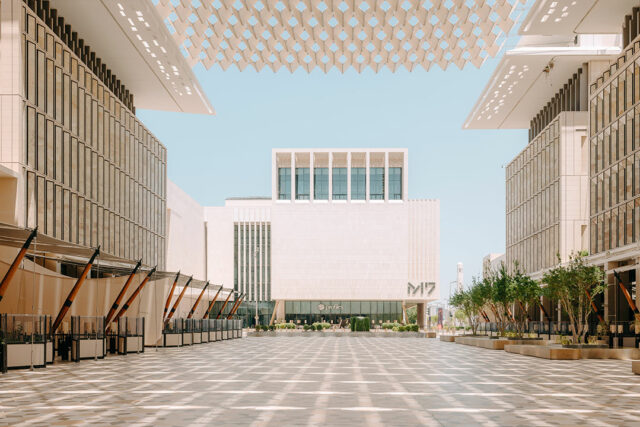
M7 in Doha — COURTESY ART BASEL

ART BASEL is expanding again.

Next year the Swiss-based art fair will open an edition in Doha, Qatar’s capital city. “We’re starting small,” says Art Basel Chief Executive Officer Noah Horowitz. “This is going to come to market in February next year in a very considered and measured way.”

The inaugural fair, Mr. Horowitz says, will include booths from about 50 galleries. This will be Art Basel’s fifth global trade fair, and mark its first presence in the region. (Its existing fairs are in Hong Kong, Miami, Paris, and in the original Swiss location — for which the brand is named.) At each location, an international roster of galleries meets an equally global group of collectors and art world professionals, who hobnob for several days amid openings, dinners, and parties.

The new fair is a partnership between Art Basel, Qatar Sports Investments, and QC+, an organization that describes itself as a “strategic and creative collective.” The fair will be held in the Doha Design District in downtown Msheireb.

“As part of His Highness the Amir’s National Vision 2030, Qatar has been transforming itself into a knowledge-based economy, with culture and the creative industries helping to lead the way,” wrote Sheikha Al Mayassa bint Hamad bin Khalifa Al Thani, the chairperson of Qatar Museums, in a statement. “As Qatar Museums marks its 20th anniversary, we are pleased to welcome the Art Basel organization as our partner to further elevate Qatar’s initiatives to support the creative industries of our region, offering exceptional new artistic experiences and opportunities to our talent.”

The news comes at a delicate moment for art fairs and the art market more generally. A recent Art Basel and UBS market report detailed the drop in gallery participation in art fairs in 2024, due, at least in part, to rising costs. Additionally, the report found that the art market had become more regional, making it more difficult for big art fairs that rely on global attendance.

But Mr. Horowitz says the timing is right. “It’s an extraordinary opportunity to lean in together and to open, in a really substantial way, a new path for our clients to develop relationships and support the progression of their artists’ careers,” he says. It’s also, he continues, a way to “help accelerate, and further broadcast, the unbelievable investment and infrastructure that our partners locally have been making.” — Bloomberg

UnionBank redeems P6.8 billion in Tier 2 notes

BW FILE PHOTO

UNION BANK of the Philippines, Inc. (UnionBank) has completed its early redemption of P6.8 billion in Tier 2 notes.

“Please be informed that Union Bank of the Philippines has completed on May 26, 2025, the exercise of its call option dated May 24, 2025 (Saturday) by way of voluntary redemption on its P6.8-billion unsecured subordinated debt eligible as Tier 2 capital due 2030, which was issued on Feb. 24, 2020,” the Aboitiz-led bank said in a disclosure to the stock exchange on Tuesday.

In February 2020, UnionBank raised P6.8 billion from the Tier 2 notes, higher than the initial P5-billion target. The issue was listed on the Philippine Dealing and Exchange Corp. that month.

The papers have an interest rate of 5.25% per annum and were originally set to mature on May 24, 2030. They have a tenor of 10 years and three months and were callable in 5.25 years from the issue date or starting May 24.

UnionBank’s attributable net income declined by 28.93% year on year to P14.06 in the first quarter.

Its shares dropped by 50 centavos or 1.51% to close at P33.70 apiece on Tuesday. — AMCS

The Philippines and Germany: Going beyond diplomacy into a new era of partnership

ORIGINAL ILLUSTRATION FROM FREEPIK

To build a stronger, more secure Philippines, we strengthen our defense posture and engage in partnerships with countries that share our values and commitment to peace, stability, and the rules-based international order. The administration of President Ferdinand Marcos, Jr. has been steadfast on these two parallel approaches. While we fortify our military by modernizing its capabilities, we also deepen our collaboration with like-minded countries, particularly those with which we share a long history.

One such country is Germany, with which we began diplomatic relations in 1954. We marked 70 years of bilateral relations last year. These ties span a wide range of areas, primarily labor, climate, peace, and culture. Germany is a primary trading partner of the Philippines among countries in the European Union. There have been investments in information technology and in the maritime sector.

And now the partnership is entering a new era.

Over seven decades since we first established diplomatic relations, the Philippines and Germany’s ties have grown into a robust partnership especially in defense and maritime security. Germany has time and again demonstrated its commitment to global peace and stability as well as an established order in the Indo-Pacific region, specifically in the West Philippine Sea.

Recent high-level engagements and landmark agreements demonstrate this deepening of the defense cooperation between our two countries. Last year, during a visit to Germany, President Marcos Jr. and Chancellor Olaf Scholz signed a Joint Declaration of Intent in the Maritime Sector. This is a pivotal step in aligning our foreign and defense policies.

This momentum is supported by the first-ever visit of German defense minister Boris Pistorius to the Philippines in August 2024, signaling Berlin’s strategic commitment to the region.

And then, on May 14 this year, in Berlin, Defense Secretary Gilberto Teodoro, Jr. and Minister Pistorius signed an Arrangement concerning Defense Cooperation. The deal builds on the long-standing 1974 Administrative Agreement, facilitating the training of Armed Forces of the Philippines (AFP) personnel in Germany. In fact, this is one of the oldest and most enduring defense cooperation frameworks the Philippines has with another country. The new arrangement broadens bilateral cooperation to include cybersecurity, defense logistics, armaments, and UN peacekeeping, as well as sets the stage for the upcoming 3rd Philippines-Germany Security and Defense Staff Talks. Here, both sides will map out concrete joint initiatives for implementation.

Also, for the first time, Germany was invited to participate as an observer in the Philippines’ Balikatan 2024 exercise. The participation of Germany is another milestone, reflecting a growing trust and convergence in military strategies.

And then, two German Navy ships docked at the Port of Manila, marking the country’s return to Philippine shores after more than 20 years. Germany’s renewed naval presence in the Philippines further symbolizes this new era of cooperation.

These events no doubt signal a fresh chapter, a new phase, for the Philippines and Germany.

These developments were central themes discussed at the forum, “70 Years of Philippine-German Relations: A New Era of Defense Cooperation,” co-hosted by the Stratbase Institute and Konrad-Adenauer-Stiftung (KAS) Philippines on May 20.

One of the speakers, Major General Rommel Cordova, Deputy Chief of Plans for the Armed Forces of the Philippines, emphasized that the Philippine-German Defense Cooperation Arrangement is a “testament to the shared resolve of both countries to broaden and diversify their strategic partnerships,” particularly in light of increasing regional tensions.

But the ties go beyond military cooperation.

The partnership also reflects a shared commitment to multilateralism and peaceful dispute resolution. As German Ambassador Andreas Michael Pfaffernoschke remarked, “Germany is serious about its Indo-Pacific commitment,” describing the partnership as one that encourages legal solutions over military power, and peaceful relations instead of a fear-based system.

Ambassador Pfaffernoschke pointed out that the Philippines’ geographical location along critical sea lanes in the South China Sea, makes it a key player in ensuring freedom of navigation, maritime security, and thereby the rules-based international order.

“For Germany, whose economy depends heavily on global trade and open sea lanes, contributing to ensuring maritime stability in the region is not a pure matter of principles and even less of charity. It’s a matter of national interest. The Philippines has consistently shown strong commitment to international law, including the United Nations Convention on the Law of the Sea,” Ambassador Pfaffernoschke said.

This strategic alignment is reinforced by thought leaders and scholars who recognize the growing significance of the Philippines in Germany’s Indo-Pacific strategy. Dr. Joachim Weber of Kiel University emphasized that “the Philippines stands out as a key partner,” underlining the essential nature of this cooperation in confronting global challenges to the rules-based international order.

The Philippines and Germany share more than simple diplomacy. It has grown into a defense cooperation and a comprehensive and forward-looking partnership. As both nations adapt to an increasingly complex regional security environment, their collaboration stands as a model of principled cooperation — anchored in mutual trust, shared democratic values, and an unwavering commitment to peace and stability in the Indo-Pacific.


Victor Andres “Dindo” C. Manhit is the president of the Stratbase ADR Institute.

Maynilad IPO valuation not finalized — Pangilinan

MANUEL V. PANGILINAN — BW FILE PHOTO

THE VALUATION of the initial public offering (IPO) of west zone concessionaire Maynilad Water Services, Inc. remains subject to adjustments, according to its chairman.

“The initial numbers are tentative. So, don’t be surprised if they adjust it. But they’re close to make a final determination,” Maynilad Chairman Manuel V. Pangilinan said on the sidelines of Manila Electric Co.’s annual stockholders’ meeting on Tuesday.

Mr. Pangilinan said the number of shares may still change as “some of the shareholders might decide to sell down a bit.”

He added that the pricing at which the shares will be offered may be finalized by June.

“So, just watch for that space. We want to launch within the year, para matapos na ang obligasyon to offer 30%,” the executive said.

Based on its latest prospectus draft dated May 14, Maynilad has reduced the size of its planned IPO to P45.8 billion, slightly lower than the up-to-P49 billion indicated in its initial prospectus.

The revised IPO comprises up to 2.29 billion common shares, down from the earlier maximum of 2.46 billion shares. The indicative maximum price remains at P20 per share.

The updated prospectus includes a primary offer of up to 1.66 billion common shares, an overallotment option of up to 249.05 million primary common shares, an upsize option of up to 354.7 million secondary common shares, and 24.9 million primary common shares to be offered to Hong Kong-based investment holding firm First Pacific Co. Ltd., which is also led by Mr. Pangilinan.

This compares with the previous allocation of up to 1.78 billion primary common shares, an overallotment option of up to 266.31 million primary common shares, an upsize option of up to 379.29 million primary common shares, and 36.31 million primary common shares for First Pacific.

The latest timetable shows that the listing date has been moved to July 17 from the earlier target of July 10.

The notice of final offer price to regulators is scheduled for July 1, while the offer period will run from July 3 to 9.

Net proceeds from the IPO will be used to fund Maynilad’s capital expenditure requirements for its water, wastewater, and customer service and information system projects through 2026. A portion of the proceeds will also be allocated for general corporate purposes.

Maynilad operates under a 25-year legislative franchise granted by Republic Act No. 11600, signed into law on December 10, 2021.

The law requires Maynilad to offer at least 30% of its outstanding capital stock within five years from the grant of the franchise.

Metro Pacific Investments Corp., which holds a majority stake in Maynilad, is one of three Philippine subsidiaries of First Pacific Co. Ltd., alongside Philex Mining Corp. and PLDT Inc.

Hastings Holdings, Inc., a unit of PLDT Beneficial Trust Fund subsidiary MediaQuest Holdings, Inc., has an interest in BusinessWorld through the Philippine Star Group, which it controls. — Sheldeen Joy Talavera

Arts & Culture (05/28/25)


MCAD questions notions of time in exhibit

THE exhibition Moments of Delay, engages with the complications of our understanding of time and the contemporary moment, through a range of formats — exhibition-making, workshops, artist-led activities, and panel discussions. Held at the Museum of Contemporary Art and Design (MCAD) Manila, it brings together 14 artists: Allan Balisi, Rocky Cajigan, Lesley-Anne Cao, Ronyel Compra, Uri de Ger, Celine Lee, Christina Lopez, Neo Maestro, Corinne de San Jose, Joar Songcuya, Cristian Tablazon, Tambisan sa Sining, Tropikalye, and Miguel Lorenzo Uy. The exhibit and its various programs run until Aug. 24 at the MCAD in College of Saint-Benilde, Malate, Manila.


Jinju silk lanterns at Korean Cultural Center

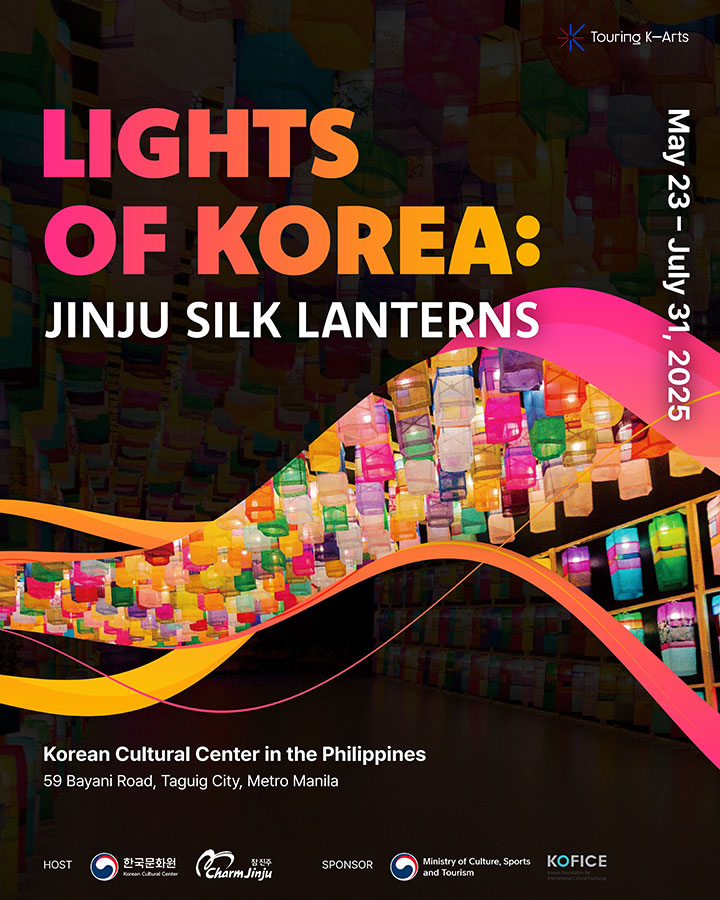
THE Korean Cultural Center in the Philippines (KCC), in partnership with the Jinju City Government, has put up the exhibit Lights of Korea: Jinju Silk Lanterns, showcasing glowing artistry and heritage. More than just lanterns, the intricate silk masterpieces from Jinju City invite viewers to experience Korean culture in a whole new light. The exhibit is part of the 2025 Touring K-Arts Program supported by Korea’s Ministry of Culture, Sports, and Tourism and the Korea Foundation for International Cultural Exchange. The exhibit runs until July 31 at the KCC Exhibition Hall in Taguig City.


Soler Santos’ photos showcased at MO_Space

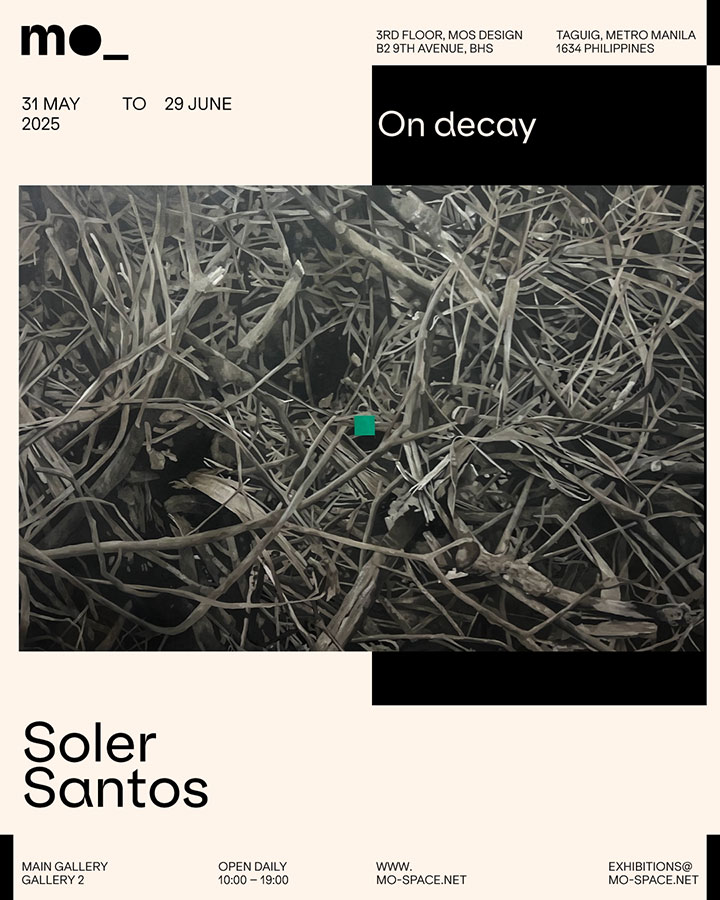
THE ephemerality of nature takes the spotlight in Soler Santos’ photographs, which depict both the environment and humans who inhabit these spaces. His exhibit, On decay, raises questions about temporality, ecological vulnerability, and the relationship between humanity and its surroundings. The goal is for viewers to “sit with their perceptions of decay, and reconsider the thought of it as an endpoint, and reframe it, instead, as a site of meaning, memory, and aesthetic possibility.” The exhibit runs from May 31 to June 29 at MO_Space, Bonifacio High Street, BGC, Taguig.


Come From Away to take the stage in Circuit Makati

THE hit Broadway musical Come From Away is set to be staged at the Samsung Performing Arts Theater at Circuit Makati from June 6 to 29. Come From Away tells the true story of 7,000 airline passengers who found themselves unexpectedly grounded in Gander, Newfoundland in the aftermath of Sept. 11. The Philippine production stars Cathy Azanza-Dy, Caisa Borromeo, Garrett Bolden, Mikkie Bradshaw-Volante, Becca Coates, Steven Cadd, Mayen Cadd, Rycharde Everley, Topper Fabregas, Sheila Francisco, Carla Guevara Laforteza, Menchu Lauchengco-Yulo, Gian Magdangal, George Schulze, and Chino Veguillas. Michael Williams is directing, with Rony Fortich is the musical director. Tickets are available on Feb. 22 via TicketWorld, starting at P900.

Zarah Juan turns campaign tarps into bags

BW FILE PHOTO

ZARAH JUAN, a Philippine social enterprise, is upcycling discarded tarpaulin materials from election campaigns into fashionable tote bags.

The initiative started after the 2022 presidential elections, when Zarah D. Juan, the creative director, saw potential in discarded campaign tarpaulins that would have otherwise ended up in landfills.

“I said, ‘OK, why don’t we create a design that is fresh and innovative in a way that people would enjoy and use every day?’” she said in an interview. “So I was very ambitious in thinking that if we created a bag out of tarp bags, we would be able to help the environment.”

After that election, the Zarah Juan brand managed to upcycle about 20,000 bags from tarpaulins over a year.

Ms. Juan said they also plan to upcycle campaign tarpaulins from the May 12 midterm elections.

“That’s our main goal again — to upcycle as much as we can so that we can lessen the impact of tarp waste on our dumpsites,” she said. “And the only thing we will change is that we’re releasing new designs. So, it’s going to be a series of bags.”

The Metropolitan Manila Development Authority (MMDA) earlier said 11.8 tons of campaign-related materials, such as posters and tarpaulins, were removed just days after the elections.

If left in landfills, plastic tarpaulins can release harmful microplastics and persist for 500 to 1,000 years.

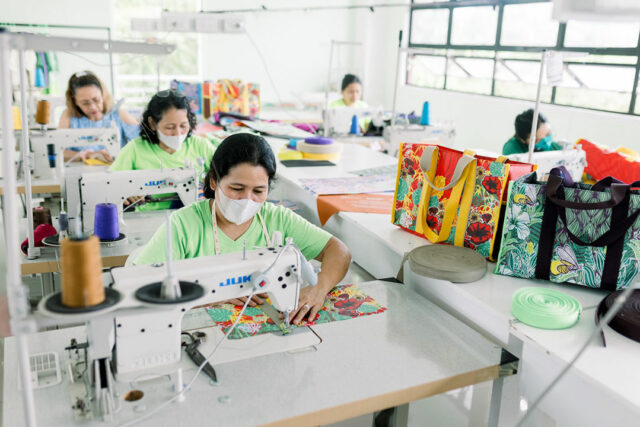
Zarah Juan gets tarpaulins from local governments such as Quezon City to send them to their production networks, including the Quezon City Jail Female Dormitory, where prisoners cut and clean them.

They have also tapped communities in Bulacan and Quezon City for printing, assembling and sewing. The products are then returned to the company for quality checks and sold on its website and at SM stores.

“It gives me joy as a designer to be able to tickle people’s minds a bit in terms of their perception of the bag, and then give them joy when they realize, ‘Wow, these are actually upcycled, printed, used tarps,’” Ms. Juan said.

She said the company plans to hire more people, especially Filipino prisoners. She also wants more companies to step up and prioritize environmental sustainability, which can go hand in hand with profits. — Edg Adrian A. Eva

BSP OKs 11 bank branches in Q4

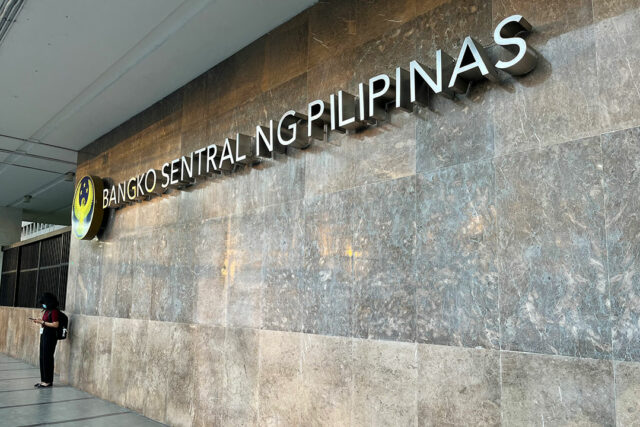
Bangko Sentral ng Pilipinas main office in Manila — BW FILE PHOTO

THE BANGKO SENTRAL ng Pilipinas (BSP) approved 11 regular bank branches in the fourth quarter.

The Monetary Board okayed applications for new banking offices of seven banks — three universal and commercial banks, two thrift banks and two rural and cooperative banks — in the fourth quarter, according to a circular letter dated May 7.

The BSP also approved applications to set up 13 branch-lite units in the period.

The central bank allowed Security Bank Corp. to open five new regular branches located in cities in Pampanga, Bacolod, Rizal, Batac City and Tandag City. It also approved the bank’s branch-lite unit in Pasay City.

The Monetary Board also approved the application of the Philippine Trust Co. to put up four regular branches located in General Santos City, Muntinlupa City, Tarlac City and Tuguegarao City.

Bank of Commerce was also allowed to open five branch-lite units — three in Pasay City, one in General Trias City, and another in Malay, Aklan.

Meanwhile, the BSP also approved First Consolidated Bank, Inc.’s application to set up a regular branch in Capiz.

Legazpi Savings Bank, Inc. also secured approval for six branch-lite units located in Butuan City, Misamis Oriental, Davao City, Koronodal City, Pagadian City and Leyte.

The central bank also granted the application of East West Rural Bank, Inc. for a regular branch in Davao City. It also allowed the opening of a branch-lite unit for Rural Bank of Rizal (Zamboanga del Norte), Inc. in Lapu-Lapu City.

Meanwhile, sixteen lenders opened new banking offices during the fourth quarter.

Among universal and commercial banks, BDO Unibank, Inc. opened 12 regular branches during the period while Security Bank opened 13 regular branches and one branch-lite unit. — Luisa Maria Jacinta C. Jocson