Home Blog Page 1077

Energy transition leading to higher inflation and lower growth

The other week, on Aug. 14, I attended the AmCham 8th Energy Forum held at Marriott Hotel Manila and energy transition dominated the discussion. Last week, on Aug. 21, I was one of session speakers in the Philippine Chamber of Commerce and Industry-Indonesian Chamber of Commerce and Industry (PCCI-KADIN) Business Forum, held at the PCCI HQ in Taguig City, I and my co-speaker, Iman Arif, talked about the beauty of coal energy.

These terms — energy transition (from fossil fuels to intermittent renewables), net zero, and decarbonization — are for me economically irrational. The real energy transition we should work for is from unstable, blackout-friendly, and expensive energy to abundant, stable, cheap energy in order to achieve lower inflation and higher growth. Below are the numbers.

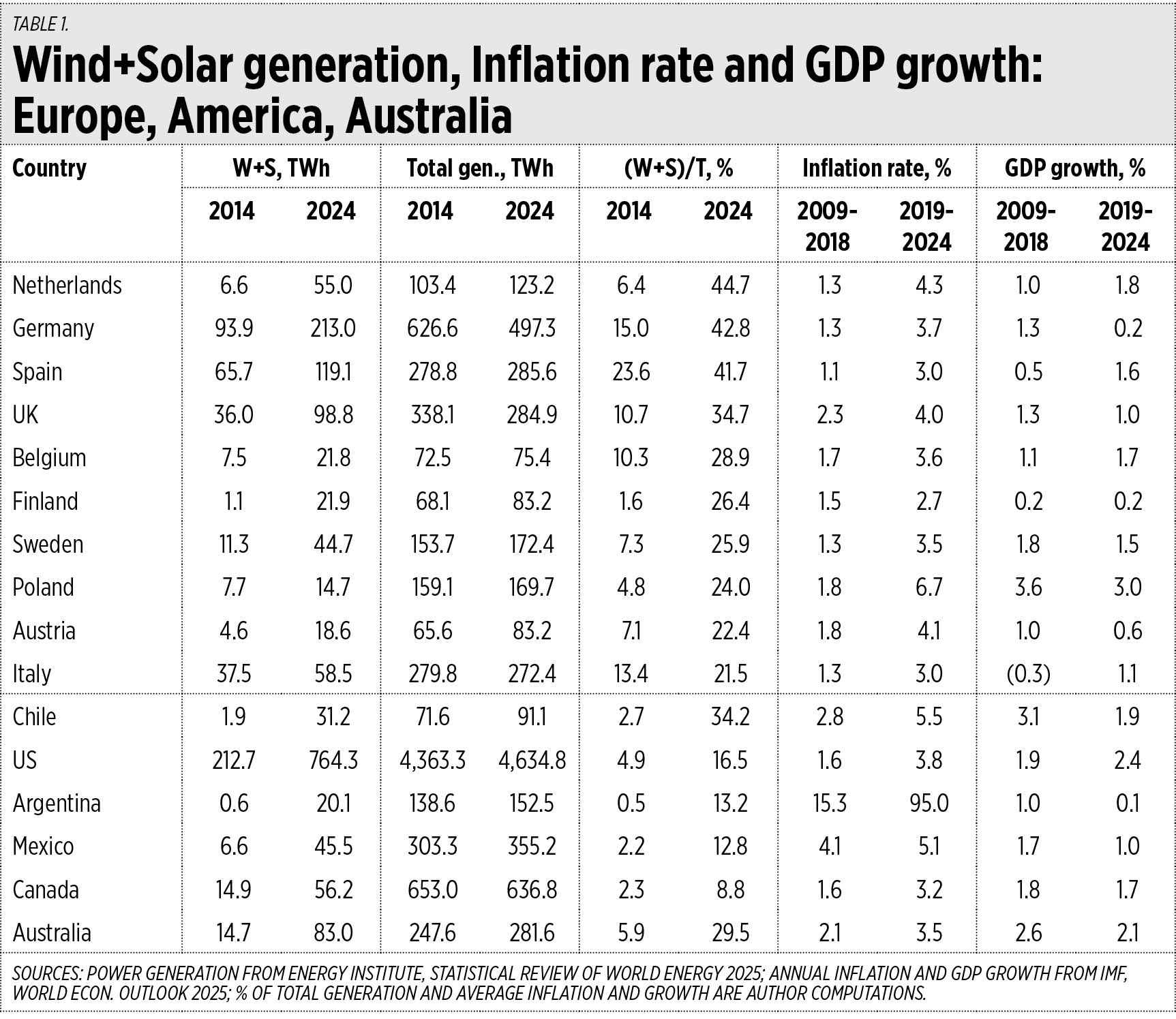
First, I added the total generation of wind plus solar (W+S) in 2014 and 2024, then computed the share of W+S over total generation, the (W+S)/T ratio. Then I got the average inflation rate and average GDP growth that touched those periods, 2009-2018 and 2019-2024.

The results are clear: countries with a (W+S)/T ratio of 20% and up have all seen rising inflation over those two periods, especially the Netherlands, Germany, the United Kingdom, Belgium, Poland, Sweden, Austria, Australia, and Chile. Even countries with medium (W+S)/T ratio of 9-16% also experienced rising inflation, like Canada and the USA.

Many of these countries also experienced low or declining GDP growth, especially Germany, the UK, Austria, Argentina, and Mexico. And two countries have had an ugly trend of declining total power generation as they add more W+S in their grid — Germany and the UK (see Table 1).
In contrast, in many Asian nations that have low (W+S)/T ratios of between 0.4% to 18%, their inflation rate is declining, especially China, India, Vietnam, Malaysia, and Indonesia. And their average GDP growth is high, 3% and above, except Japan and Thailand.

Even Russia, with its continuing war in Ukraine, has experienced declining inflation and rising growth (see Table 2).
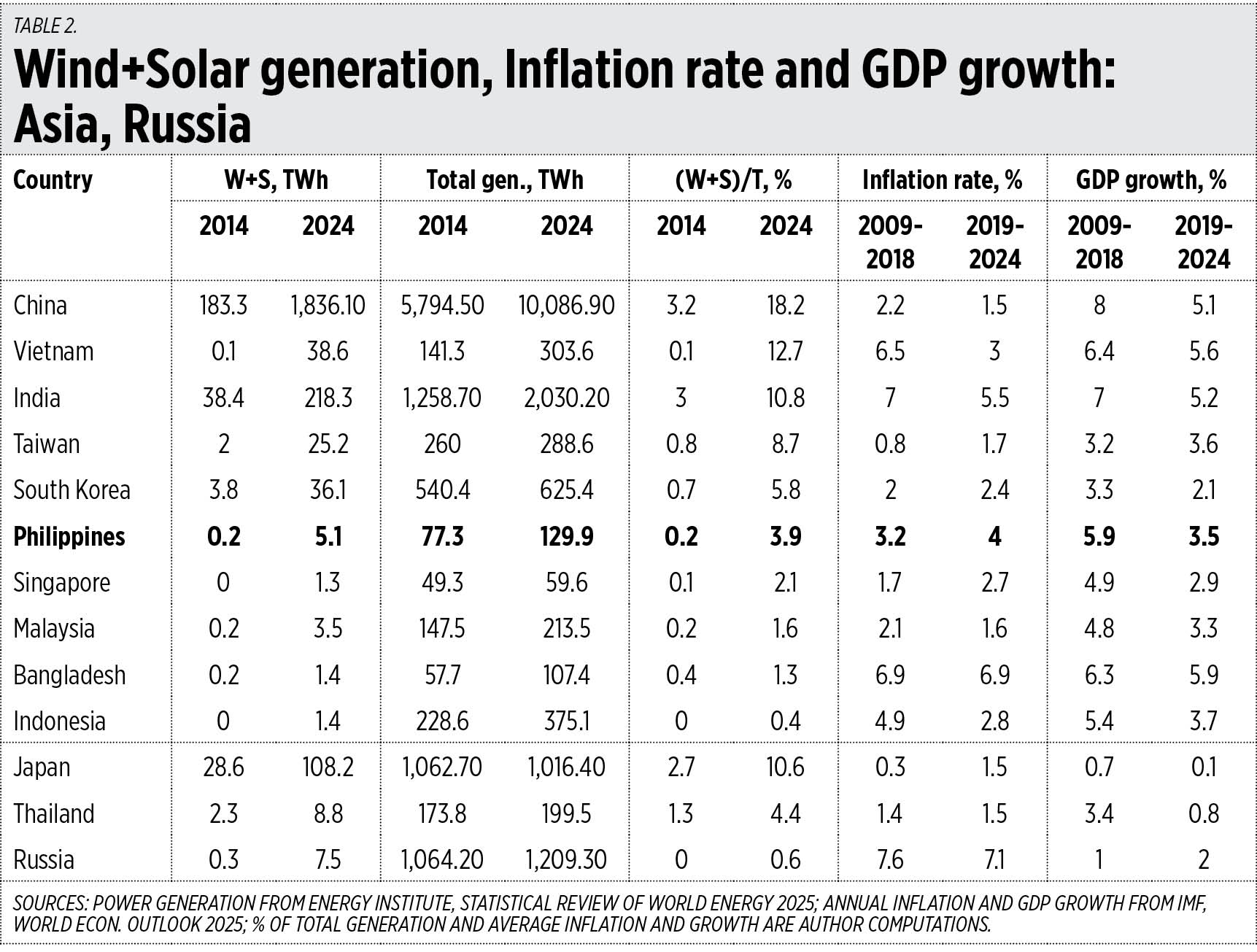
The Philippines is lucky to have a (W+S)/T ratio of only 3.9% and we should not aspire to raise it to 5% or higher. Rather, we should aspire to expand our total power generation. We generated only 130 terawatt-hours (TWh) in 2024, less than Malaysia and Thailand, less than half of Vietnam and Indonesia. Many big manufacturing companies will be scared to come and invest here because of the perennial yellow-red alerts and insufficient power supply.

Our electricity prices are higher than those of many of our ASEAN neighbors because they subsidize their energy while the Philippines taxes energy; and their power supply per capita is higher than ours, especially Malaysia, Singapore, Thailand, and Vietnam.

Currently, on-grid customers subsidize the customers in off-grid islands and provinces via a universal charge for missionary electrification (UC-ME) of P0.195 per kilowatt-hour (kWh). Then, all consumers subsidize intermittent renewables like W+S via the Feed-in Tariff Allowance (FIT-All) at P0.119/kWh.

At the AmCham energy forum, many speakers from the energy players talked about energy transition, net zero, and Green Energy Auction (GEA). As shown in the tables above, the actual and non-hypothetical numbers show that inflation rises as more renewables are added. It seems that some private energy players are praying for expensive electricity and higher inflation, so long as their businesses have assured high profits.

This will come in the form of a future GEA Allowance (GEA-All) tacked onto our monthly electricity bill, on top of FIT-All and UC-ME. This future GEA-All will be large — twice or four times the FIT-All — because of the huge solar and wind capacities that have been granted or will soon be granted with assured high prices.

The economic team, concerned with high inflation and its dampening effect on consumer spending and overall GDP growth, should warn the energy sector of the future economic sabotage of these ongoing moves.

We should have an agnostic energy policy that focuses on developing an abundant energy supply. I applaud the three energy players which have a large number of thermal plants that balance their renewables portfolio — Aboitiz Power, Meralco Power Gen (MGEN), and San Miguel Global Power. As MGEN President and CEO Manny Rubio often argued in various energy fora that I attended: “Energy Transition means people should benefit from the energy shift, reliability must remain the foundation — power has to be consistent and affordable.”


Bienvenido S. Oplas, Jr. is the president of Bienvenido S. Oplas, Jr. Research Consultancy Services, and Minimal Government Thinkers. He is an international fellow of the Tholos Foundation.


minimalgovernment@gmail.com

Villar-led retail firms report weaker second quarter

BW FILE PHOTO

VILLAR-LED retail firms posted weaker second-quarter results due to slower sales amid a subdued property market and heightened competition.

Home improvement retailer AllHome Corp. saw a 49.5% drop in April-to-June net profit to P71.76 million from P142.08 million a year earlier, the company said in a regulatory filing.

Sales fell by 22.1% to P2.23 billion from P2.86 billion the previous year, while the cost of merchandise sold also decreased by 22.2% to P1.38 billion.

First-half net income declined by 59.7% to P113.9 million from P282.43 million in the same period last year.

Sales for the January-to-June period dropped by 28.9% to P4 billion, while the cost of merchandise sold fell by 29% to P2.48 billion due to lower sales.

“The decline was chiefly attributable to a subdued property market, which has historically been a significant driver of construction and furnishing-related expenditure,” AllHome said.

Meanwhile, AllDay Marts, Inc., operator of AllDay Supermarkets, posted an 80% decline in second-quarter net profit to P18.01 million from P88.13 million a year earlier, the company said in a separate stock exchange disclosure.

Net sales fell by 40.3% to P1.4 billion from P2.47 billion last year, while the cost of merchandise sold likewise dropped by 40.3% to P1.17 billion.

For the first half, AllDay recorded an 83.2% decrease in net income to P31.1 million from P185.13 million in the same period last year.

Net sales declined by 41.7% to P2.88 billion, while the cost of merchandise sold fell by 41.7% to P2.28 billion due to weaker sales.

“Sales decline due to heightened competition, shifting consumer preferences, and the continued rise in e-commerce, resulting in reduced in-store traffic,” AllDay said.

On Friday, AllHome shares rose by 3.26% or P0.015 to P0.475 apiece, while AllDay shares slipped by 1.15% or P0.001 to P0.086 each. — Revin Mikhael D. Ochave

Spotify flags price rises as it introduces new services, FT reports

SPOTIFY will raise prices as it invests in new features and targets 1 billion users, the Financial Times (FT) reported on Sunday, citing the music streaming provider’s Co-President and Chief Business Officer Alex Norstrom.

The increases would be accompanied by planned new services and features, the FT cited Norstrom as saying in an interview.

Spotify did not immediately respond to a Reuters request for comment.

Earlier in August, the Swedish firm said it would increase the monthly price of its premium individual subscription in some markets from September, as it looks to improve profit margins.

It said the price will rise to €11.99 ($14.05) from €10.99 in markets including South Asia, the Middle East, Africa, Europe, Latin America, and the Asia-Pacific region.

“Price increases and price adjustments and so on, that’s part of our business toolbox and we’ll do it when it makes sense,” Norstrom told the newspaper.

Price increases combined with cost-cutting efforts in recent years helped Spotify achieve its first annual profit last year. — Reuters

T-bill, bond yields may decline with BSP expected to cut rates

BW FILE PHOTO

YIELDS on the Treasury bills (T-bills) and Treasury bonds (T-bonds) to be offered this week could mostly go down ahead of an expected rate cut by the Bangko Sentral ng Pilipinas (BSP) on Thursday.

The Bureau of the Treasury (BTr) will auction off P25 billion in T-bills on Tuesday, or P8 billion in 91-day and 182-day securities and P9 billion in 364-day papers.

On Wednesday, the government is looking to borrow a combined P35 billion via a dual-tranche offering of reissued T-bonds — P10 billion from seven-year papers with a remaining life of two years and seven months, and P25 billion through 25-year notes with a remaining life of 24 years and five months.

This week’s auctions were moved from the usual Monday and Tuesday schedules due to a holiday.

The T-bills and T-bonds on offer could fetch rates in line with comparable secondary market levels, which mostly declined week on week on expectations that the Monetary Board will cut benchmark borrowing costs at its Aug. 28 review, Rizal Commercial Banking Corp. Chief Economist Michael L. Ricafort said in a Viber message.

A trader said in an e-mail that the reissued seven-year bonds could fetch rates ranging from 5.75% to 5.8%, while the 25-year bonds could be quoted between 6.45% and 6.55%, with the auction expected to attract “decent demand.”

“We expect two-way interest in the next few days heading to the Monetary Board meeting, where a cut is already priced in,” the trader said.

At the secondary market on Friday, yields on the 91-, 182-, and 364- day T-bills dropped by 3.43 basis points (bps), 2.36 bps, and 6.07 bps week on week at 5.2578%, 5.483%, and 5.5985%, respectively, based on PHP Bloomberg Valuation Service Reference Rates data as of Aug. 22 published on the Philippine Dealing System’s website.

The rate of the 25-year bond likewise eased by 6.61 bps week on week to end at 6.3509% on Friday and the seven-year bond inched down by 0.33 bp to yield 5.9221%.

Meanwhile, the three-year paper, the tenor closest to the remaining life of the reissued seven-year T-bonds on offer on Wednesday, edged up by 0.58 bp to fetch 5.7419%.

All 20 analysts in a BusinessWorld poll expect the Monetary Board to reduce the target reverse repurchase rate by 25 bps to 5% at its meeting on Thursday from the current 5.25%.

This would mark the BSP’s third consecutive 25-bp cut since April.

The central bank has lowered benchmark interest rates by a total of 125 bps since it began its easing cycle in August 2024.

BSP Governor Eli M. Remolona, Jr. earlier said a cut is “quite likely” at this week’s meeting and another reduction is also on the table for the remainder of the year.

Last week, the BTr raised P25 billion as planned from the T-bills it auctioned off as the offer was more than four times oversubscribed, with total bids reaching P113.751 billion.

Broken down, the Treasury borrowed P8 billion as planned via the 91-day T-bills as total tenders for the tenor reached P36.58 billion. The three-month paper was quoted at an average rate of 5.234%, down by 5.3 bps from the rate seen in the previous auction. Yields accepted ranged from 5.21% to 5.26%.

The government likewise raised P8 billion as programmed from the 182-day securities as tenders amounted to P40.662 billion. The average rate of the six-month T-bill was at 5.435%, declining by 7.1 bps from the previous week, with accepted yields ranging from 5.433% to 5.438%.

Lastly, the Treasury sold the planned P9 billion in 364-day debt as demand for the tenor totaled P36.509 billion. The average rate of the one-year T-bill dropped by 4.8 bps to 5.564%. Tenders accepted carried rates ranging from 5.55% to 5.572%.

Meanwhile, the BTr last offered the reissued seven-year bonds to be auctioned off this week on July 22, raising P20 billion as planned at an average rate of 5.817%.

On the other hand, the 25-year notes were last sold on June 25, where the government raised just P15.076 billion via the papers, below the P20-billion offer. The bonds fetched an average rate of 6.649%.

The BTr is looking to raise P185 billion from the domestic market this month, or P125 billion through T-bills and P60 billion via T-bonds. This week’s auctions are the last ones for August.

The government borrows from local and foreign sources to help fund its budget deficit, which is capped at P1.56 trillion or 5.5% of gross domestic product this year. — A.M.C. Sy

Avida says 93% of Serin East Tagaytay units sold

SERIN EAST TAGAYTAY Ground Amenity Area — AVIDALAND.COM

AVIDA LAND Corp., the mid-income residential brand of property giant Ayala Land, Inc. (ALI), said it has sold 93% of the units in Serin East Tagaytay.

Located at Silang Junction North in Tagaytay City, Serin East Tagaytay is a townhouse development that offers countryside living with amenities designed for a vacation-like lifestyle. Its fourth tower is slated for completion in the first quarter of 2026.

“Designed as an ideal second home, Serin Terraces Tagaytay offers the perfect blend of serene countryside living and intuitive amenity features tailored for a relaxing, vacation-like lifestyle,” Avida Land said in a statement.

“The community provides residents with easy connectivity to essential commercial hubs, educational institutions, and popular tourist destinations, making it a home for those seeking both tranquility and convenience, while capitalizing on Tagaytay’s investment potential as a premier leisure and residential destination,” it added.

The development is near Ayala Malls Serin, People’s Park in the Sky, Our Lady of Lourdes Church, and Tagaytay Medical Center. It is also a few minutes from the Tagaytay-Nasugbu Highway.

For Tower 4, Serin East Tagaytay offers a 23-square-meter (sq.m.) studio unit and a 31-sq.m. exclusive studio unit.

A one-bedroom unit with a balcony measures 47 sq.m., while two-bedroom units with a balcony measure 68 sq.m.

Key amenities include a ground-level amenity area, a podium amenity area, a game room, a clubhouse with function rooms, and an indoor gym.

Avida Land earlier said it plans to build more residential developments outside Metro Manila amid stronger take-ups.

For the first half, ALI posted an 8% increase in net income to P14.2 billion. Its property development revenues improved by 1% to P52.3 billion on the back of strong commercial and industrial lot sales and resilient bookings in the premium residential segment. — Beatriz Marie D. Cruz

Why the Russia-India-China reboot won’t last

By Karishma Vaswani

THE Russia-India-China alliance, floated in the 1990s as a counterweight to the US, is being revived today as a way for the three countries to ride out the storm of President Donald Trump’s trade war. But old suspicions mean the union is unlikely to endure. Despite their shared grievances with Washington, the partnership is more a marriage of convenience.

That reality will be on display this week when the three nuclear powers converge in Tianjin for the Shanghai Cooperation Organization summit. The Kremlin is pressing for a long-awaited trilateral meeting. If the troika did find new life, it would send a powerful signal that the geopolitical heavyweights are aligning in the face of US pressure. But the inherent tensions between India and China, and economic differences between the three, make that outcome unlikely.

That pressure is most acute for India. Until recently a key American partner, it has borne the brunt of Trump’s tariffs. He doubled duties on exports to 50%due to go into effect on Aug. 27 — as punishment for its purchases of Russian oil.

Beijing, originally Washington’s primary target, is enjoying a temporary reprieve, but is stuck in a long-term strategic competition. And Russia, battered by sanctions and bogged down in Ukraine, is on the hunt for friends to blunt its isolation.

Moscow first dreamed up the idea of RIC, as it was dubbed, in the 1990s. Then-Prime Minister Yevgeny Primakov proposed the formation of the group to challenge the US’s global influence. The coalition looked formidable on paper — three nations with huge economies and populations. In practice, it’s always been undermined by mistrust, above all between rivals India and China.

Among the biggest sticking points is their long-running border dispute. They’ve been at loggerheads over an ill-defined 3,488-kilometer frontier in the Himalayan region. Those hostilities erupted into a war in 1962, and continue to simmer today. In 2020, the two clashed violently in Ladakh’s Galwan Valley, leaving soldiers dead on both sides in the bloodiest fighting in decades. Diplomatic ties froze, with New Delhi suspending tourist visas for Chinese nationals, and imposing restrictions on tech imports.

Trump’s tariffs are nudging them closer. Last week, they agreed to explore demarcating their disputed border, a key move toward resolving the territorial dispute. Strains around visas have eased and China has expressed solidarity with India on exports.

But the risk of future standoffs can’t be discounted. The fundamental contradictions in the dynamic are unlikely to disappear soon, Happymon Jacob, founder and director of the Council for Strategic and Defense Research, notes for the Hindustan Times. While serious violence may have been averted for now, a lasting rapprochement is unlikely. It’s hard for New Delhi to be fully confident of Beijing’s intentions, especially in light of its military assertiveness in areas like the South China Sea and Taiwan.

China is also far too close to Pakistan for India’s comfort. Beijing has become Islamabad’s most important defense partner since the end of the Cold War. During a clash with India in May, Pakistan claimed Chinese-made J-10C jets were used to shoot down five Indian fighter jets during the conflict. New Delhi said the PRC also provided its rival with air defense and satellite support. This alignment deepens India’s security anxieties and reinforces the sense that China can’t be trusted.

Setting security aside, the economic logic doesn’t work in New Delhi’s favor. India depends on US technology, capital, and supply chains — which neither Russia nor China can replace. America is also the most important market for Indian goods, by a wide margin. In 2024, consumers bought $77.5 billion worth of Indian goods, according to a Bank of Baroda report. In comparison, Chinese and Russian purchases were only a fraction of that.

In contrast, Moscow is much closer to Beijing. Since Western sanctions were imposed in 2014 after Russia’s annexation of Crimea, bilateral trade between the two has surged to record highs, surpassing $200 billion last year. Businesses are increasingly connected to the Chinese financial system through the use of the yuan, and services like UnionPay cards. For New Delhi, joining such a bloc would mean being the junior partner — hardly an appealing prospect.

That hasn’t stopped Moscow from trying to rejuvenate it. In May, Foreign Minister Sergei Lavrov said “the time has come for the revival” of the troika. Beijing has also backed the initiative, saying it could uphold peace, security, and stability in the world.

Resurrecting the bloc could pose a challenge to the US if it resulted in more coordinated action. But what binds these nations is necessity, not trust. The gathering in Tianjin will offer the opportunity for the optics of warmer ties, but it will be more symbolism than substance. This is an inherently fragile partnership, one that could unravel if American pressure diminishes.

BLOOMBERG OPINION

DALI operator widens net loss on higher costs, mounting liabilities

DALI EVERYDAY GROCERY FACEBOOK PAGE

HARD DISCOUNT Philippines, Inc. (HDPI), the operator of DALI Everyday Grocery, widened its net loss by 5% to P1.97 billion in 2024 from P1.88 billion in 2023 as mounting liabilities and higher expenses weighed on its operations.

Revenue rose by 52.1% to P33.93 billion in 2024 from P22.31 billion in 2023 due to higher sales, DALI said in its audited financial statement for the year. Gross income also increased by 124% to P3.33 billion.

Cost of sales grew by 46.9% to P30.59 billion, while operating expenses climbed by 60% to P4.81 billion.

HDPI said its total assets rose by 70% to P20.97 billion. However, total liabilities also surged by 110.8% to P20.25 billion.

Current liabilities, which reached P5.96 billion, exceeded current assets of P5.82 billion.

Total equity fell by 73% to P728.76 million after the company’s deficit widened by 60% to P5.24 billion.

HDPI’s independent auditor SyCip Gorres Velayo & Co. (SGV) noted that the P5.24-billion deficit and higher current liabilities might cast doubt on the company’s viability.

“These conditions indicate that material uncertainty exists that may cast significant doubt on the company’s ability to continue as a going concern and, therefore, the company may be unable to realize its assets and discharge its liabilities in the normal course of business,” SGV said in its independent auditor’s report attached to the audited financial statement.

However, HDPI said it expects profit margins to improve over the next five years with the implementation of cost-efficiency measures.

“Management believes that with the projected improvement in net profit margin, the company will be able to generate sufficient cash flows from its operations to meet its obligations as and when they fall due,” it said.

The company also noted that stockholders had infused P7.56 billion in additional capital as of end-2024, recorded as deposits for future stock subscriptions, to support its operations.

HDPI is a subsidiary of Singapore-incorporated HDPM Sin Pte. Ltd., which focuses on the Southeast Asian market. The ultimate parent of HDPI is Switzerland-based Dali Discount AG. — Revin Mikhael D. Ochave

Entertainment News (08/26/25)


ONErpm expands into the Philippines

RECORD LABEL ONErpm marked its 15th anniversary with the announcement of its expansion into the Philippines. With this milestone, it aims to deliver “transformative solutions and sustainable opportunities for artists to thrive in an increasingly dynamic and competitive music market,” it said in a statement. As part of the expansion, ONErpm has announced that it has a dedicated team in the Philippines, composed of Project Manager Louie Tamon, A&R Representative Presh Ong, Marketing Manager Alyssa “Pebs” Pe Benito, and Senior Business Development Manager Clark Cunanan.


Lola Amour releases album, readies concert

FILIPINO band Lola Amour has released their sophomore album, Love On Loop, now available on all major streaming platforms. Across eight tracks, the album explores love in all its phases, from first crush to heartbreak to inevitable romance relapses. It features collaborations with New Zealand artist RIIKI REID and Japanese collective KOKORO of Psychic Fever from EXILE TRIBE, produced in collaboration with international hitmakers Hyuk Shin and Cuurley. The album will be supported by Love On Loop: The Album Concert, set for Sept. 12 at One Ayala, Makati City, which, aside from the songs in the album, will feature Lola Amour’s biggest hits. Concert tickets are available via https://lolaamour.helixpay.ph/https://lolaamour.helixpay.ph/.


Tadhana marks 8th year with special episode

GMA PUBLIC AFFAIRS’ award-winning drama anthology Tadhana, hosted by Marian Rivera, is celebrating its 8th year on air and online through a special three-part episode. Titled “Banta ng Kahapon,” the episode stars veteran actress Cherry Pie Picache and GMA Sparkle Artist Althea Ablan. It offers another story of Filipinos who triumph over great challenges. It will air on Aug. 30, and Sept. 6, 3:15 p.m. on GMA Network, and also stream on GMA Public Affairs’ social media accounts.


Rich Brian releases first album in 6 years

RICH BRIAN has dropped his most personal and self-directed album, WHERE IS MY HEAD?, out now via 88rising. It marks his first full-length album since 2019 and offers a raw, introspective coming-of-age journey that captures the singer’s evolution. The album explores themes of heartbreak and healing, ambition and alienation, memory, and self-reinvention across 15 tracks, which include features collaborations with artists such as Toro y Moi on “Body High,” Charlotte Day Wilson and DAISY WORLD on “Is It?,” and redveil on “Bumpy Road.”


FX’s Alien: Earth now on Disney+

THE hit series from creator Noah Hawley, FX’s Alien: Earth, has released its first three episodes on the Disney+ platform. The story kicks off when the mysterious deep space research vessel, USCSS Maginot, crash-lands on Earth, and Wendy (played by Sydney Chandler) and a ragtag group of tactical soldiers come face-to-face with the planet’s greatest threat. Set in the year 2120, it dials in on the sci-fi world of the popular Alien movie franchise. It is written by Mr. Hawley and Bob DeLaurentis and directed by Dana Gonzales. Future episodes of the eight-episode season will premiere every Wednesday.


Wolf Alice’s new album out now

BRITISH band Wolf Alice has released their fourth studio album, The Clearing, via Sony Music. Highlighting the focus track “Just Two Girls,” the album was written in Seven Sisters and recorded in Los Angeles with Grammy-winning producer Greg Kurstin. It is a classic pop/rock album that nods to the 1970s while remaining rooted firmly in the present, going for the sensibilities of “what if Fleetwood Mac wrote an album today in North London?”


Genie, Make a Wish on Netflix in October

THE K-drama Genie, Make a Wish, starring Kim Woo-bin and Suzy, is coming to Netflix in October. Written by Kim Eun-sook, it tells the story of Jinn (Mr. Kim), a genie who awakens after a thousand years, and Ka-young (Suzy), his new impassive master. The show blends a romantic comedy around their conflicts over three wishes, which sets the stage for a magical twist of destiny, desire, and love. The series will launch exclusively on Netflix on Oct. 3.


Laufey drops new album

THE new album by Los Angeles-based Icelandic-Chinese artist Laufey has been released. Titled A Matter of Time, the album strips back Laufey’s polished veneer of elegance to present her at her most vulnerable and unguarded. It is accompanied by the new focus track, “Mr. Eclectic,” featuring backing vocals from Clairo. The album is now available worldwide via Vingolf Recordings and AWAL.


Jeremy Zucker returns to Asia for world tour

MULTI-PLATINUM singer, songwriter, and producer Jeremy Zucker is set to return to Asia this year for his 2025 World Tour. Kicking off this November, the tour will bring Mr. Zucker to Seoul, Singapore, Kuala Lumpur, Manila, Taipei, and Tokyo. Jeremy Zucker – World Tour 2025 in Manila will take place on Nov. 29 at the New Frontier Theater in Cubao, Quezon City. Tickets are priced starting at P2,500 and will be available via Ticketnet.


Prime Video announces Fallout season 2

THE global hit series Fallout will premiere its second season on Dec. 17, according to Prime Video, with new episodes dropping weekly until the finale on Feb. 4, 2026. The teaser trailer has unveiled key details: a new cast member, Justin Theroux as Robert House, and the appearance of the highly anticipated Deathclaw, one of the Fallout universe’s most iconic creatures. This season takes the story to the post-apocalyptic city of New Vegas, picking up where the first season’s finale left off.

RCBC expects double-digit growth in credit card receivables

RCBC/BW FILE PHOTO

THE CREDIT CARD arm of Rizal Commercial Banking Corp. (RCBC) expects sustained double-digit growth in loans over the next two years, driven by strong consumer spending amid low inflation and easing interest rates.

RCBC Credit Cards President and Chief Executive Officer Arniel Vincent B. Ong said they expect their cards business to continue growing by about 30-40% until next year.

“We are growing by more than 40% year on year so far. We are growing faster than the industry. My outlook is that by the end of the year, we will continue to be at that range… And we expect that to continue to be faster than the industry,” Mr. Ong said on the sidelines of a recent event.

“Next year, I think with the relatively benign inflation rates, the low interest rates…, I think consumption will continue to grow.”

RCBC’s credit card receivables surged by 48% year on year in 2024 as cards in force increased by 21% and billings rose by 41%.

Inflation eased to a near six-year low of 0.9% in July, which brought the seven-month average of 1.7%, a tad higher than the central bank’s 1.6% forecast for the year but below its 2-4% annual target.

Bangko Sentral ng Pilipinas (BSP) Governor Eli M. Remolona, Jr. has said that another rate cut is “quite likely” at the Monetary Board’s Aug. 28 meeting as they expect inflation to remain within target this year.

All 20 analysts in a BusinessWorld poll are penciling in a third straight 25-basis-point (bp) reduction this week to bring the policy rate to 5% from the current 5.25%.

Mr. Remolona also said that the central bank could deliver only two more reductions this year, including this week’s potential easing move.

The BSP has lowered benchmark interest rates by a cumulative 125 bps since August 2024, with the policy rate now at 5.25%.

After this week’s review, the Monetary Board’s remaining meetings for this year are scheduled for Oct. 9 and Dec. 11.

Mr. Ong said the bank is targeting to grow its credit card base to about 1.5 million by yearend, supported by products like its recently launched cobranded product, the AirAsia Platinum credit card.

“For RCBC, it’s really about targeting the right customer base, targeting the right segments. We have been very deliberate in attracting premium or affluent customers,” he said when asked what will drive credit growth this year.

The bank’s digitalization efforts, particularly in its mobile application, can also boost loan demand, he added.

RCBC’s net income jumped by 29.89% year on year to P2.92 billion in the second quarter amid higher net interest earnings.

For the first semester, its net profit climbed by 20.18% to P5.35 billion. — Aubrey Rose A. Inosante

Can domestic savings cover the country’s increasing investment needs?

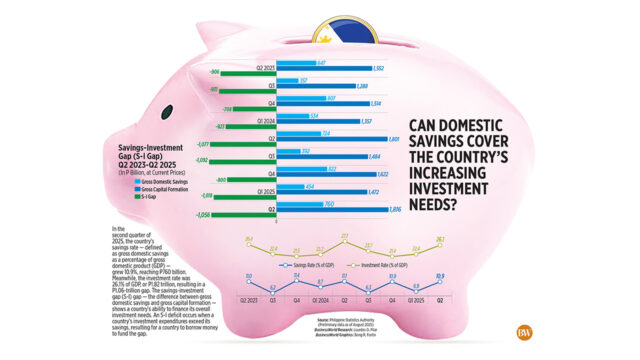
In the second quarter of 2025, the country’s savings rate — defined as gross domestic savings as a percentage of gross domestic product (GDP) — grew 10.9%, reaching P760 billion. Meanwhile, the investment rate was 26.1% of GDP, or P1.82 trillion, resulting in a P1.06-trillion gap. The savings-investment gap (S-I) gap — the difference between gross domestic savings and gross capital formation — shows a country’s ability to finance its overall investment needs. An S-I deficit occurs when a country’s investment expenditures exceed its savings, resulting for a country to borrow money to fund the gap.

Can domestic savings cover the country’s increasing investment needs?

PSEi to rise on dovish Powell speech, BSP bets

BW FILE PHOTO

SHARES may continue to climb this week following dovish comments from the US Federal Reserve chief over the weekend and as the Bangko Sentral ng Pilipinas (BSP) is expected to deliver a third straight rate cut on Thursday.

On Friday, the bellwether Philippine Stock Exchange index (PSEi) edged up by 0.05% or 3.71 points to 6,281.58, while the broader all shares index rose by 0.06% or 2.44 points to 3,737.58.

Week on week, however, the PSEi was down by 0.54% or 34.35 points from its 6,315.93 finish on Aug. 15.

The stock market was closed on Monday for National Heroes’ Day. 

“Local equities went sideways through a shortened week as investors turned cautious ahead of Fed Chairman Jerome H. Powell’s remarks at Jackson Hole summit,” online brokerage 2TradeAsia.com said in a market note.

Mr. Powell, in a closely watched speech at the Fed’s annual Jackson Hole symposium on Friday, opened the door to an interest rate cut at the central bank’s meeting next month, Reuters reported.

Mr. Powell’s dovish change of course has seen futures price in an 84% chance of a quarter-point rate cut in September, and at least 100 basis points (bp) of easing to 3.25-3.5% by the middle of next year.

2TradeAsia.com said Mr. Powell’s speech could set the tone for this week’s trading and pegged the PSEi’s support at 6,300 and resistance at 6,600. 

Philstocks Financial Inc. Research Manager Japhet Louis O. Tantiangco said in a Viber message that Mr. Powell’s dovish tilt could fuel buying activity at the stock market this week.

“Hopes of a rate cut by the Bangko Sentral ng Pilipinas in their Monetary Board meeting [this] week may also lift sentiment. Investors are also expected to look for clues on the BSP’s policy outlook at the said meeting,” he said.

All 20 analysts in a BusinessWorld poll expect the Monetary Board to reduce the target reverse repurchase rate by 25 bps to 5% from the current 5.25% at its policy meeting on Thursday.

This would be the BSP’s third consecutive 25-bp cut since April. It has lowered benchmark interest rates by a total of 125 bps since it began its easing cycle in August 2024.

Mr. Tantiangco put the PSEi’s major support at 6,150 and major resistance at 6,400.

“Chart-wise, the local market remains bearishly biased as it continues to form lower highs… This week, the market is expected to continue testing these lines,” he said. “Taking these lines under strong trading activity is seen as the market’s primary objective to be able to rise further moving forward.”

For his part, Rizal Commercial Banking Corp. Chief Economist Michael L. Ricafort placed the index’s support at 6,204.04 and resistance at 6,370.

Mr. Ricafort said the market will monitor policy hints from both the BSP and the Fed as potential rate cuts by the US central bank would also support further easing at home. — R.M.D. Ochave with Reuters

Work on final stations of MRT-7 to start next year

PHILSTAR FILE PHOTO

THE Department of Transportation (DoTr) said civil works for the last two stations of the Metro Rail Transit Line 7 (MRT-7) will start next year.

“Civil works for the Tala Station and San Jose del Monte Station are expected in 2026 and will be completed in the fourth quarter of 2028,” DoTr Spokesperson for Business Infrastructure Maricar L. Bautista said at a forum last week.

The DoTr and the city government of San Jose del Monte, Bulacan agreed in March to the new location of the MRT-7 station in that city.

The San Jose del Monte stop will now be located near the boundary of San Jose del Monte and north Caloocan, instead of the initial site, which was near the Muzon-Tungkong Mangga Road intersection.

Last year, the DoTr said the MRT-7, a project of San Miguel Corp. (SMC), is experiencing delays due to the right-of-way issues in San Jose del Monte.

MRT-7, which will have 14 stops, will run from Quezon City to San Jose del Monte, and is expected to carry 300,000 passengers daily in its first year, and up to 850,000 passengers a day by the 12th year.

The first 12 stations of the MRT-7 will be fully operational by 2027, Ms. Bautista said.

SMC is financing the construction and will operate the 23-kilometer commuter rail system under a 25-year concession agreement.

In April, SMC, through its wholly owned unit SMC MRT-7 Corp., signed an operations and maintenance services deal with Korea Railroad Corp. to fast-track the development of MRT-7.

According to the Public-Private Partnership Center, the project was originally scheduled for completion in 2019.

This timeline was delayed, and partial operations were then targeted for the fourth quarter of 2021, a deadline which was not met. — Ashley Erika O. Jose