Home Blog Page 1075

ACMobility reaps global and local HR awards

From left are ACMobility Learning and Talent Management Head Mark Relova, business partner Telene Hirang, ACMobility Organization Development and Total Rewards Head Yeng Salatamos-Udtohan, HREA Judge and Presenter Mary Margaret Tan, ACMobility Chief People Officer Ariane Nava, ACMobility Culture and Employee Experience Head Jowee Jael-De Leon, ACMobility Employee Shared Services Head Cecile Hernandez, ACMobility Organization Development and Performance Management Head Trisha Ramos, and business partner Pete Suba. — PHOTO FROM ACMOBILITY

IN ITS FIRST full year of transformation since launching in March 1 last year, ACMobility is already being recognized on both local and global stages for “reshaping the future of mobility with purpose.”

In 2025 alone, the company achieved a series of milestones. At the HR Excellence Awards held in Manila last August, ACMobility was honored with the Excellence in Business Transformation award, while its CEO Jaime Alfonso Zobel de Ayala was named Most People-Focused CEO, a testament to the company’s human-centered approach to transformation. On the global stage, ACMobility was awarded Bronze for Best Transformation Strategy at the Stevie Awards for Great Employers in New York this September, joining leading organizations from around the world.

Earlier this year, the Employees’ Compensation Commission commended ACMobility in March for its Return-to-Work Assistance Program supporting Persons with Work-Related Disabilities (PWRDs), underscoring the company’s commitment to inclusivity and care.

“These recognitions affirm that transformation begins with people. By building a culture of inclusion, well-being, and growth, we empower every ACMobilizer to bring their best selves to work and to our customers. This is what makes our movement real and what will carry us forward as we shape a sustainable mobility ecosystem,” said ACMobility Chief People Officer Ariane Nava.

Mr. Zobel de Ayala added, “Being recognized in our first full year of transformation reflects the dedication of our people and our commitment to redefining mobility and reshaping the experience. At ACMobility, transformation is not just about business, it’s about empowering people, creating sustainable solutions, and leading the way for the industry,”

Since its rebranding, ACMobility has made bold strides in both its business and people agenda. Organizational growth was evident as headcount rose from 1,370 in 2023 to over 1,600 by mid-2025, with a target of surpassing 1,700 by yearend, driven largely by the expansion of the BYD brand and the Mobility Infrastructure Group. Business results also accelerated, with market share climbing from 4.9% in 2024 to 8% in the second quarter of 2025, proving that people transformation directly fueled business growth.

Most notably, ACMobility became the first automotive company in the Philippines to be certified as a Top Employer for 2025, affirming the global competitiveness and sustainability of its people-first strategy.

US independent director Jim Jarmusch proves surprise Venice winner

A scene from Father Mother Sister Brother. — LABIENNALE.ORG

VENICE — US indie director Jim Jarmusch unexpectedly won the coveted Golden Lion at the Venice Film Festival on Saturday with Father Mother Sister Brother, a three-part meditation on the uneasy ties between parents and their adult children.

Although his gentle comedy received largely positive reviews, it had not been a favorite for the top prize, with many critics instead tipping The Voice of Hind Rajab, a harrowing true-life account of the killing of a five-year-old Palestinian girl during the Gaza war.

In the end, the film directed by Tunisia’s Kaouther Ben Hania took the runner-up Silver Lion.

Divided into chapters set in New Jersey, Dublin, and Paris, Father Mother Sister Brother features an ensemble cast including Tom Waits, Adam Driver, Mayim Bialik, Charlotte Rampling, Cate Blanchett, Vicky Krieps, Indya Moore and Luka Sabbat.

Each installment drifts gently through domestic encounters where nothing much happens, but small gestures and silences sketch out the generational awkwardness that can beset families.

“All of us here who make films, we’re not motivated by competition. But this is something I truly appreciate, this unexpected honor,” said Mr. Jarmusch, who made his name in the 1980s with offbeat, low-budget works such as Down by Law.

In other categories, Italy’s Toni Servillo was named best actor for his wry portrayal of a weary president nearing the end of his mandate in La Grazia, directed by his long-time collaborator Paolo Sorrentino.

China’s Xin Zhilei won best actress for her role in The Sun Rises On Us All, a drama directed by Cai Shangjun that delves into questions of sacrifice, guilt, and unresolved feelings between estranged lovers who share a dark secret.

The Venice festival marks the start of the awards season and regularly throws up big favorites for the Oscars, with films premiering here over the past four years collecting more than 90 Oscar nominations and winning almost 20.

GAZA TO THE FORE
Venice has often been seen as the most glamorous and least political of the major film festivals, but in 2025 the movies that made the strongest impact focused on current events, with the ongoing Israeli invasion of Gaza casting a long shadow.

As he unveiled his own picture last weekend, Mr. Jarmusch acknowledged that he was concerned that one of his main distributors had taken money from a company with ties to the Israeli military.

The Voice of Hind Rajab, which uses the real audio of a young girl’s desperate pleas for help as her car comes under Israeli gunfire, was the fan favorite, winning a record 24-minute standing ovation at its premiere.

“Cinema cannot bring Hind back, nor can it erase the atrocity committed against her. Nothing can ever restore what was taken, but cinema can preserve her voice, make it resonate across borders,” Ben Hania said on Saturday night.

“Her voice will continue to echo until accountability is real, until justice is served.”

The best director nod went to Benny Safdie for The Smashing Machine, which starred Dwayne “The Rock” Johnson in the role of the real-life mixed martial arts pioneer Mark Kerr.

“To be here amongst the giants of the past and the giants here this year, it just blows my mind,” said Mr. Safdie, who has previously co-directed films with his brother Josh.

The special jury award went to Italy’s Gianfranco Rosi for his black-and-white documentary Below the Clouds, about life in the chaotic southern city of Naples, marked by repeated earthquakes and the threat of volcanic eruptions.

Among the movies that left Venice empty-handed were a trio of Netflix pictures, Kathryn Bigelow’s nuclear thriller A House of Dynamite, Guillermo del Toro’s re-telling of Frankenstein, and Noah Baumbach’s comedy-drama Jay Kelly.

No Other Choice by South Korea’s Park Chan-wook also failed to secure an award, despite strong reviews, likewise Bugonia by Yorgos Lanthimos, which starred Emma Stone.

The main jury was chaired by US director Alexander Payne, joined by fellow filmmakers Stéphane Brizé, Maura Delpero, Cristian Mungiu and Mohammad Rasoulof, alongside actresses Fernanda Torres and Zhao Tao.

AND THE WINNERS ARE…

GOLDEN LION: Father Mother Sister Brother directed by Jim Jarmusch (USA, Ireland, France production)

SILVER LION GRAND JURY PRIZE: The Voice Of Hind Rajab directed by Kaouther Ben Hania (Tunisia, France)

BEST DIRECTOR: Benny Safdie for The Smashing Machine (USA)

BEST ACTRESS: Xin Zhilei for The Sun Rises On Us All (China)

BEST ACTOR: Toni Servillo for La Grazia (Italy)

BEST SCREENPLAY: Valerie Donzelli and Gilles Marchand for A Pied D’Oeuvre (France)

SPECIAL JURY AWARD: Below the Clouds directed by Gianfranco Rosi (Italy)

BEST YOUNG ACTOR/ACTRESS: Luna Wedler for Silent Friend (Germany, France, Hungary) — Reuters

The devil is in the technicalities

STOCK PHOTO | Image by Tingey Injury Law Firm from Unsplash

“Why do defendants in a case sometimes win because of technicalities,” I asked my attorney-friend. When technicalities of the law make a guilty person get away scot-free, has justice been served to the complainants?

Take the case of The Merchant of Venice by William Shakespeare (my baccalaureate degree was AB-English Literature — hence my reference):

The rich merchant of Venice, Antonio, guaranteed a loan of his friend Bassanio from Shylock, who was notorious, as Jews were, for his usurious money lending rates. Bassanio’s urgency for 3,000 ducats was for expenses in his courtship of the rich heiress Portia, who had set up a final selection of a husband from among her suitors. Shylock was the last recourse for the need because the often-delinquent borrower Bassanio’s trading ships had sunk, and his over-extended creditor-suppliers were crying out for his blood. Indeed, blood was the remaining collateral acceptable to Shylock from Antonio, who determinedly pitched for no interest for usance, but agreed to Shylock’s exacting “a pound of flesh” if he, Antonio, would not give back to Shylock at a certain date, the money Shylock lent to Bassanio. Antonio’s own money was tied as his ships and merchandise were at sea to Tripolis, the Indies, Mexico and England.

N.B.: The Merchant of Venice is believed to have been written between 1596 and 1598, at the height of Venice’s 16th century maritime trade, where merchants acted as crucial middlemen between Europe and the Middle East, importing goods like spices and silk, and facilitating finance, including early forms of banking and credit. A new aristocracy was rising from the capitalist merchants who financed shipments and contracted with buyers in foreign lands. The Jews were ostracized and discriminated against, although they were rich and financially influential.

Alas, Antonio’s own trading ships were reported lost at sea. Now give me your “pound of flesh,” Shylock demanded of Antonio.

By this time, Bassanio was suddenly rich — by his marriage to the heiress Portia. He sent word to Shylock that he will pay 6,000 ducats for his 3,000 ducats debt guaranteed by Antonio. But Shylock turns the offer down, and insists on the “pound of flesh” from Antonio. Enter Portia, disguised as Balthazar, a young male “doctor of the law,” bearing a letter of recommendation to the Duke who was mediating the stalemate between Shylock and Antonio/Bassanio.

“As the court grants Shylock his bond and Antonio prepares for Shylock’s knife, Portia deftly appropriates Shylock’s argument for ‘specific performance.’ She says that the contract allows Shylock to remove only the flesh, not the blood, of Antonio. Thus, if Shylock were to shed any drop of Antonio’s blood, his ‘lands and goods’ would be forfeited under Venetian laws. She tells him that he must cut precisely one pound of flesh, no more, no less; she advises him that ‘if the scale do turn / But in the estimation of a hair, / Thou diest, and all thy goods are confiscate’.” (The Merchant of Venice 4.1/344–346, Folger Shakespeare Library).

In a deconstruction analysis “Shakespeare and the Law” by the Trinity College Law Review, the basic statement was “that the rule of law facilitates certain fairness values… meant to benefit all of society.” However, “Shakespeare draws out the nuanced characteristic of law as almost a double-edged sword that the characters each try to manipulate for their own ends.” Bassanio’s appeal to the Duke “To do a great right, do a little wrong” clearly suggests compromise.

That Shylock wanted “a pound of flesh” from Antonio (Bassanio’s loan guarantor) was “gruesome and seems unjust,” but “under the ‘parole evidence rule,’ it would appear that the parties had intended (and expected) that blood might be spilled if the flesh was to be extracted.” That was the mutually agreed and understood contract. Shylock was no villain for claiming upon the contract.

The foregoing deconstruction analysis remands forthwith such intuitive misgivings about the reliability of true justice being served upon the common good. That the rights of the victim versus the rights of the accused may teeter from one to the other, based on the clever invocation of legal technicalities by lawgivers and lawyers can cause apprehension and anxiety — way into these “modern” times, in the individualistic struggle for self-preservation and survival in the most competitive environment ever — with pessimistically more insecurities to come in the future.

Such insecurities about “blind justice” meting out moral, ethical, and legal resolutions to conflicts, upholding only what is right, are toxically fed by the factional, inter- and intra-political fights in our country now, that seem to be like Shylock and Antonio’s symbolic and literal fight to the death to “win.”

On July 25, the Supreme Court of the Philippines declared: “In a 13-0-2 Decision, with the Justices present voting unanimously, and Associate Justice Alfredo Benjamin S. Caguioa inhibiting and Associate Justice Maria Filomena D. Singh on leave, the Supreme Court En Banc on July 25, 2025, declared the Articles of Impeachment against Vice-President Sara Z. Duterte unconstitutional, noting that it is barred by the one-year rule under Article XI, Section 3(5) of the Constitution and that it violates the right to due process enshrined in the Bill of Rights. Therefore, the Senate could not acquire jurisdiction over the impeachment proceedings.”

Under Article XI, Section 3(5) of the Constitution, “no impeachment proceedings shall be initiated against the same official more than once within a period of one year.” According to the Decision, the one-year bar is reckoned “from the time an impeachment complaint is dismissed or no longer viable.”

In its decision, the Court “differentiated” the first three complaints filed last December from the fourth complaint, which formed the Articles of Impeachment transmitted to the Senate on Feb. 5. It said that the first three were filed under Article XI, Section 3(2) of the Constitution which allows any citizen to file a verified complaint and endorsed by any House member. The fourth complaint was filed under Section 3 (4) of the Constitution through a resolution by at least one-third of the House.

But the court said the first three complaints were deemed terminated and archived on Feb. 5, the same day that the fourth complaint was passed by the House. That was the reckoning day for the one-year bar, according to the court.

“Therefore,” the court said, “no new impeachment complaint, if any, may be commenced earlier than Feb. 6, 2026.”

Three former Supreme Court Justices — Adolfo Azcuna, Artemio Panganiban, and Antonio Carpio — offered their comments on the implications, fairness, and timing of the decision in an article in the Inquirer reported on July 28:

“In a shift from its 2003 ruling in Francisco v. House of Representatives, which stemmed from the impeachment proceedings against then-Chief Justice Hilario Davide, Jr., the Supreme Court departed from its earlier interpretation of when an impeachment complaint is considered ‘initiated.’

“In Francisco, the Court held that initiation occurs only when a complaint is included in the Order of Business and referred to the proper committee. But in its ruling on the Duterte case, the Court clarified that complaints may be considered initiated once filed, even if they are later archived without committee referral.”

Procedural legal technicalities were changed. Retired Chief Justice Azcuna warned that the Court had changed the rules after the fact, penalizing actors who had relied on the old definition of “initiated.”

Retired Chief Justice Panganiban lamented that the Court could have opted for a “Status Quo Ante” order — freezing the process while giving both the justices and the public a fuller picture of the issues at stake.

Former Senior Associate Justice Carpio insisted that the 4th complaint was valid and submitted on time; one-third support in the House of Representatives was reached, and the resolution should be considered the articles of impeachment and transmitted forthwith to the Senate. He warned that the Supreme Court’s intervention in the matter risked encroaching on a process that is fundamentally political, not judicial.

The legal technicalities invoked are distressingly difficult to understand and accept for the non-lawyer ordinary citizen, who has empirically witnessed the recorded and published bases for the charges in the impeachment complaint: “Culpable Violation of the Constitution, Betrayal of Public Trust, Graft and Corruption, and Other High Crimes.”

The hungry, angry crowd wants its “pound of flesh.” Elected government officials know what they are getting into, when in position — there is no compromise in the strictly honest and dedicated service to the Filipino people and the Constitution.

“Our fundamental law is clear: the end does not justify the means,” said Justice Marvic Leonen, ponente for the Supreme Court judgment on the impeachment complaint vs VP Sara Duterte. Ambiguous. Sounds like Portia in The Merchant of Venice, who warned that no drop of blood must be shed to carve that pound of flesh from the guilty, but socially and politically prominent defendant.

And the villain becomes the victim, the victim the villain. That is hard to accept, in a small country where the people are the “underdogs” and victims, amidst the pervasive graft and corruption and brazen impunity of high officials in government.

The Transparency International 2024 Corruption Perceptions Index (CPI) ranked the Philippines as 114th most corrupt out of 180 countries (with 180 as the most corrupt), with a score of 33 out of 100, up a spot from 115th last year. Manila’s score of 33 is below the global average of 43, and the Asia-Pacific region’s average of 44. A score of 0-9 means “highly corrupt,” while a score of 90-100 means “very clean.” (pids.gov.ph, Feb. 12, 2025).

In July, reports revealed a P142.7 billion ($2.9 billion) insertion in the 2025 national budget, allegedly added during a conference led by Senate President Francis Escudero. Senator Panfilo Lacson claimed in a public statement in the Philippine Daily Inquirer on Aug. 22 that as much as half of the P2 trillion ($40.61 billion) allocated for flood control over 15 years may have been lost to corruption, with only 40% of project funds translating into actual construction.

President Ferdinand R. Marcos, Jr. revealed that 15 out of 2,409 accredited contractors were awarded P100 billion, or 18% of the entire P545.6-billion ($11.08 billion) flood mitigation budget allocated by his administration from July 2022 to May 2025 (Philippine Star, Aug. 20) The Senate Blue Ribbon Committee launched a motu proprio investigation dubbed “Philippines Under Water” into alleged irregularities in flood control projects.

Can we hope to know the truth in this investigation, and punish the criminals who have stolen the blood money for urgent flood control?

The devil is in the legal technicalities.


Amelia H. C. Ylagan is a doctor of Business Administration from the University of the Philippines.

ahcylagan@yahoo.com

Ayala Corp. eyes early achievement of net-zero goal

AYALALAND.COM.PH

AYALA CORP. is aiming to achieve its net-zero greenhouse gas emissions target ahead of its 2050 deadline, with progress driven by renewable energy and mobility investments across its subsidiaries, a company official said.

“Our net-zero goal is a work in progress. Obviously, 2050 was the goal. We will try to do as much as we can to make that target or even before,” Ayala Corp. Chief Sustainability and Risk Officer Jaime Z. Urquijo told BusinessWorld on the sidelines of the Philippine Investment Conference on Aug. 29.

Net zero refers to cutting greenhouse gas emissions to as close to zero as possible while offsetting remaining emissions.

Mr. Urquijo said Ayala Corp.’s strategy involves responsible investments that integrate environmental, social, and governance (ESG) principles, with a focus on renewable energy and transportation.

“We feel very strongly that the fundamental momentum is really built on solid fundamentals especially in two areas specifically, renewable energy and mobility space,” he said.

Ayala Corp.’s listed power unit, ACEN Corp., last week announced the sale of its remaining diesel power plant as it moves toward a 100% renewable energy portfolio by yearend. ACEN has set near-term emission reduction goals for 2030, long-term reduction targets for 2040, and aims to neutralize residual emissions to reach net zero by 2050.

In January, Ayala Corp. signed a $100-million (around P5.8 billion) financing deal with the Asian Development Bank to support the development of an electric mobility ecosystem in the Philippines.

The Philippines has committed to cut greenhouse gas emissions by 75% by 2030 under the 2021 Paris Agreement, with transport identified as one of the key sectors for decarbonization. — Ashley Erika O. Jose

Facilitating tourism recovery through investments

BW FILE PHOTO

By Mhicole A. Moral, Special Features and Content Writer

Tourism is making a strong rebound after years of setbacks caused by the coronavirus disease 2019 (COVID-19) pandemic, with both local and international visitors fueling the recovery.

According to the Philippine Statistics Authority, tourism directly contributed 8.9% of the country’s gross domestic product in 2024. The Tourism Direct Gross Value Added, which measures the sector’s share in the economy, reached P2.35 trillion. This number was an 11.2% increase compared to 2023.

Filipino travelers also spent more when going abroad, with outbound tourism expenditure reaching P345.68 billion, higher by 37.5% than the previous year. Domestic and inbound spending combined amounted to P3.86 trillion, showing growth of 13.1%.

The Department of Tourism (DoT) reported that revenue from foreign travelers exceeded P760 billion in 2024. This figure was a 9% increase from 2023 and more than double the level recorded in 2019, before the pandemic disrupted travel.

Tourism Secretary Ma. Esperanza Christina G. Frasco said international visitors spent more than $2,000 per person on average, which placed the Philippines among the top in Southeast Asia.

“The international visitor receipts show that our recovery in tourism performance has already gone beyond our pre-pandemic numbers,” Ms. Frasco said in a televised briefing.

Post-pandemic resilience

Data from the World Travel and Tourism Council shows that the Philippines ranks first in Southeast Asia in domestic tourism spending, with more than $66 billion generated by local travel.

Filipino travelers are also showing new habits that go beyond traditional three-day trips. The Philippine Travel Agencies Association report a growing demand for longer stays, where visitors spend extra days exploring at a slower pace.

Jaslyne Vanessa C. Estrada, co-founder of MaxJourney Travel Agency, said Filipino tourists are eager to try experiences outside the usual beach trips. In fact, many visitors now visit cultural towns and heritage villages.

“They want something different from what they usually see in the city. They shop, look for new crafts, and try local food,” Ms. Estrada told BusinessWorld. “Travelers are willing to pay for experiences that give them a sense of connection with local communities.”

Such changes are also helping smaller towns and inland provinces attract more visitors, which are now included in travel itineraries and giving businesses in less-publicized destinations new opportunities to grow.

While competition is tough, the demand for authentic and unique services gives businesses space to expand. However, success depends on their ability to adjust to what tourists expect.

According to Ms. Estrada, not every provider can meet customer requests all the time, but she emphasized that the demand itself creates new business opportunities.

“MSMEs that form partnerships with suppliers to offer additional products and services can expand what they provide and reach new markets,” she explained. “In the long term, the responsiveness of businesses builds reputation and trust. We believe the return will be a stronger customer base, more repeat clients, and higher spending per tourist.”

President Ferdinand R. Marcos, Jr. has announced that his administration will maintain programs aimed at giving micro, small, and medium enterprises (MSMEs) better opportunities to grow.

facebook.com/DepartmentOfTourism

“Tourism brings livelihood and development to countless communities,” Mr. Marcos said in a statement. “That is why government is committed to support enterprises that keep this sector alive.”

Recently, the President awarded loan packages to nine businesses under the Turismo Asenso Loan Program. Launched in July, the program offers up to P20 million in financing with competitive interest rates and flexible repayment terms. The initiative is intended to provide businesses with capital to strengthen their services for both domestic and foreign travelers.

Beyond loans, the government also highlighted other programs that support small enterprises, including the establishment of Negosyo Centers, the Go Lokal! campaign to promote local products, trade fairs for market access, and the construction of Tourist Rest Areas.

Infrastructure shaping tourism

Infrastructure has long been one of the main measures used by the government to gauge the competitiveness of the tourism industry. For an archipelagic country like the Philippines, the quality of facilities carry the weight in shaping impressions of the country.

For instance, the recent privatization of Ninoy Aquino International Airport (NAIA) is expected to ease congestion, reduce waiting time, and improve the services that tourists encounter as soon as they land.

The government has also mapped out plans for upgrades in regional airports. Projects are lined up in Bohol, Dumaguete, Laguindingan in Mindanao, and the Bicol region. These expansions are meant to provide better access to destinations that once relied heavily on limited flights and long ferry rides.

In addition, the DoT and the Philippine Ports Authority are preparing new cruise terminals in island provinces to meet the growing demand in sea transportation.

On land, more than 500 kilometers of tourism roads have been completed in partnership with the Department of Public Works and Highways. The roads connect small communities to markets, help local businesses expand, and opportunities for residents to participate in tourism.

“When more roads are open and flights are more frequent, we get more customers,” Ms. Estrada explained. “The increased accessibility has allowed providers to hire more staff and offer more jobs.”

Dominic Forrest, chief technology officer of multinational company iProov, pointed out that the Philippines has the chance to modernize its systems faster than countries that rely on older technology. He highlighted that investments in border management and digital infrastructure could improve both efficiency and security.

“The ability to arrive in a country and walk straight up to an officer without needing to search for documents makes a real difference for travelers,” Mr. Forrest said in an exclusive interview. “Smoother entry processes not only save time but also allow people to spend more time on meaningful interactions.”

Leveraging technology on tourism

The DoT is expanding its use of digital tools to make travel across the Philippines easier, faster, and safer for visitors. 

Ms. Frasco announced that the agency launched the country’s first Tourist Assistance Call Center, branded as 151-TOUR. The hotline is open to both local and foreign travelers who need help with concerns such as medical assistance, destination inquiries, or other emergencies. When necessary, the center refers cases to local governments or partner agencies. Since its opening, the hotline has already received thousands of calls from tourists representing more than 70 nationalities.

At the same time, the DoT, along with the Tourism Promotions Board, introduced the Enhanced Travel Philippines mobile application. The application gives users details on attractions, festivals, and tourism products across all regions of the country. It also connects travelers directly to accredited tour guides, agencies, and operators.

Such efforts, according to Ms. Frasco, are part of the government’s plan to provide visitors with easy access to information and direct assistance.

“If tourists know they can get assistance and plan their trip with confidence, they will want to come and return,” she added.

On the other hand, digital upgrades are not limited to communication tools. Mr. Forrest explained that digital system updates allow travelers to complete parts of the verification process before leaving their home countries.

“Travelers prefer completing some of these steps before departure instead of waiting in long queues after landing. It is about security and convenience,” he said.

According to the World Bank, digital identity systems are closely linked to higher economic growth. Smoother arrivals and stronger security can encourage first-time visitors and attract repeat travelers, particularly those who spend more during their stays.

THE PHILIPPINE STAR FILE PHOTO

Ambitious tourism plans

As competition in Southeast Asia grows tougher, the country is under pressure to keep pace with its neighbors that spend more money on promotions and tourism programs.

The DoT is seeking a P3.7-billion budget for 2026 to expand projects that aim to attract more visitors and improve their overall experience. A large part of this will be used for marketing campaigns to raise the country’s profile abroad.

While the Office of the Secretary would see a 2% increase to P3.1 billion, funding for the Intramuros Administration and the National Parks Development Committee would fall by 46% and 15%, respectively. In contrast, the Philippine Commission on Sports Scuba Diving would benefit from an 84% increase.

Beyond marketing, the agency is working with the Philippine Hotel Owners Association and other private partners to expand lodging options across the country. More hotels, resorts, and other accommodations are expected to support higher tourist arrivals and encourage longer stays.

Additional initiatives include upgrading rest areas with clean facilities across the three major regions. Ten facilities are complete, 22 are under construction, and 60 more are planned. First-aid stations and hyperbaric chambers for diving destinations are also part of the expansion, aimed at improving visitor safety and experience.

The Philippine Experience Program, one of the DoT’s flagship initiatives, keeps on expanding across the country through festivals, heritage, local food, traditional arts, and natural attractions.

The agency also partnered with Klook Philippines to tap into a wider market and make tours more accessible to domestic and international travelers.

“Through experiential travel, we hope to introduce the very essence of our nation more deeply to our tourists and instill a sense of pride and patriotism among the Filipino people through greater appreciation of our country’s inheritance and legacy,” said Ms. Frasco.

Dry weather threatens India tea exports, global supply

STOCK PHOTO | Image by Jcomp from Freepik

TINSUKIA, India — Under blazing skies at a tea plantation in India’s northeastern state of Assam, picker Kamini Kurmi wears an umbrella fastened over her head to keep her hands free to pluck delicate leaves from the bushes.

“When it’s really hot, my head spins and my heart starts beating very fast,” said Ms. Kurmi, one of the scores of women employed for their dextrous fingers, instead of machines that harvest most conventional crops within a matter of days.

Weather extremes are shriveling harvests on India’s tea plantations, endangering the future of an industry famed for beverages as refreshing as Assam and Darjeeling, while reshaping a global trade estimated at more than $10 billion a year.

“Shifts in temperature and rainfall patterns are no longer occasional anomalies; they are the new normal,” said Rupanjali Deb Baruah, a scientist at the Tea Research Association.

As the changing patterns scythe down yields and stall output, rising Indian domestic consumption is expected to shrink exports from the world’s second largest tea producer.

While output stagnates in other key producers such as Kenya and Sri Lanka, shrinking Indian exports, which made up 12% of global trade last year, could boost prices.

Tea prices at Indian auctions have grown just 4.8% a year for three decades, far behind the 10% achieved by staples wheat and rice.

Last year’s output drop of 7.8%, to nearly 1.3 billion kg (2.8 billion lb), mostly fueled by a sharp fall in Assam, boosted prices by nearly a fifth, taking the average to 201.28 rupees a kg.

“It wasn’t like this before,” said Manju Kurmi, who has worked in tea gardens for 40 years, during which she used to pick about 110 kg (243 lb) of leaves a day.

“But now that it’s grown hotter, I can only manage around 60 kilograms (132 lb).”

The falling yields are piling pressure on an industry already grappling with shrinking margins and heavy debt, making harder companies’ task of reinvesting in plantations, replacing ageing bushes, and developing climate-resilient varieties.

The most coveted part of Assam’s tea harvest is the second flush, prized for its rich aroma and flavor, which typically draws a premium over the first flush, but it is particularly vulnerable to heatwaves.

The mildly warm, humid conditions critical for the state’s tea-growing districts are increasingly being disrupted by lengthy dry spells and sudden, intense rains.

Such weather not only helps pests breed but forces estate owners to turn to the little-used practice of irrigating plantations, said Mritunjay Jalan, the owner of an 82-year-old tea estate in Assam’s Tinsukia district.

Rainfall there has dropped by more than 250 mm (10 inches) between 1921 and 2024, while minimum temperatures have risen by 1.2 degrees Celsius (2.2 degrees Fahrenheit), the Tea Research Association says.

The monsoon, Assam’s key source of rain as summer and winter showers have nearly disappeared, brought rains this season that were 38% below average.

That has helped shorten the peak output season to just a few months, narrowing the harvesting window, said senior tea planter Prabhat Bezboruah.

“Tea prices have turned volatile,” Mr. Bezboruah said.

“While they are correcting this year, lower production next year is expected to drive them higher.”

Patchy rains bring more frequent pest infestations, leaving tea leaves discolored, blotched brown, and sometimes riddled with tiny holes.

Beyond the lush gardens, the punishing heat forces workers to step away from the tea drying troughs and cool off under wall-mounted industrial fans.

“We have to take breaks as often as every 30 minutes,” said Putli Lohar, who has worked for a dozen years in tea factories.

In such factories, once the leaves have dried, they are crushed and sifted in large barrel-shaped machines before workers haul them away in sacks or hook them to pulleys to be carried off for further processing.

Then women wearing disposable caps, masks, and aprons inspect the tea before final quality checks and packaging.

After last year’s drought hit output, tea growers pruned trees early, dug compost pits, and stepped up use of pesticide.

These measures, in turn, add to costs, already rising at 8% to 9% a year, pushed up by higher wages and prices of fertilizer, said Hemant Bangur, chairman of leading industry body the Indian Tea Association.

Planters say government incentives are insufficient to spur replanting, crucial in Assam, where many colonial-era tea bushes yield less and lose resilience to weather as they age out of a usual productive span of 40 to 50 years.

India’s tea industry has flourished for nearly 200 years, but its share of global trade could fall below the 2024 figure of 12%, as the increasing prosperity of a growing population boosts demand at home.

Domestic consumption jumped 23% over the past decade to 1.2 billion kg., far outpacing production growth of 6.3%, the Indian Tea Association said.

While exports of quality tea have shrunk in recent years, India’s imports have grown, nearly doubling in 2024 to a record 45.3 million kg (99.8 million lb).

That adds expense for overseas buyers, said executives of India’s leading merchants, at a time when global competitors, such as Kenya, face similar problems.

“With India also falling short, global supplies could tighten and finally give world prices a boost,” said an official of a leading exporter in the eastern city of Kolkata, speaking on condition of anonymity. — Reuters

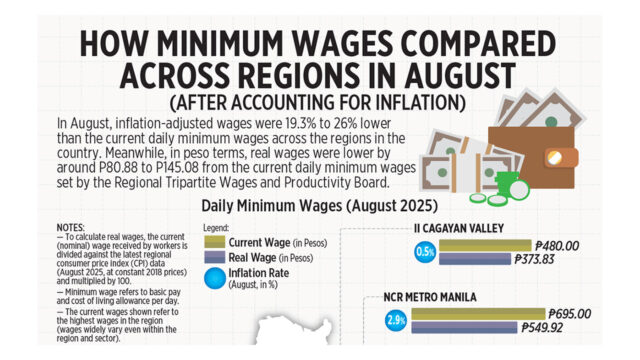
How minimum wages compared across regions in August

(After accounting for inflation)

In August, inflation-adjusted wages were 19.3% to 26% lower than the current daily minimum wages across the regions in the country. Meanwhile, in peso terms, real wages were lower by around P80.88 to P145.08 from the current daily minimum wages set by the Regional Tripartite Wages and Productivity Board.

How minimum wages compared across regions in August

Tech touted as solution to ageing-farmer crisis, but farms can’t thrive without reforms

STOCK PHOTO | Image by Waqar Mujahid from Unsplash

By Kyle Aristophere T. Atienza, Reporter

DENNIS IVAN CHAVEZ, a 25-year-old computer engineering graduate from Mindanao State University’s Iligan Institute of Technology, didn’t know he would one day co-found FrescoGreenovations, an agriculture-based startup that provides automation services for farms and gardens.

“I come from a family of Igorot farmers and traders, but as time went on, they slowly moved away from farming and pursued other careers,” he told BusinessWorld.

When the pandemic hit, the online gaming and tech enthusiast had a chance to try other things that he said weren’t taught in his university subjects, one of which was hydroponics.

“The harvest gave me a lot of dopamine. I turned to my high school classmates who took up agriculture and got them onboard We supplied a few food businesses and households,” he said.

FrescoGreenovations in January registered with the Securities and Exchange Commission, over two years after it was chosen to be part of a Department of Agriculture (DA) program for aspiring farmers.

“We pivoted to becoming an agritech startup after we received the funds. It was a rollercoaster of events after that, a lot of ups and downs,” according to Mr. Chavez, who was 21 years old when he and his teammates received a grant of P100,000 from the government.

The startup, now run by seven people including licensed agriculturists and computer engineers, is currently working with a private school that seeks to build a campus-based greenhouse farm equipped with sensors, actuators, and other farm management systems.

“The growing global interest in farming, with its related impact on food security, climate change, population growth, and technological innovation, shifts the concept from traditional labor-intensive practices to agritech entrepreneurship,” Science and Technology Secretary Renato U. Solidum told BusinessWorld.

“This gives young Filipinos the opportunity to engage in farming innovations, build startups, and earn more competitively,” he said, noting that artificial intelligence (AI)-driven decision tools, drones, sensors, and satellite data are helping attract young people to farming.

“Even during the pandemic, there was explosive interest in urban and vertical farming,” he said.

In his fourth address to Congress, President Ferdinand R. Marcos, Jr. urged the young to consider agriculture-related careers, citing state support for agrarian reform beneficiaries, including the distribution of land titles.

“Agriculture courses, programs, and scholarships are awaiting the youth, so that agriculture will be their source of livelihood in the future, and they can continue this honorable livelihood of their parents,” he said.

While the Philippines is making important strides in integrating climate-smart agriculture in the education system, with universities like the University of the Philippines (UP) Los Baños and Tarlac Agricultural University offering specialized courses on sustainable agriculture and agri technology, “much more needs to be done to reframe agriculture as a modern, tech-driven sector — not a fallback career,” Manila Business Club (MBC) Executive Director Rafael ASG Ongpin said in an interview.

He said embedding agriculture and sustainability concepts into the K-12 curriculum, coupled with training teachers, is essential to cultivate a generation open to the opportunities and challenges of climate-smart agriculture.

“It is also critical for educational institutions to partner with private sector innovators who can offer internships and hands-on experience,” he added.

“Otherwise, we’ll continue losing young talent to urban jobs. The goal is to make farming attractive, viable, and future-ready.”

The average age of Filipino rice farmers is 56 and climbing. Government data indicate that agriculture and forestry lost almost 950,000 jobs in February mainly due to typhoons that devastated farmland.

Citing the Food and Agriculture Organization, a Philippine Institute for Development Studies (PIDS) report by economist Roehlano M. Briones published in December 2021 estimated the country’s arable land at 12.44 million hectares.

PIDS found declining productivity and structural inefficiencies, with farm sizes shrinking.

The government through the DA and Department of Science and Technology (DoST) has been stepping up efforts to promote climate-smart and precision technologies in agriculture, which recently sustained P3 billion in losses after monsoon rains and three storms hit the country in late July.

For its part, the DoST has been providing farmers with knowledge and tools on pest identification that can help minimize infestations and damage to crops and seed grants to agri-based startups, according to Mr. Solidum.

He noted that its AI-powered decision support system for farmers, known as Project SarAI (Smarter Approaches to Reinvigorate Agriculture as an Industry) co-developed with UP Los Baños will be rolled out nationwide through its regional offices “very soon,” especially in areas frequently affected by extreme weather.

The project combines remote sensing, crop modeling, and localized weather data to provide timely advisories for farmers and help them decide when to irrigate, plant, or harvest.

“Climate change has made farming more unpredictable and risky, with extreme weather events, shifting rainfall patterns, and soil degradation affecting yields,” Mr. Solidum noted.

He cited the need for tech-driven farming — from smart irrigation systems that conserve water to AI-based weather and crop modeling that helps reduce risk.

“With precision agriculture, farmers can maximize productivity while minimizing inputs, waste, and environmental impact, which are crucial in adapting to a changing climate,” he said.

Among the beneficiaries of the DoST’s programs is agriculture-based startup GreenVisionsPh (formerly Waste4Good), which initially found itself thriving in transforming food waste into fertilizer.

“Over time, as we listened more deeply to farmers, we realized that waste was only one part of a much broader challenge. There was also a glaring gap in farming precision and sustainability,” according to its Chief Executive Officer and Founder Lorilyn P. Daquioag.

She cited the case of a client who, despite generating approximately P70 million annually from a 40-hectare banana farm, had struggled with “alarmingly high” production costs of up to P45.5 million.

With no baseline data, no regular soil tests, and no monitoring systems, the client’s approach had been largely based on guesswork, a situation that reflects the reality in many farms, according to Ms. Daquioag.

“That realization became our turning point. It led us to pivot into what is now GreenVisionsPh, which operates like a “hospital for farms” — bringing diagnostics, monitoring, and treatment directly to the field in real time,” she said.

The startup has an AI-powered, offline-capable device that provides soil and disease assessments in five minutes, helping small-scale banana growers in Mindanao save up to 50% on inputs.

The device is complemented by its AIMS (Agricultural Intelligence & Monitoring System) for real-time data tracking, and microbial treatments that resulted in 25% faster crop growth, 52% higher yields, and up to 93% healing efficiency against Fusarium Wilt TR4 (Panama disease) in trials.

“There’s a growing space for agri-tech startups like GreenVisionsPh, especially now that food security, climate change, and farm sustainability are top concerns,” Ms. Daquioag said, noting that farmers and agri-stakeholders are actively looking for solutions that are science-based, scalable, and grounded in real field experience.

“As a startup, we’re able to move fast, stay close to our users, and build tech that directly responds to what farmers actually need,” she said.

However, Ms. Daquoiag noted challenges for agri-tech startups like limited funding for research and development and fragmented distribution channels.

“Some farmers are also reluctant to try unfamiliar solutions, especially when their livelihood is at stake,” she said.

“On top of that, infrastructure — like poor internet in rural areas — makes digital adoption slower than it should be,” she added.

She said climate change, food insecurity, and rising input costs are forcing the industry to rethink the way it practices farming, opening the door for precision technologies and sustainability-focused tools.

Mr. Chavez, the hydroponic farmer, said the lack of large data banks is hindering AI-driven agriculture startups.

“To have reliable AI, we need big data, large data banks which we do not have. We haven’t even completed our digital transformation,” he said.

“These systems also allow ease of aggregating data. The more data we feed into the system, the better it gets.”

Mr. Ongpin of MBC said the “promise of technology is not enough without market reforms.”

“Farmers must be able to sell at fair prices,” he said, noting that many rice farmers sell palay at just P8–10 per kilo — barely enough to recover costs or break even — while retail rice sells for P35–40.

He cited persistent inefficiencies in the supply chain and unchecked imports that leave farmers with unsold stocks.

“Without fair market access and better infrastructure, no amount of technology will make farming appealing to the youth,” Mr. Ongpin said.

The MBC in 2024 launched an agriculture advocacy program to help raise farmer incomes and lower food prices.

The group currently provides training to farmer cooperatives, focusing on business management and market access.

It also assists in the professionalization of cooperatives and connects them with large businesses.

The MBC said the government should help farmers connect to stable markets, noting that technology adoption only makes sense when there is clear, consistent demand.

“The government must first put in place coherent trade and procurement policies that protect and prioritize local production,” it said. “Only then can efforts to scale climate-smart agriculture succeed.”

It also urged the government to address what it called a “trust gap,” as many farmers don’t benefit from support programs because of unclear targeting, limited transparency, and poor coordination across agencies.

“This undermines confidence in government initiatives and discourages the adoption of new practices and technology,” Mr. Ongpin said.

“Climate-smart agriculture will only succeed if the government lays the groundwork: functional infrastructure, clear and consistent rules, and strong support for farmers — while enabling the private sector to do what it does best: innovate, invest, and build competitive markets.”


Metrobank Foundation, GT Foundation turn over P45 million in social dev’t grants

METROBANK FOUNDATION, INC.

METROBANK FOUNDATION, Inc. (MBFI) and GT Foundation, Inc. (GTFI) have turned over P45 million in social development grants to 30 partner organizations to support programs for healthcare, education, livelihood, disaster risk reduction, and special interventions.

“This 2025, we are proud to say that Metrobank Foundation and GT Foundation are turning over P45 million worth of grants to 30 development partners, with the hope that these will be the seeds that translate into lives changed, futures secured, and communities strengthened,” Metrobank Foundation President Philip Francisco U. Dy said in a speech at the turnover ceremony held on Friday at the Grand Hyatt Manila in Taguig.

“We act today so that we can pave the way for a brighter present and a stronger tomorrow. No single organization can meet these challenges alone, but together, as partners, we can grow with greater purpose. Each of us here is part of that shared story of growth where the seeds we sow today will nurture lives, not just now, but for future generations,” Mr. Dy said.

This year’s theme is “Bridging Generations, Growing with Purpose” as the two foundations aim to foster long-term and sustainable programs, which is also in line with Metropolitan Bank & Trust Co.’s “Let’s Grow Together” campaign that outlines its vision to create pathways for shared growth and long-term social impact for the next generation.

For education, the two foundations partnered with several educational institutions to support financially challenged college students and youths, as well as boost inclusive education in vulnerable communities.

In health, Metrobank Foundation and GT Foundation will support projects that boost access to clean, potable water, support in-patient and in-house surgical programs for indigent patients, and increase food access and essential services for vulnerable groups.

The two foundations are also funding the development of sustainable livelihoods for military families, disadvantaged families, and solo parents and persons with disabilities through enhancing food security and income generation.

Under disaster risk reduction and management, Metrobank Foundation and GT Foundation will support capacity-building initiatives such as training communities to provide mental health screening, first aid, and resilience interventions for moderately distressed clients.

Other initiatives backed by the foundations will provide non-tuition support for students, scholarship grants to qualified and deserving college students, help implement medical missions, and targeted relief operations. — Aaron Michael C. Sy

Style (09/08/25)


Rhett Eala to headline 2025 Red Charity Gala

THE Red Charity Gala, one of the leading fashion and charity galas in the country, holds its 14th iteration, with top Filipino designer Rhett Eala as this year’s featured designer. The event will be held at The Peninsula Manila on Oct. 4. Launched in 2009, the Red Charity Gala was organized by philanthropists Tessa Prieto and Kaye Tinga to benefit the Assumption HS 81 Foundation, Hope for Lupus Foundation and the Philippine Red Cross. The charity gala has been a platform to showcase the works of renowned local fashion designers including Dennis Lustico, Furne One, Michael Cinco, Cary Santiago, Ezra Santos, Jojie Lloren, Lesley Mobo, Chito Vijandre, Joey Samson, Rajo Laurel, Ivarluski Aseron, and Lulu Tan-Gan. This year, the spotlight is on Eala who said in a statement: “It felt like an out-of-body experience when I was first told about being the Red Charity designer for this year. I feel excited now because I haven’t done a solo show in many years, perhaps even decades.” Red Charity Gala is presented by Bench together with Arthaland, with major sponsors Diagold, Emirates Airlines, Jewelmer, and The Peninsula Manila. For inquiries, contact Maggie Gineta at 0917-832-5570 and follow Red Charity Gala on Instagram (@redcharitygala).


Dr. Martens opens 3rd PHL store at Greenhills

DR. MARTENS announces the opening of its third store in the Philippines at the 2nd Floor, GH Tower, Greenhills Shopping Center, San Juan. Its other two branches are at Robinsons Place Manila and SM North EDSA Annex. Shoppers can explore a wide range of Dr. Martens’ silhouettes, including the 1460 boots, 1461 shoes, loafers, and Chelsea boots. The store also highlights seasonal drops and new collections, such as the Zebzag collection. For more information, visit @drmartensph on Instagram and https://facebook.com/DrMartensPH.


Staccato reopens in the Philippines

Staccato, the global fashion footwear brand, reopens in the Philippines under its new distributor, MAP Philippines. Staccato unveiled three new stores at Festival Mall (East Wing, Upper Ground Floor, Festival Mall Alabang), Gateway (Ground Floor, Gateway Mall, Cubao, Quezon City), and Bacolod (1st Level, Ayala Malls Capitol Central). For more information, visit @thestaccatoph on Instagram and @staccatoph on TikTok.

Free checkup for JAC passenger vehicles

IMAGE FROM JAC PHILIPPINES

ASTARA PHILIPPINES is offering owners of JAC passenger vehicles purchased between 2017 and 2023 with a “welcome gift” consisting of a free checkup and free preventive maintenance service (PMS). “This initiative is a warm gesture to reconnect with loyal customers and ensure their vehicles receive the expert care they deserve,” the distributor said in a release. “Astara Philippines wants to ensure that no owner is left behind, following a recent shift in distribution. This new program is a heartfelt invitation for customers to experience the exceptional after-sales service that the brand is known for.”

JAC Motors Philippines will also honor warranties of vehicles bought during the same period, despite those vehicles being purchased from a different distributor. These JAC vehicle owners will also be offered free PMS and checkup. On top of this, customers can expect up to 10% discount on parts and 20% discount on labor from authorized JAC service centers.

JAC Motors Philippines Brand Head Tonette Lee insisted that the new distributor hasn’t “forgotten (its) loyal customers who may have felt left out during recent changes.” Owners of eligible vehicles just need to register their vehicle on a dedicated website or visit any authorized JAC service center to schedule their free checkup and PMS.

Customers can expect faster and more efficient service visits through JAC Philippines’ network of authorized service centers nationwide. Currently, there are three authorized service centers across the country. Over the next six months, Astara Philippines looks to expand the network to seven.

Customers may register through www.jacmotors.com.ph to schedule their free checkup at any participating dealership. For assistance, contact Customer Care at 0926-013-7798 or e-mail customercare@jacmotors.com.ph. JAC dealerships are currently located in Iloilo, Manila Bay and Quezon Avenue. Interested people may also follow
@jaccarsph on Facebook and Instagram.

Healthy learners, healthy future: Why vaccination and nutrition must go hand in hand

STOCK PHOTO | Image by Ed Us from Unsplash

Schools are places of growth and learning but they can also expose children to health risks. In the Philippines, these risks are magnified by two silent threats: infectious diseases and malnutrition. Nearly three in 10 Filipino children under five are stunted, compromising not only their physical growth but also their ability to learn. Without timely intervention through proper nutrition and vaccination, millions of children face setbacks that could last a lifetime.

At a recent Health Connect media forum themed “Vax to School: Building Healthy Learners with Vaccination and Nutrition,” health experts emphasized that children’s health, learning, and future success depend on the powerful combination of proper nutrition and timely immunization.

“Both vaccination and nutrition are indispensable in ensuring that children are not only protected from illnesses but are also able to learn, grow, and succeed,” said Dr. Eric Tayag, former Health Undersecretary and forum moderator.

Theresa A. Rivas, Nutrition Officer III of the National Nutrition Council (NNC) Calabarzon, illustrated the consequences of malnutrition by comparing brain scans of a healthy child and a stunted child. The scan of the stunted child revealed 40% less brain mass and a less developed temporal lobe or the part of the brain that supports memory, language, and understanding.

“This is why malnourished children sometimes struggle in school. It’s not because they are lazy or unwilling to learn, but because they are at a biological disadvantage,” Ms. Rivas explained.

She warned that the effects of stunting are irreversible after a child’s second birthday, with consequences lasting into adulthood. This is why the “first 1,000 days” from pregnancy to a child’s second year are crucial. Children who receive proper nutrition during this critical window are 10 times more likely to survive life-threatening diseases like measles and diarrhea, complete more years of education, earn higher wages as adults, and raise healthier families.

Nutrition and vaccination are deeply interconnected. While its primary aim is preventing diseases, immunization is also recognized as a nutrition-sensitive intervention. By protecting children from illnesses that contribute to or worsen malnutrition, vaccines support proper growth and development. In turn, well-nourished children respond more effectively to vaccines.

“By combining proper nutrition with timely immunization, we give children the best chance to grow well, stay safe, and succeed in school,” Ms. Rivas said. “Let’s start with good nutrition during the first 1,000 days and avail of health services such as vaccination to achieve optimal health for our children.”

Dr. Maria Cristina Alberto, board member of the Philippine Foundation for Vaccination (PFV) and founder of the Hope in Me Club, stressed the need to correct persistent misconceptions about vaccines.

“It’s not true that nutrition alone is enough to protect your child from illness. Even healthy kids can get sick, particularly with vaccine-preventable diseases,” Dr. Alberto explained.

She emphasized that vaccines provide long-lasting protection, with some — like those for measles, mumps, and rubella — conferring lifelong immunity after just a few doses, while others require booster shots before school entry. She also noted that immunization benefits extend beyond childhood, citing vaccines such as HPV and hepatitis B that protect against cancers later in life.

Dr. Alberto further explained that vaccine-preventable diseases can derail children’s education. For example, a child with chickenpox may miss two weeks of school, which can significantly affect performance. Meanwhile, malnourished children are more likely to die from infections that cause diarrhea and pneumonia, creating a vicious cycle where poor nutrition and disease reinforce one another.

Ensuring children’s health requires a collective effort. Dr. Allen Mallari, president of the Philippine Academy of Physicians in School Health, underscored the value of collaborative care where physicians, nurses, educators, allied health professionals, community leaders, and parents work together to meet children’s needs.

“Through collaborative care, we can support school-based initiatives like feeding programs or vaccination drives, ensuring that children grow up healthy and protected against diseases,” Dr. Mallari said.

Protecting Filipino children requires more than just individual effort. Parents must provide proper nutrition and ensure vaccination schedules are followed. Schools, communities, and health professionals must continue programs that safeguard children’s well-being. Government and private partners must sustain investments in child health.

By combining the power of nutrition and vaccination, we can raise a generation of learners who are healthier, stronger, and ready to build our nation’s future.

The Health Connect forum, co-organized by the Philippine Medical Association, the PFV, and the Pharmaceutical and Healthcare Association of the Philippines with support from Sanofi, recently received a Merit Award at the 21st Philippine Quill Awards for its role in advancing public health awareness. Since its launch at the height of the COVID-19 pandemic in 2020, Health Connect has provided a trusted platform where medical experts and journalists share accurate, timely health information with the public.

For more information about childhood vaccination and nutrition, consult your doctor.


Teodoro B. Padilla is the executive director of Pharmaceutical and Healthcare Association of the Philippines which represents the biopharmaceutical medicines and vaccines industry in the country. Its members are at the forefront of developing, investing and delivering innovative medicines, vaccines and diagnostics for Filipinos to live healthier and more productive lives.