Home Blog Page 1032

The Last of Us is sci-fi. Deadly fungi aren’t

By Lara Williams

WHAT SPOILS our crops, kills about six times more people than malaria every year and is breathed in by each of us every single day? It’s not a virus or bacteria, but something even more formidable: fungi.

Aspergillus spores, for example, are ubiquitous in our environment. Most of the time, this group of molds cause no harm, but exposure to a pathogenic variety such as Aspergillus fumigatus or Aspergillus flavus can make an unlucky few, typically those with weakened immune systems or lung ailments, extremely ill. Invasive aspergillosis, for example, is a disease caused by spores invading lung tissue. An estimated 2.1 million people globally develop the disease every year, and 1.8 million people die.

What’s more terrifying than those odds? Perhaps the impact that climate change may have on these pathogens, which we’re ill-equipped to respond effectively.

Fungal pathogens are the underdogs of the medical world — largely understudied and underfunded — partly because fatal disease most often occurs in immunocompromised populations or developing countries. The most common infections known to the public are minor — athlete’s foot, thrush, ringworm — and so the idea of a deadly fungus is limited to science fiction, such as the video game-turned-TV show The Last of Us.

But these infectious agents shouldn’t be underestimated. Right now, we have a helpful innate defense: Our body temperature is too high for most species to survive. Yet there’s one thing that fungal pathogens have in common: the ability to grow well in hotter environments. For A. fumigatus, anything from a warm compost heap to a toasty human body does just fine. That’s why they’re so good at infecting us — and why the climate crisis is worrying to medical mycologists.

A study, published on preprint platform Research Square and funded by charitable foundation the Wellcome Trust, used climate modeling and forecasts to map how the global distributions of three Aspergillus strains — A. flavus, A. fumigatus, and A. niger — could be expected to change under different warming scenarios. Their geographical ranges differ according to environmental variables such as annual mean temperature and annual precipitation, and so it’s expected that these fungi will find new places to thrive as global warming alters the environment.

Under the most severe warming scenario, which imagines a world that continues to rely heavily on fossil fuels, all three species push northward, with A. fumigatus increasing its spread by about 77.5% as temperatures rise and rainfall patterns change in the Northern Hemisphere. The modeling also points to a potential rise in Europe and Australia of people living alongside these fungi, an ominous insight into the regions’ coming disease landscapes.

Some of the other findings might seem broadly positive — Africa, Asia, and South America show large potential reductions in the number of people living in suitable areas for Aspergillus, for example — but there are several reasons to be alarmed.

First, the study didn’t account for the possibility of the species adapting to warmer temperatures, something that lead author Norman van Rhijn, Wellcome Trust research fellow at the University of Manchester, told me was “very likely.” That would mean fungi could maintain their current range as well as spread to new regions.

As with vector-borne diseases such as tick-borne encephalitis and dengue, part of the challenge with migrating pathogens is that medical professionals may not know what they’re being presented with.

Invasive aspergillosis and other fungal diseases are already extremely hard to diagnose as their symptoms are generic, and testing is complex, particularly when patients are critically ill. A 2022 study showed that many cases are missed altogether and only diagnosed at autopsy. Out of 67 cases of fatal invasive aspergillosis, only 27% were diagnosed or suspected to have the disease by clinicians. Diagnosis will only be complicated further if doctors in newly suitable areas aren’t alert to the health risk.

Fungal diseases like aspergillosis aren’t easy to treat, either. Because fungi are much more closely related to human beings than either bacteria or viruses, it’s hard to find ways to kill the bug without also harming the patient. The pipeline of new antifungals has been largely stagnant for the past three decades thanks to the high risks and costs associated with their development, meaning we don’t have many effective treatments to choose from.

Meanwhile, drug resistance is becoming a larger problem. Aspergillus species also infect crops, so fungicides are a major tool needed to protect food security. The issue is that the main products available rely on the same mechanism to destroy the fungi that the antifungals use to treat serious infections. Studies have shown that airborne spores of A. fumigatus are now commonly resistant to current drugs.

Just recently, there was hope on the horizon in the form of new treatment options that tackle these infections in diverse ways. Yet it may already be too late. A new antifungal, olorofim, for example, is in late-stage clinical trials. But a fungicide called ipflufenoquin kills in the same way and has beat the drug to market in the US, Australia, and Japan, and it’s pending approval in the European Union.

Exposure to the fungicide, sold under the trade name Kinoprol, could turn the £250 million ($336 million) of investment and two decades of development spent on olorofim into a waste of time and money by allowing Aspergillus to develop resistance before it’s been deployed in the clinic. A similar predicament exists with another drug, fosmanogepix, and fungicide, aminopyrifen.

The crisis shows how important a comprehensive approach is to environmental and human health in a climate-changing world. Agricultural and medical bodies need to work together to address these common issues. The One Health movement pushes for this, which has led to some successes around the world, but government departments, research bodies, and companies remain too often siloed, and initiatives are still falling short. If we don’t start collaborating, we’ll keep walking ourselves into the same difficult positions while wasting money and resources.

For Elaine Bignell, professor of medical mycology at the University of Exeter, this study and others like it are important because they help raise awareness: “Over the last half century, a miniscule amount of funding — from governments, charities, philanthropies — have gone toward fungal disease,” she said. Though they do mostly affect those who are going through chemotherapy, organ transplants, or severe respiratory issues, Bignell points out that any of us could fit into one of those boxes in the future.

As fungi adapt to a hotter world, new diseases emerge or existing ones may find it easier to infect us. Some mycologists argue that one has already emerged thanks in part to climate change: Candida auris, a new multidrug-resistant species, which appeared simultaneously on three continents in the early 2010s. It’s been found to spread easily among hospitalized patients, clinging to plastic medical equipment such as blood pressure cuffs and catheters and causing serious infections.

It’s not just temperature, either. Bignell said that another risk lies in sea-level rise. As seawater creeps further inland, more fungi will be exposed to high-salt environments. Adaptation to salinity may also help fungi withstand the conditions in the human body. As Bignell told me: “The tougher fungi get in response to stressors in the environment, the harder it’ll be for us to fend them off.”

The Last of Us has exposed the public to the idea of a future deadly fungal pathogen, but what’s less appreciated is that they’re already among us. More research, regulation and monitoring are desperately needed to combat them. Environmental health and human well-being are inextricably linked, and we should start acting like it.

BLOOMBERG OPINION

Why strategy still fails

Strategy execution sounds straightforward — set a plan, follow through, see results. But anyone who’s led a strategic initiative knows it’s rarely that simple. I’ve been in those meetings where we’ve built what looked like the perfect plan on paper, only to watch it stall once implementation starts. That disconnect between planning and doing is the problem many organizations are still struggling to fix. According to the 2025 AchieveIt report, even with more awareness, tools, and processes available than ever, the majority of organizations are still falling short when it comes to getting strategies across the finish line.

The study found that execution problems almost always tie back to six key areas: leadership alignment, collaboration, accountability, progress tracking, continuous improvement, and the smart use of technology. Let’s start with leadership. The numbers speak loudly — 91% of leaders believe that a lack of strategic vision is the reason most plans fail. I’ve seen this firsthand. You can have the most detailed roadmap, but if your team doesn’t see how their work connects to a bigger picture, they lose motivation. Worse, they start pulling in different directions. What makes it harder is that some leaders think their job ends once the strategy is drafted. But execution demands ongoing leadership. The best leaders don’t just set the vision — they keep everyone aligned with it every step of the way.

Then, there’s collaboration, or rather, the lack of it. The report showed that 77% of leaders say silos slow down both execution and innovation. And while many organizations claim to promote collaboration, most aren’t following through. It’s one thing to say departments should work together; it’s another to give them the space and support to do it. One of the most interesting insights was that organizations with strong cross-functional collaboration were nearly twice as successful in reaching their strategic goals. That’s not surprising when you think about how quickly things can move once teams stop duplicating efforts and start sharing ideas and resources.

Accountability was another big one. The study found that 95% of leaders saw better progress when accountability was clear. It seems so obvious — if no one owns a task, it doesn’t get done. But in practice, we often assign projects to “teams” rather than individuals, and the responsibility gets lost. Organizations that defined ownership clearly, tracked it, and followed up regularly were 10 times more likely to see improved results. That’s huge. And yet, 81% of organizations still struggle with delays caused by unclear accountability. This is where structured status updates, regular check-ins, and visible ownership make a difference.

One point that stood out for me was how many organizations still treat plans as static documents. Strategy isn’t something you print and forget. Only 55% of leaders actually use regular check-ins to track progress, even though 66% say consistent updates increase their odds of hitting targets. That mismatch shows how hard it is to build routines around tracking. Still, when teams use tools like real-time dashboards, they’re 10 times more likely to achieve their goals. That’s not because dashboards are magic — it’s because they provide clarity and visibility. When everyone can see progress (or the lack of it), conversations become more productive, and decisions move faster.

Continuous improvement is another area where organizations know what to do but struggle to follow through. The report showed that 82% of organizations that conduct annual reviews improve their goal achievement. On top of that, plans that are updated every year are seven times more likely to support better collaboration. But here’s the kicker — only about half of the organizations surveyed said they learn from each strategy cycle. It’s a missed opportunity. If we don’t reflect on what worked and what didn’t, we’re likely to repeat the same mistakes. One leader in the study described it best: “Companies fail because they either do too much of the same or chase too much of the new.” Success often means balancing both — building on lessons while staying flexible.

Technology is supposed to make strategy execution easier, and when used right, it does. The study showed that 87% of leaders said access to real-time data directly improves strategic outcomes. And organizations using dashboards are 88% more likely to improve year over year. That’s not surprising. I’ve seen how just one good dashboard can shift how a team communicates, prioritizes, and adjusts. On the other hand, teams still relying on manual updates are 79% more likely to respond slower to change. It’s not just about speed, though — it’s about confidence. Teams that use real-time tools feel more aligned with long-term goals.

At the heart of it all, execution isn’t about fancy frameworks or jargon. It’s about people doing the right work at the right time, with enough clarity and support to stay focused. That’s why strategy execution is less about writing a better plan and more about managing how people act on it day-to-day. As the AchieveIt report shows, when organizations commit to alignment, collaboration, accountability, tracking, improvement, and smart tech, strategy stops being an abstract idea and becomes something real — something that gets done.

The views expressed herein are his own and do not necessarily reflect the opinion of his office as well as FINEX.


Reynaldo C. Lugtu, Jr. is the founder and CEO of Hungry Workhorse, a digital, culture, and customer experience transformation consulting firm. He is a fellow at the US-based Institute for Digital Transformation. He is the chair of the Digital Transformation and Governance program of the FINEX Academy. He teaches strategic management and digital transformation in the MBA Program of De La Salle University. The author may be e-mailed at rey.lugtu@hungryworkhorse.com

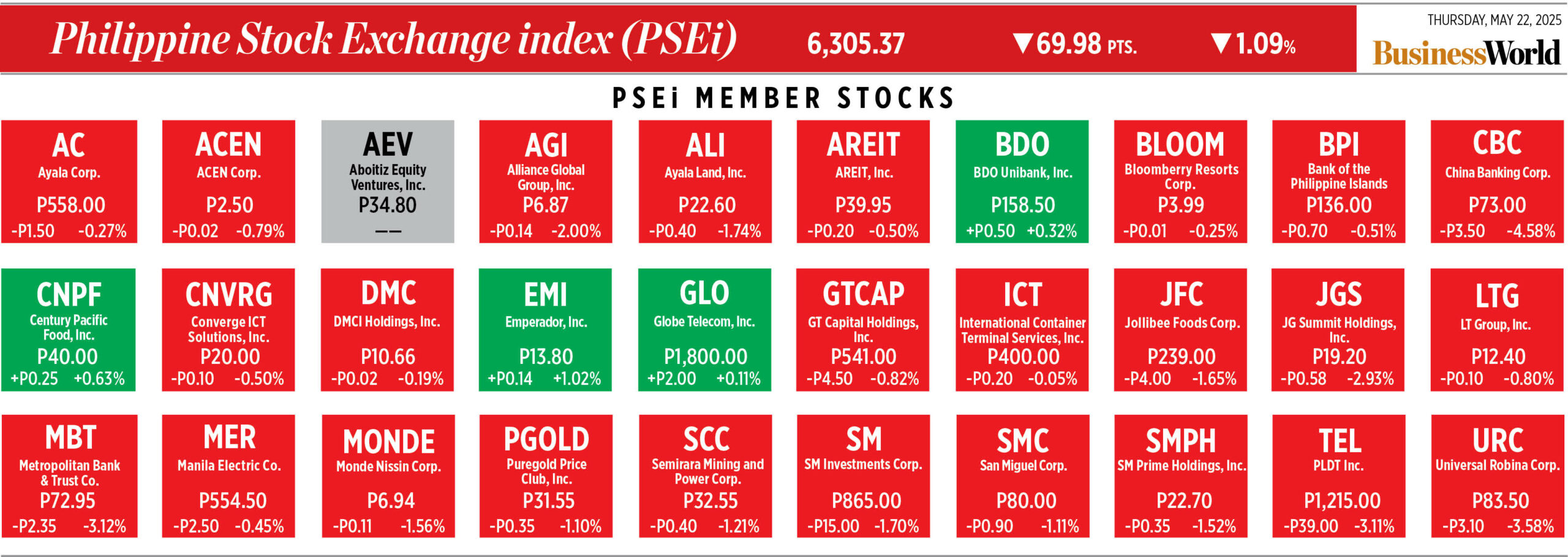
How PSEi member stocks performed — May 22, 2025

Here’s a quick glance at how PSEi stocks fared on Thursday, May 22, 2025.


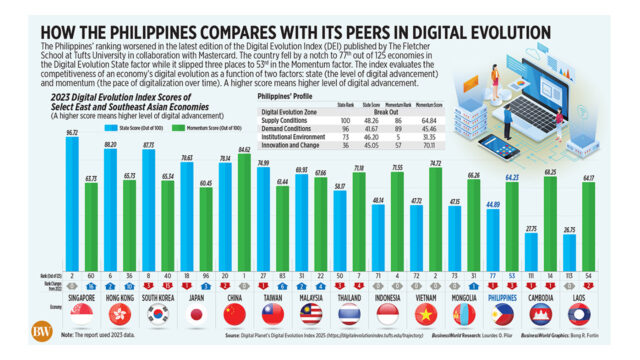
How the Philippines compares with its peers in digital evolution

The Philippines’ ranking worsened in the latest edition of the Digital Evolution Index (DEI) published by The Fletcher School at Tufts University in collaboration with Mastercard. The country fell by a notch to 77th out of 125 economies in the Digital Evolution State factor while it slipped three places to 53rd in the Momentum factor. The index evaluates the competitiveness of an economy’s digital evolution as a function of two factors: state (the level of digital advancement) and momentum (the pace of digitalization over time). A higher score means higher level of digital advancement.

How the Philippines compares with its peers in digital evolution

Philippines says Chinese vessels harassed its civilian ships at Sandy Cay

PHILIPPINE STAR/MICHAEL VARCAS

By Kenneth Christiane L. Basilio, Reporter

THE PHILIPPINES on Thursday accused China of endangering Filipino researchers in the South China Sea, saying its coast guard harassed two Philippine civilian vessels at a disputed reef on Wednesday, further raising tensions in the contested waterway.

The Philippine ships BRP Datu Sanday and BRP Datu Pagbuaya were on a routine scientific mission to collect sand samples at Sandy Cay, where they encountered “dangerous maneuvers and illegal acts” from Chinese coast guard and militia ships, according to Manila’s fisheries bureau.

The Chinese Embassy in Manila did not immediately reply to a Viber message seeking comment.

A Chinese coast guard vessel fired its water cannon at BRP Datu Sanday — the first time it has been used against Philippine ships at the disputed reef — before colliding the vessel, damaging its bow and chimney, the Bureau of Fisheries and Aquatic Resources said in a statement.

“Despite the aggressive interference, dangerous maneuvers and illegal acts by the China Coast Guard and Chinese maritime militia vessels, the Philippine scientific team was able to complete its operations in Pag-Asa Cays 1, 2 and 3,” the fisheries agency said, referring to the Sandy Cay features by their Filipino names.

“The incident occurred within the territorial sea of the Philippines,” it added.

The sandbars have become a flashpoint in the ongoing dispute between the two nations in the South China Sea, where they both lay competing claims. Confrontations between Manila and Beijing at other sea features have involved the use of water cannons and sideswipes by Chinese vessels on Philippine ships.

Manila has condemned such acts as aggressive and unlawful, while Beijing maintains its actions are meant to defend Chinese sovereignty.

China claims nearly all of the potentially mineral- and oil-rich South China Sea based on a 1940s nine-dash line map that overlaps with the exclusive waters of the Philippines and neighbors like Vietnam and Malaysia.

Chinese state media in mid-April reported that China’s coast guard had asserted sovereignty over the Sandy Cay by landing and displaying Beijing’s national flag on the feature.

But Manila has denied China’s claim over the sandbar, deploying its own contingent of troops shortly after to reinforce its position and challenge Beijing’s assertion of control.

The sandbank lies close to Thitu Island, where the Philippines maintains a military outpost and a small Filipino community has lived since 1971.

“Despite all the harassment, we’re still going to continue our maritime scientific research,” Philippine Coast Guard (PCG) spokesman for the West Philippine Sea Commodore Jay T. Tarriela told reporters on the sidelines of a maritime security forum in Manila.

“We’re still going to exercise our sovereignty and sovereign rights in the West Philippine Sea,” he added, using the Philippine name for parts of the South China Sea within the country’s exclusive economic zone.

Mr. Tarriela declined to say whether PCG vessels would escort future scientific research missions to the sandbars but confirmed that coast guard personnel were on board the ships during Wednesday’s operation.

SEA CODE
Meanwhile, a Philippine state lawyer said on Thursday that the finalized code of conduct for the disputed South China Sea must align with international maritime law and uphold Manila’s arbitration victory over Beijing.

“The code of conduct should not have any provisions that would supervene the provisions of the United Nations Convention of the law of the Seas (UNCLOS),” Fretti G. Ganchoon, senior state counsel at Manila’s Justice department, told a maritime security forum.

“The UNCLOS is considered as the highest instrument of the Constitution for the oceans, and so the code of conduct must be consistent with it. It cannot have rules there that would, for example, impair the arbitral award,” she added.

Manila took legal action against China in 2013 over its blockade on Philippine vessels going to Scarborough shoal, a prime fishing ground claimed by both nations that Beijing has controlled since 2012.

In 2016, a United Nations-backed tribunal ruled that China had interfered with Filipino fishermen’s rights to access the area. It also voided its expansive sea claim in the contested waterbody for being illegal. Beijing has continued to deploy vessels around the maritime feature to assert its claim despite the ruling.

The Association of Southeast Asian Nations (ASEAN) and China pledged in 2002 to come up with a code of conduct on the South China Sea, a framework that seeks to prevent conflict through diplomatic means, but it has remained elusive due to slow progress.

Philippine Foreign Affairs Secretary Enrique A. Manalo last month said ASEAN and Beijing are “politically committed” to finalize the South China Sea code by next year, when the Philippines is set to host the regional grouping.

“At an early stage, we need to use the UNCLOS as a framework,” Hamzah bin Ishak, deputy director-general of national security at Malaysia’s National Security Council, said in the same forum.

“We are not living in the jungle, where people who are strong can do whatever they do,” he added. “We believe that UNCLOS remains relevant in disputes on the rights and responsibilities at sea.”

Mr. Hamzah said that “political solutions” outside the international treaty should only be explored if negotiations reach a deadlock. “I think ASEAN will continue to use the framework in the negotiations.”

Philippines, Australia seek deeper cyberdefense ties

DEFENSE Secretary Gilberto C. Teodoro, Jr. and Australia Defense Force’s Cyber Command chief Paul Pettigrew committed to strengthening cyber defense cooperation in a meeting in Manila on Wednesday. — DND

THE PHILIPPINES and Australia vowed to strengthen their cyberdefense cooperation on Wednesday, as top security officials from both nations committed to advancing their cybersecurity capabilities amid evolving national security threats in the digital space, according to Manila’s Defense agency.

Defense Secretary Gilberto C. Teodoro, Jr. met Australia Defense Force’s Cyber Command chief Paul Pettigrew in Manila, where Canberra pledged support for the Philippines’ efforts to strengthen its cyberdefense systems, it said in a statement late Wednesday.

“Both sides emphasized the need to deepen the enduring partnership between the Philippines and Australia, particularly in the cyber domain and highlighted that collaboration is needed not only at the tactical level, but also in governance and strategic planning,” the Philippine Department of National Defense (DND) said.

It noted discussions covered potential areas for cyber capacity building and collaboration with the DND and the Philippines’ armed forces.

The Philippines’ weak cyberdefense systems have led to national security vulnerabilities and economic losses, with incidents ranging from foreign actors allegedly breaching the President’s office and stealing sensitive documents to more than 80% of businesses facing cyberattacks last year.

Bolstering Manila’s cyberdefense capabilities has become increasingly urgent as Beijing has allegedly escalated state-sponsored attacks since last year, according to a report by US-based cybersecurity company CrowdStrike.

“The underlying motivation is likely China’s desire for regional influence in the nation’s near abroad,” it said in its 2025 report.

China has become increasingly assertive in the South China Sea, deploying a fleet of vessels to stake its sovereignty in the disputed waters, a key global trade route that is believed to be rich in minerals and oil deposits.

Manila and Beijing have repeatedly locked horns over maritime features that both nations claim in the contested waterbody, leading to confrontations that involve the use of water cannons and repeated sideswipes by Chinese vessels against Philippine ships.

The Philippines has stepped up efforts to counter China’s expansive claims in the South China Sea, broadening defense partnerships beyond its traditional ally, the US, to include Japan, Australia, and other western nations.

“Both sides concluded the meeting with a shared vision of deepening bilateral defense ties and promoting a free, open and secure Indo-Pacific region,” the Defense department said. — Kenneth Christiane L. Basilio

Congress told to push land use, homebuyer financing bills

PHILIPPINE STAR/NOEL PABALATE

By Beatriz Marie D. Cruz, Reporter

LAWMAKERS in the 20th Congress should pass bills seeking to institutionalize a national land use policy and a homebuyer financing program for the poor to address the country’s housing woes, according to analysts.

“We believe this new chapter in national governance presents a vital opportunity to tackle with even greater focus the issue of homelessness which remains one of the country’s most urgent and persistent challenges,” Noel Toti M. Cariño, national president of the Chamber of Real Estate and Builders’ Associations, Inc. (CREBA), said in a Viber message.

The Philippines faces a housing deficit of 6.5 million units, which could rise to 22 million by 2040 if not addressed, according to the United Nations Human Settlements Program.

In a document sent to BusinessWorld, CREBA urged congressmen to pass the proposed national land use policy, which seeks to establish parameters for land use to address the unequal distribution of economic resources.

The measure, which is among the Marcos administration’s priority bills this year, has been stuck in Congress for nearly three decades.

CREBA also called for the passage of a bill that seeks to establish a centralized homebuyer financing program.

The proposed law aims “to establish a permanent revolving fund pool to be used exclusively for home lending to the low- and lower- middle-income, and link up lending operations with secondary market operations,” CREBA said. 

The group is also pushing for amendments to Republic Act (RA) No. 7279, the Urban Development and Housing Act of 1992, which would address low private sector participation and lack of funding in housing projects.

CREBA also sought to amend RA 6552, the Realty Installment Buyers Protection Act, as its defects have led to “untold losses for developers.” The chamber noted this has impaired the financial capability of developers to cross-subsidize socialized and low-income housing.

Moreover, CREBA called for the approval of bills instituting land registration reforms, authorizing electronic notarization of real property transactions, and requiring usufruct for government-owned lands used in social housing projects.

“CREBA stands ready to work with the 20th Congress in crafting legislation toward a future where every Filipino has a place to call home—and where housing becomes the cornerstone of a stronger, more resilient economy,” Mr. Cariño said.

Marcos to meet with ASEAN leaders next week

President Ferdinand R. Marcos, Jr. is set to deliver his second State of the Nation Address before Congress on Monday. — PPA POOL/RENE H. DILAN

PRESIDENT Ferdinand R. Marcos, Jr., is set to meet with Association of Southeast Asian Nations (ASEAN) leaders next week during the 46th ASEAN Summit ahead of the Philippines’ chairmanship of the regional bloc in 2026.

Speaking in a palace briefing on Thursday, Foreign Affairs Deputy Assistant Secretary Dominic Xavier M. Imperial said Mr. Marcos will be meeting with leaders of Laos and Vietnam at the ASEAN Summit in Kuala Lumpur, Malaysia, on May 26 and 27.

He will also meet with Kuwaiti leaders, although the Gulf country is not a member of ASEAN, Mr. Imperial said, noting the list is still being finalized.

“He will be accompanied by the Secretary of Foreign Affairs, Enrique A. Manalo, and Trade Secretary Cristina A. Roque,” Mr. Imperial said.

Mr. Marcos’ visit will also include his participation in two expanded engagements: the 2nd ASEAN-Gulf Cooperation Council (GCC) Summit and the ASEAN-GCC-China Summit.

A key agenda item for the summit will be ASEAN’s unified response to the recent imposition of unilateral tariffs by the United States.

Mr. Imperial said that while ASEAN remains concerned about the economic impact of these tariffs, the bloc has agreed not to retaliate. Instead, member states are focusing on enhancing bilateral and multilateral engagement with the US, a strategy strongly supported by Mr. Marcos.

President Marcos supports this non-retaliatory, dialogue-focused approach aimed at benefiting all ASEAN member states, he added.

The summit is expected to release a joint statement on the agreements among ASEAN leaders, with the GCC, and China, covering ASEAN’s three pillars of peace and security (including maritime cooperation), economic cooperation (such as digital transformation and artificial intelligence), and socio-cultural ties (including people-to-people exchanges and climate change).

The summit will also discuss Timor-Leste’s pending membership in the world’s 5th largest economy, but Mr. Imperial noted they may not yet vote on its application yet. — Chloe Mari A. Hufana

June 6 declared regular holiday

PRESIDENT FERDINAND R. MARCOS, JR. — PCO.GOV.PH

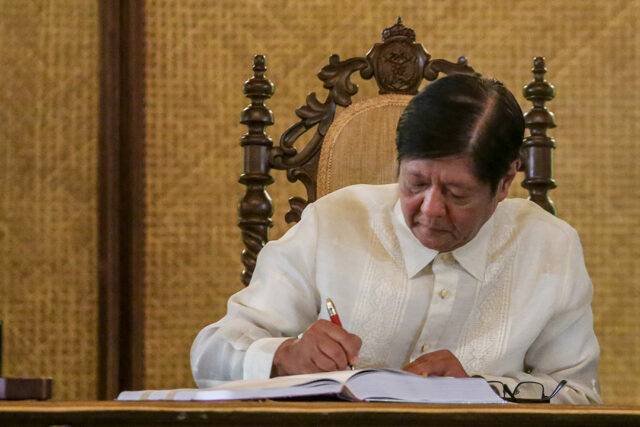
PRESIDENT Ferdinand R. Marcos, Jr. declared June 6 a regular holiday nationwide in observance of Eid al-Adha or the Feast of Sacrifice.

Mr. Marcos signed Proclamation No. 911 on May 21.

Eid al-Adha is one of the two major holidays in the Islamic calendar, alongside Eid al-Fitr, which marks the end of the holy month of Ramadan.

The day commemorates the willingness of Prophet Ibrahim to sacrifice his son in obedience to Allah’s command.

In observance, Muslims traditionally slaughter sheep, goats, cows, or camels, with the meat shared among family, friends, and those in need. — Chloe Mari A. Hufana

PCO: Marcos won’t sit in budget bicam

PRESIDENT FERDINAND R. MARCOS, JR. — PHILIPPINE STAR/NOEL PABALATE

PRESIDENT Ferdinand R. Marcos, Jr. will not sit as part of bicameral proceedings for next year’s budget, the palace clarified on Thursday.

“He will not definitely sit during the Bicam meeting, this is just an expression to show to the people that he will keep an eye on the national budget for 2026,” Presidential Communications Office (PCO) Undersecretary Claire B. Castro told a media briefing on Thursday.

“The budget should base on the priorities of the government, and it should prioritize the projects of the government.”

Budget Secretary Amenah F. Pangandaman on Tuesday said Mr. Marcos is keen on keeping an eye out for the budget, noting that should it be deemed necessary, the President will “sit in the Bicam.”

A lawmaker said Mr. Marcos should have no role in the government’s budgeting process amid a controversial spending plan it approved last year.

In a statement on Thursday, House Deputy Minority Leader and Party-list Rep. France L. Castro said that Mr. Marcos should have no role in the finalization of the proposed national budget, as it could undermine the separation of powers between government branches.

“The bicameral conference committee is a responsibility of the legislature — it should not be interfered with or attended by the President,” she said in Filipino.

“The presence of Mr. Marcos or any representative of the executive in the bicameral imposes unnecessary pressure and threatens the freedom of lawmakers to decide based on the interests of the people.”

The Philippines’ P6.326-trillion budget this year faces legal challenges due to unresolved issues due to allegations of mismanaged allocations and shady maneuvers in its drafting last year.

In December, Mr. Marcos signed into law the 2025 budget but vetoed P194 billion worth of line items that he said were inconsistent with his government’s priorities. — Kenneth Christiane L. Basilio

Marcos seeks stricter ODA rules

PRESIDENT FERDINAND R. MARCOS, JR. — YUMMIE DINGDING / PPA POOL 

PRESIDENT Ferdinand R. Marcos, Jr., on Thursday, said the government will impose stricter rules on the approval of Official Development Assistance (ODA) loans as he called on implementing agencies to ensure that government-funded projects are completed on time.

“I’ve said before that all ODA loans, especially those that have been severely delayed, must be thoroughly reviewed,” he said in Filipino during the presentation of the country’s newly enacted laws to implementing agencies and stakeholders during a ceremony.

“The approval of ODA loans will also be stricter from now on,” he added. He did not elaborate on the details.

ODA refers to concessional financing extended by foreign governments and multilateral institutions, such as the Japan International Cooperation Agency, the World Bank, and the Asian Development Bank, to support the development priorities of partner countries.

These loans are typically offered at lower interest rates and with longer repayment terms compared to commercial loans, making them a crucial source of funding for developing countries like the Philippines. ODA loans are often used to finance large-scale infrastructure projects, social services, and capacity-building initiatives that are critical to national development. — Chloe Mari A. Hufana

Senate to convene court for VP trial

BW FILE PHOTO

SENATE President Francis “Chiz” G. Escudero said that the Senate is expected to convene as an impeachment court for the trial of Vice-President (VP) Sara Duterte-Carpio on June 3, following the reception of House prosecutors a day before.

In a letter sent to reporters on Thursday, Mr. Escudero said that the Senate is set to convene as an impeachment court at 9 a.m. on June 3, where it will issue the summons and other relevant orders.

The letter, dated May 19, had also scheduled the formal reception of House prosecutor at 4 p.m. on June 2, following the resumption of Congress.

Congress, which went on a nearly four-month break on Feb. 8 for the midterm elections, is set to resume for a two-week session from June 2 to 13.

“The Senate shall expect the prosecution to read the seven charges under the Articles of Impeachment in open session,” Mr. Escudero added.

The House impeached the vice-president on Feb. 5, alleging secret fund misuse, unexplained wealth, acts of destabilization and plotting the assassination of Mr. Marcos, his family, and the Speaker of the House. Ms. Duterte has denied any wrongdoing.

The impeachment complaint was filed and signed by more than 200 congressmen, meeting more than the one-third legal requirement before it could be sent to the Senate. The Vice-President is expected to face the Senate as an impeachment court once her trial commences in July.

The letter was sent to House Speaker Martin G. Romualdez and to the Office of the Vice-President. This was received by both offices on May 19. — Adrian H. Halili