

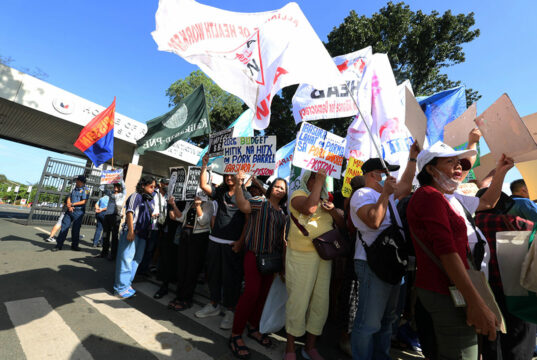





Never get tired of remembering people power
By Philip Ella Juico
TODAY, February 22, is the first of the four days of the 1986 EDSA People Power Revolution. The Revolution against the Marcoses officially ended on February 25, when Corazon Cojuangco Aquino took her oath as President of the Republic. Her oath of office was administered by Supreme Court Justice Claudio Teehankee at what is now called appropriately the Kalayaan (Freedom) Hall of Club Filipino in San Juan.
Contexts: The Rappler case
By Luis V. Teodoro
ASKED if he caused the February 13 arrest of Rappler CEO and editor Maria Ressa, President Rodrigo Duterte said he had nothing to do with it, and that he did not “relish picking on her.” He also said he did not know Wilfredo Keng, whose complaint that he had been libeled by the online news site led to the Ressa arrest.
Journalists have rights, just like everybody else
By Jemy Gatdula
PROBABLY it’s intersectionality. Or identity politics. Or the glorification of victimhood. Whatever the cause, everyone nowadays seems to demand preferential treatment. Of course, it’s never stated that way. Usually, it’s called as a plea for “rights.”
Preventing polio
By Teodoro B. Padilla
POLIOMYELITIS, more commonly known as polio, is a highly infectious viral disease, which mainly affects young children. It is a crippling and potentially deadly disease, according to the Centers for Disease Control and Prevention (CDC).
Mandatory fare discount as socialistic policy
By Bienvenido S. Oplas, Jr.
MODERN day socialists and populists in governments, explicit and implicit, are aware of the limits of governments giving all sorts of endless, no timetable subsidies, discounts and other welfarist programs. So they invented a new form of welfarism — forcing private corporations to give mandatory discounts (restaurant food, medicines, fare in public transportation, etc.) to people, rich and poor no distinction. Politicians and governments get the credit while corporations get the financial burden as those forced discounts cannot be used for tax deduction.
Business with a Heart
By Angelina G. Golamco
The average annual pay of a chief executive officer (CEO) in the Philippines is Php 2,200,000. This is in stark contrast to the annual income of around Php 169,000 that a minimum wage earner in Metro Manila lives on. Globally, companies with the largest CEO-worker pay gaps include Disney at 367:1 and 21st Century Fox at 311:1. On a more positive light, new data reveal that 20 companies with the lowest CEO-worker pay gaps include Facebook (CEO: Mark Zuckerberg) at 37:1 and, topping the list, Berkshire Hathaway (CEO: Warren Buffett) at 2:1.
Addressing the housing backlog
By Marvin A. Tort
On a visit to Singapore about 15 years ago, I had the chance to meet a number of key government officials, including senior people from Singapore’s public housing authority, the Housing Development Board (HDB). Many of the public condominium units in Singapore now were built and are currently managed by HDB.
Advancing the EU-ASEAN partnership for sustainability
IN January I joined Federica Mogherini, the EU’s High Representative for Foreign Affairs and Security Policy, in Brussels as she co-chaired the 22nd EU-ASEAN Ministerial Meeting. It was an impressive occasion, and the best attended such gathering anyone could remember, with almost all the 10 ASEAN and 28 EU member states represented by their foreign ministers. Brussels was preparing for its first big snowfall of the winter, but the reception we gave our ASEAN partners was a truly warm one.
Why the US and China can’t make a real deal
OPTIMISM that the US and China can reach a trade deal is rising, with another round of intensive negotiations in Washington this week. What buoyant investors are ignoring, however, is that the talks have become a test of strength between the world’s two great powers -- or, more accurately, a test of how accurate each nation’s sense of its own strength is.
Choose champions for economic reforms
By Weslene Uy
The campaign season officially kicked off last week, marking the start of a three-month period that will no doubt be filled with theatrics and mudslinging. After all, the outcome of the midterm election is, in some ways, a litmus test for the popular support for this administration. Other than re-electionists, at least three hopefuls closely associated with President Duterte are vying for a seat in the senate. And in the latest Pulse Asia Senatorial Preferences survey, the former Special Assistant to the President finally broke into the coveted twelve spots, overtaking even more seasoned politicians.
How to avoid being sued for libel
By Greg B. Macabenta
The libel case that caused the arrest of Maria Ressa of Rappler has had a chilling effect on journalists who post their hard-hitting anti-government columns online, as well as folks who love to expose other people’s dirty laundry on social media.
The business of art
PRIVATE BANKERS have included investment in art (paintings and sculptures, and now installations) as an asset class. Diversification of the investment portfolio beyond fixed-income securities and equities may include art pieces as a component. The dynamics of art as an investment, with its characteristics of scarcity and greed, can best be observed at an art auction.