
The China-US summit and recent ASEAN summit
Today is the start of the two-days visit of US President Donald Trump, Jr. to China. Trade, investment, and market access, the Iran war, and energy are expected to dominate the talks between Mr. Trump and China’s President Xi Jinping. Taiwan may also crop up.
Today I have assembled a variety of economic and energy data from different sources for the three largest economies in Asia, North America, and Europe. In GDP size at current values, the US is No. 1 in the world, but at purchasing power parity (PPP) values, China is No. 1. And this is consistent with rankings in merchandise exports, total energy supply (TES), and total power generation (TPG).
In 2025, the total combined GDP size of the US, Canada, and Mexico was $36.98 trillion, smaller than China’s $41.24 trillion. When it comes to merchandise exports, the total combined exports of the US, Canada, and Mexico was $3.40 trillion, smaller than China’s $3.77 trillion.
In TES, the combined size of the three North America countries was 111.75 exajoules (EJ), smaller than China’s 158.88 EJ. And in TPG, the combined size of the US, Canada, and Mexico was 5,627 terawatt-hours (TWh), smaller than China’s 10,087 TWh (see Table 1).
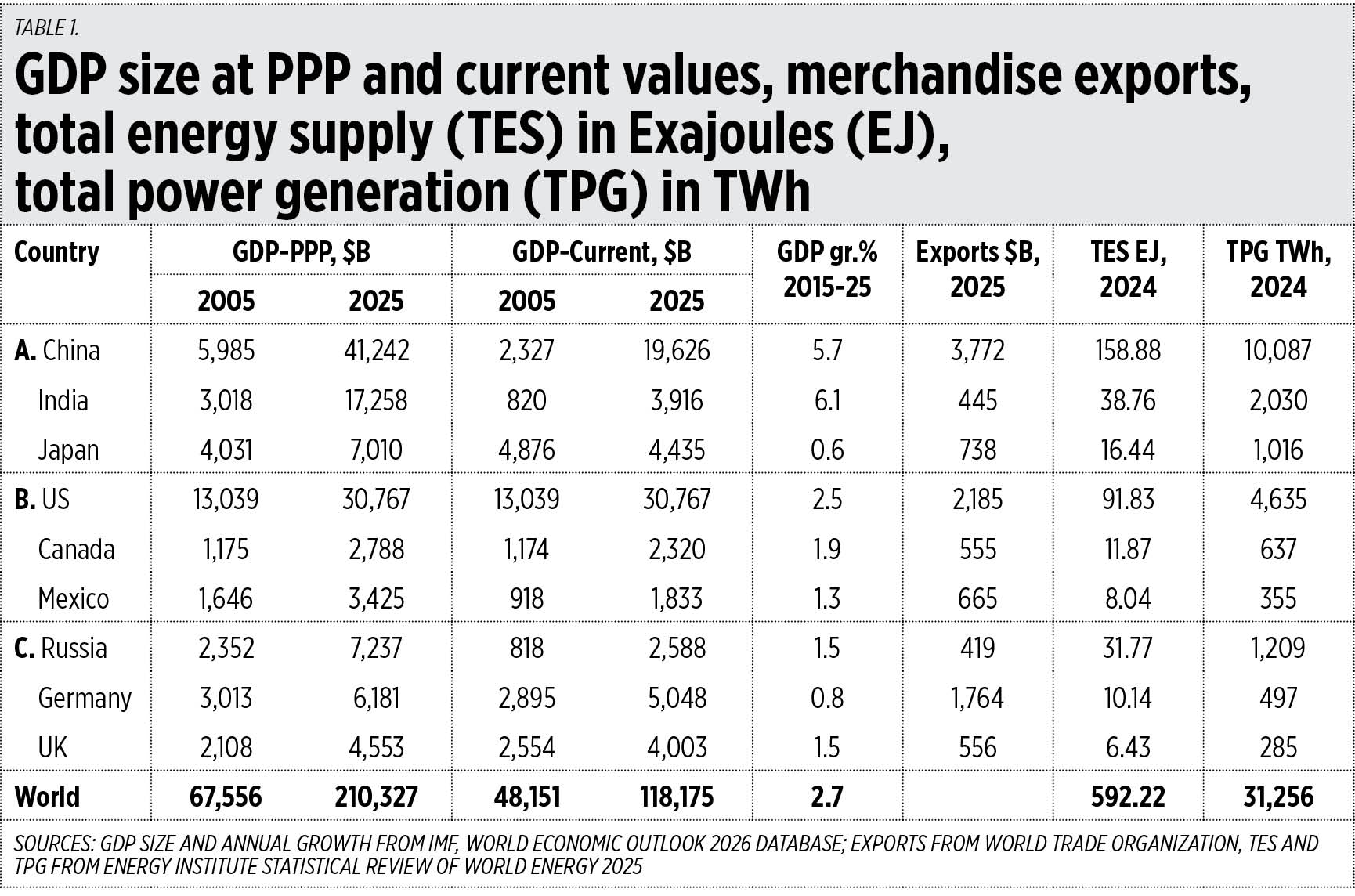
These numbers show that China already eclipsed the US economy several years ago. But we keep hearing and reading in many news outlets and even academic papers that the US economy is larger than China’s so the US can throw its weight around in many negotiations on trade, investments, infrastructure, and energy.
It seems that China has patiently endured the “US is more economically dominant” narrative while consistently increasing its market share in global exports and energy supply. BYD and Geely cars, Howo trucks, Yutong buses, Huawei mobile phones, and many other brands continue to expand their markets in many countries.
The more important thing that must be addressed in the Trump-Xi summit is the avoidance of more political and military conflict in the region, from the Middle East to the South China Sea, the Strait of Malacca, and the Taiwan independence issue.
THE ASEAN
Last Friday, May 8, the ASEAN summit was successfully held in Cebu as the leaders of the member-countries reiterated that they would be “reinforcing peace and security through dialogue and cooperation, promoting maritime cooperation as an important avenue for enhancing regional connectivity, mutual trust and dialogue, deepening economic integration… peaceful settlement of disputes, including full respect for legal and diplomatic processes, without resorting to the threat or use of force in accordance with international law…”
Using the same indicators as Table 1, I summarized the numbers for the ASEAN-6 plus South Korea, Taiwan ,and Australia. Notable was the fast expansion in GDP size of other Asian economies in just two decades, from 2005 to 2025.
In merchandise trade, Singapore has more exports than the UK, Russia, and Canada. In power generation, Indonesia, Taiwan, and Vietnam are larger than the UK (see Table 2).

The real driver of the global economy now is Asia, not North America or Europe. The pace of industrialization, manufacturing expansion, and modernization, and electricity production to power those big and expanding industrial needs, are simply fast, led by China, India, South Korea, and Japan.
In the ASEAN, the leading economies are Indonesia, Singapore, and Vietnam. The Philippines has generally been left behind by some of its ASEAN neighbors in many aspects of industrialization, but this is not necessarily bad for us. Our merchandise trade deficit can be compensated for by non-merchandise trade surplus. It is important that free trade should prevail, and that discriminatory non-tariff barriers be kept to the minimum.
More importantly, we need to look inwards more and address various governance problems and issues that adversely affect our businesses, industries, and exporters.
Bienvenido S. Oplas, Jr. is the president of Bienvenido S. Oplas, Jr. Research Consultancy Services, and Minimal Government Thinkers. He is an international fellow of the Tholos Foundation.