An auction is not just theater, it is contract law in motion
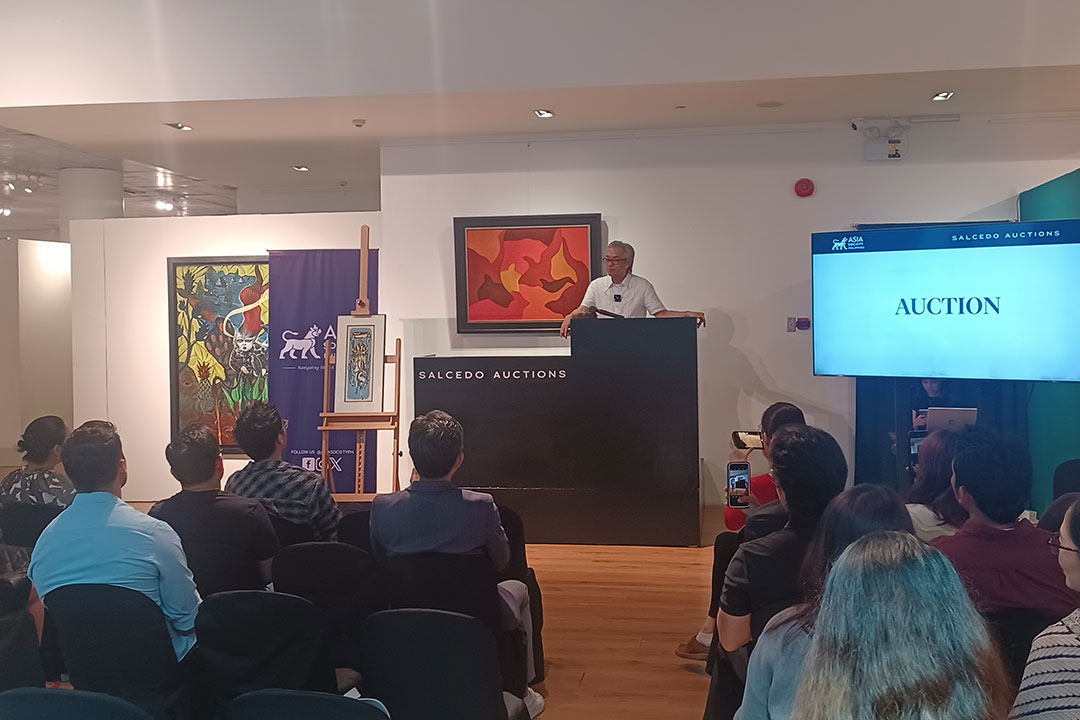
TO HELP cultivate art appreciation and sustain the growth of the Philippine art market, a major auction house recently held a talk to shed light on how auctions work behind the scenes.
Organized by the Asia Society Philippines in partnership with Salcedo Auctions, the event, “Auctions 101: The Art of the Bid,” welcomed seasoned collectors, aspiring bidders, and those simply curious about auctions.
Live auctions involve a great deal of theatrics. Bidders raise their paddle boards in the heat of the moment as they try to outbid each other in a spirited process facilitated by the auctioneer up front. Each successful bid is marked by the bang of the gavel on the block, after which the winner gets to take home a coveted Anita Magsaysay-Ho or H.R. Ocampo painting.
Setting aside the hype and the fanfare, auctions are actually quite serious. They are bound by law through the Civil Code of the Philippines under Article 1476 (“A contract of sale is perfected when there is a meeting of minds.”) and Article 1485 (“Before the hammer, retractable. At the fall of the hammer, perfected. After the hammer, binding”). So, there is a legal foundation for auctions here.
“The hesitation to raise your paddle is healthy because an auction is not just theater. It is, in fact, contract law in motion,” Salcedo Auctions chairman Richie Lerma said at the talk held on Feb. 28. “The fall of the hammer is juridical.”
REGULATION AND ETHICS
Salcedo Auctions, founded in 2010 by husband-and-wife duo Richie and Karen Lerma, is one of the few auction houses in the country.
According to Mr. Lerma, an auction house’s credibility is of utmost importance, especially in the Philippines. Here, art is “largely unregulated as a specialized sector,” he said.
“In the Philippines, there is no dedicated national auction commission, no licensing board for auctioneers, and no statute that exclusively regulates fine art auction conduct. There is no mandatory public registry of reserves, no centralized enforcement authority overseeing bidding behavior,” he explained.
“So, where regulation is light, ethics must be heavy.”
Aside from the usual promotional materials for the artworks, jewelry, furniture, or artifacts up for bid which are found on an auction house’s website, the catalog is the basis for what potential buyers can expect. They are encouraged to peruse the e-catalogs and even visit the gallery before the auction date to scrutinize the items up for grabs.
For Mr. Lerma, these catalogs “cannot misrepresent authorship.”
“Condition reports cannot conceal known material defects. Provenance and prices cannot be fabricated,” he said. “A catalog entry is not marketing fluff because what’s in the catalog is legally consequential.”
VALUATION OF ART
A factor to consider in valuing art is when a piece falls under the National Cultural Heritage Act. Legal due diligence must also consider the weight of an item’s patrimony in the Philippines when it comes to pricing. A major example of such an item is the previously lost 1883 boceto or study for Juan Luna’s Spoliarium, which was auctioned by Salcedo Auctions in 2018 for P73.58 million.
While there is no government valuation board for art or statutory pricing authority in the Philippines, auction houses must follow five pillars of auction valuation, Mr. Lerma added.
“This is not guesswork,” he said. “It is structured judgment.”
The pillars are: scholarship (considering where a work falls in an artist’s trajectory or in art history); visual literacy (the composition, material, and overall quality); provenance (tracing ownership of the work); exhibition and publication history (if the work was exhibited by an institution or reproduced before); and comparative market analysis (based on how a particular artist, medium, or size does in the market).
“All this information is not background decoration. It sets the framework for pricing architecture,” explained Mr. Lerma, noting that their auction house in particular has a reliable database of results over the 16 years they’ve been holding auctions. “We’ve found that the market rewards master works, and a strong provenance reduces risk.”
An example he gave was Jose Joya’s 1962 abstract oil painting Flight, valued at around P7 million by Salcedo Auctions and ultimately sold for over P37 million last year.
Mr. Lerma noted that the painting represented the Philippines at the Venice Biennale in 1964, considered “the apogee of Joya’s career.” Plus, it came from the well-preserved collection of a Filipino diplomat in the US, which meant it was in pristine condition, while its provenance was strong having been previously owned by a friend of Joya.
“The P7-million valuation is our reserve, or the price agreed to by the seller and the auction house,” he said. “If an item hits the reserve, then it can sell. That’s what the reserve is.”
He added that pricing must be “high enough to protect the consignor but still grounded in reality” while also expressing the market’s collective judgment on the quality of the work.
“In a lightly regulated environment like the Philippines, discipline in valuation is not optional. It is the foundation of trust,” Mr. Lerma said.
SHILL BIDDING
One of the topics covered in the talk was the dangers of an unregulated landscape. “Shill bidding,” in particular, was highlighted as one of the worst fraudulent practices to look out for.
“It’s when the seller or someone working with them places fake bids on an auction item to artificially inflate its price and desirability,” said Mr. Lerma. “It is designed to trick legitimate bidders to pay more than the item is actually worth.”
In the Philippines, because there is no auction-specific authority to police such conduct, auction houses must be wary and collectors must take care not to be misled. A single exaggerated result in Philippine art auctions can “shift perception dramatically,” especially in a country where disinformation spreads faster than correction.
“Again, an auction is not just theatrics. There is legal framework behind it. You need to enter with knowledge or assurance and never allow yourself to be tricked into a sale,” Mr. Lerma explained.
AUCTION PROCESS
The talk ended by detailing the lifecycle of an auction.
It all begins with consignment, when the seller approaches the auction house with the item. Then, there is the arduous assessment of authentication, provenance, and market viability, after which both parties conclude with a consignment agreement.
The pre-sale takes place once the items are cataloged, photographed, studied for a condition report, and marketed to the public. Mr. Lerma said that the final step in this stage is mounting the preview exhibition — a “fun step that allows everyone to see and scrutinize what exactly is available.”
On auction day, bidders come in to register and get their paddles. The theatrics ensue with the bidding, where the auctioneer calls out prices usually in increments of 10% to which interested buyers can commit. Finally, the sale is perfected when the hammer falls.
“The post-sale is very crucial because this is where the agreement is fully realized,” Mr. Lerma said, describing the issuance of the invoice and the buyer paying the full price. “Once compliance checks are applied and the seller is paid, the title is then transferred.”
To conclude the talk, he explained that the Philippine art auction market is “an intersection of history, scholarship, and spectacle.”
“It’s governed but not tightly regulated, so its most powerful stabilizing force is credibility,” he said. “Ultimately, auctions are not about the hammer. They are about the legacy of authenticity and stewardship that we uphold.”
“Auctions 101: The Art of the Bid” is the first installment of a new program series on art, heritage, and collecting, launched by the Asia Society Philippines and Salcedo Auctions. More details on their next talk will be announced through their social media pages and subscription e-mails. — Brontë H. Lacsamana