Inflation likely accelerated to over 2-year high in April — poll
By Justine Irish D. Tabile, Senior Reporter
SHARP increases in fuel, electricity, and some food prices, along with a weaker peso, may have driven Philippine inflation to its fastest pace in more than two years, analysts said.
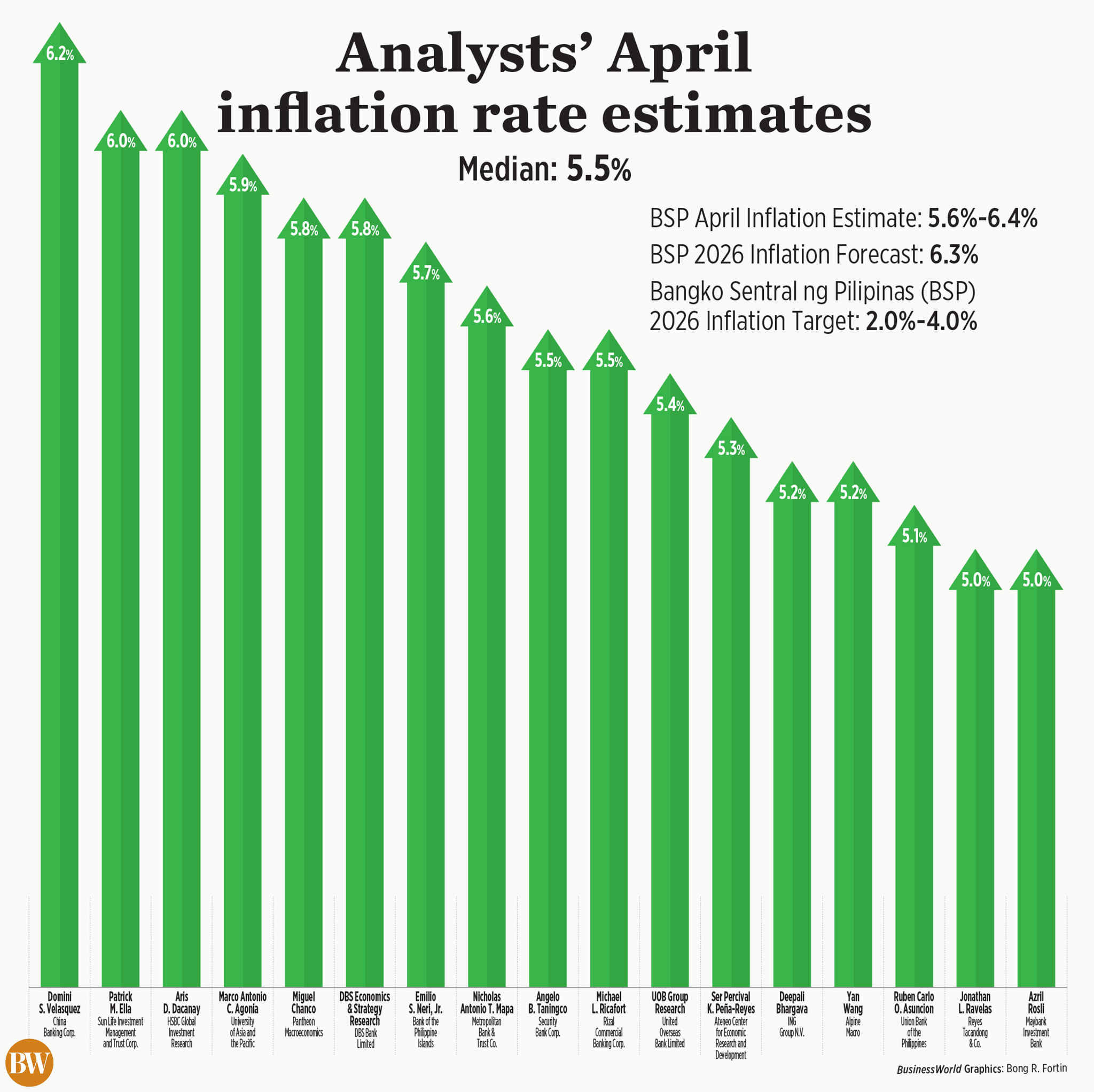
A BusinessWorld poll of 17 analysts yielded a median estimate of 5.5% for the consumer price index in April, accelerating from the 4.1% in March and 1.4% a year ago.
This is a tad below the Bangko Sentral ng Pilipinas’ (BSP) 5.6%-6.4% forecast for the month.
If realized, the headline print would be the fastest in over two and a half years or since the 6.1% seen in September 2023.
April would also mark the second straight month that inflation settled above the central bank’s 2%-4% target.
The Philippine Statistics Authority will release the April inflation data on Tuesday, May 5.
“Higher petroleum, transport and select food prices are the key culprits for the uptick,” Emilio S. Neri, Jr., lead economist of the Bank of the Philippine Islands (BPI), said.
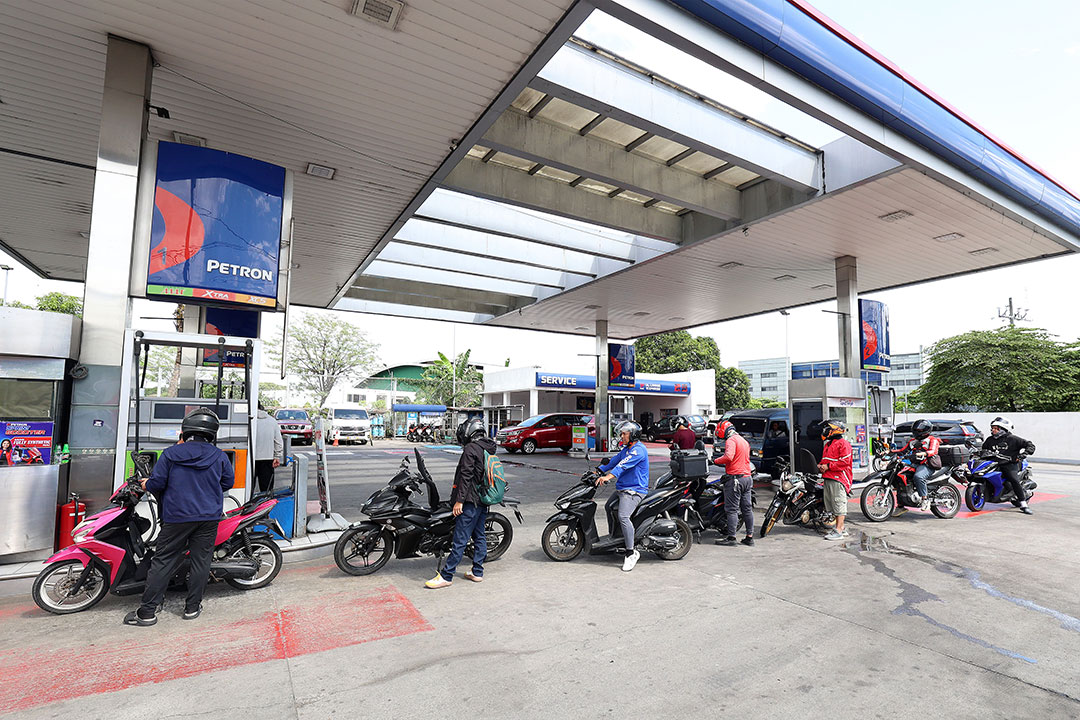
Fuel prices remained elevated in April, as the Middle East war continued. The Philippines, as a net oil importer of crude oil, makes it extremely vulnerable to global crude price swings.
“Fuel and transport also exerted upward pressure amid volatile global oil prices. These outweighed easing base effects, keeping headline inflation elevated,” Union Bank of the Philippines Chief Economist Ruben Carlo O. Asuncion said.
Pump price adjustments in April resulted in a net decrease of P0.58 per liter for gasoline, P28.18 per liter for diesel, and P17.71 per liter for kerosene.
Security Bank Financial Markets Segment Research Head and Chief Economist Angelo B. Taningco said April inflation was also driven by higher electricity rates, as well as the peso depreciation.
Manila Electric Co. raised rates by P0.5335 per kilowatt-hour (kWh), bringing the overall rate to P14.3496 per kWh for April.
The peso closed at P61.485 a dollar on April 30, weakening by 73.7 centavos from its P60.748 close on March 31. It hit a record low of P61.567 on April 29.
Deepali Bhargava, regional head of research for Asia-Pacific at ING, said higher rice prices are another source of inflationary pressures as Asian rice prices are going up due to soaring prices of fuel and fertilizer.
“Supply constraints are likely to intensify as fertilizer shortages persist, exacerbating upward pressure on rice prices and adding further to overall inflation in the Philippines,” she said in an e-mail.
Rice prices further climbed in April, with the average cost of regular milled rice rising by 15.9% to P51.53 in the April 15 to 17 period from P44.44 a year earlier.
The price of well-milled rice jumped by 15.3% year on year to P58.88 a kilo, while the price of special rice rose by an annual 9.8% to P66.23 per kilo.
Domini S. Velasquez, chief economist at China Banking Corp., said she sees inflation accelerating to 6.2%, citing upward pressure from higher prices of key food items such as meat, fruits, eggs and cooking oil, as well as a hike in water rates.
The Metropolitan Waterworks and Sewerage System Regulatory Office approved a rate hike of P0.04 per cubic meter (cu.m.) for Manila Water Co., Inc. and an increase of P0.09 per cu.m. for Maynilad Water Services, Inc. The rate adjustments were implemented starting April 1.
MORE RATE HIKES
With inflation likely to stay elevated in the next few months, several analysts see the BSP remaining on a tightening path.
“We expect inflation to remain above the target range. The BSP may not tighten at every meeting, but it will maintain a clear tightening bias,” said Alpine Macro Chief Emerging Markets & China Strategist Yan Wang in an e-mail.
BPI’s Mr. Neri said the BSP’s latest rate hike will help temper inflation expectations.
“A lot more rate hikes will be necessary, with outsized intermeeting or off-cycle hikes even possible,” he said.
The central bank hiked its key rate for the first time in over two years in a policy meeting on April 23, bringing the benchmark rate to 4.5%.
“Inflation will likely be above the 2-4% target band for the rest of the year. Our new rate outlook pencils in two more 25-basis-point hikes this year to bring the policy rate to 5%, though risks are tilted towards more hikes if tensions escalate in the Middle East,” said University of Asia and the Pacific Economist Marco Antonio C. Agonia in an e-mail.
Mr. Asuncion said the rate hike will help “limit second-round effects, anchor expectations, and support currency and financial stability over the medium term.”
Sun Life Investment Management and Trust Corp. Economist Patrick M. Ella said policy rates have a slow impact over time.
“Inflation will have to be above the BSP upper-bond tolerance rate for an extended period, hence seeing more rate hikes … I see a full year between a total of 2 to 3 rate hikes,” he said in an e-mail.
The central bank is now expecting the headline print to remain above 5% for the rest of the year, amid price pressures from elevated oil costs and second-round inflation effects.
If the BusinessWorld poll’s median forecast materializes, headline inflation would average 3.5% as of April, still below the BSP’s revised inflation estimate of 6.3% for the entire year.
“Private consumption in the Philippines remains on a weak footing. The central bank will likely keep an eye on the extent to which weak demand could stem the spillover effects of food and energy on inflation,” said HSBC Global Investment Research Senior ASEAN (Association of Southeast Asian Nations) Economist Aris D. Dacanay in an e-mail.
However, Pantheon Macroeconomics Chief Emerging Asia Economist Miguel Chanco said that inflation above the target range should not immediately result in further rate hikes.
“I do expect inflation to remain above the target range for some time this year, but that doesn’t necessarily mean that the BSP should continue to hike rates, as the chances of this supply-side-induced inflation shock filtering through to stronger demand-side price pressures are very small, given the still-weak state of the economy,” he added.
Maybank Investment Bank Economist Azril Rosli, who estimates April inflation at 5%, said inflation may be approaching its peak, “reducing the urgency for immediate further tightening.”
“As such, the BSP may opt to pause at its next meeting to assess the impact of recent policy actions, while retaining a tightening bias should inflation prove more persistent,” he added.
The Monetary Board will hold its next policy review on June 18.