Inflation worries drag peso to over three-week low
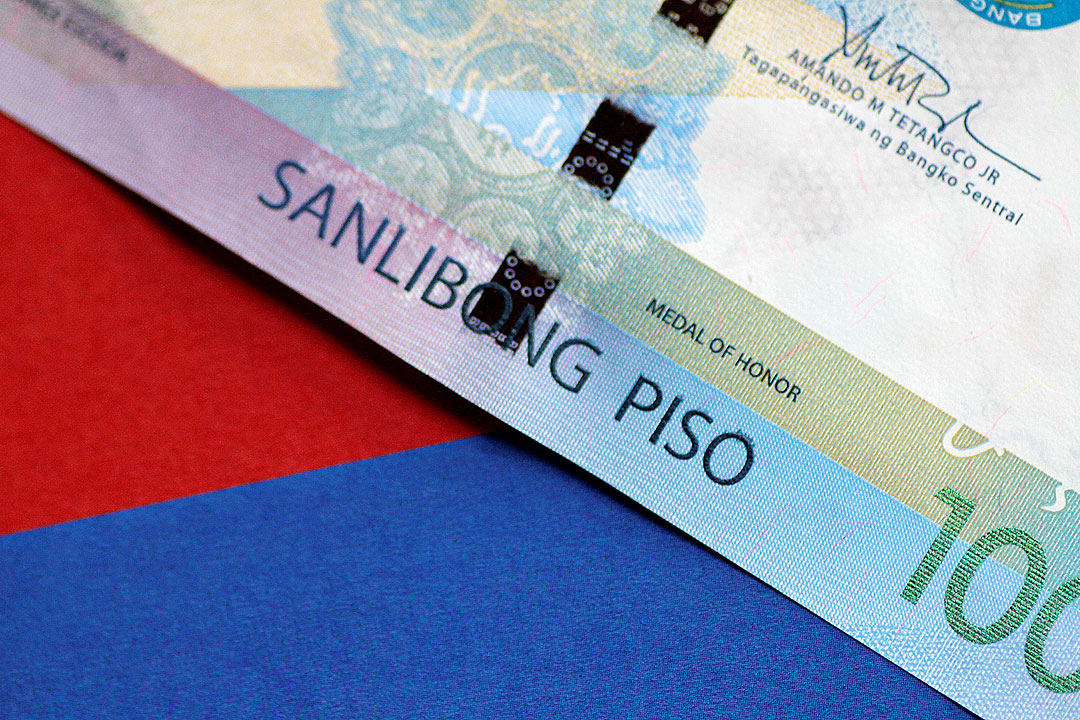
THE PESO plunged to an over three-week low versus the dollar on Thursday on heightened concerns over the Middle East war, especially after the Philippine central bank said it now sees inflation breaching its target until next year as global shocks push up domestic prices.
The currency fell by 35 centavos to end at P60.48 against the greenback from its P60.13 finish on Wednesday.
This was its weakest close since March 31’s P60.748, which is the peso’s record low against the dollar.
The peso opened Thursday’s trading session weaker at P60.25, which was already its best showing for the day. Meanwhile, its intraday low was P60.58 versus the dollar.
Dollars traded rose to $1.83 billion from $1.61 billion on Wednesday.
“The peso weakened after the BSP (Bangko Sentral ng Pilipinas) significantly revised higher its inflation outlook for 2026 despite the 25-basis-point (bp) rate hike,” the first trader said in an e-mail.
“The dollar-peso closed higher on remaining uncertainties due to the Middle East war and elevated global crude oil prices,” the second trader said in a phone interview.
The Monetary Board on Thursday raised benchmark interest rates by 25 bps to bring the policy rate to 4.5%, as expected by 11 of 19 analysts in a BusinessWorld poll. This was its first tightening move since October 2023.
BSP Governor Eli M. Remolona, Jr. said the hike was a preemptive move to help rein in growing price pressures amid the Middle East war.
“The inflation outlook has deteriorated amid the ongoing conflict in the Middle East. Higher global oil and fertilizer prices have begun feeding through to domestic fuel and food prices. At the same time, core inflation has con-tinued to rise, pointing to a broadening of underlying price pressures,” he said.
He also signaled further tightening ahead as they now see inflation breaching their 2%-4% tolerance band in 2026 and 2027. For this year, the BSP expects the consumer price index (CPI) to average 6.3%, significantly higher than the earlier 5.1% forecast.
This comes as elevated oil prices amid conflict drove headline inflation to a near two-year high of 4.1% in March, bringing the three-month average to 2.8%. Mr. Remolona said the CPI could breach 5% for the rest of the year.
For 2027, the BSP also raised its projection to 4.3% from 3.8% previously.
The dollar was headed for its first weekly rise in a month on Thursday, as a stand-off between Iran and the US in the Middle East war and a lack of progress on peace talks sent oil prices back above $100 a barrel and dented in-vestor optimism, Reuters reported.
Tehran seized two ships in the Strait of Hormuz on Wednesday, escalating tensions after US President Donald J. Trump extended a ceasefire with Iran indefinitely with no sign of peace talks restarting.
The two sides remain divided on a ceasefire, their blockades, nuclear issues and control of the strait, leaving the strategic waterway still effectively shut and triggering an energy shock in a blow to economies across the world.
The dollar index, which tracks the performance of the US currency against six others, was a touch higher at 98.60. It is heading for a weekly rise of 0.4%, the first gain in a month.
Brent crude futures rose $1.26 or 1.2% to $103.17 a barrel at 0630 GMT, after settling above $100 for the first time in more than two weeks on Wednesday. West Texas Intermediate futures were also up $1.20 or 1.3% at $94.16.
For Friday, the first trader said they expect the peso’s weakness to persist on continued safe-haven demand for the dollar before the weekend as the situation in the Middle East remains volatile.
The second trader said the market could consolidate as traders digest the BSP’s latest policy signals.
The first trader said the peso could move between P60.35 and P60.60, while the second trader sees the local unit ranging from P60.20 to P60.60. — Bettina V. Roc with a report from Aaron Michael C. Sy and Reuters