

US, Iran leave door open to dialogue after tense Islamabad talks

ISLAMABAD/DUBAI/WASHINGTON — After a sleepless and at times tense night in Islamabad, Iranian and US officials ended their highest-level talks in decades without a breakthrough, but 11 sources familiar with the negotiations said dialogue was still alive.
The weekend meeting to resolve the conflict between the US and Iran, held four days after last Tuesday’s ceasefire announcement, was the first direct encounter between US and Iranian officials in more than a decade and the most senior engagement since Iran’s 1979 Islamic Revolution.
Inside Islamabad’s luxury Serena Hotel, the talks unfolded across two separate wings and one common area — one for the US side, one for the Iranians and one for trilateral meetings involving Pakistani mediators, operational staff told Reuters.
Among the slew of issues at stake was the Strait of Hormuz, a major transit point for global energy supplies that Iran has effectively blocked but the US has vowed to reopen, as well as Iran’s nuclear program and international sanctions on Tehran.
Phones were not allowed in the main room, forcing delegates, including US Vice President JD Vance and Iranian Parliamentary Speaker Mohammad Baqer Qalibaf, to step out during breaks to relay messages back home, two of the sources said.
“There was a strong hope in the middle of the talks that there would be a breakthrough and the two sides would reach an agreement. However, things changed within no time,” a Pakistani government source said.
Another source involved in the talks said the parties came “very close” to an agreement and were “80% there”, before running into decisions that could not be settled on the spot.
Two senior Iranian sources described the atmosphere as heavy and unfriendly, adding that while Pakistan tried to soften the mood, neither side showed any willingness to ease tensions.
AT ONE POINT, THE ATMOSPHERE BEGAN TO LIFT
Nevertheless the two Iranian sources said that by early Sunday morning the atmosphere had shown some improvement, and the possibility of a one-day extension began to take shape.
However, differences persisted. A US source said the Iranians did not properly understand that the core US aim was to have a deal that ensured Iran would never obtain a nuclear weapon. Among Iran’s concerns was a distrust of US intentions.
This account, based on sources who spoke on condition of anonymity due to the sensitivity of the matter, offers a first account of the internal dynamics of the meeting, how the mood in the room shifted, how talks ended after signs the meeting might be extended, and how further dialogue remains on the cards.
There was no immediate response from the Iranian government to a request for comment on the issues reported in this story.
On Monday US President Donald Trump said Iran had “called this morning” and that “they’d like to work a deal.” Reuters could not immediately verify the assertion.
A US official, referring to Mr. Trump’s comment, said there was continued engagement between the US and Iran and forward motion on trying to get to an agreement.
Asked for comment, White House spokeswoman Olivia Wales said the US position had never shifted in the Islamabad meeting.
“Iran can never have a nuclear weapon, and President Trump’s negotiating team stuck to this red line and many others. Engagement continues toward an agreement,” she said.
‘UPS AND DOWNS’
A Middle East-based diplomat said conversations between mediators and the Americans have continued since Mr. Vance left Islamabad, while the source involved in the talks said Pakistan was still passing messages between Tehran and Washington.
“I want to tell you that a full effort is still on to resolve the issues,” Pakistan’s Prime Minister Shehbaz Sharif said on Monday.
Despite numerous obstacles to peace, both sides appear to have strong reasons to consider de-escalation.
The US strikes appear unpopular at home and look unlikely to topple Iran’s theocratic ruling system, while Tehran’s strangling of energy supplies is hurting the global economy and pushing up inflation months before US midterm elections.
Also, war damage to Iran’s ailing economy risks leaving the authorities there weaker internally just weeks after protests they were able to put down only with mass killings.
In Islamabad, the longtime foes had gathered to try to chart a path to a long-term settlement, after a Pakistan-brokered ceasefire paused six weeks of war that has killed thousands of people and disrupted the world’s energy supplies.
Central to the dispute is a belief among Western countries and Israel that Iran wants a nuclear bomb. Iran denies seeking nuclear weapons.
A White House official said the US wanted Iran to end all uranium enrichment, dismantle all major nuclear enrichment facilities, turn over its highly enriched uranium, accept a broader peace, agree a security framework that includes regional allies, end funding for regional proxies, and fully open Hormuz, charging no tolls.
Iran’s demands included a guaranteed permanent ceasefire, assurances of no future strikes on Iran and its allies in the region, lifting of primary and secondary sanctions, unfreezing of all assets, recognition of its right to enrichment and continued control of Hormuz, Iranian sources have said.
Four of the 11 sources said that at times the dialogue appeared close to producing at least a framework understanding, but unraveled over Iran’s nuclear program, the Hormuz Strait and the amount of frozen assets Tehran wants access to.
The Iranian sources said most of the substantive exchanges in Islamabad were between Mr. Vance, Mr. Qalibaf and Iranian Foreign Minister Abbas Araghchi.
“There were ups and downs. There were tense moments. People left the room, and then came back,” the security source said.
Pakistani representatives, including Army Chief Asim Munir, and Foreign Minister Ishaq Dar, moved between the sides through the night to keep things on track, five Pakistani sources said.
‘HOW CAN WE TRUST YOU?’
The talks stretched for more than 20 hours with on-duty hotel staff eating, sleeping, and working on site after undergoing expedited background checks, they said.
When discussions turned to guarantees, both non-aggression assurances and sanctions relief, the tone of the normally mild-mannered Mr. Araghchi grew sharper, the two Iranian sources said.
The sources quoted him as saying: “How can we trust you when, in the last Geneva meeting, you said the US would not attack while diplomacy was under way?”
The US-Israeli attack on Iran began two days after the two sides held a previous round of talks in Geneva.
In addition to differences over Hormuz, sanctions and other topics, the two sides also disagreed over the scope of any deal. While Washington focused on the nuclear file and Hormuz, Tehran wanted a broader understanding, according to two of the sources.
During one tense moment, raised voices could be heard outside the negotiating room before Mr. Munir and Mr. Dar called a tea break and moved the two sides back into separate rooms, the government source said.
‘OUR FINAL AND BEST OFFER’
Toward the final stages of the discussions, which spilled into Sunday morning, the US delegates were moving between the negotiating room and their private floor far more often than the Iranians, the senior Pakistani official said.
A US source said the vice president came to the talks with the aim of making a deal and reaching a mutual understanding. The US side has been wary of protracted negotiations with Iran, believing the Iranians are adept at delaying tactics and refusing to make concessions, the source said.
Despite the deadlock, when Mr. Vance appeared in front of reporters later to announce the talks had ended, his remarks suggested more exchanges of some kind might be in prospect.
“We leave here with a very simple proposal, a method of understanding that is our final and best offer,” he said. “We’ll see if the Iranians accept it.” — Reuters
Excise tax on LPG, kerosene suspended
By Chloe Mari A. Hufana, Reporter
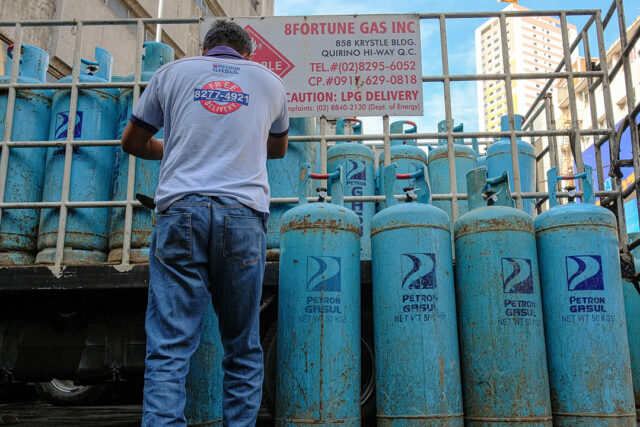
PRESIDENT Ferdinand R. Marcos, Jr. on Monday said he approved the suspension of excise taxes on liquefied petroleum gas (LPG) and kerosene to soften the impact of rising fuel costs on households, while leaving levies on gasoline and diesel unchanged.
The selective suspension is expected to provide modest relief to household budgets but may have limited effect on transport costs and inflation, which are more sensitive to diesel prices.
“We have reduced the tax on petroleum products that are directly used in the daily lives of our countrymen under the power given to us by law… meaning lower costs for cooking and the daily needs of each family,” he told a briefing in Filipino.
Mr. Marcos said the reduction is equivalent to P3.36 per kilo of LPG or about P37 per tank and P5.60 per liter of kerosene.
LPG prices are currently around P1,000 to P1,600 per tank, while kerosene prices are around P154 to P177.19 per liter.
Republic Act No. 12316, which took effect on April 13, granted the President emergency powers to cut or suspend excise taxes on fuel products.
Mr. Marcos said the Unified Package for Livelihoods, Industry, Food, and Transport (UPLIFT) Committee will still convene on Tuesday morning to decide on the possible reduction or suspension of excise taxes on gasoline and diesel.
“What we will do [on April 14] is to make sure… [we have] the supply of oil, food products and all the other raw materials [needed to] continue the running of the economy,” the President said.
The country is under a year-long energy emergency as the Middle East crisis threatens its fuel supply. Mr. Marcos established the UPLIFT Committee, an inter-agency body responsible for managing the government’s response to the war’s impact on the economy.
Excise taxes are capped at P6 a liter for diesel and P10 a liter for gasoline and other petroleum products, with a 12% value‑added tax applied broadly to goods and services.
FOOD SUPPLY
Meanwhile, Mr. Marcos said he ordered the Department of Agriculture (DA) and the Tariff Commission to lessen duties on imported food to make them cheaper for Filipino consumers, but he did not expound on the specific rates.
“We will protect consumers, farmers and the industry. That is the balance we are looking for because… the economy is a complicated system,” he added.
The DA and local governments are also expected to buy from local farmers.
“The government will catch this, so the harvest is not wasted, our farmers do not lose money, and our consumers benefit,” he said, adding the government will also expand its flagship Benteng Bigas Program.
The government also moved to expedite the processing of permits, such as the Sanitary and Phytosanitary Import Clearance and the Certificate of Necessity to Import, to lessen costs.
Mr. Marcos also ordered the removal of fees at fish ports.
The Philippine Ports Authority also set the “RoRo” (roll-on, roll-off) terminal fee for vessels carrying agricultural products to P1.
“Our goal is to maintain adequate supply, prevent price increases, and ensure that our countrymen continue to earn a living,” Mr. Marcos said.
John Paolo R. Rivera, a senior research fellow at the Philippine Institute for Development Studies, said the impact of the excise tax suspension on kerosene and LPG will be modest and targeted rather than broad-based.
Mr. Rivera said the move can bring immediate relief to households but the overall effect on inflation and total household spending will be limited.
“Global price movements will still be the dominant driver of local prices. So, it helps at the margin especially for vulnerable households, but it is not enough on its own to significantly offset broader cost-of-living pressures,” he said via Viber.
TAX CREDIT SCHEME
Meanwhile, lawmakers are pushing a tax credit scheme to allow immediate fuel price cuts, challenging the Department of Finance’s (DoF) position that suspending excise taxes may only apply to future imports.
Marikina Rep. Romero Federico “Miro” S. Quimbo, who heads the Committee on Ways and Means, said the government should ensure the public feels the relief “right away.”
He proposed at a House of Representatives hearing on Monday that fuel companies be granted tax credits for excise taxes already paid on existing inventories so they could cut pump prices without waiting for new shipments.
He estimated potential reductions of about P10 per liter for gasoline, P6 for diesel and P4.50 for kerosene as early as the day after a presidential directive.
The proposal runs counter to the DoF’s position that applying tax relief to fuel already in the country would be difficult.
“It will be hard with regard to administrative feasibility, the removal of the excise stocks, the inventories that are here in the Philippines,” Finance Undersecretary Rolando T. Ligon, Jr. told the hearing. The direction they are looking at is to apply it to “upcoming importations.”
Mr. Ligon said implementing tax relief on fuel already in storage poses technical and administrative challenges, citing the complexity of adjusting taxes on existing inventories.
He said once a directive is signed, implementation could take effect within one to two days through issuances from the Bureau of Customs.
Mr. Quimbo also asked the DoF to explain why a tax credit scheme would be unworkable, noting that the Bureau of Customs maintains records of inventory and tax payments.
Discussions on fuel tax measures come as volatility persists in global oil markets amid tensions linked to the Strait of Hormuz and the US-Israel war on Iran.
Energy Undersecretary Alessandro O. Sales said diesel prices are expected to drop by P20 to P21 per liter on Tuesday due to market movements, but warned that conditions remain unstable.
He said prices could climb to P130 to P170 a liter if hostilities resume, while a longer-term resolution could bring diesel prices down to P75 to P90 a liter over several months.
VAT REMOVAL UNLIKELY
Meanwhile, Mr. Marcos rejected calls to cut or suspend value-added tax (VAT) on fuel products, saying revenues from VAT collection are needed to fund aid programs for the public.
“If we take away the VAT on petroleum products, it will only help the petroleum market. What we need is funding to help the entire society,” he said.
“Right now, the cost-benefit analysis between the VAT collections and the benefit to people, ordinary people, still favors that we collect VAT and we use the extra funds.”
The DoF also expressed reservation regarding proposals to reduce the VAT on fuel to 10% from 12%.
Mr. Ligon said the removal or reduction of the VAT on petroleum products would result in a revenue loss of approximately P120 billion, further straining the national budget.
Joseph J. Capuno, undersecretary at the Department of Economy, Planning, and Development, said the Executive branch favors targeted subsidies over a uniform reduction in VAT.
“Targeted subsidies rather than uniform reduction in taxes that will compromise our ability to raise revenues to support those subsidies,” Mr. Capuno said, noting that broad tax cuts benefit all segments of the population rather than just the vulnerable.
In response, Cagayan de Oro Rep. Rufus B. Rodriguez called for a temporary reduction of the VAT to 10% only until the market price of oil drops below $80 per barrel, calling the current situation as a pressing emergency.
Mr. Rodriguez also pushed for a joint session of Congress to enact a “Bayanihan 3” package to address the energy crisis, similar to the one implemented during the coronavirus pandemic. — with Erika Mae P. Sinaking
Philippines lags ASEAN neighbors in FDI Confidence Index

By Justine Irish D. Tabile, Senior Reporter
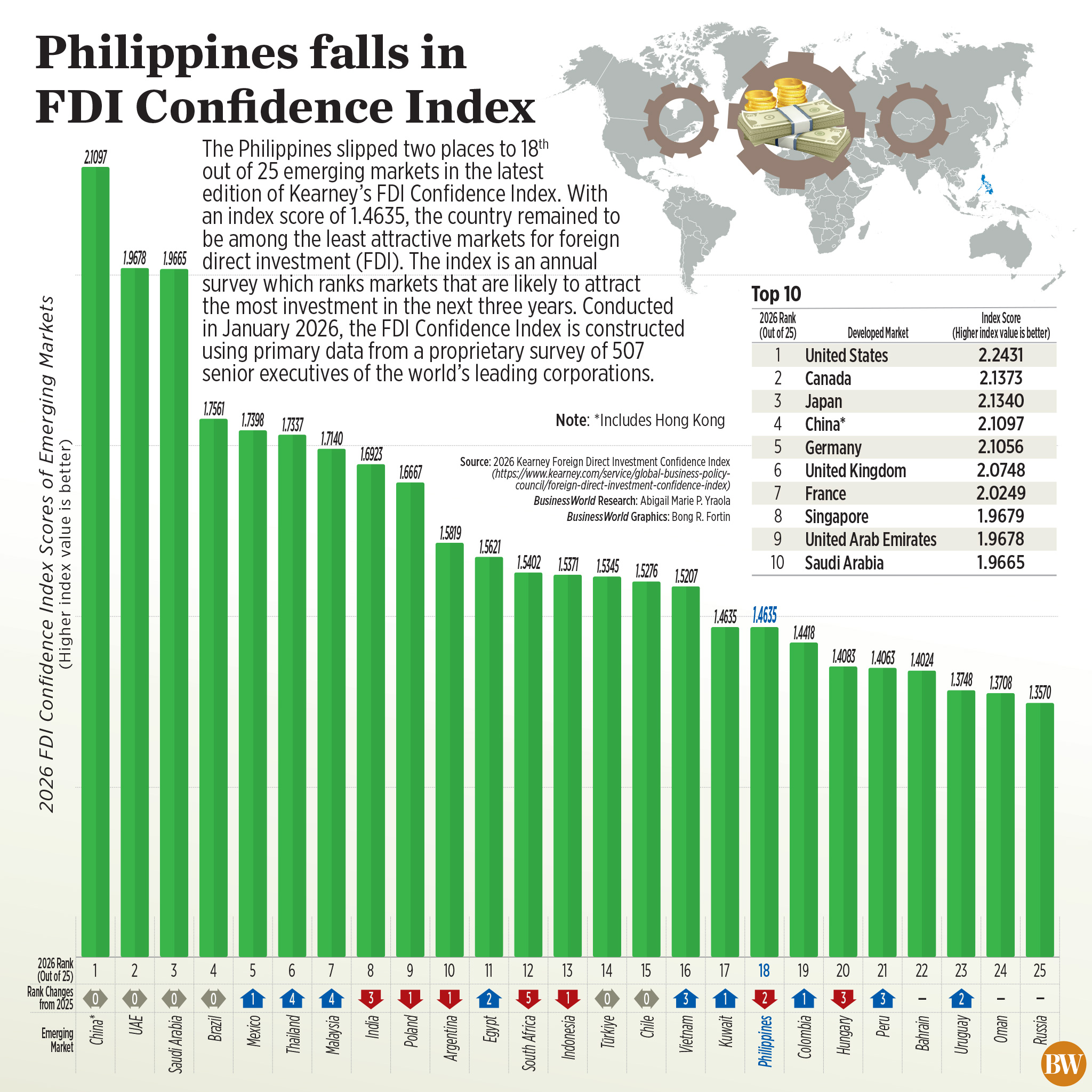
THE PHILIPPINES dropped two spots to 18th out of 25 emerging markets in the 2026 Foreign Direct Investment (FDI) Confidence Index by global management consulting firm Kearney.
The Philippines posted a score of 1.4635 in the index, which ranks markets that are likely to attract the most FDI in the next three years.
This was the third straight year the Philippines’ ranking declined in the index. It ranked 16th in 2025, 13th in 2024 and 12th in 2023.
“The index reflects a three-year outlook, so the shift points to softer medium-term investor confidence, rather than any single short-term factor,” Kearney Senior Partner, Philippines Country Head & APAC Communications, Media & Technology Lead Marco de la Rosa said in an e-mail interview.
“At the same time, recent Philippine-specific developments, including headlines last year around infrastructure spending and political challenges, may have weighed on investor sentiment, alongside a more risk-sensitive global environment, making the country a relatively less attractive destination for FDI,” he added.
The Philippines was rocked by a corruption scandal last year that linked government officials, lawmakers, and public contractors to anomalous flood control projects.
In 2025, the Philippines saw its FDI net inflows drop 17.1% year on year to $7.791 billion. This was the lowest yearly FDI level since 2020.
The downtrend continued at the start of this year as January FDI net inflows slid to a four‑month low of $443 million, 39.2% lower compared with the same month a year ago.
Conducted in January 2026, the FDI Confidence Index uses primary data from a proprietary survey of 507 senior executives of the world’s top corporations.
“China, the United Arab Emirates, and Saudi Arabia lead the emerging market ranking for the third consecutive year,” Kearney said.
Among emerging markets, the Philippines fell behind regional peers such as Thailand (6th), Malaysia (7th), Indonesia (13th) and Vietnam (16th).
“Other ASEAN (Association of Southeast Asian Nations) markets have become more attractive, particularly those benefiting from supply chain shifts and stronger positioning in innovation,” Mr. de la Rosa said. “Thailand and Malaysia are benefiting from China+1 diversification, while Vietnam stands out for linking talent to a clear sector strategy, particularly in semiconductors.”
Ateneo Center for Economic Research and Development Director Ser Percival K. Peña-Reyes said that the steady decline in the index is not driven by a single factor but rather by the Philippines’ relative underperformance versus peers and persistent structural constraints.
“The index is relative, so even if the Philippines is stable, (the fact) that other countries are rising faster pushes it down,” he said in a Facebook Messenger chat.
According to Kearney, investors cited the Philippines’ labor talent as its strongest asset (32%), followed by natural resources (28%) and economic performance (27%).
A fourth of the investors have identified the country’s tech innovation and ease of doing business as top reasons for investments, while 22% cited transparent governance. Only 12% cited infrastructure quality.
However, a small percentage or 2% said that there were no strong reasons at all to invest in the Philippines.
“What it suggests is that, for a small group of investors, the Philippines’ strengths may not yet be coming through as distinctly as some peers,” Mr. de la Rosa said.
Mr. Peña-Reyes said that the country continues to show weaknesses in the areas that investors are focusing on.
“Our innovation ecosystem is still lagging versus our peers. Our bureaucracy and regulatory complexity remain huge concerns. Our infrastructure gaps persist despite improvements,” he said. “Nevertheless, if the Philippines improves execution, specialization, and policy clarity, it can realistically reverse the trend within a few years.”
Mr. Peña-Reyes said that the Philippines can no longer rely on its talent pool, as other countries are highly competitive. For instance, 40% of investors view India’s talent pool as its strongest asset, while 34% cited the same for Vietnam.
“To stay competitive, [the Philippines] needs to differentiate, upgrade, and support talent. If it does these things well, it can remain highly attractive, even against larger players like India and fast-rising ones like Vietnam,” he said.
The survey showed investor sentiment in the Philippines had a score of -2, with 22% pessimistic about the Philippines’ three-year economic outlook compared with 20% optimistic.
Two other countries with negative optimism scores were Malaysia and Russia, which had -7 and -10, respectively.
“For the Philippines, the implication is clear. Even if its talent advantage remains strong, it must reduce uncertainty, improve execution, and signal stability to convert interest into actual inflows,” Mr. Peña-Reyes said.
While the survey was conducted before the Iran war, Kearney said investors already expected an increase in geopolitical tensions (36%), a rise in commodity prices (30%), and political instability in a developed market (30%) to occur in the next year.
“When the survey was in the field in January, there was incredible instability in the global operating environment that likely drove a rise in geopolitical tensions to the top of the rankings,” Kearney said.
The report pointed to global instability, citing military operations in Venezuela, protests in Iran, and reports about the US potentially using force to acquire Greenland.
Kearney said that these tensions are likely to have contributed to greater concerns over increased political instability and rising commodity prices “which often occurs amid conflict-induced supply chain disruptions, as in the current Middle East conflict.”
Meanwhile, Kearney said that industrial policy is becoming an extremely important determinant in where investors put their investments, especially for information technology, heavy industry, telecommunication sectors, and healthcare firms.
“Investors recognize industrial policy as an important factor in making FDI decisions: 84% say industrial policy is “extremely” or “very” important,” it said.
“Predictability, grounded in clear and consistent industry policy frameworks, is key to sustaining investor confidence and strengthening industrial policy outcomes,” it added.
In particular, the report identified infrastructure development (80%) and tax incentives (78%) as the most positively viewed industrial policy tools.
Housing dream slips further for Manila’s working poor

By Beatriz Marie D. Cruz, Senior Reporter
ELISA T. IFURUNG still imagines the day she can stop packing belongings into rented rooms. The 69-year-old retired household helper has moved five times as landlords raised rents beyond what her family could afford, each transfer shrinking the chances of settling down in a home she can call her own.
Her son, who works at a business process outsourcing company, pays P4,000 a month for a one-bedroom house in Quezon City, where they live quietly and keep expenses tight. Buying a house, Ms. Ifurung said, no longer feels reachable.
“What matters is we are able to put food on our table everyday — other material things don’t matter, for now,” she told BusinessWorld in an interview.
 She has heard of state-backed housing projects but said the paperwork, fees, and long repayment periods discourage her from even trying.
“Owning a house availed from government housing will take years to pay for,” she said. “These days, everything is so expensive.”
Her doubts play out against a deepening shelter gap. Government estimates place the Philippines’ housing shortage at 2.2 million units, driven by urban migration, land scarcity and wages that lag living costs. The Pambansang Pabahay Para sa Pilipino (4PH) program was designed to cut that backlog but has delivered far fewer homes than planned.
Since 2022, the program has completed 423,430 socialized housing units, well short of the original target of 6.5 million units by 2028, and below the revised goal of 1.1 million. Funding constraints, permitting delays, and affordability limits have slowed progress.
Marife M. Ballesteros, vice-president at the Philippine Institute for Development Studies (PIDS), said the program’s reliance on a build-and-sell model shuts out many intended beneficiaries.
“Most workers seeking a home are low-skilled, have low wages and are mobile,” she said in an e-mailed reply to questions. “The government should consider lifecycle-adjusted housing interventions.”
Nathaniel A. von Einsiedel, former president of the Chamber of Real Estate and Builders’ Associations, Inc., said household earnings simply don’t match housing prices.
“While the population continues to increase, the income of the people is not rising commensurately with the increase in cost of the housing units,” he said by telephone.
In Metro Manila, where the daily minimum wages range from P658 to P695, many urban poor households rely on informal jobs with unstable pay and short-term contracts, reducing their capacity to carry long housing loans.
Price caps meant to make socialized housing reachable have also stretched. House-and-lot packages are capped at P844,440 for units measuring at least 24 square meters, while slightly bigger units can cost as much as P950,000. Socialized condominium projects carry a maximum selling price of P1.8 million.
Implementing rules allow additional charges of as much as P200,000 linked to zonal values, pushing total prices close to P2 million. For families near or below the poverty line, those figures remain out of reach.
Dino Mari G. Palanca, director for marketing and research at Savills Philippines, said Metro Manila’s supply does not match demand.
“Much of the unmet demand comes from lower- and middle-income households, while a large portion of new supply — particularly in Metro Manila — has been concentrated in middle- to upper-income condominium developments,” he said in an e-mailed reply to questions.
Colliers Philippines data showed about 30,000 unsold ready-for-occupancy units in Metro Manila as of last year, equal to roughly eight years of inventory. Most carry price tags of at least P1.8 million.
“Its price is significantly higher than what homeless Filipinos could afford,” Mr. Palanca said. He added that higher fuel prices tied to geopolitical risks add pressure on both builders and buyers.
“Higher fuel costs typically feed into construction materials, logistics, and the price of everyday consumer goods, which reduces household purchasing power and raises development costs at the same time,” he pointed out.
Land scarcity keeps costs high, particularly in the capital. Mr. von Einsiedel said land policy often works against public housing goals.
Declaring government land alienable and disposable allows private ownership, which later forces the state to repurchase plots at higher prices.
“If the government retains ownership of land by not declaring it alienable and disposable, then it will have enough land for public housing,” he said.
A 2025 study by the PIDS found that urban growth in Metro Manila has intensified spatial inequality. Township developments and renewal projects raised land values and displaced low-income residents toward fringe areas.
“While urban revitalization can drive growth and attract investments, it may also lead to gentrification and uneven development, reinforcing existing social and spatial divides,” wrote Ms. Ballesteros, PIDS Supervising Research Specialist Tatum P. Ramos and PIDS Research Specialist Jenica A. Ancheta.
Only eight socialized housing projects and 14 economic housing projects have been approved in Metro Manila over the past decade, according to the study. Low-income workers form a large share of the capital’s labor force, yet housing supply there skews toward higher-income buyers.
Relocation tied to development often pushes informal settler families into nearby provinces. Philippine Statistics Authority data show households in the bottom 30% of income deciles earn P11,940 to P17,369 a month, levels that leave little room for formal housing costs.
AFFLUENT ENCLAVES
Mr. von Einsiedel said redevelopment of former state-owned land illustrates the imbalance. Projects such as Bonifacio Global City in Taguig and Newport City in Pasay evolved into high-end districts.
Development in these areas catered to the rich, leaving low-income families to cluster around cheaper land on the edges, he pointed out.
Chester Antonino C. Arcilla, associate professor at the University of the Philippines-Manila’s Department of Social Sciences, said urban-poor groups should take part in planning housing solutions.
“In the last decade, they have advocated for a ‘people-planning’ approach to ensure that housing location, design, financing and estate management are suitable and sustainable for urban-poor lives,” he said in an e-mailed reply to questions.
The 4PH program has expanded to include house-and-lot packages, rental housing and subsidized financing. It revived the Community Mortgage Program, which lets organized communities buy the land they occupy.
The state has also distributed certificates of entitlement to informal settler families on land reserved for housing under presidential proclamations.
“We hope that the expanded 4PH program’s openness translates to inclusive and sustainable housing for the Filipino urban poor,” Mr. Arcilla said.
Under the revised rules, the Social Housing Finance Corp. raised the loan cap to P400,000 per household to cover land purchase with basic site development. Final loan amounts depend on property value, selling price, and borrower income.
Rafael Vicente V. Dimalanta, technical adviser for human settlements at the Philippine Resource Center for Inclusive Development, said the cap remains thin against land and building costs.
“Not all urban-poor households fall under the same income decile, so it does not address the financial limitations of the poorest of the poor,” he said by telephone.
He said the Social Housing Finance Corp. should play a stronger role in land negotiations. “Nongovernmental organizations typically help in negotiating land acquisitions, but they can only do so much,” he said.
Ursula G. Orapa, a 41-year-old housewife, shares a studio-type home in Meycauayan, Bulacan province north of the capital with her husband, uncle, sister and niece.
Her husband built the structure using plywood and metal roofing on a small rented lot that costs P1,100 a month. Cabinets divide the room into a sleeping area and kitchen.
Four years ago, the family left Marilao after the landowner reclaimed the plot. “Under these written agreements, if the owner needs their lot back, we always have no choice but to leave and find another place to stay,” Ms. Orapa said by telephone in mixed English and Filipino.
She said public housing sites often lie far from jobs. Travel costs and long commutes erase the appeal, even when units appear cheaper.
More Filipinos now live with relatives to share expenses, a shift not reflected in public housing design, Ms. Ballesteros said. PIDS data show 29% of Philippine households no longer fit the nuclear family model.
Families that can support extended arrangements tend to have steadier incomes, she said, leaving others exposed when rents rise or jobs disappear.
Alternative housing types remain scarce. Budget support has also stayed thin. Housing has received about 0.3% of the national budget over the past decade, according to the Department of Human Settlements and Urban Development.
Lawmakers cut funding for the 4PH program to P35 million this year from the agency’s P700-million proposal.
“For almost every President, housing is not given a very high priority, hence the low budget,” Mr. von Einsiedel said.
Ms. Ifurung said corruption further weakens trust in public programs. “The money stolen by corrupt officials could have been used to provide housing for the poor,” she said.
She remains settled for now but still imagines permanence. “Hopefully, when we get a bigger budget,” she said.
Fuel retailers roll back gasoline, diesel prices
By Sheldeen Joy Talavera, Reporter
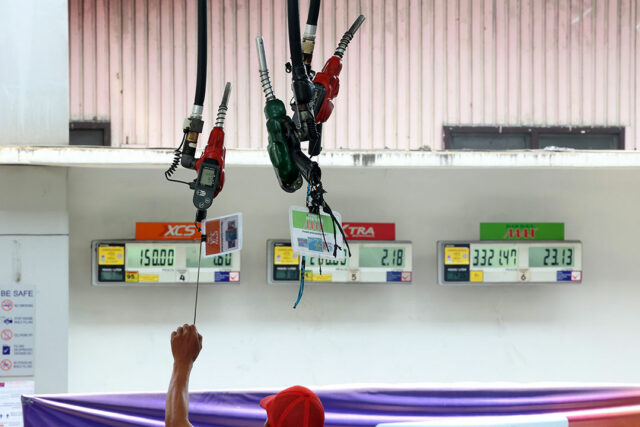
SEVERAL OIL FIRMS are rolling back prices beyond the government’s initial projections, with diesel prices expected to drop by up to P23 per liter.
In separate advisories on Monday, fuel retailers announced a reduction in the prices at the pump starting April 14 (Tuesday), reflecting the sharp drop in global oil prices amid the ceasefire in the Middle East.
Shell Pilipinas Corp. is implementing the biggest rollback, with a reduction of P6.50 per liter for gasoline, P23 per liter for diesel, and P11.50 per liter for kerosene.
Unioil Petroleum Philippines, Inc. will slash gasoline and diesel prices by P4.50 per liter and P20.90 per liter, respectively.
Petron Corp. will reduce gasoline prices by P4.43 per liter, diesel by P20.89 per liter, and kerosene by P8.50 per liter.
Jetti Petroleum, Inc. said it is only reducing diesel prices by P2 per liter as it did not implement the P18.60 hike that the firm was supposed to implement last week. It will not adjust gasoline prices.
Seaoil Philippines, Inc. will cut gas prices by P4.43 per liter, diesel by P20.89 per liter, and kerosene by P8.50 per liter.
Flying V likewise will reduce gas prices by P4.50 per liter, biodiesel by P20.90 per liter, and kerosene by P8.50 per liter.
This marked the first rollback in recent months and providing a slight relief to consumers after weeks of consecutive price hikes.
Some of the announced price rollbacks are slightly higher than the Department of Energy’s earlier estimates, which projected minimum reductions of P20.89 per liter for diesel and P4.43 per liter for gasoline.
“I had a meeting with the oil companies… They have confirmed they will do the rollback as prescribed,” Energy Secretary Sharon S. Garin told DZMM radio on Monday.
However, oil prices face renewed upward pressure following US President Donald J. Trump’s announcement the US military will begin a blockade in the Strait of Hormuz after talks with Iran collapsed.
Reuters reported that the US military’s Central Command later said the blockade would only apply to ships going to or from Iran, including all Iranian ports on the Gulf and Gulf of Oman. US forces would not impede freedom of navigation for vessels transiting the Strait of Hormuz to and from non-Iranian ports and additional information would be provided, it said.
Iran’s Revolutionary Guards responded to Mr. Trump by warning that military vessels approaching the strait would be considered a ceasefire breach and dealt with harshly and decisively.
With the renewed threat to oil prices, Ms. Garin said they will monitor the five-day international trading to determine its impact and identify measures.
Jetti President Leo P. Bellas said the US blockade in the Strait of Hormuz may escalate the six-week-old conflict.
“If the US does successfully block vessels from Iranian ports, the economic pressure on Iran due to lost revenue may push the country to launch more attacks on energy infrastructures,” Mr. Bellas said in a Viber message.
“Further attacks by Iran on export facilities that bypass the Strait of Hormuz would inflict maximum damage to the already shaky crude oil markets, and may result to further increase on prices,” he added.
SUBSIDIES
At the same time, the Federation of Philippine Industries (FPI) said the rollback in pump prices provides temporary relief for manufacturers that have been grappling with soaring costs since the Iran war started.
FPI Chairperson Elizabeth H. Lee in a statement urged the government to provide subsidies for manufacturers that have been affected by high oil prices.
“Philippine industries cannot plan around geopolitical windfalls — we need durable energy policy,” she said.
Despite the pump price rollback, Ms. Lee said pump prices are far from pre-Iran war levels.
“A P20 rollback today can be reversed by a P20 hike next week if the ceasefire collapses and the conflict escalates or persists,” she added.
Ms. Lee said the government should support local manufacturers by institutionalizing fuel subsidies for micro, small, and medium enterprises (MSMEs) and logistics players.
“Targeted, time-bound support should complement tax measures by assisting employed workers and firms in the most affected sectors, particularly MSMEs and energy-intensive industries such as manufacturing,” she said.
Ms. Lee also said there is a need to reduce the country’s reliance on imports and leverage a “buy local strategy.”
“This approach supports local enterprises, particularly MSMEs, while retaining value within the economy, sustaining employment, and strengthening our capacity to withstand global disruptions,” she said.
Ms. Lee said the conflict in the Middle East continues to affect manufacturers beyond oil prices. She cited lost or delayed export contracts, deferred capital investment, and workforce adjustments.
Meanwhile, Management Association of the Philippines President Donald Patrick L. Lim said businesses should resume continuity planning in case of another oil price spike.
“Businesses should view this as temporary and remain cautious, as the rollback only partially offsets recent increases and global oil markets remain volatile,” he said in a Viber message.
“Companies should continue planning for resilience by improving efficiency, reviewing supply chains, revisiting flexible work arrangements, and preparing contingency plans in case fuel prices rise again,” he added. — with Beatriz Marie D. Cruz and Reuters
DPWH OKs award of P7.78-B Boracay bridge to SMC unit
By Ashley Erika O. Jose, Reporter
THE Department of Public Works and Highways (DPWH) said it has approved the award of the P7.78-billion Boracay bridge project to San Miguel Holdings Corp. (SMHC), the infrastructure arm of San Miguel Corp. (SMC).
“We are pleased to notify SMHC that on March 25, 2026, the DPWH approved the resolution by the Public-Private Partnership (PPP) prequalification, bids, and awards committee (PBAC) for PPP recommending the award of the contract to San Miguel Holdings Corp.,” Public Works Secretary Vivencio B. Dizon said in a notice of award dated March 30.
SMHC secured the project after no competing bids were submitted by the deadline.
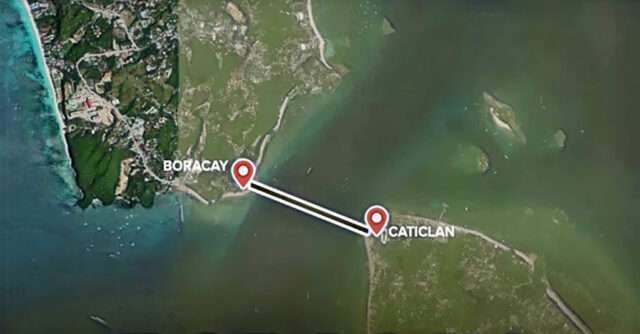
The company holds original proponent status for the unsolicited project, which involves the financing, design, construction, operation, and maintenance of a 2.54-kilometer bridge system, including a 1.14-kilometer limited-access bridge linking Caticlan in Malay, Aklan, to Boracay Island.
Under project guidelines, the contract is awarded to the original proponent if no comparative proposal is found to be superior.
The bridge will include access for public transport, pedestrian lanes, bikeways, and provisions for utilities such as power, telecommunications, water supply, and sewerage, according to the PPP Center.
The DPWH said the project aims to provide all-weather access between Boracay and Caticlan, improve emergency response, address solid and liquid waste management concerns, and support the island’s tourism-driven economy.
Separately, SMC is upgrading the Godofredo P. Ramos Airport in Caticlan through its unit Trans Aire Development Holdings Corp., with Megawide Construction Corp. undertaking the design and construction of the new passenger terminal building.
Meanwhile, Mr. Dizon said SMC has committed to partially opening a section of the P58.42-billion South Luzon Expressway Toll Road 4 (SLEX TR4) by 2026.
“For San Miguel, RSA (Ramon S. Ang) has committed that they will finally open part of TR4 by the end of 2026,” Mr. Dizon told reporters on the sidelines of an event last week.
Package A of the SLEX TR4 project is scheduled for completion by December 2026, based on DPWH data. The 11.32-kilometer segment covers Sto. Tomas, Batangas, to Makban, Laguna.
The full project, which is divided into six packages, is targeted for completion by June 2029. SLEX TR4 is being implemented by SMC SLEX, Inc., formerly South Luzon Tollways Corp.
The project has an estimated cost of P58.42 billion, excluding Package F, the final segment spanning 9.96 kilometers from Tayabas to Mayao, Lucena, Quezon.
SLEX TR4 is a 66.74-kilometer, four-lane toll road from Sto. Tomas, Batangas, to Tayabas and Lucena City in Quezon province.
The project is expected to improve the movement of goods and services between Metro Manila and southern provinces by reducing travel time and easing congestion along the Pan-Philippine Highway.
“And then after (TR4) we will then move to TR5. These things will take time but with the right push, we can get things done,” Mr. Dizon said.
The SLEX TR5 project is an extension of SLEX TR4. It is a four-lane toll road spanning about 420 kilometers from the terminal point of SLEX TR4, according to the DPWH.
The project aims to link Quezon and Bicol provinces and provide access to roll-on/roll-off ports.
SLEX TR5 consists of eight segments and is being implemented by South Luzon Toll Road 5 Expressway Corp. Segment 1 is estimated to cost about P22.6 billion.
CNPF profit rises 11% to P7.1B on cost controls
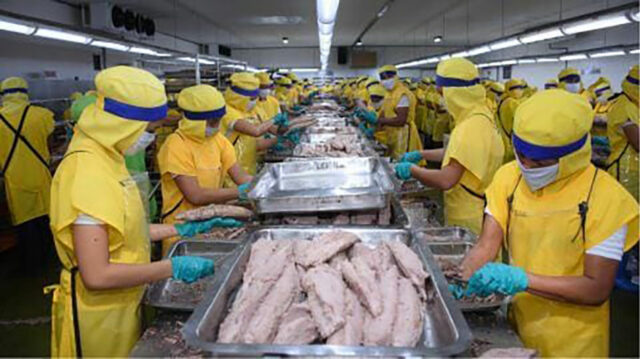
CENTURY PACIFIC Food, Inc. (CNPF) reported an 11% increase in net income for 2025 to P7.1 billion, as tighter spending offset pressure on gross margins.
The listed food company posted a 10% rise in consolidated revenues to P83.3 billion, driven by its branded segment, which compensated for the soft performance of its export business, it said in a statement on Monday.
The branded segment — comprising marine, meat, milk, and other segments — recorded a 13% volume-led sales growth, driven by its offerings, which reach nine out of 10 households in the Philippines, the company said.
“In our effort to balance short- and long-term growth, we made strategic decisions back in 2024 to invest in our brands while holding prices even up to 2025,” said Chad Manapat, CNPF chief financial officer.
“Ultimately, this meant providing consumers with more accessible and nutritious food options, leading to double-digit volume growth in 2025.”
Meanwhile, the group’s original equipment manufacturing (OEM) white label tuna and coconut exports posted a muted 2% growth.
The segment faced headwinds from global trade uncertainty and an unfavorable commodity cycle, though a double-digit recovery in the fourth quarter of 2025 helped offset earlier declines.
Margins remained under pressure as input costs normalized from a favorable 2024 cycle, pulling gross margin down by 100 basis points to 25.1%.
However, by deliberately tightening operating expenses, the company lifted its net profit margin by 10 basis points to 8.5%.
Healthy cash flows funded P4.1 billion in capital expenditures during the year, allocated to capacity expansion and renewable energy initiatives, including solar and biomass capabilities.
The balance sheet remained strong, with a net gearing ratio of 0.13x.
Looking ahead, Mr. Manapat said 2026 is “shaping up to be a tough year.”
While the company is currently on track for the first quarter, it is navigating disruptions from the Middle East and a higher bar for the next few months.
The company plans to rely on its portfolio of “pantry essentials,” which have historically shown resilience during economic uncertainty.
To manage rising cost pressures, CNPF is maintaining a “tight leash on spending” and optimizing discretionary costs to keep products affordable.
“Growth, for us, is not just a financial metric. It means keeping accessible and nutritious food on the table for more Filipino families,” Mr. Manapat said, noting that the company’s operations support 33,166 jobs.
CNPF’s brands include Century Tuna, Argentina, 555, Ligo, and Birch Tree. The company is also one of the leading providers of private label tuna and coconut products for export.
CNPF shares fell by 0.62% to P32 apiece on Monday. — Alexandria Grace C. Magno
Axelum earnings grow 23% to P849.6M on higher sales

AXELUM RESOURCES CORP. reported a 23.42% increase in net income for 2025 to P849.59 million, driven by higher sales and selling prices across its core product segments.
In a regulatory filing on Monday, the listed coconut product manufacturer said profit rose from P688.36 million in 2024.
Revenue increased 38.85% to a record P10.19 billion from P7.34 billion a year earlier, supported by higher export and local sales.
“Consolidated topline [growth] was driven by robust volume growth and higher average selling prices across core product segments,” Axelum said in a separate statement.
Export sales rose 41%, driven by new customer acquisitions and a larger order book in North America, Europe, Australia, and Asia.
Local sales increased 47%, supported by a wider distribution footprint and higher online engagement.
Axelum said its sales-related expenses fell 9.94% to P683.52 million from P758.94 million in 2024. General and administrative expenses rose 83.14% to P793.39 million from P433.22 million.
Axelum President and Chief Operating Officer Henry J. Raperoga said the company’s 2025 performance reflects its ability to operate under market pressures.
“Our record performance in 2025 underscores our ability to consistently deliver value amid industry headwinds and global uncertainties,” he said in the statement.
He added that the company is monitoring developments in the Middle East and assessing potential impacts on fuel and logistics costs.
For 2026, Axelum said it has allocated about P200 million in capital expenditures for new machinery, equipment maintenance, and automation of management systems.
The company plans to expand its consumer-branded segment through the rollout of new domestic retail offerings.
It added that it continues to develop higher-value and new products for export markets. — Vonn Andrei E. Villamiel
Bert Lozada Swim School: Alive and splashing for 70 years

 IT HAS been 70 years since the Bert Lozada Swim School (BLSS) began, a staple for those looking for swimming lessons either for themselves or for their children, especially in the summer. As the Philippines’ largest and longest-running swim school, its mission has been simple — to help Filipinos overcome their fear of water.
Started in 1956 by Remberto “Tito Bert” Lozada, whose experience in international swimming competitions motivated him to use what he had learned to teach others, the school has spent the last 70 years championing water safety nationwide. It has taught over one million students in that time, and has produced seven Olympian swimmers.
Bert Lozada’s sons, Anthony and Angelo, now run the business. In a recent virtual interview with BusinessWorld, they said that passion is behind the constant improvement of their programs over the decades.
“When it started, it was a mom-and-pop thing with a few family members teaching at a couple of swimming pools. The curriculum was based on what my dad developed from his experiences coaching abroad,” Anthony Lozada, BLSS president and chief executive officer, told BusinessWorld via video call on April 10.
“At the time, there was no structure, methodology, or pedagogy on how to transfer information to children, given that it’s a free moving environment, not a classroom setting,” he added.
It was Tito Bert’s father, Capt. Catalino Lozada, who sowed the seeds for a swim school in the early 1950s. Each generation of the family got more exposure to international swimming standards, resulting in the necessary modifications and teaching aids.
The brothers underwent a certification course in Australia, where they got the information needed to equip Filipino coaches with the skills to teach basic fundamental swimming, in turn upgrading their own learn-to-swim program.
DROWN-FREE PHILIPPINES
Angelo Lozada, chief operating officer of BLSS, explained that they now boast of “a menu of services for different ability levels,” from children to adults to those with adaptive needs, all based on best practices around the world, available year-round.
“We have 130 regular teachers and coaches around the country. During the summer, where we open up more classes and get to activate working students, we have roughly more than 200 teachers and coaches,” he said.
It is unfortunate that in an archipelagic country, many Filipinos still do not know how to swim. Angelo Lozada posits that a major factor is economics — with people not having the funds to enroll in swimming classes.
“In Australia, if a kid doesn’t know how to swim by the time they’re six years old, that’s considered bad parenting. Here, we noticed a lot of kids don’t learn simply because of lack of money for lessons,” he explained. “Another thing that hinders is the knowledge to teach. That’s the reason we built the Drown-Free Philippines Foundation, to equip people on the barangay level to teach.”
INCLUSIVITY
Now, they are looking to collaborate with more swim providers, to help out more financially challenged Filipinos, especially children.
“It’s doable if we’re able to branch out,” Angelo Lozada said. “We’re already moving forward in terms of reaching different institutions and barangays. We just have to get more sponsors and raise more funds to teach even more kids for free.”
Because Bert Lozada’s dream is to have “a drown-free nation,” his sons are working to bring swimming lessons to indigents, to children from families without access to funds, and to those with physical and intellectual disabilities.
Anthony Lozada, who also handles the national team for para-athletes, told BusinessWorld that they aim to expand their adaptive swimming lessons.
“It’s about inclusivity regardless of demographic. BLSS wants to bring swimming to everyone,” he said.
MAKING GREAT SWIMMERS
BLSS also offers their services to educational institutions, to take over the swimming portions of Physical Education (PE) programs. Those with a fear of water can be more adequately handled by a full-time swim teacher compared to a more general PE teacher, according to the brothers.
It’s also a way to spot talent that can be recruited into more advanced modules, or even a varsity program.
“We’re talking about those who are really comfortable in the water, which you can tell because they move differently. We get to identify usually one or two of those in every 40 students,” said Angelo Lozada.
Once those are spotted, they are encouraged to join intramurals, after which they are brought into a highly competitive program. “A lot of swimmers discovered in our classes now in the national team used to be scared of the water. But with proper guidance and a lesson plan, we were able to tap those hidden talents in them,” he added.
“The motto of our grandfather was: ‘Great swimmers are made, not born.’”
THE FUTURE OF BLSS
Modules used by BLSS now are on par with those of other countries. The brothers likened it to how Jollibee took the fastfood concept from abroad and modified it to the Filipino context — and they continue to improve on it to this day.
“Our students don’t only learn the water safety skill of swimming, but we also impart to them the values of being an athlete and a positive contributor to Philippine society. Many coaches that we recruited are also doing well in jobs abroad,” said Anthony Lozada. “BLSS is a swim school that imparts not just knowledge of how to swim, but also values and the importance of family bonding.”
Right now, they are working on an app which aims to professionalize everything from enrollment to alumni matters. “We want to remind alumni to continue learning to swim, and offer them refresher courses,” said Angelo Lozada.
The brothers assured that “the passion of Tito Bert is alive” through them.
“We have our dad to thank. He really loved teaching,” Anthony Lozada said. “We weren’t able to figure it out before because we were looking at it as a job, but now that we’re in the driver’s seat, the rewards, the fulfillment, are unmatched.”
To inquire about the BLSS Summer Swim Program or their other programs, contact the Bert Lozada Swim School through their social media pages, send an e-mail to blss.inquiry@gmail.com, or call 0917-700-7946. The school has over 40 venues nationwide. — Brontë H. Lacsamana
Metro Retail profit up 12% as sales reach P41.56B

LISTED RETAILER Metro Retail Stores Group, Inc. (MRSGI) reported a 12% increase in net income to P682.64 million in 2025.
“2025 was a year of disciplined execution and measurable impact for MRSGI,” Metro Retail President and Chief Operating Officer Joselito G. Orense said in a statement on Monday.
“By strategically expanding our network into high-growth regions and introducing innovative store formats, we strengthened our market presence, delivered higher sales and margins, and improved cash earnings. These results reflect the dedication of our teams nationwide and our commitment to serving customers with modern retail experiences while driving sustainable, long-term growth,” he added.
Total sales rose 4.9% to P41.56 billion from P39.62 billion in 2024.
Same-store sales inched up 0.6%, despite minor disruptions during the year.
Blended gross margin increased to 21.8% from 21.4% in 2024, supported by higher margins in the food retail segment.
This offset a 9.3% increase in operating expenses driven by new store openings, higher utility and personnel costs, and calamity-related losses. The company also implemented cost-control measures, including the installation of solar photovoltaic (PV) systems in up to 19 stores.
MRSGI’s earnings before interest, taxes, depreciation, and amortization (EBITDA) rose 12.4% to P2.63 billion a year earlier.
In 2025, the company opened 10 new stores across Luzon and the Visayas, including additional small-format Metro Value Marts and a Metro Supermarket and Department Store in Bais, Negros Oriental.
It also introduced Metro Corner lifestyle stores, including a site at Mandani Bay, marking its entry into the premium urban segment.
Metro Retail operates 81 branches across Luzon and the Visayas under formats such as Metro Supermarket, Metro Department Store, Super Metro Hypermarket, Metro Value Mart, and Metro Home Improvement and Lifestyle.
At the local bourse on Monday, shares in Metro Retail Stores Group, Inc. (MRSGI) fell by 0.89% or one centavo to close at P1.11 apiece. — Alexandria Grace C. Magno
All the President’s Men at 50: One of the finest films about investigative journalism ever made

NIGHTTIME. A dim and dingy car park. Woefully inadequate fluorescent lights flicker and buzz overhead. Two men stand in half-shadow. One is barely visible, his face almost entirely swallowed by darkness. His voice is low and gravelly:
“The list is longer than anyone can imagine. It involves the entire US intelligence community. FBI, CIA, Justice. It’s incredible. The cover-up had little to do with Watergate. It was mainly to protect the covert operations. It leads everywhere. Get out your notebook. There’s more.”
The other man is lost for words. He just stands there, mouth slightly open and eyes wide, trying to make sense of what he’s hearing. The exchange ends with a warning: his life, along with that of his colleague, is in grave and immediate danger.
This is a pivotal moment in Alan J. Pakula’s All the President’s Men, which has just turned 50. The film was based on the 1974 book by journalists Bob Woodward and Carl Bernstein, who investigated the Watergate scandal for the Washington Post.
The man doing the talking in the scene I’ve been describing is Mark Felt (Hal Holbrook), then associate director of the FBI, better known as “Deep Throat.” His interlocutor, temporarily stunned into silence, is Woodward (Robert Redford).
A masterpiece of political cinema, All The President’s Men remains one of the finest films about investigative journalism ever made.
Steeped in a fog of paranoia and distrust — an atmosphere shaped in no small part by cinematographer Gordon Willis’ matchless treatment of light and shade — it is as relevant now as it was on first release.
UNCOVERING THE WATERGATE SCANDAL
“At its simplest,” journalist Garrett M. Graff writes about the scandal, “Watergate is the story of two separate criminal conspiracies: the Nixon world’s ‘dirty tricks’ that led to the burglary on June 17, 1972, and the subsequent wider cover-up. The first conspiracy was deliberate, a sloppy and shambolic but nonetheless developed plan to subvert the 1972 election; the second was reactive, almost instinctive — it seems to have happened simply because no one said no.”
What started out as an ostensibly ordinary break-in at the Democratic National Committee headquarters in Washington, DC during the US presidential election cycle soon revealed a broader pattern of political espionage, illegal surveillance, campaign sabotage and the systematic misuse of state power. Much of it targeted perceived political enemies.
As the indefatigable Woodward and Bernstein pursued the story, it became clear the burglary was part of a much larger operation — one that reached all the way into the heart of the White House.
Their probing would ultimately lead to the disgrace and resignation of Richard Nixon, who faced near-certain impeachment.
Redford was the driving force behind All the President’s Men.
He became interested in the Watergate story while working on The Candidate, a 1972 satire about the backstage machinations underpinning an idealistic Senate campaign that, in an instance of uncanny timing, overlapped with the unfolding scandal.
Redford followed Woodward and Bernstein’s investigation as it panned out in real time. In 1972, he reached out to Woodward directly, hoping to better understand both the facts of the case and the methods of the reporting.
Convinced that the story demanded a restrained, quasi-documentary approach, Redford initially envisioned a black-and-white film shot in a pared-back style, with an emphasis on process rather than star power.
Warner Bros., with whom he had a production deal, thought otherwise. Having already agreed to finance the film, the studio insisted that Redford take a leading role — and marketed the as yet-unmade project as “the most devastating detective story” of the century.
There were early discussions about casting Al Pacino as Bernstein, fresh from the success of The Godfather (1972), but the part ultimately went to Dustin Hoffman. Pakula then signed on to direct, bringing with him a conceptual and tonal sensibility ideally suited to the material.
A quandary remained: how do you build suspense out of a story whose outcome is already common knowledge? Film scholars Robert B. Ray and Christian Keathley suggest the filmmaking team’s response to that challenge is “the key” which unlocks the movie.
At one point, during his first meeting with Deep Throat, Woodward admits: “The story is dry. All we’ve got are pieces. We can’t seem to figure out what the puzzle is supposed to look like.”
We share the confusion of the reporters as they struggle to get to the bottom of things. What might, in the wrong hands, have been a disastrous mistake turned out to be a masterstroke.
The result is an endlessly watchable and quotable (“Follow the money”) film that generates narrative and dramatic tension through the sheer difficulty of knowing anything at all.
In age beset by disinformation, brazen political deceit, strategic obfuscation, and collapsing trust in public institutions, that lesson feels less historically distant than it does disturbingly prescient. — The Conversation via Reuters Connect
Alexander Howard is a Senior Lecturer for the Discipline of English and Writing at the University of Sydney.
IDC earnings fall 27% as costs offset revenue growth

LISTED real estate developer Italpinas Development Corp. (IDC) and its subsidiaries reported a 27.4% decline in net income to P250.9 million for 2025, as higher financing costs and lower gains from investment property appraisals offset higher revenue.
In a statement on Monday, IDC said its sales reached P784.7 million in 2025, up 29.9% from P604.2 million in 2024, driven by sales from ongoing projects, including Primavera City – Città Bella in Cagayan de Oro and Miramonti in Sto. Tomas, Batangas.
“From inception, IDC has focused on being an early mover in emerging locations, foreseeing the current shift in real estate focus from Metro Manila to provinces, and this has paid off with the significant generated sales from these flagship projects during the year,” the company said.
In 2025, IDC subsidiaries IDC Homes and IDC Prime recognized revenue from their projects, Verona Green Residences and Primavera City – Città Grande, respectively.
Despite higher revenue and margins, net income declined due to higher interest costs and lower gains from investment property appraisals compared with those recorded in 2024.
“Positive performance was also noted in the group’s financial position, reflecting a significant improvement in its liquidity position compared to 2024. Total assets increased to P4.5 billion from P4.3 billion in 2024 or 3.5%. Coupled with this was an overall decrease in the total liabilities to P2.5 billion from P2.6 billion in 2024 or 3.6%,” IDC said.
Basic earnings per share from continuing operations declined to P0.35 from P0.54 in 2024. The current ratio rose to 1.74 from 1.51 in 2024, indicating improved short-term liquidity.
For 2026, IDC said it expects continued growth as it expands into new locations nationwide, including Palawan, Boracay, Bataan, and Bukidnon, where it plans to launch eco-friendly developments.
Shares in Italpinas Development Corp. fell by 1.25% or one centavo to close at P0.79 on Monday. — Alexandria Grace C. Magno