Fuel retailers roll back gasoline, diesel prices
By Sheldeen Joy Talavera, Reporter
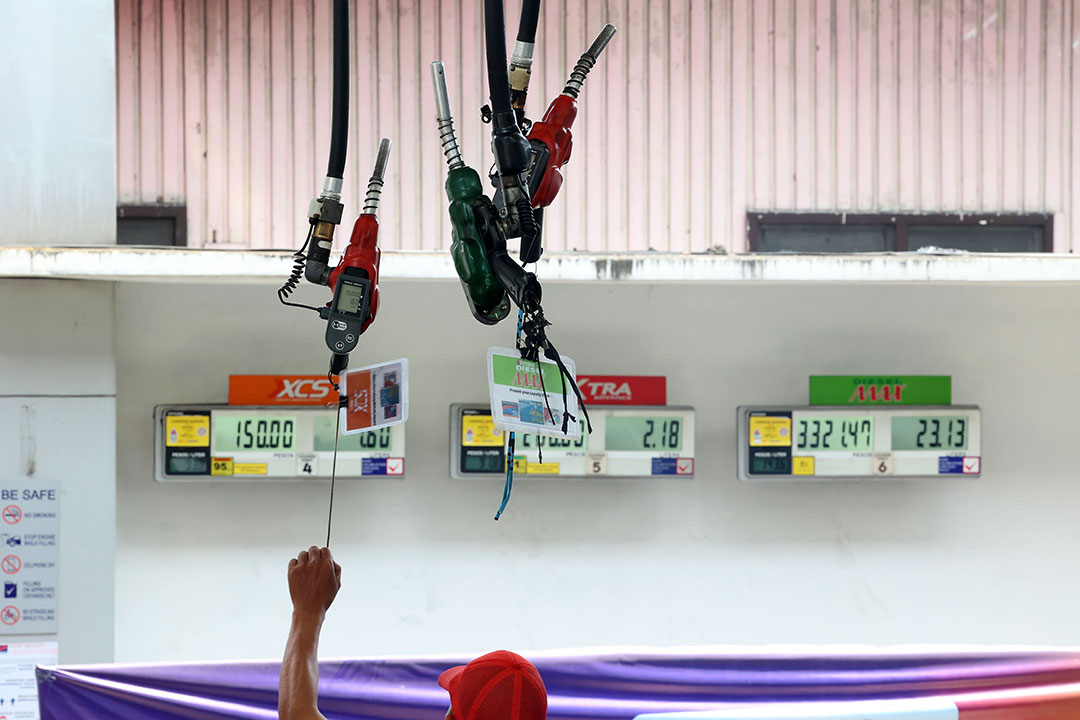
SEVERAL OIL FIRMS are rolling back prices beyond the government’s initial projections, with diesel prices expected to drop by up to P23 per liter.
In separate advisories on Monday, fuel retailers announced a reduction in the prices at the pump starting April 14 (Tuesday), reflecting the sharp drop in global oil prices amid the ceasefire in the Middle East.
Shell Pilipinas Corp. is implementing the biggest rollback, with a reduction of P6.50 per liter for gasoline, P23 per liter for diesel, and P11.50 per liter for kerosene.
Unioil Petroleum Philippines, Inc. will slash gasoline and diesel prices by P4.50 per liter and P20.90 per liter, respectively.
Petron Corp. will reduce gasoline prices by P4.43 per liter, diesel by P20.89 per liter, and kerosene by P8.50 per liter.
Jetti Petroleum, Inc. said it is only reducing diesel prices by P2 per liter as it did not implement the P18.60 hike that the firm was supposed to implement last week. It will not adjust gasoline prices.
Seaoil Philippines, Inc. will cut gas prices by P4.43 per liter, diesel by P20.89 per liter, and kerosene by P8.50 per liter.
Flying V likewise will reduce gas prices by P4.50 per liter, biodiesel by P20.90 per liter, and kerosene by P8.50 per liter.
This marked the first rollback in recent months and providing a slight relief to consumers after weeks of consecutive price hikes.
Some of the announced price rollbacks are slightly higher than the Department of Energy’s earlier estimates, which projected minimum reductions of P20.89 per liter for diesel and P4.43 per liter for gasoline.
“I had a meeting with the oil companies… They have confirmed they will do the rollback as prescribed,” Energy Secretary Sharon S. Garin told DZMM radio on Monday.
However, oil prices face renewed upward pressure following US President Donald J. Trump’s announcement the US military will begin a blockade in the Strait of Hormuz after talks with Iran collapsed.
Reuters reported that the US military’s Central Command later said the blockade would only apply to ships going to or from Iran, including all Iranian ports on the Gulf and Gulf of Oman. US forces would not impede freedom of navigation for vessels transiting the Strait of Hormuz to and from non-Iranian ports and additional information would be provided, it said.
Iran’s Revolutionary Guards responded to Mr. Trump by warning that military vessels approaching the strait would be considered a ceasefire breach and dealt with harshly and decisively.
With the renewed threat to oil prices, Ms. Garin said they will monitor the five-day international trading to determine its impact and identify measures.
Jetti President Leo P. Bellas said the US blockade in the Strait of Hormuz may escalate the six-week-old conflict.
“If the US does successfully block vessels from Iranian ports, the economic pressure on Iran due to lost revenue may push the country to launch more attacks on energy infrastructures,” Mr. Bellas said in a Viber message.
“Further attacks by Iran on export facilities that bypass the Strait of Hormuz would inflict maximum damage to the already shaky crude oil markets, and may result to further increase on prices,” he added.
SUBSIDIES
At the same time, the Federation of Philippine Industries (FPI) said the rollback in pump prices provides temporary relief for manufacturers that have been grappling with soaring costs since the Iran war started.
FPI Chairperson Elizabeth H. Lee in a statement urged the government to provide subsidies for manufacturers that have been affected by high oil prices.
“Philippine industries cannot plan around geopolitical windfalls — we need durable energy policy,” she said.
Despite the pump price rollback, Ms. Lee said pump prices are far from pre-Iran war levels.
“A P20 rollback today can be reversed by a P20 hike next week if the ceasefire collapses and the conflict escalates or persists,” she added.
Ms. Lee said the government should support local manufacturers by institutionalizing fuel subsidies for micro, small, and medium enterprises (MSMEs) and logistics players.
“Targeted, time-bound support should complement tax measures by assisting employed workers and firms in the most affected sectors, particularly MSMEs and energy-intensive industries such as manufacturing,” she said.
Ms. Lee also said there is a need to reduce the country’s reliance on imports and leverage a “buy local strategy.”
“This approach supports local enterprises, particularly MSMEs, while retaining value within the economy, sustaining employment, and strengthening our capacity to withstand global disruptions,” she said.
Ms. Lee said the conflict in the Middle East continues to affect manufacturers beyond oil prices. She cited lost or delayed export contracts, deferred capital investment, and workforce adjustments.
Meanwhile, Management Association of the Philippines President Donald Patrick L. Lim said businesses should resume continuity planning in case of another oil price spike.
“Businesses should view this as temporary and remain cautious, as the rollback only partially offsets recent increases and global oil markets remain volatile,” he said in a Viber message.
“Companies should continue planning for resilience by improving efficiency, reviewing supply chains, revisiting flexible work arrangements, and preparing contingency plans in case fuel prices rise again,” he added. — with Beatriz Marie D. Cruz and Reuters