Marcos signs P6.79-T budget, vetoes P92.5B in unprogrammed funds
By Chloe Mari A. Hufana, reporter
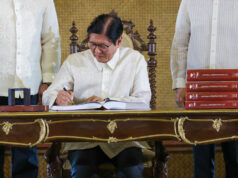
Philippine President Ferdinand R. Marcos, Jr. on Monday signed this year’s P6.793-trillion national budget but vetoed almost P100 billion worth of unprogrammed appropriations amid heightened scrutiny over public spending as authorities probe a graft scandal.
During the signing of Republic Act No. 12314 or the 2026 General Appropriations Act in Malacañang, Mr. Marcos said the veto aims to ensure public funds are spent strictly in line with national priorities.
“To ensure that public funds are expended in clear service of national interests, I vetoed several items of appropriations with their purposes in corresponding special conditions under the unprogrammed appropriations totaling almost P92.5 billion,” he said.
He ordered government agencies to exercise prudent fiscal management while ensuring uninterrupted public service.
Unprogrammed appropriations are meant to give the government flexibility in responding to emergencies or unforeseen needs. However, their use has drawn closer scrutiny amid concerns that excessive or unclear releases could weaken fiscal oversight and accountability.
After the veto, total unprogrammed appropriations were reduced to P150.5 billion from P243 billion in the bicameral conference committee report. The President said the revised level is the lowest since 2019 and stressed that releases would undergo careful validation.
“My administration will enforce these safeguards without exception, to serve the public interest and to advance our national development goals,” he said.
The Department of Budget and Management (DBM) said the veto underscored the administration’s commitment to fiscal responsibility. Acting Budget Secretary Rolando U. Toledo said the Executive thoroughly reviewed the budget to ensure it is consistent with state priorities, while taking into account stakeholder recommendations.
The country began 2026 under a reenacted budget until Jan. 4 after delays in the bicameral conference committee deliberations late last year. Mr. Marcos said expenditures lawfully
incurred during the reenacted period would be considered by the Budget department in formulating fund releases for the year.
Education received the biggest allocation at P1.35 trillion, equivalent to 4.36% of economic output, meeting the benchmark under the United Nations Educational, Scientific and Cultural Organization’s Education 2030 framework, according to the DBM.
The budget provides for almost 33,000 teaching positions, more than 32,000 nonteaching posts, and funding for about 25,000 classrooms.
Health spending will rise to P448.1 billion to support universal healthcare, including zero-balance billing, disease surveillance and the hiring of more health workers. The allocation is also expected to strengthen the Philippine Health Insurance Corp.
Agriculture was allotted P297.1 billion to boost food security and productivity, while spending on social services will reach P270.2 billion. The budget includes P15.33 billion for disaster rehabilitation and reconstruction, and higher spending for military and uniformed personnel after pay adjustments set to take effect this year.