Universities, groups warn against GE reframing
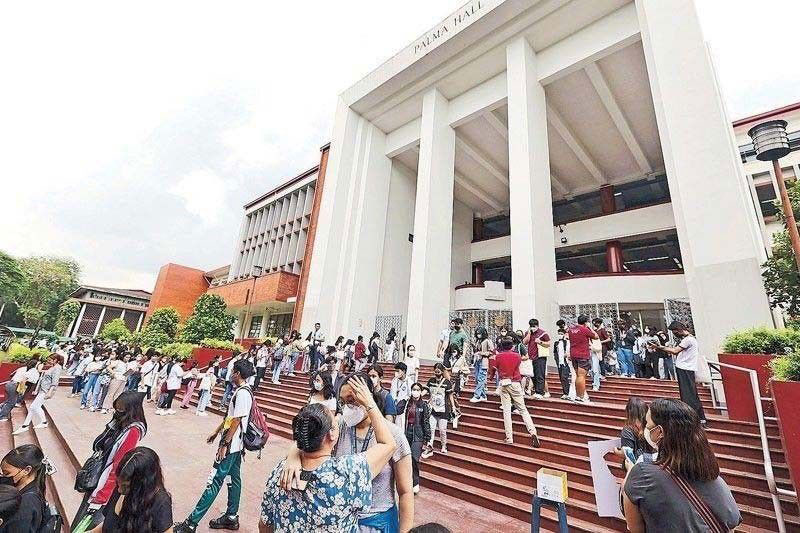
Education stakeholders warned against the proposed reframing of the General Education (GE) curriculum for undergraduate education in the Philippines, citing gaps in the academic reform.
“We call upon CHED (Commission on Higher Education) to discard the said draft and conduct broader, deeper, and more meaningful discussions to produce a new GE curriculum that reflects the insights of stakeholders and responds to the needs of our communities,” Pambansang Samahan sa Linggwistika at Literaturang Filipino, Ink. said in a statement on Thursday.
“The draft CHED memorandum on the RGECC (Reframed General Education Curriculum Component) is an example of over-regulation that stifles academic freedom, innovation, and creativity in the course offerings of HEIs,” the group added.
The current 36 units of the GE curriculum will be “reframed” into 18 units under the proposed overhaul by the commission. Of which, 15 units will include core or mandated GE, and three units will be dedicated to institutional GE.
The five core GE courses would be Professional Communication, Global Trends and Emerging Technologies, Data Evidence and Ethics in a Knowledge Society, Rizal and Philippine Studies, and Labor Education.
Among the concerns raised over the public hearing held on Tuesday were the possibility of merging or removing humanities-related subjects into a smaller set of skills-oriented subjects.
Compared to the current curriculum, classes in philosophy, ethics, literature, art appreciation, and Philippine history will not be mandatory as standalone courses in the RGECC.
The University of Santo Tomas (UST) Department of Creative Writing said that the attempt to reduce the space for humanities subjects within the university also erases Filipinos’ sense of being.
“It is not only courses that are being removed, but also voices and memories, as well as our understanding of ourselves, society, and others,” the department said in Filipino in a statement.
“The humanities are the foundation of the education provided by the university… A university without humanities is a towering yet hollow structure,” it added. “Education should not merely respond to the demands of industry and capital.”
Ateneo de Manila University (AdMU) also recommended the restoration of “strong grounding in the liberal arts” in the new curriculum by offering at least a three-unit course in Ethics, Understanding the Self, and Arts Appreciation.
“‘Creative imagination’ as well as ‘empathy development’ are also essential in holistic learner development, especially in a world that is increasingly dominated by technology,” the university said.
AdMU questioned the reframed GE proposal and its target to create a ‘holistic learner development’, which the university said should have “strong grounding in the liberal arts”.
“The assumption is that it is supposed to be for the education of the whole person,” the university said. “How can critical thinking and holistic learner development be achieved with the radical excision of courses in the humanities and the social sciences?”
Apart from the reduction of units, the Alliance of Concerned Teachers (ACT) Philippines also warned of the possible 90,000 job cuts within universities.
“Many part-time and contractual instructors in the humanities and social sciences are at risk of losing their jobs due to non-renewed contracts, reassignments, or even outright displacement,” ACT Vice Chairperson Carl Marc Ramota said in a statement yesterday.
Amid criticisms from some universities and groups, CHED said that inputs from all stakeholders will be “carefully examined” to ensure a curriculum that is “coherent, responsive, and aligned” with national priorities and global standards.
“The proposed reframed GE curriculum is not yet final and remains subject to the ongoing consultation process with higher education institutions, faculty, students, professional organizations, and other education stakeholders,” the commission said.
“CHED will continue to engage stakeholders through additional consultation mechanisms. This will ensure that the final policy, if issued, reflects careful study, meaningful participation, and the best interests of Filipino learners and higher education,” it added.
The target implementation of the new GE curriculum is scheduled for the academic year 2027-2028. — Almira Louise S. Martinez