Home Blog Page 9993

Taal residents return home after alert status lowered

RESIDENTS from several towns around Taal Volcano in Batangas province were allowed to return home on Sunday after the state seismologist lowered the alert status, citing a “decreased tendency toward a hazardous eruption.”

Batangas Governor Hermilando Mandanas lifted the lockdown in the towns of Alitagtag, Balete, Cuenca, Lemery, Malvar Mataasnakahoy, San Nicolas, Sta. Teresita, Taal and Talisay, and Tanauan and Lipa cities, all within the 14-kilometer danger zone.

Residents of Taal Volcano Island, which remained on a permanent lockdown, were barred from going home. The municipalities of Agoncillo and Laurel, which are seven kilometers away from the volcano, remained on lockdown.

The Philippine Institute of Volcanology and Seismology (Phivolcs) lowered Taal Volcano’s alert status to level 3 from 4 on Sunday morning, ending a two-week crisis that displaced at least a million people.

Phivolcs recorded fewer earthquakes around Taal, while gas and steam activity had eased, Phivolcs Director Renato U. Solidum, Jr. said at a briefing streamed on Facebook.

The agency recorded only 27 “significant earthquakes,” down from 959 a day from Jan. 12 to 24, it said in an 8 a.m. report.

Activity at the Taal Main Crater also eased to “infrequent weak ash eruptions and longer episodes of degassing or steaming” that generated steam-laden plumes that were less than a kilometer tall.

“This marked decline coupled with volcanic earthquake activity suggests stalling, degassing and reduction in gas pressures of eruptible magma in the shallow magmatic region that feeds surface eruptive activity,” Phivolcs said.

“Residents of all towns under lockdown except Agoncillo and Laurel now have the option to return to their respective residences or places of work,” Mr. Mandanas said at a televised briefing from Batangas.

Mr. Mandanas and other top local officials cheered after a representative from Phivolcs announced the alert status had been lowered.

In Lemery, hundreds of residents aboard vehicles rushed to the town after police allowed them entry past 9 a.m. One of them was Annabel Enriquez, who said they have been waiting at the checkpoint since 4 a.m.

Evacuation centers will remain open for residents who need a temporary shelter, the governor said. He also urged people to be wary of ashfall and other health hazards.

Agoncillo Mayor Daniel Reyes asked Mr. Mandanas to lif the lockdown in their area because only two villages are within the seven-kilometer danger zone.

“In case we are allowed to go home, we will be ready in case another eruption occurs,” he told dzBB radio in Filipino.

Phivolcs said the level of sulfur dioxide emissions steadied at an average of 250 tons per day in the past five days, which is “consistent with a progressively degassed shallow magma source and diminished plume activity.”

“People are also advised to observe precautions due to ground displacement across fissures, frequent ashfall and minor earthquakes,” it said.

The agency noted, however, that lowering the volcano’s alert level “should not be interpreted that unrest has ceased or that the threat of a hazardous eruption has disappeared.”

The alert status will be lowered by another step if the volcano’s activity continues to subside, it said.

More than 98,000 families in Batangas, Quezon, Laguna and Cavite provinces were affected by the volcano’s eruption, according to the local disaster agency’s 6 a.m. report on Sunday.

About 37,000 families were taking temporary shelter in 497 evacuation centers, while 43,824 families were being served outside them, it said. — Genshel L. Espedido and Emmanuel Tupas, Philippine Star

Higher FDI seen with CITIRA in place

FOREIGN INVESTORS could pour in more than $10 billion in the Philippines once a measure that seeks to lower corporate income tax is enacted, central bank Governor Benjamin E. Diokno said last week.

“Our estimate is around $8 billion but that’s early in the game,” he told reporters on the sidelines of a Bangko Sentral ng Pilipinas event on Friday. He added that the amount could exceed $10 billion yearly once the proposed Corporate Income Tax and Incentives Rationalization (CITIRA) Act is put in place.

The bill, which will gradually cut corporate income tax to 20% from 30%, will also remove redundant fiscal incentives. Finance Secretary Carlos G. Dominguez III earlier said he expects the law by March.

Mr. Diokno is bullish that the Philippines remains a strategic target for foreign direct investments (FDI) amid global uncertainties. “There are few countries that you want to invest in right now,” he said. “The Philippines is one.”

FDI net inflows rose by a third to $672 million in October from a year earlier, according to data from the Bangko Sentral ng Pilipinas (BSP). Yearly FDI net inflows declined in the past seven months before that.

FDI net inflows worth $5.8 billion for January to October, however, were a third lower than a year earlier, reflecting subdued investor sentiment due to sluggish global economic activity, BSP said.

In comparison, Vietnam received $11.96 billion worth of FDI for the eight months through August, 6.3% higher than a year earlier, Reuters reported, citing the Ministry of Planning and Investment. Indonesia got $7 billion in FDI in the third quarter alone, up 17.8% year on year.

The Philippine central bank expects FDI net inflows to hit $8.8 billion this year, higher than its $6.8 billion target for 2019.

Cheuk Wan Fan, chief market strategist for Asia at the Hongkong and Shanghai Banking Corp., earlier said Philippine FDI this year would probably remain at the same level if uncertainties about the proposed income tax law remained unresolved.

Slowing foreign direct investments in the Philippines is a downside risk to the growth outlook this year, Fitch Solutions Macro Research said in a note on Friday.

The research firm has upgraded its 2020 growth forecast to 6.3% from 6.1%, lower than the government’s 6.5% to 7.5% target for the year.

PEZA PROPOSES CHANGES
Meanwhile, the Philippine Economic Zone Authority (PEZA) has submitted its proposed enhancements to tax bill to the Department of Trade and Industry (DTI) after meeting with industry stakeholders.

The agency in October reversed its stance seeking exemption from the bill rationalizing tax incentives and reducing corporate income tax for investors, proposing changes instead.

PEZA proposed to retain an investment promotion agency’s ability to give incentives, instead of submitting recommendations to a fiscal incentive review board (FIRB) headed by the Finance secretary, according to an e-mailed document.

“Creating another layer of investment approval through the FIRB is an anathema to efficiency-seeking investments that go to PEZA,” PEZA Director General Charito B. Plaza said in an accompanying letter. “This will unduly add burden to what is now a very simple and very straightforward approval and registration process in PEZA.”

PEZA wants four to eight years of income tax holidays (ITH) for new projects.

Under the bill approved by the House of Representatives, investment projects in Metro Manila will have an ITH of up to three years. Areas adjacent to Metro Manila will enjoy four years of ITH, and other areas will be given six years.

PEZA also proposed an alternative of four years’ ITH for Metro Manila enterprises, six years for Metro Manila-adjacent projects and up to eight years for all other areas.

After the expiration of the ITH, PEZA export-supporting enterprises will pay 7% tax on gross income in lieu of national and local taxes for 20 years.

Alternatively, export companies in economic and freeport zones may choose to pay the reduced corporate income tax, which would otherwise be required from all companies.

The agency also proposes a 5% tax on gross income for 20 years on garments, apparel, textile, leather goods and footwear industries.

PEZA also wants spare part imports to be exempted from duty. These include aviation parts for repair, overhaul and maintenance. — Luz Wendy T. Noble and Jenina P. Ibañez

PHL economic risks from China virus downplayed

BANGKO SENTRAL ng Pilipinas (BSP) Governor Benjamin E. Diokno downplayed economic risks that may arise from the continued spread of the novel coronavirus from Wuhan, saying the Philippines’ exposure to China is not that significant.

Mr. Diokno assured that the Philippines’ trade with China is not as significant compared to Beijing’s trade relations with other economies in the Association of Southeast Asian Nations (ASEAN).

“’Yung estimate nila, di naman tayo masyadong ano (Based on their estimate, we are not so much affected)… Siguro ’yung merong…there’s a lot of trade with China…like Vietnam or Thailand, ’yun may problema ka talaga ’dun (Maybe countries that have a lot of trade with China like Vietnam or Thailand, they’ll really have a problem),” he told reporters on the sidelines of the BSP’s Annual Reception for the Banking Community held in Manila on Friday.

“Lockdown na rin ’yung province (The province where it originated from [Wuhan] has been locked down), so as long as we don’t get those people, okay lang tayo (we are okay). At saka this is less severe than SARS (Severe Acute Respiratory Syndrome)… Don’t scare yourself. But avoid travelling,” Mr. Diokno said.

Reuters reported that more than 2,000 people around the world have already tested positive for the novel coronavirus. Casualties have also risen to 56 as of early Sunday morning. (Read related story “Over 2,000 infected with coronavirus” on S2/5)

South China Morning Post cited a report released by the Economist Intelligence Unit on Thursday which said the economic impact of the virus for China and potentially elsewhere could be “significant if the virus continues to spread.”

The report added that between 0.5 to 1 percentage point could be reduced from China’s gross domestic product growth in 2020 due to the virus.

Latest data from the Philippine Statistics Authority (PSA) showed China was the biggest supplier of imported goods to the Philippines in November, with a 22.9% share in total imports. Import payments from China rose to $2.05 billion during the month from $1.8 billion in the comparable year-ago period.

As of Sunday, there is no confirmed case of the virus in the country.

EFFECT ON TOURISM
Analysts, meanwhile, said the tourism industry could be affected as the country has seen an influx of mainland Chinese spending their holidays here.

According to data from the Department of Tourism (DoT), China was the second top tourism market of the Philippines, next to South Korea. More than 1.5 million Chinese visited the country in the first 10 months of 2019, 41% higher year on year. This represented 22% of the total 6.74 million foreign tourist arrivals during the January to October period.

“Tourism is first to be hit. People will have to keep away from crowds, so retail and other recreational activities are put on hold,” UnionBank of the Philippines Inc., Chief Economist Ruben Carlo Asuncion said in a text message.

He, however, noted economic risks coming from the virus are still “hard to estimate at this point.”

“Compared to SARS, some say that Chinese authorities are more quick to their feet now,” Mr. Asuncion said.

Meanwhile, Rizal Commercial Banking Corp. Chief Economist Michael L. Ricafort said the effect of the virus on the tourism sector will be “temporary.”

“The Philippine economy, compared to other Asian countries, is less dependent on foreign tourism business as a source of economic growth,” Mr. Ricafort said in a text message.

Data from the PSA showed the tourism industry’s contribution to the gross domestic product (GDP) was at 12.7% in 2018, up by 0.5% from its contribution in the preceding year. This represents P2.2 trillion of GDP.

“The adverse effects of any slowdown in tourism business due to the coronavirus, especially if temporary and contained, could have less impact on the local economy,” Mr. Ricafort added.

Sought for comment, Tourism Secretary Bernadette Fatima T. Romulo-Puyat said they are working closely with DoH on how to handle the situation.

“The DoT relies on the expert and timely advice of the DoH in handling the coronavirus situation. The DoT’s priority at this time is the safety and the welfare of our tourists and local communities,” Ms. Romulo-Puyat said in a text message.

The Civil Aeronautics Board already ordered the suspension of all flights linking Wuhan to the Philippines last Friday.

In a note sent to media on Thursday, Fitch Ratings said global corporates exposed to travel and tourism would be the most exposed to risk of being affected by the coronavirus outbreak.

“The global airlines, gaming, lodging and leisure sectors are vulnerable to pandemics that influence consumer behavior,” Fitch Ratings said in the report.

Fitch noted that among the economies with Chinese travellers making up a significant percentage or more than a third of their total tourists are Hong Kong (78.3%), South Korea (34.7%), Cambodia (32.7%), Vietnam (32.2%) and Japan (30.1%).

“Operational disruptions caused by idiosyncratic events — including disease outbreaks, acts of terrorism and even weather — are a perennial risk faced by these sectors,” it added.

The report said a sharp escalation in the outbreak will mainly affect Asian economies.

“Service sector activity, particularly in fields associated with tourism, would be most vulnerable, which could leave economies such as Thailand, Vietnam and Singapore exposed, along with Hong Kong and Macao, both of which are already on negative outlook,” the report said. — Luz Wendy T. Noble with Reuters

Philippines delisted from EU’s counterfeit watchlist

THE European Union (EU) removed the Philippines from its “priority” counterfeit watchlist, even if it noted that intellectual property (IP) protection in the country has not improved.

The Intellectual Property Office of the Philippines (IPOPHL) said in a statement that this is the first time the Philippines has been delisted from a priority category. The country had been downgraded to “Priority 3” — or the countries of least concern — in 2015.

In its report released on Jan. 8, the European Commission said it will closely monitor the situation in the Philippines and countries like Israel, Morocco, South Africa, Switzerland and United Arab Emirates where IP enforcement is a concern.

“The Philippines was removed from the priority list and included in the group of countries, which need to be closely monitored. This is due to the very few complaints received from stakeholders and the increase in the relative importance of other countries for EU right holders,” the Commission said.

However, the European Commission acknowledged that the situation in the Philippines “has not improved over the years,” citing studies by the EU Intellectual Property Office (EUIPO) and Organisation for Economic Co-operation and Development (OECD).

“According to the EUIPO-OECD studies on Mapping the Real Routes of Trade in Fake Goods (2017), on Trends in Trade in Counterfeit and Pirated Goods (2019) and on Why do countries export fakes? (2018), the Philippines has remained an important country of origin of counterfeit goods destined for the EU in a number of product categories such as leather articles, handbags, pharmaceuticals, footwear, games, toys and sport equipment,” the Commission said.

Another EUIPO-OECD study also showed the Philippines is a top source of small parcel trade in fake jewelry.

IPOPHL Officer-in-Charge Director General Teodoro C. Pascua disputed the European Commission’s claims, saying the studies used a single set of data.

“The data used even dates back to 2011 to 2013. Several actions on improving IPR enforcement have been made since then,” Mr. Pascua said in a statement.

Although the 2019 study aimed to recalibrate the findings with updated data and enhanced methodology, he noted the findings were presented in ways that make them unsuitable for comparison.

“The first study assessed provenance economies on a per-sector basis and ranked them on their likelihood of being either a fake-goods producer or transit point for counterfeit trade while the latter ranked the likelihood of an economy in being a provenance economy overall,” Mr. Pascua said.

Mr. Pascua added that IPOPHL has initiated efforts to fast-track decision making for IP cases, after the European Commission raised concerns in its 2018 report. IPOPHL collaborated with the judiciary to revise the Special Rules on IP for Litigation.

“We expect that once IPOPHL’s efforts in the last quarter of 2019 are factored in, including the manifold projects and programs we intend to take in the next few years, the European Commission will give a more positive evaluation of the Philippines in its next report,” he said. — Jenina P. Ibañez

Regulator drafts rules on financial derivatives

Securities and Exchange Commission (SEC) logo

THE Securities and Exchange Commission (SEC) is seeking to revise rules on financial derivatives to “improve the regulatory compliance of investment companies and their fund managers and ensure adequate protection to shareholders and unitholders.”

The country’s corporate regulator released draft rules on investment in financial derivatives last Friday.

“[T]he Commission seeks to align the rules with global standards and practices in order to develop the Philippine capital market that will help prepare the investment companies qualify and compete in international cross-border transactions,” the SEC said.

At present, the implementing rules and regulations (IRR) of Republic Act No. 2629 or the Investment Company Act provides the basic rules for financial derivatives.

Derivatives are types of investments wherein an investor does not own the underlying asset, but instead makes a bet on the direction of the price movement of the underlying asset through an agreement with another party.

The SEC’s draft rules include additional requirements for financial derivatives and investment limits in the security.

Under the draft, the underlying of a financial derivative should also include the “rate of inflation, calculated, endorsed or determined by a government or government agency.” The underlying of a derivative currently consists of eligible assets, financial indices, foreign exchange rates or currencies and interest rates.

The SEC also proposed to include a limit on investments in over-the-counter (OTC) financial derivatives issued by any single business group. A qualifying collective investment scheme (CIS) must not invest, in aggregate, more than 20% of its net assets in OTC financial derivatives, in addition to transferable securities, money market instruments and deposits.

Also, the corporate regulator proposes to increase the aggregate limit to 15% from 10% for investments in deposits placed with unrated or non-investment grade institutions; unrated debt securities or those that are not dealt in an organized market; in unlisted shares; and OTC financial derivatives with non-investment grade or unrated counterparty.

“For the avoidance of doubt, the exposure to a counterparty of an OTC financial derivative should be measure based ‘on the maximum potential loss that may be incurred by the qualifying CIS if the counterparty defaults,’” the draft read.

In terms of risk management, the SEC is looking to raise the limit for global exposure of financial derivatives to 20% of the net assets of the investment company from 10% previously.

The SEC said the investment company is expected to be capable of meeting its payment and delivery obligations at all times. Its exposure to the underlying assets must not exceed, in aggregate, the investment limits as previously set in the Investment Company Act.

The corporate regulator is also putting a limit to the maximum exposure of an investment company in the counterparty of a financial derivative: it must not go above 10% of the company’s net assets if the counterparty has a minimum long-rating of investment grade, otherwise the limit is 5%.

The SEC is seeking comments from the public until Feb. 7. — Denise A. Valdez

How undervalued the Philippine peso is compared with other currencies: a look at the Big Mac index

How undervalued the Philippine peso is compared with other currencies: a look at the Big Mac index

SEC orders companies to certify compliance with governance code

THE Securities and Exchange Commission (SEC) is requiring companies to submit on or before Jan. 30 certifications in relation to its new Code of Corporate Governance for Public Companies and Registered Issuers.

In a statement over the weekend, the country’s corporate regulator said companies must submit to it a Compliance Officer Certification, a document that indicates its compliance with the Revised Code of Corporate Governance, and a Corporate Secretary Certification, which has the attendance record of the company’s board meetings in 2019.

This is in line with the new corporate governance code, or Memorandum Circular No. 24 Series of 2019, that the SEC published on Dec. 27 requiring stricter standards for public companies.

Covered by the policy are public companies that have assets of at least P50 million and have at least 200 shareholders holding a minimum of 100 shares of equity securities each.

Among the requirements of the new code is strengthening diversity in a company’s board of directors through having a majority of non-executive directors and having at least two independent directors, or at least one-third of the total board members, whichever is higher.

Companies are also asked to form an audit committee, corporate governance committee and board risk oversight committee within the board of directors to perform oversight roles of its functions.

To take into account the rest of the provisions of the code — which includes transparency initiatives and improved communication efforts that the SEC wants from companies towards its shareholders — a revised manual of corporate governance must be submitted by companies within six months from the memorandum’s effectivity in January, together with an annual corporate governance report.

The SEC noted, however, that while the new code wants to elevate the level of corporate governance in the country to be competitive with internationally recognized principles, the guidelines are still recommendatory in nature and will be followed through a “comply or explain” approach.

“Companies do not have to comply with the code, but they must state in their Annual Corporate Governance Reports whether they comply with the code’s provisions, identify any areas of non-compliance, and explain the reasons for non-compliance,” it said.

SEC Chairperson Emilio B. Aquino said if companies comply with the new code, it is expected to “translate to better value propositions for shareholders and customers, minimized risks, growth and sustainability.” — Denise A. Valdez

DoubleDragon targets P11B in maiden REIT listing

By Denise A. Valdez
Reporter

DOUBLEDRAGON Properties Corp. is finalizing plans for its maiden real estate investment trust (REIT) listing as it targets to raise about P11 billion every year in the next six years through the investment vehicle.

In an e-mail to BusinessWorld over the weekend, DoubleDragon Chairman Edgar “Injap” J. Sia II said the company is “very happy” with the REIT guidelines released by the government last week, and it wants to firm up the size, asset composition and timeline for the REIT listing within the first quarter.

“As of now, DoubleDragon is looking at possible REIT listing of about 1/4 of its currently completed leasable GFA (gross floor area) portfolio. We aim to do REIT listing for a total of about 200,000 sq.m. leasing asset every year…,” he said.

He added the move “should enable DoubleDragon to generate about P11 billion of new capital annually in the next six years starting from 2020 to 2025 at an estimated cap rate of 6%.”

“We intend to choose the most mature assets for the first tranche of REIT listing on the first year, and then the following year choose another batch of leasable space that has ripened and matured on that specific year,” he said.

DoubleDragon had completed 603,000 square meters (sq.m.) of leasable space in its portfolio as of end-2018. In the nine months to September 2019, its recurring revenues jumped 41% to P2.9 billion, pushing it closer to its goal of sourcing 90% of its total revenues from recurring revenues by 2020.

Mr. Sia said he is confident of the company’s portfolio of diversified leasing assets, which he noted are “sunrise real estate hard assets” and will not be affected by “foreign-owned online digital e-commerce platforms that are expected to reach its inflection growth points in the Philippine market soon.”

DoubleDragon’s assets are comprised of mall spaces, office spaces, hotel rooms and industrial spaces. It is targeting to hit 1.2-million sq.m. of leasable space within the year, which will be comprised of 700,000 sq.m. from CityMalls branches; 300,000 sq.m. from office spaces in DD Meridian Park and Jollibee Tower; 100,000 sq.m. from hotel rooms in Hotel 101 and Jinjiang Inn Philippines; and 100,000 sq.m. from industrial spaces in CentralHub.

“We believe the availability of REIT in the Philippines came just in time for DoubleDragon to begin this year harvesting the fruits from the seeds that [it] has strategically planted across the country in the past five years,” Mr. Sia said.

“…REIT is a very efficient way for recurring income generating portfolio holders like DoubleDragon to raise new equity capital,” he added.

Shares in DoubleDragon at the stock exchange gained 16 centavos or 0.90% to P18 each on Friday.

The approved REIT guidelines allow a minimum public ownership of 33%, a minimum paid-up capital of P300 million and tax exemption for the transfer of property into a REIT vehicle. Proceeds from a REIT listing must be reinvested in a real estate or infrastructure project in the Philippines within a year.

The Philippine Stock Exchange, Inc. (PSE) said in a statement the new guidelines had sparked excitement from property developers, noting one company had already met with PSE President and Chief Executive Officer Ramon S. Monzon last week to discuss its plans.

“[J]ust days after the momentous signing event, the President of the biggest property firm in the country met with us to discuss their REIT listing plans and timetable,” Mr. Monzon was quoted in the statement as saying.

“When a one trillion peso company wants to be the first to have a REIT listing and a sizeable first one at that, you know that the confidence in this new asset class and the support it will get from property companies will be remarkable,” he added.

Property giant Ayala Land, Inc., which has a market value of P609 billion as of Friday, had previously disclosed plans to raise about $300 million from its maiden REIT offering involving its office assets in Makati.

Other companies that have expressed interest in REIT before are Megaworld Corp., Robinsons Land Corp., SM Prime Holdings, Inc. and Century Properties Group, Inc.

Toyota unveils ‘Woven City’

By Manny N. de los Reyes

TOYOTA has rolled out its crystal ball and showed a glimpse of the future with the unveiling of plans to build a prototype “city of the future” on a 70-hectare site on no less than the base of spectacular Mt. Fuji in Japan.

Called the Woven City, it will be a fully connected ecosystem powered by hydrogen fuel cells.

Envisioned as a “living laboratory,” the Woven City will serve as a home to full-time residents and researchers who will be able to test and develop technologies such as autonomy, robotics, personal mobility, smart homes and artificial intelligence in a real-world environment.

“Building a complete city from the ground up, even on a small scale like this, is a unique opportunity to develop future technologies, including a digital operating system for the city’s infrastructure. With people, buildings and vehicles all connected and communicating with each other through data and sensors, we will be able to test connected AI technology… in both the virtual and the physical realms… maximizing its potential,” said Akio Toyoda, president, Toyota Motor Corporation.

Toyota will extend an open invitation to collaborate with other commercial and academic partners and invite interested scientists and researchers from around the world to come work on their own projects in this one-of-a-kind, real-world incubator.

“We welcome all those inspired to improve the way we live in the future, to take advantage of this unique research ecosystem and join us in our quest to create an ever-better way of life and mobility for all,” said Mr. Toyoda.

For the design of Woven City, Toyota has commissioned Danish architect, Bjarke Ingels, founder and creative director of Bjarke Ingels Group (BIG).

His team at BIG have designed many high-profile projects: from 2 World Trade Center in New York, and Lego House in Denmark, to Google’s Mountain View and London headquarters.

“A swarm of different technologies are beginning to radically change how we inhabit and navigate our cities. Connected, autonomous, emission-free and shared mobility solutions are bound to unleash a world of opportunities for new forms of urban life. With the breadth of technologies and industries that we have been able to access and collaborate with from the Toyota ecosystem of companies, we believe we have a unique opportunity to explore new forms of urbanity with the Woven City that could pave new paths for other cities to explore,” said Ingels.

The masterplan of the city includes the designations for street usage into three types: for faster vehicles only, for a mix of lower speed, personal mobility and pedestrians, and for a park-like promenade for pedestrians only. These three street types weave together to form an organic grid pattern to help accelerate the testing of autonomy.

The city is planned to be fully sustainable, with buildings made mostly of wood to minimize the carbon footprint, using traditional Japanese wood joinery, combined with robotic production methods. The rooftops will be covered in photo-voltaic panels to generate solar power in addition to power generated by hydrogen fuel cells.

Toyota plans to weave in the outdoors throughout the city, with native vegetation and hydroponics. Residences will be equipped with the latest in human-support technologies, such as in-home robotics to assist with daily living. The homes will use sensor-based AI to check occupants’ health, take care of basic needs and enhance daily life, creating an opportunity to deploy connected technology with integrity and trust, securely and positively.

To move residents through the city, only fully-autonomous, zero-emission vehicles will be allowed on the main thoroughfares. In and throughout Woven City, autonomous Toyota e-Palettes will be used for transportation and deliveries, as well as for changeable mobile retail.

Both neighborhood parks and a large central park for recreation, as well as a central plaza for social gatherings, are designed to bring the community together. Toyota believes that encouraging human connection will be an equally important aspect of this experience.

Toyota plans to populate Woven City with Toyota Motor Corporation employees and their families, retired couples, retailers, visiting scientists, and industry partners. The plan is for 2000 people to start, adding more as the project evolves.

The groundbreaking for the site is planned for early 2021.

Isuzu PH to donate vehicle to Philippine Red Cross

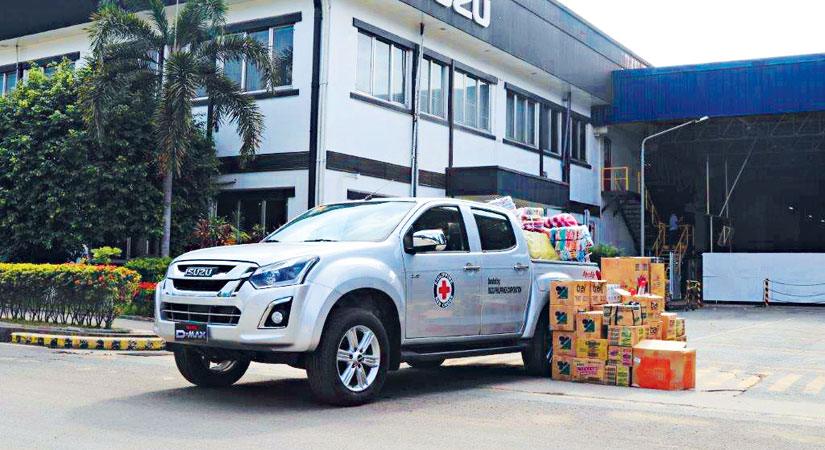
ISUZU PHILIPPINES Corporation (IPC) early this week donated one unit of Isuzu D-MAX 4×4 LS MT to the Philippine Red Cross (PRC), Laguna Chapter, at the IPC Plant in Biñan Laguna, for the Taal Volcano eruption relief efforts mobilization. Additional supplies were also provided such as bottled water, toiletries, clothes and other essentials to alleviate the condition of evacuees and affected individual.

The donation is earmarked to support Philippine Red Cross’s mission to provide life-saving services that protect the life of Filipinos in vulnerable situations.

IPC is delighted to be able to help bridge volunteers like PRC, and people affected by the Taal Volcano eruption.

During the interview, IPC Executive Vice-President Shojiro Sakoda said, “Isuzu D-MAX 4×4, being a utilitarian pickup, is surely essential in bringing relief goods and aiding victims of Taal Volcano eruption.”

The Isuzu D-Max 4×4 LS MT donated to Philippine Red Cross

“Isuzu D-MAX is a combination of power and performance and is equipped with Blue Power technology that can withstand any roads, from the toughest terrain to the slickest street all in style and comfort,” he added.

Local residents are encouraged to support humanitarian organizations and to do initiatives in helping the victims of the recent eruption.

For more information on Isuzu’s commitment to improving communities nationwide, visit www.isuzuphil.com.

Alphaland plans stock market return

ALPHALAND Corp. owner Roberto V. Ongpin is considering a return for the operator of Balesin Island Club to the stock market soon, its incoming president said.

Dennis O. Valdes told reporters last week that the five-year ban for Alphaland to list had been lifted last year, opening the opportunity for the company to return to the equity market as it seeks the expansion of Balesin.

“I think he wants to list again… I think he will re-list Alphaland this year or next,” he said, referring to Mr. Ongpin. “The five-year ban is done. He’s free to re-list. He’s just waiting for the right timing.”

Mr. Valdes is set to begin his role as president of Alphaland on Feb. 1, leaving his post in formerly Ongpin-led company PhilWeb Corp.

In 2014, Alphaland was involuntarily delisted from the Philippine Stock Exchange (PSE) for violating disclosure rules involving the company’s alleged “simulated sale” of shares to increase its public float.

But after more than five years, Mr. Valdes said he thinks “it makes sense for Alphaland to re-list,” as the company is also embarking on the expansion of its flagship Balesin Island Club in Polillo, Quezon.

In an April 2018 note signed by Mr. Ongpin on Alphaland’s website, he said the company had acquired 789 hectares of the Patnanungan Island close to Balesin Island Club, which he wants to turn into an airport to be called the Balesin International Gateway.

The project involves a 2.5-kilometer runway that can handle international flights, an aerodrome, a hotel, a championship golf course and hundreds of villas.

“Balesin Gateway will take us at least five years to complete, but it is an exciting project…,” Mr. Ongpin said in the note. Unlike the 500-hectare Balesin Island Club, Balesin Gateway will not be exclusive to members.

Mr. Valdes estimates the project to cost about P10 billion, which is why he signaled the timeliness of re-listing at the PSE to raise additional funding.

“I think Patnangunan is a huge deal… [I]t’s a huge development in an area of the Philippines that nobody has really invested in. So imagine if you had an airport there, at some point you’re bringing development to such an under-resourced area of the country. There’s got to be a lot of people who would benefit from that,” he said.

Aside from Balesin Island Club, Alphaland also owns Alphaland Makati Place, Alphaland Baguio Mountain Lodges and The Alpha Suites in Makati City. — Denise A. Valdez

Government probe of contracts drags down stock price of Ayala Corp.

THE government’s review of its contracts with diversified conglomerate Ayala Corp.’s units prompted investors to sell the stock, making it one of the most actively traded issues last week.

Data from the Philippine Stock Exchange showed a total of P1.32 billion worth of 1.82 million Ayala Corp. (AC) shares were traded from Jan. 20 to 24, making it the fourth most actively traded issue last week.

Ayala Corp. dropped 7.8% on a week-on-week basis to P740 per share last Friday from P803 apiece on Jan. 17. Since the start of the year, the stock is down 3.9%.

COL Financial Group, Inc. Senior Research Manager Richard G. Laneda said in an e-mail interview attributed the decline to the “negative investor sentiment” amid a proposed government review of its contract with Ayala-linked companies such as Manila Water Co., Inc., Ayala Land, Inc. (ALI), and Light Rail Manila Corp. (LRMC).

PNB Securities, Inc. President Manuel Antonio G. Lisbona shared this view, saying that “the current focus is on AC’s Ayala Land, Inc. (ALI), which was allegedly paying significantly lower lease rates to the University of the Philippines (UP) on the UP-Ayala Land Technohub.”

“ALI is responsible for 41% of AC’s income, thus if the allegations prove true, ALI’s income (and consequently AC’s) will be affected negatively,” he said in a separate e-mail interview.

In December last year, President Rodrigo R. Duterte threatened to file economic sabotage cases against water companies, which included Manila Water, over alleged onerous provisions in their contracts with the government. New contracts are being drafted by the government.

Meanwhile, Mr. Duterte said in a speech in Davao on Jan. 17 that separate companies led by Fernando Zobel de Ayala and Manuel V. Pangilinan were getting the most of their contracts with the government. Rep. Eric G. Yap filed a resolution last Monday that seeks to investigate the alleged onerous agreement between the government and LRMC.

Following this, LRMC, the operator of Light Rail Manila that operates the Light Rail Transit Line 1, last week said it was ready to cooperate with the government should it push through with an investigation into an alleged irregularity in its concession contract.

LRMC is a joint venture company of Pangilinan-led Metro Pacific Investments Corp.’s (MPIC) Metro Pacific Light Rail Corp., Ayala Corp.’s AC Infrastructure Holdings Corp., and the Philippine Investment Alliance for Infrastructure’s Macquarie Infrastructure Holdings (Philippines) PTE Ltd.

After Malacañang Spokesman Salvador S. Panelo floated the idea of a UP-Ayala Land Technohub contract review in a radio interview on Jan. 19, ALI said it welcomed a transparent review of its partnership with UP.

Mr. Panelo said on Tuesday that Mr. Duterte approved the review of that agreement.

Ayala Corp., the holding company of the Ayala group, has business interests in real estate and hotels; financial services and insurance; telecommunications; water infrastructure; electronics solutions and manufacturing; industrial technologies; automotive; power generation; infrastructure; health care; education; and technology ventures.

In the third quarter last year, the conglomerate’s net income attributable to equity holders of the parent company went up 6.8% to P8.32 billion, taking the nine-month tally to P46.16 billion.

For this year, COL Financial’s Mr. Laneda expects Ayala Corp. to reach a bottom line of P37.8 billion due to higher earnings from ALI, Globe Telecom, Inc., Bank of the Philippine Islands and AC Energy, Inc.

PNB Securities’ Mr. Lisbona sees the conglomerate to net P55 billion in 2020.

“This translates to an earnings per share of about P87.90 which works out to price to earnings ratio of 8.41 times at current price of P740 per share,” he said.

For this week, Mr. Laneda placed the stock’s support and resistance at P690 and P804, respectively.

Mr. Lisbona gave its support levels between P700 and P695.50 and resistance at P800. — Edwin C. Aruta, Jr.

ADVERTISEMENT
ADVERTISEMENT