Home Blog Page 9990

Stocks extend decline on Ayala group’s woes

By Denise A. Valdez, Reporter

THE MAIN INDEX continued its decline on Tuesday due to regulatory risks that are hounding the Ayala group.

The benchmark Philippine Stock Exchange index (PSEi) gave up 85.95 points or 1.13% to close at 7,466.65 yesterday, while the broader all shares index lost 39.56 points or 0.88% to 4,434.71.

“The market breached the 7,500 level despite foreigners becoming net sellers today, mainly due to index heavyweights AC (Ayala Corp.) and ALI (Ayala Land, Inc.) dragging the market with them as investors continued their selloffs because of President Duterte’s tirades against them over the weekend,” Timson Securities, Inc. Trader Darren T. Pangan said in a text message on Tuesday.

ALI and AC were two of the most actively traded stocks on Tuesday, with shares in each losing 2.47% and 4.67% at the close of the market, respectively.

This follows the government’s threat of probing the contract between ALI and the University of the Philippines for UP-Ayala Land Technohub in Quezon City due to alleged underpayment.

ALI said it is open to any review of the partnership, but it claims it is paying UP P171 per square meter per month, contrary to the statement of Presidential Spokesperson Salvador S. Panelo that the company is paying less than P20 per square meter.

Another factor that affected the market’s decline was Moody’s lowering of its ratings for Hong Kong to AA3 from AA2 amid concerns of political unrest due to continuous protests in the region.

“Philippine shares became collateral damage from Moody’s downgrading HK rating to AA3 from AA2 but changed outlook to ‘stable’ from ‘negative,’ citing the absence of tangible plans to address the concerns of the people,” Regina Capital Development Corp. Head of Sales Luis A. Limlingan said in a mobile message.

Other Asian markets also closed lower yesterday: Japan’s Nikkei 225 and Topix indices fell 0.91% and 0.53%, respectively, Hong Kong’s Hang Seng index collapsed 2.81%, China’s Shanghai SE Composite index slumped 1.41% and South Korea’s Kospi index shed 1.01%.

Back home, all sectoral indices remained losers, led by financials which dropped 28.55 points or 1.56% to 1,797.19. Holding firms declined 96.14 points or 1.31% to 7,214.76; services fell 14.22 points or 0.91% to 1,539.56; property reduced 25.68 points or 0.66% to 3,853.61; industrials erased 52.61 points or 0.56% to 9,313.72; and mining and oil decreased 15.51 points or 0.19% to 8,029.73.

Some 741.11 million issues valued at P7.76 billion switched hands yesterday from the 913.66 million issues worth P6.28 billion seen on Monday.

Decliners reached 132, outpacing advancers which stood at 67, while 38 names ended unchanged.

Foreigners turned bullish to record net purchases of P422.45 million, a turnaround from Monday’s net foreign selling of P512.9 million.

Peso drops ahead of GDP

peso dollar
THE PESO weakened further ahead of key local data. — BW FILE PHOTO

THE PESO continued to weaken on Tuesday due to uncertainties from regulatory risks and as the market awaits data on the country’s economic growth in the fourth quarter.

The local unit ended trading at P51.015 against the greenback, weakening by four centavos from its Monday finish of P50.975 per dollar.

The peso opened at its Monday close of P50.975 versus the dollar. Its weakest showing for the day was at P51.10, while its intraday best was at P50.975 against the greenback.

Dollars traded slipped to $1.35 billion from $1.559 billion on Monday.

A trader attributed the peso’s weakness to “cautious” trading before the gross domestic product (GDP) growth report this week.

“The peso depreciated above the P51 level as market participants remained cautious ahead of the Philippine GDP (gross domestic product) growth report this Thursday,” the trader said in an e-mail.

The Philippine Statistics Authority is set to report the fourth quarter and full-year 2019 GDP growth data on Jan. 23.

Economic growth quickened to 6.2% in the third quarter after logging a pace of 5.6% and 5.5% in the first and second quarters, respectively. This brought average growth for the first nine months to 5.8%.

The government targets at least a six percent GDP growth for 2019. Socioeconomic Planning Secretary Ernesto M. Pernia last week said GDP growth for the last quarter of 2019 might have ended around 6.6-6.7%.

Meanwhile, Rizal Commercial Banking Corp. Chief Economist Michael L. Ricafort said the peso depreciated alongside the decline in the local stock market due to some regulatory risks.

“The peso exchange rate closed the weakest in more than three weeks and in nearly three months after the recent regulatory risks,” he said in a text message.

“Peso [is] also weaker amid the latest decline in the local stock market, to new one-year lows for the PSEi (Philippine Stock Exchange index) still partly due to the regulatory uncertainties,” he added.

Ayala Land, Inc (ALI). and Ayala Corp. were two of the most actively traded stocks on Tuesday, with shares in each losing 2.47% and 4.67% at the close of the market, respectively.

This follows the government’s threat of probing the contract between ALI and the University of the Philippines for UP-Ayala Land Technohub in Quezon City due to alleged underpayment.

For today, the trader sees the peso playing around P50.90 to P51.10 while Mr. Ricafort gave a forecast range of P50.80 to P51.10. — L.W.T. Noble with Reuters

House may go over and above P30-B calamity budget request

REUTERS

THE HOUSE of Representatives said it will assign the “highest priority” to President Rodrigo R. Duterte’s request to fast-track approval of a P30-billion supplemental budget for communities affected by the Taal Volcano eruption, and signalled a willingness to provide even more.

“Under the leadership of Speaker Alan Peter Cayetano, we assure that the House of Representatives would give the highest priority to the request of President Duterte for Congress to fast-track the approval of a P30-billion supplemental budget for areas affected by the Taal Volcano eruption” House Majority Leader Ferdinand Martin G. Romualdez said in a statement Tuesday.

Mr. Romualdez also said that the House leadership is willing to increase the budget up to P50 billion “for the sake of our kababayans (countrymen) there.”

“The House is committed to show malasakit (compassion) and provide families displaced by the explosion of Taal Volcano long-term and permanent solutions to their woes. We are going to coordinate with the Palace to get the full details of the supplemental budget” Mr. Romualdez said.

Speaker Alan Peter S. Cayetano said that the chamber will work with the Department of Budget and Management (DBM) to pass the proposed supplemental budget and ensure “effective and responsive” execution of the relief program.

On Monday, President Rodrigo R. Duterte called on Congress to pass a P30-billion supplemental fund for the rehabilitation of communities affected by the Taal Volcano eruption and to build evacuation centers in high-risk areas. — Genshen L. Espedido

Senate studying how to fund supplemental budget for Taal aid

THE SENATE is verifying possible funding sources for the P30-billion supplemental budget after President Rodrigo R. Duterte sought to expedite emergency aid for local government units (LGUs) affected by the Taal eruption.

“We will have to find out how much is readily available in calamity funds of the national government, (the National Disaster Risk Reduction and Management Fund) and the (Local Disaster Risk Reduction and Management Fund),” Senator Panfilo M. Lacson, Finance Committee Vice Chairman, said in a statement Tuesday.

Mr. Duterte on Monday asked the 18th Congress to pass a supplemental budget to fund government efforts to provide relief from Taal.

Mr. Duterte also directed Congress to pass a measure for the construction of permanent evacuation centers in disaster-prone areas.

Mr. Lacson cited the Philippine Disaster Risk Reduction and Management Act of 2010, Republic Act No. 10121, which requires LGUs to allocate at least 5% of their income to the LDRRMF (Local Disaster Risk Reduction and Management Fund).

“Counting five years backwards from January 2020 when Taal erupted, as RA 10121 mandates that unexpended LDRRMF shall accrue to a special trust fund solely for the purpose of supporting disaster risk reduction and management activities of the LDRRMCs within the next five years, I can imagine they still have sufficient funds,” he added.

Senator Risa N. Hontiveros-Baraquel proposed that the supplemental budget earmark P30,000 worth of cash assistance to each family that sustained damage to their homes.

She said beneficiaries may be classified by the damage obtained by their houses, or as may be recommended by the rehabilitation plan the government is drafting. — Charmaine A. Tadalan

Over 214,000 Metro Manilans emerge from poverty in 2018

By Lourdes O. Pilar, Researcher

MORE THAN 200,000 Filipinos in Metro Manila made it past the poverty threshold in 2018, according to new data derived from poverty incidence estimates by the Philippine Statistics Authority (PSA).

In a news conference, the PSA’s National Capital Region (NCR) office announced further findings from the government’s poverty survey released in December, showing that around 214,200 Metro Manila residents exited the category of people classified as poor, as estimated from the decline in the poverty incidence rate to 2.3% from 4.1% in 2015.

Poverty incidence measures the proportion of those whose incomes fall below the poverty threshold.

The incidence rates suggest that in 2018, around 308,600 Filipinos in Metro Manila did not earn enough to buy basic needs, compared to 522,800 Filipinos in 2015.

Poverty incidence among Filipino families, or the proportion of those whose incomes fell below the poverty threshold, fell to 1.5% from 2.8% three years earlier. In 2018, this corresponded to around 48,400 Filipino families that remained poor, from 86,100 previously.

The subsistence incidence — or the proportion of those whose incomes fell below the monthly food threshold — fell to 0.4% in 2018 from 0.7% in 2015.

The subsistence incidence among families — or the proportion of those in extreme poverty — fell to 0.2% from 0.4%.

The food threshold is defined as the minimum income required to meet basic food needs and satisfy the nutritional requirements “for economically necessary and socially desirable physical activities.”

The poverty threshold is defined as the minimum income needed to meet basic food and non-food requirements.

The poverty threshold for a family of five in 2018 was P11,951 per month in Metro Manila, as compared to P10,495 per month in 2015.

Meanwhile, the monthly food threshold per family was P8,345 against P7,329 in 2015.

In an e-mail, UnionBank of the Philippines, Inc. Chief Economist Ruben Carlo O. Asuncion said economic growth was the “number one reason” for the decline in Metro Manila’s poverty incidence.

“Increasing incomes and more job opportunities have contributed to this decline in poverty incidence,” he said.

Mr. Asuncion noted that further poverty reduction in Metro Manila can be achieved if economic growth can average “higher than 6% or even 7% by 2021.”

“However, this should also be approached with caution regarding the quality of poverty reduction. Economic growth should be shared by as many as possible,” he said.

In a separate e-mail, Security Bank Corp. Chief Economist Robert Dan J. Roces cited “higher wage and salary incomes” due to better employment opportunities as the top contributor in reducing the NCR’s poverty incidence, as well as the “initial effects of tax reforms” that may have led to an increase in take-home pay.

Mr. Roces however noted that Metro Manila exhibits low growth elasticity in poverty reduction — meaning that the percentage reduction in poverty rates associated with changes in mean income do not closely align — with the region still suffering from “systemic difficulties” in alleviating poverty.

“[T]he poor and those in the threshold will be the first to suffer during high inflation periods, for instance… and absent financial inclusion and financial literacy, plus lack of social safety nets, income inequality might remain and the level of the poverty threshold will be a concern,” Mr. Roces said.

DA provides P2.7M worth of aid to farmers in 3 Batangas towns

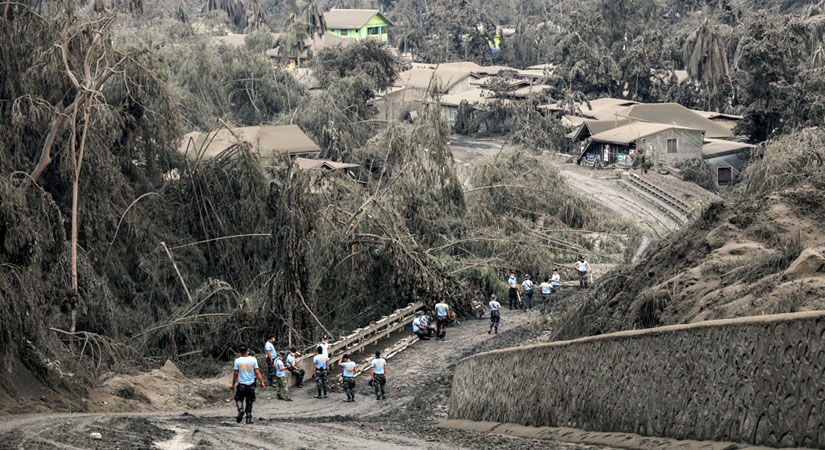
THE government has awarded an initial P2.708 million worth of assistance to farmers and fisherfolk in Batangas affected by the Taal ashfall.

“President (Rodrigo R.) Duterte and Agriculture Secretary William (D.) Dar awarded an initial P2.708 million worth of assistance including crop insurance, livelihood, seed and seedlings, and farm machinery, among other donations to the affected farmers and fisherfolk of Talisay, Tanauan, and Sto. Tomas,” the Department of Agriculture (DA) said in a statement Tuesday.

Some P160 million worth of assistance was also given elsewhere in Batangas, including Agoncillo, San Nicolas, Lemery, Laurel, Lipa City, San Jose, Nasugbu, Mataas Na Kahoy, Balete, Cuenca, Alitagtag, Padre Garcia, Malvar, and Taal.

The government is planning to put together a P30-billion package to respond to the damage caused by the Taal Volcano eruption.

The DA has said it will set aside P357 million from its Quick Response Fund for rehabilitation and recovery programs. The DA Field Office in Region IV-A also provided P22 million worth of assistance like equipment, seed, planting materials, and fingerlings.

Assistance amounting to P1.9 million was given by the Philippine Coconut Authority to affected coconut farmers, including seedlings and fertilizer. The Bureau of Plant Industry will also distribute coffee, cacao, mango, lanzones, rambutan, jackfruit, corn, squash, and cowpea seedlings.

The Agricultural Credit Policy Council will also provide P10 million for the use of the DA Taal Livestock Care Emergency Operations Center “to pay owners who wish to pawn their animals at 50% of their market value.”

Damage to agriculture due to the eruption and ashfall has been estimated at P3.33 billion, with the fisheries sector accounting for the about 50%. The damage counts 16,150 hectares of farmland, and caused the death of 55,881 farm animals. — Vincent Mariel P. Galang

Cold storage inspections authorized to control ASF

THE Department of Agriculture (DA) has instructed quarantine officers to inspect non-accredited cold storage warehouses and container vans to prevent the entry of African Swine Fever (ASF)-infected pork products.

“All Veterinary Quarantine Officer and Inspectors are hereby authorized to inspect all NMIS (National Meat Inspection Service) non-accredited private cold storage warehouses and container vans or any items that are possible carriers of the African Swine Fever virus at the ports of entry (1st border) and cold storage warehouses (2nd border),” the DA said in Memorandum Order No. 3, series of 2020.

The measure supports the National Zoning Plan authorized by Administrative Order No. 12, series of 2019, which sets guidelines for the movement of pork and pork products across the country, and Food and Drug Administration (FDA) Order No. 2019-183, which also authorizes designated officers from the NMIS and the Bureau of Animal Industry (BAI) to inspect all imported pork and pork products.

This order is in effect until Dec. 4, 2020, unless the FDA revokes the order earlier.

In October, branded and unbranded pork products were confiscated at Calapan Port in Oriental Mindoro, which tested positive for ASF. It was later confirmed that branded processed pork products were made by Pampanga-based Mekeni Food Corp.

Two cargo containers from China were also apprehended in the Port of Manila in the same month. These were declared to be containing tomato paste and vermicelli, but were later discovered to be containing meat products like dimsum, dumplings, and minced vegetables with meat.

The government has banned the entry of pork and pork products from countries suffering from ASF outbreaks, like China, Belgium, Bulgaria, Cambodia, Hungary, Laos, Moldova, Poland, South Africa, and Indonesia.

The BAI estimates the number of culled pigs at 147,334 as of Dec. 15, of which 18% or 26,077 head were confirmed to be infected by the virus. — Vincent Mariel P. Galang

WESM key to viability of new RE projects in Mindanao

By Carmelito Q. Francisco, Correspondent

DAVAO CITY — The attractiveness and viability of renewal energy (RE) investments in Mindanao depends in part on the operations of the wholesale electricity spot market (WESM), a Mindanao Development Authority (MinDA) official said.

MinDA Deputy Executive Director Romeo M. Montenegro, who also heads the technical working group of the Mindanao Power Monitoring Committee, said the WESM will serve as a key platform for selling green energy output, which enjoys priority status under the Renewable Energy Act of 2008.

“Cheaper RE is first scheduled for dispatch,” he explained.

The Independent Market Operator of the Philippines announced last year that WESM, which has been in place in Luzon and Visayas, is planned for opening in Mindanao on Jan. 26.

However, Mr. Montenegro said this “will continue to be a moving target because issues like the price cap have yet to be addressed.”

The Energy Regulatory Commission is in charge of setting the price cap.

As the WESM remains pending, Mr. Montenegro said the investment landscape will not be too favorable for RE projects given the current supply surplus and existing contracts signed by distribution utilities, particularly the electric cooperatives, with fossil-fuel plants.

“So who will buy (the RE output)?” Mr. Montenegro said.

Nonetheless, the MinDA official said the agency continues to push for RE projects with the expectation that WESM will soon be operational.

“It is important that we are able to balance the (energy) mix to preserve the environment,” Mr. Montenegro told BusinessWorld.

Mindanao currently has a daily surplus of about 1,000 megawatts, with the energy mix at 70-30 in favor of fossil fuel-powered plants.

The National Grid Corp. of the Philippines’ Mindanao-Visayas Interconnection Project is also expected to be completed this year, which will allow Mindanao power suppliers to participate in a nationwide WESM.

Mr. Montenegro also noted that demand in the southern islands is projected to continue increasing with economic growth.

“At the rate that Mindanao is growing, and at the rate of 7-8% annual demand increase for power in Mindanao, we’re looking at that excess… but that excess will not last long,” he said.

“As early as now, companies should start considering building new power plants to address the impending need.”

Ecozones’ contingency plans geared for heavier Taal ashfall

ECONOMIC ZONES are evaluating their disaster preparations in the event of further activity from Taal volcano, with the industry association considering the likeliest scenario to be more ashfall.

Philippine Ecozones Association (PHILEA) President Francisco S. Zaldarriaga said in a mobile phone message Tuesday that the association “can expect merely heavier ash fall and if at all — small projectiles to reach our parks.”

He said this assessment is based on a Philippine Institute of Volcanology and Seismology (Phivolcs) briefing for locators and industry stakeholders organized by the Philippine Economic Zone Authority on Monday.

Mr. Zaldarriaga told reporters Monday that evacuation plans will depend on the intensity of ash fall and projectiles from the volcano.

“Apart from… cleanup, (locators are organizing) a plan for a level-5 situation. You really just have two options. One is to evacuate immediately, or two is to stay put.”

A level-5 alert denotes an ongoing explosive eruption. The current alert level for Taal is 4, signifying imminent danger of a stronger eruption.

“Evacuation, if you are allowed, seems to be the most logical. But if there are projectiles, you know those things move at 150 miles per hour,” he said.

He said PHILEA is not considering evacuating in advance.

For now, the association is sharing best practices in preparation for Phivolcs alert level 5.

“We are hoping that in spite of the level of preparedness we are programming ourselves that we will not need to implement,” Mr. Zaldarriga said in the text message.

PHILEA members closest to the volcano include Lima Technology Center and First Philippine Industrial Park, Inc., in Batangas. Both are outside the 14 kilometer high-risk zone.

Mr. Zaldarriaga said ecozones have returned to operation after the initial phreatic eruption. — Jenina P. Ibañez

DoF touts auction for sugar imports

THE Department of Finance (DoF) said it is studying an auction scheme to replace the current system of sugar imports.

“The import system has several issues that need to be addressed. The first one is the transparency of the system itself… instead of deciding on the amount and the volume and who will receive the permits baka pwede auction na lang (maybe an auction is the better system),” Finance Assistant Secretary Antonio Joselito G. Lambino II told the House Committee on Agriculture and Food, which was discussing proposals to liberalize the sugar industry Tuesday.

He said the transparency issue can be addressed via auctions because the bidding process can be open, disclosing the bidders’ identities and offers, as well as the import volumes awarded.

“The decision on how much volume will come in is (currently) made by a few people (who) are trying to outsmart the market… but if we let the market help us decide through an auction system, baka mas magiging efficient (it might be more efficient),” he said.

Sugar imports must pay a 5% tariff under the ASEAN Trade in Goods Agreement (ATIGA.)

Mr. Lambino said auctions are one option that the DoF is considering, but others are geared towards achieving more transparency in import permits.

The National Economic Development Authority (NEDA) said that it will conduct a study to evaluate Thai sugar prices and the competitiveness of leading sugar-producing regions like Negros Occidental.

During the committee hearing, House Resolutions 412 and 439 were also approved, seeking to investigate the impact of sugar import liberalization on the industry and economy. — Vincent Mariel P. Galang

Local governments at the front lines of UHC implementation

FORTY-FIVE-year-old Melodina Hugo is the go-to person when family members and relatives, especially those from the remote Paquibato district, get seriously sick and need to be brought to the Southern Philippines Medical Center (SPMC) in Davao City, the biggest government-owned hospital in Mindanao.

Her know-how of the ins and outs of public health services stems from her sad experience of losing her husband, who was a security guard, in 2009.

He died of prostate cancer, which was already at a late stage when diagnosed.

“That was hard,” she said in an interview, speaking in mixed Visayan and Filipino, “Going back-and-forth to the hospital, sourcing financial assistance, but it was too late for a surgical procedure.”

As a stay-out housekeeper in the city for many years now, she enjoys work schedule flexibility, making her available for emergency situations or to keep watch of a patient overnight, or spend a whole day gathering documents and processing monetary assistance.

There are many funding sources, she says, such as the offices of local government officials and even senators, and the Philippine Charity Sweepstakes Office (PCSO).

But the first place she goes to is the Davao City Lingap Para sa Mahirap center — a program launched in 2001 by then mayor and now President Rodrigo R. Duterte for medical and hospitalization assistance, food supplements, and funeral services to residents, especially indigents and members of the indigenous people communities.

From a small office at city hall, the program now has its own building inside the SPMC that serves as a one-stop-shop for assistance, housing other agencies such as the PCSO and the Department of Social Welfare and Development.

The Lingap program is the model for the Malasakit Center Act, signed by Mr. Duterte in December last year, which mandates the establishment of a similar help desk in all hospitals run by the Department of Health (DoH).

It is intended to complement the Universal Health Care (UHC) law, also passed last year, that automatically makes all Filipinos members and entitled beneficiaries of the Philippine Health Insurance Corp. (PhilHealth).

Implementation of the UHC starts this year, but will not yet be nationwide.

Coverage will initially be in five out of 145 cities (Valenzuela, Parañaque, Dagupan, Baguio, and Cagayan de Oro) and 28 out of 81 provinces (Benguet, Isabela, Nueva Vizcaya, Quirino, Bataan, Tarlac, Batangas, Quezon, Oriental Mindoro, Masbate, Sorsogon, Aklan, Antique, Guimaras, Iloilo, Cebu province, Biliran, Leyte, Samar, Zamboanga del Norte, Misamis Oriental, Compostela Valley, Davao del Norte, Sarangani, South Cotobato, Agusan del Sur, Agusan del Norte, and Maguindanao).

Department of Health Davao Region Director Anabelle P. Yumang said the UHC implementation involves the “managerial integration of province-wide and city-wide systems” within the first three years, and “financial integration” within the next three.

“Because the LGUs (local government units) still need more funds to ensure proper installation and implementation of the integrated health system, to ensure health systems at the local level are more focused, strategically-planned,” she told BusinessWorld.

She said with UHC, the LGU programs can take care of medical costs that are not covered under the PhilHealth system.

PhilHealth’s National Health Insurance Program for UHC guarantees the following: immediate eligibility, no co-payment in basic or ward accommodation, co-payment/co-insurance for amenities in public hospitals, no reduction in current PhilHealth packages, and additional benefits for direct contributors.

Ms. Yumang also said that UHC is not just about access to medical services but making all Filipinos “health literate” in terms of lifestyle, avoiding risks, and knowing that they do not have to suffer the added burden of “financial hardship” in times of sickness.

OUTBREAK
The weaknesses in the health care system become even more pronounced during epidemics, such as in the dengue outbreak last year.

Among the areas with the highest number of cases was the Western Visayas Region, particularly Iloilo province, which has a population of about 2.4 million in 42 towns, Passi as the lone component city, and Iloilo City as an independent city.

Mayor Francis A. Amboy of Maasin, categorized as a 3rd class municipality and one of the most affected towns, recalled the local government’s struggle to respond to the increasing dengue patients at the rural health unit (RHU), which has limited facilities, supplies, and manpower.

“Our RHU cannot accommodate the surge of patients… We also lacked funds to finance the laboratory and monitoring of the patients,” Mr. Amboy told BusinessWorld.

Maasin, home to about 40,000 people, has no hospital. Four died during the dengue outbreak.

One of the response measures taken by Maasin and other towns was setting up temporary medical facilities such as a hydration area in basketball courts and other covered public buildings.

The regional DoH office also sought an arrangement with private hospitals — equally overflowing with patients — to accommodate the more critical ones endorsed by the government hospitals and health units.

Health Secretary Francisco T. Duque III, during his visit to Iloilo at the height of the outbreak in August, said the dengue epidemic is a kind of test on how well local systems can execute UHC.

“UHC is always in the context of the network of service delivery from the barangay health centers to rural health units to city health centers, community, district levels, provincial hospitals linking to your medical center, and all the way to your apex. How well you are doing in the lower delivery of units will be an indicator of how burdensome it will be for your mid and upstream delivery units,” Mr. Duque said.

With this year’s UHC rollout that includes Iloilo, DoH-Western Visayas Assistant Regional Director Dr. Julia Z. Villanueva said households will now be assigned a “primary health care provider,” which would be the front-line unit.

“The primary health care provider (such as RHUs) will navigate the patients or the residents to their needed health care, whether on secondary or tertiary hospitals,” she told BusinessWorld.

With a structured referral system, Ms. Villanueva said, the crowding at hospitals and other facilities like what happened during the dengue epidemic will likely be prevented.

“The outbreak created a panic and people with suspected dengue symptoms rushed to the hospitals and clinics to get tested, and those who tested positive demanded to be admitted in the hospitals when, in fact, they can just be treated in the hydration unit. This kind of referral system will be corrected with the UHC because instead of going directly to hospitals, they will have to be assessed first by their primary care provider,” she said.

“All the municipalities will become a member of a provincial health care network or health system,” she added.

Ms. Villanueva said one of the challenges the department foresees at the local level is the cooperation of leaders.

“There may be indifferences, and mayors might not cooperate with the creation of the network,” she said.

Mr. Amboy, whose two daughters were among the dengue patients, said he will definitely be supporting the UHC.

“We are very willing to cooperate. All the residents should have access to health care. They should be provided with the needed health services,” he said.

As of mid-December, the dengue outbreak alert in Western Visayas was still ongoing.

The region recorded 51,233 dengue cases with 219 deaths as of Oct. 14.

Ms. Hugo, for all her experience in the workings of the Philippine public health care system, has never heard of UHC.

When told about it during the interview, her reaction was a mixture of awe and skepticism.

“There is such a program? Can they do that? Won’t SPMC go bankrupt?” she asked.

At the same time, she said the improvements she has seen over the years at SPMC in terms of facilities and service — as well as the recent establishment of a Botika ng Bayan (government pharmacy dispensing free medicines) in her remote hometown of Paquibato — makes her cautiously optimistic that a comprehensive health care system could eventually be a reality.

Pasensya lang (We just need patience),” she said, the one main virtue she has learned from getting public medical services.— Marifi S. Jara, Maya M. Padillo and Emme Rose S. Santiagudo


Consumer financial protection bill filed in House

A LEGISLATOR has filed a bill seeking to provide a regulatory framework for consumer financial protection and to institutionalize the Bangko Sentral ng Pilipinas’ (BSP) Financial Consumer Protection Department.

Rep. Jose Maria Clemente S. Salceda of Albay, who is also the Chairman of the House Committee on Ways and Means, filed House Bill 5976 Tuesday, which if passed will be known as the Comprehensive Consumer Financial Protection Act.

The bill retains the basic framework included in House Bill 9054 filed during the 17th Congress which could give financial regulators the abilities of rulemaking, surveillance and inspection, market monitoring, and enforcement powers relative to consumer protection.

House Bill 9054 was passed in the House of Representatives during the 17th Congress but was not ultimately enacted into law.

In addition to the framework, the bill also seeks to create the Financial Stability Oversight Coordinating Council (FSOCC) “which shall be a body for coordination among the regulators to address all potential threats to the financial system and provide a broader, inter-agency venue for financial stability.”

“The FSOCC will also expand the reach of our prudential laws to ensure that our regulatory structures are not limited by the lack of jurisdiction of the Monetary Board. The FSOCC will also empower the Monetary Board to regulate firms which the Council deems to be significant enough to impact the country’s financial stability” Mr. Salceda said in the bill’s explanatory note.

The measure also seeks the institutionalization and expansion of the Financial Consumer Protection Department to enforce “fair and truthful lending” and mandate the coverage of non-depository institutions.

Meanwhile, to protect investor rights and boost investor confidence, the bill also seeks to create the Office of the Investor Advocate which will be under the Security and Exchange Commission.

Mr. Salceda said that the bill complements other fiscal, economic and financial reforms, particularly the Corporate Income Tax and Incentives Rationalization Act (CITIRA), the Passive Income and Financial Intermediaries Tax Act (PIFITA), the Virtual Banking Act, and the amendments to the Public Services Act (PSA), the Foreign Investments Act (FIA), and the Retail Trade Liberalization Act (RTLA).

CITIRA aims to gradually cut the corporate income tax rate to 20% from the current 30%, was approved on third and final reading at the House of Representatives on Sept. 13. It is also one of the four packages of the Comprehensive Tax Reform Program (CTRP).

PIFITA is also one of the packages under the CTRP which was passed by the House on third reading in September.

The measure aims to decrease the tax rates on interest income from savings and short-term deposits to 15% from the current 20%. Tax rates on interest income from foreign currency deposits and long-term deposits will also be lowered to 15%.

Mr. Salceda filed the Virtual Banking Act on Jan. 6 which seeks to provide a regulatory framework for virtual banks.

FIA was passed by the House in September, while the PSA and RTLA are still pending at plenary level.

“With the increase in investments (especially retail investments) that these reforms will trigger, this representation sees the need for a financial services regulatory framework that not only deals with current gaps for current problems, but also proactively anticipates future issues in the financial sector” Mr. Salceda said. — Genshen L. Espedido