Home Blog Page 9821

HSA, AMLA amendments sought

THE ANTI-MONEY Laundering Council (AMLC) has urged lawmakers to speed up the passage of the amendments for the Anti-Money Laundering Act (AMLA) and the Human Security Act (HSA) which are among the “most difficult” for the recommended actions to avoid being re-included in a global dirty money watch list, according to AMLC Executive Director Mel Georgie B. Racela.

“We likewise clarified that we don’t only need to pass the laws, we also have to demonstrate effective implementation, so deadline of October 2020 on the amendments of these laws is not merely for legislation but includes implementation,” Mr. Racela said in a text message on Friday.

The country has been subjected to a 12-month observation period that ends in October to implement the recommendations to improve anti-money laundering (AML) and counter-terrorism financing (CTF) measures in the Mutual Evaluation Report (MER). After which, the country will then be required to submit a comprehensive progress report to the Asia/Pacific Group on Money Laundering (APG).

Failure to comply to the required reforms could endanger the country to again be a part of the list of high risk and non-cooperative countries in terms of AML and CTF measures.

The AMLC has previously said the revisions to AMLA and HSA should be effective by June 2020 to provide room for implementation before the observation period ends in October.

Mr. Racela said AMLC has sought the support of Senate President Vicente C. Sotto, III and House Peter Alan Peter S. Cayetano to fast-track the passage of the two bills.

The bill to revise HSA, House Bill (HB) 7141, has been pending with the Committee on Public Order and Safety since March 2018. Meanwhile, its counterpart at the Senate, Senate Bill 2204, is on second reading and its period of sponsorship as of Feb. 6.

Meanwhile, amendments to the AMLA under HB 6174 is pending with the Committee on Banks and Financial Intermediaries as of Feb. 5. In the Senate, no bill on the amendments has been filed.

Mr. Racela added that the “conviction of terrorist financiers” is also among the “most difficult” in the recommended actions by the MER.

“As for amendments to bank secrecy, we were rated largely compliant in this area so this is not included in our priority actions,” Mr. Racela said.

Among the key revisions in the AMLA under the filed bill are the enhancement of investigating measures that could be done by the AMLC through subpoena power, and including tax related to tax evasion and terrorism financing under AMLA. — L.W.T. Noble

Victoria’s Secret’s challenging makeover

VICTORIA’S SECRET has finally found its angel.

Parent L Brands Inc. said on Thursday that it would sell a controlling stake in Victoria’s Secret to private equity firm Sycamore Partners in a deal that values the lingerie brand at an enterprise value of $1.1 billion.

It’s the end of an era in more ways than one. L Brands is giving up control of its prized asset, once famous for its opulent catwalk shows.

Leslie Wexner will also step down as chairman and chief executive officer of the group. He is the longest-serving CEO in the S&P 500 Index but had drawn attention for his association with the late financier Jeffrey Epstein.

Under the terms of the deal, Sycamore would acquire 55% of the Victoria’s Secret for $525 million, with L Brands retaining 45% of the separate company, which will also contain the younger Pink division.

The transaction values Victoria’s Secret’s total enterprise value at 0.15 times its $7.4 billion of sales in the year to February 2019. That is well below the average of 1.3 times for apparel deals in the last three years, according to Bloomberg data. Shares of L Brands dropped nearly 7 percent when the market opened Thursday morning.

The valuation reflects the fact that Victoria’s Secret is expected make little or no operating profit in the year ended Jan. 31, compared with $1.4 billion in fiscal 2016.

OUT OF FASHION
The sale underlines just how badly the brand has been hurt by many consumers turning their backs on sexy lingerie, preferring more casual and functional underwear and brands that are more inclusive of different body shapes. Comparable sales fell a worse-than-expected 12% in November and December.

The new majority owner will need to invest heavily in revamping Victoria’s Secret’s image and will also need to close a swath of its about 1,200 stores. Although L Brand has tweaked its portfolio, it has resisted the large-scale culling favored by many rivals.

But there is potential for a revitalized chain. For all its challenges, Victoria’s Secret remains America’s biggest lingerie retailer by market share, according to Bloomberg Intelligence. There are more opportunities in beauty and fragrance, not to mention athletic apparel.

A full sale would have been cleaner than a partial one and more helpful to L Brands’ roughly $4 billion of net debt. But retaining a minority stake allows it to share in any potential upside. What’s more, its continued presence should help prevent Victoria’s Secret from alienating its core customers as it rejuvenates. This is a delicate balance that must be managed. But the new owner must also have the freedom to make the necessary but painful changes. At least it will be able to do so away from the scrutiny of quarterly earnings.

In the meantime, the deal will leave L Brands focused on Bath & Body Works, the seller of candles, home fragrances and body care products, which has been thriving.

Assuming roughly $1 billion of value from the transaction and Bernstein’s estimate of Bath & Body Works’ enterprise value of $11.4 billion, after subtracting the net debt, the equity would be worth about $8 billion, ahead of the market capitalization of $6.8 billion as of Wednesday’s close. The shares have risen about 35% so far this year.

But there is a risk that Bath & Body Works won’t be able to sustain its stellar sales growth, given that its 1,700 stores are not immune from the pressures on malls. At least without the drain of Victoria’s Secret, L Brands should have more capacity to ensure this division doesn’t lose its eucalyptus-scented way. — Bloomberg

Malaysia to implement B30 biodiesel mandate in transport sector before 2025

KUALA LUMPUR — Malaysia will implement a B30 biodiesel program in the transport sector by 2025 or even earlier, Prime Minister Mahathir Mohamad said on Friday at the launch of the country’s National Automotive Policy plan.

The policy will provide supporting measures including the development of testing and research standards to facilitate the adoption of biodiesel with a 30% palm oil content, Mahathir said.

Malaysia’s primary industries ministry has previously said it plans to test a B30 program in June. — Reuters

Dashboard (02/24/20)

Toyota Motor Philippines welcomes new president

TOYOTA MOTOR Philippines Corporation (TMP) formally introduced Atsuhiro Okamoto as its incoming president in a ceremonies witnessed by members of the business community and the media at the Grand Hyatt Manila. The event highlighted TMP’s successes in the past four years under the leadership of president Satoru Suzuki, and presented a glimpse of how Toyota will transform into a mobility company, which aims to improve people’s daily lives through various mobility solutions.

Suzuki left the helm on a high note with TMP’s achievement of record-breaking market share of 39.5% and 18th consecutive Triple Crown by end-2019. TMP’s business also grew with the introduction of new Toyota models and the expansion of its distribution network nationwide, with additional 23 dealers, to better serve the needs of the market. In his farewell speech, Suzuki thanked Toyota customers who put their trust in the brand, saying, “You are the reason for Toyota’s passion to be always better.”

For his part, TMP Chairman Alfred V. Ty thanked stakeholders for their support to Toyota’s business in the Philippines for over 30 years. Ty underscored Toyota’s sustained commitment to nation building, especially through local automotive manufacturing. “Because of your unwavering support and friendship, we have been able to remain true to our promise of service to the Filipino and the Philippine nation,” Ty said. In his message, Ty highlighted TMP’s investments under the Government’s Comprehensive Automotive Resurgence Strategy or CARS program, which already reached P5.42 billion, enabling transfer of technology, employment generation and skills development, among others. Ty also thanked the government for the CARS because it gave Toyota an indispensable role in enhancing the industrial and manufacturing capability of the country.

Globally, Toyota is transforming into a mobility company, stemming from Toyota Motor Corporation President Akio Toyoda’s direction. Toyota’s concept of the automobile is said to continue to change in the current era of innovations, particularly in terms of connectivity, automation, shared mobility, and electrification.

With such new technologies, Toyota aims to develop communities that are not just centered on “cars” but on “people.” In the Philippines, where the population is huge and the economy is fast-growing, mobility needs will continue to evolve and become vital to socioeconomic development.

Leading TMP’s path towards offering new mobility solutions is incoming TMP President Atsuhiro Okamato. “As TMP’s new president, I would like to reiterate to all TMP team members, dealers and suppliers alike, the importance of dedicating our work to contribute to society. We will continuously do so by providing ever better cars and services to enhance the quality of life of Filipinos.” Okamoto said in his speech.

A graduate of Keio University, Okamoto started his career at Toyota Motor Corporation in 1992. He has gained a rich marketing experience handling Toyota and Lexus brands in the past 28 years. His former assignment as executive vice-president of Toyota Motor Asia Pacific, likewise, gave him a closer understanding of the ASEAN market and the Philippines.


The Porsche Taycan is touted as the world’s first fully electric sports car.

Porsche sales up 10% in 2019

STUTTGART-HEADQUARTERED car maker Porsche registered a 10% increase in sales last year compared to 2018 figures, selling 280,800 vehicles worldwide.

The performance was largely a result of the strong sales of the Porsche Cayenne and Macan sport utility vehicles. The Cayenne, made available last year in a sportier form called the Cayenne Coupé, moved 29% more vehicles last year (92,055 units in total) than the previous year. For its part, the Macan emerged as Porsche’s best-selling model with worldwide deliveries of 99,944 units, a 16% increase versus 2018.

Said Detlev von Platen, board member for sales and marketing at Porsche AG, “We are pleased with this strong result, which shows the worldwide customer enthusiasm for our sports cars, and are also proud that we have further strengthened the radiance of our brand and the customer experience with new approaches.”

The executive added that Porsche is “optimistic” it can “maintain the high demand in 2020,” citing the company’s planned introduction of new models, as well as the “full order books for the Taycan.”

The all-new Porsche Taycan is the world’s first fully electric sports car already into volume production. There are three versions of the four-door model available: Taycan Turbo S, Taycan Turbo and Taycan 4S. The first batch of vehicles is set to arrive in the first half of the year in markets across the globe, including the Philippines.

Last year, Porsche saw its strongest growth pace in its home market of Germany, as well as in Europe as a whole, where sales of its models rose 15%. A total of 31,618 units were sold in Germany and 88,975 units in combined European markets during a 12-month period.

Mirroring this uptrend was the pace of sales in China and the US, two of Porsche’s largest markets in terms of volume. It registered an eight-percent increase there, “defying a slump in these economies,” according to a Porsche release. The car maker sold 86,752 units in China and 61,568 units in the US.

Porsche deliveries in Asia-Pacific, Africa, and the Middle East totaled 116,458 vehicles, up seven percent over 2018.

Shares seen steady on firms’ earnings reports

By Denise A. Valdez
Reporter

LOCAL SHARES are seen to move in a stable range this week, with major catalysts being the release of corporate earnings and developments in the outbreak of the coronavirus disease 2019 (COVID-19).

The 30-member Philippine Stock Exchange index (PSEi) closed lower on Friday at 7,369.78, down 43.22 points or 0.58% from the previous session. But it was higher by 1.21% on a weekly basis, a reversal of the drop seen a week ago.

Value turnover also rose 1.4% to P6.13 billion despite foreign investors turning sellers with an average net selling of P250 million last week from a net buying of P163 million the week prior.

“Markets found comfort in Beijing’s message over the week, which communicated that virus control efforts ‘are working.’ Thus, coming from a deep selloff (the previous week), the bellwether index made an 87-point jump to close the week at 7,369,” online brokerage 2TradeAsia.com said in a market note.

This week, the scheduled release of full year 2019 earnings of some listed firms is seen to be a major driver of the market.

“We’re expecting the market to move sideways within 7,200 and 7,500 range as COVID-19 worries linger in the market… (On) a positive note, anticipation of FY2019 corporate earnings result may lift sentiment along with the month-end window dressing,” Philstocks Financial, Inc. Research Associate Claire T. Alviar said via text.

2TradeAsia.com pointed to the same catalyst, noting that those scheduled to release their earnings this week comprise 25% of the PSEi basket — Manila Electric Co.; Metro Pacific Investments Corp.; BDO Unibank, Inc.; and SM Investments Corp.

“So far, average 2019 EPS (earnings per share) growth for companies that have reported as of Feb. 21 (six firms, 32% of PSEi basket) is at 14.7%. With participants in ‘earnings mode’, corporates will likely have to clarify growth expectations, especially in the context of COVID-19 and Taal eruption impact, among others,“ it said. It noted that its weighted average EPS growth estimate for 2020 is 10%.

“As the macro picture awaits more cogent policies to counter COVID-19’s economic impact, corporate watches will continue to heed for capex (capital expenditure) and earnings feelers for 2020, and from there weigh whether ‘hope springs eternal’ amid the noise,” 2TradeAsia.com said.

Philstocks Financial’s Ms. Alviar said the market may record weaker volume this week due to the shortened trading due to Tuesday’s holiday. But 2TradeAsia.com said it may eventually increase later in the week.

“Volume scenario in the coming week may be characterized by a crescendo, with a holiday early in the week possibly thinning out turnover, before later finding momentum on funds’ window dressing,” it said. “As such, brace for volatility, as the index finds composure near the next hurdle at 7,500.”

The brokerage put immediate support at 7,200-7,300 and resistance at 7,400-7,500.

India allots import licenses for Indonesia refined palmolein

MUMBAI/NEW DELHI — India has issued import licenses for 1.1 million tonnes of refined palmolein from Indonesia, government and trade sources told Reuters, a move that has surprised the industry as only last month New Delhi restricted imports of the commodity.

A resumption in refined palmolein buying by India, the world’s biggest palm oil importer, could lift its total palm oil imports and support Malaysian palm oil futures FCPOc3, which have corrected a fifth from a three-year high hit in January.

India put refined palm oil and palmolein on the list of restricted items on Jan. 8, a move sources said was retaliation against top supplier Malaysia after its criticism of actions in Kashmir and a new citizenship law.

The move prompted traders to seek permission from the Directorate General of Foreign Trade (DGFT) to import refined palmolein, and the commerce ministry’s wing received more than 100 applications for licenses.

The DGFT has issued import licenses for 1.1 million tonnes of refined palmolein to traders based on their applications, a government official and three traders told Reuters.

New Delhi has given permission to import refined palmolein only from Indonesia, a government official said.

In the second week of January New Delhi privately urged palm oil importers to boycott Malaysian products after Prime Minister Mahathir Mohamad criticized India’s actions in Kashmir and its new citizenship law.

In their application importers were required to mention “country of origin” and all specified Indonesia, said one trader who received a license.

“I don’t know anyone who mentioned Malaysia as the country of origin. I know a few others who mentioned Indonesia,” the trader said.

HUGE VOLUME
The allocation of licenses surprised the industry and senior officials of the commerce ministry.

“Allowing large-scale imports of refined palmolein defeats the purpose of putting the commodity in the restricted list for imports,” said B.V. Mehta, executive director of trade body the Solvent Extractors’ Association (SEA), which is based in Mumbai.

India’s edible oil industry has been seeking import curbs on refined palm oil to boost local refining.

At a meeting with industry officials on Wednesday, a senior official of the commerce ministry expressed displeasure at allowing large-scale imports of refined palm oil, and asked DGFT officials not to allocate more licenses, said a trader who attended.

A rally in edible oil prices in the last few weeks prompted New Delhi to examine changes in the import policy, said another government official.

India’s commerce ministry did not respond to a request for further information

New Delhi’s palm oil imports in January fell 27% from a year ago to 594,804 tonnes, partly due to the restriction on imports of refined palm oil, the SEA said in a statement.

India imported 9.4 million tonnes of palm oil in the marketing year that ended on October 31, including 2.72 million tonnes of refined palm oil.

Palm oil makes up nearly two-thirds of India’s total imports of edible oil. It buys palm oil mainly from Indonesia and Malaysia, which are the world’s top and second biggest producer of the commodity respectively. — Reuters

Gov’t debt yields drop on BSP bets

YIELDS ON government securities (GS) went down last week after the Bangko Sentral ng Pilipinas (BSP) signaled another rate cut as early as the second quarter.

GS yields, which move opposite to prices, dropped by an average of seven basis points (bps) week on week, according to Philippine Dealing System’s PHP Bloomberg Valuation Service Reference Rates published on Feb. 21.

“Sentiment was renewed when BSP Gov. [Benjamin E. Diokno] hinted [on Feb. 14] that they might resume their rate cut cycle as early as Q2. Looks like this is a lot earlier than expected, hence the strong buying across all tenors that carried over to [last] week,” Carlyn Therese X. Dulay, Security Bank Corp. first vice-president and head of Institutional Sales, said in an e-mail interview last Friday.

“Apart from that, the 10-year auction was surprisingly very strong and US treasuries continue to rally towards multi-month lows (US 10-year hit 1.44% last August 2019 and it looks like it’s going there now),” she added.

For his part, ATRAM Trust Corp. Head of Fixed Income Jose Miguel B. Liboro said in separate e-mail interview: “Trading volumes have seen a dramatic increase over the last three weeks, showing clear and consistent buying interest across tenors,” citing the Bureau of the Treasury’s (BTr) full award of its reissued 10-year paper offering last Tuesday.

“Market optimism has surged with the supply overhang of the RTB (retail Treasury bonds) lifted, inflation anticipated to stabilize at the 3.0% level and the BSP looking to cut policy rates further this 2020,” he said.

On Feb. 14, the BSP chief said the Monetary Board (MB) might trim key policy rates by another 25 bps as early as the second quarter or the latter half of the year to rein in the possible effects of the coronavirus disease on the economy.

This came after the MB implemented a 25-bp cut to its key rates to a range of 3.25-4.25% on Feb. 6.

The decision followed the 75-bp easing that took effect last year, partially dialing back the 175 bps rate increasing in 2018 to curb the rising inflation expectations.

The central bank also revised its inflation outlook for this year to three percent from 2.9% previously, while maintaining a 2.9% inflation forecast for 2021 — still within the 2-4% target range.

Meanwhile, the BTr fully awarded the reissued 10-year Treasury bonds (T-bonds) worth P30 billion it auctioned off on Feb. 18.

The offering was more than twice oversubscribed, with total tenders reaching P83.5 billion, prompting the Treasury to open its tap facility for another P15 billion.

The average rate for the 10-year debt was lower by 20.8 bps at 4.409% from the 4.617% average yield fetched during the Nov. 12 offering.

Earlier this month, the government raised P310.8 billion — P250 billion in fresh funds and P60.8 billion from the exchange offer program — from its three-year RTB offering.

The BTr has set a P420-billion local borrowing program this quarter, divided into P240-billion Treasury bills and P180-billion T-bonds.

The government eyes to raise P1.4 trillion this year from local and foreign lenders to seal off its budget deficit, which is expected to widen to as much as 3.2% of the economy.

Yields on benchmark tenors fell across-the-board last Friday against the week-ago finish with three-month, six-month, and one-year Treasury bills (T-bills) dropping 9.9 bps, 2.9 bps, and 3.5 bps, respectively, to 3.100%, 3.420%, and 3.869%.

Rates on two-, three-, four-, five-, and seven-year T-bonds declined by 7.4 bps, 7.9 bps, 8.8 bps, 8.7 bps, and 5.4 bps, respectively, fetching 3.943%, 4.061%, 4.131%, 4.184%, and 4.279%.

Yields on 10-, 20-, and 25-year papers likewise edged lower by 3.5 bps, 11.2 bps, and 7.6 bps, respectively, to 4.352%, 4.857%, and 4.929%.

For this week’s trading, Mr. Liboro sees a “slight pause” in profit taking as GS yields continue to “grind lower over the longer term.”

“However, while inflation remains a risk, given the readiness of the BSP to continue easing policy and the trend in the region of neighboring central banks who have expressed similar sentiments, rates appear poised to continue to grind lower over the longer term,” he said.

“We’ll have T-bills again [this] week but in any case, these will definitely be issued 5-10 bps lower given the move [last] week,” Security Bank’s Ms. Dulay said.

The government will issue P20 billion worth of T-bills today. Broken down, the Treasury will offer P6 billion in 91-day debt, P6 billion in 182-day papers, and P8 billion worth of 364-day notes.

“Apart from that, no drivers on the local front so we can expect yields to trade within range and maybe follow moves in US Treasuries,” she added. — Mark T. Amoguis

Investors sell MacroAsia shares after award of Sangley airport project

By Lourdes O. Pilar
Researcher

INVESTORS sold MacroAsia Corp. shares following news of the company, along with its Chinese partner China Communications Construction Co. Ltd. (CCCC), being awarded the contract to develop Sangley airport in Cavite.

A total of 24.91 million MacroAsia shares worth P272.41 million were traded from Feb. 17 to 21, data from the Philippine Stock Exchange showed.

MacroAsia shares closed at P10.02 apiece on Friday, down 9.73% from P11 a week ago. Year to date, the stock’s share price is down 40.7%.

In an e-mail, Unicapital Securities, Inc. Technical Analyst Cristopher Adrian T. San Pedro attributed MacroAsia’s stock movement last week to investors reacting to the news on the awarding of the $10-billion project by the province of Cavite to MacroAsia and CCCC.

“Unfortunately, the stock price reaction was a sell on news after the stock established a short term peak at P12.00 last February 17 to close the week at P10.02,” Mr. San Pedro said.

The province of Cavite has awarded the four-runway airport project to the Lucio C. Tan-led company and the Chinese state-run firm. MacroAsia said it received the notice of selection and award for the airport project on Feb. 14.

The four-runway project, which is double the two runways of the Ninoy Aquino International Airport (NAIA) in Metro Manila, will undergo three phases. The first phase, which costs $4 billion, includes the construction of the Sangley connector road and bridge to connect the Kawit segment of the Manila-Cavite Expressway (CAVITEx) to the international airport.

Phase one will involve the construction of the airport’s first runway, which can accommodate 25 million passengers annually. The consortium will have to buy from the Transportation department the existing Sangley Airport before it could start construction works for the first phase.

The same consortium will work on the other two phases of the project, but may involve contract renegotiations, Cavite Governor Juanito Victor C. Remulla was quoted in previous reports as saying.

The second phase, which will cost about $6 billion, involves the construction of two more runways with a yearly capacity of 75 million passengers, while the last phase is the expansion to four runways to accommodate 130 million passengers yearly.

The Cavite provincial government targets the airport to start fully operating by 2023, with partial operations to start a year earlier. The fourth runway will be opened after six years.

MacroAsia’s attributable net income stood at P858.15 million in the nine months to September 2019, 11% more than the P773.21 million in the same period in 2018.

Unicapital’s Mr. San Pedro expects the stock to consolidate between P9.85 support and P11.20 resistance in the short term. “The stock might resume its downtrend path to re-test P9.28 and P8.82 support levels if it fails to hold above P10 [this week],” he said.

For Mercantile Securities, Inc. Analyst Jeff Radley C. See: “The stock may continue to slide down and visit its next support level at P8.80. Support levels to watch are P10 and P8.80,” he said in a separate e-mail.

Mr. See placed the stock’s resistance levels at P11.20 and P12.

Guilt-free engagement rings are here

WHEN KRISH Himmatramka was working as an engineer in the oil industry, he would spend his spare time in his trailer in northern Louisiana scouring the internet for the perfect engagement ring for his girlfriend. But he struggled to find one that was ethically and sustainably produced.

After researching the jewelry industry, he decided to quit his job and start the brand Do Amore, which means “I give with love” in Latin. His girlfriend’s ring — structured with recycled rose gold and an oval diamond from Botswana — was one of the first Do Amore created.

Himmatramka’s rings have an average price of about $3,000 and can be made using natural diamonds or lab-grown ones such as moissanite, an alternative in the crystal family. But what really sets the rings apart, he says, is that proceeds from the purchase of each one contribute to providing water to an underserved area. The company has given almost 8,900 people access to clean water through 25 wells built in Bangladesh, Ethiopia, Haiti, India, and Nepal.

Consumers insisting that their diamonds be conflict-free or ethically mined and sold is nothing new. But brands including Do Amore, Vrai, Brilliant Earth, and Clean Origin feel the need to go further, touting minimal carbon emissions and the use of recycled gold and platinum to appeal to the millennial and Gen Z clients that care about combating climate change.

Three-quarters of millennials say they’d alter their buying habits because of environmental concerns, according to a report from Jefferies Financial Group Inc., while 34% of baby boomers would do the same. But millennials and Gen Z will account for an estimated four-fifths of luxury industry growth in the coming years — and companies are responding.

“Shoppers today really talk about voting with their wallets,” says Kegan Fisher, co-founder of jewelry service Frank Darling. “As I look more to start-up brands and new companies that are forming, everyone is thinking about that from the get-go, not as an add-on.”

DOING MORE
The toll that producing sparkly gems takes on the environment often goes largely unnoticed, but customers are waking up to the reality that beautiful jewelry often has an ugly side. Each metric ton of gold produced last year was responsible for 32,689 metric tons of carbon dioxide emissions, according to the World Gold Council. That’s the same amount as burning about 36 million pounds of coal.

A report released in May by Trucost for the Diamond Producers Association found that diamond mining by its members, including Alrosa, De Beers Group, and Rio Tinto, produced 160kg of carbon dioxide per polished carat in 2016. By comparison, the production of a 13-inch Apple MacBook Air contributes 136kg of carbon, according to the report.

The rings from Do Amore are made from recycled gold, palladium, and platinum and are displayed in ring boxes made from jarrah wood, which is grown in forests in New Zealand and Australia through an operations that preserves the biodiversity and soil quality of the local ecosystem.

The company has also signed the No Dirty Gold campaign, which supports groups working to end water and land pollution from gold mining practices.

Do Amore’s prices start at about $800, but the customization options mean they can go for as much as $400,000. The natural diamonds come from Canada, Botswana, South Africa, Namibia, and Russia, while the lab-grown ones are made in the U.S. and India.

An infographic on the company’s website lets customers see exactly which countries they source materials from. For instance, sapphires come from Montana, Sri Lanka, and Thailand.

SUSTAINABLE PARTNERS
Efforts to curb the diamond industry’s negative impact are a labor of love for Frank Darling. After years working in 3D printing in the tech industry, Fisher, 34, and her partner Jeff Smith, 38, noticed the lack of transparency and sustainability within diamond jewelry brands.

About a year ago, they launched Frank Darling, with the name inspired by their desire to be “frank” yet offer “darling” gems. Featured prominently in their lineup are lab-grown diamonds that are made using renewable energy from San Francisco-based producer Diamond Foundry. Currently the world’s only zero-carbon-footprint diamond producer, Diamond Foundry has created stones worn by celebrities such as Reese Witherspoon and Laura Dern. The foundry is powered by Washington state’s Columbia River with no emissions or water pollution.

On Frank Darling’s website, interested buyers can take a quiz to receive a free sketch of their dream ring. They can choose from a selection featuring cuts like pear, asscher, and marquise in settings such as halo, solitaire, and eternity band. Prices start at about $1,000 for an engagement ring and increase with the level of customization.

Frank Darling also sells recycled natural diamonds and works with customers who have heirloom stones and want to repurpose them. They’ve even combined antique diamonds with lab-grown gems into a single piece. In addition, the company is committed to using recycled gold whenever possible.

“Gold mining is often overshadowed by diamond mining, but it’s really disruptive to the environment, and there’s no reason we need to be mining new gold,” Fisher says.

The company allows customers to try on mock-ups of their products at home using sterling silver replica rings with 1-carat cubic zirconia stones, which are then sent back to Frank Darling using recycled packaging. All products are made on-demand to prevent waste from excess inventory.

CUSTOMER DEMAND
For Ken Leung, founder of Ken & Dana Design, there was never a question that his operation wouldn’t be eco-friendly. He’s fulfilling the goal by using recycled metals for his engagement rings, offering a wide selection of lab-grown diamonds, and reusing packaging. Leung’s family has been in the jewelry business since the 1970s, and he branched out on his own in 2009 with a line that’s been worn by Beyoncé, Rashida Jones, and Rachel Ray.

A portion of the sale of every engagement ring is donated to Global Witness, an organization that works to break the links between natural resource exploitation, conflict, poverty, corruption, and human-rights abuses.

“It seems kind of intuitive. I don’t see myself as doing something that different,” he says about creating rings that give back. “It’s just our duty to do it.”

This sustainability shift could also benefit businesses’ bottom lines. A survey by First Insight Inc. found that 73% of those surveyed would pay more for sustainable items, with the majority willing to pay a 10% price premium.

Young consumers “want sustainable products, they want green companies,” says Gabriella Santaniello, chief executive officer and founder of Aline Partners, a retail research firm. “We see that across the apparel and footwear and other sectors, so it’s not surprising they would want sustainable engagement rings.”

Himmatramka hopes that others looking toward a marriage proposal will take the opportunity to support the Earth in the process. “I realized I wanted to propose with a ring that didn’t just not hurt the world, it helped the world,” he says. — Bloomberg


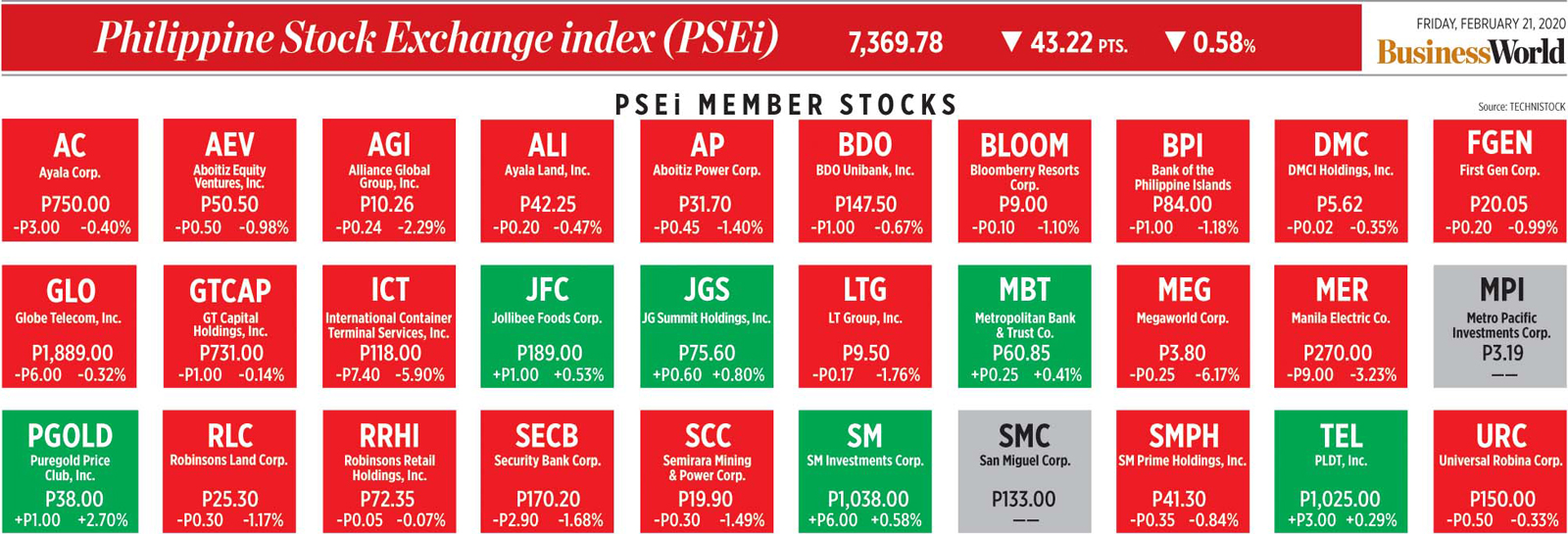
How PSEi member stocks performed — February 21, 2020

Here’s a quick glance at how PSEi stocks fared on Friday, February 21, 2020.


DoE planning energy complex at Chevron site in Batangas

By Victor V. Saulon
Sub-Editor

THE Department of Energy (DoE) is looking at converting the property in Batangas being leased by the Philippine unit of Chevron Corp. into what its top official called an “energy city” which will house a liquefied natural gas (LNG) facility, among others.

“We wanted that (property) to become an energy area because we wanted to use that for an LNG terminal,” Energy Secretary Alfonso G. Cusi told reporters last week after an event at the agency’s main office in Taguig City.

He also downplayed any impact on petroleum supply should Chevron leave the area, which it uses as a facility for imported fuel.

“There’s no impact on our energy,” Mr. Cusi said. “What we want to do there with that place is to be (an) energy city,” he said.

He said there was supposed to be a draft executive order on the use of the property, but the issues that arose surrounding the lease contract between Chevron and state-led lessor National Development Co. (NDC) led to a further study of the proposed directive.

Mr. Cusi said the property had been previously considered by other entities, including the DoE-attached agency Philippine National Oil Co. (PNOC), as a site for an LNG import terminal. He said Lloyds Energy Group LLC also looked into the property.

Dubai-based Lloyds Energy said in November 2018 that it had submitted a letter of interest to PNOC to join in the selection of the state-owned agency’s joint venture partner to develop an LNG hub in Batangas.

Nothing came out of their discussions, but PNOC later partnered with Davao City businessman Dennis A. Uy for an LNG project called Tanglawan Philippine LNG, Inc. In late 2019, Tanglawan sought regulatory approval for the suspension of the venture, which the DoE approved.

Mr. Cusi should the handling of the property be “awarded” to the DoE to be used as an energy city, then the DoE will create a master plan for the project. He said he has to work with the Department of Finance to realize the plan.

“There is a process,” he said, adding that the intent is to maximize the use of the property, which is underutilized under Chevron.

In January, the DoF said the lease contract between NDC and privately owned Chevron Philippines, Inc. contains “onerous” provisions as the oil firm is paying lower-than-market rental fees on the site in San Pascual, Batangas.

Citing data from NDC, the DoF said Chevron has been paying a monthly rental fee of 74 centavos per square meter (sq.m.) on the 120-hectare or 1.2 million sq.m. property, significantly lower than the estimated fair market rental value of P17.90 per sq.m.

Finance Secretary Carlos G. Dominguez III, who is an NDC board member, described the deal as another “government contract with onerous provisions.” The DoF said the “sprawling” Batangas property is now valued at around P4.9 billion to P5.3 billion. Chevron Philippines is using the property as an oil import terminal, it said.

The Department of Trade and Industry (DTI) later said that the NDC board, which it chairs, has approved the dissolution by 2021 of Batangas Land Co., a joint venture formed by NDC and Chevron Philippines in the 1970s. The NDC board also approved the consolidation of ownership of BLC land in favor of the government.

Trade Secretary Ramon M. Lopez said the property will not be sold but repackaged through long-term leases or joint ventures.

New target date for South Korea FTA set before Moon state visit

THE trade department hopes to conclude negotiations for a free trade agreement (FTA) with South Korea by the time South Korea’s president pays a state visit, trade secretary Ramon M. Lopez told reporters last Monday.

“Hopefully we finish Korea (FTA talks) after April. ’Yun ’yungnext target (that is the next target): before the visit of the Korean president here,” he said.

President Rodrigo R. Duterte invited South Korean President Moon Jae-in to pay a state visit to the Philippines after the countries failed to sign an FTA at the ASEAN-Republic of Korea Commemorative Summit.

Negotiations stalled last year as the countries have not agreed on reduced tariffs for Philippine banana exports and South Korean auto exports.

Both countries have since replaced their negotiating teams, with the Philippine team now led by trade undersecretary Ceferino S. Rodolfo.

He said the two countries had mutually agreed to establish new teams, in hopes that talks will expand beyond tariff reduction.

“Hopefully, mag-agree na on certain terms na hindi lang ’yung tariff ‘yung pinag-uusapan — ‘yung future investment, innovation, ’yung mga gusto nating ipasok(I hope we reach agreements beyond tariffs and proceed to future investment and innovation),” Mr. Lopez said.

Mr. Lopez said issues on the banana and auto trade are “being worked out.”

Hindi ko pa masabi na 100% pero getting there, nag-improve na from before (I can’t say everything has been resolved, but it has improved from where we were previously),” he said.

South Korea is one of the Philippines’ largest trading partners, according to the Philippine Statistics Authority. It is the Philippines’ sixth-largest export destination in 2019 at $3.2 billion accounting for 4.6% of the value of total Philippine exports.

South Korea is the Philippines’ third-largest import source at $8.2 billion, accounting for 7.7% of the value of total Philippine imports. — Jenina P. Ibañez