

How PSEi member stocks performed — March 6, 2020
Here’s a quick glance at how PSEi stocks fared on Friday, March 6, 2020.
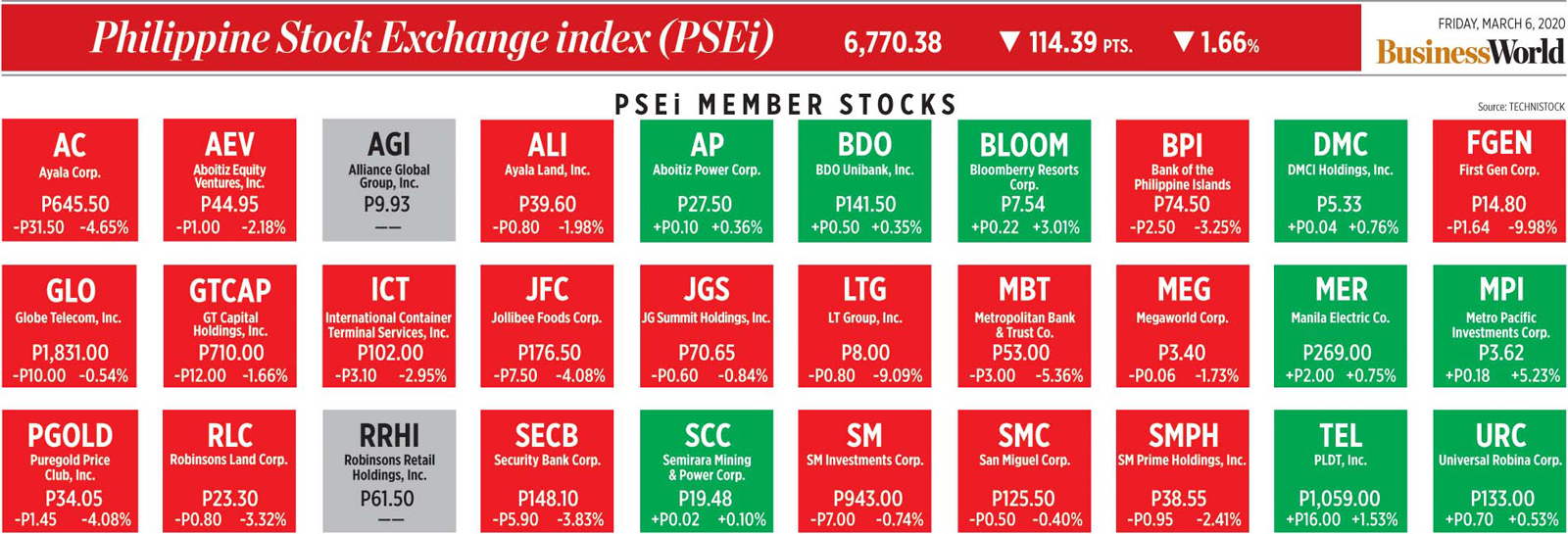

Here’s a quick glance at how PSEi stocks fared on Friday, March 6, 2020.
THE Department of Trade and Industry (DTI) expects to determine this month the need for safeguard measures against automotive imports.
Trade Secretary Ramon M. Lopez said the department had notified the World Trade Organization (WTO) about its intention to investigate safeguard measures on Feb. 18.
“Dapat ‘yun, pumapasok na ‘yung mga data, consultation, hearing (The data, consultations, and hearings should have come in),” he said.
The DTI launched a preliminary safeguard investigation on automotive imports in February, after being petitioned by a labor group.
The Philippine Metalworkers Alliance (PMA) last year asked the department last year to rule on whether a surge in automotive imports is causing injury to the domestic industry.
The WTO notification noted that the PMA claims “increased imports of motor vehicles are the substantial cause of serious injury to the domestic industry in terms of declining market share, production sales, capacity utilization, incurred losses, employment, price depression and price undercutting.”
PMA, after filing its petition in November, said workers fear job losses as companies downsize.
Mr. Lopez recently highlighted the ongoing safeguard measures probe after Honda Cars Philippines, Inc. (HCPI) decided it would stop operating.
Mr. Lopez has said that the decision was made by Honda headquarters, following a global automotive industry slowdown. The company will continue selling cars in the Philippines through its regional network.
The DTI has not yet decided on possible tariff rates or restrictions on import quantities. — Jenina P. Ibañez
THE Philippine Stock Exchange, Inc. (PSE) said it backs the passage of a tax reform bill gradually lowering corporate income tax and urged the Senate, where the legislation is pending, to give it top priority.
The PSE issued the statement over the weekend to express its “strong support” for the tax reforms under the Corporate Income Tax and Incentives Rationalization Act (CITIRA) bill, saying the bill if passed will help attracting new investment from overseas and domestic investors.
“The PSE respectfully urges (the Senate Committee on Ways and Means) to prioritize the immediate passage of the CITIRA bill as we all look forward to jump-start its short- and long-term benefits to Filipinos,” it said.
The bill proposes to gradually lower the corporate income tax to 25% by 2024 and to 20% by 2029 from 30% at present. The PSE said passing CITIRA would make the Philippines competitive in the ASEAN region where corporate tax rates range between 17 and 25%, according to 2019 data from consultancy Deloitte.
“This will make the Philippines an attractive investment destination for new foreign and domestic businesses and encourage existing companies to expand their operations,” it said.
“All these will redound to job creation, higher income, increased spending and more money in circulation, a cycle that can continue indefinitely as a result of the multiplier effect,” it added.
The benchmark Philippine Stock Exchange index has been volatile in recent weeks due to the coronavirus outbreak, closing 6,770.38 last, as against 7,742.53 when the year started.
The PSE joined 10 business groups last week in backing CITIRA. Those groups were the Anvil Business Club, Bankers Association of the Philippines, Federation of Filipino Chinese Chambers of Commerce and Industry, Financial Executives Institute of the Philippines, Foundation for Economic Freedom, Management Association of the Philippines, Makati Business Club, Organization of Socialized Housing Developers of the Philippines, Subdivision and Housing Developers Association and University of the Philippines School of Economics Alumni Association.
The Senate, through its President Vicente C. Sotto III, has been unable to respond to questions for comment on the recent statements in support of CITIRA. But he said last weekend that the Senate may set the bill aside to prioritize measures that will address the outbreak of coronavirus, formally known as Covid-19.
The Philippines has reported six confirmed cases of Covid-19 as of Sunday.
The House passed its CITIRA legislation last year.
Representative Jose Ma. Clemente S. Salceda of the chamber’s Ways and Means Committee considers passage to be necessary as an “economic vaccine” against the outbreak, and warned that delay could worsen the economy.
The Department of Finance has also requested that the Senate pass CITIRA before it goes on a seven-week break.
In a text message Sunday, Senate President Vicente C. Sotto III said senators will “try our best to pass either CITIRA or PIFITA (Passive Income and Financial Intermediary Taxation Act).”
PIFITA is the fourth package of the government’s Comprehensive Tax Reform Program, which seeks to streamline the number of tax rates on financial instruments to 26 from 80, among others.
Congress will be in recess between March 14 and May 3. — Denise A. Valdez

THE Department of Labor and Employment (DoLE) said it signed an agreement with the People Management Association of the Philippines (PMAP) to provide labor information through online seminars.
In a statement Saturday, the DoLE said it signed a Memorandum of Understanding (MoU) with PMAP to offer DoLE lectures to PMAP members. Labor Secretary Silvestre H. Bello III called this partnership “long overdue” and added: “I hope this collaboration would be for life.”
PMAP President Louisa Mila V. Echevarria said that PMAP “is very thankful for this cooperation.”
Prior to the MoU, PMAP had been offering so-called “webinars” on human resources, industrial relations, and people management.
“Under the deal, PMAP’s webinar sessions will feature DoLE lectures on general labor standards, occupational safety and health standards, contracting arrangements and other issuances of the department,” DoLE said. Also included the MoU are texts and e-mails on DoLE orders, advisories, explanatory bulletins and others.
PMAP has over 2,000 member companies and individual executives. — Gillian M. Cortez
Digital technology has undoubtedly revolutionized the world economy. With the growing popularity of online shopping in particular, businesses can reach consumers without needing a physical location. The increasing digitization of the world economy has not only made the sale of goods and services instantaneous and efficient — it has also provided a convenient way for consumers to purchase goods without having to waste time being stuck in heavy traffic.
According to research pioneered by Google, the internet economy in Southeast Asia hit the $100 billion mark in 2019. By 2025, the internet economy is projected to grow to $300 billion. These numbers indicate a significant opportunity for tax authorities to not only regulate appropriately, but to also tap this source for additional government revenue.
CROSS-BORDER ONLINE TRANSACTIONS
In 2013, the BIR issued Revenue Memorandum Circular (RMC) No. 55-2013 to set the tone for companies operating in the digital market. By reiterating the obligations of parties in online transactions, the Circular sought to enforce our tax laws in the digital economy. However, the Circular has yet to address cross-border online transactions, or how taxes will be imposed on non-residents for online sales to local consumers. One apparent reason for this may be the inadequacy of our present tax laws as basis for taxing this type of transactions.
Like most jurisdictions, the Philippines relies on physical presence or locus of activity within the country as a condition for the imposition of taxes. Tax treaties are likewise framed this way. However, cross-border online sales do away with physical presence since most online servers are located outside the country. Sales activities conducted through these portals are deemed to occur outside Philippine territory, as it can be argued that since an online transaction’s server is located outside the Philippines, the business itself isn’t considered to be held within the country. Such transactions can therefore be said to be outside the country’s taxing jurisdiction. Regardless, it is difficult to determine where the locus of the sales activity truly lies, only making it more difficult to enforce tax rules.
THE NEED TO INNOVATE PRESENT TAX LAWS
Tax authorities will need to come up with innovations to our present tax laws to address tax profits earned by non-residents from consumers here, as well as the enforcement or collection of taxes, the visibility over tax reporting data, and the addressing of the controversy surrounding the issue of capturing lost profits for our country. However, doing so without disrupting how bricks-and-mortar businesses are taxed can be daunting. In this light, perhaps our tax authorities can revisit the recent proposals of the Organization for Economic Cooperation and Development (OECD).
Last year, the OECD released the Programme of Work to Develop a Consensus Solution to the Tax Challenges Arising from the Digitization of the Economy. While the Philippines is not a member of the OECD, the issues tackled by the organization are felt worldwide, and our tax treaties are patterned after the publication. The tax authority has also cited OECD commentaries in several rulings, giving the commentaries a more persuasive effect. The Philippines can benefit from the suggestions raised by the organizations in addressing base erosion issues for tax purposes.
The proposals contained in the publication were grouped into two pillars:
Pillar One, which focuses on the allocation of taxing rights and seeks to undertake a coherent and concurrent review of the profit allocation and nexus rules; and Pillar Two, which seeks to develop rules that provide jurisdictions with a right to tax back where other jurisdictions have not exercised their primary taxing right, or where the payment is otherwise subject to low levels of effective taxation. It calls for the development of a coordinated set of rules such as the income inclusion rule, switch-over rule, undertaxed payment rule, and the subject to tax rule. Their development addresses the ongoing risks from structures that allow multinational companies to shift profit to jurisdictions with very low or no taxation.
There are three proposals under Pillar One that tackle how taxing income generated from cross-border activities in the digital age could be allocated among countries. These are composed of the “user participation” proposal, the “marketing intangibles” proposal and the “significant economic presence” proposal. All are supposed to allocate more taxing rights to the jurisdiction of the customer and/or user.
Of special interest is the “user participation” proposal, which focuses on digitized business models such as search engines, social media platforms and online marketplaces. This proposal suggests that profits should be allocated to market jurisdictions based on the value-creating activities of the active user base.
THE DIGITAL ECONOMY AS AN ADDED SOURCE OF REVENUE
As a burgeoning digital economy, we may wish to explore how value-creating activities can be a source of taxing rights over income from digital cross-border sales.
Granted, tax authorities will need to carefully weigh the nature of digital taxing rights vis-à-vis the importance of negotiations. One only needs to ask about the fate of the digital tax passed by France last year, which had to be postponed amid US retaliatory tariffs.
However, once the statutory foundation for a set of tax rules that apply to the digital economy is drafted, bilateral as well as region-wide discussions in matters of implementation will surely follow. The key here is to find the right balance between creating a consistent and globally accepted set of digital tax rules that can benefit tax authorities in all jurisdictions while also being fair and supportive of digital enterprises that face new and rapidly evolving challenges to remain competitive in an increasingly crowded online market.
This article is for general information only and is not a substitute for professional advice where the facts and circumstances warrant. The views and opinion expressed above are those of the author and do not necessarily represent the views of SGV & Co.
Ma. Theresa M. Abarientos-Amor is a Senior Manager from the Tax Advisory Services Group of SGV & Co.
PRESIDENT Rodrigo R. Duterte will sign an order today declaring a public health emergency after the Health department confirmed at the weekend the first case of human coronavirus transmission in the country, his spokesman said on Sunday.
Mr. Duterte considered “all critical factors with the aim of safeguarding the health of the Filipino public,” presidential spokesman Salvador S. Panelo said in a statement at the weekend.
The Philippines has had six coronavirus disease 2019 (COVID-19) infections, half of which were confirmed last week. Before that, it had not reported any new cases for weeks.
One of the new cases includes a 62-year-old man who has no travel history overseas. The man’s wife also tested positive for the virus, making her the country’s sixth case. Aside from the couple, a 48-year-old man had also been infected after traveling to Tokyo.
Earlier, three Chinese visitors were infected with the virus — one of them died, and the other two have since recovered and left the country.
The Department of Health on Saturday raised the country’s alert level to Code Red sublevel 1, as health authorities “prepare for a possible increase in suspected and confirmed cases,” according to Health Secretary Francisco T. Duque III.
Health officials will intensify contact tracing, surveillance and its testing capacity, in preparation for a possible community transmission.
Mr. Duque had urged the presidential palace to declare a state of public health emergency as early as Feb. 21, when the Philippines only had three confirmed COVID-19 cases.
The move will “be crucial to facilitate the sufficient and immediate access to funding, particularly for local government units, and ease processes on procurement, mandatory reporting, mandatory quarantine, and travel restrictions,” Mr. Duque said in a letter to Executive Secretary Salvador C. Medialdea.
“It would also put to rest questions on whether an automatic price freeze on medicines and medical supplies may be made by the DoH and the Department of Trade and Industry,” he wrote.
The virus has killed more than 3,500 people and sickened about 105,000 more globally, mostly in China, according to the World Health Organization.
“There is no need for alarm and worry because from the very start, we’ve been ready,” Mr. Panelo said on Friday.
Meanwhile, the Senate is ready to tap this year’s national budget to help DoH fight the spread of COVID-19, Senator Juan Edgardo M. Angara said in a statement.
The senator, who heads the finance committee, asked DoH and other agencies to inform the committee of their budget needs so lawmakers could adjust the numbers if needed.
“There can be funds contained in the 2020 General Appropriations Act that can be tapped for this purpose and if these are not enough then DoH should say so,” Mr. Angara said.
The senator said DoH should not be complacent and should be “very transparent” in reporting new cases.
“There is too much false information going around on social media so the government should constantly come out with its reports in all forms of media,” he said.
Senator Juan Miguel F. Zubiri on Saturday also asked for stronger and more proactive government response, including setting an earlier summer vacation for students and providing test kits to all hospitals. — Gillian M. Cortez and Charmaine A. Tadalan
PRESIDENT Rodrigo R. Duterte won’t ban offshore gaming companies in the Philippines despite the ills that critics say they bring, because they are a major source of tax revenue, his spokesman said on Sunday.
“We still need the funds,” presidential spokesman Salvador S. Panelo told Radyo Inquirer in Filipino. “He will not suspend or stop it.”
Some lawmakers have sought a halt in the operations of the billion-peso industry that is mostly Chinese-run and caters to its own nationals after these were linked to crimes including kidnapping, tax evasion, money laundering and sex trafficking.
So-called online gaming operators employ more than 400,000 workers, many of them from mainland China, amid the Chinese government’s crackdown on gambling.
Mr. Panelo said the government should enforce laws against Chinese criminals instead of banning the industry as a whole.
Senators last week rebuked financial regulators for failing to promptly investigate the entry of P19.7 billion ($389.6 million) — suspected to have been laundered by Chinese criminal syndicates — into the Philippine financial system last year.
Various travelers carried the foreign currencies — $336 million, HK$215 million and 2.7 million yen — and entered the Philippines through the Ninoy Aquino International Airport, Senator Richard J. Gordon said during a Senate hearing, citing Anti-Money Laundering Council records.
Aside from the almost P20 billion that entered the country in the first quarter of last year, about $633 million (P32 billion) also suspiciously came in from September last year to March this year, Mr. Gordon said, citing Bureau of Customs data.
Mr. Gordon earlier said offshore gambling companies here were probably being used as fronts for Chinese spies.
The Immigration bureau earlier said it had revamped workers at Terminals 1 to 3 of the international airport in Manila after the “recent resurgence of unauthorized activities and irregularities” there.
The agency relieved 19 officials and employees allegedly involved in a bribery scheme that allowed the illegal entry of Chinese nationals who end up working in offshore gaming companies here. — Gillian M. Cortez
A LAWMAKER urged Congress on Saturday to exempt face masks, sanitizers and other protective goods from import duties and taxes after the Health department asked the government to declare a public health emergency amid a novel coronavirus outbreak.
Exempting face masks and other products such antiseptics from taxes would “assure adequate supply, stabilize prices and avoid hoarding at this time of crisis,” Quezon City Rep. Precious Hipolito-Castelo said in a statement at the weekend.
“Our goal is to make these currently important health products available in the market and enable consumers to buy them at cost,” she said.
Ms. Hipolito-Castelo said she would file a bill that will give the tax and duty exemption. She added that flooding the market with these goods would lead to lower prices and prevent unscrupulous traders from hoarding them and selling them later at prohibitive prices.
The measure could “pinch” government revenue, but “it could bolster public safety, sustain commerce and keep the economy at its feet.”
Albay Rep. Jose Maria Clemente S. Salceda, who heads the ways and means committee, said he would act on the measure.
“We will act on it and find means so it could be done without legislation to speed up cheaper imports,” he said in a mobile-phone message on Sunday.
Ms. Hipolito-Castelo also urged health authorities to be “more straightforward” in informing the public about coronavirus disease 2019 (COVID-19) cases.
She noted that on Friday, the Health secretary said it was “premature” to call the infection of a 62-year-old man as a local transmission since it was “only one,” only to be declared as such by the World Health Organization a few hours later.
Mr. Duque belatedly admitted on Saturday that it was a “localized transmission.” The infected man had no history of travel outside the country.
“We should tell the public the situation exactly as it is to encourage our people to strengthen their defenses against this virus,” Ms. Castelo said. — Genshen L. Espedido
AFRICAN SWINE Fever (ASF) cases have been confirmed in nine villages in Solana, Cagayan, acting Provincial Veterinarian Noli V. Buen said on Saturday. In a statement released by the provincial government, Mr. Buen said set procedures have immediately been taken to isolate the affected barangays and cull the affected hogs. So far, 54 pigs have been culled and properly disposed, he reported to the provincial management committee meeting Friday. Apart from road checkpoints, Mr. Buen recommended tapping naval forces to help monitor riverside areas on the movement of hogs and pork products.
THE COMMISSION on Audit (CoA) has “partially granted” the petition of Aquasolv Philippines, Inc. against the Makati City government for a claim of almost P1 million involving the maintenance of sewerage treatment plants and water treatment. In its decision dated January 29, state auditors ruled that “the city cannot evade payment and unjustly enrich itself, especially when it admitted in its Answer that petitioner actually rendered services.” Aquasolv provided services to Makati from May 1, 2015 to June 30, 2015. However, the city refused to pay due to the absence of approved contracts and the company’s failure to go through the required procurement process. “On the above premises, this Commission believes that the petitioner should be compensated, based on quantum meruit, which entitles a party to payment as much as he reasonably deserves, for the services rendered to the city,” it said. On the other hand, CoA denied Aquasolv’s claim for legal interest due to “lack of legal basis.” “The City Government of Makati is liable to pay Aquasolv Philippines, Inc. the amount of P983,656.80, subject to availability of funds and the usual accounting and auditing rules and regulations. The claim for legal interest is denied,” CoA said. — Genshen L. Espedido
A 10-HECTARE property in the small town of Sablan is being eyed for development as an information technology (IT) economic zone as part of the BLISTT (Baguio-La Trinidad-Itogon-Sablan-Tuba-Tublay) growth strategy. Baguio City Benjamin B. Magalong, chair of the BLISTT Council, announced last week that the lot owner has already expressed willingness to discuss the venture. Another potential site for development has also been identified in the town of Tublay. The creation of the BLISTT zone, informally referred to as Metro Baguio, is intended to spread economic growth in areas adjacent to Baguio City, specifically the five towns under Benguet province. The council is tasked with the coordination of projects and programs, including those relating to traffic, infrastructure, and tourism. “We can’t just concentrate or focus on Baguio alone. We have to help our neighbors develop and sustain their growth,” Mr. Magalong said in a statement. Last March 6, the Philippine Economic Zone Authority (PEZA) briefed local leaders on the benefits of setting up ecozones and determining what industries are suitable for their respective areas. PEZA representatives also committed to assist with the promotion of the growth area to investors. The council is also preparing to pass a resolution authorizing Mr. Magalong to represent BLISTT members in discussions with potential investors. Bills on the creation of the BLISTT Development Authority are pending in Congress.
BAGUIO P4 RULES
Meanwhile, Baguio City announced on Friday that the implementing rules and regulations (IRR) of its local public-private partnership code has been completed. The IRR for the city’s Public-Private Partnership for the People Initiative (P4) Code is contained in an executive order issued by the mayor. It spells out the revised P4 selection committee membership, procedures, and eligible projects, which include power generation, various infrastructure, water supply and distribution, and processing facilities, among others. All recommendations of the P4 selection committee will be subject to the assessment and approval of the mayor with prior authorization from the city council.
TWENTY BUSES are set to ply the streets of Cebu City for the Interim Bus Service (IBS) starting March 15. Cebu City Mayor Edgardo C. Labella said the IBS will introduce the riding public to a more systematic transport system wherein buses have a strict departure schedule and designated stops. “This will serve as a training or an orientation because the system will provide that the interim bus would stop in certain areas and at certain times,” said Mr. Labella. The IBS is being rolled out pending the implementation of the Bus Rapid Transit (BRT) system. Rey Gealon, executive director of the Cebu City Transportation Office, said among the designated routes are: from Fuente Osmeña to N. Bacalso, South Bus Terminal to SM Seaside then South Road Property (SRP); and from Fuente Osmeña to Capitol- Escario, to IT Park. These routes, he said, will be part of the BRT system. He added that there will be 17 bus stops along the routes. Cebu City Councilor Antonio V. Cuenco, committee on transportation chair, said the IBS is a good start to help ease the traffic congestion in the city. “I appeal to the people to be dedicated to follow the correct instructions for the bus stop,” he said. The BRT is expected to be partially operational before December 2021. — The Freeman