Home Blog Page 9666

More health insurance claims processors win exemption from ECQ

MUTUAL benefit associations (MBAs) have been allowed to operate with minimal workforces after their employees were deemed exempt from enhanced community quarantine (ECQ) rules, according to the Insurance Commission (IC).

IC issued Circular Letter (CL) No. 2020-39 on April 9 to classify MBAs as health insurance providers, effectively exempting them from ECQ.

“The IC recognizes the necessity of allowing MBAs to maintain operational capacity for processing of claims from the death of their members considering volumes, as well as the need to service the marginalized,” the circular read.

The Inter-Agency Task Force on Emerging Infectious Diseases (IATF-EID) exempts health maintenance

organizations (HMOs) and insurance companies from the lockdown as they are considered health services frontliners.

The IC also issued CL. No. 2020-40, ordering health insurance providers including HMOs, life and non-life insurance firms offering health insurance products as well as MBAs to operate with minimal staffing for the processing of claims.

Staffing has been capped at 10% of the total workforce, the IC said, with only “essential personnel” needed in the processing of claims.

Companies seeking exemptions for their workers will need to submit to the IC a list of essential personnel, which the regulator will approve via issuance of a certification on a per company basis, with workers subject to social distancing rules and required to wear face masks while in the office.

“Personnel who are 54 years old and above, pregnant women, those with underlying medical conditions,

with COVID-19 symptons or have been exposed to persons under investigation or monitoring” are not eligible for the exemption, according to the circular.

Companies should also arrange for worker transport from home to office and back as well as meals and accommodation as needed. — Beatrice M. Laforga

Kindness knows no tax boundaries

Last week, many believers all over the world celebrated the most important event in the Christian calendar — Holy Week. For devout Christians like me, Holy Week is a time for prayer, sacrifice, repentance, and reflection. This year, however, Holy Week was celebrated differently in response to the government’s call to contain the transmission of COVID-19. Christian rituals and local traditions were carried out without crowds, while masses were televised or streamed online. Undoubtedly, this outbreak continues to affect life in more ways than we could have imagined. We can bear witness to how this pandemic brought new meaning and significance to our lives. It invited us to see the greater reality of what is important in life, brought many people back to their faith, and inspired people to show more kindness and empathy for others.

As COVID-19 brought the world economy to a screeching halt, the government’s available funds to implement the measures and programs laid out under the Bayanihan to Heal as Once Act may not last until the pandemic is over. Thus, with COVID-19 cases still rising, the urgent need for financial assistance and donations in kind has become a primordial concern. Donations and gifts generally have tax consequences. Hence, to draw the needed support and help from the private sectors, stakeholders, and individuals, the Bureau of Internal Revenue (BIR) relaxed certain rules on the taxation of donations and gifts during this extraordinary time.

In Revenue Regulations (RR) No. 09-2020 dated April 6, the BIR laid down the guidelines on availing of full deductibility against gross income of donor-corporation/donor individuals for specific donations/gifts when given for the sole and exclusive purpose of combating COVID 19 during the state of national emergency.

In the RR, cash donations, donations of all critical or needed health care equipment or supplies, relief goods, and use of property whether real or personal (shuttle service, use of lots/buildings), may be deducted from the taxable gross income of the donor, provided that the donations are made to the National Government or entities created by any of its agencies (including public hospitals) which is not conducted for profit, or to any political subdivision of the Government, including fully-owned government corporations. The full deductibility is allowed regardless of whether the donations are covered by the National Economic and Development Authority (NEDA)’s annual priority plan. These donations must be supported by a Deed of Donation. On the other hand, if the recipient is an accredited non-stock, non-profit educational and/or charitable, religious, cultural or social welfare corporation, institution, foundation, non-government organization, trust or philanthropic organization and/or research institution or organization, the certificate of donation (BIR Form 2322) must be submitted to the BIR as a supporting document, while the Notice of Donation has been dispensed with.

It should be noted that the above donations are already exempt from donor’s tax according to Section 101 of the Tax Code, as amended.

Moreover, RR 9-2020 allows exemption from donor’s tax and full deduction from gross income those donations in cash and kind even if given to private hospitals, non-accredited non-stock non-profit educational and/or charitable religious, cultural or social welfare corporations, institutions, foundations, non-government organizations, trust or philanthropic organizations, research institutions or organizations; and to a local private corporation or international organization/institutions who partner to serve as a conduit with accredited NGOs and/or the national government or any entity created by any of its agencies which is not conducted for profit, or to any political subdivision of the government, subject to the timely submission of applicable documentary requirements (e.g. Sworn Certification, BIR-registered Acknowledgment receipt, proof of purchase, and donee’s liquidation report, as may be applicable). These documentary requirements shall be submitted to the corresponding Revenue District Office within 60 days from the lifting of the Enhanced Community Quarantine. Note though, that these documentary requirements are not applicable to donations to foreign institutions or international organizations which are fully deductible in pursuance of or compliance with agreements, treaties, or commitments entered into by the government of the Philippines and the foreign institutions or international organizations or in pursuance of special laws.

Also, the RR provides that donations of all critical or needed health care equipment or supplies such as personal protective equipment (PPEs), testing kits and relief goods such as food packs (rice, canned goods, noodles, etc.) and water shall not be treated as transactions deemed as sales subject to VAT. Any input VAT attributable to such purchase of goods shall be creditable against any other output VAT.

As a gentle reminder though, the donors and donees should maintain the relevant documents supporting the donation, as the BIR has the power to examine books of account and pertinent documents in a possible future audit.

RR 09-2020 and other BIR issuances during the Enhanced Community Quarantine are acts of kindness that have somehow provided our kababayan relief in this extraordinary time. Donations and gifts are subject to tax rules, but acts of kindness are limitless. They know no tax boundaries. As we continue to reflect on the deep meaning of Holy Week, we are reminded that as the recipient of God’s loving kindness and mercy, we too are called to spread God’s kindness by looking beyond our petty concerns such as being inconvenienced by the lockdown, or being deprived of certain freedoms and luxuries, and to empathize with the sufferings and pains of others.

At this terrible time, every act of kindness such as merely staying at home to flatten the curve of COVID-19, giving donations, extending help to our front liners, refraining from complaining and spreading negative thoughts, or just being prudent when sharing news in social media can help an extra mile in battling this pandemic. After all, the Greek fabulist and storyteller, Aesop, said: “No act of kindness, no matter how small, is ever wasted.”

Let’s Talk Tax is a weekly newspaper column of P&A Grant Thornton that aims to keep the public informed of various developments in taxation. This article is not intended to be a substitute for competent professional advice.


Farrah Andres-Neagoe is a senior manager of Tax Advisory & Compliance division of P&A Grant Thornton, the Philippine member firm of Grant Thornton International Ltd.

pagrantthornton@ph.gt.com

Widespread hunger staring in our face… Time to act now!

The hurriedly implemented government imposed lockdown-quarantine to arrest the COVID-19 crisis has brought about unintended consequences. It has caused serious income loss not only to the business community but, more importantly, to the lower and economically vulnerable income groups, most of whom are minimum wage earners, day workers, contract or piece workers, or self-employed in the underground economy… All of whom live virtually hand-to-mouth for their daily existence.

As I see it, unless the government can figure out a way to help these economically vulnerable groups bridge the absence of income during this lockdown-quarantine period so they could meet their minimum subsistence needs with a financial or food support program, both crime and political instability are a real possibility in the near term.

It’s the above concern that prompts me to bring to attention the wisdom behind the creation of the National Grains Authority (NGA), later renamed National Food Authority (NFA). The Food Agency was created by President Ferdinand Marcos under PD4 precisely in anticipation of the need to address the possible risk that hunger could cause political instability in the event of a crisis, be it man-made or caused by natural calamities.

With availability and access to food being a key component to ensure political stability, the government required the NFA to stockpile rice to address the unforecastable political risk like COVID-19 today.

However, to give it a day-to-day role and to always be in the ready to address any crisis, as well as to keep the rice inventory fresh, the government tasked the NFA with a parallel function — to stabilize palay farm-gate prices for the farmers and rice retail prices for the consumers. Although this farmer and consumer support activity is the more familiar role of NFA’s twin responsibility, it is the food security role in a crisis situation that is most important for any administration.

Like insurance, one would hope never to have to call on its support to avert political instability, the unwelcome consequence of a crisis situation that induces a food insecurity situation. As we navigate the lockdown-quarantine period, I believe that in the coming days, due to the acute lack or absence of income for a great number of our brothers, the Food Security role of the NFA may be needed to address public anxieties to insure political stability.

Presently, the Government, through the NFA, has more than adequate rice inventory that is strategically positioned throughout the country. The NFA is manned with competent and well-trained personnel in food security management and distribution to meet any food security crisis.

With the halt of all economic activities under lockdown-quarantine, the economically disadvantaged members of our community will be facing hunger in a few days when money runs out… an unavoidable offshoot of the programs to arrest the COVID-19 crisis.

To address this hunger crisis, the NFA must be given proper authority, clear directives as to how to act and release the held rice inventory to quell the hunger anxieties of the economically disadvantaged. The NFA, when directed, can release the stored rice to the Department of Social Welfare and Development or the Department of the Interior and Local Government, both of whom have capable networks to identify the needy and provide the rice support as ordered by the President.

RA11203 or Rice Tariffication Law, which was passed on Feb. 14, 2019, had redefined and seriously limited the role, functions and authority of the NFA.

Therefore, it is necessary to review and re-establish the appropriate protocols and proper documentation to ensure that regularity and accountability will be in place before the NFA can release its rice inventory.

With the above information, it is my hope that with public awareness, the Palace’s attention will be directed at utilizing the NFA-held government rice inventory as an immediate and viable solution to addressing any food insecurity that may arise as a consequence of the lockdown-quarantine program to address the COVID-19 crisis.

Let’s all join in prayer that we get through this crisis stronger, with better respect and compassion for our less fortunate brothers and sisters.

Salamat at mabuhay po kayo!

This article reflects the personal opinion of the author and does not reflect the official stand of the Management Association of the Philippines or the MAP.


Romeo G. David is a member of the MAP National Issues Committee, Chair and President of BNL Management Corp., and former National Food Authority Administrator.

romeogdavid@gmail.com

map@map.org.ph

http://map.org.ph

Shares end higher on efforts to boost economy

By Denise A. Valdez, Reporter

PHILIPPINE SHARES closed higher on Monday, beating most of their Asian peers, as investors reacted to government efforts to support the economy amid the coronavirus disease 2019 (COVID-19) pandemic.

The bellwether Philippine Stock Exchange index (PSEi) gained 100.15 points or 1.81% to end at 5,610.98 yesterday. The broader all shares index rose 48.19 points or 1.44% to 3,380.63.

The stock market remains on shortened trading hours for the duration of the extended enhanced community quarantine over Luzon. Trading will be from 9:30 a.m. to 1 p.m. until April 30.

Philstocks Financial, Inc. Senior Research Analyst Japhet Louis O. Tantiangco said yesterday’s climb is due to the economic stimulus programs that came amid the pandemic.

“We’re seeing both fiscal and monetary policy working together to combat the Coronavirus’ impact on the economy and this is what’s keeping the local bourse afloat so far,” he said in a text message.

Among these are government efforts such as emergency cash transfers and other social spending measures to protect public welfare. The central bank also said on Sunday it is looking a “deeper cut” in interest rates to help support the economy amid a “once-in-a-lifetime crisis.”

AAA Southeast Equities, Inc. Research Head Christopher John Mangun attributed the decline in Asian equities to the rising COVID-19 cases across the world. He also traced negative investor sentiment from the announced cut in oil production of the Organization of the Petroleum Exporting Countries and its allies starting May.

The PSEi opened at 5,551.96 and hit a low of 5,521.49 before it rose to its high of 5,610.98 towards the close of trading.

“It opened lower as some investors took profits but quickly rebounded and traded sideways. Almost all its gains came at the close as selling was also minimal,” Mr. Mangun said via e-mail.

Sectoral indices all closed higher as well: mining and oil by 174.06 points or 4.02% to 4,495.02; industrials by 262.73 points or 3.71% to 7,335.89; property by 91.99 points or 3.24% to 2,930.39; services by 29.79 points or 2.43% to 1,252.03; holding firms by 22.77 points or 0.41% to 5,533.56; and financials by 4.62 points or 0.39% to 1,161.99.

Value turnover stood at P5.20 billion with 539.99 million issues switching hands, slightly lower from last session’s P5.95 billion with 490.73 million issues.

Advancers outpaced decliners, 112 against 70, while 46 names ended unchanged.

Net foreign outflows dropped to P587.63 million from last session’s net foreign selling of P1.68 billion. Foreigners have been pulling their money out of the Philippine bourse for the 19th straight day yesterday, which Philstocks’ Mr. Tantiangco said means local funds are mostly responsible for the lifting of the market.

“Support remains at 5,500 although we may see it break lower if we see a sudden surge of profit-taking,” AAA Southeast Securities’ Mr. Mangun said.

Peso flat as volume thins

THE PESO inched down as investors stayed on the sidelines. — BW FILE PHOTO

THE PESO was flattish on Monday as investors stayed on the sidelines, waiting for a bigger response to the economic impact of the coronavirus disease 2019 (COVID-19) and also following the central bank chief’s fresh signals of a “deeper” rate cut.

The local unit finished trading at P50.595 per dollar yesterday, shedding just a centavo from its P50.585 close on Wednesday before the Holy Week break, according to data from the Bankers Association of the Philippines.

The peso opened the session at P50.62 per dollar. Its weakest showing was at P50.65, while its intraday best was at P50.57 against the greenback.

Dollars traded dropped to $194.20 million on Monday from the $521 million seen on Wednesday.

A trader attributed the peso’s steady finish to low market volatility in the absence of market-moving developments.

“Trading volume was low as there was no motivation to trade considering there is no significant international news. Market sentiment kasi is based on any news on COVID-19 and there was nothing significantly new so far,” a trader said in a phone call.

The virus has already sickened more than 1.8 million globally and has killed over 114,000. In the Philippines, COVID-19 patients rose to 4,648 as of Sunday afternoon. Casualties totaled 297, according to the Department of Health.

Meanwhile, another trader said the peso’s finish came after hints from the Bangko Sentral ng Pilipinas (BSP) about a more aggressive policy move amid the crisis.

“The peso slightly weakened amid dovish comments from BSP Governor [Benjamin E.] Diokno over prospects of stronger policy rate cuts and a forthcoming reduction in the reserve requirement ratio (RRR),” the second trader said in an e-mail.

The central bank is looking at a “deeper cut” in interest rates to help cushion the economy from the impact of a “once-in-a-lifetime crisis” caused by the coronavirus disease 2019 (COVID-19) pandemic, Mr. Diokno said on Sunday ahead of a policy meeting next month.

He also signaled another cut in the amount of cash that banks need to hold as reserves to boost liquidity in the financial system.

The policy-setting Monetary Board (MB) has cut rates by a total of 150 basis points (bps) since 2019, almost completely unwinding the 175 bps in hikes it implemented in 2018 amid multi-year high inflation.

Its latest move was 50-bp reduction on March 19, which brought the overnight reverse repurchase rate — or the key policy rate — to 3.25% and overnight lending and deposit rates to 3.75% and 2.75%, respectively, in a bid to shield the economy from the virus’ fallout.

The MB will meet to discuss policy anew on May 21.

The central bank chief added that they will cut lenders’ RRR by another 200 bps following a reduction of the same magnitude in universal and commercial banks’ reserve ratio earlier this month as they seek to boost liquidity to support economic activity.

The MB last month authorized Mr. Diokno to cut RRR by a maximum of 400 bps for the year, with potential cuts in the reserve requirements for other banks and nonbank financial institutions also to be explored.

Mr. Diokno earlier said the 200-bp cut freed up some P180-200 billion in liquidity.

The first trader expects the peso to move around the P50.40 to P50.80 band versus the dollar today, while the second trader gave a forecast range of P50.55 to P50.75. — L.W.T. Noble

DoLE reps share insights on working during ECQ

By Hannah Mallorca
Features Writer, The Philippine STAR

AS a result of the Enhanced Community Quarantine (ECQ), which will run until April 30, companies from various sectors have implemented a “work from home” arrangement. The STAR’s CareerGuide section recently invited representatives from the Department of Labor and Employment (DoLE) to clarify employee guidelines and provide insights on working from home amid the pandemic.

Ma. Teresita S. Cucueco

The Facebook live discussion featured Labor and Employment Undersecretary Atty. Ana Dione, OIC-Assistant Secretary Dominique Rubia-Tutay, OIC-Assistant Secretary Ma. Teresita Cucueco, and Tech Mahindra HR manager Mayeth Reyes.

Use of leave credits

One of the employees’ concerns is the use of leave credits during the quarantine, as many netizens stated that not all sectors can bring their work at home.

Ms. Dione informed that the DoLE released Labor Advisory Nos. 4, 9 and 11 to guide employees on when to use these leaves.

LABOR ADVISORY NO. 4
An employee’s leave of absence may be charged to his sick or vacation leave credits under the company policy. Employers are considered to implement leave of absence without pay if credits are used up. Despite this, employers are encouraged to grant additional leave with pay.

LABOR ADVISORY NO. 9
Flexible work arrangements are considered, citing reduction of work hours or work days, rotation of workers and forced leaves.

LABOR ADVISORY NO. 11
Flexible work arrangements for employers. Employees in healthcare, manufacturing, retail, and delivery sectors are advised to operate, provided that proper safety and health measures are observed.

Atty. Ana C. Dione

Pero dito sa hindi makapag-implement ng work from home, necessarily, there is reduced income since hindi makapasok. If mayroon kang available leave credits, you may use your leave credits so that yung period na covered ang leave credits mo, you will receive salary,” added Ms. Dione.

On the other hand, Ms. Cucueco emphasized that companies should provide accommodation and transportation for their employees if they need to report to work, citing it as a requirement mandated by the International Automotive Task Force.

“They should be providing nearby accommodations so they can practice social distancing and other health measures. They should try to find someplace nearby or if not, a shuttle within the area,” added Ms. Cucueco.

Compensation for employees

COVID-19 ADJUSTMENT MEASURES PROGRAM (CAMP)
Provides assistance to affected workers in the formal sector, regardless of status (i.e. permanent, probationary, or contractual), who are affected by Flexible Work Arrangements or temporary closure

TUPAD #BARANGAY KO, BAHAY KO PROGRAM
For displaced or disadvantaged (“no work, no pay” or reduced salary), minimum wage earners, underemployed and self-employed workers in the informal sector

According to Ms. Dione, companies are encouraged to provide relief assistance to their employees — so they can provide their families with basic necessities during the COVID-19 pandemic.

You can access DOLE’s Labor Advisory No. 04, Labor Advisory No. 09, Labor Advisory No. 11, CAMP’s guidelines and forms and information about TUPAD #Barangay Ko, Bahay Ko program on DOLE’s official website.

For more information about job openings and advertising options, visit CareerGuide PH on Facebook.

Alcohol, tobacco and vapes, virus infection and WHO disinformation

In the ongoing Enhanced Community Quarantine (ECQ) in the Philippines, there are many prohibitions and closures — office or shop work, many businesses, and public transportation have been shut, strolling around and long travel are prohibited, etc. Also among the weird bans is a liquor ban in many cities in Metro Manila and provinces, and cigarette and e-cigarette bans in some small municipalities like General Luna in Quezon province.

The main reason given is that these three products are seen to weaken our body’s immune system against the China virus infection, so these should be restricted or prohibited for the ECQ duration.

And the World Health Organization (WHO) issued a paper, “WHO, Q&A on smoking and COVID-19” (posted March 24) saying that “smokers are likely to be more vulnerable to COVID-19 as the act of smoking means that fingers (and possibly contaminated cigarettes) are in contact with lips which increases the possibility of transmission of virus from hand to mouth.” (https://www.who.int/news-room/q-a-detail/q-a-on-smoking-and-covid-19)

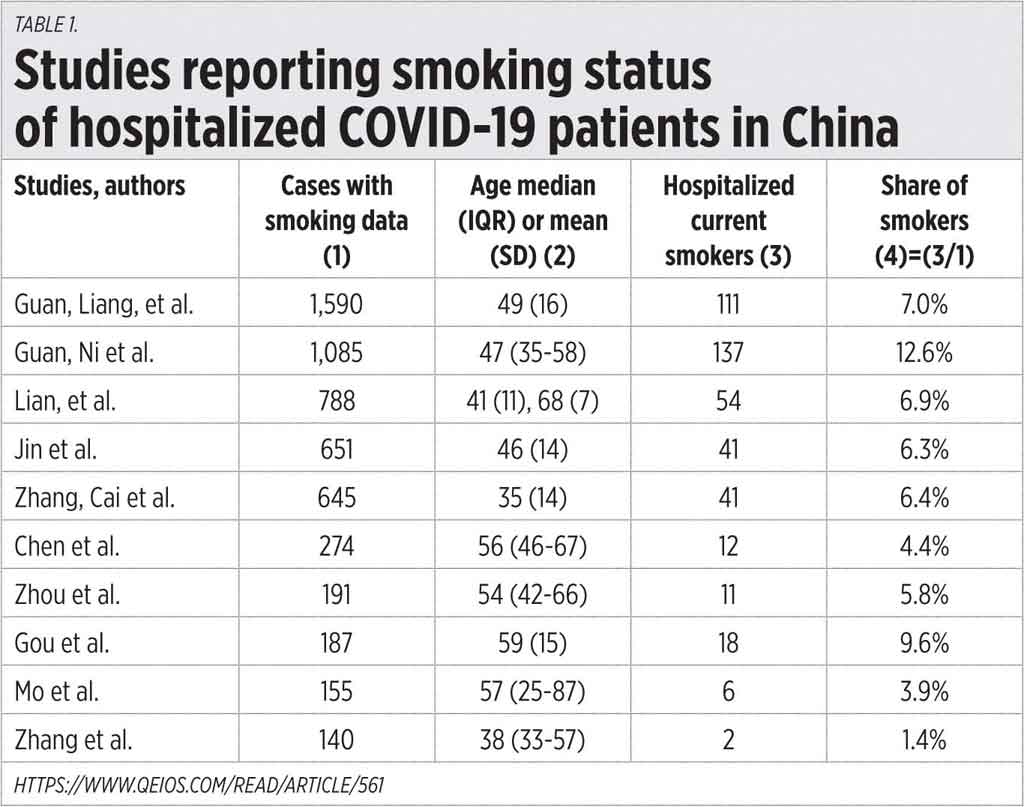
Is the WHO correct here? I want to see numbers to verify if the WHO is correct or spreading disinformation. I searched many materials online and I found two case studies, in China and the US. The China case study, “Smoking, vaping and hospitalization for COVID-19,” (10 pages) was published (April 4) by three academics, Konstantinos Farsalinos, Anastasia Barbouni, and Raymond Niaura. The first two are from the University of West Attica, Athens, Greece and Dr. Niaura is from New York University, USA. The authors made a review of publications on PubMed using the terms “[SARS-CoV-2 OR COVID-19 OR 2019-nCoV] AND [Clinical OR Mortality OR Outcome].” Out of 432 studies in total, the authors identified 13 studies that included data about smoking status of hospitalized COVID-19 patients.

I repost their table below but I did not include three studies which have small sample sizes of below 140 patients. The median interquartile (IQR) or mean standard deviation (SD) age of patients are given. There is an interesting revelation – in China, with high smoking prevalence of 26.6%, only about 7% of the hospitalized COVID-19 patients are current smokers (see Table 1).

The authors concluded, “The generalized advice to quit smoking as a measure to improve health risk remains valid, but no recommendation can currently be made concerning the effects of smoking on the risk of hospitalization for COVID-19. No studies recording e-cigarette use status among hospitalized COVID-19 patients were identified. Thus, no recommendation can be made for e-cigarette users.”

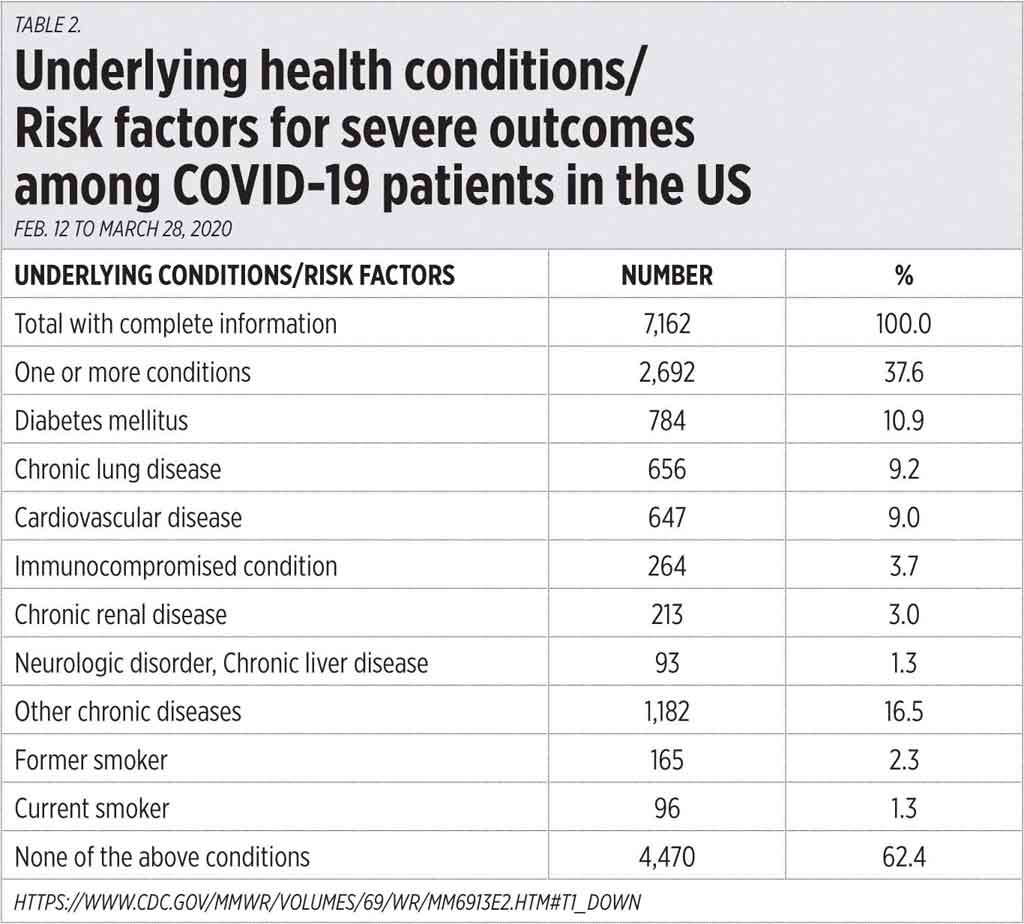
Next the US case. I found a report from the US Centers for Disease Control and Prevention, “Preliminary Estimates of the Prevalence of Selected Underlying Health Conditions Among Patients with coronavirus disease 2019 — United States, February 12–March 28, 2020” (posted April 30). An attached table shows the total cases with case report forms, 74,439, of which (a.) with missing or unknown status for all conditions, 67,277, and (b.) with completed information, 7,162.

And the table shows another interesting revelation — only 3.6% of the US’ COVID-19 cases as of March 28 are former or current smokers. Meaning 96.4% are non-smokers, past or present, and they still got the infection (see Table 2).

In the two cases, the big lesson is that the WHO is spreading disinformation when it announced that “Smokers are likely to be more vulnerable to COVID-19…”

And If we follow the WHO’s logic that hand to mouth actions like smoking or vaping increase the risk of transmission, then finger-lickin-good foods like potato chips, KFC chicken should also be avoided or banned?

The WHO and many national governments’ Health Departments or Ministries seem to have PhD and post-doctorate degrees in regulating, banning certain products to deal with non-infectious diseases, but they seem to have only an AB or high school degrees in dealing with really killer infectious diseases like dengue and many strains of corona viruses. They should learn to reverse their priorities.


Bienvenido S. Oplas Jr. is the President of Minimal Government Thinkers.

minimalgovernment@gmail.com

New way of life leads to new way of doing business

The best way to beat the coronavirus is to practice social distancing and to avoid gatherings, say our national health officials. In simple terms, people should stay home in order not to be infected by the virus. And at home, one should keep distance from other members of the household.

In our part of town, the “stay home” order is strictly enforced. Jogging out in the streets is prohibited at any time of the day. So is walking the dog. The subdivision’s sports facilities like the basketball and tennis courts and the swimming pool are cordoned off. The convenience store and the clinic are closed. The village administrative office is open only three days of the week and from 10 a.m. to 3 p.m. only. Curfew is from 8 p.m. to 5 a.m. Security guards and maintenance crew remain in the village for the duration of the community quarantine. Quarters have been provided for them.

Only the main gate of the subdivision is open. A resident is allowed to drive out of the subdivision to go to the supermarket, drugstore, or the bank. Only one member of each household is allowed to leave the village and only once during the day. Each household designates one member as the errand person of the household. That person’s name is registered with the subdivision’s Security Office and is given a pass which has to be shown to the security guards at the open gate. No other member of the household can leave the village to do errands.

Non-residents are denied entry into the community. Household help and family drivers who had gone home to join their family the weekend before the enhanced community quarantine (ECQ) order came into effect were not allowed to report back for work. While delivery of ready-to-eat food is allowed, fast-food chains would not deliver. When we call their 8888 number to place an order, we are told that they don’t deliver to our place as our barangay is listed as totally locked down.

By the third week of the lockdown, residents of our community began to miss many of the things they used to enjoy on weekends, things like their favorite burger, pizza, dim sum, or fried chicken meal, all of which used to be delivered directly to their homes. Then someone thought of forming a Viber group to serve as a community billboard on which residents can post the things they need or the products they can supply.

Within an hour of the formation of the group, soft drinks, beer, sourdough, pan de sal, eggs, fresh fruits, fresh vegetables, antiseptic alcohol, face masks, even charcoal and dog food were posted as “wanted.” To the pleasant surprise of many, some fellow residents posted they have the wanted products and can be picked up anytime. The following day, other residents posted they can make to order cinnamon rolls, banana cakes, lumpiang togue (spring rolls), turon (sweet banana spring rolls), suman (a rice cake), ginataan (a coconut milk treat), brownies, pancit (a noodle dish), and pizza.

It turned out some residents own restaurants, bake shops, or gasoline stations with a convenience store. They had pulled their supplies out of their establishments and brought them home for safekeeping before the lockdown was imposed. So, when fellow residents made known what they needed or wanted, those with the products offered their supplies for sale. Cases of soft drinks are available from a pickup parked in front of the vendor’s residence. Others posted the products they can make. There happened to be buyers for all of them.

Then the big players came into the scene. Somehow they managed to work their way into the Viber group. Chooks, the roasted chicken chain, posted it can deliver. It was immediately swarmed with multiple orders. The Max’s group followed suit. It can deliver any product of the member companies except Max’s fried chicken. Select of Shell offered frozen Jollibee Chicken Joy. Days before Easter Sunday, there appeared postings that paella, baked salmon, beef caldereta (a stew), bicol express (pork cooked in coconut milk and chili peppers), embotido (a meat loaf), kare-kare (a stew with a peanut-based sauce), truffles pasta, paksiw na pata (vinegar and soy sauce-stewed pork hock), and many other dishes could be made to order and delivered on Easter Sunday.

Payment for orders is mostly through online bank deposit to the vendor’s bank account. Other payment options are GCash, PayPal, and Pay Maya. A screenshot of the transaction is taken as proof of payment and the image is sent to the vendor via Viber. Cashless payment is preferred by most vendors as it eliminates handling of money which can be a carrier of the virus. If payment is made in cash, vendors require an exact amount to avoid giving change. The money is dropped into paper bags or cardboard boxes. It is presumed the vendor will disinfect it.

As nobody, not even epidemiologists nor molecular biologists, can tell when the COVID-19 virus will be eradicated from the face of the earth, people will continue to practice physical distancing and avoid gatherings. A face mask will be part of daily wear. The way of life that has evolved out of the lockdown may prevail indefinitely. It will in turn give rise to a new way of doing business.

Many restaurateurs will opt to close down and instead set up a commissary where the food can be prepared and delivered from. Exorbitant rent for strategically located space would be eliminated as the commissary need not be located in a business district. Likewise, many grocery store owners would choose to give up their space in expensive commercial areas in favor of putting up a warehouse in the periphery of residential districts from where goods can be delivered to online customers. Advertising for these enterprises will shift from mainstream media to social media.

We have seen how Cabinet meetings and Congressional sessions have been held lately. Attendees are seated far apart from each other yet some of them had been infected by the COVID-19 virus. Offices of companies and government institutions will have to be reconfigured to avoid the spread of COVID-19 among officemates. Cubicles of business processing workers will have to be redesigned to enclose each worker to protect him from being infected by co-workers. Cubicles, earphones, and gadgets will have to be dedicated to each worker. Restrooms in office buildings will have to be sanitized several times a day and soap and tissue or hand dryers have to be provided. Same for coffee lounges.

Companies into the manufacture of alcoholic beverages might step up their production of disinfectant alcohol. Ladies undergarment manufacturers might switch some of their production line to the making of disposable and washable face masks and gloves.

Movie houses, live show theaters, and concert halls will suffer a sharp fall in ticket sales as physical distancing is not feasible in those places. People will not risk getting infected with just to see their favorite star or hear their favorite singer.

I also foresee the decline in popularity of the Philippine Basketball Association (PBA) games. As in movie houses, theaters, and concert halls, physical distancing in sports arenas during PBA games is highly improbable. And with all the cheering, shouting, and razzing during the games, the virus would fly all over the place, The transmission of the virus from an infected person to the people around him would almost be guaranteed.

I expect even the quality of the games to decline. Players will avoid close physical contact with opposing players for fear of getting the virus. Then even the TV audience will shrink considerably.

There is a saying which goes, “There are no atheists in foxholes.” It is used to argue that in times of extreme crisis or fear, such as during an intense fighting on the battlefield, every soldier in foxholes will believe in a higher power that will protect him and keep him alive. What COVID-19 has done is make people renew their faith in a super power who will be their salvation. That renewal of faith in a Supreme Being will have a great impact on the life of every Filipino.

Alleluia!


Oscar P. Lagman, Jr. is a retired corporate executive, business consultant, and management professor. He has been a politicized citizen since his college days in the late 1950s.

A new meaning for staycation

By Tony Samson

STAYCATION was a clever marketing strategy for hotels to fill up rooms over lean days like weekends which business travelers seldom book. It meant staying a weekend in a nearby luxe hotel, requiring a short car trip (free basement parking) at the same time enjoying fresh bed sheets, fluffy towels, a swimming pool, and free breakfast buffet. And this is offered as a package with hefty discounts for a family staying in the city and having a vacation. This is not to be confused with the shorter stay for a couple where the fluffy towels also come in handy along with a preference for in-room dining — no breakfast required.

Can staying at home even on a work day and going to the office downstairs in pajamas be the new meaning of staycation?

Even those retired from work, including those “between jobs,” had a schedule involving getting out of the house. This may even have been a daily routine with a digital calendar slicing up the day’s to-do list into hours, lest they be forgotten — check out the new jazz pub in Timog. These activities filled up the hours which included commute time. Often did we airily dismiss this boring routine and envied start-up entrepreneurs in the fin tech space looking for angels and whose run of the day was more freewheeling but longer.

Of course, staying home and making a tour of corners and checking the aquarium for bubbles and what’s still there in the attic can be something of a routine too, especially in a household where division of labor is enshrined. (You can’t just lie around the house and read about stoicism.) Home work (two words) is a routine for the homemaker.

Breaks from routine are also scheduled. Isn’t this what vacations are for? There was a time when such breaks were an option. Not these days. But vacations were welcome disruptions of routine. They were stress-relievers when the office rut (from the same root word) got too repetitive or pressured. The very novelty of a new place to visit like Milan or Davao offered a break from routine, especially with the option of customized tours, and lots of unscheduled activities like shopping and trying out restaurants.

Still, the person used to routine and having something definite to do with a schedule to follow during the day seems at a loss when the calendar is blank. Isn’t this the biggest fear of someone retired from work? Second only to the loss of revenues, or their lack of regularity. Dipping into savings can be stressful.

We are supposed to be creatures of habit. Routine provides a certain structure to life, like three meals a day. Even the scheduled change of scenery going from home to office and the commute time this involves can be comforting. A full calendar seems to define the value of a person. And staying home, even when this entails working on a computer or phone and attending virtual meetings is a new routine that takes getting used to.

Routine is not really something we embrace. It can be stultifying too. So, maybe staying at home at this time has become, even if only temporarily, the new normal in terms of work habits. What is missing are the little breaks from routine. The coffee chats, the meetings outside the office, the training sessions, and dropping in on colleagues, these are not possible when forced to stay home.

Maybe the next wave of medical attention will involve psychiatric therapy. The findings posted on social media may not be as compelling as the present updates on the contagion spread. Still, the sense of alienation and the interruption of the circadian sleep patterns will be pronounced. When asked what exercise was preferred, do “climbing the walls” and “tearing out my hair” qualify?

Who would have thought that anyone would miss traffic jams with motorcycles weaving in and out between the stuck cars, of people lining up for their rides? People were going somewhere. Economists arguing lost productivity and man hours from commute time are also quick to point out the increase in car sales and the boom in SMEs. They point out that heavy traffic is an indicator of economic growth. Hmmmm.

The empty streets with checkpoints along the way are eerie. True, the skies are bluer… and so are those under them.


Tony Samson is Chairman and CEO, TOUCH xda.

ar.samson@yahoo.com

Politics and Crisis: A Discussion Series POWER FROM BELOW: Social Policy for the People, by the People

By the Ateneo de Manila Department of Political Science

(Third of an eight-part series)

THE COVID-19 pandemic has re-worked the economic, social, and even political fabric of countries around the world. In the Philippines, problems of slower — or even contracted — economic growth, large-scale displacement of workers, and food insufficiency are expected effects of the adoption and extension of the Luzon-wide enhanced community quarantine (ECQ) policy. The pandemic as such has brought to the fore the importance of social policy — both in the form of social services provision, and social protection mechanisms.

A crucial aspect of the National Action Plan (NAP) for COVID-19 is the Social Amelioration Program (SAP). Dubbed by the president himself as the most ambitious social protection policy by far, the SAP intends to aid the sectors made most vulnerable by the pandemic. It includes social assistance in the form of cash or in-kind transfers specifically targeted for the poor, as well as for the workers displaced by the pandemic, including those in the agricultural sector. The program also has an aid package for micro- and small-scale entrepreneurs. Furthermore, the SAP sets up income-generating activities in the form of short-term public employment programs.

Several difficulties in effectively implementing the SAP at once present themselves. The duration and substance of the aid, and the tensions between the implementing agencies, as well as tensions between the national and local levels of government are some of the relevant issues that need to be addressed.

We argue as such that an effective social policy is founded on two interdependent factors. First, it must be designed well. And second, it must be supported by a strong administrative system.

DESIGNING SOCIAL POLICY THAT WORKS
First, the design of social policies and programs should reflect long-term solutions, not just short-term fixes or one-off legislative acts, because social issues transcend beyond a generation. The goal is to achieve intergenerational and sustainable security and productivity, able to absorb shocks brought about by disasters and disruptions.

The pandemic has caught many off-guard, but a country like ours that has experienced multiple disasters in the last decade should have been at least half-prepared to respond. The devastation caused by the typhoons and tropical storms such as Ondoy, Sendong, and Yolanda, the earthquakes in the Visayas and Mindanao, the eruptions of Taal and Mayon volcanoes, and the Marawi siege should have enabled us to create innovative and long-lasting social policies that would cushion many of the impacts most of us are facing today. Hence, social policies must be able to respond to social issues not only of the present, but also of the future by building on the lessons of the past.

Second, there should be broader participation in designing social policies and programs. As Amartya Sen mentioned most recently, add ressing social calamities like this pandemic is less a matter of approaching it like being engaged in a war, but more of engaging in public discussion and participatory governance. It does not also help that most of our policymakers are detached from the realities of ordinary people. Citizens, especially the poor, should be able to voice their concerns and suggestions, for no one understands their situation better than themselves.

However, meaningful participation in policy making is difficult if certain political, economic and social conditions have not yet been achieved. Hence, we need to encourage intermediaries that promote the organization of voice, important of which are social movements, community-based groups, labor unions, and cooperatives to name a few. We also need to encourage new tools and channels of participation as well as the opportunities given by information communication technologies (ICTs).

Third, LGUs must be enabled to contextualize national social policy. Although the pandemic undoubtedly does not choose its victims, its aftermath, and the policies intended to control it will be experienced differently across geographical lines. Public policies do not operate in a vacuum. It is a product of its place. Part of its success or failure will depend on how well it is able to address the specificities of its context.

For instance, the epicenter of the pandemic in the country, Metro Manila, is one of the densest urban areas in the world. It is not only the country’s center of economic, social, and political activities, but also a hotbed of poverty, poor living conditions, unsatisfactory water and sanitation facilities, job insecurity, and overcrowding of public schools and health facilities. Such conditions might not necessarily be true in other places in the country, hence blanket social policies and programs might bring more problems than solutions.

Fourth, social policy should be universal, in the sense that programs should not be targeted only towards the poorest of the poor. There is preference for developing countries whose financial resources are limited, to implement social protection that is residual — one that specifically targets only those who are in most need. While this is the most intuitive way of proceeding, it must be emphasized, however, that finding those who are “in need” is like trying to hit a constantly moving target. For example, many families of Overseas Filipino Workers (OFWs) who were considered “not poor” became vulnerable when cruise ships, construction work, and hotel industries in other countries shut down and sent their workers home.

While targeted social policies might be more economical in the short term, they are more politically problematic as they create tensions between those who are part of the list of beneficiaries, and those who were excluded. More importantly, targeting makes the programs a source of patronage, given the clientelist nature of Philippine politics. In the long term, therefore, a universal social policy is the more effective and enabling way of moving forward.

THE NEED FOR A STRONG ADMINISTRATIVE SYSTEM
A strongly-designed social policy will be brought to naught if it is not coupled with an equally strong administrative system. This need for a strong administrative system, however, does not mean a recourse to authoritarianism.

Characteristic of a strong administrative system is recruitment based on ability, technical knowledge, and merit. The COVID-19 pandemic reveals the importance of technical competence. Now more than ever, there is a demand for decision-making based on evidence and data analyzed with the appropriate tools of public health and its allied sciences. A militaristic response to the pandemic is not apt given the different competency of the military; in fact, such a response is indicative of our weak administrative system.

Another cornerstone of a strong administrative system is the presence of mechanisms that promote transparency and accountability. By allowing citizens to access information, check and question decisions, it prevents abuse of power and corruption. This highlights that power comes from the people and the institution should, therefore serve the people, not the politicians. In becoming so, it is able to defend itself from — if not withstand — bad leaders, and adapt as well as maximize its potential in the presence of a good leader.

The administrative system should also allow for, and give value to innovative solutions at the local level. We have seen how local business communities, homeowners’ associations, students, researchers, professional groups, and grassroots organizations have creatively supplied solutions to their respective local government units (LGUs). An administrative system responsive to the needs of its people, and a people critically engaged with the affairs of the administrative system are important ingredients for democratic governance.

Building a strong Philippine administrative system therefore requires having: 1.) public servants who are able to generate evidence-based policies, 2.) mechanisms that promote transparency and accountability, and 3.) trust in the LGU, private sector, and civil society’s capability to share in the governance of social policy.

TOWARDS POLICYMAKING ‘FROM BELOW’
Post-pandemic, we are given a unique opportunity to construct social policy from below. We have seen how, despite the lack of organized voice, we are able to collectively revise misleading narratives, push for better policy designs, demand for clarity when confronted by incoherent utterances, and find creative solutions to localized problems brought about by COVID-19.

The many disruptions brought about the pandemic have affected both our individual and collective lives. The boundaries we drew to separate ourselves from the others collapsed, because regardless of inequality — the rich, the poor, well-educated or not, factory workers, farmers, business people, jeepney drivers, medical practitioners, teachers, lawyers, OFWs, business process outsourcing (BPO) staff — we are all in the same boat; that we do not have a choice but to rely on each other because our institutions simply cannot protect us all. This sense of fraternity has always been alive in moments of calm and calamity, proof that the “imagined community” theory of political scientist and historian Benedict Anderson is real.

We must seize this moment to reclaim the power to participate in crafting and implementing policies that are and will be affecting our lives and the next generation. This is the only way for our institutions to remain resilient and rational during the most irrational and dysfunctional times.

(To be continued.)

Philippines boosts test capacity as COVID-19 cases reach 4,932

By Vann Marlo M. Villegas, Reporter

THE Philippines now has 15 testing centers for the coronavirus disease 2019 (COVID-19), allowing it to test 3,000 samples daily, according to a government task force against the pandemic.

“We’re now in a better position to reach our target of 3,000 tests per day, then eventually 8,000 to 10,000 tests per day,” Cabinet Secretary and task force Spokesman Karlo Alexei B. Nograles said at a news briefing on Monday.

The Department of Health yesterday reported new 284 COVID-19 infections, bringing the total to 4,932. Eighteen more patients died, raising the death toll to 315. It said in a bulletin. Forty-five more patients have gotten well, bringing the total of those who have recovered to 242, it added.

The Health department would start expanded COVID-19 tests on April 14, Health Undersecretary Maria Rosario S. Vergeire told a separate news briefing.

The agency would coordinate with the University of the Philippines National Institute of Molecular Biology and Biotechnology in Diliman, Quezon City for the deployment of 300 volunteer medical technologists, molecular biologists, laboratory technicians and researchers to various laboratories.

“We want to ensure that there are enough health workers at each facility,” Ms. Vergeire said, adding that 1,429 volunteers had finished an online biosafety course organized by UP Manila.

They are also coordinating with the Department of Science and Technology for borrowed supplies and equipment.

Ms. Vergeire noted that aside from the 15 testing laboratories, 28 institutions were undergoing certification and 37 have expressed a desire to become testing laboratories.

She said the agency would prioritize the first and second stages of the certification process for laboratories in the Visayas and Mindanao.

DoH was also looking at alternative approaches that will deliver fast and accurate results to detect the disease, she said.

The agency was awaiting delivery of 3,000 GeneXpert cartridges developed by Cepheid and approved by the US Food and Drug Administration for COVID-19 tests.

GeneXpert, which is used in diagnosing tuberculosis, yields faster results than the reverse transcriptase polymerase chain reaction technique used for COVID-19, Ms. Vergeire said.

Mr. Nograles said the testing centers now include St. Luke’s Quezon City and Bonifacio Global City, V. Luna Hospital in Quezon City, Medical City in Pasig, the Makati Medical Center and the Molecular Diagnostic Laboratory.

He said 33,814 individuals have been tested for the virus.

Meanwhile, the city of Manila has started localized mass testing and could now test more than 1,000 virus samples a week, it said in a statement.

Manila Mayor Francisco Domagoso allowed localized target mass testing to be led by the city’s Health department and six district hospitals.

Seven health facilities in the nation’s capital can conduct 232 swab tests daily, or 1,624 a week, it said.

The swab tests will be processed by the Department of Health’s Research Institute for Tropical medicine or the University of the Philippines Philippine General Hospital.

UP-PGH Director Gerardo D. Legaspi has committed to release results in two to three days, according to the statement.

DSWD releases P48B in cash assistance to local governments

THE Department of Social Welfare and Development (DSWD) said it has released P48 billion in emergency cash subsidies to local governments and welfare offices to help Filipino families affected by the Luzon-wide lockdown meant to contain the coronavirus disease pandemic.

More than 77,000 low-income families not covered by the government’s conditional cash grants have received P424 million in cash aid as of April 13, Social Welfare Secretary Rolando Joselito D. Bautista said at a news briefing on Monday.

About 3.7 million poorest of the poor families under the state’s cash grant program have received P16.3 billion in financial assistance, he added.

Public utility drivers in the National Capital Region were among the first to receive the cash aid, Mr. Bautista said.

He added that more than 368,000 family food packs have been distributed to 12 regions in the country.

The social amelioration program is on top of the agency’s regular financial assistance programs, he said.

“The agency has served 12,204 clients with COVID-19-related concerns, including medical and burial assistance worth P57 million,” Mr. Bautista said.

The government allotted P200 billion in cash aid for about 18 million low-income families under a law that gave President Rodrigo R. Duterte special powers to deal with the coronavirus disease 2019 pandemic.

Eligible families will get P5,000 to P8,000 depending on the prevailing wage rate.

Mr. Bautista said eligible families “should make a noise” if they haven’t received their share to ensure local government officials are made accountable. — Genshen L. Espedido